PAPER
Thermal properties of the Rényi entropies of free
bosons and fermions
To cite this article: Joaquín E Drut and William J Porter 2017 J. Phys. A: Math. Theor. 50 145304
View the article online for updates and enhancements.
Related content
Lattice methods for strongly interacting many-body systems
Joaquín E Drut and Amy N Nicholson
-Rényi entropies of generic thermodynamic macrostates in integrable systems Márton Mestyán, Vincenzo Alba and Pasquale Calabrese
-A contour for the entanglement entropies in harmonic lattices
Andrea Coser, Cristiano De Nobili and Erik Tonni
-Recent citations
Entropy, purity, and fidelity in Majorana phase space
Ria Rushin Joseph et al
-Estimating the central charge from the Rényi entanglement entropy A. Bazavov et al
-Journal of Physics A: Mathematical and Theoretical
Thermal properties of the R
é
nyi entropies
of free bosons and fermions
Joaquín E Drut and William J Porter
Department of Physics and Astronomy, University of North Carolina, Chapel Hill, NC, 27599-3255, United States of America
E-mail: [email protected] and [email protected]
Received 18 November 2016, revised 1 February 2017 Accepted for publication 17 February 2017
Published 8 March 2017
Abstract
We generalize techniques previously used to compute ground-state properties of one-dimensional noninteracting quantum gases to obtain exact results at finite temperature. We compute the order-n Rényi entropy to all orders in the fugacity in one, two, and three spatial dimensions. In arbitrary spatial dimensions, we provide closed-form expressions for its virial expansion up to next-to-leading order. In all of our results, we find explicit volume scaling in the high-temperature limit.
Keywords: Renyi entropy, virial expansion, non-interacting quantum systems
(Some figures may appear in colour only in the online journal)
1. Introduction
The exciting prospect of quantum computation for condensed matter, nuclear, and high-energy physics has brought about considerable activity at the interface between those areas and that of quantum information [1]. This interest has been fueled even further by the discovery of direct connections between topological quantum phase transitions and the concept of entanglement entropy [2]. More recently, the realization of topological insulators in condensed matter sys-tems has brought all of the above together and is at the moment one of the most active areas of research in physics (see e.g. [3]).
In the last few years, substantial work has been carried out to rigorously characterize the scaling of the Rényi and von Neumann entanglement entropies of noninteracting systems in the ground state [4]. A number of exact results and inequalities have been established for a variety of systems (e.g. in external traps, in varying dimensions, etc) in the ground state [5–12]. In contrast, the behavior of the Rényi entropy for such systems at finite temperature has been much less explored [13].
To help fill that gap, we generalize a technique previously applied with great success to degenerate noninteracting gases [14, 15]. Using this method, we perform calculations of the
J E Drut and W J Porter
Thermal properties of the Rényi entropies of free bosons and fermions
Printed in the UK
145304
JPHAC5
© 2017 IOP Publishing Ltd 50
J. Phys. A: Math. Theor.
JPA
1751-8121
10.1088/1751-8121/aa612d
Paper
14
1
16
Journal of Physics A: Mathematical and Theoretical
2017
Rényi entropies Sn to all orders in the fugacity z=eβµ, where β is the inverse temperature and
μ the chemical potential. In addition, we present closed-form expressions of the contributions to Sn at leading and next-to leading order in z around z = 0, which are the first terms in the virial expansion; we compute those contributions for both bosons and fermions. This expan-sion is interesting because, even though it is only valid in a dilute regime (which implies high temperature in the scale set by the Fermi energy), it is non-perturbative in character, and it is therefore useful as a benchmark for other approaches toward calculating what has proven to be a challenging observable. Those approaches include, in particular, quantum Monte Carlo methods, of which a variety of flavors have been recently put forward [16–25].
It should be noted that we do not expect to see in our results any kind of peculiar behavior associated with phase transitions (such as anomalous area-law scaling). However, we empha-size that the results are exact, and for this reason they are both useful and interesting.
2. Formalism and results for fermions
2.1. Basics
We set the stage for our calculation of noninteracting fermions in this section. We focus on non-relativistic d-dimensional systems, such that the dispersion relation is ε( )p =p2/2m,
tak-ing m = 1 in what follows. The grand-canonical partition function is =det(1+z )
Z (1)U
where Upp′=δ( )d(p−p′)exp(−βε( ))p , z=exp( )βµ is the fugacity, β is the inverse temper-ature and μ is the chemical potential. The single-particle Green’s function is
= +
z
z ,
1
G U
U
(2)
which is diagonal in momentum space:
( )
( ) ( ) δ( )
=
+ − ′
βε
βε −
− ′
G z p p
z
e
1 e ,
pp
p
p d
(3)
while in coordinate space (in an infinite volume) it takes the form
∫
π=
+
βε βε ⋅ − −
−
′ p ′ z
z
d
2 e
e
1 e .
xx p x x
p
p d
d i
d ( )
( ) ( ) ( )
R
G (4)
To characterize the behavior of the entanglement entropy in the low-z regime, we need G in the virial expansion, which we write as
∑
λ
=
= ∞
′ z ′z,
xx xx
T d j
j j
0 ,
G (5)F
where the thermal wavelength λT= 2πβ and the expansion coefficients are functions given by
⎛ ⎝
⎜ ⎞
⎠ ⎟ π
λ
= −
+ −
| − | +
′
′
x x
j j
1
1 exp 1 .
xx j
j
d
T
, 2
2
2 ( )
( ) / ( )
F
(6)
2.2. Rényi entropy
The Rényi entanglement entropy Sn for a subregion A is defined for positive integers n from
the system’s reduced density matrix ρˆA as
ρ
−n S =
1 n ln tr nA.
( (7)) ˆ
By way of an auxiliary field decomposition, Grover showed that Sn may be computed as an
expectation value taken over multiple copies (replicas) of a Hubbard-Stratonovich (HS) field (see [20]). Writing the reduced density operator as a superposition of operators corresponding to free particles in an HS field σ,
∫
ρ (8)ˆA= DσPσρˆA,σ,
with the normalized probability measure Pσ determined by the underlying dynamics, an
explicit form for the operators ρˆA,σ may be derived by requiring them to reproduce the one-body physics. In particular, Grover showed
ρ (9)ˆA,σ=CA,σexp(−cˆ†log(G−A,1σ−IdA) )cˆ ,
where cˆ(†) are the fermionic annihilation (respectively, creation) operators, and
= −
σ σ
C (10)A, det Id( A GA, )
preserves the unit normalization. The identity operator (continuous or discrete) supported in the region A has been denoted by IdA, and GA,σ is the single-particle restricted Green’s function
in background field σ.
Using this form for the reduced density operator, it follows that the Rényi entropy can be written in path integral form as
∫
σ σ σ−n S = P
1 n ln det n
( (11)) D [ ] M [ ]
with σ=(σ1,…,σn), for normalized measure
σ σP[ ]= σ1… σnPσ1…Pσn,
D D D
(12) and with
⎡ ⎣
⎢ ⎤
⎦ ⎥
∏
∏
σ = − +
−
σ σ
σ
= =
M G G
G
Id Id
Id .
n k
n
A A A
k n
A
A A
1
,
1 ,
,
k
k k
(
)
[ ] (13)
Despite its amazingly general form, this expression has been found to be ill-suited for direct numerical calculations for systems with interactions of any appreciable strength, even in the case where n = 2 which requires no matrix inversion [24]. In spite of its complexity, numerous complementary approaches have been devised to compute the Rényi entropies for interacting systems [16–19, 21–25].
For the noninteracting case, the measure is trivial, and the entropy may be recast as −n S =
1 n ln det n
( (14)) M
where Mn is given
= Id − + ,
n ( A A)n nA
M G G
and multiplications prescribed above, in the case of continuous quantum numbers, are to be understood as
∫
=′ d y ′
xx xy yx
A d
1 2 1, 2,
[ (16)O O] O O
given operators O1 and O1 supported for x x, ′∈A.
It is instructive to write down Sn above in terms of the eigenvalues λ of GA:
∑
λ λ=
− = − λ − +
S
n n
1
1 ln det
1
1 ln 1 ,
n Mn [( )n n]
(17)
where the eigenvalues λ lie in the closed segment [0,1]. We return to expressions of this form below.
The above results for noninteracting systems, or in general for quadratic Hamiltonians, were first derived by Peschel and colleagues in [27].
2.3. Fermionic Rényi entropy from the eigenvalue spectrum of restricted correlators
Inspired by [14, 15], we place the system in a finite box of volume V = Ld and implement
periodic boundary conditions. In principle, as soon as the eigenvalues λ of GA are known, one can compute Sn; however, GA is a matrix with continuous indices, and therefore it is useful to obtain an expression in momentum space, where indices are discrete.
We begin by defining the Fredholm determinant DA( )λ in terms of the restricted finite-temperature correlator GA and the identity operator on our subregion IdA via
= −
D wA( ) det(wIdA GA).
(18) Note that this function vanishes whenever w equals an eigenvalue λ of GA. Using this fact, as previously done in [26], we write the nth order Rényi entropy as a contour integral
π
=
Γ
S w f w
w D w
d 2 i
d
d ln
n
∮
n( ) A( )(19)
where
=
− − +
f w
n w w
1
1 ln 1 ,
n( ) [( )n n]
(20)
and the integration contour Γ encloses the segment [ ]0, 1
⊂
R of the complex-w plane (see equation (17) above). From this expression, we writeω
− = + − −
w V w w
ln det( IdA GA) ( )ln ln det Id( A 1GA),
(21) for some (infinite) constant ω that depends on the volume of space. Because the function fn
vanishes at w = 0 for n⩾2, this term makes no contribution to the integral, and we may safely neglect it in derivations that follow and in the infinite-volume limit taken later. Expanding the Fredholm determinant on the right in powers of w−1, we have
∑
− − = −
= ∞ w
w s
ln det IdA A tr ,
s A s
s 1
1
( G) G
(22)
and writing out the trace in d spatial dimensions, we obtain
∑
∑
= … … =
∈ ∈
F F F F
tr tr
k k
k k k k k k
A
s s
s
s
d d
1
1 2 2 3 1
Z Z
G
for each positive integer s where the (infinite) overlap matrix F is comprised of discrete elements
∫
=+
π λ
π λ π
−
− − ⋅ −
′ ′
F L
z
z x
1 e
1 e d e .
kk
k
k
x k k d
L
L A
d 2 i L
T T
2 2
2 2
( / )
( / ) ( )/
(24)
We note that this matrix is identical to that used in [14, 15] save two crucial differences: the domain of the indices is not bounded as a result of all momentum states having nontrivial occupation at finite temperature; this noncompact support is thankfully accompanied by the additional Fermi-Dirac prefactor providing a point of connection between our generalization and this method’s ground-state formulation (again, see [14, 15]). In the case of continuous indices, we find
∫
= k
Sn Rdddk f an( ( ))
(25)
where the values a( )k are the spectrum of the continuum limit of F, and we have indexed them by momenta.
In order to perform our numerical calculations for arbitrary fugacity, we diagonalize the matrix A defined above at fixed
ξ λ (26)≡ T/L,
for some finite momentum cutoff Λ. Following that, we formally construct a (diagonal) matrix
Λ
Mn( ) with elements f an( ( ))k δkk′ for values of the d-dimensional integer vectors satisfying
| | | | Λk k, ′ ⩽ and perform the trace corresponding to the continuum limit via the limit of infinite
cutoff and consequently the limit in which the matrix becomes infinite in linear extent NΛ. That
is, we compute the entropy in a finite volume via the limit
∫
ξ ≡Λ
Λ
Λ Λ ∞
k k S
N M k M
1 tr d , .
n n
N d
n
d
( ) ⟶ ( )
( ) ( ) →
R
(27)
In addition to the continuum limit, we perform the infinite volume limit by taking ξ to zero while fixing the region size LA in units of the thermal wavelength, thus maintaining that we are
in the dilute (high-temperature) regime.
From the above definitions, we note that for ξ1, the matrix elements of F become
ξθ
π ξ
=
+ + +
′
F z
z
2 1 ,
kk
d
d2 d 2
( )
( ) / O( )
(28)
where we have written
θ
λ π
= LA 2 ; T
(29)
that is, they become momentum-independent to leading order as we take the continuum limit, so that in the this limit, F is a constant matrix. Working at leading order, we find that for fermions this gross degeneracy implies that the entropy takes a particularly simple form. Independent of the form of the cutoff, we find that for finite Λ the above trace gives
( )ξθ ( )( ) ⟶ξ → ( ) /
π − +
ξ
− SΛ n
n z
z
1
2 1 1 ,
d
n d
0 2
(30)
2.4. Virial expansion of the entropy for fermions
Starting from equation (11), where the Green’s function is an explicit function of the fugacity
z, we expand to leading and next-to-leading order in z. In the interacting case, this involves expanding both the determinant present in the probability measure P, as well as the pure entanglement contribution coming from detMn. In the noninteracting case, however, P is just a constant and therefore plays no role in the calculation, i.e. our starting point is actually equation (14). Thus, expanding that equation in powers of z, we obtain
⎪ ⎪ ⎪ ⎪ ⎡ ⎣⎢ ⎤ ⎦⎥ ⎧ ⎨ ⎩ ⎡ ⎣ ⎢ ⎢ ⎛ ⎝ ⎜ ⎞⎠⎟ ⎛⎝⎜ ⎞⎠⎟⎤ ⎦ ⎥ ⎥ ⎫ ⎬ ⎭ − = + ∂ ∂ + ∂ ∂ − ∂ ∂ + = − = − − =
M M M
M M M M
n S z
z
z
z z O z
1 tr ln tr
2! tr .
n n z n n
z
n n n n
z 0 1 0 2 1 2 2 2 2 0 3 ( )
( ) (31)
We continue by analyzing the z dependence of Mn. At z = 0, the single-particle Green’s function vanishes, which implies that the first term in the above expansion vanishes as well. From this, we find immediately that the limiting form of the operator Mn, as well as its inverse (where it exists), is the identity, i.e.
= =
= − = Id .
n z 0 n z1 0 A
M M (32) Therefore, ⎡ ⎣⎢ ⎤⎦⎥ ⎡ ⎣ ⎢ ⎛⎝⎜ ⎞⎠⎟ ⎤ ⎦ ⎥ − = ∂ ∂ + ∂ ∂ − ∂ ∂ + = = M M M
n S z
z
z
z z O z
1 tr
2!tr .
n n z n n z 0 2 2 2 2 0 3 ( )
( ) (33)
Further, we have for n⩾2 ∂
∂ = −
∂ ∂
= =
z n z .
n z A z 0 0 M G (34)
The peculiar structure of the operator under consideration, together with the behavior of the Green’s function at z = 0, necessitates separating the second order contribution into cases
n = 2 and n > 2. For n = 2, we find
⎡ ⎣ ⎢ ⎛⎝⎜ ⎞⎠⎟ ⎤ ⎦ ⎥ ∂ ∂ = ∂ ∂ − ∂ ∂ = =
z 4 z 2 z ,
z A A z 2 2 2 0 2 2 2 0
M G G
(35)
with the general expression for n > 2 being different:
⎡ ⎣ ⎢ ⎛⎝⎜ ⎞⎠⎟ ⎤ ⎦ ⎥ ∂ ∂ = − ∂ ∂ − ∂ ∂ = =
z n n 1 z n z .
n z A A z 2 2 0 2 2 2 0 ( )
M G G
(36) Therefore, ⎡ ⎣ ⎢ ⎛⎝⎜ ⎞⎠⎟⎤ ⎦ ⎥ ∂ ∂ − ∂ ∂ = − ∂ ∂ = =
z z 2 z .
z A z 2 2 2 2 2 0 2 2 0
M M G
and ⎡ ⎣ ⎢ ⎛⎝⎜ ⎞⎠⎟⎤ ⎦ ⎥ ⎡ ⎣ ⎢⎛⎝⎜ ⎞⎠⎟ ⎤ ⎦ ⎥ ∂ ∂ − ∂ ∂ = − ∂ ∂ + ∂ ∂ = =
z z n z z
n n z A A z 2 2 2 0 2 2 2 0
M M G G
(38)
From the virial expansion of the free fermionic Green’s function given in equation (5), we observe not only
λ ∂ ∂ = = − ′ ′ z xx xx z T d 0 0, G F (39) but also λ ∂ ∂ = = − ′ ′
z 2 .
xx xx z Td 2 2 0 1, G F (40)
The restricted form of Gxx′, therefore, translates into restricted forms of the Fj,xx′ coefficients.
We evaluate the required traces according to
∫
= y
tr A d yy
A d
A,
O O
(41)
for the d-dimensional case, and we have chosen the region A to be the rectangular prism defined by the vectors x1 and x2 via A=[x1 1( ),x2 1( )]××[x1( )d,x2( )d]
⊆
Rd Putting the above contributions together up to second order in z, we find that the second Rényi entropy isθ = + +
S z2( ) (, 2 trF0,A)z (2 trF1,A)z2 O z( )3 ,
(42) while for n > 2 Rényi entropies we obtain
θ = − + − + + F F F
S z n
n z
n
n z O z
,
1 tr
2 1 tr 2 tr .
n A
A A
0,
0, 2
1, 2 3
(
)
(
)
( )
( ) ( ) (43)
For the coefficients, we obtain the following closed-form expressions:
π θ θ θ
= − …
tr A 2 d
d 0, ( ) /2 1 2
F
(44)
π θ θ θ
= − = − …
tr 1
2 tr
1 2
A d A d d d
1, /2 0, /2 1 2
F F (45) ⎡ ⎣ ⎢ ⎤ ⎦ ⎥
∏
π θ θ π= + θ −
=
−
tr 1
2 erf
1
2 e 1 .
A k d k k 0, 2 1 k 2 ( ) F (46)
In each case above, we have introduced dimensionless length variables θk defined for each k by
θ π
λ
= 2 x −x .
k
T (2( )k 1( )k)
(47)
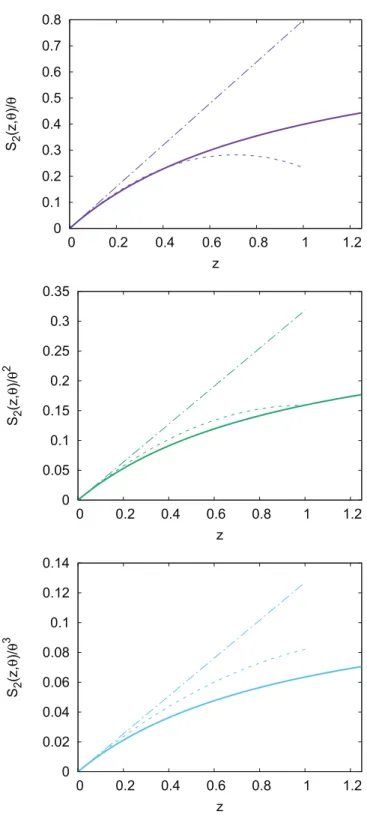
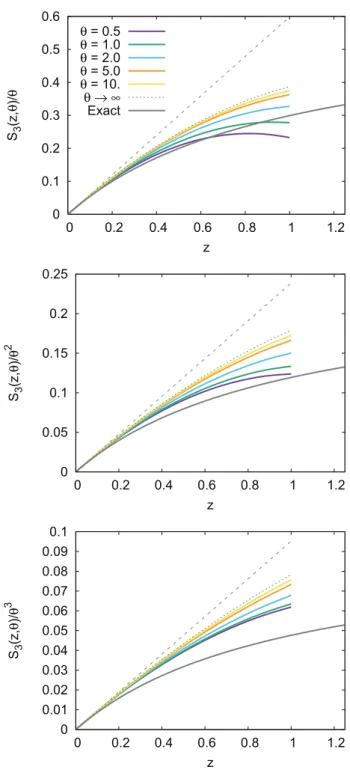
Equations (42) and (43) are our main result for the virial expansion for fermions. Plots of the first of these results are given in figure 1, where we display the second Rényi entropy
θ
several values of the dimensionless region size θ and for dimensions 1, 2, and 3. In contrast to the n = 2 case, n > 2 does have non-trivial volume effects at second order in z.
3. Formalism and results for bosons
3.1. Basics
Continuing with our focus on non-relativistic systems, the partition function for noninteract-ing bosons is
1
[ ( )]
= − −
Z (48)det zU 1,
such that the single-particle Green’s function is
= − z z , 1 G U U (49)
which takes the momentum-space form
δ = − − ′ βε βε − − ′
G z p p
z
e
1 e ,
pp
p
p d( )
( ) ( ) ( )
(50)
and the coordinate-space form Gxx′ can be obtained by Fourier transforming, as shown above
in the fermion case. With this as a starting point, we may formally expand in powers of z:
∑
λ
=
= ∞ ′ z ′z
xx xx T d j j j 0 ,
G (51)B
where, not surprisingly, we find = −
′ 1 ′.
xx xx
j, ( )j j,
B F
(52)
3.2. Rényi entropy
With the replacement of the bosonic Green’s function defined above for the fermionic equiva-lent used earlier, the auxiliary-field decomposition of the reduced density matrix becomes
(
ˆ ˆ)
ˆ † ( )
ρ = (53)A,σ BA,σexp −b logGA−1+IdAb
where
= +
σ −
BA, [ (det IdA GA)] 1
(54) and we have introduced the bosonic annihilation (creation) operators bˆ(†).
From this expression for the reduced density operator, the Rényi entropy for bosons can be expressed in path integral form as
∫
σ σ σ−n S = P
1 n ln det n
( (55)) D [ ] N [ ]
with ⎡ ⎣ ⎢ ⎤ ⎦ ⎥
∏
∏
σ = +
and where the probability P[ ]σ is now generated by the product measure of the single-field densities coming from the underlying dynamics of the bosonic degrees of freedom.
Interestingly, the above expressions extend Grover’s Monte Carlo method to interacting bosons. However, stability of the latter requires a repulsive interaction, which would give a sign problem. Therefore, the above is not (at the moment) of practical interest for Monte Carlo methods. It does, however, provide a starting point for formal analyses. In particular, in the noninteracting case the entropy becomes
−n S = −
1 n ln det n
( (57)) N
where
= Id + − .
n ( A A)n nA
N G G
(58)
3.3. Bosonic Rényi entropy from the spectrum of restricted correlators
In close analogy to the fermionic case, we again place the system in a finite box and impose periodic boundary conditions. We define the Fredholm determinant DA( )λ in terms of the restricted bosonic correlator as
= −
D wA( ) det(wIdA GA),
(59) and write the nth order Rényi entropy as a contour integral
π
=
Σ
S w g w
w D w
d 2 i
d
d ln
n
∮
n( ) A( )(60)
where now
⎡ ⎣⎢
⎤ ⎦⎥
=
− + −
g w
n w w
1
1 ln
1
1 ,
n( ) ( )n n
(61)
and the integration contour Σ is defined to contain the segment [0,∞)
⊂
R of the complex-wplane.
Again, writing out the trace in d spatial dimensions, we obtain an expression
∑
∑
= … … =
∈ ∈
B B B B
tr tr
k k
k k k k k k
A
s s
s
s
d d
1
1 2 2 3 1
Z Z
G
(62)
for each positive integer s where the (again infinite) matrix B differs from the matrix F in an obvious way:
∫
=−
π ξ
π ξ π
−
− − ⋅ −
′ ′
B L
z
z x
1 e
1 e d e .
kk
k
k
x k k
d A d 2 i L
2 2
2 2 ( )/
(63)
Evaluating the limit as before, we obtain a continuum limit valid to all orders in the fugacity:
ξθ ξ
π − −
ξ
− SΛ n
n z
z
1
2 1 1 .
d
n d
0 2
( ) ( ) ⟶
( )
( ) → /
(64)
3.4. Virial expansion of the entropy for bosons
⎡ ⎣⎢ ⎤ ⎦⎥ ⎡ ⎣ ⎢ ⎢ ⎛ ⎝⎜ ⎞ ⎠⎟ ⎤ ⎦ ⎥ ⎥ − = ∂ ∂ + ∂ ∂ − ∂ ∂ + = = N N N
n S z
z
z
z z O z
1 tr
2!tr .
n n z n n z 0 2 2 2 2 0 3 ( )
( ) (65)
We easily obtain for orders n⩾2 ∂
∂ =
∂ ∂
= =
z n z .
n z A z 0 0 N G (66)
Similary operator structure requires we again treat separately the second order contribution into cases of n = 2 and n > 2. For n = 2, we get
∂
∂ =
∂ ∂
= =
z z 2 z
A z 2 2 2 0 2 2 0 N G (67)
and with the expression for n > 2 being
⎡ ⎣ ⎢ ⎛⎝⎜ ⎞⎠⎟ ⎤ ⎦ ⎥ ∂ ∂ = − ∂ ∂ + ∂ ∂ = =
z n n 1 z n z .
n z A A z 2 2 0 2 2 2 0 ( )
N G G
(68)
From the virial expansion given above for the bosonic correlator, we find that for the sec-ond order entropy the expansion becomes
θ =
+ − +
S z z
z O z
, 2 tr
2 tr 2 tr
A
A A
2 0,
1, 0,2 2 3
( ) ( )
( ) ( )
B
B B (69)
=
− + +
z
z O z
2 tr
2 tr 2 tr ,
A
A A
0,
1, 20, 2 3
( )
( ) ( )
F
F F (70)
and for the entropies of order n > 2, we have
(
)
(
)
( ) ( ) ( ) θ = − + − − + B B BS z n
n z
n
n z O z
,
1 tr
2 1 2 tr tr
n A
A A
0,
1, 0,2 2 3 (71)
= − − − + + F F F n n z n
n z O z
1 tr
2 1 tr 2 tr .
A
A A
0,
0, 2
1, 2 3
(
)
(
)
( ) ( ) (72)
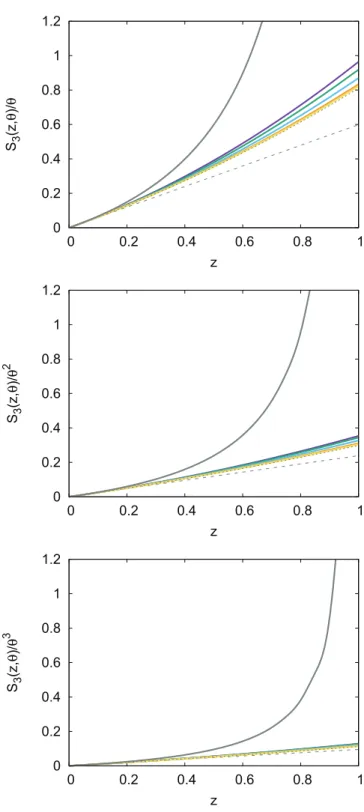
Equations (69) and (71) are our main result for the virial expansion for bosons. As could be anticipated, the leading-order result is the same for bosons and fermions. This is expected, as it corresponds to the single-particle contributions, and therefore the statistics plays no role.
4. Summary and conclusions
We have performed a semi-analytic calculation to all orders in the fugacity z=eβµ of the
Rényi entanglement entropy of noninteracting quantum gases in arbitrary spatial dimensions. We provide an analytic expression in the continuum, high-temperature limit L→∞, λT/ →L 0, at fixed λT/LA. In addition, we have calculated the leading and next-to-leading order terms in the virial expansion.
As expected, we found volume scaling for our exact results as well as at both orders in the virial expansion. In [28], the same leading scaling was found via a different analysis. At leading order (where the statistics is irrelevant) our result is the same for bosons and fermi-ons. For fermions, the two-particle, i.e. z2, contributions decrease the entanglement entropy
relative to the leading-order result, while the opposite happens for bosons; this appears to be true for all n.
In all cases, we find that the convergence properties of the virial expansion, as estimated from considering the two orders computed here, improve when going to higher dimensions. Indeed, in the scale shown in our plots the results for d = 1 are much less promising in this regard than d = 3.
With the rapid development in the area of Monte Carlo calculations of the entanglement properties of many-body systems, having non-perturbative results available is of great value as a benchmark. In this work we have aimed to provide such results.
Acknowledgments
The authors are grateful to L Rammelmüller for thought-provoking discussions and proofread-ing. This material is based upon work supported by the National Science Foundation under Grants No. PHY1306520 (Nuclear Theory program) and No. PHY1452635 (Computational Physics program).
References
[1] Amico L, Fazio R, Osterloh A and Vedral V 2008 Rev. Mod. Phys.80 517
Horodecki R, Horodecki P, Horodecki M and Horodecki K 2009 Rev. Mod. Phys.81 865 Eisert J, Cramer M and Plenio M B 2010 Rev. Mod. Phys.82 277
[2] Osterloh A, Amico L, Falci G and Fazio R 2002 Nature416 608–10 Vidal G, Latorre J I, Rico E and Kitaev A 2003 Phys. Rev. Lett.90 227902 Kitaev A and Preskill J 2006 Phys. Rev. Lett.96 110404
Levin M and Wen X-G 2006 Phys. Rev. Lett.96 110405 [3] Barkeshli M and Sau J D 2015 arXiv:1509.07135
Xu Y, Miotkowski I, Liu C, Tian J, Nam H, Alidoust N, Hu J, Shih C-K, Hasan M Z and Chen Y P 2014 Nat. Phys.10 956
[4] Gioev D and Klich I 2006 Phys. Rev. Lett.96 100503
Leschke H, Sobolev A V and Spitzer W 2014 Phys. Rev. Lett.112 160403 [5] Peschel I and Eisler V 2009 J. Phys. A: Math. Theor.42 504003
[6] Süsstrunk R and Ivanov D A 2012 Europhys. Lett.100 60009
[7] Ivanov D A and Abanov A G 2013 J. Phys. A: Math. Theor.46 375005 Eisler V and Peschel I 2013 J. Stat. Mech.P04028
[8] Ossipov A 2014 Phys. Rev. Lett.113 130402
Pouranvari M and Yang K 2014 Phys. Rev. B 89 115104
[9] Calabrese P, Le Doussal P and Majumdar S N 2015 Phys. Rev. A 91 012303 Drut J E and Porter W J 2015 Phys. Rev. Lett.114 050402
[11] Mondragon-Shem I and Hughes T L 2014 J. Stat. Mech.P10022 Eisler V and Peschel I 2014 J. Stat. Mech.P04005
You W-L 2014 J. Phys. A: Math. Theor.47 255301 [12] Chen X and Fradkin E 2013 J. Stat. Mech.P08013
Storms M and Singh R R P 2014 Phys. Rev. E 89 012125 [13] Pastur L and Slavin V 2014 Phys. Rev. Lett.113 150404
Bernigau H, Kastoryano M J and Eisert J 2015 J. Stat. Mech.P02008 Schliemann J 2014 J. Stat. Mech. P09011
[14] Calabrese P, Mintchev M and Vicari E 2011 J. Stat. Mech.P09028 [15] Vicari E 2012 Phys. Rev. A 85 062104
Eisler V and Peschel I 2012 Europhys. Lett.99 20001
Calabrese P, Mintchev M and Vicari E 2012 J. Phys. A: Math. Theor.45 105206 Calabrese P, Mintchev M and Vicari E 2012 Europhys. Lett.97 20009
[16] Buividovich P V and Polikarpov M I 2008 Nucl. Phys. B 802 458 [17] Melko R G, Kallin A B and Hastings M B 2010 Phys. Rev. B 82 100409
Hastings M B, González I, Kallin A B and Melko R G 2010 Phys. Rev. Lett.104 157201 Isakov S V, Hastings M B and Melko R G 2011 Nat. Phys.7 772
Singh R R P, Hastings M B, Kallin A B and Melko R G 2011 Phys. Rev. Lett.106 135701 Inglis S and Melko R G 2013 Phys. Rev. E 87 013306
[18] Humeniuk S and Roscilde T 2012 Phys. Rev. B 86 235116 [19] McMinis J and Tubman N M 2013 Phys. Rev. B 87 081108 [20] Grover T 2013 Phys. Rev. Lett.111 130402
[21] Broecker P and Trebst S 2014 J. Stat. Mech.P08015 [22] Wang L and Troyer M 2014 Phys. Rev. Lett.113 110401
[23] Luitz D J, Plat X, Laflorencie N and Alet F 2014 Phys. Rev. B 90 125105 [24] Assaad F F, Lang T C and Toldin F P 2014 Phys. Rev. B 89 125121
Assaad F F 2015 Phys. Rev. B 91 125146
[25] Drut J E and Porter W J 2015 Phys. Rev. B 92 125126 Drut J E and Porter W J 2016 Phys. Rev. E 93043301 [26] Jin B-Q and Korepin V E 2004 J. Stat. Phys.116 79 [27] Chung M-C and Peschel I 2001 Phys. Rev. B 64 064412
Cheong S-A and Henley C L 2004 Phys. Rev. B 69 075111 Peschel I 2003 J. Phys. A: Math. Gen.36 L205