Territorial Identity Configurations in the European Union: The Impact of Regional Identity on Attachment to Europe and Support for Integration
Anna Brigevich
A dissertation submitted to the faculty of the University of North Carolina at Chapel Hill in partial fulfillment of the requirements for the degree of Doctor of Philosophy in the
Department of Political Science.
Chapel Hill 2012
Approved By:
Liesbet Hooghe, Chair
Gary Marks
John Stephens
Jim Stimson
ABSTRACT
ANNA BRIGEVICH: Territorial Identity Configurations in the European Union: The Impact of Regional Identity on Attachment to Europe and Support for Integration
(Under the direction of Liesbet Hooghe)
How does territorial identity impact support for European integration? This
dissertation explores the relationship between different types of territorial identity,
particularly regional identity, on public opinion attitudes towards the European project. In the
process, it challenges the scholarly convention that we have entered an era of a new, pro-EU
regionalism that is rooted in inclusivity and cosmopolitanism. Instead, using the case studies
of Spain and France, I show that there exist two distinct types of regionalism today: the more
parochial and “backwards” exclusive regionalism that is opposed to European integration and the more inclusive and Europhile inclusive regionalism. In both cases, particular attention is paid to the way that strong regional identity functions in minority nations (Catalonia, Basque
Country, Corsica, and Brittany). I then apply the concepts developed in the case study
chapters to a cross-national analysis of territorial identity across the EU-27 member states,
and show that in Europe as a whole, exclusive regionalism is associated with greater
Euroscepticism than any other type of territorial identity. Large-N statistical analysis is
employed throughout, and a novel measure to capture territorial identity is developed across
TABLE OF CONTENTS
LIST OF TABLES………...v
LIST OF FIGURES……….vii
Chapter 1. INTRODUCTION……….………..1
2. PEELING BACK THE LAYERS: TERRITORIAL IDENTITY AND EU SUPPORT IN SPAIN ………...10
2.1.Social Identity Theory, Territorial Identities, and Attachment to Europe: Hypotheses………..12
2.1.1. Nested or Inclusive Identities versus Exclusive Identity………..13
2.1.2. Exclusive National versus Exclusive Regional Identity………...…18
2.1.3. Exclusive Regional Identity: Distinctive versus Non -Distinctive Regions……….…22
2.2.Exclusive Regional Identity and Territorial Identity Configurations: Concept and Measurement……….………26
2.3.Data and Operationalization………...34
2.4.Explaining European Attachment………...39
2.5.Concluding Remarks………..46
3. IN WITH THE NEW, NOT OUT WITH THE OLD: IDENTITY, ATTACHMENT TO EUROPE AND DECENTRALIZATION IN THE FRENCH REGIONS………..…47
3.1.Social Identity Theory, Territorial Identities, and Support for Integration…………49
3.3.Traditional and Modern Regional Identity Types: Hypotheses………..57
3.4.Measuring Regional Identity: Who are the Regionalists?………..62
3.4.1. A Detour to Attitudes in Spain……….70
3.5.Data, Operationalization, and Method………73
3.6.Explaining Support for Integration: Models and Results………...78
3.6.1. Variation Among Regions………89
3.7.Concluding Remarks ……….97
4. PAIRING UP OR PAIRING DOWN?: EXPLORING REGIONAL IDENTITY COMBINATIONS IN THE EU……….99
4.1.Regional Identity and Support for Integration: Concepts and Measurement……...101
4.2.Conceptualization 1: The Territorial Dimension of Regionalism………104
4.3.Conceptualization 2: Regions as Politically, Culturally, and Economically Distinctive Spaces……….106
4.3.1. The Regional Autonomy Dimension: Minority Nationalism and Regional Distinctiveness………...108
4.3.2. The Economic Distinctiveness Dimension: Economic “Over- achievers” and “Laggards”………..…117
4.4.Conceptualization 3: Individual Regional Identity………...120
4.5.Data, Method, and Operationalization………..130
4.6.Empirical Analysis………134
4.7. Conclusion ………..142
APPENDIX ONE: Supplementary Statistics for Spain Analysis ……….144
APPENDIX TWO: Supplementary Statistics for France Analysis………...146
APPENDIX THREE: Descriptive Statistics for Cross-National Analysis………..…..151
LIST OF TABLES
2.1 Distribution of Inclusive versus Exclusive Identity Types by Region, %...29
2.2 Territorial Identity Configurations and Predicted Effect on European Attachment...30
2.3 Distribution of Territorial Identity Configurations by Region, %...33
2.4 Variable Descriptions………...38
2.5 The Effects of Inclusive vs. Exclusive Identities on European Attachment…………40
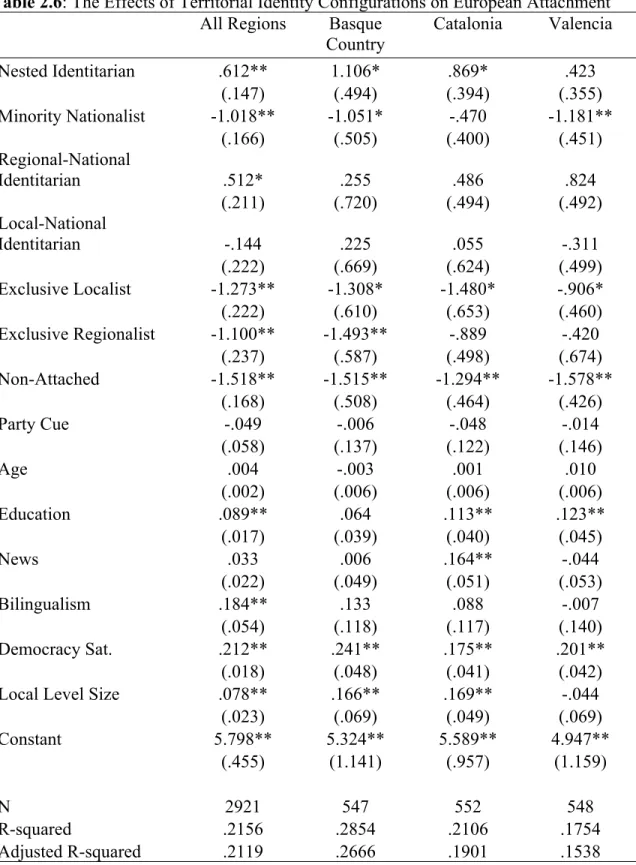
2.6 The Effects of Territorial Identity Configurations on European Attachment………..42
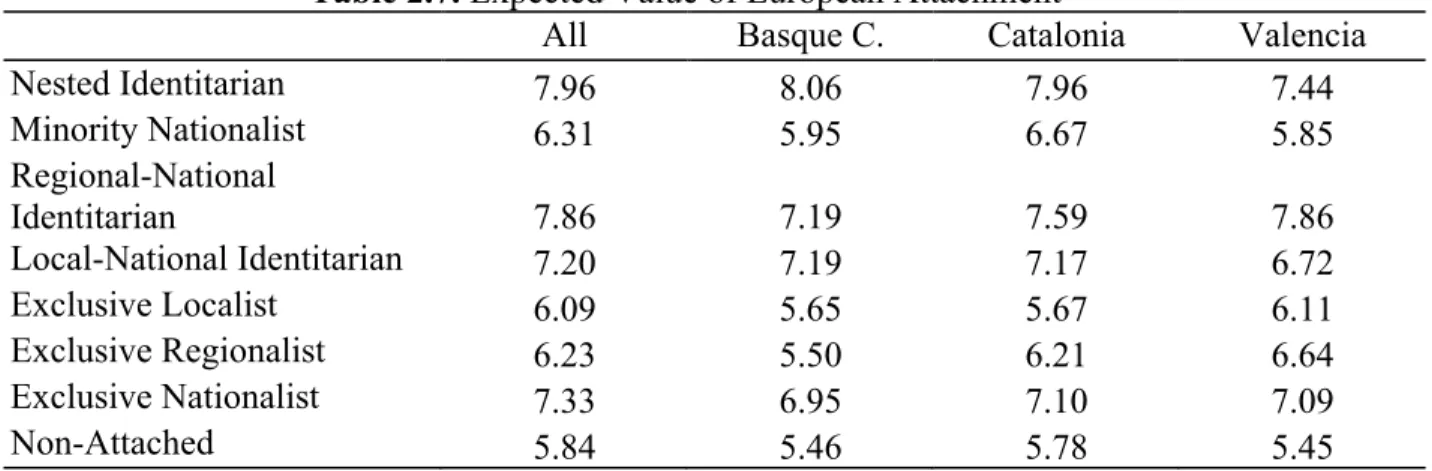
2.7 Expected Value of European Attachment………45
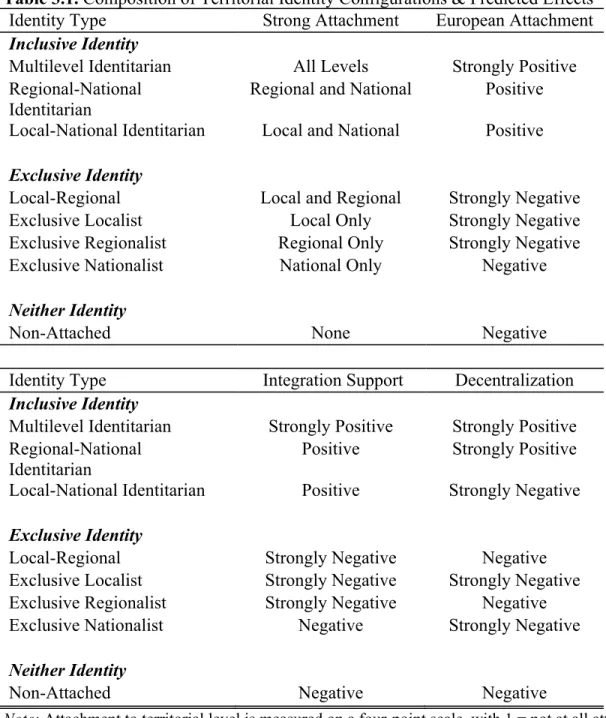
3.1 Composition of Territorial Identity Configurations and Hypothesized Effects………..65
3.2 Distribution of Sample Across Identity Types……….67
3.3 Difference in Means of Socio-Demographic and Attitudinal Variables………..68
3.4 Variable Descriptions………...79
3.5 Results of Maximum Likelihood Estimation of Attachment to Europe (Model 1), Support for Integration (Model 2), Preference for Decentralization (Model3)………. 81
3.6 Predicted Probabilities by Different Types of Territorial Identity, %...82
3.7 Results of Maximum Likelihood Estimation for Economic Decentralization (Model 4) and Cultural/Linguistic Decentralization (Model5)……….…..….87
3.8 Predicted Probabilities for Decentralization Preferences by Different Types of Territorial Identity, %...88
3.9 Distribution of Sample Across Identity Types in Corsica and Brittany, %...91
3.10 Results of Maximum Likelihood Estimation of Attachment to Europe (Model 1), Support for Integration (Model 2), Preference for Economic Decentralization (Model 4), and Preference for Cultural Linguistic Decentralization (Model 5) in Corsica……….93
Decentralization (Model 4), and Preference for Cultural Linguistic
Decentralization (Model 5) in Brittany………96
4.1 Minority Nations and Distinctive Regions in Europe………....110
4.2 Distribution of Sample Across Territorial Identity Configurations………...125
4.3 Distribution of Identity Types across Types of Region, %...130
4.4 ANOVA……….135
4.5 Determinants of Support for European Integration (Multilevel Analysis)…………136
4.6 Determinants of Support for European Integration in the Old-15……….140
4.7 Determinants of Support for European Integration in the New-12………141
2.A Descriptive Statistics for European Attachment and Control Variables…………...144
3.A Distribution of Sample Across Identity Types, %...146
3.B Difference in Means of Socio-Demographic and Attitudinal Variables in Spain………..147
3.C Difference in Means of Socio-Demographic and Attitudinal Variables, Basque………....148
3.D Difference in Means of Socio-Demographic and Attitudinal Variables, Catalan………...149
3.E Descriptive Statistics……….150
LIST OF FIGURES
Chapter 1
Introduction
The impact of national identity on European attachment and support for integration
has been well documented in the identity literature. We know, for example, that an exclusive
national identity predisposes individuals against Europe, while multiple or inclusive
identities allow loyalty to be transferred with relative ease to a higher-order territorial level,
such as Europe. We also know that the extent to which exclusive identity depresses European
identity formation or support for integration varies, and is dependent on political
entrepreneurs, such as parties and the media, and their willingness to exploit identity for
political gain.
A similarly systematic study of regional identity, and the way that it fits together with
national and European identities, has not yet emerged. This is surprising, given that the
region has become a significant actor in the EU. To the extent that this increased role goes
together with a shift in individual loyalties from the national to the regional level, this could
have serious ramifications for the economic and cultural coherence of the nation-state.
The presumption in the literature is that a strong regional identity predisposes
individuals to be more attached to Europe, at the expense of the nation-state. For example,
pro-European attitudes, but is simultaneously anti-Spanish. For strong and distinctive regions, the
EU serves as a means of circumventing the state, leading to greater support for European
integration (Keating 1998; Hooghe and Marks 1996, 2001; Marks et al. 1996; Keating and
Hooghe 2001; Fleurke and Willemse 2006). However, there has been little empirical testing
of this presumption. Furthermore, the literature often fails to make the distinction between
regional/national minority actors, such as political parties and elites, and the public at large.
The assumption is that national minority actors and citizens feel similarly about Europe and
integration. However, studies of elite versus public opinion in the EU have shown that the
public is generally more Eurosceptic (Hooghe, 2003). There is no reason to think that this
relationship would not hold for distinctive regions. Even if regional elites in distinctive regions may be more favorably disposed to Europe, the same may not be true for their
publics.
The purpose of this project is to use quantitative analysis to explore the relationship
between regional identity and European integration using public opinion data: Does an
exclusive regional identity exist in Europe, and if so, what kind of impact does it have on
European attachment? Are the causal logics that connect regional identity with Europeanness
different or similar to the ones that connect national identity with Europeanness? More
broadly, how do the different identity configurations (local, regional, national) in multilevel
polities affect attachment to Europe and condition support for integration? Are the effects of
different identity configurations uniform or varied across EU regions?
Much of the recent literature on territorial identity in Europe has drawn on social
identity theory to explain how multiple or nested identities impact support for European
integration. Most individuals hold multiple identities and have developed mechanisms for
negotiating and reconciling these identities (Hermann and Brewer 2004; Hooghe and Marks
2005; Citrin and Sides 2004; Diez Medrano and Gutierrez, 2001; Risse 2010; Moreno 1986,
2006; Marks, 1999; Martínez-Herrera, 2002; Llamazares and Marks, 2006; Llamazares and
Reinares, 1999; Berg 2007). In the context of Europe, many EU citizens exhibit a positive
attachment to the nation and Europe, as well as to the region (Hooghe and Marks 2001,
Medrano and Gutierrez 2001, Citrin and Sides 2004). More specifically, studies have shown
that strong feelings of attachment to one’s nation or region do not, on average, automatically
predispose, an individual to have a lower attachment to Europe or to support integration less.
Quite the contrary, in certain cases, individuals with strong national and regional attachments
may also be strongly attached to Europe (Diez Medrano and Gutierrez 2001, Marks 1999).
The key to understanding how strong national attachment impacts support for
European integration lies in the conceptualization of national identity. On the one hand,
individuals may hold an inclusive national identity, where strong attachment to the national
level does not preclude strong attachment to the European level, but rather encourages deeper
ties to Europe (Citrin and Sides 2004; Hooghe and Marks 2005; Diez Medrano and
Gutierrez; Marks 1999; Risse 2003). On the other hand, an individual may have an exclusive
national identity, where strong attachment to the nation prevents the formation of a European
identity and deflates attachment to the European level (Carey 2002; McLaren 2002, 2006). It
is precisely these exclusive nationals who exhibit lower levels of support for integration.
the way in which national identity fits together with other territorial identities. Does an individual conceive his national identity as one of many, (be it first, second, or third), or as
the first and only possible territorial identity?
My research builds on the social identity theory approach to understanding European
attachment and support for integration by extending the inclusive/exclusive identity
framework to the regional level. Whether or not an exclusive regional identity dampens
attachment to Europe much like an exclusive national identity has gone untested. We assume
that a lower-order identity behaves in a manner similar to a higher-order identity, but why
should it?
There is good reason to believe that this might not be the case. For one, while all
nations in Europe are endowed with a strong national identity, characterized by distinct
features of that nation, not all regions have a distinct regional identity. While some regions
may be associated with a certain ethnicity (Basque Country), language (Catalonia), political
arrangement with the nation (Scotland), or economic situation (the Italian Northern regions),
other regions may lack a distinctive feature. Here, a regional identity might not be salient,
and may have no impact on European attachment. There is bound to be greater variation in
the salience and content of regional than national identity throughout Europe, and this
generates more variation in how regional identity relates to European identity.
Second, an exclusive regional identity, particularly in distinctive regions, may have a
different effect on European identity and support for integration than an exclusive national
identity. Keating (1996, 1998) and Risse (2010) argue that in some distinctive regions, such
as the Basque Country and Catalonia, an antagonistic relationship exists between the regional
regional identity goes together with a strong European identity – with Brussels against
Madrid. The “enemy of my enemy is my friend” phenomenon therefore leads one to expect
that exclusive regionalists may have a higher level of attachment to Europe—quite contrary
to what one would expect from exclusive nationalists.
A competing hypothesis, and the one ventured here, is that individuals with an
exclusive regionalidentity may be more hostile to Europe and integration than those with an
exclusive national identity. The reason is that an exclusive regional identity could be
evidence of parochialism. With the growing heterogeneity and multiplicity of identities in an
ever-enlarging EU, citizens may fail to see their preferences addressed or realized at the EU
level, as well as find little common ground with citizens in other countries or regions
(Karolewski 2007). In this case, a strong exclusive regional identity will preclude the
individual from forming any attachment to Europe (Inglehart 1970) or from supporting
further integration (Olsson 2007). As I elaborate below, there is little empirical evidence to
support the theory of region and Brussels versus the nation—at least at the individual level.
Quite the contrary, individuals residing in distinctive regions may well be more prone to
having an exclusive regional identity that negatively impacts attachment to Europe because
they are better able to see themselves as a small group of insiders pitted against a large group
of outsiders threatening their distinctive culture, political institutions, or economic standing.
DATA AND METHODOLOGY
(EVS) 2008 international survey, to evaluate these questions. I use OLS regression,
maximum likelihood estimation, and multilevel modeling. My goal is to show that regional
identity is critical to our understanding of how territorial identities fit together, that some
identity configurations support the development of a strong European identity while others
impede it, but that regional identity drives public opinion about European integration only to
a limited degree.
To test the impact of territorial identity on support for integration, I construct a new
measure—territorial identity configurations (TIC)—which I employ across all three papers (Spain, France, and the cross-national analysis). The measure is constructed from questions
that ask respondents for the strength of their attachment to various levels. These ratings allow
us to simultaneously track how strongly a respondent identifies with all the territorial levels
(strength) and how these attachments relate to one another (fit). Furthermore, to evaluate whether territorial identity has a different impact in distinctive versus non-distinctive regions,
I run separate regressions for minority nations in the Spanish and French papers, and control
for regional distinctiveness in the cross-national analysis. This approach allows me to
compare the effects of exclusive regionalism across different countries and different types of
regions.
PAPERS
For my first paper, I develop and hone my theory of exclusive regionalism within the
Spanish context. Spain makes for an informative case study of territorial identity because it is
a semi- federal state with a history of strong independent regions. We therefore should find
Autonomas (Autonomous Communities or regions) three have national minority status: the Basque Country, Catalonia and Galicia. In this paper, I seek to explain the psychological
mechanisms behind exclusionary and inclusionary tendencies by grounding the discussion of
territorial identities in the optimal distinctiveness theory approach (Brewer 1999). I detail the merits of using the territorial identity configurations measure and compare it to a more frequently-used measure, the Moreno identity question. I use OLS regression to test the
validity of both measures, and find that the TIC measure more accurately captures exclusive
regionalism. Using the 2006 CIS data, I show that exclusive regionalists, on average, are less
attached to Europe than individuals with an inclusive identity and exclusive nationalists. The
separate regressions for Basque Country and Catalonia show interesting and divergent
results. Exclusive regionalism in Basque Country has a significantly stronger dampening
effect on European attachment than in the rest of Spain, while this effect is not present in
Catalonia. This leads me to conclude that we can at least partially refute the hypothesis that
minority nationalists are more pre-disposed towards Europe. The results of the Basque and
Catalan regressions also highlight that the impact of territorial identity is bound to vary not
just across counties, but also across country regions as well.
The second paper extends the analysis to the French regions. France makes for an
excellent case study for a number of reasons. First, it has outstanding regional-level data with
indications of strong territorial identities, but has attracted little interest in the past. Second, it
allows examination of regional identity in the context of a relatively centralized state
structure, which provides a contrast with Spain’s semi-federal structure and a robustness test
minority nations, Corsica and Bretagne, which exhibit different types of regional identity and
this provides opportunity for a dual comparison—within France and with Spain.
The paper makes a two-step argument. I first explore the antecedents of regionalism,
and then test their usefulness in explaining political attitudes. Drawing upon the new regionalism framework developed by Keating (1998), the paper begins by examining whether two types of regionalists exist: the conservative, past-oriented traditional
regionalists, and the progressive, future-oriented modern regionalists. The analysis critically
discusses the affinities between traditional regionalism and exclusive regionalism, and
between modern regionalism and inclusive regionalism. ANOVA means testing confirms
that there are indeed two distinct types of regionalists, but it casts doubt on the assertion that
exclusive regionalists are more traditional and past-oriented than inclusive regionalists.
Next I test the impact of these two types of regional identity on three kinds of
political attitudes: attachment to Europe, support for European integration, and preference for
greater decentralization of power. The maximum likelihood analysis shows that much as in
the case of Spain, exclusive regionalists are less likely to be attached to Europe, and less
likely to support integration. This relationship is only statistically significant for European
attachment, and so the causal power of regional identity for shaping political attitudes is
delimited. Contrary to expectation, exclusive regionalists are more in favor of economic and
cultural decentralization policies than inclusive regionalists. The separate regression results
for Corsica and Brittany echo the findings in the Spanish paper. Regional identity in Corsica
has a much greater causal effect on political attitudes than in Brittany.
The third paper extends the previous two analyses to the cross-regional level. Using
on support for European integration across 325 regions in 27 EU-member states. In addition
to testing the effects of an individual-level regional identity, I also examine the impact of the
distinctive identity of the region. One of the contributions of this paper is the development of
a coding scheme to chart minority nationalism and distinctive regionalism across both
Western and Eastern European member states. I identify four types of distinctive regions:
minority nations (regions with a distinctive culture and autonomist aspirations), distinctive
regions without autonomist aspirations, economic “overachievers”, and economic “laggards”.
Using a multilevel model, I test for the impact of both individual-level and regional-level
identity. The analysis shows that while there is variation in support for integration at the
regional level, most of the variation is at the individual level. The TIC measure performs well
in explaining support for integration, and solidifies the findings of the previous two papers.
Exclusive regionalists across Europe are less likely to support integration than exclusive
nationalists and inclusive identitarians. Furthermore, respondents from minority nations are
less predisposed towards Europe.
Taken as a whole, the three articles point to the fact regional identity is a significant
predictor of public opinion attitudes on a host of important political issues. Furthermore,
there is evidence in these three papers that regional identity, particularly when it is not
combined with other identities, is more hostile than friendly towards European integration.
Although the impact of regional identity on EU support is likely to vary across regions, the
cross-regional analysis here shows that the effects of regional identity are fairly stable across
Chapter 2
Peeling Back the Layers: Territorial Identity and EU Support in
Spain
1INTRODUCTION
The impact of national identity on European attachment and support for integration
has been well documented in the identity literature. We know, for example, that an exclusive
national identity predisposes individuals against Europe, while nested and inclusive identities
allow loyalty to be transferred with relative ease to a higher-order territorial level, such as
Europe. We also know that the extent to which exclusive identity depresses European
identity formation or support for integration varies, and is dependent on political
entrepreneurs, such as parties and the media, and their willingness to exploit identity for
political gain.
A similarly systematic study of regional identity, and the way that it fits together with
national and European identities, has not yet emerged. The presumption in the literature is
that a strong regional identity, typically found in regions populated by minority nationals,2
predisposes individuals to be more attached to Europe, at the expense of the nation-state. For
example, Thomas Risse (2010: 71) argues that Spanish regionalism correlates positively with
pro-European attitudes but is simultaneously anti-Spanish. However, there has been very
little empirical testing of this presumption. Furthermore, the handful of studies that do
attempt to test the impact of a strong regional identity (Diez Medrano and Gutierrez, 2001;
Carey, 2002) make no distinction between inclusive and exclusive identity, potentially
diluting and compromising their findings.
This paper explores the impact of a strong regional identity on European attachment
in the Spanish regions. I develop a new measure sensitive to the variation in regional identity
types that allows one to distinguish among nested, inclusive and exclusive identities, while
also accounting for minority nationalist identity. Using a 2006 survey conducted by the
Centro de Investigaciones Sociológicas (CIS),3 I carry out a large-N statistical analysis to examine how different identity configurations affect attachment to Europe. My findings
partly extend mainstream arguments with respect to identity and European integration to the
2 The term “minority nationalism” is used here to refer to the assertion of sovereignty by culturally, ethnically, or historically distinct minority groups that are located in a well-defined territory (region) within a larger state, (see Keating, 1996; Keating and McGarry, 2001). While a few national minority groups threaten secession, most realize the benefits of belonging to a well-established state order. Moore (2001: 48) points out that most minority nationalists do not seek to resurrect the traditional sovereign nation-state on an even smaller scale, but instead try to assert the right of self-determination or autonomy within the existing state order. In Spain, minority nationalism is manifested in the “stateless nations” or “historical nationalities” of Basque Country, Catalonia, and Galicia. The 1978 Spanish Constitution recognizes these three regions as “historical nationalities” within the Spanish state, and reserves a special status for them based on the fact that they are “distinct societies”, (Moreno, 2006). The 1978 Constitution granted the historical nationalities autonomy through a fast and simplified process, and initially allocated them more extensive political functions. To this day, the Basque Country, along with Navarra, has its own fiscal regime that allows it to raise its own taxes and negotiate a transfer to Madrid to pay for common services (Keating, 2006). The Basque Country, Catalonia, and Navarra also keep their own police force.
3
realm of regional identity, but they also provide a significant correction. First, consistent with
arguments on nested versus exclusive national identity, I find that a nested regional identity
leads to a greater attachment to Europe, while an exclusive regional identity leads to less
attachment to Europe. However, contrary to conventional wisdom, an exclusive regional
identity in Spain dampens attachment to Europe much more than an exclusive national identity. Furthermore, minority nationals in Spain have a weaker attachment to Europe than
individuals with both nested and exclusive national identities.
This paper builds on social identity theory to analyze the relationship between
national and regional identity and European attachment, and is structured in the following
way. In the next section, I summarize the literature on social identity theory as it has been
applied to territorial identity in Europe and discuss how individual regional identities may affect European attachment. Then I establish expectations about how collective territorial identity configurations in the EU may structure European identity by focusing on the
variation in region types. Next, I introduce two measures for operationalizing different
identity configurations. After discussing the results of the analysis and placing them in the
Spanish context, I conclude by suggesting future avenues for research.
2.1 SOCIAL IDENTITY THEORY, TERRITORIAL IDENTITIES, AND ATTACHMENT TO EUROPE: HYPOTHESES
Political scientists have drawn on social psychology literature to explain how
individuals conceive of and process their identities. Social, or group, identity serves a dual
function: differentiation and inclusion/equivalence (Calhoun, 1994; Brewer, 1993, 1999;
that social identity is derived from the opposing forces of two universal human motives – the
need for inclusion and assimilation, on the one hand, and the need for differentiation from
others on the other”. The desire for belonging associated with the need for inclusion
motivates immersion in social groups, while the need for differentiation drives individuation
and personal identity. Since most individuals are simultaneously members of many social
and cultural groups it is possible that different social identities might be combined in order to
satisfy both differentiation and inclusion. Brewer (1999: 190) writes that, “The superordinate
identity satisfies the need for secure inclusion in a large collective, while the subgroup
identity serves the need for distinctiveness within the larger social category”.
2.1.1 Nested or Inclusive Identities versus Exclusive Identity
Within the context of the EU, national and European identities could serve two
distinct functions. A strong national identity satisfies the individual’s needs for
differentiation—I am Spanish and thus different from the French or Italians—while a strong
European identity satisfies the need for inclusion—we are all European. This is consistent
with surveys that show that many EU citizens hold a strong national and European identity
simultaneously, (see Hooghe and Marks, 2005; Citrin and Sides, 2004; Diez Medrano and
Gutierrez, 2001). Willingness to grant the EU authority over daily life requires some
identification with Europe, but not one that prioritizes Europe over the state or regional group
(Risse, 2003). The argument about this dual inclusion/differentiation function of identity is
lower-order level of identification as well, with regional identity serving the need for
differentiation and national or European identity serving the need for inclusion.4
Optimal distinctiveness theory posits that individuals can reconcile lower-order and
higher-order identities with relative ease. Feelings of strong regional identification in one
political context do not necessarily interfere with feelings of national identification in another
context. This has been born out in public opinion studies of national and regional identity in
Spain and the United Kingdom, both states with fairly autonomous regions and significant
minority nationalist movements. Moreno (2006), who has greatly contributed to the study of
dual identity in Europe, argues that citizens in sub-state minority nations or regions
incorporate, in variable proportions, both the ethnoterritorial (regional) identity and the state
(national) identity. Moreno (2006: 2) writes that, “As a result of this, citizens share their
institutional loyalties at both levels of political legitimacy without any apparent fracture
between them”.
In a study of dual identity in Spain, Moreno, Arriba and Serrano (1998) find that in all
17 Comunidades Autónomas a high proportion of citizens claim some form of dual identity. Between 1990-1995, around 70 per cent of all Spaniards indicated that they felt some
combination of regional and national identity, while 30 per cent identified with either their
4
region or Spain exclusively. 5 Hence, shared, rather than conflicting, territorial identities
appears to be the norm in Spain, (see also Marks, 1999; Martínez-Herrera, 2002; Llamazares
and Marks, 2006; Llamazares and Reinares, 1999). A similar trend is observable in the UK,
where a majority of English, Welsh, and Scottish citizens assert a dual regional and British
identity (Bond and Rosie, 2008; Moreno, 2006).
There are two limitations to optimal distinctiveness theory as applied to the study of
territorial identity. First, the theory was originally formulated to account for the relationship
between two social identities; it does not speak to the possibility of more than two identities. This is problematic because EU scholars acknowledge that there are at least three territorial
levels that elicit feelings of attachment or identification in individuals – the subnational,
national, and supranational (Marks, 1999; Hooghe and Marks, 2001; Diez Medrano and
Gutierrez, 2001; Carey, 2002; Risse, 2010; Berg, 2007).
The most common way of conceptualizing territorial identity relations in the EU has
been to think of them as nested, either as concentric circles (Bruter, 2004), such as layers of
an onion, or as Russian Matrushka dolls (Risse, 2001, 2010). As Berg (2007: 46) points out,
“In its ideal form, nested territorial attachments are perceived as completely vertically
compatible (and even mutually amplifying), from one level to the next”. Being strongly
attached to one level provokes strong attachment to additional levels.6
Two recent studies underscore the mutually amplifying nature of territorial identity. A
quantitative study by Medrano and Gutierrez (2001) analyzing the relationship between
regional, national, and European identity in Spain finds that people who identify strongly
with their region or with Spain also identify strongly with Europe. However, while this study takes an important step towards demonstrating that a strong single territorial identity encourages European attachment, it does not directly speak to nested identities theory
because it fails to account for individuals who feel attached to the regional andthe national
levels simultaneously. A qualitative study by Schrijver (2004) also shows that, in France, regional and national identities are not mutually exclusive; strong regional attachment tends
to go together with strong national attachment. However, Schrijver does not elaborate on the
relationship between regional or national identity and European identity.
The second limitation of optimal distinctiveness theory is that it has little to say about
conflicting lower-order and higher-order identities. While Brewer (1999) concedes that the relative importance of superordinate and subordinate identity groups may shift from one
occasion to the other, the theory does not tell us whether--or when--the differentiation motive
may conflict with the inclusion motive or eclipse it altogether.
Some recent literature has emphasized that national identity can be exclusive (Carey,
2002; Hooghe and Marks, 2005; McLaren, 2002). According to Carey (2002), this could be
the dominant pattern; he argues that the stronger the bond that an individual feels towards the
nation, the less likely that the individual will approve of measures that decrease national
influence over economics and politics. This leads to a relationship where a strong national
identity reduces support for European integration.7 McLaren (2002) is more nuanced and
shows that exclusive national identity and anti-Europeanism tend to reinforce one another for
the subgroup of individuals who care deeply about the preservation of their national culture.
The bottom line is that, when conceptualizing territorial identities, it is useful to
consider both the way various territorial identities fit together and the strength of attachment
to a particular territorial level (Citrin and Sides, 2004; Hooghe and Marks, 2008a). Does an
individual conceive his national identity as one of many, (be it first, second, or third), or as
the first and only possible territorial identity?
One can think of nested and exclusive identities as two opposing ideal types (Berg,
2007). A person with a nested identity, whom I refer to as a nested identitarian, exhibits
strong attachment to all three levels – local, regional, and national – while a person with an
exclusive identity has a strong attachment to only one. Between these two opposing identity
types are individuals with an inclusive identity who feel strongly attached to two territorial
levels – be it local and regional, regional and national, or local and national. While an
inclusive identity should also allow for easier identification with a higher level, it falls one
level short of being truly nested.
Although the trend in the literature is to treat nested and inclusive identities as
synonymous (Marks, 1999; Hooghe and Marks, 2005; Citrin and Sides, 2004), there are
conceptual differences.8 Therefore, I treat these two groups as distinct. I expect that nested
identitarians, for whom the inclusion/assimilation need appears to be greatest, will have a
higher level of attachment to the supranational level than individuals with an inclusive
identity.
Hypothesis 1: Individuals with an inclusive identity have higher levels of attachment to Europe than individuals with an exclusive identity, with nested identitarians exhibiting the
highest level of European attachment.
2.1.2 Exclusive National versus Exclusive Regional Identity
One prominent way of measuring the effects of exclusive and inclusive identity on
support for integration has been through a standard Eurobarometer question, (see Marks,
1999; Hooghe and Marks, 2005, 2008b; de Vries and Edwards, 2009; Citrin and Sides,
2004). The question asks respondents: “In the near future, do you see yourself as (1)
8
[nationality] only, (2) [nationality] and European, (3) European and [nationality], or (4)
European only?”, (see Eurobarometer Survey 60.1). Individuals who answer that they feel
“[nationality] only” are coded as having an exclusive identity, while all others are coded as
having one that is inclusive. Cross-national statistical analyses by these authors show that an
exclusive identity does indeed have a negative impact on support for integration.
There are a number of problems with this measure. First, the question does not ask
about the intensity of attachment. The core of the nested identities argument, where identities
are mutually amplifying, is not captured by the question. Hence it tells us little about how the
nested identities theory performs. As I show below, weak identities in themselves dampen
attachment to Europe more than an exclusive national identity does.
The second problem is the way that national and European identities are
conceptualized. The wording of the question implies a zero-sum relationship (Bruter, 2003).
Respondents must choose whether they feel national or European first, as if being one always
takes something away from being the other. A more accurate question would include an
additional category where respondents can state that they feel equally national and European.
This option would better capture the essence of multiple strong identities.
The third problem is that the question ignores people who feel strongly attached to
their locality or region. We assume that a lower-order identity behaves in a manner similar to
a higher-order identity, but why should it?
There are two possible ways that an exclusive regional identity may differ from an exclusive national identity in the way it impacts European attachment. On the one hand, regional exclusivists may be more likely to support the European project than exclusive
empower the regional level in a number of ways. As Marks and Wilson (2000: 463) point
out, “Over the past fifteen years, the EU has become part of a multi-level polity in which
European institutions share authoritative power with national and subnational governments in
a variety of policy areas, including environmental policy, competition, social policy, regional
policy and communications policy.” The EU has greatly changed the opportunities structure
for regions as political actors. The Committee of Regions and the regional offices in Brussels
allow for the region to bypass their national governments and effect policy more directly on a
European level (Marks and Wilson, 2000; Llamazares and Marks, 2006; Risse, 2010).
Furthermore, Ohmae (1995) claims that the functional imperatives of economic
restructuring at the global level are breaking down nation-states in favor of trading “regional
states.” The single European market reduces the economic penalty for regional political
autonomy because regional firms continue to have access to the European market, (Marks
and Wilson, 2000: 438). In other words, the EU’s open borders allow regions to compete
economically on a transnational level, effectively sidestepping the nation-state.
Hence, what we should see emerging in the EU regions is a type of cosmopolitan localism, where societal interests are aimed at both developing a sense of local community and participating simultaneously in the international context (Moreno, 1999; 2006). Regions
are no longer confined within their national borders, but have become an element in
European and international politics. Furthermore, regional elites and political parties have
picked up the issue of integration and have attempted to marshal support in favor of Europe
by activating and constructing a new regional identity that is complementary to the process of
hypothesize regional exclusivists who maintain their antagonism towards the national level,
but are more accepting of Europe than their exclusive nationalist counterparts.
On the other hand, it is also possible to envision an exclusive regionalism that is even
more hostile to the idea of Europe than an exclusive nationalism. While economic integration
provides the region with the opportunity to be a powerful and independent economic actor, it
also opens up the potential for an influx of foreign capital and labor, and undermines national
sovereignty (Hooghe and Marks, 2008b). This increased labor mobility, particularly in the
form of immigrants from outside Western Europe, threatens the cultural homogeneity of the
region (Jolly, 2007). Hence, if like exclusive nationalists, exclusive regionalists are
concerned with the protection of regional culture, then they are likely to view this new labor
as both a cultural threat that dilutes the content of their regional identity and an economic
threat that redistributes their resources from the in-group to the out-group.
In fact, we should expect to see that exclusive regionalists are even more hostile to
integration than exclusive nationalists because this type of regional identity is closely
associated with parochialism (Keating, 1998; Berg, 2007). Parochial practices are
characterized by refusing to cooperate or trade with outsiders because this lowers the returns
to members of parochial networks (Bowles and Gintis, 2004: 5). With the growing
heterogeneity and multiplicity of identities in an ever-enlarging EU, regionalists may fail to
see their preferences addressed or realized at the EU level (Karolewski, 2007: 27-8), and may
wish to protect their parochial networks from EU encroachment. In accordance with optimal
distinctiveness theory, the threat to group distinctiveness and autonomy motivates
A public opinion study of Spanish territorial identity by Llamazares and Reinares
(1999) appears to support the latter conjecture. Analyzing a set of questions from the CIS
1996 survey on national and regional identity in Spain, the authors find that respondents who
claim to feel attachment to their region only are, on average, less likely to identify with
Europe than respondents who claim to feel only Spanish. In fact, individuals who feel more
attached to their region than to Spain, are less attached to Europe than those who identify
with both levels equally, or those that are more attached to Spain than to their region.
Unfortunately, while the authors do find that these differences are significant at the .05 level,
they stop short at including these different identity categories in a multivariate statistical
analysis. Nonetheless, their findings suggest that in general, strong attachment to the region
dampens identification with Europe.
Hypothesis 2: Individuals with an exclusive regional identity have lower levels of attachment to Europe than individuals with an exclusive national identity.
2.1.3 Exclusive Regional Identity: Distinctive versus Non-Distinctive Regions
All European nations are endowed with a, more or less, strong national identity.
However, not all regions have a distinct objective identity. Some regions may be associated
with a certain ethnicity (Basque Country), language (Catalonia), political arrangement with
the nation (Scotland), or economic situation (the Italian Northern regions), while others may
lack a distinctive feature. There is great variation in the salience and content of regional
The strength and content of regional identity depends on a plethora of specific and
contingent factors (Karolewski, 2007), and the causal effects of identifying exclusively with
the region may differ between distinctive (minority nationalist) and non-distinctive regions.
An exclusive regional identity in the historic nationalities of Catalonia, the Basque Country,
or Galicia, could be more politically consequential than in Valencia, Castile and Leon, or
Madrid.
On the one hand, citizens residing in distinctive regions may feel they have more to
lose economically or culturally in the integration process than their non-distinctive regional
counterparts, and an exclusive regional identity may exacerbate the already low levels of
attachment to Europe and the EU. Conversely, individuals from distinctive regions may
perceive the EU as a guardian of regional interests in Europe (Keating, 1996; 2006).
In line with the first scenario, Börzel suggests that Europeanization actually
dis-empowers the Spanish regions because it leads to the transfer of domestic competencies to
the European level, where decision-making powers are concentrated in the hands of member
states (Börzel, 1999: 587). Consequently, distinctive Spanish regions have lost some of their
autonomous jurisdiction that they initially gained under 1978 Constitution. In her study of the
Basque Country, Bourne (2003), finds that integration has, in fact, dis-empowered the region
vis-à-vis the central government by removing the powers granted in the Basque Autonomy
Statute.
Hence, the first scenario assumes that in stateless nations, a pre-existing antagonistic
relationship between regional and national identities is simply extended to the European
level. When regional and national identities are incompatible, regional and European identity
of insiders pitted against a large group of outsiders threatening their distinctive culture,
political institutions, or economic standing.
The second scenario, advanced by Risse (2010) and Keating (1996), posits some kind
of trade-off in stateless nations between the three types of identity, whereby antagonism
between regional and national identities is balanced by a positive relationship between
regional and European identities. The “enemy of my enemy is my friend” phenomenon leads
one to expect that minority nationals may have a higher level of attachment to Europe.
Indeed, Carey (2002) finds some evidence for this in his analysis of a British Household
Panel Study (2000). His results indicate that respondents who identify themselves as Scottish,
Welsh, Irish, or Northern Irish, on average, are significantly more likely to support the EU
than their English counterparts.
The explanation for this is related to the particular political opportunity structure of
the EU, which empowers the regions (Marks et al., 1996; Hooghe and Marks, 2001) and allows them to coordinate their strategies (Llamazares and Marks, 2006). Llamazares and
Marks (2006) argue that prior to the World War II era, the logic of conflict for
ethnoterritorial regions was bipolar, pitting the region against the state. Regions like the
Basque Country, that straddled national borders, developed along different lines in each
country, and were prevented by national governments from forming alliances between
subnational actors located in other states. However, European integration has removed these
barriers for regional communication and coordination by making stateless nations legitimate
actors in an international arena.
Additionally, minority nationals may perceive the EU as a champion of minority
this way, European integration has strengthened minority nationalist identity, while
simultaneously protecting it. Therefore, while respondents from distinctive regions may
claim to identify exclusively with their region, rather than the nation, this antagonism should
not be extended to the European level.
While there is no consensus on this debate, the dominant view is that actors from
“distinctive” regions are empowered by the EU in relation to the central government of their
country, and may be much more likely to develop a European identity and support
integration. But this is a mechanism pitched at regional governments. Does it also make
sense for individual attitudes? The discussion above leads me to propose one final hypothesis:
Hypothesis 3: Individuals residing in distinctive regions with a minority nationalist identity have higher levels of attachment to Europe than their non-minority nationalist counterparts.
To test these hypotheses, I employ two different measures of exclusive regional
identity. The first is derived from the Moreno question and is comparable to the
Eurobarometer identity question; this allows one to compare the impact of exclusive regional
identity versus exclusive national identity within an empirical framework that has been
largely accepted by identity scholars.
However, this conceptualization fails to take into account the intensity of territorial
attachment. Hence, I develop a new measure that simultaneously taps the strength of
territorial attachment and the various ways that identities – local, regional, and national – are
the exclusive/inclusive identities theory. Taken together, these two measures help unpack the
effects of an exclusive regional identity on European attachment.
2.2 EXCLUSIVE REGIONAL IDENTITY AND TERRITORIAL IDENTITY CONFIGURATIONS: CONCEPT AND MEASUREMENT
Before proceeding to the empirical evaluation of the hypotheses, it is important to
clarify the concepts “regional identity” and exclusive regional identity, and to explain how
the concepts are measured in the analysis. The term regional identity is widely used in
current scholarly work, but definitions of it remain nebulous and frequently contested. In this
paper, I define regional identity as a type of collective social identity that can be measured
using the individual’s feeling of belonging and loyalty to a certain regional group, and where
the region is defined as an area of political and administrative activity.9 I define exclusive regional identity as a strong, positive attachment to the region that results in a low, or virtually nonexistent, attachment to the national and local levels10.
9 A region may simultaneously be any combination of the following: a territorial delineation of similar topographical characteristics, a group of people interested in their own well-being and autonomy, a place of history and culture, a site for economic development, and an area of political activity (Karolewski, 2007; Keating, 1998). The extent to which any of the above features coincide varies widely across Europe. I have opted for the minimalist criterion of a region as site of political activity because it more directly corresponds to the idea of region in the EU’s institutional structure. However, the Spanish Comunidades, the units used in this analysis, come close to capturing all of the possible elements of a regional identity.
10
To measure exclusive regional identity, as well as the other identity types, I use the
data collected by the Spanish Centro de Investigaciones Sociológicas (CIS) 2006 survey conducted in the seventeen Comunidades Autónomas (Autonomous Communities or regions). While the CIS sampled a total of 3,192 people, the Basque Country, Catalonia,
Madrid, and Valencia are all overrepresented, with roughly 600 respondents hailing from
each of these regions. To test for the effects of identity in distinctive regions, I conduct
separate analyses for the Basque Country and Catalonia.11 I also include a separate analysis
for Valencia to investigate the impact of identity in a non-distinctive region.
In the first model of this analysis, I measure exclusive regional identity by drawing on
the Moreno question from the CIS 2006 survey.12The question asks respondents: “Which of
the following phrases best describes how you feel? (1) I feel Spanish only, (2) I feel more
Spanish than (regional adjective), (3) I feel equally Spanish as (regional adjective), (4) I feel
more (regional adjective) than Spanish, (5) I feel (regional adjective) only, (6) Neither of
these options”. This measure of territorial identity is comparable to the Eurobarometer
question that taps into a respondent’s exclusivity of identity (Hooghe and Marks, 2005; Citrin
and Sides, 2004; Marks, 1999; Carey, 2002), but with the dichotomy between regional and
“local level size” variable in the analysis below, which groups respondents according to the size of the town/city where they live.
11 Ideally, one would also include a separate analysis for Galicia, the other historical nationality in the sample, to compare the impact of identity across all distinctive Spanish regions. However, the relatively low response rate from Galicia in the survey precludes me from including it here.
12
national identity replacing the one between national and European identity. It also improves
on the Eurobarometer question by including the response of equally Spanish and regional.
Following a strategy similar to the one frequently employed by scholars using the
Moreno question (Moreno, Arriba and Serrano, 1998; Martínez-Herrera, 2002; Llamazares
and Reinares, 1999) I generate six different territorial identity types. A respondent who
answers “Spanish only” is classified as an exclusive nationalist, while one who answers “regional only” is classified as an exclusive regionalist. Respondents who answer that they feel “more Spanish than regional”, “equally Spanish and regional”, and “more regional than
Spanish” are considered to have an inclusive identity, while the last category of respondents
is the “non-attached” group.
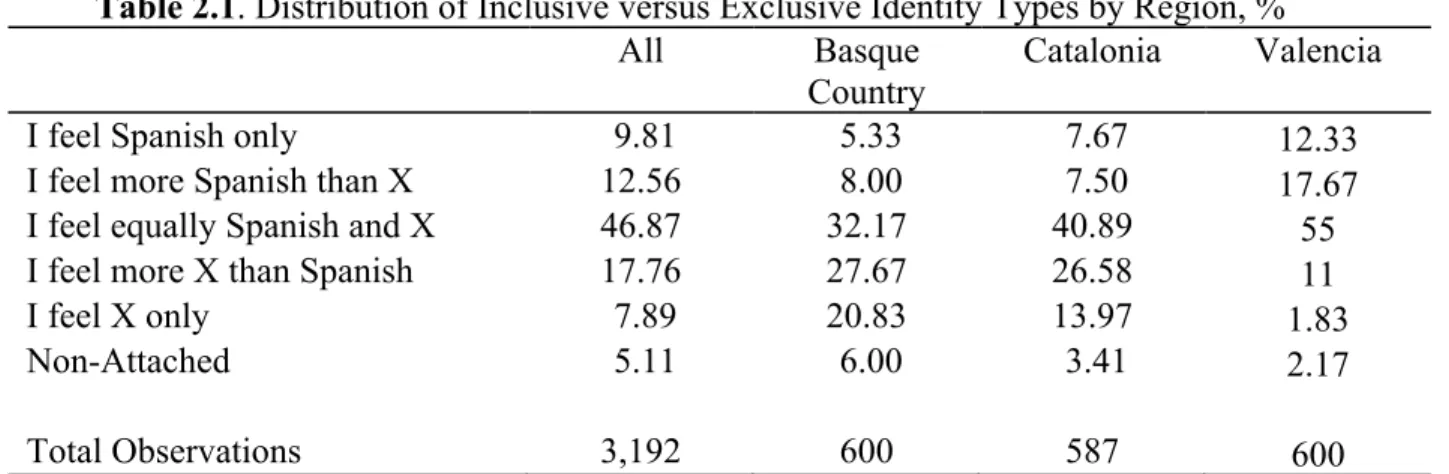
Table 1 shows the distribution of responses to the above question for the overall
sample, Basque Country, Catalonia, and Valencia. Almost 50% of the Spanish population
feels “equally Spanish and regional”. However, that percentage is significantly lower in the
Basque Country. One striking difference between the overall sample/Valencia and the
distinctive regions is the percentage of respondents who feel “more regional than Spanish”
and “regional only”; there is a much higher incidence of a strong regional identity and an
exclusive regional identity in the distinctive regions. On the other hand, exclusive national
identity is less prevalent in the Basque Country and Catalonia.
This conceptualization of territorial identity allows for easy comparison with the
Eurobarometer identity measure, but it suffers from a number of problems. First, it does not
speak to the strength of territorial attachment. A more serious problem is that it does not
allow one to distinguish between two types of exclusive regional identity: the “true”
European attachment, and the pseudo-exclusivism associated with minority nationalism that should have a positive impact on European attachment. In other words, when a respondent
answers that she feels “regional only”, how can we gauge whether she means that she is
incapable of having other territorial attachments or that she is anti-national?
Table 2.1. Distribution of Inclusive versus Exclusive Identity Types by Region, %
All Basque
Country Catalonia Valencia
I feel Spanish only 9.81 5.33 7.67 12.33
I feel more Spanish than X 12.56 8.00 7.50 17.67
I feel equally Spanish and X 46.87 32.17 40.89 55
I feel more X than Spanish 17.76 27.67 26.58 11
I feel X only 7.89 20.83 13.97 1.83
Non-Attached 5.11 6.00 3.41 2.17
Total Observations 3,192 600 587 600
X = the regional adjective of where the interview was conducted, such as Basque, Catalan, etc. Source: Centro de Investigaciones Sociológicas (CIS) 2006.
One solution is to expand the Moreno question conceptualization into a measure that
is based on territorial identity configurations constructed from questions that ask respondents for the strength of their attachment to various levels. The CIS 2006 survey asks respondents
to rate their attachment to the local, regional, national, and European levels, on a scale from 0
to 10. These ratings allow us to simultaneously track how strongly a respondent identifies
with all the territorial levels (strength) and how these attachments relate to one another (fit). They can also tell us about the type of regional identity (content): parochialism or minority nationalism.
The respondent’s attachment to the local level is a crucial piece of information. If the
national levels, then she is a true exclusive regionalist. However, if she is strongly attached to
the local and regional levels, but not to the national level, she appears capable of holding
multiple identities. This indicates that she has a minority nationalist identity that is hostile
towards the state, but potentially friendly towards Europe.
I identify eight different territorial identity configurations. First, respondents who feel
strongly attached to all levels (nested identitarians) hold nested identities, and are expected to have the highest level of identification with Europe. Second, respondents who are strongly
attached to the local and regional levels only are minority nationalists, and are also expected to have a positive attachment to Europe. Third, respondents who are strongly attached to the
regional and national levels (regional-national identitarians), but not to the local level, are presumed to have a inclusive identity and to have a slightly weaker, but still positive,
attachment to Europe than the nested identitarians. The same can be said for the fourth group,
which has very strong attachments to the local and national levels (local-national identitarians).
Table 2.2. Territorial Identity Configurations and Predicted Effect on European Attachment
Identity Type Strong Attachment Predicted Effect
Nested Identitarian All Levels Strong and Positive
Minority Nationalist Local and Regional Positive
Regional-National Identitarian Regional and National Positive
Local-National Identitarian Local and National Positive
Exclusive Localist Local Only Strong and Negative
Exclusive Regionalist Regional Only Strong and Negative
Exclusive Nationalist National Only Negative
Non-Attached None Negative
The next three groups are exclusivists: exclusive localists, exclusive regionalists, and
exclusive nationalists. All three groups are expected to be low on attachment to Europe. My expectation is that exclusive regionalists and localists will have even lower levels of
European attachment than the nationalists given their parochial nature and their more intense
need for differentiation. The final group of respondents is the non-attached group. Given their lack of attachment to any of the lower-order territorial levels, I expect that the
non-attached will similarly have no attachment to the super-ordinate European level. Table 2
summarizes the eight territorial identity configurations and their hypothesized effects on
attachment to Europe.
In the analysis below, respondents who rate their identification to a territorial level at
eight or higher are coded as having strong attachment to that level.13 Next, I create a series of
eight categorical variables that correspond to the eight territorial identity configurations.
These categorical variables are based on the varying strength of the respondent’s attachments
to the three levels and the combination of these attachments. For example, a respondent who
answers that she feels very attached to the national level (10), fairly attached to the regional
level (6), and not very attached to the local level (2) is coded as having an exclusive national
identity because she only feels strong identification with Spain. On the other hand, a
respondent who indicates that she feels very attached to all three levels (all 8s) is coded as
having nested identities.
While the territorial identity configurations measure does improve on the Moreno
question in terms of incorporating local, regional, and national attachments, it too has a
weakness. Numerous authors who have attempted to use similar attachment questions,
primarily included in the Eurobarometer surveys, highlight that a respondent’s quantification
of personal attachment is highly subjective (see Keating, 1998; Marks, 1999; Fitjar, 2009). In
other words, individuals are unlikely to agree on where to draw the line between “very
attached” and “fairly attached” (Fitjar, 2009: 13), or what a regional attachment of 7 points
actually means. On the one hand, a respondent with high attachments to all levels may truly
be a nested identitarian, but she may just as easily have a liberal understanding of the scale.
Conversely, a person with a more cautious understanding may unintentionally be coded as
unattached, even though this might not really be the case. Additionally, because the
attachment to Europe is measured on the same scale, the respondent’s understanding of the
scale will affect both the independent and dependent variables.
A more prudent approach is to use both measures to assess the impact of identity on
European attachment and to cross-reference the number of respondents in each of the
relevant categories. Specifically, if the percentage of respondents in the Moreno measure
who answer that they feel “Spanish only” is roughly proportional to the number of
respondents in the territorial identity configurations measure who are coded as exclusive
nationalists, then we can be confident that both measures are actually capturing exclusive
nationalism. The same should hold true for the proportion of respondents who answer that
they feel equally attached to their region and to Spain and the proportion of respondents who
are coded as nested identitarians. The key difference between the two measures should be in
Catalonia. Because there Moreno measure does not allow one to unpack the difference
between regional exclusivists and minority nationalists, we should see a much higher
proportion of respondents in the distinctive regions falling into the regional exclusivist
category when using the Moreno question. However, when using the territorial identity
configurations measure, the proportion of regional exclusivists should be much smaller, with
a large share of respondents now falling into the minority nationalist category.
Table 3 shows the distribution of respondents amongst these eight categories for
Spain and for the three regions of interest. In Spain, and Valencia, roughly half of the
respondents hold nested identities, but that percentage is much smaller in the Basque
Country, and somewhat smaller in Catalonia. About eight percent of Spanish respondents
have an exclusive national identity, while that percentage is smaller in the two distinctive
regions. These statistics are consistent with the distribution of respondents in Table 1 who
answered that they felt “equally Spanish and regional” and “Spanish only”.
Table 2.3. Distribution of Territorial Identity Configurations by Region, %
All Basque
Country
Catalonia Valencia
Nested Identitarian 42.11 21.81 35.10 49.5
Minority Nationalist 16.07 39.01 29.81 8.33
Regional-National Identitarian 5.29 1.95 7.05 6.17
Local-National Identitarian 5.11 3.19 3.35 6.00
Exclusive Localist 4.42 4.61 2.29 7.67
Exclusive Regionalist 3.73 6.38 6.70 2.67
Exclusive Nationalist 8.52 4.26 6.17 9.17
Non-Attached 14.76 18.79 9.52 10.5