CORPORATE BLOGGING IN THE TECHNOLOGY INDUSTRY
Sarah Harwood
A thesis submitted to the faculty of the University of North Carolina at Chapel Hill in partial fulfillment of the requirements for the degree of Master’s of Arts in the School of Journalism and Mass Communication.
Chapel Hill 2006
Approved by:
Advisor: Dr. Debashis Aikat Reader: Robert Lauterborn
ABSTRACT
SARAH HARWOOD: Corporate Blogging In The Technology Industry (Under the Direction of Dr. Debashis Aikat)
ACKNOWLEDGMENTS
This thesis could not have been completed without the help and support of several people. First, I would like to thank my advisor, Dr. Debashis Aikat, for guiding me through the thesis process. It was because of his course, Global Impact of New Communication Technologies, that I chose the thesis topic that I did!
To my committee members, Professor Bob Lauterborn and Wes Durow, thank you both for your ideas and insight into the practical application of corporate blogging in the business world. You both offered valuable real-world perceptions. In addition, you are two of the busiest people I know, and I will be forever grateful for you taking time out of your schedule to participate in this journey.
To the CMO team at Nortel, I offer sincere thanks for the support, encouragement, and flexibility you gave me in completing this task. Everyone’s genuine interest in my topic helped propel me forward, and your understanding about my schedule helped to make the thesis process less stressful.
TABLE OF CONTENTS
Page
LIST OF TABLES………vii
Chapter I INTRODUCTION………….……… 1
II LITERATURE REVIEW……….. 5
Overview………5
Virtual Communities and Blogs….………7
The New Marketing and Corporate Blogging………....7
Relationship Marketing………..8
Viral Marketing………. 9
Reasons Why Corporations Should Be Blogging………..10
Humanizing the Company………..11
Communicating with the Customer………11
Building a Reputation……… 12
PR and Media Relations……… 13
The Drawbacks of Corporate Blogging………. 14
New Tools for Corporate Blogs………. 16
RSS………. 17
Audioblogging and Podcasting………. 17
Theoretical Framework………. 19
III METHOD...……..………. 21
The Role of the Researcher………... 21
Selection of Participants……… 22
Choice of Research Methods………. 23
Data Gathering Techniques………24
IV RESULTS………..……… 27
Blogging in the Technology Industry……….27
Why Corporations Blog………. 28
The Effectiveness of Blogs……….…... 31
Legal Concerns……….. 37
Drawbacks………. 38
Attitudes……….41
New Blog-Related Technology………..42
V REVIEW OF METHODS & LIMITATIONS...………45
Review of Methods……… 45
Limitations & Constraints………..46
VI DISCUSSION & CONCLUSIONS………...48
Discussion & Results………. 48
APPENDICES………52
LIST OF TABLES
Table
CHAPTER I INTRODUCTION
During the past year, blogs have become a cultural phenomenon. Once the preserve of technically-minded enthusiasts, blogging has begun to transform key areas of society such as journalism and politics and now seems set to rival e-mail as a medium for personal
communication. The number of blogs is increasing exponentially. In January 2006,
Technorati, a blog search site, tracked 26.7 million blogs, up from eight million in early 2005. The number of blog readers is also on a sharp upward curve. In January 2005, the Pew
Internet and American Life Project reported that blog readership had increased by 58% in 2004, claiming that “blogs had established themselves as a key part of online culture” (Rainie, 2005, p. 1).
Evidence for the blogging revolution is not only statistical. Merriam-Webster, the dictionary publisher, chose blog1as its top word of 2004, defining a blog as “a Web site that contains an online personal journal with reflections, comments and often hyperlinks.” Bloggers were featured in the “People of the Year” lists of both Time Magazine and ABC News in 2004. Finally, the purchase of Blogger, one of the original online blogging tools by Google in February 2004 and the launch of a blogging service, MSN Spaces, by Microsoft later that same year, are clear indications that blogging is more than a passing fad.
1
Companies are also beginning to appreciate the power of blogs, a trend reflected in the business press. In its January 2005 issue, Fortune put blogs at number one in its “10 Tech Trends to Watch for,” arguing that blogs are changing working practices in the areas of advertising, marketing and PR (Kirkpatrick & Roth, 2005). Similarly, The Harvard Business Review named blogs as one of its “Breakthrough Ideas for 2005,” commenting that “ blogs are the most conversational of all the forms of media, and marketers can’t afford to be left out of the talk” (Sawhney, 2005). In February 2005, The Economist devoted an article to Robert Scoble, Microsoft’s “celebrity blogger,”2 in which it was suggested that blogging might lead to the death of traditional public relations. However, proof that blogs had finally entered the corporate mainstream was given in May 2005, when the front cover of Business Week boldly proclaimed that “blogs will change your business.”
In fact, some global companies have been using blogs for a number of years. In 2002, the software firm Macromedia was among the first to encourage its employees to start
blogging. The company realized that blogs could provide a forum for its managers to discuss new products with developers and answer their questions. The response was positive. Blogs are credited with “humanizing” Microsoft, a company which had been widely criticized for its aggressive business strategies.3 In March 2006, Microsoft had over 1,115 blogs on their website; even Bill Gates himself was reported to be thinking about starting a blog (Dudley, 2004). Many companies, including Google, are using blogs internally for project and knowledge management. Others have created blogs for external marketing, PR or
2
communication purposes. In fact, blogging is now emerging as a corporate job, and ads for bloggers have begun to appear on online job boards (Needleman, 2005).
As blogs require minimum financial outlay and only basic technical know-how, the barriers to entry are virtually non-existent. At one end of the scale, Bob Lutz, vice-chairman of General Motors, blogs about everything from management issues to new GM models in his FastLane Blog. At the other, 19-year old student Keiko Groves uses her blog as a means to promote her Inased clothing business. Steve Rubel, a well-known PR blogger, calls her “t he future of marketing” (Rubel, 2004).
Interest in the blog as a marketing tool has coincided with a growing realization that traditional marketing methods are no longer suited to today’s fragmented markets and increasingly cynical customers. Blogs have the potential to fulfill many of the aims of new marketing methods, particularly relationship marketing, buzz marketing, and viral marketing.
Blogs are a form of instant publishing which enables companies to “have conversations” with their customers while projecting a more human face. At the Search Engines Strategies Conference held in New York at the beginning of March 2005, PR marketing and research professionals agreed that blogs “will soon be an indispensable marketing tool” (O’Malley, 2005). However, the number of companies currently using blogs for marketing or PR purposes remains small. A survey carried out in October 2004 by Technorati (Sifry, 2004) estimated the number of corporate bloggers at 5,000, over 20% of whom worked for just two companies: Microsoft and Sun Microsystems. A case study
released in March 2005 by MarketingSherpa, a well-known online media company, found that corporate blogging was barely registering on the proverbial radar:
estimate that only .03% of the 34.5 million existing blogs are driving sales or prospective customers to their bloggers (MarketingSherpa, 2005).
Finally, in May 2005, eMarketer, a New York “meta-market research” company, released a report entitled The Business of Blogging. An informal survey found that “just 4% of major US corporations have blogs available to the public – and even fewer produce active sites with the link and feedback features that most readers associate with true blogs” (eMarketer, 2005).
Despite the proliferation of articles, white papers, books, and blogs promoting
CHAPTER II LITERATURE REVIEW
This chapter provides an in-depth discussion of the literature. Because there were a limited number of articles written about corporate blogging in the technology industry, I have widened the scope to include general information about corporate blogging. Also, due to the limited number of scholarly articles, most pieces were accessed via the Internet. Links are provided in the references. This chapter also provides a basis for trust theory, the theoretical framework used.
Overview
book online. The provisional title of the first chapter is Blog or Die, which leaves little room for doubt as to the stance Scoble will take.
The abundance of trade and journalism sources on corporate blogging contrasts sharply with the lack of academic works. Standard marketing textbooks (e.g. Kotler, 2003; Jobber, 2004; Smith & Taylor, 2004) make no mention of blogs. Turban et al. (2004, p. 357) devote half a page to the subject of blogs, remarking surprisingly that “blogs are not yet used for commercial purposes.” Searches on LexisNexis, ProQuest and other databases for
academic papers relating to the business applications of blogs yielded negligible results. The lack of research concerning corporate blogging may be due to the recent nature of the phenomenon. In fact, it was only towards the end of 2004 that blogs finally gained
widespread acceptance as a marketing tool. Up until then the words fad or craze were regularly to be found in blog-related articles (e.g. Anderson, 2004). In November 2004, Forrester Research published a report entitled Blogging: Bubble or Big Deal? (Li, 2004). According to Forrester, “blogging will grow in importance, and at a minimum, companies should monitor blogs to learn what is being said about their products and services.” However, the report’s title indicates the uncertainty which surrounded corporate blogging at the time.
Although interviews with corporate bloggers appear regularly in the media (e.g. Bruner, 2004a; Wackä, 2004), few researchers have undertaken a scientific study of the attitudes and experiences of corporate bloggers. This is a deficiency which the current paper aims to address.
Virtual Communities and Blogs
The collective term blogosphere is regularly used by journalistic sources to refer to blogs as a social network. However, the existing blogosphere has developed from humble beginnings. The early blog community consisted of a small number of technically-minded individuals who were familiar with HTML (Blood, 2002). It was not until the appearance of the first blogging tools and hosting services such as Blogger in 1999 that the big bang occurred (Bausch et al., 2002). These tools allowed users to create a blog easily and introduced features such as automatic archiving and a choice of multiple templates. Once blogs became accessible to more people, the original blog community fragmented. Derek Powazek (2002), an author with long experience of creating community sites, describes the process by which weblog communities are formed:
Any weblog with comments can quickly turn into a community of one, attracting a small group of people who are interested enough to follow along and participate. And if each of these readers then starts a weblog of his own, with comments that the others take part in, you wind up with a giant, interconnected, ever-evolving community (Powazek, 2002, p. 266).
The role of blogs in creating virtual communities is probably the area which has seen the greatest amount of blog-related academic research. The University of Minnesota
maintains a website entitled Into The Blogosphere featuring an online collection of essays which “explores discursive, visual, social and other communicative features of weblogs” (Gurak, 2005). The project represents perspectives from various fields including sociology and communication, but none of the posted essays mention the corporate blogosphere.
In 1999, The Cluetrain Manifesto proclaimed “the end of business as usual” and declared that “markets are conversations” (Levine et al., 1999, p. xxii). There followed ninety-four theses detailing a new agenda for corporate marketing in the Internet age. The Cluetrain Manifesto is considered a bible by many corporate bloggers (Rendon, 2004), despite the fact that it makes no mention of blogs at all. The work may be seen as the culmination of a long process of disenchantment with conventional marketing methods leading to a more customer-centered approach. This next section will review the literature relating to some of the key trends in marketing over the past fifteen years or so of the Internet age and explain their relevance to corporate blogging.
Relationship Marketing
Relationship marketing first appeared as a concept in the 1980s, long before the Internet became an essential marketing tool. Egan (2004, p.19) describes the shift from the
transactional marketing model with its heavy reliance on marketing to “anonymous masses” to an approach which emphasized the importance of developing relationships with identifiable customers. The need for such a change was explained by Regis McKenna in his pioneering work Relationship Marketing (1992). McKenna suggested that companies faced the “end of loyalty” as a result of increasing customer choice. The solution was to integrate the customer into the company, to create and sustain a relationship between the company and the customer. This new approach represented:
Kaye claims that “unlike narrowly targeted advertising and email newsletters, blogs build trusting relationships with customers that actually fulfill the promise of one-to-one marketing” (2003, p. 4).
Viral Marketing
Viral marketing is a concept which has its origins in the Internet. The term was invented by Steve Jurvetson, a venture capitalist, to describe the method used by Hotmail to develop its e-mail service (Godin, 2001, p. 67). Most of the standard marketing textbooks mention the term. For example, Jobber (2004, p. 572) refers to viral marketing as “electronic word of mouth,” while Smith and Taylor (2004) give the following description of the process involved:
It is not “accidental” spreading but, rather, carefully planned spreading of the message online. Two elements are required: first the idea itself, and second, the seeding (Smith & Taylor, 2004, p. 632).
The two main benefits of word-of-mouth sources are that they are convincing and low cost (Kotler, 2003, p. 575).
A related concept is buzz marketing. Buzzmarketing, a specialist website, says that it is about “capturing attention of consumers and the media to the point where talking about your brand becomes entertaining, fascinating, and newsworthy” (Buzzmarketing, 2005). In a paper for the Harvard Business Review, Dye (2000) investigated the marketing practices at more than 50 companies and found that buzz affects not only the entertainment and fashion industries but also agriculture, electronics, and finance. She forecast a world in which “buzz will dominate the shaping of markets,” citing forums such as Epinions.com as generators of buzz. In a mass-market business book, Gardner (2005, p. 11) considers that “the power of blogs is buzz, or conversations that bounce from blog to blog and gather mass and impact.”
Reasons Why Corporations Should Be Blogging
Humanizing the Company
Corporations do not speak in the same voice as these new networked conversations. To their intended online audiences, companies sound hollow, flat – literally inhuman. (Thesis 14, The Cluetrain Manifesto)
While traditional websites are increasingly seen as platforms for empty corporate rhetoric (Levine et al., 2002), blogs have acquired a reputation for authenticity, transparency, honesty and openness – four qualities regularly mentioned in the trade literature (Gardner, 2005; Kaye, 2003). Robert Scoble, Microsoft’s chief technical evangelist, is widely credited with giving the software giant a more human voice by blogging openly about company issues. An article entitled “Chief Humanizing Officer,” The Economist (Anon, 2005, p. 58) goes so far as to suggest that Scoble’s example “might mark the beginning of the end of ‘corporate communications’ as we know it.” Scoble’s own Corporate Weblog Manifesto (2004) begins with the words “Tell the truth. The whole truth. Nothing but the truth.” He even recommends linking to a competitor if their product is better.
Communicating with the Customer
Unlike forums and newsletters, the vast majority of blogs are accessible to anybody with an Internet connection4. Moreover, the comments feature of blogs provides a simple way for readers to respond to posts. This potential for interaction is often mentioned in the published literature. According to Gardner (2005, p. 20), “the biggest strength of blogs is in establishing dialogue with readers.” Kaye (2003, p. 18) uses the term “customer relationship blogs” to describe blogs which “allow businesses to connect with their customers in a personalized, immediate way.” She gives several examples including an Indian restaurant in 4
Northfield, Minnesota, which used its blog to rally customer support when threatened with the loss of its lease.
Blogs also provide a way to reach niche audiences. For example, Kaye (2003, p. 37) tells the story of niche manufacturer Clip-n-Seal, which used a blog to market a device for resealing bags. By tracking and monitoring what visitors are reading and responding to, companies can “hone specific content and promotions for very high interest micro-audiences, which can then be delivered by weblogs at a fraction of the cost of conventional offline and online marketing” (IMN Inc., 2003).
Building a Reputation
Blogs can be used to demonstrate expertise in a particular area. Gardner (2005, p. 15) cites the example of a law firm which has created a blog specializing in Brain Injury Law. Top executives such as Jonathan Schwartz, President and COO of Sun Microsystems, and Alan Meckler, CEO of Jupitermedia, have used their blogs to establish a position as “thought leaders” in their particular domain.
Hewitt (2005, p. 131) employs the term “earned credibility” and sees this, along with the authentic voice, as “the crucial difference between websites and blogs.” Crumlish (2004) takes a similar view:
…business weblogs can help companies manage an online profile and generate the sort of reputation or aura of goodwill that enables strangers to trust each other and make commitments or transactions online (Crumlish, 2004, p. 181).
PR and Media Relations
The death of PR has been announced on more than one occasion (e.g. Stern, 2003). Thesis 26 of The Cluetrain Manifesto (Levy et al., 2000, p. xxiv) states that “Public Relations does not relate to the public. Companies are afraid of their markets.” Scoble and Israel (2005) believe that blogs are the answer to this problem:
[Blogging] is necessary because the other communication tools - press releases, ads, banners, websites, brochures, and PowerPoint presentations are all irreparably broken. People neither believe nor trust the slickness of corporate materials and spokespeople (Scoble & Israel, 2005).
The PR industry has been slow to take blogs seriously. However, Steve Rubel (2004), one of the most influential of the small band of PR bloggers, believes that blogs are having a profound effect on his profession:
The proliferation of Weblogs and RSS news feeds has changed the practice of public relations forever. Despite all of the hype about media consolidation, we are no longer living in a mass media world dominated by conglomerates (Rubel, 2004).
Rubel uses the term “micro persuasion” (also the name of his blog) to refer to the process of influencing influential bloggers. This skill is important not only for PR
professionals but also to the individual company blogger who wants to communicate company news or respond to press coverage.
expected to cost Kryptonite over $10 million (Kirkpatrick & Roth, 2005). If the company had their own blog, it could have responded more quickly and, perhaps, limited the damage. The incident clearly demonstrates that companies ignore the blogosphere at their peril.
The Drawbacks of Corporate Blogging
Despite the intensive promotion of blogging as “the next big thing” in the trade press (e.g. McIntosh, 2005), a number of commentators are skeptical about the business potential of blogs. One of the most vocal skeptics is Robert Bly, a well-known direct marketing
copywriter:
I have yet to find a single marketer who says that a business blog has gotten him a positive return on investment. I know plenty of online marketers who make millions of dollars a year from their Web sites and e-zines, for instance. But I’ve not seen a blog whose creator says that the time and effort spent on it has directly put money into his pocket (Bly, 2004a).
Bly’s post raises two key issues. The first concerns the value of blogs compared with other marketing media such as e-mail, white papers, e-zines, and websites. Bly considers the latter media to be better formats for publishing information to establish one’s expertise.
Bly’s second issue relates to ROI (return on investment). Two weeks after starting his own blog in October 2004, Bly (2004b) posted the following comment: “I am concerned that, since for me time equals money, my blogging is costing me a lot of money … with no visible ROI other than fun.”
In a traditional marketing sense, companies measure marketing ROI by seeing how many products they sell after an ad campaign launches. However, how do you measure mindshare that can be produced by a blog? You can’t, really—and that may scare some organizations away. You could measure the traffic that the blog receives, but traffic does not equate to money in all cases (Scrivens, 2004).
A number of potential drawbacks and dangers exist in the corporate blogging domain. McGovern (2004) identifies several disadvantages of blogs, including the problem of time:
…blogs are easy to start and hard to maintain. Writing coherently is one of the most difficult and time-consuming tasks for a human being to undertake. So, far from blogs being a cheap strategy, they are a very expensive one, in that they eat up time. As a result, many blogs are not updated, thus damaging rather than enhancing the reputation of the organization (McGovern, 2004).
Michael Gartenberg (2004) of Jupiter Research highlights three separate issues which companies need to deal with. The first concerns monitoring the blogosphere for references to the company or brand. The second relates to the need for companies to have guidelines for official corporate blogs:
Establishing policy and knowing who is saying what is critical. There are worse things in the world than not having a weblog, and corporations are right to tread lightly and to carefully establish policies and rules before they jump in (Gartenberg, 2004).
The third issue concerns “employees personally blogging but identifying themselves with the company they work for.” Once again, Gartenberg stresses the need for weblog policies just as a company would have phone and e-mail policies.
Management (2004), which concludes that “while blogs have a legitimate use, online journals pose serious threats to enterprise confidentiality, integrity and availability.”
However, as Kellaway (2005) makes clear, a willingness to take risks could make the difference between an effective blog and one which becomes an exercise in corporate speak:
The point about blogs is risk. If they are made risky in any way - either through publishing negative comments, or because the author is honest about themselves or their business, people will take notice. If they are merely another conduit for sanitized corporate information, or exercises in executive vanity, they will go the way of corporate mags, the voicemails and the company spam (Kellaway, 2005).
There is general agreement among commentators that trust is an essential factor when blogging for business (e.g. Scoble, 2004). Companies that have abused that trust by creating “fake blogs” or using blogs as just another advertising medium have tended to meet with ridicule in the blogosphere. Kaye (2003) uses the term “adverblog” to describe weblogs that “actively market on a particular brand, product or service, often using fictional personae as the blog authors.” Dr Pepper, a soft drink company, incurred the wrath of the blogosphere in 2003 when it launched a viral marketing campaign for its new Raging Cow drink. The company briefed a number of young bloggers who were encouraged to blog about the product. This they did without revealing their connection with Dr Pepper. When the truth leaked out, there were calls for a boycott of the product.
New Tools for Corporate Blogs
RSS (Really Simple Syndication)
You should be fired if you do a marketing site without an RSS feed (Scoble, 2005).
While Robert Scoble’s assertion may be deliberately provocative, many commentators view RSS as the key to leveraging the power of blogs (e.g. Weil, 2004; Barbour, 2005). RSS is an XML-based pull technology which enables the distribution of online content by means of news feeds. Once readers have subscribed to an RSS feed, they receive updated content automatically via a feed reader or news aggregator such as Bloglines or Newsgator. Weil (2004b) identifies several advantages of using RSS rather than e-mail as a means of distributing content. From the publisher’s point of view, RSS offers a way of bypassing spam filters and avoiding e-mail overload. For the consumer, RSS is a practical way to receive news and information which avoids the need to visit multiple websites or blogs.
Although RSS is seen by some analysts as an even more significant development than blogs themselves, a March 2005 report from Jupiter Research predicted that the “adoption rate [of RSS] for marketing purposes will remain low during the next 24 months.” According to Alam Khan (2005), only six percent of consumers have installed an RSS reader and the “adoption rate will change little until the reader’s functionality is embedded into browsers or e-mail clients.” However, this may happen sooner rather than later as Microsoft is “taking blogging very seriously” and has plans to bundle a free RSS/news aggregator with Internet Explorer 7 (Wyman, 2005).
While standard blogs use text as a means of delivering content, tools such as Audioblogs have made it relatively easy to incorporate sound files into blog posts. An extension of audioblogging is podcasting. Wikipedia (2006), an online encyclopedia, gives the following definition:
Podcasting is the practice of making audio files available online in a way that allows software to automatically detect new files and download them. Most podcasts are MP3 files distributed through RSS, but other formats and other types of files, such as video, can also be podcasted (Wikipedia, 2006).
Spencer (2005) gives four reasons why companies should podcast: to gain first mover advantage, to develop customer loyalty, to give the company a more human voice, and to exploit the PR value of a new technology.
Although weblogs are not the only means of publishing podcasts, the ease with which weblogs can be updated makes them an ideal distribution tool. The twice-weekly “For Immediate Release” (F.I.R.) podcast by PR professionals Neville Hobson and Shel Holtz is supplemented by a blog which provides a content summary and running order as well as links for the various items mentioned in the show. The “F.I.R.” podcast is a prime example of how to establish oneself as an expert in a particular field of business.
Videoblogging and Moblogging
of these new technologies has yet to be proven, any feature which drives traffic to a website or blog is likely to attract the interest of companies.
Theoretical Framework
Grunig and Grunig (1992) maintain that the two-way symmetrical model of public relations represents the ideal way to practice the discipline. Grunig and Grunig (1992) think that organizations that practice public relations in a two-way symmetrical manner perform better than organizations that do not. According to them, this view is supported by various empirical findings. In spite of their advocacy of the two-way symmetrical public relations theory, public relations is rarely practiced in a symmetrical manner.
Grunig and Hunt (1984) argue that the actions of the dominant coalition and the structure of the organization are important. If the most powerful people in an organization don’t feel that public relations practitioners should be given access to the decision making process, or they don’t think public relations are important, then it is unlikely that public relations will be practiced in a symmetrical way. The same seems to hold true if the organization is authoritarian and hierarchical in structure.
The emergence of corporate blogs changes the prevalent one-way flow of information from media to audience. The two-way trait of blogs makes interaction between the media and audience possible. Blogs combine the mass communication and interpersonal communication in a single channel – internet users can obtain information and send feedback without having to leave the same communication context. Interactivity, assumed as the inherent attribute of the internet from the very beginning, contributes tremendously to the promotion of audience activity to a higher level.
CHAPTER III METHOD
This chapter provides an in-depth discussion of how I went about conducting the interviews. I describe my own biases, the research technique used, and how I selected the participants. I also review how I collected and stored the data.
The Role of the Researcher
During a research project, I was called upon to play a number of different roles. First, I had to decide on the research question(s) to be investigated – a decision likely to be a
subjective one, based on my own interests or needs. However, one of the main tasks of the researcher during the research process is to achieve a necessary degree of objectivity.
Strauss and Corbin (1998) define “objectivity” in qualitative research as follows: …objectivity does not mean controlling the variables. Rather, it means openness, a willingness to listen and to “give voice” to respondents, be they individuals or organizations. It means hearing what others have to say, seeing what others do, and representing these as accurately as possible (Strauss & Corbin, 1998, p. 43).
According to Mason (2002), the fact that the researcher is an active participant in the research act means that objectivity is an impossible goal:
Qualitative research should involve critical self-scrutiny by the
belief that a researcher cannot be neutral, or objective, or detached, from the knowledge and evidence that they are generating (Mason, 2002, p.7).
In the current project, I had to put aside personal experience of blogs and
blogging to view the activity from an objective perspective. During the interview phase, in particular, it was all too easy to introduce a personal bias. I am currently employed as an intern with a technology company, which explains my interest in the impact of corporate blogs in the technology industry. Because the company for which I work does not have an external blog, this exploration will ultimately serve as an analysis of
whether or not companies in the technology industry should institute this new communication medium as a marketing technique.
I was aware of the potential pitfalls posed by qualitative interviewing and thus adopted the role of detached interviewer. This approach was facilitated by the fact that the interviews were all conducted via an online chat session.
Selection of Participants
The interviewees were selected by non-random (non-probability) sampling. White (2002) identifies three forms of non-random sampling including “purposive sampling.” This is often called judgmental sampling, because the researcher picks the sample they think will deliver the best information in order to satisfy the research objectives in question (White, 2002, p. 64).
The first step in selecting the participants was to identify a number of blogs which met the following criteria:
• the blog should have been updated recently and regularly
• the blog should have an identifiable author
Out of the major technology-focused corporations, 20 blogs fulfilled the above requirements. Out of these companies contacted, only 10 employees at various companies chose to participate in this study: Cisco, IBM, HP, Microsoft, Sun, Adobe, Accenture, Red Hat, Oracle, BEA. Due to confidentiality reasons, bloggers’ names and their companies are usually not identified in quotes. The selected bloggers acknowledged the value of this study by their participation, but wished to remain anonymous in my discussion of the interview findings. Also, all bloggers had a chance to review the sections in which they were quoted, which explains why some companies are mentioned in conjunction with certain quotes and others are not.
Choice of Research Methods
This research project aims to investigate the attitudes and experiences of corporate bloggers who are using blogs as a marketing and communications tool. The most appropriate research method for obtaining the data required to carry out such a project was deemed to be the qualitative interview study. The justification for using this method can be found in the relevant literature. For example, Weiss (1994, pp. 9-11) lists seven research aims which would justify using a qualitative interview study as the basis for a research project. The first three—developing detailed descriptions, integrating multiple perspectives, and describing process—correspond closely to the aims of the current project. Mason (2002) gives a number of reasons for using qualitative interviewing as a method, the first of which is as follows:
If you choose qualitative interviewing it may be because your
interpretations, experiences, and interactions are meaningful properties of the social reality which your research questions are designed to explore. Perhaps more importantly, you will be interested in their perceptions (Mason, 2002, p. 63).
Although respondents’ attitudes and experiences could be explored using a quantitative survey approach, this method was rejected. Indeed, the goal of the research project is not to undertake a statistical analysis using uniform questions and pre-defined categories but to obtain fuller responses in order to “gain in the coherence, depth and density of the material each respondent provides” (Weiss, 1994, p. 3). Similarly, White (2002, p. 33) believes that “unstructured interviews are excellent where the aim is to understand the perspective of the interviewee and the personal meanings they attach to different situations.”
Data Gathering Techniques
As I live in Chapel Hill and all the participants live outside a 100 mile radius, face-to-face interviews were not be possible given financial and time constraints. Instead, the interviews were conducted via online chat sessions. The chat session was hosted by Chatzy (www.chatzy.com), which is a free, private, and secure chat service. This allowed me to set up a link to a private chatroom, send the link to the interviewee, and keep the transcripts of the chats on that service. The transcripts of the interviews are only accessible by my username and password.
asynchronous interviewing). In addition to those reasons, “rich and interactive” online interviewing was appropriate in this particular study because it “honors the field in which the participants are working – the online environment” (Crichton & Kinash 2003, p. 8). The main drawback of online interviews compared to face-to-face interviews is that non-verbal information (such as facial expressions and gestures) is absent.
Before each interview, time was spent researching the background of the interviewee. The interviewee’s blog provides an overview of their professional activities and an
introduction to their blogging voice. Several interviewees and their blogs have been the subject of articles in the press or on other blogs. Information gleaned from these various sources was used to personalize the questions used as the starting point for the interview. Although the majority of the interview questions are standardized, I also explored specific topics relating to the blogger’s own situation as well as more general themes common to all. Mason (2002) stresses the importance of varying the questions:
Your approach to making analytical comparisons in your data set will certainly not depend on having asked all interviewees the same set of questions. You will assume that in order to achieve data that are comparable in key ways, far from giving everyone standardized questions in a standardized form, you may well need to ask different questions of your different interviewees -precisely so that you can generate situated knowledge with all of your interviewees (Mason 2002, p. 65).
CHAPTER IV RESULTS
This chapter examines the interviewees’ experiences and perceptions of using blogs as a marketing and communications tool in the technology industry. The results have been organized on the basis of themes identified when reviewing the data. A key issue is the perceived effectiveness of blogs when used as a marketing medium. However, a number of other points will also be considered, including the bloggers’ motivations for using blogs, their feelings about the act of blogging, and their experience of new blog-related technologies. The intention is to let these bloggers tell their story with their own voice.
Blogging in the Technology Industry
When questioned about their opinions of corporate blogging in the technology industry, the interviewees all very firmly believed and agreed that blogging is the way to go. One interviewee discussed the importance of relating to customers on their level:
When you work in the technology industry, it is always important to be on the cusp of the latest and greatest. Anything less is simply not acceptable. Right now, that trend is blogging. I am a firm believer in following trends, especially the low cost trends. Blogging allows me to spend a minimal amount of money from my budget, yet provides an immeasurable benefit – I am able to identify with my customers by
All ten interviewees mentioned that they believed blogging is more effective for technology customers than for customers outside of the technology realm:
I believe that blogging is THE best choice to reach technology consumers on any level. You are already dealing with a savy, technology-focused group of people, and it’s almost insulting to them to not approach them on their level. Many of the customers who read my blog have blogs of their own. These customers know how the process works. It’s my belief that these customers wouldn’t necessarily respond as well to other methods of communication.
Another blogger elaborated:
Blogging works in the technology industry. We’re talking about people who live and breathe technology. If my company doesn’t talk to the customers the way they want to be talked to, then we’re losing out on a major segment. We’re actually doing something far worse; we’re alienating our customer.
Why Technology Corporations Blog
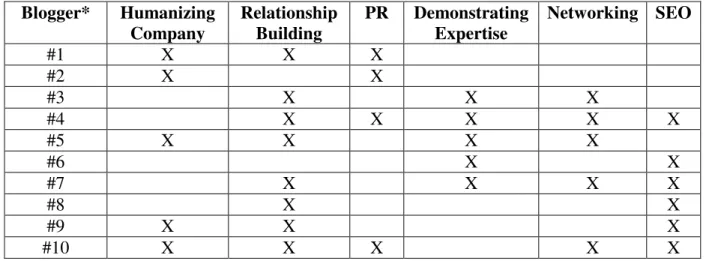
The interviews revealed that none of the corporations were using their blogs for a single purpose. Moreover, the blog use matrix (see Table 1 on next page) clearly shows that the blogging mix, or specific combination of purposes for which a blog is used, was different for each of the bloggers in the study.
Relationship building was the most common reason for blogging, with only two interviewees failing to mention this point. This result tends to confirm the view that blogs are an excellent tool for communicating with customers (e.g. Gardner 2005; Kaye, 2005).
One blogger at Sun saw a clear link between humanizing the company and relationship building:
audience knows who wrote it because it has the author’s name at the top and it’s written in first person.
Table 1 - Blog Use Matrix5 Blogger* Humanizing Company Relationship Building PR Demonstrating Expertise Networking SEO
#1 X X X
#2 X X
#3 X X X
#4 X X X X X
#5 X X X X
#6 X X
#7 X X X X
#8 X X
#9 X X X
#10 X X X X X
Several interviewees found that the blog had definite advantages over a traditional website. One blogger described a website as a “dry, impersonal brochure that is just sitting there.” A blog, on the other hand, gives readers an insight into the way a company operates. One of the interviewees from HP commented:
A website is only an online brochure. There’s obviously a lot more that goes on behind the scenes on a daily basis where you can actually expand upon who you are as a company. It’s obviously the whole transparency thing – what you’re like as a company, the personalities behind the business. I really do honestly believe that people can actually judge whether they want to do business with you.
The human factor was particularly important to several bloggers. A blogger at Microsoft talked about his blog providing “some branding of my own personality” while a blogger at Sun took a similar view:
5 A box which is left unchecked does not necessarily indicate that the blogger was not using the blog for that
purpose, only that it was not mentioned during the course of the interview.
In corporations it’s easy for the voice and feel of the company to get lost – what I strive to do is present the human side. If I have a blog, then people can know me before I even start working with them, so when I walk into the first meeting they already have an idea about who’s going to turn up, what this person can do and a little bit about their personality. So half the work’s already done.
Half of the bloggers interviewed were using blogs as a networking tool. One blogger at BEA stressed the importance of her blog to network in this respect:
The blog’s primary purpose is as an informal communication channel on business topics with my direct network of contacts (who tend to be
non-bloggers). My work is based on maintaining network contacts so this is an efficient way to maintain a balance of offline/online contact.
Several companies were using blogs for PR purposes. For corporations with limited resources, a blog represents an inexpensive means to disseminate information to potential customers and the press. A blogger at Adobe found that his blog provided a way into the mainstream media:
I think it’s a great tool to alert your readers to what you’re doing, and also the press. We’ve actually done that and had stories picked up and people calling us to ask us if they could use similar content for a story that they’re doing.
As stated in the literature review, there is some debate as to whether blogs should be used as search engine optimization (SEO) vehicles (Woodhouse, 2005). Although the blog use matrix (Table 1) shows clearly that none of the bloggers interviewed were using their blog solely for this purpose, SEO was an important consideration for many of them. A blogger at Oracle elaborates:
Not all of the interviewees were interested in SEO. One said that he did not use his blog as a reciprocal linking tool in order to drive traffic since “it won’t do you any good if you bring irrelevant hits to your site.” However, on the whole, SEO was considered to be a key argument for maintaining a blog.
All of the reasons for blogging listed in the blog use matrix (Table 1) are frequently mentioned in the literature (e.g. Gardner, 2005; Kaye, 2003). However, the interviewees reported a number of other uses. Several bloggers have used their blogs as a crisis management tool. When one company’s products received bad publicity, the associated company blogger commented that the blog network helped to give the company a voice. Another blogger viewed his blog as “an educational tool” and used it as “resource bank” for his company. Others saw their blogs as a means of self-expression, while one stated that “there are business purposes, but it’s also, in a way, my art.”
These results indicate that the interviewees were creating a blogging mix appropriate to their own specific needs. However, Gardner (2005, p. 41) warns against falling “into the trap of trying to do everything at once.” She suggests starting several blogs if you have different aims in mind.
The Effectiveness of Blogs as a Marketing and Communications Tool
measurement tool used in marketing is return on investment (ROI). The Chartered
Management Institute (2003) defines ROI as “a ratio of the profit made in a financial year as a percentage of an investment.” However, the term ROI is often used more loosely to signify the benefits which accrue in relation to the resources employed. As stated in the literature review, there is an ongoing debate as to whether corporate blogs provide an acceptable ROI, or any ROI at all (Bly, 2004a; Scrivens, 2004).
Although none of the interviewees had carried out a quantitative analysis to determine the ROI of their blogging activity, several were able to identify specific opportunities which had come as a result of blogging. In one blogger’s words, “My blog has generated four
qualified freelance opportunities for me since I launched it about a year ago.” Another blogger commented, “[My blog] brings me national and international contacts in ways that are always surprising, and I’ve even gotten some requests for speaking engagement invitations.”
Other bloggers were able to point to benefits of a less concrete nature. When one blogger was asked about what results her company has seen, she likened blogs to “any PR effort” in that the results are “somewhat intangible.” She added that:
Our CEO has agreed to just play things by ear. We’re going to assume that there is some value in terms of a return to our company in doing this at this moment. It’s very hard to measure, but everybody knows it works.
For corporations with limited marketing resources, a blog can provide a solution to the problem of establishing a marketing presence. One blogger commented:
SEO and relationship building were the two benefits most frequently mentioned by interviewees. For a blogger at Sun the two go hand in hand:
So far I’ve been measuring the effectiveness in terms of search engine rankings and also I measure effectiveness by the kind of publicity you can get. I measure the success by the kind of visitors I get because of my blog posts. It’s a brand building exercise, it’s not just in terms of sales and profits. Blogging is more about building relationships, so that’s also how I measure the
effectiveness.
One blogger at Cisco linked his blog to improved performance in terms of both lead generation and search engine results:
Obviously, there are more people looking. You have better targeted key words. Not only are we getting more inquiries about products/services, we’re getting a better quality of inquiry. I’d say the blog bolsters the website, but it’s starting to bring in traffic in its own right.
One of the difficulties of determining the effectiveness of using blogs for SEO
purposes is the lack of accurate measurement tools. Attitudes to traffic varied considerably, as did the traffic itself. Some interviewees were not measuring traffic at all. Others assumed that “the company” was tracking things for them.
During the investigation of this thesis, accurate statistical comparisons were impossible. Some interviewees were measuring hits while others were measuring visits6. However, a blog does not need high levels of traffic to be effective. As Bricklin (2002) notes:
…the purpose of a blog is not always to get the largest and widest readership possible. The purpose is usually to communicate with interested individuals. Even in business, the number of those individuals may be very few, but the impact of the communications can have economic impact far beyond its cost. For example, for a business selling high-ticket items or services, one sale can make up for the time cost of a whole year of frequent blogging (Bricklin, 2002).
6
One of the most frequently cited marketing benefits of blogs in the literature (e.g. Gardner, 2005) is communicating with customers. The traffic statistics only indicate how many people visit the blogs; they do not give any sense of the dialogue or conversation which may be taking place. Customer feedback, via the blog’s comments feature or to an e-mail address given on the blog, is potentially a valuable source of marketing information. According to Jeff Weiner, Yahoo’s senior vice-president, “Never in the history of market research has there been a tool like [the blog]” (Baker & Green, 2005).
There were an overwhelming number of positive responses about conversation with customers among the bloggers interviewed:
The number of comments is huge, but that might also be due to the fact that I try to put some controversial topics in there every now and then. I find that it gets people revved up and really sparks discussion. That’s ultimately what I’m trying to do—spark discussion—about my company’s products and services. I find that if I can get them hooked on something, then they keep coming back for more.
This sentiment was echoed by other bloggers:
I believe that my blog serves as a conduit for conversation; when I post an entry, I always look forward during that immediate hour after in reading people’s thoughts about what I’ve written. It’s almost as if you’re in a room with 100 other people, and everyone is conversing about the same topic.
Some bloggers were getting feedback by other means, such as emails. For example, one blogger states:
I wish I could have more comments on my blog than emails about it. The majority of feedback I’ve received has been in the form of an email, which clutters up my inbox and takes away time from work and life. That’s why I like the idea of a blog. It’s an online forum where people are supposed to interact
Two interviewees did not have comments enabled on their site. One of those cited comment spam as a contributing factor. The problem of spam, which was mentioned by other interviewees, poses a threat to the conversational potential of blogs: “Spam ruined e-mail for me, I’m not going to give the spammers another platform to ruin blogging which is something I really love.” The other blogger who does not have comments enabled on his blog stated:
Comments are for people with time to delete tons of comment spam. My company doesn’t give me that kind of time, and I don’t know any fellow employees who have the amount of time it would take to delete all the spam comments. That would be almost a full-time job in itself.
Any consideration of ROI must also take into account the cost of setting up and maintaining the blog. This cost was generally considered to be insignificant:
We have hardly spent any money. We bought the software, hired a contract designer once or twice for a couple of hundred dollars worth of work, but it’s really minimal.
I think that one of the best parts about blogging is the low barrier to entry. It’s very inexpensive, very accessible.
I don’t have any conclusive evidence to say whether or not the blog is worth the money we invested in it or the time I spend on it. But the investment is pretty minimal: a few hundred bucks in development and a few minutes of someone’s time each week.
When evaluating the costs of blogging, the interviewees tended not to take into account the amount of time they spent on this activity. This “hidden” cost can be considerable, as highlighted by a blogger from Adobe:
The interviewees were asked to put a figure on the amount of time they devoted to blogging. The amounts varied enormously, as the following table shows:
Table 2 – Time Spent Blogging7
Blogger* Posting Frequency Time Spent
#1 At least once a week 20 minutes for a typical post
#2 Once a week 10-15 minutes per post. Less if short.
#3 Minimum of 3-5
posts per week
10 hours plus a week
#4 1-3 posts per week “not much”
#5 Every other day 30 minutes (does not include time spent thinking what to write)
#6 First hour of the day; five days a week
Includes time spent viewing competitors’ blogs
#7 3-4 hours per day Includes reading company news
#8 Every day 2 hours per post
#9 60% of working time Takes care of 5 blogs #10 2 posts per week 3 hours per post
In some cases, blogging had become part of the daily routine, making it all but impossible to estimate its comparative cost in terms of time allocated.
While nearly all of the interviewees believed that their blog was bringing benefits to their company, none were able to measure the ROI in purely financial terms. Moreover, in reviewing the blogs before and after the interview, there seemed to be a warped perception that the amount of conversation with customers mentioned in the interview was actually taking place on all interviewees’ blogs; in a review of several blogs, there were not as many comments on the site as had been referenced in the interview.
7 All interviewees cautioned that the numbers given for time spent are merely estimates.
Legal Concerns
Surprisingly, legal concerns were not an issue for any of the interviewees. Although some had to sign a confidentiality agreement with the company prior to having their own blog, others could blog without severe legal constraints or ramifications. One company solved the problem of legal concerns by establishing a different website to host their employees’ blogs; this website specifically stated that the information in the blogs was not representative of the company’s position. One blogger commented:
At first I was concerned about legal issues, but after awhile you learn what you can and can’t say. I’d never want to say anything in my blog to jeopardize my
company, but then again, I’m not stupid. What worries me is that there ARE stupid people out there, and not all corporate bloggers are necessarily charged with the appropriate information. Some like to seem more important than they are, and that could be a problem.
Table 3 – Legal Disclaimers and Constraints Company Corporate
blogging policy
guide
Disclaimer on top of main blog
page
Disclaimer on bottom of
main blog page Disclaimer linked in sidebar of main blog page Disclaimer required in employee blog External site for corporate bloggers Accenture X
Adobe X X
BEA X X
Cisco X
HP X
IBM X X
Microsoft
Oracle X
Red Hat X
Sun X X recommended
not have a published policy, nor does Microsoft use or require bloggers to use a legal disclaimer. The Microsoft blogger commented:
I recognize the importance of having a blog, but I think that most of us who blog know the rules – you don’t reveal trade secrets or secret information, you never completely rat out a bad product on your blog, and you never want to say things about people that aren’t true.
Sun and IBM are especially revolutionary in their blogging policy in the sense that they encourage their employees to blog. However, these companies recognize the importance of providing guidelines. Policy guides can be accessed on both websites, and contain
information on best practices.8 As the IBM blogger says, “It’s always nice to know that the guidelines are there if you need them. I’ve only had to reference them once or twice, but both times I was glad I did. Had I not, I would have gotten the company in a bit of trouble.”
Surprisingly, when asked if there had ever been known legal ramifications from something posted in an employee blog, none of the bloggers interviewed could provide a definitive answer. All of the bloggers felt certain that if there had been legal ramifications, they would have heard about it. In one blogger’s words:
I honestly have never heard of any incidents like that. I believe that since my company does such a great job of providing guidelines and assistance when you have a question regarding the legality of a statement, we’ve been home free. I also think that the bloggers who blog are, for the most part, highly educated people who can discern the difference between something you should say and something you
shouldn’t. My rule of thumb is always that if I can’t go out and tell my friends about it at the softball barbeque, then I shouldn’t be posting it for the world to see. It’s the same principle they’ve taught us all along – just applied in a different medium.
Drawbacks of Using Blogs as a Marketing and Communications Tool
8
There was a general consensus among interviewees in these technology companies that blogging is not for everyone. One blogger felt that the fact that anyone can set up a blog was “a very strong plus point but also a detriment.” The experiences related in this section suggest that companies that jump onto the blogging bandwagon without minimal preparation expose themselves to unnecessary risks.
Although the interviewees’ experience with blogs was mostly positive, several identified problem areas. The most frequently mentioned drawback was the time investment required to maintain a blog:
One downside is you have another thing you have to make sure you keep up and maintain. It’s not like a static website. It’s a living, breathing thing. You have to keep working at it; that’s a downside because it’s going to take time.
Other bloggers discussed their company’s hesitation to enter the blogging world. Several mentioned that their companies did a bit of research and testing before setting up blogs. An interviewee reported that his company uses their blogs primarily as a posting site for news:
Having a corporate blog is pretty tough. You don’t want to post something unless it’s somewhat newsworthy, and something newsworthy
doesn’t happen every day. We all have a ton of other things to do besides post to the blog, so sometimes it can get pretty stale – like a few weeks between posts. There was some controversy about the blog and whether or not to keep it going. In the end, we decided it would be useful at times and not useful in other times in a “news” sense. Since then, we have tried to branch out and use our blogs for other methods.
If the ROI is not immediately obvious, corporations may decide that the blog is not a priority. Since blogging does take employees’ time away from doing other activities,
A drawback could be that a blog could be successful in terms of site traffic and getting customers to return to the site frequently, but not a success in terms of revenue generated per unit of input (which would be my time, since the technology itself is free).
Although many commentators (e.g. Gardner, 2005) promote blogging as a way to engage in dialogue with customers, one blogger pointed out the risks involved in such a dialogue:
You have to be careful about what you post sometimes. You can alienate people. A blog is a place where people can respond and sometimes the
comments can be nasty, so you have to be very careful how you respond to them, because you have to remember that you’re representing the company. You have to be cool-headed. You can’t just shoot your mouth off, especially when people take the trouble to comment on your blog and respond to your posts. There are always people who will try to provoke you. You’ve got to maintain your dignity when you’re responding to people’s comments.
Another blogger told the story of a controversy which had developed on one of her blogs concerning the reputation of her company’s product versus a competitor’s:
It was difficult to see such negative remarks about my company’s
products and such a glowing report of my competitor’s. However, I knew when I signed up for this that I was entering the realm of free speech. Commenters have the right to say what they want to say in regard to my posts. I just need to
remember that when such negative remarks appear, it’s my job to respond to their statements and take everything that is said into consideration.
This incident demonstrates the importance of monitoring the blog for comments and responding appropriately. However, such vigilance is time consuming and employees need to be conscious of this fact before they embark on a blog. As one blogger pointed out, a blog that is not updated regularly can have negative effects on the company:
Attitudes to the Act of Blogging
Attitudes to blogging as an activity varied greatly. Even though none of the interviewees regretted having started a blog, some had mixed feelings. A blogger, for instance, made the following comments:
I’m glad I’ve done it. Besides the benefits it directly delivers to the company, I get more of a community feel for the Internet. This helps me in my day to day job, which is to make our site better. I don’t think it makes or breaks the company. I don’t think people will fall over whatever words I write on the site. I also don’t think I’d ever want to have a personal blog.
One out of the 10 bloggers interviewed made the surprising admission that he had very little experience of blogs before being appointed:
I was not a person who did blogs myself. I didn’t read them, and although I did go to one or two topic areas I might be interested in, I just couldn’t stay with it. I’m too busy to sit around and read somebody else’s writing. That just means I had to put my own prejudices aside and understand that there are people out there for whom this is a very important medium.
Despite this blogger’s rather dispassionate view of blogging, he reported that his blog has been successful in attracting high levels of traffic, suggesting that it is not necessary to live and breathe blogs to achieve success as a blogger. However, it should be noted that this particular blogger did have a background in journalism before taking up his position as a company blogger.
Blogging was variously thought to be “really hard work,” “moderately hard work,” and “not at all hard work.” Several interviewees considered blogging to be enjoyable and even fun. During this interview, one blogger demonstrated the passion that blogging can arouse:
When the Internet came along, I was really excited. Having the responsibility to blog is like having this excitement all over again. I’m just so glad that my company has taken advantage of this new marketing tool.
The wide range of attitudes shown by the interviewees towards blogging suggests that there is not one typical profile for corporate blogger. What seems to be an important success factor is a willingness to embrace the medium and learn by doing.
Experiences of Using New Blog-Related Technology
Since blogs first appeared, they have undergone a number of technological
transformations resulting in the addition of new features such as comments and trackback9. What started as a written medium is now developing into new areas with the appearance of audioblogging and videoblogging. Moreover, RSS and podcasting are allowing users to access content in different ways. Although all of these technologies were mentioned during the course of the interviews, RSS was by far the most commonly cited. Several interviewees, mostly tech-bloggers, said that they no longer visit blog sites, preferring to receive the content exclusively via RSS. One blogger had even invented a term to describe this behavior:
I have this new term – I’ve become feed dominant, because after all these years of being on the Internet and living in a browser, I now use a newsreader called FeedDemon. I don’t go to the extreme of saying that if you don’t have a feed, you don’t exist (which some people will say), but I don’t actually type in URLs and go to sites anymore. It’s very important for me to find the feed. 9
On the other hand, another blogger’s experience suggested that not all users are ready for RSS:
A few days ago I shifted one of my newsletters to a blog. In doing this, I had to explain to my subscribers what RSS was. There was a lot of confusion and many of them said they preferred to receive posts by e-mail. They don’t want to go through the process of subscribing to the newsletters by RSS. I suppose that it depends on what you are trying to achieve, it depends on who you are trying to reach, and it depends where your market is.
These examples indicate that while experienced bloggers are likely to be early adopters of new technologies, those at grassroots level often lag behind. For many
corporations, a blog is just a marketing tool, and participation in the blogosphere is not part of their agenda. However, by not interacting with other blogs, companies may be missing out on the full potential of blogging, including the “micro persuasion” effect described in the
literature review.
Attitudes to audioblogging, videoblogging, and podcasting were generally positive. Several interviewees had experimented with these new tools. One blogger’s comments suggested a willingness to try new technologies regardless of customer reaction and lack of short- term ROI:
I did one or two audio posts. I’m not sure if our audience would really go for podcasting, but it would be interesting to play around with. I think the
underlying theme would be that as long as you don’t expect immediate, measurable, dollar return, it’s a great thing to experiment with and see what works.
One interviewee thought that audioblogging could be an alternative means for
I do regular, good old-fashioned blogging. I do audioblogging and podcasting and videoblogging. Those are three distinct forms of media. What you need to remember is that not everyone is going to like one or the other. None of these media are better than the other, they’re just different.
Another blogger recorded “off-the-cuff” material for podcasting via his blog while out walking and was enthusiastic about his experiment:
I’m really enjoying this process. It’s a great outlet and a great way for me to do things. I can take advantage of time I have when I can’t write but I have ideas. I’m getting some good feedback.
CHAPTER V
REVIEW OF METHODS & LIMITATIONS
The first part of this chapter considers the appropriateness of the methods and data collection techniques that were used. The second part will discuss the limitations of the study and provide areas for further research.
Review of Methods
In hindsight, it could be argued that the inclusion of a quantitative survey would have yielded some useful information regarding certain areas of activity. For example, details of the amount of time spent blogging and posting frequency were available for some
interviewees but not all of them. A survey would have allowed for a more systematic comparison of the results.
Another limitation of qualitative research is that it is subjective; ten different people other than those interviewed might have voiced different opinions. It is also important to note that the opinions of the ten people interviewed are not necessarily indicative of the majority opinion.
answers if need be. Having an open chat session allowed interaction between the interviewee and me, which also turned out to be their preferred method of communication. Almost all the interviewees confessed they would rather email than phone any day, and had responded positively to the interview because it would be conducted online. It must also be remembered, though, that perhaps the 10 others who declined to be interviewed would have accepted had the interview been conducted via phone or in person.
Limitations and Constraints
While blogs have their detractors, there is a groundswell of support for blogs in the media and published literature. Corporate blogging seems to be more than a vogue
phenomenon. However, there is a lack of research-based evidence to show whether blogs can be an effective corporate marketing tool. The results of this study suggest that technology corporations are able to use blogs effectively for a wide range of purposes from viral marketing to SEO. The consensus of the interviewees was that blogs are a valuable tool for increasing the visibility and credibility of a corporation, despite the difficulties involved in measuring the ROI.
Another limitation of this study is the bias towards the United States that is present in media reports and published literature regarding corporate blogging. For the moment,
corporate blogging appears to be a US-centric phenomenon. This bias is reflected in this thesis; all interviewees are based in the US, and their blogs are written in English. An area for further research would be how corporate blogging is related to national cultures and the global economy.