GEOMETRIC INVARIANT THEORY AND APPLICATIONS TO TENSOR PRODUCTS AND THE SATURATION CONJECTURE
Joshua Kiers
A dissertation submitted to the faculty at the University of North Carolina at Chapel Hill in partial fulfillment of the requirements for the degree of Doctor of Philosophy in the Department of Mathematics in the College
of Arts and Sciences.
Chapel Hill 2020
ABSTRACT
Joshua Kiers: Geometric Invariant Theory and Applications to Tensor Products and the Saturation Conjecture
(Under the direction of Prakash Belkale)
ACKNOWLEDGEMENTS
It is my great pleasure to thank my thesis advisor, Prakash Belkale, for his guidance, teaching, and support throughout my graduate years. His initial directive to me was to simultaneouslyreadmathematics andwork on new mathematics, and if I have had any success in graduate school, it is both because of and couched within this framework he provided. Invariably, Prakash was exceedingly generous with his time toward me, and this is a gift for which I am deeply grateful. Over the years, it is not untrue to say that Prakash has been an advisor, a teacher, a coauthor, a colleague, and a friend, and he somehow, beating all the usual odds, has transitioned among these roles seamlessly.
I am thankful also for the support of my remaining committee members; Shrawan Kumar, Richárd Rimányi, Jiuzu Hong, and Ivan Cherednik have opened their office doors to me on numerous occasions, teaching me a great deal about mathematics, providing feedback on multiple projects and ideas, and offering a diversity of perspectives. Daniel Thompson was a more recent addition to the committee, replacing Ivan during his absence, and he, along with Jiuzu, participated in the weekly seminar with gusto. I have learned an incredible amount from their combined expertise.
The Mathematics Department staffmembers at UNC are truly a delight to work with, and I am pleased to thank Laurie, Brian, Sara, and Rhonda in particular for many conversations, ranging from critically helpful to delightfully random. On the technical side of things, I would like to thank Gina from OASIS and Sandeep from ITS Research Computing for their computer help.
The mathematics graduate students at UNC exhibit a high degree of camaraderie, and for this I am extremely grateful. In particular, I thank Marc, Sam, Logan, Gonzalo, Michael, Chen, Blake, Evan, and Dmitro for their friendship and encouragement through the travails of graduate school. Other friends, old and new, have supported me along the way. Among others, these include Sebas, Samuel, Caleb, Jordan, Bart & Jacqueline, Evan, Steve & Katherine, Amy, and David & Tosha.
DeLong, helped with this independent study and also advised me throughout my college years. To both Ann and Matt I am exceedingly thankful.
It was my father, Ken, who was the first to show me that earning a PhD was possible, and it was my mother, Greta, who first demonstrated to me that earning a degree with children in the house was not unmanageable. My parents, together with my siblings, Joel, Ben, and Leah, as well as Quynn and Annika, have thoroughly supported this endeavour of mine. They have, as it were, been understanding without ever needing tounderstandwhat it was I was studying or why to do so at all.
TABLE OF CONTENTS
LIST OF FIGURES . . . xi
LIST OF TABLES . . . xii
CHAPTER 1: INTRODUCTION AND BACKGROUND . . . 1
1.1 Introduction of the main problem . . . 1
1.1.1 Faces ofCpGãÑGpq . . . 2
1.1.2 Change of basis on a regular face . . . 5
1.1.3 Type I rays . . . 5
1.1.4 Type II rays . . . 7
1.1.5 Generalized Fulton’s conjecture . . . 8
1.1.6 Applications to the saturation conjecture . . . 9
1.1.7 Related computations onCpGq . . . 10
1.1.8 Layout of the thesis . . . 10
1.2 Some preliminary comments on the coneCpGãÑGpq . . . 11
1.2.1 The setS . . . 11
1.2.2 Proof of Proposition 1.1.5 . . . 11
CHAPTER 2: A GENERALIZATION OF A CONJECTURE OF FULTON . . . 13
2.1 Generalization of Fulton’s conjecture forGĎGp . . . 13
2.1.1 Geometric setup . . . 14
2.1.2 Comparison ofYandZand proof of Theorem 1.1.11 . . . 16
2.1.3 Tangent space analysis . . . 17
2.1.4 Relation to representation theory forLss . . . 22
CHAPTER 3: EXTREMAL RAYS OF THE EMBEDDED SUBGROUP SATURATION CONE 29
3.1 Type I extremal rays . . . 29
3.1.1 Proof of Theorem 1.1.6(a) . . . 30
3.1.2 Proof of Theorem 1.1.6(b) . . . 31
3.1.3 Proof of Theorem 1.1.6(c) . . . 32
3.2 Parameter stacks for type I rays . . . 32
3.2.1 Review of principalG-spaces . . . 32
3.2.2 Introduction of universal intersection stacks . . . 32
3.2.3 The main diagram of stacks . . . 34
3.2.4 Line bundles onCpand FlLare related (Levification) . . . 34
3.2.5 Proof of Theorem 1.1.6(d) . . . 36
3.3 Formula for type I rays . . . 37
3.3.1 Intersection theory setup . . . 37
3.3.2 Proof of Theorem 1.1.7 . . . 39
3.4 Decomposition ofF into subcones . . . 39
3.5 More stacks and the geometry ofF2 . . . 42
3.5.1 The stack Fl1G . . . 42
3.5.2 The stackCp1 . . . 43
3.5.3 Connection with the Levi subgroup . . . 45
3.5.4 Connection withLss . . . 46
3.6 Induction and type II rays . . . 48
3.7 Formula for induction . . . 49
3.8 On the number of components ofRL . . . 50
3.9 Inequalities for testing raysp0,ωpjq . . . 51
CHAPTER 4: EXAMPLES . . . 59
4.1 Preliminaries . . . 59
4.2 A root embedding ofSL2 ÑSL3 . . . 60
4.2.1 Change of basis and inequalities . . . 61
4.2.3 Illustration of Proposition 3.8.2 . . . 62
4.3 Principal embeddingsSL2ÑGpforGpsimple . . . 63
4.3.1 Minimal inequalities in the principal case withGpsimple . . . 63
4.3.2 The rays . . . 64
4.3.3 Illustration of Proposition 3.8.2 . . . 65
4.4 An example of case (A): factor embeddingSL2ÑSL2ˆSL2 . . . 65
4.4.1 The inequalities . . . 65
4.4.2 The rays . . . 67
4.4.3 Proposition 3.8.2 still holds . . . 68
4.5 The natural embeddingSpn ÑSL2n,n“2,3 . . . 68
4.5.1 The regular facets . . . 69
4.5.2 Casen“2 . . . 69
4.5.3 Casen“3 . . . 72
CHAPTER 5: PROOF OF THE SATURATION CONJECTURE FOR TYPESD5,D6, ANDE6 74 5.1 The saturation conjecture . . . 75
5.1.1 Inequalities for the Tensor Cone . . . 75
5.1.2 Facets of the Tensor Cone . . . 76
5.1.3 Extremal rays ofCpGq . . . 76
5.2 Reduction to smaller groups . . . 77
5.3 Calculation methods . . . 79
5.3.1 Polynomial realization ofH˚pG{Pq . . . 79
5.3.2 Polynomials and integration . . . 79
5.3.3 Pseudocode for products and inequalities . . . 82
5.3.4 Method for rays . . . 83
5.4 Proof of Theorem 1.1.16 . . . 83
5.4.1 Proof of part (a) . . . 83
5.4.2 Proof of part (b) . . . 84
5.4.3 Proof of part (c) . . . 85
5.5 Related Results . . . 87
5.5.1 The saturated tensor cones for typeAof small rank . . . 87
5.5.2 The saturated tensor cones for typeCof small rank . . . 87
5.5.3 Summary of results for typeD . . . 88
5.5.4 Summary of results for typeE . . . 88
5.5.5 “Non-Fultonian” Hilbert basis elements inCpSpinp10qq. . . 89
5.6 Another proof of Proposition 5.3.3 . . . 90
CHAPTER 6: FUTURE DIRECTIONS . . . 92
6.1 Vertices in the generalized multiplicative eigenvalue problem . . . 92
6.2 Optimal Levi induction . . . 93
6.3 More saturation calculations . . . 93
LIST OF FIGURES
LIST OF TABLES
4.1 Inequalities for the coneCpSp2ÑSL4q . . . 69
4.2 Rays of the coneCpSp2ÑSL4q . . . 71
4.3 Inequalities forCpSp3ÑSL6qcoming fromδ1 . . . 72
4.4 Inequalities forCpSp3ÑSL6qcoming fromδ2 . . . 72
4.5 Rays of the coneCpSp3ÑSL6q . . . 73
5.1 Hilbert basis elements not lying on any regular facet ofCpSpinp12qq . . . 84
5.2 Hilbert basis elements not lying on any regular facet ofCpE6q . . . 86
5.3 TypeAcomputational overview . . . 87
5.4 TypeCcomputational overview . . . 87
5.5 TypeDcomputational overview . . . 88
CHAPTER 1
Introduction and background
In this chapter we introduce the main problem under consideration: describing the extremal rays of the cone that governs the branching of the representation theory of a semisimple Lie groupGpto that of a
subgroupG. We state our main theorems and indicate the chapters in which their proofs can be found. Finally, we make an important reduction on the nature of the embeddingG ĎGpso that the reader of subsequent
chapters may be less encumbered by notation. 1.1 Introduction of the main problem
For a connected semisimple complex algebraic groupGand fixed maximal toral and Borel subgroups H ĂB, the saturated tensor coneCpGqconsists of triples of dominant weightsλ, µ, ν:H ÑC˚such that λ`µ`νis in the root lattice forGand the tensor product of irreducible representations
VpNλq bVpNµq bVpNνq
has a nontrivial subspace ofG-invariants for someN ą0. A comprehensive survey of the study of this cone can be found in [Kum]. The origin of its study is a conjecture of Horn on eigenvalues of a sum of Hermitian matrices, but this problem and its solution has since been rephrased in terms of the representation theory ofGLnpCqand further generalized to the representation theory of an arbitraryG, with contributions from [Kly, Be1, KTW, BeSj, KaLM, BK1, Re2, Re3].
An even more general setup is the following: letG ĎGpbe connected semisimple complex algebraic
groups, and letHĎB,HpĎBpbe fixed maximal tori and Borel subgroups forGandGpsatisfyingHĎHpand
BĎB. The saturated tensor conep CpGãÑGpqis the semigroup consisting of pairs of dominant (w.r.t.B,B)p
weightsµ,pµsuch that
dimpVpNµq bVpNpµqqGą0
study of the possible embeddingsG Ď G). Whenp G is diagonally embedded in GˆG, one recovers
CpGq “CpGÝÝÑdiag GˆGq.
In Chapter 3 we prove our main results, which are formulas for the extremal rays of the rational cone CpGãÑGpqQ:“CpGãÑGpq bZě0 Qě0, generalizing the formulas given in [BeKi] forCpGqQby adapting
them to the complexities of the Lie combinatorics in the G ãÑ Gpcontext. There are a couple of key
differences:
(I) Unlike in [BeKi], extremal rays ofCpGãÑGpqneed not lie on aregular face- that is, the locus where
one of the defining inequalities holds with equality. We only present formulas for rays on regular faces; however, the other rays are easy to check for: see Observation 1.1.2 and the discussion preceding. (II) The formulas for extremal rays on a regular faceF are most conveniently expressed and used whenBp
is in good position relative to part of the data definingF. This may not be the case a priori, but we can conjugateBpsuitably (depending onF) to account for this; see Section 1.1.2. In [BeKi], the choice
p
B“BˆBis already in good position for every face, so this issue did not arise.
(III) Underpinning the main results of [BeKi] was the main theorem of [BKR]: a generalization of a conjecture of Fulton. We need a more general case of this conjecture, so we prove it in Chapter 1. 1.1.1 Faces ofCpGãÑGpq
Letδ:C˚ ÑHbe a one-parameter subgroup such thatαpδq ě0 for each positive rootαofG; that is,δ isG-dominant. One defines a parabolic subgroupPpδq ĎGby
Ppδq:“ tgPG: lim
tÑ0δptqgδptq
´1exists inG
u.
The dominance assumption on δensures BĎ Ppδq. Viewingδnaturally as a cocharacter ofH, one alsop
defines the parabolic subgroupPppδqofGpin the same way, although notablyPppδqneed not containBpas a
subgroup. By definition,Ppδq “Pppδq XG.
There are associated Levi subgroupsLpδq ĎPpδqandpLpδq ĎPppδqdefined by
Lpδq:“ tgPG: lim
tÑ0δptqgδptq
´1
“gu,
and simply writeP,P,p L,pL. Thesemisimple partof a Levi subgroupLis by definitionLss:“ rL,Ls.
The cohomology rings H˚
pG{Pqand H˚
pGp{Ppq have nice bases given by the Schubert varieties: for
wPW{Wδ, defineXwP:“BwPĎG{P; similarly defineXpPp
p
w:“BpwpPpĎGp{PpforwpPWp{Wpδ(hereWδis the
stabilizer subgroup ofδinW, similarlyWpδinW.) We writep XwandXp
p
wwhen the reference toP,Ppis clear.
The Schubert basis consists of the Poincaré duals,rXws(resp.,rXp
p
ws), of the homology fundamental classes of the Schubert varieties.
We shall distinguish two cases for the embeddingGãÑG:p
(A) There exists an ideal ofgwhich is also an ideal ofpg.
(B) There does not exist an ideal ofgwhich is also an ideal ofpg.
Case (B) gives the sufficient and necessary condition under whichCpG ãÑ Gpqhas nonempty interior
[Re2]. In case (A), the inequalities which determine the coneCpG ãÑGpqare known, but not (in general)
optimally. In case (B), they are known optimally. Each case yields a finite setSofB-dominant one-parameter subgroupsδwhich give rise to the inequalities for the cone. See Section 1.2 for details. In the diagonal case GÑGˆG,Sis just (up to scaling) the set of fundamental coweights.
Let φδdenote the induced mapG{P Ñ Gp{P, andp φ˚δ the corresponding pullback in cohomology. In
[ReRi], Ressayre and Richmond define a deformed pullback
φd
δ :H˚pGp{P;p d0q ÑH˚pG{P;d0q
which is a ring homomorphism for the Belkale-Kumar deformed product in cohomology of flag varieties [BK1].
We recall now the theorem of Ressayre [Re2, ReRi] describing the cone CpG ãÑ Gpq with a set of
inequalities, minimal in case (B):
Theorem 1.1.1. A pair of dominantµ,pµis inCpG ãÑ Gpqif and only if for everyδ P S and every pair
w,wpPW{WδˆWp{Wpδsuch that
φd δ
´ rXp
p ws
¯
in H˚pG{P;d0q, the inequality
µpwδ9q ` p
µpwpδ9q ď0
holds. Furthermore, in case (B), the set of such inequalities is irredundant.
Thus forδPSandw,wpsatisfying (1.1), we may define theregular faceFpw,w, δp qofCpGãÑGpqto be
Fpw,w, δp q “ tpµ,pµq Ph ˚
Z,`ˆph
˚
Z,`:µpwδ9q `µppwpδ9q “0u,
where h˚
Z,` denotes the set of dominant weights forGw.r.t. B, andph
˚
Z,` similarly for Gpw.r.t. B. Thisp
gives a regular facet (highest possible dimension, not equal to one of the facets determining the dominant chamber)FQofCpGãÑGpqQin case (B) by [Re2]. In case (A), it is a (possibly smaller-dimensional) face of
CpGãÑGpqQ.
In the sequel, we fix a regular face of the cone and study its extremal rays. Of course there could be (a priori) other extremal rays ofCpGãÑGpq. (In the case ofG
diag
ÝÝÑGˆG, this was not so, see [BeKi, Lemma 5.4].) However, these extraneous extremal rays are only of a certain type:
Observation 1.1.2. Ifpµ,pµqgives an extremal ray ofCpGãÑGpqand does not belong to any regular face,
thenµ“0and, up to scaling,pµis a fundamental dominant weight.
See Section 3.9 for a more detailed discussion of these extraneous rays, culminating in the following theorem, which decreases the required inequalities for verifying whether a candidatep0,ωpjqis an extremal
ray. Hereωpjis the j
thfundamental weight for
p
Gandsi means the simple reflection induced by theithsimple rootαi.p
Theorem 1.1.3. Assume the set ofh-weights inpg{gcoincide with those ofpg. The following are equivalent:
(a) the ray given byp0,ωpjqis extremal;
(b) p0,ωpjq PCpGãÑGpq;
(c) the inequality
p
ωjpwpδ9q ď0
holds for everyδPSandwpPW such that:p φ d δrXp
p
ws “ rXesandXp
p wĹXps
Remark 1.1.4. Actually, this theorem holds without the assumption if we replaceδPSwithδan extremal ray of the conehQ,`XpvphQ,`for somepvPW.p
1.1.2 Change of basis on a regular face
Supposeδ,w,wpare given as above satisfying (1.1); that is,δ,w,wpare the data of a regular faceF. The
theorems and formulas in the remainder of the paper are easier to describe ifPpδq,Pppδqarebothstandard
parabolics (we are only guaranteedPpδqis). To accommodate this, we introduce a specific change of basis onph˚induced by an element ofW. Namely, letp pvPWp satisfy:
(H1) pvδis dominant w.r.t.B;p
(H2) pvhas minimal length (w.r.t.B) among all elements satisfying (H1).p
Note thatpvδis uniquely determined byδ.
Proposition 1.1.5. SetBp1 :“pv´1Bppv. Then
(a) δis dominant w.r.t.Bp1; thereforeBp1 ĎPppδq;
(b) pµis a dominant weight w.r.t.Bp ðñ pv ´1
p
µis dominant w.r.t. Bp1; therefore the settpω1
j :“pv ´1
p
ωju
consists of the fundamental weights w.r.t.Bp1;
(c) BĎBp1;
(d) φdδprXp1
pv ´1
p
wsq d0prXwsq “ rXesin H
˚
pG{P;d0q, whereXp1
pu
denotes the subvarietyBp1puPpĂGp{P for anyp
p
uPW.p
See Section 1.2 for a short proof.
Therefore in this thesis we will always assume thatPandPpare both standard parabolics relative
to the given pair of BorelsBĎB.p We use∆and∆pfor the sets of simple roots ofGandGpdetermined byB
andB, respectively. Under the assumption that bothp PandPpare standard, these choices induce sets of simple
roots∆pLqand∆ppLqofLandpL, respectively. We define∆pPq:“∆pLqand∆pPpq:“∆ppLq.
For an example of changing bases, see Section 4.2. 1.1.3 Type I rays
Supposeδ,w,wpsatisfy (1.1),δnot necessarily inS. Define an associated universal intersection scheme
By the cup product assumption, Xw andφ´δ1pXp
p
wq generically meet in a single point. Indeed, the natural mapπ : X Ñ G{BˆGp{Bpis birational [BKR, Corollary 5.3]. It may be possible, then, to construct
G-invariant divisors onG{BˆGp{Bp(which may, via the Borel-Weil correspondence, give rise to extremal rays
ofCpGãÑGpqQ) by first constructingG-invariant divisors onX. We now make this precise.
Suppose eitherv ÝαÑ` worv pα`
ÝÑ wpfor some`, where in either Weyl group we takeu γ Ý
Ñ u1 to mean
u1 “s
γuand`pu1q “`puq `1. Then define
˜
Dpvq “ tpg,pg,zq PG{BˆGp{BpˆGp{Pp:zPφδpgXuq XpgXppuu,
whereu “ v,pu “ wp oru “ w,pu “ v, depending on the case above. Let Dpvq be the image of ˜Dpvq in
G{BˆGp{B. Our first main theorem concerns the properties ofp Dpvq:
Theorem 1.1.6. Set D“Dpvq.
(a) D is a closed, codimension1irreducible subvariety of G{BˆGp{B.p
(b) H0pG{BˆGp{B,p OpmDqqGis1-dimensional for all mě0.
(c) WritingOpDq “LµbL p
µ,Qě0pµ,pµqgives an extremal ray ofCpGãÑGpqQ.
(d) pµ,pµqlies onFpw,w, δp q.
Let~µpDpvqqdenote the pairµ,µpinduced byD. We also give an explicit formula for~µpDpvqq:
Theorem 1.1.7. Writeµ“řrk“1ckωkandpµ“ řpr
k“1pckωpk in the respective bases of fundamental weights.
Then ck is the intersection number c in
φ˚ δ
´ rXp
p us
¯
¨ rXsαkus “crXes
if sαkuPW
Pand is of length`
puq `1, and0otherwise. Likewise,pckis the intersection number c in
φ˚ δ
´ rXps
p αkpus
¯
¨ rXus “crXes
if sαkpuPWp
p
Pand is of length`
An extremal rayQě0pµ,pµqofFQis to be called “type I” if, for some simple rootβsatisfyingv
β Ý
Ñ w
(resp.,vÝÑβ w),p µpβ _
q ą0 (resp.,pµpβ _
q ą0). Thus the rays induced byDpvqas above are type I (cf. Lemma 3.4.1).
1.1.4 Type II rays
Unsurprisingly, we call an extremal rayQě0pµ,pµqofFQ“type II” if for every suchβ,µpβ_q “0 (resp.,
p
µpβ_q “0). These vanishing equalities determine a sub-semigroupF2insideF and a subconeF2,Qinside
FQ; the type II rays ofFQare by definition the extremal rays ofF2,Q. One of our theorems is that the rays
Dpvq, together with the type II rays, do indeed generate all ofF:
Theorem 1.1.8. Lettδ1, . . . , δqube the collection of type I rays~µpDpvqq. Then the addition map q
ź
b“1
Zě0δbˆF2ÑF
is an isomorphism of semigroups. OverQ, it is an isomorphism of rational cones.
We also give a formula for finding extremal rays ofF2,Q. Define a map Ind :h˚Lss ˆph˚
p Lss Ñh
˚ˆ p
h˚as
follows. For a pairpη,pηq Ph ˚
Lss ˆph˚
p
Lss, first lift each ofη,pηto elements ofh
˚,ph˚, respectively, by extending
via trivial action on eachxi Ph,αiR∆pPq, resp. eachxip Pph,pαiR∆pPpq. Denoting these extended elements
again byη,pη, define
Ind :pη,pηq ÞÑ pwη,wppηq ´ ÿ
vÝα`Ñw
wηpα_` q~µpDpvqq ´ ÿ
vÝpα`Ñwp
p
wpηppα _
` q~µpDpvqq.
We then prove
Theorem 1.1.9. Indrestricts to a surjection of cones
Ind :CpLssÑpLssqQÑF2,Q.
In particular, every extremal ray ofF2,Qis the image of an extremal ray of the lower-dimensional cone
CpLssÑ pLssqQ. However, Ind may not be injective and also may not take all extremal rays to extremal rays.
Lastly, we derive an identity relatingc“dimpker Indqandq, the number of type I rays (see also [BeKi, Proposition 10.3]):
1.1.5 Generalized Fulton’s conjecture
In fact, Theorem 1.1.6(b) follows almost immediately from the following result. For an arbitrary Schubert varietyXw, there is a maximal subgroup (a standard parabolic)Qw ĎGwhich stabilizes it; set Yw “QwwPĎXw. Similarly defineQp
p w,Yp
p
w. Analogous toX, defineYby replacingXwwithYw,Xp
p wwith
p
Y p
w. LetRbe the ramification divisor of the birational mapπ:YÑG{BˆGp{Bp(note thatYis smooth).
Theorem 1.1.11. For every ně1,dimH0pY,OpnRqqG“1.
This has a representation-theoretic interpretation, thanks to the following isomorphism. LetΦdenote the set of roots forG, andΦ`the positive roots determined byB. Likewise, use
p
ΦandΦp`to mean the same for p
G. Define weightsχw“ρ´2ρL`w´1ρ,χ p
w“pρ´2ρpL`wp
´1
p
ρ, whereρ“ 12řαPΦ`αandpρ“ ř
p
αPΦp`α,p
andρLandρpLare the corresponding half-sums forLandpL, respectively. Then
Theorem 1.1.12. For every ně1, H0pY,OpnRqqG» rVpnχwq˚bVpnχwpq
˚sLss.
Combined, Theorems 1.1.11 and 1.1.12 generalize Fulton’s conjecture for Littlewood-Richardson coeffi -cients, whose history we recall briefly: letG“GLprqandλ, µbe dominant weights for a maximal torus w.r.t. a chosen Borel subgroup. The Littlewood-Richardson coefficientscνλ,µare defined by the decomposition of G-representations
Vpλq bVpµq “à ν
Vpνqc ν λ,µ.
The original conjecture is
Theorem 1.1.13. If cνλ,µ“1, then cnnνλ,nµ “1for all ně1.
It was first proven by Knutson, Tao, and Woodward in [KTW].
The obvious extension to other groups fails, but the following generalization of Belkale, Kumar, and Ressayre [BKR] holds, where the “cνλ,µ“1” of Theorem 1.1.13 is reinterpreted as an intersection number: Theorem 1.1.14. Let G be any connected reductive group and P any standard parabolic subgroup. For any w1, . . . ,wsPWP such that
rXw1s d0¨ ¨ ¨ d0rXwss “1rXes
Theorems 1.1.11, 1.1.12 imply that (taking duals) for all n ě 1, dimrVpnχwq bVpnχwpqs Lss
“ 1. So we generalize the result further to the setting ofGĎGpand recover the previous result by considering the
diagonal embeddingGÑGˆ ¨ ¨ ¨ ˆG
looooomooooon
s´1
. Many of the proofs are similar, but we highlight that thexP-filtration on tangent spaces in [BKR, §7] is replaced by the more naturalδ-filtration in our setting; see Section 2.1.3. The stabilizing parabolicsQwassociated to Schubert varietiesXwand the subvarietiesYwcontinue to play a crucial role.
1.1.6 Applications to the saturation conjecture
Now consider again the caseGp“GˆGwith the diagonal embedding ofG. The coneCpGqhas a natural
additive structure viapλ1, λ2, λ3q ` pλ11, λ12, λ13q “ pλ1`λ11, λ2`λ12, λ3`λ13q, making it a monoid with identityp0,0,0q. This follows from the Borel-Weil theorem (and is implied by the linearity of the inequalities forCpGq). Define a related set
RpGq “ !
pλ1, λ2, λ3q PCpGq| rVpλ1q bVpλ2q bVpλ3qsG‰ p0q
)
.
The same argument shows thatRpGq is a monoid as well. By definition,RpGq ĎCpGq. The saturation conjecture asks about the converse:
Conjecture 1.1.15. For G simple, simply-connected, and simply-laced,
RpGq “CpGq.
ForGof typeA, Conjecture 1.1.15 is true, as demonstrated by Knutson and Tao in [KnTa]. Furthermore, Kapovich, Kumar, and Millson proved this conjecture forG“Spinp8q(typeD4) [KKM]. It is known that ifGis not of simply-laced type, 1.1.15 fails: see [Ela], [KaMi], and the discussion in [Kum]. The question is still open for typesDandEin general. This thesis contributes to the status of the overall conjecture by proving
Theorem 1.1.16. The saturation conjecture holds for (a) G“Spinp10q(type D5),
For the proof, we generally follow the approach of [KKM]: the proof reduces to finding a finite set of generators forCpGqand verifying that these generators each belong toRpGq. For part (a), we are able to produce the defining inequalities forCpGqand use software to deduce a generating set from these; this is exactly the [KKM] approach. For parts (b) and (c), the inequalities are too many in number, and accordingly we find a (redundant) set of extremal rays forCpGqbased on the formulas of [BeKi]; we then use software to deduce the minimal generating set from these rays.
1.1.7 Related computations onCpGq
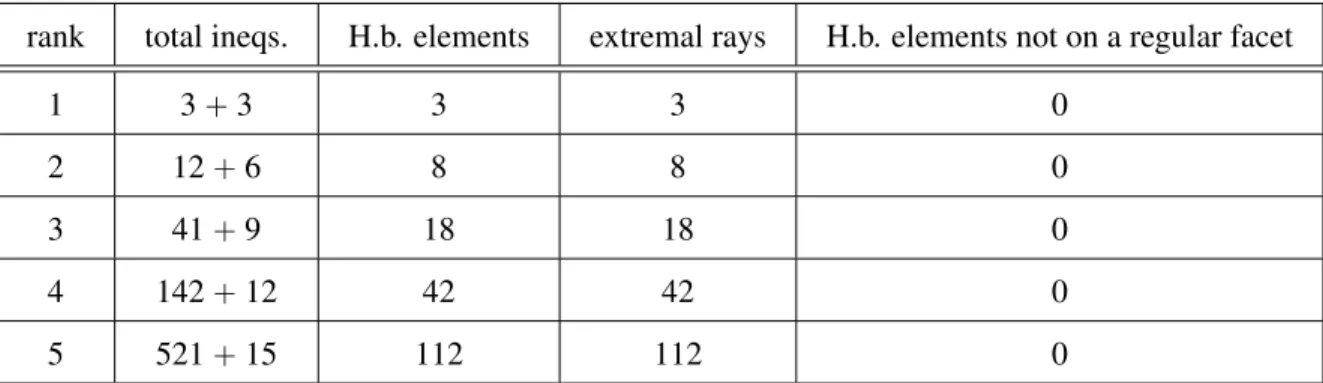
Additionally, we list a summary of computational results - number of (irredundant) inequalities, number of Hilbert basis elements, number of extremal rays - pertaining to the saturated tensor cones of typesA,C, andDand of small rank. For several of these examples, such computations have already been presented in the literature, and we verify that our results agree. In principle, similar computational results could be obtained for typeB(dual to typeC) and the exceptional typesE,F,G.
Finally, we include a discussion of certain Hilbert basis elements forCpSpinp10qqwhich fail to have the “Fulton scaling property.” It was conjectured and proven that all elements of typeAcones have this property,
but a strictly weaker statement holds for general type. 1.1.8 Layout of the thesis
Because of its importance to the main results of this thesis (the rays formulas), we will first establish the generalized Fulton conjecture (Theorems 1.1.11 and 1.1.12) in Chapter 2.
Most of our theorems are proved in Chapter 3: we prove Theorem 1.1.6 on the existence of the divisors giving rise to type I rays (Sections 3.1 and 3.2) and Theorem 1.1.7 for the type I ray formulas (Section 3.3) in succession. Next we prove the decomposition Theorem 1.1.8 (Section 3.4) and the induction Theorem 1.1.9 (Sections 3.5, 3.6, 3.7). Finally, we prove Proposition 1.1.10 in Section 3.8 and discuss the extraneous extremal rays in Section 3.9.
In Chapter 4 we include a few example calculations, some of which were first considered in [BeSj] or [PaRe]; in general there are a wealth of branching situationsGãÑGpone could consider.
1.2 Some preliminary comments on the coneCpGãÑGpq
1.2.1 The setS
Here we recall from the literature the setSparametrizing the inequalities of the coneCpGãÑGpq. Say a
G-dominant one-parameter subgroupδisindivisibleif it cannot be writtenδ“δ¯nas the power of another G-dominant one-parameter subgroup.
In case (A), we takeSto be the set of all indivisibleG-dominant one-parameter subgroups which arise as extremal rays of the coneshQ,`XpvphQ,`aspvvaries inW. See [BeSj, §2] for a more detailed description ofp
these cones.
In case (B),Sis smaller. Say a (nonzero) indivisibleG-dominant one-parameter subgroupδisspecial w.r.t. pG,Gpqif the spanCδ9 Ăhis equal to the common kernel of theh-weights ofplpδq{lpδq. LetSdenote
the set of all special indivisibleG-dominant one-parameter subgroups; it’s easy to seeSis a finite set. This definition ofSis due to Kumar [Kum]. An equivalent definition is given in [ReRi]:Sconsists of dominant indivisible one-parameter subgroupsδsuch thatδis orthogonal to a hyperplane ofh˚spanned byh-weights
ofpg{g. The setSis nonempty since theh-weights ofpg{gspanh˚(this follows from our assumption in case
(B): by the proof of [Kum, Lemma 7.1],hÑEndppg{gqis injective and induces a surjection from the abstract span of theh-weights ofpg{gtoh
˚.)
1.2.2 Proof of Proposition 1.1.5
Here we justify that changing basis on a regular faceFpw,w, δp qofCpGãÑGpqis allowable.
Proof. Let ∆p denote the base for B. Sincep pv´1∆p is the base for Bp1, (a) and (b) follow immediately by
definitions.
As for (c), examine the embedding on the level of Lie algebras:bĎpbis anh-equivariant inclusion, so
ifγis a positive root forB, thengγ Ď à
p
γ|h“γ
pgpγ. Furthermore, the sum on the right is actually just over the rootspγwhich are positive forB. We wish to show that any suchp pγon the RHS is actually positive w.r.t.Bp
1;
equivalently, thatpvpγis positive w.r.t.B.p
To that end, consider the two possible cases: ifxγ,δ9y “ xpγ,δ9y ą 0, thenxpvpγ,pvδ9y ą 0. Since pvδis p
B-dominant, we must havepvpγą0. On the other hand, ifxγ,δ9y “ xpγ,δ9y “0, thenspγδ“δ. Ifpvpγă0, then
show thatφ˚ δprXp1
p v´1
p
wsq ¨ prXwsq “ rXesunder the usual cup product, and secondly that
xρ`w´1ρ,δ9y ´ x2ρ,δ9y ` xpρ1 ``pv
´1
p
w˘´1pρ 1,δ9
y “0,
whereρis the half-sum of positive roots ofBandpρ
1 the same for p
B1.
The first follows immediately from the given productφ˚ δprXp
p
wsq ¨ prXwsq “ rXesand the observation that
rXp
p
ws “ rpvXp1
pv´1wp
s “ rXp1
pv´1wp
s. The second follows from the given identity
xρ`w´1ρ,δ9y ´ x2ρ,δ9y ` xpv ´1ρ
`wp ´1
p
ρ,δ9y “0
and the observation thatρp“pvpρ 1(here
p
CHAPTER 2
A Generalization of a Conjecture of Fulton
An original conjecture of Fulton concerning Littlewood-Richardson numbers says that ifcνλ,µ“1, then for all positive integersN,cNNνλ,Nµ “1. These numberscνλ,µmay be interpreted as structure coefficients in the cohomology of Grassmannians (in the Schubert basis) and as multiplicities of irreducible components of tensor products ofGLnrepresentations. A valid generalization of this conjecture to non-typeAobjects uses both interpretations, with the mantra “multiplicity one in cohomology yields rigidity in representation theory” [BKR]. In this chapter we generalize the result further to the branching context, where the same mantra will continue to hold.
2.1 Generalization of Fulton’s conjecture forGĎGp
With all notation as in the introduction, in this section we prove Theorems 1.1.11 and 1.1.12. As an immediate corollary, we obtain a generalization of Fulton’s conjecture for a pair of reductive groupsGãÑG,p
one embedded in the other. We recall the following deformed pullback in cohomology from [ReRi]. Letρbe half the sum of positive roots forG, and letpρdenote the same forG.p
Definition 2.1.1. Letφ˚
δ be the induced pullback in cohomology for an embedding G{Ppδq ÑGp{Pppδq. Then
in the Schubert basis for H˚pG{Pq, we may write
φ˚ δ
´ rXp
p ws
¯ “
ÿ
wPWP
dw p wrXws
for suitable integers dw p
w. Define
φd δ
´ rXp
p ws
¯ “
ÿ
wPWP
cw p wrXws,
where cw p w“d
w p
w ifxρ`w
´1ρ,δ9y ´ xpρ`
p
w´1pρ,δ9y “0and c
w p
w “0otherwise.
There is another, equivalent, definition of this product which replaces the numerical requirement for cw
p w “d
w p
wwith a geometric one, which is calledLevi-movability(L-movability for short): Proposition 2.1.2. Suppose w,w satisfy dp
w p
w ‰0. Then c w p
vector space map on tangent spaces
Te9pG{Pq Ñ
Te9pG{Pq Te9plw¯´1Xw¯q
‘ Te9pGp{Ppq
Te9pplwp´1Xp
p wq
is an isomorphism, wherew¯ “ w0wwP0 is the dual of w P WP. The latter condition is equivalent to the statement: generic LˆL-translates ofp w¯´1Xw¯ andwp´1Xp
p
wintersect transversally ate.9
Proof. This is [ReRi, Proposition 2.3].
Supposew,w, δp satisfy
φd δ
´ rXp
p ws
¯
d0rXws “drXes (2.1)
for somed ą 0; we do not necessarily require in this chapter thatδPS. As always, we assumePppδqis
standard. We assume thatw,wpare minimal length coset representatives inW{Wδ,Wp{Wpδ.
Theorem 2.1.3(Generalization of Fulton’s conjecture). If d“1in (2.1), then for any ně1,
dim`VLpnχwq bVpLpnpχwpq
˘Lss “1.
2.1.1 Geometric setup
Define the universal intersection scheme
X“ tpg,pg,zq PG{BˆGp{BpˆGp{Pp:zPφδpgXwq XpgXpwpu; (2.2)
the scheme structure comes from the same construction as in [BKR, §5]. For a Schubert varietyXw, let Qw ĂGbe its stabilizer subgroup. LetZwdenote its smooth locus,Ywthe orbitQwwP, andCwthe Schubert cellBwP. Observe that
Xw ĚZwĚYwĚCw.
Define analogous spacesZp
p w,Yp
p w,Cp
p
wfor theG-context. Then by replacingp Xw,Xp
p
win the definition ofXwith the corresponding pairs of subvarieties, we define open subvarieties
We record various properties of these spaces in the following lemma: Lemma 2.1.4. (a) Each ofX,Z,Y,Cis irreducible.
(b) Z,Y,Care all smooth.
(c) XzZis codimensioně2insideX.
The proofs of these statements are identical to those of [BKR, Lemma 5.2], so we omit them here. Assumed“1 in (2.1). Thenπ:ZÑG{BˆGp{Bpis a birational morphism of smooth varieties, andπ
fails to be injective exactly where the map on tangent planes is not an isomorphism. We useRto denote the associatedramification divisor, and may use the symbolRto mean analogous divisorsRXYandRXC, depending on the context.
The proof of Theorem 1.1.11 relies on the following crucial geometric result of [BKR, Proposition 3.1], which we recall without proof:
Proposition 2.1.5. Supposeπ:XÑY is a regular birational morphism of smooth irreducible varieties with Y projective, and supposeX is an irreducible projective scheme containing X as an open subscheme such that¯
(a) the codimension ofX¯zX inX is at least¯ 2, and (b) πextends to a regular mapπ¯ : ¯X ÑY. Set R to be the ramification divisor ofπ. Then
dimH0pX,OpnRqq “1
for every ně1.
When applied to our context, we obtain the following result:
Corollary 2.1.6. Suppose equation (2.1) holds with d“1. Then for every integer ně1,dimH0pZ,OpnRqq “
1.
Proof. In the setting of the proposition, take X “ Z, Y “ G{BˆGp{B, andp π : Z Ñ G{BˆGp{Bp the
projection map. Here X plays the role of ¯X. By Lemma 2.1.4, Z Ď Xis an open subscheme whose
2.1.2 Comparison ofYandZand proof of Theorem 1.1.11
Theorem 1.1.11 is a statement about sections onY, and our previous corollary pertains toZ, so we connect the two here, thereby proving the theorem.
Proposition 2.1.7. There exists a subvariety AĂZsuch thatcodimpA,Zq ě2andZzYĎAYR. Proof. A pointpg,pg,zq P ZzY if and only ifz P φδpgZwq XpgZpwp but z R φδpgYwq XpgYpw. That is,p z P φδpgCvq XpgCppvfor somev,pvPW
P
ˆWppPsuch thatCvĘYworCp
pvĘYpw, butp CvĎZwandCppv ĎZpw. In otherp words,
ZzY“
ğ
pvP,pvPpq PZwˆZp
p w
pvP,pvPpq RYwˆYp
p w
´
pGˆBCvq ˆ pGpˆ
p BCppvq
¯
ˆG{PˆGp{PpGp{P.p
loooooooooooooooooooooooooomoooooooooooooooooooooooooon
“:Cv,pv
By inspection, the codimension ofCv,pvinsideZis equal to codimpCv,Zwq `codimpCppv,Zpwpq. Therefore, if we show that the codimension 1 cellsCv,pvthat are disjoint fromYare contained inR, we may takeAto be the disjoint union of the remaining cells in the above expression and the result will follow.
To that end, we observe that (givenpvP,pvPpq PZwˆZpw) codimp pCv,Zwq `codimpCppv,Zpwpq “1 if and only if
(C1) vÝÑβ wandpv“wpfor some rootβPΦ `or
(C2) v“wandpv β Ý
Ñwpfor some rootβPΦp `
(these are obviously mutually exclusive). Furthermore, ifβ is a simple root in either (C1) or (C2), then Cv,pv ĂYby [BKR, Proposition 7.2] (since thenCv ĂYwin case (C1) orCvp ĂYpwpin case (C2)). So the result follows from
Proposition 2.1.8. If v,pv satisfy either (C1) or (C2) withβnot simple, thenCv, p
vX pZzRq “ H.
The proof is deferred until the next subsection.
Therefore we have the inclusions
CãÑH0pY,OpnRqqG ãÑH0pY,OpnRqqãÑH0pZ,OpmpnqRqq »C
for eachn, and the result follows.
2.1.3 Tangent space analysis
This section is devoted to the proof of Proposition 2.1.8. The following lemma is proved in [BKR, Lemma 7.3]:
Lemma 2.1.9. Suppose vÝÑβ wPWP. As H-modules,
Tv9pXwq » ˜
à
γPΦ`XvΦ´ gγ
¸
‘g´β.
Equivalently, as H-modules,
Te9pv´1Xwq » ˜
à
γPv´1Φ`XΦ´ gγ
¸
‘g´v´1β.
As a direct sum ofH-eigenspaces,
Te9pG{Pq “ à
βPΦ`zΦ` l
Te9pG{Pq´β.
Define, for any jPZ,
Vj :“
à
βPΦ`zΦ`l
βpδ9q “ j
Te9pG{Pq´β.
Note thatVj “ p0qif j ď 0 or j ą m0 :“ maxβtβpδ9qu. DefineVjpZq :“ Vj XTe9pZq for anyH-stable
subvarietyZĎG{Pcontaininge. Then9
Te9pZq “ à
j VjpZq
Recall the following important theorem from [BKR, Theorem 7.4] (see also [Re1, Proposition 3]). Although the original statement uses a different filtrationVjthan that given byδ, the same proof goes through unchanged (just replacexPwithδ9everywhere).
Theorem 2.1.10. Given that u ÝÑβ w PWP andβis not simple, there exists j such thatdimVjpu´1Zwq ‰ dimVjpw´1Zwq.
In exact parallel,
Te9pGp{Ppq “ à
p
βPΦp`zΦp`
pl
Te9pGp{Ppq ´pβ,
and one may define
p
Vj :“
à
p
βPΦp`zΦp`
pl
p
βpδ9q “ j
Te9pGp{Ppq ´pβ.
Analogously, ifpu
p
β Ý
ÑwpPWp
p Pand
p
βis not simple, there exists a jsuch that dimVjppu´1Zp
p
wq ‰dimVjpwp ´1
p
Z p wq. Becausedφδ : Te9pG{Pq ãÑ Te9pGp{Ppqis anH-equivariant inclusion, it follows that for anyβ PΦ, the
restriction ofdφδsatisfies
dφδ:Te9pG{PqβãÑ à
p
βˇˇ
h”β
Te9pGp{Ppq
p
β.
In particular, then,dφδ:VjãÑVpjfor each jPZ.
The gradingsVj,Vpjgive rise to filtrationsFj,Fpj ofTe9pG{Pq,Te9pGp{Ppq, respectively. With respect to
the adjointP-action onTe9pG{Pq(resp.,PponTpe9pGp{Ppq), eachFjisP-stable (resp., eachFpjisP-stable). Letp
FjpZq,FpjpZqmean the induced filtrations of anyTe9pZq.
Now we introduce a lemma similar in spirit to [BKR, Lemma 4.2]. The following setup is essentially the same. LetY ĂXbe irreducible smooth varieties,Y locally closed inX. SupposeXhas a transitive action by a connected linear algebraic groupG, and supposeHis an algebraic subgroup fixingY. For anyyPY, define φy :GÑXbygÞÑgy. Then for anygPG, there is an induced tangent space map
BecauseYisH-stable, there is an induced map
Φpg,yq:Tg¯pG{Hq ÑTgyX{TgypgYq.
One easily checks thatΦpg,yq“Φpgh,h´1yqifhPH, so for each equivalence classrg,ys PGˆHY the map Φrg,ysis well-defined. The transitivity of theG-action implies that the mapsΦrg,ys are surjective.
Supposea“ rg,zs,rpg,pzs PZ. Definex“gz,px“pgpz. In particular,px“φδpxq. Consider the following
diagram of maps of tangent spaces
TaZ TgpG{Bq ‘TpgpGp{Bpq
TxpG{Pq
TxpG{Pq
TxpgZwq
‘TpxpGp{Ppq TpxppgZp
p wq
, dπ
dmˆ Ψrg,zsˆΨrpg,pzs
(2.3)
where the bottom horizontal map is the canonical projection in the first factor and dφδ followed by the canonical projection in the second factor.
Lemma 2.1.11. Diagram (2.3) commutes. In fact, it is a fibre-product diagram. Proof. An arbitrary curve throughainZmay be expressed as
prgptq,zptqs,rpgptq,pzptqsq, wheregp0q “g, etc. The image underdπof this curve’s initial velocity is the initial
velocity of
ˆ
gptq,gyptq ˙
. Its further image underΨrg,zs ˆΨrpg,pzsis the pair of projections in the respective quotients of the initial velocities ofgptqzptqandpgptqpzptq. Note thatpgptqpzptq “φδpgptqzptqqfor allt. Therefore
the curve’s image via the down and across compositions agree and the diagram commutes. ThatTaZis a subspace of (i.e., includes into) the fibre-product is clear since, for a curve
ˆ
gptq,gyptq ˙
throughpg,pgqinTgpG{Bq‘TpgpGp{Bpqand correspondingxptqthroughxinG{P, the curveprgptq,zptqs,rpgptq,pzptqsq can be uniquely recovered viazptq:“gptq´1xptq,pzptq:“pgptq
Counting dimensions,
dimZ“dimG{P` ´
dimpGˆBZwq `dimpGpˆ
p BZp
p wq
¯ ´
´
dimG{P`dimGp{Pp ¯
“dimG{P`dimG{B`dimZw`dimGp{Bp`dimZp
p w
´dimG{P´dimGp{Pp “dimG{P`
´
dimG{B`dimGp{Bp ¯
´ pdimG{P´dimZwq
´ ´
dimGp{Pp´dimZp
p w
¯
,
soTaZhas the correct dimension and the result follows.
Now we come to the desired result.
Proof of Proposition 2.1.8. Assume, for the sake of contradiction, that there existv,pvsatisfying either (C1)
or (C2) withβnot simple, and that there existsa “ rg,zs,rpg,pzs P Cv,pvXZzR. Set x “ gz,px “ pgpz; note
p
x“φδpxq. By leftG-translation, assumex“eP9 (this is possible sinceCv, p
v,Z,Rare allG-invariant.) ByaRR,dπis an isomorphism, so
Te9pG{Pq »
Te9pG{Pq
Te9pgZwq
‘ Te9pGp{Ppq
Te9ppgZp
p wq
by Lemma 2.1.11. Becausea PCv,pv, writeeP“gz“gbvPfor suitablebP B, andePp “pgpz “pgpbpvPpfor somepbPB. So writep g“pv´1b´1,pg“ pppv´1pb´1for suitablepPP,ppPP. Sop Te9pgZwq “Te9ppv´1Zwqand
Te9ppgZp
p
wq “Te9ppppv ´1
p
Z p wq. Observe that
Fj Ñ Fj
Fjppv´1Zwq
‘ p
Fj
p
Fjppppv ´1Zp
p wq
is therefore injective for each j, so
dimFjďdimFj´dimFjppv´1Zwq `dimFpj´dimFpjppppv´1Zp
p
wq. (2.4)
Furthermore, dimFjppv´1Zwq “ dimTe9ppv´1Zwq XFj “ dim Adp
`
Te9pv´1Zwq XFj
˘
“ dimFjpv´1Zwq since AdppFjq “Fj. Likewise, dimFpjp
p
ppv´1
p
Z p
wq “dimFpjppv´1Zp
Now, the argument of [BKR, Eq. (38) and paragraph preceding it] shows that for each jthe inequalities
dimFjpw´1Zwq ďdimFjpv´1Zwq and dimFjppwp´1Zp
p
wq ďdimFjpppv´1Zp
p
wq (2.5)
hold in general. Furthermore, by Theorem 2.1.10, there exists a j“ j0such that
dimFjpw´1Zwq ‰dimFjpv´1Zwq or dimFjppwp´1Zp
p
wq ‰dimFpjppv´1Zp
p
wq, (2.6)
depending on whether (C1) or (C2) holds. On the other hand, byL-movability,
ψ:Te9pG{Pq Ñ
Te9pG{Pq Te9plw´1Xwq
‘ Te9pGp{Ppq
Te9pplwp´1Xp
p wq
is an isomorphism for genericl,plPLˆpL.
The latter decomposes (sincelw´1Xw,
plwp´1Xp
p
wareZpLq-stable) as
˜
m0
à
j“1
VjpG{Pq Vjplw´1Xwq
¸
‘ ˜
m0
à
j“1
p
VjpGp{Ppq p
Vjpplwp´1Xp
p wq
¸
,
andψpreservesH-weight spaces with the sameδaction, for each jwe must have
VjpG{Pq »
VjpG{Pq Vjplw´1Xwq
‘ p
VjpGp{Ppq p
Vjpplwp´1Xp
p wq
.
Therefore
dimFj“dimFj´dimFjplw´1Xwq `dimFjp ´dimFjppplwp´1Xp
p
wq (2.7)
Finally, with j“ j0,
dimFjďdimFj´dimFjpv´1Zwq `dimFpj´dimFpjppv´1Zp
p
wq by (2.4)
ădimFj´dimFjpw´1Zwq `dimFpj´dimFpjppw´1Zp
p
wq by (2.5), (2.6)
“dimFj by (2.7),
a contradiction.
2.1.4 Relation to representation theory forLss
The schemeYis intriguing on its own as indicated by 1.1.11. However, our first step in proving Theorem 1.1.12 is to exchangeYandRfor a related pair of varieties.
Define
Y1 :“ ´
pGˆQwYwq ˆ pGpˆQp
p
wYpwpq
¯
ˆG{PˆGp{PpGp{P,p
a scheme closely related to (and constructed analogously to)Y. Set-theoretically, we have (cf. (2.2))
Y1“ tpg,pg,zq PG{QwˆGp{QpwpˆGp{Pp:zPφδpgYwq XpgYpwpu.
The surjectionsGˆB Yw Ñ GˆQw Yw andGpˆBpYpwp Ñ GpˆQp
p
w Ypwp give rise to the surjective morphism YÑY1. In fact, the following diagram is a fibre diagram:
Y Y1
G{BˆGp{Bp G{QwˆGp{Qp
p w. ˜
p
π π1
Furthermore,π1is a dominant morphism. By [BKR, Lemma 4.1], for eachn ě1,
H0pY,OpnRqq »H0pY1,O pnR1
asG-modules, whereR1is the ramification divisor ofπ1.
There is a helpful equivalent description ofY1, thanks to the following lemma (the proof is
Lemma 2.1.12. Define
P:“ ´
P{w´1QwwXPˆPp{pw´1Qp
p wwpXPp
¯
.
Thenψ:GˆPPÑY1given byrg,p,¯ pps ÞÑ prgpw
´1,wPs,rg
p
pwp ´1,
p
wPps,gPpqis an isomorphism.
We will now relateOpR1
qto a line bundle onPand then to the representation theory ofL. First let us recall some properties of the Borel construction of line bundles:
Proposition 2.1.13. Let R be a reductive algebraic group with B a Borel subgroup of R. Suppose R1 is a subgroup of R satisfying BĎR1.
(a) For any characterχ:R1 Ñ
Cˆ,Lχ:“RˆR1C´χis a line bundle on R{R1. (b) The pullback map induces an isomorphism H0pR{R1,Lχq »H0pR{B,Lχq.
Proof. Part (a) is standard. Global sections ofLχcan be thought of as algebraic functions f :RÑCsuch that fprr1
q “χpr1
qfprqfor allrPR,r1
PR1. ThenR-invariant global sections are those functions which also
satisfy fprxq “ fpxqfor anyrPR.
For (b), we observe that f : R Ñ Csatisfying fprr1q “ χpr1qfprq for allr PR,r1 P R1 also satisfies fprbq “χpbqfprqfor allrPR,bPB. Therefore there is a (clearly injective) pullback mapH0pR{R1,Lχq Ñ
H0pR{B,Lχq. Suppose f :RÑCis a global section onR{Bonly. We wish to argue that fprr1q “χpr1qfprq for allr1PR1and thus obtain surjectivity of the map. SinceR1is a parabolic subgroup, it is generated byBand
thoseU´αcontained inR1(αbeing a simple root forB). So it would suffice to show that fpruq “χpuqfprq
for alluPU´αfor such anα. First of all, note thatχpuq “1 sinceuis unipotent, so we really aim to show fpruq “ fprq. Now setRαto be the rank 1 subgroup ofR1generated byU
˘α. Fix anrPRand consider the map
P1»Rα{BXRα ÑC
given by ¯xÞÑ fprxq. It is well-defined since fpruq “χpuqfprq “ fprqforuPUαand fprtq “χptqfprq “
fprqfortthe generator of the torus ofRα(sincetis generated byU˘α,χptq “1). SinceP1has only constant functions, ifuPU´αthen ¯uand ¯1 map to the same element and therefore fpruq “ fprqas desired.
Lemma 2.1.14. The torus weight χw : H Ñ Cˆ extends to a character of w´1QwwXP. Likewise,χwp extends to a character ofwp´1
p
Q p wwpXP.p
Proof. The second statement is simply the application of the first to a different group, so we prove the first statement. We naïvely defineχw : w´1QwwXP Ñ Cˆ by settingχwpuq “ 1 for allu P Uα, Uα a root
subgroup ofw´1Q
wwXP(we have no choice in this as suchuare unipotent). Thenχwwill be well-defined if,
wheneverUα,U´αare both root subgroups,χwpα_q “0 (2.8)
(on the algebra level).
We first make a reduction:U˘αĎw´1Q
wwXPimpliesαis actually a root forL. So we may restrict our attention to root subgroups ofw´1Q
wwXL. Note thatw´1QwwXLĚ BL, sow´1QwwXLis a standard parabolic ofL. Therefore it suffices to check (2.8) only for simple rootsαofL.
This is fairly straightforward: if´αis a root forw´1Qww, then´wαis (a) a negative root and (b) a root forQw. Therefore´wαcan be expressed as a negative sum of simple roots forQw:
´wα“ ÿ
´niβi,
where theniě0 andtβiu “∆pQwq “∆XwpΦ`l \Φ´q. Rearranging, one obtains
α` ÿ
w´1β
iă0
nip´w´1βiq “
ÿ
w´1β
iPΦ`l
niw´1βi.
Now, eachw´1βion the LHS cannot be an element ofΦ´
l by the length-minimality ofwin its coset. Therefore if the LHS has anynią0, we reach a contradiction because the LHS is a sum of positive roots (forG), some of which are not roots forL, but the RHS is a sum of positive roots forL. So
α“ ÿ
w´1β
iPΦ`l
niw´1βi.
Therefore
χwpα_q “ρpα_q `w´1ρpw´1β_j q ´2ρLpα_q “1`ρpβ_j q ´2
“0.
Lemma 2.1.15. Supposeµ,pµare dominant weights of H,H such thatp pµ`pµqpδ9q “0. Then the pullback map
H0pP{BLˆPp{Bp
p
L,LpµqbLppµqq P
ÑH0pL{BLˆpL{Bp
p
L,LpµqbLppµqq L
is an isomorphism.
Proof. This is just a restatement of Proposition 3.2.5, which will be proved below.
Proposition 2.1.16. Supposeφdδ
´ rXp
p ws
¯
d0rXws “drXes PH˚pG{Pqfor some dą0. Then
H0pY,OpnRq|YqG»
`
VLpnpχw´χ1qq˚bVpLpnpχwpq
˚˘L
.
Proof. LetTP “Te9pG{Pq,TPp“Te9pGp{Ppq,Tw“Te9pΛwq, andT
p
w“Te9pΛppwq.
For a pointpg,p,ppq PGˆPP, seta“ψprg,p,ppsq. we have the diagram
Tpg,p,ppqpGˆPPq TaY
1 T
gpw´1pG{Qwq ‘Tg p pwp
´1pGp{Qp
p wq
TgPpG{Pq TgPpG{Pq
TgPpgpw´1Ywq ‘
TgpPpGp{Ppq
TgpPpgppwp´1Yp p wq
,
„
dψ
dπ
dmˆ
which is a fibre-product diagram for the same reason as (2.3). There areP-equivariant isomorphisms
P{w´1QwwXPˆTP»Pˆw´1Q
wwXPT
and
p
P{pw´1Qp
p
wwpXPpˆT
p P
»Ppˆ
p w´1Qp
p
wwpXPp TPp
given bypp,¯ vq ÞÑ pp,p´1vqin both cases, cf. [BK1, Definition 5]. Therefore there exist maps
PˆTP ÑP{w´1QwwXPˆTP »Pˆw´1Q
wwXPT
P
ÑPˆw´1Q
wwXPpT
P
{Twq
and
PˆTPÑ Pp p
w´1Qp p wwpXPp
ˆTPãÑ Pp p
w´1Qp p wwpXPp
ˆTPp
»Ppˆ
p w´1Qp
p
wwpXPp TPp
Ñ Ppˆ
p w´1Qp
p
wwpXPppT p P
{T p wq.
The map between fibres of the bundle map
GˆPpPˆTPq ÑGˆPpPˆw´1Q
wwXPpT P
{Twqq ‘GˆPpPpˆ
p w´1Qp
p
wwpXPppT p P
{T p wqq
over a pointpg,p,ppq PGˆPPis readily identified with the map
TgPpG{Pq Ñ TgPpG{Pq
TgPpgpw´1Ywq
‘
TgpPpGp{Ppq
TgpPpgppwp´1Ypwpq ;
therefore the ramification divisorψ´1pR1qinGˆ
PPis the same as the ramification divisor of the bundle map
GˆPpPˆTPq ÑGˆPpPˆw´1Q
wwXPpT
P
{Twqq ‘GˆPpPpˆ
p w´1Qp
p
wwpXPpp TPp
{Twpqq
overGˆPP. Setting
M“LPpχw´χ1qbLPppχwpq,
Therefore for anyn,
H0pY,OpnRqqG»H0pY1,OpnR1qqG
»H0pGˆPP,GˆPMbnqG
»H0pP,Mbn
qP.
Finally, setL“L{pw´1Q
wwXLq ˆpL{pwp´1Qp
p
wwpXLpq. Then, by Lemma 2.1.15 and Proposition 2.1.13(b)
(see also [BK1, Theorem 15, Remark 31(a)]), it also holds that
H0pP,Mbn
qP »H0pL,pM|LqbnqL,
from which the result follows.
Proof of Theorem 1.1.12 Theorem 1.1.12 is essentially proved. We simply make the following observation comparing invariants forLandLss.
Lemma 2.1.17. There is a canonical isomorphism
“
VLpnpχw´χ1qq˚bVpLpnpχwpq
˚‰L
»“VLpnχwq˚bVpLpnpχwpq
˚‰Lss
.
Proof. SinceZpLqhas trivial action on all ofVLpnpχw´χ1qq bVpLpnpχwpq, we know
“
VLpnpχw´χ1qq˚bVpLpnχpwpq
˚‰L
»“VLpnpχw´χ1qq˚bVpLpnpχwpq
˚‰Lss
via the identity map. ButVLpnpχw ´χ1qq˚ and VLpnpχwqq˚ are the same as vector spaces and as Lss representations; they only have differentZpLqactions. Thus the result follows.
2.2 Interlude
We will need the “Cversion of Theorem 1.1.11” in the next chapter, so this section serves as the bridge between the generalized Fulton’s conjecture and the type I rays. The proof of the following lemma is straightforward and omitted; compare with Lemma 2.1.12.
Lemma 2.2.1. C»GˆP
´
P{w´1Bw
XPˆPp{wp´1BpwpXPp ¯
Proposition 2.2.2. For all ně1, H0pC,OpnRqqG»C.
Proof. The idea of the proof is to exchangeY1(see the end of proof of Proposition 2.1.16) forC, which we
hope is manageable since they both appear asGˆPpa homogeneousPˆP-varietyp q.
Consider the maps
P{BLˆPp{Bp
p
L P{w
´1Bw
XPˆPp{pw´1BpwpXPp
P, f1
f
f2
wherePis as in Lemma 2.1.12; all arrows are the natural surjections (we are using thatwBLw´1ĎBand
p
wBp
p Lwp
´1Ď
p
B). TakeMas in Proposition 2.1.16. Then by Proposition 2.1.13(b), all arrows in H0pP{BLˆPp{Bp
p L,pf
˚M
qbnq H0pP{w´1Bw
XPˆPp{pw´1BpwpXP,p pf˚
2Mq
bn
q
H0pP,Mbn
q,
f˚ 1
f2˚ f˚
areP-equivariant isomorphisms. The bottom vector space hasP-invariants»Cfor anyně1 by Proposition 2.1.16. Finally, by the commutativity of the following diagram:
Y
C Y1,
¯ p
ι
idˆf2
we ascertain that (for anyně1)
OpnR|Cq “ι˚OpnRq »ι˚p¯˚OpnR1q » pidˆ f2q˚pGˆPMbnq “GˆPpf2˚Mqbn.
Therefore
H0pC,OpnRqqG»H0pC,GˆPpf2˚MqbnqG
»H0pP{w´1BwXPˆPp{pw´1BpwpXP,p pf2˚MqbnqP »C
CHAPTER 3
Extremal Rays of the Embedded Subgroup Saturation Cone
This chapter contains the statements and proofs of the formulas for extremal rays ofCpG ãÑGpq. We
begin by focusing attention on an arbitrary regular faceF given by the data ofw,w, δp satisfying
φd δ
´ rXp
p ws
¯
d0rXws “ rXes (3.1)
in the ringH˚pG{P;d0q(cf. Thm 1.1.1 in the Introduction). On this face, we first identify a series of “type I” rays coming from certainG-invariant divisors inG{BˆGp{B. We secondly decompose the face into the spanp
of its type I rays and a smaller coneF2. The rays onF2are called “type II” and we show that they are images of extremal rays under a linear map from a related cone, which we describe.
Finally, there could be some rays of CpG ãÑ Gpqwhich are not on any regular face, so we show that
the possible candidates for such rays are finite and easily described, and then we give a truncated list of conditions useful for checking whether a possible ray of this type is actually an extremal ray.
3.1 Type I extremal rays
In this section we introduce the divisors Dpvq Ă G{BˆGp{Bpwhose associated line bundles, via the
Borel-Weil theorem, give generatorspµ,pµqof certain extremal rays on a given regular face.
Supposew,w, δp satisfy (3.1). We assume, as always, thatPppδqis a standard parabolic. We also assume
w,wpare minimal-length representatives in their cosets insideW{Wδ,Wp{Wpδ. LetXĚZĚYĚC, as well
asR, be as in Section 2.1.
As in the introduction, suppose eithervÝÑβ worvÝÑβ wpfor some simple rootβ(for the appropriate root
system). In the first case, setu“v,pu“w. Otherwise in the second, setp u“w,pu“v. Define
˜
Dpvq:“ tpg,pg,zq PG{BˆGp{BpˆGp{Pp:zPφδpgXuq XpgXppuu
and setDpvq “πpD˜pvqq, the projection of ˜DpvqontoG{BˆGp{B. Although it is clear that ˜p Dpvqis codimension
prove now:
3.1.1 Proof of Theorem 1.1.6(a) The result will follow from Lemma 3.1.1. D˜pvq XY´R‰ H.
Indeed, this prevents ˜Dpvqfrom being contained inRand thus being contracted to a codimensioně2 subvariety ofG{BˆGp{B. By the arguments of [BKR, Lemma 5.2] (cf. Lemma 2.1.4(a)), ˜p Dpvqand hence
alsoDpvqare irreducible.
Proof. Take any pointpg,pg,zq PC´R. Then
zPφδpgCwq XpgCpwpĎφδpgXwq XpgXpw.p
By the tangent space requirement (away from R), the preimage of pg,pgq P G{BˆGp{Bp under πis
1-dimensional, and containspg,pg,zq. By Zariski’s main theorem, this preimage is also connected. Therefore
we conclude
φδpgCwq XpgCpwp “φδpgXwq XpgXpwp“ tzu,
a single point. Now,z“φδpxPqfor somexPPgBwP. GivenxPp“gbwPp“pgpbwpPpfor suitableb,pb, we may
replacegb,pgpbwithg,pgwithout changing the cosetsgB,pgB. Furthermore, we may as well assumep x“gw.
Then for suitable ppPP,p
x“gw“pgwppp.
As bothCandRare (diagonal)G-invariant, we may translate bypgwq´1to obtainpw´1,
pp ´1
p
w´1,e
p
Pq PC´R. Observe that
tePpu “φδpw´1Cwq Xpp´1wp´1Cp
p
wĎφδpw´1Ywq Xpp ´1
p
w´1Yp
p w
Ďφδpw´1Xwq Xpp ´1
p
w´1Xp
p
w“ tePpu,
so equalities hold all around.
and thereforepv´1,pp ´1
p
w´1,ePpq PY´R. This point also lies in ˜DpvqsinceePpis included in bothv´1BvPp
andpp ´1
p
w´1
p
BwpP.p
In the other case,sβ PQ p
wandsβYp
p w“Yp
p
w. Againwp ´1
“v´1s
β, so
tePpu “φδpw´1Ywq Xpp´1v´1Yp
p w
andpw´1,
p
p´1v´1,e
p
Pq P Y´R. This point also lies in ˜Dpvq sinceePpis included in bothw´1BwPpand p
p´1v´1
p
BvP.p
We conclude that, in either case, ˜Dpvq XY´R‰ H.
Like in [BeKi, Corollary 2.3], the above proof lets us also conclude thatπ˚pD˜pvqq “Dpvqas divisors. 3.1.2 Proof of Theorem 1.1.6(b)
Recall that by Proposition 2.2.2,
H0pC´R,OqG»C.
We relateG-invariant functions onC´Rwith those onG{BˆGp{Bpaway fromDpvqby means of
Lemma 3.1.2. πpC´Rq ĎG{BˆGp{Bp´Dpvq.
Proof. Assumepg,pgq PDpvqis in the image ofC´R. Then there exists a uniquezsuch that
tzu “φδpgCwq XpgCpwp“φδpgXwq XpgXpwp,
and there exists az1 such that
z1 PφδpgXvq XpgXpw,p
or the analogous statement forv ÝÑβ w. Of course,p gXv Ă gXw, soz
1 P φδpgXwq X p
gXp
p
w impliesz “ z1. However,φδ is injective and gXv is disjoint fromgCw, which showsz ‰ z1, a contradiction. A similar
contradiction arises in the other case.
We come now to the proof of Theorem 1.1.6(b): Any f P H0pG{BˆGp{B,p OpmDpvqqqG, viewed as a
G-invariant function onG{BˆGp{Bp´Dpvq, can be pulled back to aG-invariant function onC´Rviaπ. Now
G{BˆGp{Bp´Dpvq. Therefore f itself is actually constant. We conclude thatH0pG{BˆGp{B,p OpmDpvqqqG
is 1-dimensional for allm.
3.1.3 Proof of Theorem 1.1.6(c)
This statement follows from part (b) exactly as in [Be2, Lemma 2.1]. 3.2 Parameter stacks for type I rays
In this section we introduce some of the core geometry of the paper, using quotient stacks to describe a Levification procedure and prove Proposition 3.2.5, and we prove Theorem 1.1.6(d).
3.2.1 Review of principalG-spaces
Definition 3.2.1. For us, aprincipalG-spaceE is a variety with a right G action such that for any xPE, the map GÑE given by gÞÑxg is an isomorphism.
Ifφ:GÑ H is a morphism of linear algebraic groups, then
EˆGH“ tpe,hq PEˆHu{pe,hq „ peg, φpgq´1hq
is naturally a principal H-space.
We also define the notion ofrelative position.
Lemma 3.2.2. Let E be a principal G-space and BĎPĎG as usual. Letg¯ PE{B,z¯PE{P. Then there is a unique wPWPsuch that there exist bPB,pPP satisfying
z“gbwp´1.
Proof. There is a uniquey PGso thatgy “z. Anyy PGis expressible asbwp´1for somebP B,p PP, w P W; furthermore, the choice ofwis unique toy. Thusz “ gbwp´1 as prescribed. Furthermore, the choices ofg,zas representatives for ¯g,¯zdo not affectw, given thatb,p´1are free to change accordingly.
We define therelative positionrg,¯ z¯s PWPto bewas above. 3.2.2 Introduction of universal intersection stacks
We introduce the following stacks, similar in nature to those of [BeKi, §3.4].
with sections ¯gPE{BandpgP pEˆGGpq{B).p
FixingxPE,g“xhandpg“ px,phqdefines elements ¯hPG{BandphPGp{B. Changing representativesp
for ¯gandpgdoes not change ¯handph. Changingxtoxg˜ for ˜gPGchanges ¯h,phto ˜g´1hand ˜g´1ph. Thus
as stacks,
FlG “ ”´
G{BˆGp{Bp ¯
{G
ı
,
where the RHS is the quotient stack with rightG-action given by left multiplication byg´1.
‚ Similarly, set FlL “ ”´
L{BLˆpL{Bp
p L
¯ {L
ı
, which parametrizes principal L-spacesF together with ¯
qPF{BLandpqP pFˆLpLq{BppL.
‚ LetCpbe the stack parametrizing principalG-spacesE, elements ¯g PE{B,pg P pEˆGGpq{B, and anp
element ¯zPE{Psatisfying
rg,¯ ¯zs “w and
”
p
g,pz,eq ı
“w.p
Then, similar to above,Cp“ rC{Gs.
Observe that there is a natural map π : CpÑ FlG induced by theG-equivariant morphismπ : C Ñ
G{BˆGp{B.p
The following lemma will help us identify maps betweenCpand FlL.
Lemma 3.2.3. The stackCpparametrizes principal P-spaces E1together with elementsy¯ PE1{pw´1BwXPq
andpyP pE 1
ˆPPpq{ppw´1BpwpXPpq.
Proof. This is simply a reformulation of Lemma 2.2.1.
The equivalent description of Cpgiven by Lemma 3.2.3 allows us to use the inclusion L Ñ P and
projectionPÑ P{U“Lmaps to define maps FlLÑCpandCpÑFlL, respectively. We describe these maps
now.
First recall (cf. [BeKi, Lemma 3.2]) thatBLĂw´1BwXPand that, ifφ:PÑ Lis the quotient map, φpw´1BwXPq “ BL. Thus ifF is a principalL-space with ¯qP F{BLandpqP pFˆLpLq{BppL, theP-space FˆLPand elementspq,eq P pFˆLPq{pw´1BwXPqandppq,eq P pFˆLPpq{ppw´1BpwpXPpqare well-defined.
Conversely, ifE1 is a principalP-space with ¯y P E1
{pw´1Bw
XPqandpy P pE 1
ˆPPpq{pwp´1BpwpXPpq, the
L-spaceE1
ˆPLand elementspy,eq P pE1ˆPLq{BLandppy,eq P pE1ˆPpLq{Bp
p
3.2.3 The main diagram of stacks
There are natural maps of stacksCÑCpandG{BˆGp{BpÑFlG, and these commute with the relevant
mapsπ. Introducing the map ˜i“π˝i, we present the following useful diagram of stacks:
C Cp
G{BˆGp{Bp FlG FlL
π π τ
˜ i i
3.2.4 Line bundles onCpandFlLare related (Levification)
LetZpLqdenote the center ofL, andZ0pLqits connected component containing the identity. Recall the following definition from [BeKi, Definition 3.7]:
Definition 3.2.4. LetMbe a line bundle onFlL, viewed as an L-equivariant line bundle on L{BLˆLp{Bp
p L. Then ZpLqand, in particular, Z0pLqact on each fibre ofM. Because the group of characters of Z0pLqis discrete, the map
X:“L{BLˆpL{Bp
p
LÑHompZ 0
pLq,Cˆq
is constant (X is connected). ThusMgives rise to a singleγM:Z0pLq ÑCˆ, andγMcan be defined even if Mis only defined over a connected subset of X (for example, any Zariski open subset, given irreducibility of X).
The following proposition generalizes [BeKi, Proposition 3.8]:
Proposition 3.2.5. Let U be a non-empty open substack ofFlL,La line bundle onτ´1pUqandM“i˚L, a
line bundle on U. Then
(a) L“τ˚M. This showsτ˚: PicpUq ÑPicpτ´1pUqqis an isomorphism with inverse i˚.
(b) IfγMis trivial, then H0pτ´1pUq,Lq ÑH0pU,Mqis an isomorphism.
Before embarking on the proof, we set up the generalized setting for Levification (cf. [BeKi, §3.6]); here the role oftxL will be played byδptq.
Definition 3.2.6. Define a family of mapsψ:PpˆC˚ ÑP byp ψtppq “δptqpδptq´1for tPC˚.