Impact of non-menthol
fl
avours in tobacco products
on perceptions and use among youth, young adults
and adults: a systematic review
Li-Ling Huang,
1Hannah M Baker,
2Clare Meernik,
2Leah M Ranney,
1,2Amanda Richardson,
1Adam O Goldstein
1,2ABSTRACT
Objective This systematic review examines the impact of non-mentholflavours in tobacco products on tobacco use perceptions and behaviours among youth, young adults and adults.
Data sources English-language peer-reviewed publications indexed in 4 databases were searched through April 2016.
Study selection A search strategy was developed related to tobacco products andflavours. Of 1688 articles identified, we excluded articles that were not English-language, were not peer-reviewed, were qualitative, assessed menthol-flavoured tobacco products only and did not contain original data on outcomes that assessed the impact offlavours in tobacco products on perceptions and use behaviour.
Data extraction Outcome measures were identified and tabulated. 2 researchers extracted the data independently and used a validated quality assessment tool to assess study quality.
Data synthesis 40 studies met the inclusion criteria. Data showed that tobacco product packaging with flavour descriptors tended to be rated as more appealing and as less harmful by tobacco users and non-users. Many tobacco product users, especially adolescents, reported experimenting, initiating and continuing to use flavoured products because of the taste and variety of theflavours. Users of manyflavoured tobacco products also showed decreased likelihood of intentions to quit compared with non-flavoured tobacco product users. Conclusions Flavours in most tobacco products appear to play a key role in how users and non-users, especially youth, perceive, initiate, progress and continue using tobacco products. Banning non-mentholflavours from tobacco products may ultimately protect public health by reducing tobacco use, particularly among youth.
INTRODUCTION
In 2010, WHO Framework Convention on
Tobacco Control guidelines recommended
restric-tions or bans on flavours in tobacco products and
recognised that ‘masking tobacco smoke harshness
withflavours contributes to promoting and
sustain-ing tobacco use’ and that ‘there is no justification
for permitting the use of ingredients, such as fl
a-vouring agents, which help make tobacco products
attractive’.1 Jurisdictions (including cities, states/
provinces and countries) around the world have
taken legislative measures to regulate flavours in
tobacco products with different levels of restrictions to reduce tobacco product attractiveness, especially among youth. The 2009 US Family Smoking
Prevention and Tobacco Control Act (FSPTCA)
banned cigarettes containing non-menthol fl
avour-ings,2a step that other global entities, including the
European Union (EU), Australia and France, have also taken. Other countries, such as Canada and Brazil, have extended, or are in the process of
extending, flavour bans to include other tobacco
products and even mentholflavour.3
The passage of the FSPTCA was influenced by
data showing that candy-flavoured and
fruit-flavoured cigarettes may be marketed to selectively
appeal to and attract younger consumers.4–6 An
examination of tobacco industry documents outlines
perceived benefits of flavoured products to
consu-mers, including pleasing aromas and aftertaste,
increased excitement about theflavours and smoking
enjoyment and a ‘high curiosity to try factor’.4
Flavouring was determined as one of the key factors underlying the growth in smokeless tobacco sales from 2005 to 2011, accounting for 59.4% of the
total growth in moist snuff sales alone.7Owing to
the reported rapid rise of novel tobacco products and the concern over their effects on public health,
the US Food and Drug Administration (FDA) fi
na-lised a rule in May 2016 to extend its authority over
all tobacco products (also known as the ‘deeming
rule’).8FDA cited the high prevalence offlavoured
tobacco use among youth and young adults as a reason for extending their authority over other
tobacco products.8 However, FDA has not banned
flavours in non-cigarette tobacco products in the
final deeming rule but intends to issue a proposed
product standard for prohibiting flavoured cigars,
including cigarillos and little cigars.9
Despite recent bans on flavoured cigarettes in
some countries, the marketing and sale offlavoured
cigarettes still occurs in many countries. Further,
the marketing and sale of exempted flavoured
non-cigarette tobacco products is still broadly allowed, and the tobacco industry continues to
introduce new flavours in non-cigarette products
into the market.10 The use of flavoured
non-cigarette tobacco products remains high. For
example, in 2014, ∼12% of US middle and high
school students usedflavoured tobacco products in
the past 30 days,11 and a 2012 study found that
19% of US young adults reported past 30-day use
offlavoured tobacco products.12The prevalence of
flavoured tobacco product use in the last 30 days
among Canadian students in grades 9 through 12 is
also high, at 10% in 2013.13
Understanding the impact of flavouring on
tobacco use is a research priority outlined by FDA To cite: Huang L-L,
Baker HM, Meernik C, et al. Tob Control
2017;26:709–719.
►Additional material is published online only. To view please visit the journal online (http:// dx. doi. org/ 10. 1136/ tobaccocontrol- 2016- 053196).
1Lineberger Comprehensive Cancer Center, University of North Carolina, Chapel Hill, North Carolina, USA
2Department of Family Medicine, Tobacco Prevention and Evaluation Program, School of Medicine, University of North Carolina, Chapel Hill, North Carolina, USA
Correspondence to Dr Li-Ling Huang, Lineberger Comprehensive Cancer Center, University of North Carolina, Chapel Hill, Chapel Hill, NC 27599, USA;
huangl@ email. unc. edu
Received 24 May 2016 Revised 14 October 2016
Center for Tobacco Products,14 and it is an area of interest for
tobacco researchers and government bodies worldwide.15
While FDA and its affiliated Tobacco Products Scientific
Advisory Committee have investigated the effect of menthol
flavouring on public health,16 17more limited work has
investi-gated the impact of non-menthol flavouring on youth and
adult perceptions, initiation, use and cessation of diverse tobacco products.
A recent systematic review examined the use of and attitudes
towards non-menthol flavoured tobacco products,18 but its
scope was limited to US studies only, and only studies prior to
September 2013 were included.18 While this review did
examine the prevalence offlavoured tobacco use and the
rela-tionships betweenflavoured tobacco use and age, it did not
crit-ically examine the role that non-menthol flavouring plays in
tobacco use behaviours, such as initiation and cessation, and
whether the flavouring in tobacco products specifically affects
these relationships. Given the rapid pace at which the
market-place and research onflavoured tobacco products are evolving,
and the interest of the topic to domestic and international pol-icymakers, we conducted a systematic review of articles
pub-lished through April 2016 to investigate the role of
non-menthol flavoured tobacco products in attitudes,
percep-tions, intenpercep-tions, use and cessation of tobacco products in the USA and globally.
METHODS Eligibility criteria
Eligibility criteria of participants included populations of any age, race, sex, ethnicity or country. We excluded the following types of articles: those that were not English-language; were not
peer-reviewed; did not contain original data about flavoured
tobacco products; did not address the impact of flavours on
tobacco product perceptions and use behaviours; were related
to smoking marijuana and limitedfindings to mentholflavoured
tobacco products only. For this paper, we excluded articles that used qualitative study designs.
Type of outcome measures and intervention
Our outcome measures included reasons for using flavoured
tobacco products; perceptions about product taste, appeal and health risks; expectancies and beliefs; intention to try; intention to quit; use behaviours, including experimentation, initiation, preference and progression to regular use, dual or poly tobacco use, and cessation.
Data sources and study selection
One author (HMB) conducted searches of PubMed, Embase, PsycINFO and CINAHL during March 2015. A general search strategy was developed using Boolean language to connect
var-iants of words related to tobacco products and use andflavour
for PubMed,i which was translated to match the search string
requirements for other databases. To supplement the database search, two authors (CM and HMB) conducted a manual search of the reference lists in each of the included articles. In September 2015, authors conducted a second search using the same search strings and databases to include articles published and indexed after the initial search. A total of 2013 articles resulted from searching the 4 databases during the initial search
Figure 1 PRISMAflow diagram of
article identification, screening and selection. *Checking reference lists of included articles.
i
Final PubMed search string: (electronic cigarettes[mesh] OR tobacco
products[mesh] OR smoking[mesh]) AND flavoring agents[mesh] OR
(((smoke OR smoker OR smokers OR smokes OR smokings OR smoking OR cigarette OR cigarettes OR cigar OR cigars OR cigarillos OR cigarillo OR hookahs OR hookah OR waterpipe OR waterpipes OR narghile OR narghiles OR argila OR argiles OR tobacco OR tobaccos OR cigar* OR
smoke* OR tobacco* OR ends OR“electronic nicotine delivery system*”
OR vape OR vapor OR vapour OR vapours OR vapors OR vapor OR
vapors OR vaping OR snus OR pipe OR pipes OR“e-cigarette” OR
“e-cigarettes” OR bidi OR bidis OR kretek OR kreteks OR chewing
tobacco OR snuff OR shisha OR“water pipe”OR“water pipes”OR goza
OR narkeela OR“hubble bubble”OR hukkah OR hukkas OR hukka OR
argileh) AND (flavor OR flavor* OR flavour OR flavour* OR flavors
ORflavours ORflavoring ORflavouring ORflavorings ORflavourings OR
flavoured OR flavoured ORflavoring OR flavorings ORflavouring OR
flavourings ORflavouring ORflavoring ORflavourants ORflavorants))
(March 2015) (figure 1). After authors removed duplicates, 1404 articles remained for title and abstract review. The second
search (September 2015) identified 88 additional articles for
title/abstract review after de-duplication. Owing to the rapid
pace of research on flavoured tobacco products, a third search
was conducted in April 2016. This search identified 196 articles
for title/abstract review after removing duplicates. Two authors (CM and HMB) reviewed the full text of articles eligible for full-text screening. A third author (L-LH) resolved any discrep-ancies on inclusion decisions. In total, 122 full-text articles from the databases were assessed for eligibility, along with an add-itional 16 articles using the same eligibility criteria through the manual search of references. Eighty articles were excluded because they did not include original data (n=17), did not have
data on the specified outcomes (n=58), were only on menthol
(n=1) or were duplicates to the previous searches (n=4). Eighteen articles with a qualitative study design were further excluded from analysis. A total of 40 articles were included in
the final analysis. The study selection processes, including
reasons for exclusion at the full-text review phase, are illustrated infigure 1.
Data extraction and synthesis
Two authors (CM and L-LH) independently extracted data using a pilot-tested data extraction sheet, which assessed study
aim, type offlavoured tobacco product, characteristics of study
populations and study design, and main results and findings
related to the impact offlavours in tobacco products. We used a
validated quality assessment tool (QATSDD) to examine the quality of quantitative studies with a diverse range of research
designs.19 Studies were scored on a 4-point scale from 0 (did
not address criteria at all) to 4 (completely addressed criteria),
with specified guidance to inform scorers based on the level of
detail provided by study authors.19Specific scores were not used
for inclusion/exclusion or used in any analysis. Rather, the tool was used to provide a valuable overall assessment of the general quality of included studies from which our conclusions are based. To ensure agreement in data extraction and quality assess-ment, two authors (CM and L-LH) reviewed and extracted a
sample of the same five articles and resolved discrepancies
through an iterative approach of discussion. We created evidence tables using pertinent information extracted from each study, and we grouped the results by outcome measures. Owing to the heterogeneity in outcomes across studies, a meta-analysis was not conducted.
RESULTS
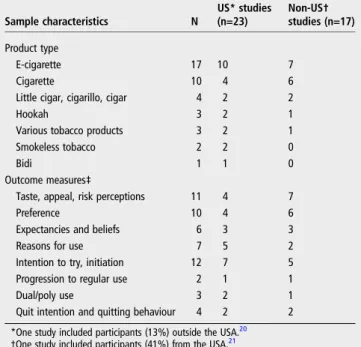
Over half of the 40 included studies were conducted in the USA (table 1), and most studies (90%) were published between 2010 and 2016. The majority of the studies used cross-sectional data,
with one study using a longitudinal design.21 Table 1 lists
product types examined and relevant outcomes for included
studies. Descriptions of study design and mainfindings are
pro-vided intable 2(more detailed results of included studies are in
the online supplementary table).
Taste, appeal, risk perceptions
Eleven studies examined taste, appeal and perceived risk for
flavoured tobacco products. Four studies with similar study
designs assessed the impact of cigarette packaging descriptors
with and without flavours among girls and young women in
Brazil,46 Canada,40 the UK42 and the USA.41 Results indicated
that removing flavour descriptors from packs significantly
reduced measures of taste40–42 46and appeal.40 42 46 Further,
two of the studies found that packs with flavour descriptors
were more likely to be rated as lower health risk than packs
without descriptors,42 and young girls were significantly more
likely to rate packs with flavour descriptors as less harmful
than young women.46 Similarly, a smokeless tobacco packaging
study of 1000 participants in the USA found that among those who reported a difference between packaging elements on their product opinions, more youth and young adults perceived
the pack with flavour descriptors as having better taste and as
more appealing compared with the pack without flavour
descriptors.53 Young adults were also more likely than older
adults to report that packs without flavour descriptors would
deliver more dangerous chemicals than those with flavour
descriptors.53A longitudinal study with large numbers of
parti-cipants from the USA, Mexico and Australia examined cigarette
brands with flavour capsules and found that, compared with
adult smokers of regular non-flavoured cigarettes, adults who
preferred brands with flavour capsules viewed their variety of
cigarettes as having better taste, as more appealing and less harmful (except Australian smokers) than other brand
var-ieties.21A UK study of 1205 adolescents assessed the impact of
electronic cigarette (e-cigarette) flavour descriptors on
percep-tions of product harm and also found perceppercep-tions of harm
dif-fered depending on the flavours.28 Tobacco flavoured
e-cigarettes were perceived as being more harmful, while
cherry and candy floss flavours were perceived as less
harmful.28 An online study conducted among 915 Canadians
aged 16 years and older found thatflavours accounted for 36%
of consumers’ overall perceptions of reduced harm about
e-cigarettes, as equally influential as health warnings (35%),
while other product attributes such as nicotine content and
price were less influential in perceived reduced harm.24
Younger smokers and non-smokers particularly perceived
cherry-flavoured or coffee-flavoured e-cigarettes as less
harmful, while older smokers indicated tobacco flavour as
being less harmful.24In a UK study of 471 e-cigarette and
cig-arette non-users, aged 11–16 years,flavoured e-cigarette
adver-tisements were more appealing than non-flavoured e-cigarette
Table 1 Product types and outcome measures of included studies
Sample characteristics N
US* studies (n=23)
Non-US† studies (n=17)
Product type
E-cigarette 17 10 7
Cigarette 10 4 6
Little cigar, cigarillo, cigar 4 2 2
Hookah 3 2 1
Various tobacco products 3 2 1
Smokeless tobacco 2 2 0
Bidi 1 1 0
Outcome measures‡
Taste, appeal, risk perceptions 11 4 7
Preference 10 4 6
Expectancies and beliefs 6 3 3
Reasons for use 7 5 2
Intention to try, initiation 12 7 5 Progression to regular use 2 1 1
Dual/poly use 3 2 1
Quit intention and quitting behaviour 4 2 2
*One study included participants (13%) outside the USA.20
†One study included participants (41%) from the USA.21
Table 2 Sample cha ra cteris tics, objectiv es and main findings on fla vours ’ impa ct of included articles Study ID (country) Sample size and study popula tion (y ears old) Study aim Main findings on fla vours ’ impa ct E-cigar ettes Ama to et al , 22 2016 (USA) N=9301 Adult (18+) Users, non-users Inv es tiga te pa tterns of e-cigar ettes ’ use in order to es tablish a standard definition of e-cigar ette curr ent use pr evalence for the purpose of popula tion surv eillance ▸ Curr ent e-cigar ette users cited fla vours as a reason for use mor e often than pas t users Berg, 23 2016 (USA)
N=1567 Young
adult (18-34), e-cigar ette users, non-users; cigar ette users, non-users C ompar e (1) e-cigar ette nev er, curr ent and former users; (2) nev er, curr ent and former tr aditional cigar ette smok ers in rela tion to e-cigar ette use char acteris tics, fla vours pr eferr ed and reasons for use; and (3) reasons for discontinued use among former e-cigar ette users acr oss nev er, curr ent and former smok ers ▸ Fla vours w er e fr equently indica ted as reason for use acr oss smoking and non-smoking e-cigar ette users Czoli et al , 24 2016 (Canada)
N=915 Youth
and young adult users and non-users (16 – 24 years); adult users (25+) Determine the effect of dis tinct attributes of e-cigar ettes (fla vours, nicotine content, health w arnings, price) and attribute lev els on consumer choice ▸ Fla vours in e-cigar ettes significantly pr edicted lo w er per ceptions of pr oduct harm and ability to help someone quit smoking Etter, 25 2010 (Fr ance, Belgium, Canada, Switzerland) N=81 Adult (19 – 65; median age=37) Users Assess usage pa tterns of e-cigar ettes , reasons for use and users ’ opinions of these pr oducts ▸ Adult e-cigar ette users reported fla vours as being the mos t positiv e fea tur e of the pr oduct Farsalinos et al , 26 2013 (surv ey online 10 languages) N=4618 Adults (32 – 49; mean age=40) Users Examine the pa tterns and per ceptions of fla vouring use in e-cigar ettes among dedica ted users ▸ E-cigar ette users who w er e former smok ers w er e mor e lik ely to pr efer fruit and sw eet fla vours compar ed with curr ent smok ers ▸ E-cigar ette users reported tha t the variability of e-cigar ette fla vours w as an important fa ctor in reducing or quitting cigar ette smoking and a gr ea ter number of fla vours used w as associa ted with smoking abs tinence Farsalinos et al , 27 2014 (surv ey online 10 languages) N=19 441 Adults (31 – 47; mean age=39) Users Assess the char acteris tics and experiences of a large, worldwide sample of e-cigar ette users and examine the differ ences betw een those who partially and completely subs tituted smoking with e-cigar ette use ▸ The variability of fla vours w as cited as one of the reasons for initia ting e-cigar ette use, though it w as not a primary reason Ford et al , 28 2016 (UK)
N=1205 Youth
(11 – 16), Users, non-users Examine adolescents ’ aw ar eness of e-cigar ette mark eting and inv es tiga te the impa ct of e-cigar ette fla vour descriptors on per ceptions of pr oduct harm and user image ▸ Fruit and sw eet fla vours w er e per ceiv ed as mor e lik ely to be tried by young nev er smok ers than adult smok ers trying to quit ▸ The per ceiv ed harmfulness of e-cigar ettes w as moder ated by-pr oduct fla vours Kong et al , 29 2015 (USA)
N=1157 Youth,
young adult Users Assess reasons for e-cigar ette experimenta tion and discontinua tion and examine whether these reasons differ ed by school lev el (middle school, high school, college) and cigar ette smoking sta tus ▸ A vailability of fla vours w as a primary reason for experimenta tion with e-cigar ettes, and appealing fla vours w er e particularly important to high school students Krishnan-Sarin et al , 30 2015 (USA)
N=4780 Youth
(middle school mean age=12.18, high school mean age=15.63) Users, non-users Examine e-cigar ette aw ar eness, use pa tterns, susceptibility to futur e use, pr efer ences, pr oduct components used and sour ces of mark eting and access among youth ▸ Use and pr efer ence for sw eet e-cigar ette fla vours w as high among adolescents regardless of cigar ette smoking sta tus Nonnemak er et al , 31 2016 (USA) N=765 Adults (18+), curr ent or former smok ers Examines ho w e-cigar ette attributes influence willingness to pa y for e-cigar ettes ▸ For cigar ette-only users, losing fla vours significantly reduced the price participants w er e willing to pa y for e-cigar ettes Pepper et al , 32 2013 (USA)
N=228 Youth
Table 2 C ontinued Study ID (country) Sample size and study popula tion (y ears old) Study aim Main findings on fla vours ’ impa ct Shiplo et al , 35 2015 (Canada)
N=1095 Younger
non-smok ers and smok ers (16 – 24), older smok ers (25+) Examines e-cigar ette ev er and curr ent use, types of pr oducts used and reasons for use ▸ Use of fla vour ed e-cigar ettes varies by smoking sta tus, with smok ers being mor e lik ely to try fla vours than non-smok ers ▸ A common reason for e-cigar ette use is for the tas te Ta ck ett et al , 36 2015 (USA) N=215 Adult (mean age=36.2) Users Es tima te e-cigar ettes pr efer ence, e-cigar ettes use beha viours, per ceiv ed harm and health beliefs of various smoking cessa tion medica tions, nicotine repla cement ther apies and nicotine/toba cco pr oducts and smoking his tory and curr ent biochemically verified smoking sta tus ▸ Mos t e-cigar ette users reported a pr efer ence for vaping non-tr aditional fla vours. ▸ Those who reported vaping non-toba cco and non-menthol fla vours w er e mor e lik ely to ha ve quit smoking V asiljevic et al , 37 2016 (UK)
N=471 Youth
(11 – 16) Non-users Assess the impa ct on appeal of toba cco smoking after exposur e to adv ertisements for e-cigar ettes with and without candy-lik e fla vours ▸ Fla vour ed, compar ed with non-fla vour ed, e-cigar ette adv ertisements elicited gr ea ter appeal, inter es t in buying and trying e-cigar ettes Yings t et al , 20 2015 (USA and other countries) N=421 (87% in USA; 13% outside USA) Adult (mean age=40) Users Examine the fr equency with which e-cigar ette users tr ansition betw een device types and identify device char acteris tics and user pr efer ences tha t ma y influence such tr ansitions ▸ Mos t e-cigar ette users began use with a device shaped lik e a cigar ette (firs t-gener ation devices) and tr ansitioned to a larger advanced gener ation device with a mor e po w erful ba ttery and a wider choice of liquid fla vours ▸ Advanced gener ation device e-cigar ette users report the variety of fla vours as being important char acteris tic of e-cigar ettes Cigar ettes Agaku et al , 38 2014 (EU) N=26 566 Y outh, young adults (15 – 24), adults (25+) Users, non-users Assess the role of cigar ette design and mark eting char acteris tics in initial smoking, cigar ette br and choice and the per ception of reduced harm of cigar ette br ands ▸ Fe w ev er smok ers reported specific fla vours as being important in their initial smoking, but fla vours w er e significantly associa ted with initial smoking in younger smok ers ▸ Curr ent smok ers, particularly female smok ers, reported specific fla vours as important in their cigar ette br and pr efer ence Ashar e et al , 39 2007 (USA)
N=424 Young
adult (mean age=19) Users, non-users Determine the appeal of fla vour ed and non-fla vour ed cigar ettes among college student non-smok ers, regular smok ers and those susceptible to smoking ▸ Positiv e and nega tiv e expectancies w er e influenced by fla vour, with higher positiv e and lo w er nega tiv e expectancies for fla vour ed cigar ettes compar ed with non-fla vour ed cigar ettes. Positiv e expectancies significantly pr edicted the lik elihood of trying fla vour ed cigar ettes Doxe y and Hammond, 40 2011 (Canada)
N=826 Youth
(18 – 19), female Users, non-users Examine the effects of cigar ette br and descriptors, br and colour and imagery , as w ell as the impa ct of plain or standardised pa ckaging on young female ’ s beliefs about smoking ▸ No differ ences w er e observ ed betw een cigar ette pa cks with and without fla vour descriptors in ra tings of tar deliv ery and health risk, though participants ra ted pa cks with fla vour descriptors as better tas ting and mor e appealing Hammond et al , 41 2011 (USA)
N=826 Youth
(18 – 19), female Users, non-users Examine the effects of cigar ette br and descriptors, br and colour and imagery , as w ell as the impa ct of plain or standardised pa ckaging on young female ’ s beliefs about smoking ▸ Fully br anded cigar ette pa cks with fla vour descriptors w er e ra ted as better tas ting than the same pa cks without fla vour descriptors Hammond et al , 42 2013 (UK)
N=947 Youth
(16 – 19), female Users, non-users Examine the effects of cigar ette br and descriptors, br and colour and imagery , as w ell as the impa ct of plain or standardised pa ckaging on young female ’ s beliefs about smoking ▸ R emo ving fla vour descriptors fr om cigar ette pa cks significantly reduced measur es of appeal and tas te and incr eased measur es of health risk Kaleta et al , 43 2014 (P oland) N=2254 Adult (15+) Users Examine whether the use of fla vour ed cigar ettes varies by sociodemogr aphic char acteris tics, aw ar eness of the smoking health consequences and the per ception of risk of use compar ed with regular cigar ettes fr om curr ent smok ers ▸ Fla vour ed cigar ette use w as associa ted with not intending to quit among females but not among males Manning et al , 44 2009 (USA)
N=253 Youth
(mean age=15.7) Users, non-users Examine the inter activ e effects of cigar ette pa ckage fla vour descriptors and sensa tion seeking on adolescents ’ br and per ceptions ▸ Among high sensa tion-seeking adolescents, the fla vour descriptors led to mor e fa vour able hedonic br and beliefs and higher trial intentions than the tr aditional descriptors O ’ C onnor et al , 45 2007 (USA)
N=20 Young
Table 2 C ontinued Study ID (country) Sample size and study popula tion (y ears old) Study aim Main findings on fla vours ’ impa ct ▸ Pr efer ence for fla vour capsule cigar ettes (though primarily menthol varieties) has significantly risen in the pas t fe w years in Me xico and Aus tr alia, particularly among young adults White et al , 46 2012 (Br azil )
N=640 Youth
and young adult (16 – 26), female Users, non-users Examine the effects of cigar ette br and descriptors, br and colour and imagery , as w ell as the impa ct of plain or standardised pa ckaging on young female ’ s beliefs about smoking ▸ The plain pa cks with fla vour descriptors w er e giv en significantly higher appeal and tas te ra tings than the plain without fla vour descriptor pa cks, though no significant differ ences w er e observ ed betw een pa cks in health risk ra tings Little cigars, cigarillos and cigars Delnev o et al , 47 2015 (USA)
N=6678 Youth
(12 – 17), young adult (18 – 25), adult (26+) Users, non-users Examine use and pr efer ence of fla vour ed cigar br ands among youth, young adults and adults in USA. ▸ A clear pr efer ence w as observ ed for cigar br ands tha t pr oduce fla vour ed varieties among youth, young adult, female, and bla ck cigar smok ers ▸ Pr efer ence for fla vour ed cigars w as associa ted with curr ent cigar ette smoking. Lea therdale et al , 48 2011 (Canada) N=29 296 9th – 12th gr ader Users, non-users Examine the pr evalence of cigar, cigarillo and little cigar use and fa ctors associa ted with their use among na tionally repr esenta tiv e sample of Canadian youth ▸ Ev er use of fla vour ed toba cco w as associa ted with being a curr ent cigar, cigarillo or little cigar smok er Y ates et al , 49 2014 (Canada)
N=133 Young
adult and adult users (age 19 – 29; mean age=23.6) Examine the pa tterns, attitudes and beliefs regarding cigarillo use and couse of cigarillos and cigar ettes among young adults ▸ Fla vour w as the primary reason cited for smoking cigarillos Hookah Dani et al , 50 2015 (India)
N=447 College
students, users and non-users Assess per ception among young adults in a college envir onment to w ards using hookah for smoking toba cco ▸ A significant differ ence betw een users and non-users w as found, wher e mor e users indica ted tha t hookah ‘ contains pleasant fla vors ’ compar ed with non-users Salloum et al , 51 2015 (USA) N=367 Adult (18+ mean age 21.9) college students, users Measur e pr efer ences for w aterpipe smoking and determine which pr oduct char acteris tics ar e mos t important to smok ers ▸ Participants pr eferr ed fruit-fla vour ed varieties to toba cco fla vour Smith et al , 52 2011 (USA)
N=689 Youth
(mean age=17.1) Users, non-users Examine pa tterns of use (eg, initia tion, cessa tion), risk per ception and ps ychosocial fa ctors among users, former users and non-users of hookah among high school students ▸ High school students cited fla vours of the hookah as one of the reasons the y believ ed hookah to be sa fer or less addictiv e than cigar ettes Smok eless toba cco Adkison et al , 53 2014 (USA)
N=1000 Youth
advertisements.37 A study of 689 US adolescents citedflavours as one of the reasons why they perceived hookah to be safer
or less addictive than cigarettes.52 However, a small US study
of 20 college smokers did not detect an appreciable difference
in harshness or irritation between flavoured and non-flavoured
cigarettes.45
Preference
Ten studies examined preference forflavoured tobacco products.
One US study of 4780 middle and high school students found
that preference for sweet e-cigarette flavours was high, with
most lifetime and current e-cigarette users reporting they
pre-ferred sweet flavours compared with menthol and tobacco fl
a-vours when they smoked e-cigarettes.30 A UK study of 1205
adolescents also found that fruit, sweet and coffeeflavours in
e-cigarettes were perceived as more likely to be tried by young
never smokers compared with tobacco flavour, and these fl
a-vours were perceived as more likely to be used or tried by young never smokers than adult smokers trying to quit
smoking.28Three studies among adult e-cigarette users reported
that the variety offlavour choices was rated as important by the
majority of users (85.4%) and influenced device choice;20most
users (72%) preferred vaping non-traditional flavours such as
fruity and candy/nuts to traditional flavours (ie, menthol or
tobacco);36 and former cigarette smokers were more likely to
use fruit and sweetflavours.26Similarly, a US study of 6678
par-ticipants reported a clear preference among youth, young adults, female and black cigar smokers for cigar brands that
produce flavoured varieties.47 Many current adult cigarette
smokers (33%) in 27 EU countries, particularly female smokers,
reported specific sweet, menthol or fruityflavours as important
in their cigarette brand preference.38 Preference for flavour
capsule cigarette brands has significantly risen in recent years in
Mexico and Australia, particularly among young adults (though
the majority of the flavour capsule varieties reported refer to
menthol).21But a US study of 20 college smokers did notfind a
relationship between preference and whether the brand of
cigar-ette was flavoured or non-flavoured.45An online study of 367
US college hookah users found that participants preferred
fruit-flavoured varieties to tobacco flavour.51 Further, flavour
accounted for almost two-thirds of the hookah use decision,
compared with price (22%) and nicotine content (13%).51
Expectancies and beliefs
Six studies examined expectancies and beliefs of flavoured
tobacco products that influence consumers’decisions. An online
study conducted among 915 Canadians found that flavours in
e-cigarettes had a moderate influence (25%) on judgements of
product efficacy in quitting smoking compared with other
product attributes such as nicotine content (10%), price (26%)
and health warnings (39%).24 Another online US study of 765
adult smokers that estimated the value smokers placed on
attri-butes of e-cigarettes found that removing the attribute‘coming
inflavours’significantly reduced the price smokers were willing
to pay among e-cigarette-only users.31 Among 424 US college
students, Camel Exotics (flavoured cigarettes) produced greater
positive expectancies than did Camel Lights (non-flavoured
cigarettes), with the strongest difference among susceptible/
experimenters.39 In addition, participants rated Camel Lights
more negatively than Camel Exotics; this relationship held true across non-smokers, susceptible/experimenters and regular smokers. A cigarette packaging study among 253 high school
students in the USA found thatflavour descriptors led to more
positive beliefs about the hedonic qualities (eg, enjoyable,
Table
2
C
ontinued
Study
ID
(country)
Sample
size
and
study
popula
tion
(y
ears
old)
Study
aim
Main
findings
on
fla
vours
’
impa
ct
King
et
al
,
57
2014
(USA)
N=18
866
6th
–
12th
gr
ader
Users,
non-users
Assess
the
pr
evalence
and
sociodemogr
aphic
corr
ela
tes
of
fla
vour
ed
little
cigar
and
fla
vour
ed
cigar
ette
smoking
among
US
middle
and
high
school
students
▸
R
espondents
who
used
fla
vour
ed
cigars
or
cigar
ettes
had
a
lo
w
er
intent
to
quit
than
non-fla
vour
ed
users
Lee
et
al
,
58
2015
(US)
N=24
658
6th
–
12th
gr
ader
Users,
non-users
Assess
the
pr
evalence
and
concurr
ent
use
of
pa
tterns
of
various
toba
cco
pr
oducts
and
examine
associa
ted
risk
fa
ctors
among
US
youth
▸
The
use
of
fla
vour
ed
pr
oducts
w
as
associa
ted
with
multiple
pr
oduct
use
Minak
er
et
al
,
59
2015
(Canada)
N=17
396
Y
outh
(gr
ades
9
–
12),
nev
er
smok
ers
Examines
smoking
susceptibility
and
alterna
tiv
e
toba
cco
pr
oduct
use
in
Canadian
youth
▸
Nev
er
smok
ers
who
ha
ve
ev
er
tried
A
TPs,
and
particularly
fla
vour
ed
A
TPs,
ar
e
at
significantly
incr
eased
odds
of
being
susceptible
to
cigar
ette
relaxing, good tasting) of brands than the traditional
descrip-tors, although this interaction was only significant among high
sensation seekers.44A study of 81 adult e-cigarette users in four
countries found that the most frequently cited positive feature
of e-cigarettes was their taste and variety of flavours (18% of
total open-ended comments).25A study of 447 young adults in
India that assessed perception of hookah use, 36.8% of hookah
users indicated that hookah ‘contains pleasant flavours’, which
was significantly higher than non-users (24.6%).50
Reasons for use
Seven studies addressed reasons for usingflavoured tobacco
pro-ducts. In a US study of 13 651 adolescents, product flavouring
was consistently reported as the most common reason for use across all product types, including e-cigarettes (81.5%), hookah (78%), cigars (73.8%), smokeless tobacco (69%) and snus
pouches (67.2%).56An online study of 1567 adults found that a
majority of e-cigarette users (60%) and one-third of non-users
reported reasons or interest for using e-cigarettes because‘they
come in appealing flavors’ and ‘I like experimenting with
various flavors’.23 This study also found that flavours were a
common reason for discontinued use of e-cigarettes among
former e-cigarette users because they‘don’t like theflavor(s)’.23
In an online study of 1095 Canadians, ‘they taste good’was a
more common reason for using e-cigarettes cited by younger non-smokers (32.3%) and smokers (18.4%) than by older
smokers (6.5%).35In a US study of 9301 adults, 55.5% of daily
e-cigarette users, 50.4% of infrequent e-cigarette users (1–
5 days in past 30 days) and 41.9% of intermediate e-cigarette
users (6–29 days in past 30 days) reported the availability offl
a-vours (not including menthol) as a reason to use e-cigarettes, while cutting down on other tobacco products was the most common reason cited for e-cigarette use among daily (91%) and
intermediate (84.6%) users.22 In an online US study of 3878
adults, 8% of e-cigarette users reportedflavours as a reason for
first trying e-cigarettes compared with 53% of respondents
reporting first using e-cigarettes out of curiosity, and 30%
reportingfirst using them because they wanted to quit or reduce
smoking.33In an urban sample of 133 Canadian young adults,
the primary reason reported for smoking cigarillos was because
of the flavour (56%).49 Among a convenience sample of 642
youth in Massachusetts, only 1% reported using bidis instead of
cigarettes because of the flavour, but 23% said bidis tasted
better than cigarettes.55
Intention to try/initiation
Twelve studies assessed intention to try or initiation offlavoured
tobacco products. In a US study of 13 651 adolescents, the
majority of ever users (80.8%) reported that the first product
they had used was flavoured, including hookah (88.7%),
e-cigarettes (81.0%), snus pouches (81.2%), smokeless tobacco excluding snus (68.9%), any cigar type (65.4%) and cigarettes
(50.1%).56 The majority of past 30-day users (79.8%) also
reported that the products used wereflavoured.56One US study
of 468 adult users reported a majority (60%) of participants’
first smokeless tobacco product used was mint flavoured.54
A study in the EU found that though few ever adult cigarette
smokers (1.4%) reported specific flavours as being important
in their initial smoking, flavours were significantly associated
with initial smoking in younger smokers aged 15–24.38Among
US adolescents and young adults, flavoured cigarette brands
led to higher trial intentions compared with non-flavoured
cig-arette brands in two different studies.39 44 In an online study
of 915 Canadians aged 16 years and older, flavour accounted
for 24% of consumers’intentions to try e-cigarettes, showing a
moderate influence compared with other product attributes.24
Younger smokers and non-smokers were particularly interested
in trying cherry-flavoured e-cigarettes, while older smokers
indi-cated greater interest in trying tobaccoflavour.24A US study of
1157 adolescent and young adult ever e-cigarette users found
that the availability offlavours was a primary reason for
experi-mentation with the product, particularly among high school
stu-dents compared with college stustu-dents.29 An online study of
1095 Canadians showed that younger non-smokers were less
likely to try a flavoured e-cigarette than younger smokers and
older smokers.35In a UK study of 471 e-cigarette and cigarette
non-users aged 11–16 years,flavoured e-cigarette advertisements
elicited greater interest in buying and trying e-cigarettes than
non-flavoured e-cigarette advertisements, but the appeal of
using e-cigarettes was low for both sets of advertisements.37 A
US study of 228 male adolescents found that their willingness to try e-cigarettes compared with plain varieties did not differ
based on flavour status, although virtually none of the males
(<1%) had tried e-cigarettes previously.32 An online European
study, financially underwritten by an e-cigarette users advocacy
group, reported that initiating e-cigarette use to enjoy the
vari-ability offlavours was ranked as a 3 on a 5-point scale from 1
(not important) to 5 (most important).27 A US online study,
financially supported by a company that markets e-cigarettes,
reported that non-smoking teens’interest in trying e-cigarettes
did not vary byflavour, but adult smokers’interest did.34
Progression to regular use
Two studies examined the impact of flavoured tobacco on the
progression from tobacco initiation to regular use of flavoured
products.48 54 A US study that used data from five separate
studies of adult smokeless tobacco users at various stages of reducing or quitting tobacco found that among smokeless
tobacco users who started using mint-flavoured products, 64.4%
reported current use of flavoured products, whereas 48.7% of
those who started using non-flavoured products continued to
use non-mint-flavoured products.54 A nationally representative
sample of 29 296 high school students from the Canadian Youth Smoking Survey reported a strong association between
flavoured tobacco use and being a current cigar, cigarillo or
little cigar smoker.48 Respondents who reported ever usingfl
a-voured tobacco were more likely to currently use cigars, cigaril-los or little cigars compared with respondents who had never
usedflavoured tobacco products.48It should be noted that the
two studies used cross-sectional data to examine progression to regular use.
Dual/poly use
Three studies assessed the role offlavours in dual or poly use of
tobacco products. One survey among 24 658 middle and high school students in the USA assessed the association between types of use (singular tobacco product vs multiple tobacco pro-ducts) and found that among current cigarette smokers, the use
offlavoured products was significantly associated with dual and
poly tobacco use.58Another study found that cigar brands
offer-ing flavoured varieties were preferred more by cigar smokers
who were also current cigarette smokers.47A Canadian study of
17 396 young never smokers found that those who had ever
tried or tried a flavoured tobacco product in the past 30 days
had significantly higher odds of being susceptible to cigarette
Quit intention and quitting behaviour
Four studies assessed flavoured tobacco use and intention to
quit. A study of 18 866 US middle and high school students
found that flavoured cigar (59.7%) and cigarette (49.3%) users
had a higher prevalence of not thinking about quitting tobacco
than non-flavoured cigar (18.4%) and cigarette (9.8%) users.57
Similarly, a study in Poland of 2254 adult users reported that
females who smoked flavoured cigarettes were less likely to
intend to quit than females who smoked non-flavoured
ciga-rettes.43 US adult e-cigarette users who reported vaping
non-tobacco and non-mentholflavours were more likely to have quit
smoking than e-cigarette users who vaped traditionalflavours.36
One study of adult e-cigarette users,financially underwritten by
an e-cigarette user advocacy group, reported that the variability
of e-cigarette flavours was an important factor in reducing or
quitting smoking and a greater number of flavours regularly
used was associated with smoking abstinence among dedicated
long-term e-cigarette users.26
Risk of bias assessment
Most studies were rated highly in terms of having explicit aims
and objectives, description of research setting and fit between
stated research question and method of data collection (see QATSDD scores in online supplementary table). However, a majority of studies did not report an explicit theoretical frame-work, evidence of sample size consideration and statistical assessment of reliability and validity of measurement tools.
Several studies failed to adequately address fit between stated
research question and method of data collection (scored at 1 or
below).26 34 54 It is important to note that studies may have
received a low score simply because a certain criteria was not described in detail in the manuscript, even though the study authors may have considered it (eg, power calculations for sam-ple size consideration often not reported due to word count
constraints). Three studies were financially supported by
e-cigarette companies or advocacy groups of e-cigarette
users.26 27 34
DISCUSSION
This systematic review highlights and extends in important ways what policymakers and public health practitioners strongly
suspect: flavours play a key role in influencing perceptions and
multiple tobacco use patterns about most tobacco products, par-ticularly for adolescents. Flavours in tobacco products seem to have a universal and rather strong appeal to youth and young adults interested in initiating tobacco use or experimenting with
different products due to the variety and availability of fl
a-vours,24 29 37 46 47 53 56are reported as a reason for using most
tobacco products,22 23 33 49 51 55 56and appear to play a more
important role in the use of e-cigarettes, hookah, little cigars
and cigarillos among younger people.48 49 56The availability of
non-menthol flavoured tobacco products and their appeal to
adolescents have the potential to undermine progress gained on
reducing tobacco use.8 Flavoured tobacco products were
perceived as having better taste and were more appealing by users and non-users, especially among younger age
groups.21 40–42 46 53Flavoured tobacco products were also
per-ceived as less risky or harmful, and these perceptions potentially interact with age, with younger participants appearing more
likely to believe thatflavoured products were less harmful
com-pared with non-flavoured products.21 24 28 42 53 Tobacco
product users and non-users showed a clear preference for
sweet, fruit-flavoured varieties over traditional tobacco
flavours,20 21 30 36 38 47 51 andflavours give tobacco products
higher positive expectancies and beliefs about hedonic qualities,
product features and values that may influence consumers’
deci-sions more than non-flavoured tobacco products.24 25 31 39 44 50
Not surprisingly, given the strong impact offlavours in
percep-tions of tobacco products, flavours were associated with
pro-gression to regular use and dual and poly use of tobacco
products. Tobacco users tended to switch to flavoured
pro-ducts and maintain multiple flavoured products.47 48 54 58 59
Finally, results from this review showed that the use of fl
a-voured tobacco products, such as cigarettes and cigars, may be
associated with lower quit intentions.43 57 However, two
e-cigarette studies, one funded by a user advocacy group, found
thatflavours in e-cigarettes may help adult e-cigarette users in
quitting cigarette smoking.26 36
Our systematic review significantly expands on a recent
sys-tematic review by Feirman et al18 of US studies published
through 2013. Our review includes articles that critically
sum-marised data for thefirst time on the role offlavours in tobacco
use perceptions as well as tobacco use behaviours. We specifi
c-ally examinedflavours as being related to taste, appeal, risk
per-ceptions, preference, reasons for use, intention to try, initiation, progression to regular use, dual/ploy use, quit intention and quitting behaviour. Our review also includes 17 non-US studies and 26 new studies published between 2014 and 2016 alone. While there did not appear to be any appreciable difference between the results of US versus non-US studies, it is important to note that most of the non-US studies were conducted in highly developed countries with moderate to strong tobacco regulatory frameworks, such as Canada and the UK.
The relevance of this new systematic review on public policy
in the USA and internationally is significant and immediate.
First, as the majority of countries have no ban on anyflavoured
tobacco product, results from this systematic review support the
rationale for global regulations on most non-mentholflavoured
tobacco products in order to positively impact public health out-comes related to reduced tobacco use. Second, it addresses the
FDA’s need for data on the role of certainflavoured products in
supporting reduction in or abstinence from the use of
combust-ible tobacco products, as well as data on the role of flavoured
products in youth initiation and use, as stated in the final
deeming rule. Third, this research may help inform countries,
such as Brazil, that have banned all tobacco productflavours but
face litigation from the tobacco industry. Fourth, it may strengthen efforts of local jurisdictions that have enacted more
comprehensive bans on flavoured tobacco products, such as
New York City; such bans led to significant reductions in ever
use offlavoured tobacco products, from 20% in 2010 to 16%
in 2013.60
Finally, this review may help some countries in strengthening their existing regulations. For instance, the 2010 Canadian Bill C-32, the Cracking Down on Tobacco Marketing Aimed Youth
Act, prohibited the sale of all flavoured cigarettes, little cigars
and cigarillos, and blunt wraps that weighed <1.4 g, with an
exemption for menthol flavouring.61 The prevalence of fl
a-voured tobacco product use among Canadian high school stu-dents remained high even after the enactment of this legislation,
in part because the tobacco industry reformulated flavoured
cigarillos to circumvent the bill (eg, increased the product’s
weight to more than 1.4 g).61 Bill C-32 also exempted many
categories of tobacco products from regulation (eg, pipe
tobacco, smokeless tobacco and cigars).61 In 2015, two
Canadian provinces extended existing flavour bans on the sale
flavours, but with exemptions for pipe tobacco and some
cigars.62This review can be helpful for jurisdictions in
formulat-ing more comprehensive and effective bans.
Our review has several limitations. This review did not include grey literature or non-English language articles, leading to the possibility that some relevant results could be missed. The inclusion of grey literature may have expanded the scope of the results and provided additional evidence that has not yet been published. While we assessed the risk of bias in individual studies using a validated tool, we did not set minimum threshold for study quality a priori, and we included several e-cigarette
industry or advocacy user funded studies.26 27 34 Caution
should exist in extrapolating results from studies that scored lower in study quality. There also appeared to be a lack of homogeneity in the measures used in each study. Measures of perceptions and use behaviours varied across studies, and estab-lished reliability and validity measures are lacking. Invalidated measures may fail to adequately assess what needs to be mea-sured and/or bias results.
Future research may elucidate specific mechanisms underlying
the role offlavours in tobacco use perceptions and behaviours;
many studies included in this review were not designed to assess
flavours as the major predictor variable (table 2). This resulted
in some studies lacking power to detect differences in measures
between flavoured and non-flavoured conditions (see online
supplementary table), thus causing our systematic review to
likely underestimate thefindings offlavours’impact due to
non-significant results. The majority of studies used cross-sectional
data and did not assess the impact of flavours on behavioural
outcomes, such as continued use and abstinence; longitudinal research could examine changes over time in use patterns of tobacco products. Future research is also needed in countries that are not represented in this review, including those with
weak tobacco regulatory frameworks, tofill the knowledge gap
regarding the role of tobaccoflavours in other populations and
cultures, as products may differ greatly across countries because of sociocultural difference (eg, smokeless tobacco in the USA is a different product than it is Southeast Asia). As the number of studies examining e-cigarettes and cigarettes included in this review far outweighed the number of studies examining other tobacco products, research examining different products and in
different countries may help to elucidate the role that flavour
plays in each identified behavioural outcome. Finally, our review
did not examine the impact of menthol flavours on outcomes.
A previous report of the Tobacco Product Scientific Advisory
Committee found sufficient evidence that menthol flavourings
in cigarettes increased experimentation and regular smoking and decreased the likelihood of smoking cessation compared with
non-menthol cigarettes,17 findings similar to that of our review
on non-mentholflavourings. Future reviews should examine the
literature on mentholflavourings to determine if the impact of
menthol flavouring is the same as or different from other fl
a-vours in diverse tobacco products, particularly given the fact
that mentholflavoured cigarette smokers account for one-third
of all cigarette smokers in the USA, and mentholflavoured
cig-arette use has increased or remained stable, despite significant
decreases in non-menthol cigarette use.63 64
CONCLUSIONS
While further exploration of the impact that flavours have on
tobacco use and perceptions are needed, existing evidence
pro-vides a rationale for banning non-menthol flavouring in most
tobacco products to maximally protect youth from being
enticed byflavours from tobacco use around the world. Further
research examining flavoured tobacco products should include
the specification of the flavours’ impact on tobacco use
beha-viours and perceptions, particularly the impact offlavoured
e-cigarettes on adults cessation patterns with combustible tobacco, use standardised and validated measures and adopt longitudinal research designs to measure changes, especially behavioural
out-comes, over time in relation toflavours.
Contributors L-LH and AOG conceptualised and designed the study. L-LH, CM, HMB and LMR conducted the data screening, extraction and analyses. L-LH led and oversaw the writing of the manuscript, with contributions from CM, HMB, LMR and AR. AOG contributed to the manuscript by providing key information on the study context, suggestions about the analysis approach and interpretation of results. All authors read, provided comments and approved thefinal manuscript.
Funding Research reported in this publication was supported by grant number P50CA180907 from the National Cancer Institute and the FDA Center for Tobacco Products (CTP).
DisclaimerThe content is solely the responsibility of the authors and does not necessarily represent the official views of the NIH or the Food and Drug Administration.
Competing interests None declared.
Provenance and peer reviewNot commissioned; externally peer reviewed.
Open Access This is an Open Access article distributed in accordance with the Creative Commons Attribution Non Commercial (CC BY-NC 4.0) license, which permits others to distribute, remix, adapt, build upon this work non-commercially, and license their derivative works on different terms, provided the original work is properly cited and the use is non-commercial. See: http://creativecommons.org/ licenses/by-nc/4.0/
REFERENCES
1 World Health Organization. Partial guidelines for implementation of Articles 9 and 10 of the WHO Framework Convention on Tobacco Control; Regulation of the contents of tobacco products and regulation of tobacco product disclosures. Adopted 2010, amended 2012. http://www.who.int/entity/fctc/guidelines/ Guideliness_Articles_9_10_rev_240613.pdf?ua=1
2 1256–111th HR.Family Smoking Prevention and Tobacco Control Act. 2009. http:// www.govtrack.us/congress/bills/111/hr1256/text (accessed 15 Nov 2015). 3 Tobacco Control Legal Consortium.How Other Countries Regulate Flavored Tobacco
Products. 2015. http://publichealthlawcenter.org/sites/default/files/resources/ International-Restrictions-on-Flavored-Tobacco-2015.pdf
4 Carpenter CM, Wayne GF, Pauly JL,et al. New cigarette brands withflavors that appeal to youth: tobacco marketing strategies.Health Aff (Millwood) 2005;24:1601–10.
5 Klein SM, Giovino GA, Barker DC,et al. Use offlavored cigarettes among older adolescent and adult smokers: United States, 2004–2005.Nicotine Tob Res 2008;10:1209–14.
6 Lewis MJ, Wackowski O. Dealing with an innovative industry: a look atflavored cigarettes promoted by mainstream brands.Am J Public Health2006;96:244–51. 7 Delnevo CD, Wackowski OA, Giovenco DP,et al. Examining market trends in the
United States smokeless tobacco use: 2005–2011.Tob Control2014;23:107–12. 8 Food and Drug Administration.Deeming Tobacco Products to Be Subject to the
Federal Food, Drug, and Cosmetic Act, as Amended by the Family Smoking
What this paper adds
▸ The study highlights the key role offlavours in tobacco
products in influencing perceptions and multiple tobacco use
patterns about most tobacco products, particularly for adolescents; thus providing a rationale for banning
non-mentholflavouring in most tobacco products.
▸ Further research on the impact offlavours, particularly given
the increasing appeal and prevalence offlavoured tobacco
products among young populations, should include the
specification of theflavours’impact on tobacco use
Prevention and Tobacco Control Act; Regulations on the Sale and Distribution of Tobacco Products and Required Warning Statements for Tobacco Products. 2014. http://www.federalregister.gov/articles/2014/04/25/2014-09491/deeming- tobacco-products-to-be-subjectto-the-federal-food-drug-and-cosmetic-act-as-amended-by-the (accessed 15 Nov 2015).
9 Food and Drug Administration.TAB B 2014-850 Deeming Final Rule Redline Changes. 2016. https://www.regulations.gov/document?
D=FDA-2014-N-0189-83193 (accessed 4 Oct 2016).
10 Zhu SH, Sun JY, Bonnevie E,et al. Four hundred and sixty brands of e-cigarettes and counting: implications for product regulation.Tob Control2014;23(Suppl 3): iii3–9.
11 Corey CG, Ambrose BK, Apelberg BJ,et al. Flavored tobacco product use among middle and high school students—United States, 2014.MMWR Morb Mortal Wkly Rep2015;64:1066–70.
12 Villanti AC, Richardson A, Vallone DM,et al. Flavored tobacco product use among U.S. young adults.Am J Prev Med2013;44:388–91.
13 Minaker LM, Ahmed R, Hammond D,et al. Flavored tobacco use among Canadian students in grades 9 through 12: prevalence and patterns from the 2010–2011 youth smoking survey.Prev Chronic Dis2014;11:E102.
14 Food and Drug Administration.Center for Tobacco Products, Food and Drug Administration: Research Priorities. 2012. http://www.fda.gov/downloads/ TobaccoProducts/NewsEvents/UCM293998.pdf (accessed 15 Nov 2015). 15 Parliament of Canada.An Act to amend the Tobacco Act. 2009. http://www.parl.
gc.ca/HousePublications/Publication.aspx?Pub=Bill&Doc=C-32_4&Language= &Mode=1&Parl=40&Ses=2&File=4
16 Tobacco Products Scientific Advisory Committee.Menthol Cigarettes and Public Health: Review of the Scientific Evidence and Recommendations. 2011. http://www. fda.gov/downloads/AdvisoryCommittees/CommitteesMeetingMaterials/
TobaccoProductsScientificAdvisoryCommittee/UCM269697.pdf
17 Food and Drug Administration.Preliminary scientific evaluation of the possible public health effects of menthol versus nonmenthol cigarettes. 2013. http://www. fda.gov/downloads/UCM361598.pdf (accessed 15 Nov 2015).
18 Feirman SP, Lock D, Cohen JE,et al. Flavored tobacco products in the United States: a systematic review assessing use and attitudes.Nicotine Tob Res2016;18:739–49. 19 Sirriyeh R, Lawton R, Gardner P,et al. Reviewing studies with diverse designs: the
development and evaluation of a new tool.J Eval Clin Pract2012;18:746–52. 20 Yingst JM, Veldheer S, Hrabovsky S,et al. Factors associated with electronic
cigarette users’device preferences and transition fromfirst generation to advanced generation devices.Nicotine Tob Res2015;17:1242–6.
21 Thrasher JF, Abad-Vivero EN, Moodie C,et al. Cigarette brands withflavour capsules in thefilter: trends in use and brand perceptions among smokers in the USA, Mexico and Australia, 2012–2014.Tob Control2016;25:275–83. 22 Amato MS, Boyle RG, Levy D. How to define e-cigarette prevalence? Finding clues
in the use frequency distribution.Tob Control2016;25:e24–9.
23 Berg CJ. Preferredflavors and reasons for e-cigarette use and discontinued use among never, current, and former smokers.Int J Public Health2016;61:225–36. 24 Czoli CD, Goniewicz M, Islam T,et al. Consumer preferences for electronic
cigarettes: results from a discrete choice experiment.Tob Control2016;25:e30–6. 25 Etter JF. Electronic cigarettes: a survey of users.BMC Public Health2010;10:231. 26 Farsalinos KE, Romagna G, Tsiapras D,et al. Impact offlavour variability on
electronic cigarette use experience: an internet survey.Int J Environ Res Public
Health2013;10:7272–82.
27 Farsalinos KE, Romagna G, Tsiapras D,et al. Characteristics, perceived side effects and benefits of electronic cigarette use: a worldwide survey of more than 19,000 consumers.Int J Environ Res Public Health2014;11:4356–73.
28 Ford A, MacKintosh AM, Bauld L,et al. Adolescents’responses to the promotion andflavouring of e-cigarettes.Int J Public Health2016;61:215–24.
29 Kong G, Morean ME, Cavallo DA,et al. Reasons for electronic cigarette experimentation and discontinuation among adolescents and young adults.Nicotine
Tob Res2015;17:847–54.
30 Krishnan-Sarin S, Morean ME, Camenga DR,et al. E-cigarette use among high school and middle school adolescents in Connecticut.Nicotine Tob Res 2015;17:810–18.
31 Nonnemaker J, Kim AE, Lee YO,et al. Quantifying how smokers value attributes of electronic cigarettes.Tob Control2016;25:e37–43.
32 Pepper JK, Reiter PL, McRee AL,et al. Adolescent males’awareness of and willingness to try electronic cigarettes.J Adolesc Health2013;52:144–50. 33 Pepper JK, Ribisl KM, Emery SL,et al. Reasons for starting and stopping electronic
cigarette use.Int J Environ Res Public Health2014;11:10345–61.
34 Shiffman S, Sembower MA, Pillitteri JL,et al. The impact offlavor descriptors on nonsmoking teens’and adult smokers’interest in electronic cigarettes.Nicotine Tob Res2015;17:1255–62.
35 Shiplo S, Czoli CD, Hammond D. E-cigarette use in Canada: prevalence and patterns of use in a regulated market.BMJ Open2015;5:e007971.
36 Tackett AP, Lechner WV, Meier E,et al. Biochemically verified smoking cessation and vaping beliefs among vape store customers.Addiction2015;110:868–74. 37 Vasiljevic M, Petrescu DC, Marteau TM. Impact of advertisements promoting
candy-likeflavoured e-cigarettes on appeal of tobacco smoking among children: an experimental study.Tob Control2016; Published Online First: 17 Jan 2016. doi:10.1136/tobaccocontrol-2015-052593
38 Agaku IT, Omaduvie UT, Filippidis FT,et al. Cigarette design and marketing features are associated with increased smoking susceptibility and perception of reduced harm among smokers in 27 EU countries.Tob Control2015;24:e233–40. 39 Ashare RL, Hawk LW, Jr, Cummings KM,et al. Smoking expectancies forflavored
and non-flavored cigarettes among college students.Addict Behav 2007;32:1252–61.
40 Doxey J, Hammond D. Deadly in pink: the impact of cigarette packaging among young women.Tob Control2011;20:353–60.
41 Hammond D, Doxey J, Daniel S,et al. Impact of female-oriented cigarette packaging in the United States.Nicotine Tob Res2011;13:579–88. 42 Hammond D, Daniel S, White CM. The effect of cigarette branding and plain
packaging on female youth in the United Kingdom.J Adolesc Health 2013;52:151–7.
43 Kaleta D, Usidame B, Szosland-Fałtyn A,et al. Use offlavoured cigarettes in Poland: data from the global adult tobacco survey (2009-2010).BMC Public Health 2014;14:127.
44 Manning KC, Kelly KJ, Comello ML. Flavoured cigarettes, sensation seeking and adolescents’perceptions of cigarette brands.Tob Control2009;18:459–65. 45 O’Connor RJ, Ashare RL, Cummings KM,et al. Comparing smoking behaviors and
exposures fromflavored and unflavored cigarettes.Addict Behav2007;32:869–74. 46 White CM, Hammond D, Thrasher JF,et al. The potential impact of plain packaging
of cigarette products among Brazilian young women: an experimental study.BMC
Public Health2012;12:737.
47 Delnevo CD, Giovenco DP, Ambrose BK,et al. Preference forflavoured cigar brands among youth, young adults and adults in the USA.Tob Control2015;24:389–94. 48 Leatherdale ST, Rios P, Elton-Marshall T,et al. Cigar, cigarillo, and little cigar use
among Canadian youth: are we underestimating the magnitude of this problem?
J Prim Prev2011;32:161–70.
49 Yates EA, Dubray J, Schwartz R,et al. Patterns of cigarillo use among Canadian young adults in two urban settings.Can J Public Health2014;105:e11–14. 50 Dani KK, Oswal K, Maudgal S,et al. Perception of young adults toward hookah use
in Mumbai.Indian J Cancer2015;52:694.
51 Salloum RG, Maziak W, Hammond D,et al. Eliciting preferences for waterpipe tobacco smoking using a discrete choice experiment: implications for product regulation.BMJ Open2015;5:e009497.
52 Smith JR, Novotny TE, Edland SD,et al. Determinants of hookah use among high school students.Nicotine Tob Res2011;13:565–72.
53 Adkison SE, Bansal-Travers M, Smith DM,et al. Impact of smokeless tobacco packaging on perceptions and beliefs among youth, young adults, and adults in the U.S:findings from an internet-based cross-sectional survey.Harm Reduct J2014;11:2. 54 Oliver AJ, Jensen JA, Vogel RI,et al. Flavored and nonflavored smokeless tobacco
products: rate, pattern of use, and effects.Nicotine Tob Res2013;15:88–92. 55 Centers for Disease Control and Prevention (CDC). Bidi use among urban youth
—Massachusetts, March-April 1999.MMWR Morb Mortal Wkly Rep
1999;48:796–9.
56 Ambrose BK, Day HR, Rostron B,et al. Flavored tobacco product use among US youth aged 12–17 years, 2013–2014.JAMA2015;314:1871–3.
57 King BA, Tynan MA, Dube SR,et al. Flavored-little-cigar andflavored-cigarette use among U.S. middle and high school students.J Adolesc Health2014;54:40–6. 58 Lee YO, Hebert CJ, Nonnemaker JM,et al. Youth tobacco product use in the United
States.Pediatrics2015;135:409–15.
59 Minaker LM, Shuh A, Nguyen N,et al. Cigarette smoking susceptibility among youth alternate tobacco product users: implications offlavoured tobacco from a national cross-sectional Canadian sample (YSS 2012/2013).BMJ Open2015;5: e009549.
60 Farley SM, Johns M. New York Cityflavoured tobacco product sales ban evaluation.
Tob ControlPublished Online First: 12 Feb 2016.
doi:10.1136/tobaccocontrol-2015-052418
61 Ontario Tobacco Research Unit. Prohibitions/restrictions onflavoured tobacco products—2013 monitoring update. 2013.
http://otru.org/prohibitionsrestrictions-flavoured-tobacco-products-2013-monitoring-update/
62 Brown J, DeAtley T, Welding K,et al. Tobacco industry response to menthol cigarette bans in Alberta and Nova Scotia, Canada.Tob ControlPublished Online First: 19 Jul 2016. doi:10.1136/tobaccocontrol-2016-053099
63 Caraballo RS, Asman K. Epidemiology of menthol cigarette use in the United States.
Tob Induc Dis2011;9(Suppl 1):S1.