SUPPORT FOR THE EUROPEAN UNION- LIKE WINE, DOES IT IMPROVE OVER TIME?
Lauren Yeargin
A thesis submitted to the faculty of the University of North Carolina at Chapel Hill in partial fulfillment of the requirements for the degree of Master of Arts in the Department of Political
Science, Concentration TransAtlantic Studies.
Chapel Hill 2014
ABSTRACT
Lauren Yeargin: Support for the European Union- Like wine, does it improve over time? (Under the direction of Erica Edwards)
This thesis examines the relationship between political support and generational effects in the European Union. This paper argues that age has a negative effect on support for the
European Union with older citizens being less supportive of the European Union than their younger counterparts. By using Eurobarometer data from twenty-seven member states, this paper analyzes the influence of age on citizens’ support for the European Union on a
TABLE OF CONTENTS
LIST OF FIGURES………...vii
CHAPTER 1: INTRODUCTION………...1
CHAPTER 2: LITERATURE REVIEW………3
Section 2.1: Theory……….3
Section 2.2: Case Studies………6
CHAPTER 3: HYPOTHESIS………...…11
CHAPTER 4: DATA………....12
Section 4.1: Description………12
Section 4.2: Variables………...13
CHAPTER 5: RESULTS………..18
Section 5.1: Correlation………....18
Section 5.2: Bivariate Analysis……….21
Section 5.3: Multivariate Analysis………25
CHAPTER 6: DISCUSSION………29
APPENDIX 4.1: DISTRIBUTION OF INDEPENDENT VARIABLE………...35
APPENDIX 4.2: DISTRIBUTION OF DEPENDENT VARIABLE (SUPPORT)…….…...….36
APPENDIX 4.3: DISTRIBUTION OF DEPENDENT VARIABLE (OPINION)………...37
APPENDIX 4.4: DISTRIBUTION OF DEPENDENT VARIABLE (TRUST)……...38
LIST OF FIGURES
Figure 4.1: Description of Sample Size……….13
Figure 4.2: Distribution of interval age variable………...14
Figure 4.3: Distribution of new interval age variable………...…16
Figure 5.1: Hypothesis 1 chi2 test………....19
Figure 5.2: Hypothesis 2 chi2 test………....20
Figure 5.3: Hypothesis 3 chi2 test………....21
Figure 5.4: Cross Tabulation -‐ Age vs. Opinion towards the European Union………..22
Figure 5.5: Cross Tabulation – Age vs. Support for European Integration ……….23
Figure 5.6: Cross Tabulation – Age vs. Trust in the European Union……….24
Figure 5.7: Logistic Regression for Opinion, Age, and Education……….26
Figure 5.8: Logistic Regression for Support, Age, and Education……….27
CHAPTER 1: INTRODUCTION
The European Union has often been called a project created and maintained by technocrats that has vague connections to the European public. One often hears rhetoric suggesting a democratic deficit or a lack of public support. Multiple studies have been
conducted to explain distaste, or support, for the European Union. One explanation that does not receive much attention among scholars is the influence of a citizen’s age on his or her support towards the European Union. Therefore, this research paper will attempt to answer the following research question: Does the age of a European citizen influence his or her support towards the European Union?
In addition to being an intriguing research question, this topic has contemporary relevance. As mentioned earlier, there seems to be vocal dissatisfaction with the European Union. It is important to analyze the roots of this distaste. If age is one of these explanatory causes there could be hope for a brighter, more positive European future. If the youth are more positive towards the European Union now, then when they reach an older age they will still remain positive. The older, more critical generation will die off and positive cohorts of citizens will remain. This topic is also relevant to current and future European politicians. If there proves to be a correlation between age and support towards the European Union then politicians can tailor their speeches and campaigning when interacting with different age groups. This research topic proves relevant to both citizens and leaders.
CHAPTER 2: LITERATURE REVIEW
To understand the argument that is proposed by this paper it is important to understand the theory and previous literature on the topic. The first section of this literature review will uncover the theoretical underpinnings of my dependent and independent variables. The second section of this chapter will evaluate the previous articles written about political support and age. This section will rely on both European literature as well as American literature to provide a complete background on age effects and political support. The last section of this literature review will position my research in the context of these two important components, theory and previous case studies.
Section 2.1: Theory
this specific member of the European Parliament is able to provide tangible gains for his or her constituents.
On the other hand, diffuse support is related to what a government represents, not to what it does or does not do (Easton 444). Diffuse support tends to be more durable than specific support because it is directed towards offices themselves. This connection typically provides the support that underlies the regime as a whole, and it originates from childhood and continues on through adult socialization (Easton 445). Therefore, unlike specific support, citizens view institutions as being responsible for their wellbeing in society. In the European Union for example, a citizen with diffuse support would have greater political support for the European Parliament instead of the specific Parliamentary member chosen to represent them. With this theory one could even go so far to say that citizens with diffuse support are supportive of European integration in general.
The independent variable of my research question is age. The relationship between age and political support has been thoroughly discussed in previous literature (Braungart 206-07). An important article by Richard and Margaret Braungart provides multiple methodological designs to measure the effects of age on political support. The authors highlight two perspectives of age effects present in contemporary theory: positivist and romantic-historical (Braungart 206). According to the authors, positivists stress the importance of life-course development, claiming that distinct ages of life condition for political support. Supporters of this camp believe
some citizens to vote in both European and National elections. Also, when some citizens age they lose social ties to the community and become less motivated to be involved in
representative politics. This camp also promotes that social changes and historical development have little to no influence on groups (Braungart 206). The fundamental premise of this view rests on the notion that a citizen at the age of fifty will have the same level of political support as a fifty-year-old citizen a hundred years from now.
The romantic-historical camp argues that biological age is somewhat irrelevant when understanding age effects and political support. These theorists believe that significant cultural and historical factors structure the mentality of a generation and bind its members together (Braungart 207). Often referred to as cohort or generational explanations, the results of exposure to common schools, family structures, political regimes, and economic cycles explain how individuals in the same cohort maintain similar political preferences (Hudson & Strate 555). Under this same umbrella falls the notion of period effects. Period effects are environmental changes, such as wars, depressions, or political corruption, which simultaneously alter attitudes of all citizens who experience them (Hudson & Strate 555). An example would be citizens who suffered through World War II maintain a similar level of political support because of the
Section 2.2: Case Studies
In European political science research there are countless studies focused on European public support. The following articles highlighted in this subsection provide insight to how political science researchers have addressed the issue of citizens’ support
towards the European Union.
In 1993 Richard Eichenberg and Russel Dalton conducted research that represented one of the first articles that used cross-‐sectional and time-‐series analyses to study public opinion across European nations (Eichenberg & Dalton 509). This study relied on
economic conditions and political events to explain European citizens’ opinions towards the European Union. Researchers used Eurobarometer data to measure citizens’ support
and analyzed these results at a national level (Eichenberg & Dalton 519). The study continued on to measure citizens’ support for European integration using national
economic variables such as GDP index, inflation and unemployment (Eichenberg & Dalton 522). In conclusion the study suggests that domestic and international factors influence a citizens’ support for the European Union (Eichenberg & Dalton 528). It is important to
note that this study does not measure citizens’ opinion on an individual scale nor does it measure the influence of age in its analysis.
Another case study in 1998, written by Matthew Gabel, focused on explaining citizens’ support towards the European Union. In his study Gabel relied on five theories to explain variance between citizens’ opinion towards the European Union. These five
controlled for age, along with other variables, in order to eliminate potential confounding variables. Although Gabel notes that age might be an interesting variable to analyze in its own right, he decides to stick to his other five variables to test his theories (Gabel 344). The results of Gabels analysis conclude that utilitarian theory has the greatest consistent
impact on support for integration (Gabel 350). While this study proves important in explaining public support for the European Union, it does not provide specific analysis of age’s influence on European public support.
In 2005 Adam Brinegar and Seth Jolly also wrote an article on public support in the European Union. This study attempted to demonstrate how national contextual factors explain more variation in support for European integration than individual-‐level factors
(Brinegar & Jolly 157). The authors relied on Eurobarometer survey data from 1996 to test their hypotheses and utilized individual-‐level predictors such as education, ideology, and age as independent variables. Overall, their analysis showed that individual-‐level
predictors fall short of explaining the variance at the individual level (Brinegar & Jolly 172). Brinegar and Jolly promote further study on the cross-‐level interactions of individual-‐,
party-‐, and national-‐level factors on citizens’ support for European integration (177). It is true that this study briefly analyzes the influence of age on public support. However, by compiling this variable with all other individual-‐level predictors, like education, it is difficult to analyze the specific influence of age on public support.
After researching case studies in the European Union it became apparent that
necessary to jump to American literature and highlight past case studies. Two case studies, highlighted below, provide inspiration for measuring age and its influence on political support.
The first case study, conducted by Francis D. Glamser in 1974, studied the
generalization that older people are more politically conservative than their younger
counterparts. The population size of this study was 118 interviews and all age groups up to age 65 were represented. Each participant was interviewed following a strict schedule and was asked twenty-‐two questions on topics relating to race, law enforcement, and
patriotism. Age, education, father’s education, father’s occupational status, and childhood community size served as the independent variables in this study. Whereas the
respondent’s overall views on race, law enforcement and patriotism served as the dependent variable (Glamser 551). The results from this case study were statistically significant but proved insufficient in explaining the variance between respondents. All together, the five independent variables accounted for a little less than 25% of the variance in conservative opinions. Overall, Glamser concluded that while a polarization of opinion
could not be described by age alone, it did reveal that age had some influence on her population size (Glamser 552).
classified themselves as Democrats. Glenn and Hefner then tracked the progression of party identification over time for the same seven age cohorts. At the end of their study Glenn and Hefner concluded that there was no direct evidence of a relationship between age and liberalism-conservatism (Glenn & Hefner 47). This study strongly questioned the conviction that older citizens are more conservative than their younger counterparts.
Both the theories and case studies mentioned in this chapter allow me to position my own research question within the realm of academic literature. For the purpose of my hypothesis testing I will be relying on both diffuse political support and the positivists’ theory of age politics to explain my results. I will test for diffuse political support by analyzing respondent’s questions relating to the European Union’s institutions instead of politicians specifically. To measure my independent variable, age, I will rely on the positivist theory of life-cycle effects. Since I am using a cross-national analysis to test my hypotheses it will be most convenient to measure specific age groups. If I were to rely on the romantic-historical theory I would have to account for varying historical events for each country, making it nearly impossible to accomplish a cross-national analysis.
Along with theory, the case studies provide a skeletal structure to conduct my own quantitative analysis. The use of periodic measurements in the second study is very innovative and provides a progressive analysis of age and political support. The first study used
CHAPTER 3: HYPOTHESES
Since the research question I propose is quite broad, I will restrict myself to
quantitatively testing indicators that highlight the relationship between age and opinion. To answer this research question I will test three different hypotheses. These three hypotheses test citizens’ outlook, support, and trust towards the European Union.
Hypothesis 1 (H1): The older a citizen of the European Union is, the more negative his or her outlook towards the European Union is.
Hypothesis 2 (H2): The older a citizen of the European Union is, the less supportive he or she is of continuing European Integration.
Hypothesis 3 (H3): The older a citizen of the European Union is, the less trust he or she has towards European Union.
CHAPTER 4: DATA
To test the hypotheses of this paper I will need to rely on dependable data to define my variables. The first part of this section will explain where the data has been located in order to prove its relevance to my hypotheses. The second part of this section will provide an elaborate, detailed explanation of the variables used in my hypothesis testing.
Section 4.1: Data Description
In testing my hypotheses, I utilized data from the Eurobarometer 71.1 survey. Conducted in January and February of 2009, this study sampled around 30,000 European citizens and asked participants multiple questions concerning their opinions towards the European Union. The survey was conducted in a multi-stage, random (probability) sampling design throughout the 27 countries of the European Union, the remaining candidate countries (Croatia and Turkey), as well as the Former Yugoslav Republic of Macedonia (European Commission 2009).
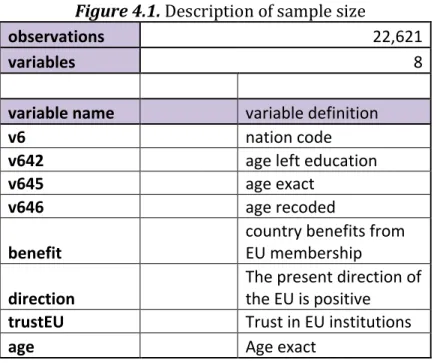
For the purposes of this paper I will only focus on the twenty-seven member states, excluding Croatia from analysis, since Croatia did not join the European Union until 2013. After I eliminate results from Croatia, and the other non-EU member states during 2009, my sample size of the population is 22,621 respondents. Please refer to figure 4.1 on the following page.
Figure 4.1 appropriately displays the number of observations included in my testing as well as the various variables I will utilize to conduct my analysis. The following subsection will analyze these variables in greater detail.
Section 4.2: Variables
For all three hypotheses my independent variable is age. Due to the limits of the survey I am using, I will only be able to test the positivists’ theory on age. This theory, mentioned earlier in the literature review, claims that distinct ages of life influence a citizen’s political support. This study will not focus on the romantic historical’s theory on age because the disparity between historical events in member states makes it impossible to create a variable able to control for these differences. By creating age categories solely based on age, and not historical events, I am able to test the exclusive influence of the number of years a person lives on their political support. The Eurobarometer study provides a continuous variable that represents a respondents’ exact age. The range of this continuous variable is between 15 and 98. This
observations 22,621
variables 8
variable name variable definition
v6 nation code
v642 age left education
v645 age exact
v646 age recoded
benefit country benefits from EU membership
direction The present direction of the EU is positive
trustEU Trust in EU institutions
age Age exact
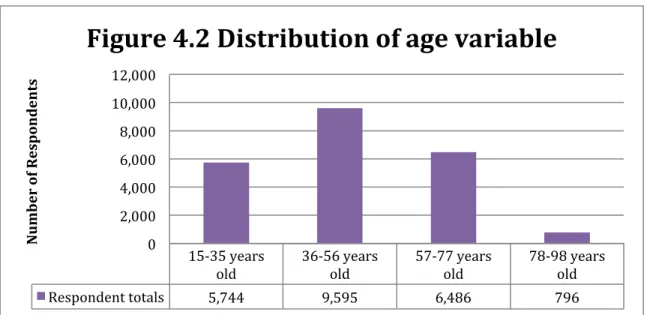
continuous variable is divided into four even groups. These groups are 15 to 35 years old, 36 to 56 years old, 57 to 77 years old, and 78 to 98 years old. The distribution of this variable can be found on the following page in Figure 4.2.
As one can see, the recoding of the independent age variable has created a more normal distribution. This will be critical to continuing the hypotheses testing in the next chapter. To observe the distribution of this variable please refer to Appendix 4.1. My dependent variables for the tests will be levels of trust, support and outlook towards the European Union.
The first variable, support for European integration, relies on a question asking
participants to decide whether they believe European integration is moving in the right direction or the wrong direction. Participants must respond with “things are moving in the right
direction”, “things are moving in the wrong direction”, or “neither the one nor the other.” A total of 22,621 responses were recorded. To observe the distribution of this variable please refer to Appendix 4.2. I chose this question to demonstrate citizen’s support for European integration
15-‐35 years
old 36-‐56 years old 57-‐77 years old 78-‐98 years old Respondent totals 5,744 9,595 6,486 796
0 2,000 4,000 6,000 8,000 10,000 12,000
N u m b er o
f R
esp
on
d
en
ts
because if a citizen believes European integration is moving in the right direction then they are more than likely supportive of European integration as a whole. If a citizen believes that European integration is moving in the wrong direction then they are more than likely unsupportive of European Integration as a whole.
The second variable, opinion towards the European Union, comes from a question that asks, “taking everything into account, would you say that (YOUR COUNTRY) has on balance benefited or not from being a member of the European Union?” Participants are then asked to choose between the following responses: “benefited” or “not benefited.” A total of 22,621 responses were recorded. To observe the distribution of this variable please refer to Appendix 4.3. Participants’ responses to this specific question demonstrate their positive or negative outlook towards their country’s membership to the European Union. It is safe to claim that if a citizen feels that their country has benefited from membership of the European Union then their outlook towards the European Union is positive. If a citizen feels that their country has not benefited from EU membership, then their outlook towards the European Union is probably negative.
The last independent variable relies on question nine of the Eurobarometer survey. This question measures the level of trust citizens have in the European Union. In total, there are 22,621 responses to this question. To observe the count distribution of this variable please refer to Appendix 4.4. This question asks participants to explain how much trust they have in the European Union. Participants must choose between three answers: tend to trust, tend not to trust, and don’t know. For the purposes of testing I eliminated the responses for “don’t know”,
In my multivariate analysis I control for a potential confounding variable. This
alternative independent variable is the age when the survey participant left full time education. This confounding variable is important to control for in my study, over other confounding variables, because it is easy for researchers to naturally pair these two variables (age and
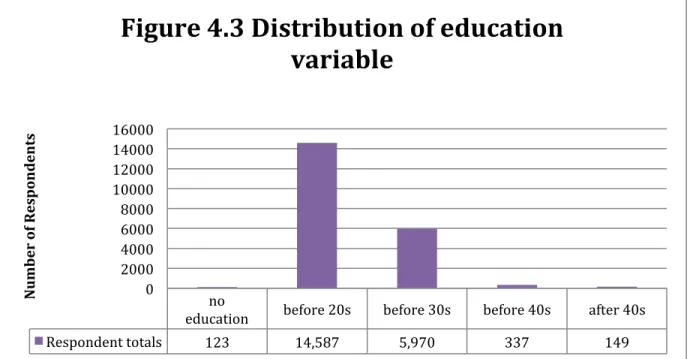
education) together. By including this variable separately into my results I am able to control for the potential influence of education in the participant’s responses. There were 21,166 responses to this question. To observe the count distribution of this variable please refer to Appendix 4.5. The Eurobarometer survey asks respondents to indicate what age they were when they stopped full time education. This continuous variable ranges from no education to seventy-five years old. In order to comply with my analysis it is necessary to convert this continuous variable into an interval variable. Therefore, I have divided this variable into five groups. The groups are as follows: “no education”, “before 20s”, “before 30s”, “before 40s”, and “after 40s”. Figure 4.3 displays a distribution of this variable.
no
education before 20s before 30s before 40s after 40s Respondent totals 123 14,587 5,970 337 149
0 2000 4000 6000 8000 10000 12000 14000 16000
N u m b er o
f R
esp
on
d
en
ts
Figure 4.3 Distribution of education
variable
The histogram presents a variable slightly skewed left but this is predicted since the majority of citizens leave education before they reach their 30s. It is important to note the difficulty associated with categorizing this variable. First, it is difficult to discern between elementary education, higher education, and secondary education. Since the Eurobarometer does not provide a question that addresses this variable it, and because education still lacks
cohesiveness at the European level, the most accurate way to categorize this variable is in age groups. This, as a result, has reduced this variable to non-education generalizations. This may or may not be entirely accurate.
CHAPTER 5: RESULTS
My analysis proceeds in three stages. These stages are correlation, bivariate analysis and multivariate analysis.1 This section displays the testing and graphics I obtain after testing my hypotheses. This section will only describe my results to these tests. The subsequent section will analyze these results and discuss their implications.
Section 5.1: Correlation
The first stage I will focus on is the correlation between my dependent and independent variables. Since all variables are labeled as categorical for this study I will rely on cross tabulations and chi2 tests to measure the level of significance for each of my hypothesis tests.
The first correlation I will measure is between my dependent variable, age, and my independent variable, citizen’s outlook. As mentioned in the previous section, the measurement of this independent variable (citizen’s outlook) relies on whether participants find that their country has benefited or not benefited from becoming a member of the European Union.
As you can see in Figure 5.1, the p-value is less than .05 (it is actually 0.000). With three degrees of freedom, the critical value of chi2 must be above 7.815 to maintain a 0.05 level of significance. Since the chi2 value is 132 it is safe to reject the null hypothesis and to consider a relationship between age and citizen’s outlook as being statistically significant.
The second correlation I must measure is between my dependent variable, age, and my second independent variable- support for European Integration. As mentioned in the previous section, the measurement of this independent variable (support) relies on whether participants find that European Integration is moving in a positive or negative direction.
Age category
Respondent thinks Country benefits from
EU membership
Respondent thinks country does not
benefit from EU
membership Total
15-‐35 years old 4,338 1,406 5,744
36-‐56 years old 6,907 2,688 9,595
57-‐77 years old 4,318 2,168 6,486
78-‐98 years old 527 269 796
Total 16,090 6,531 22,621
In Figure 5.2 you find the p-value of this second significance test is less than .05 (it is actually 0.000). The degrees of freedom for this test were six; meaning to achieve a 0.05 level of significance the chi2 value must be above 12.592. The chi2 value for this correlation test is 181. Therefore, it is safe to reject the null hypothesis and to consider a relationship between age and citizen’s support towards European Integration as being statistically significant.
The final correlation test I will preform is between age (dependent variable) and trust in the European Union (independent variable). As mentioned in the previous section, the
measurement of this independent variable (citizen’s trust in the EU) relies on whether participants trust or do not trust the European Union
Age category
Respondent thinks EU is moving in the right direction
Respondent thinks EU is moving in the wrong direction
Respondent thinks EU is moving in neither the right
or wrong
direction Total 15-‐35 years old 2,551 2,077 1,116 5,744 36-‐56 years old 3,582 3,655 2,358 9,595 57-‐77 years old 2,184 2,594 1,708 6,486
78-‐98 years old 301 336 159 796
Total 8,618 8,662 5,341 22,621
Figure 5.3 presents a p-value less than .05. As mentioned earlier with my first correlation test, with three degrees of freedom, the critical value of chi2 must be above 7.815 to maintain a 0.05 level of significance. Since the chi2 value for this hypothesis testing is 75 it is safe to reject the null hypothesis and to consider a relationship between age and trust in the European Union as being statistically significant.
It is important to note that while all three of our chi2 tests have proved to be statistically significant further testing is required to determine whether a causal relationship exists between each dependent variable and our main independent variable, age. The following subsection will introduce bivariate tests to analyze whether a causal connection can be determined.
Section 5.2: Bivariate Analysis
In all three hypotheses tests my independent and dependent variables can be labeled as categorical. To measure the causal relationship between two categorical variables you must rely on cross tabulations to depict a pattern. This following subsection displays the cross tabulations I created to measure the relationship between each dependent and independent variable.
Age category Respondent trusts EU institutions
Respondent does not trust EU
institutions Total
15-‐35 years old 3,701 2,043 5,744
36-‐56 years old 5,614 3,981 9,595
57-‐77 years old 3,723 2,763 6,486
78-‐98 years old 492 304 796
Total 13,530 9,091 22,621
For the first hypothesis, which states, “The older a citizen of the European Union is, the more negative their outlook towards the European is.” Figure 5.4 tests this hypothesis.
In Figure 5.4 two trends are apparent. The first is the gradual decline in age category percentage for respondents who believe their country benefited from joining the European
Union. Starting with the youngest age group (15 to 35) through to the fourth, and final age group (78 to 98) the respective percentages of people who believe their country benefited from
European Union membership were 76%, 72%, 67% and 66%. These percentages show a steady linear decline of positive outlook in relation to a respondent’s age. The second noticeable trend is the relationship between age and whether the respondent feels their country has not benefited from becoming a member of the European Union. As the age group increases the percentage of respondents who feel their country has not benefited from European Union membership
Age category
Respondent thinks country benefits
from EU membership
Respondent thinks country does not
benefit from EU
membership Total
15-‐35 years old 4,338 1,406 5,744
Percentage 75.52 24.48 100.00
36-‐56 years old 6,907 2,688 9,595
Percentage 71.99 28.01 100.00
57-‐77 years old 4,318 2,168 6,486
Percentage 66.57 33.43 100.00
78-‐98 years old 527 269 796
Percentage 71.13 28.87 100.00
Total 16,090 6,531 22,621
Percentage 71.13 28.87 100.00
Pearson chi2: 132.3325 Pr= 0.000
increases as well. The respective percentages of people who believe their country has not benefited from membership to the European Union are as follows: 24% of the age group 15 to 35 years old, 28% of the age group 36 to 56 years old, 33% of the age group 57 to 77 years old, and 34% of the age group 78 to 98 years old. These percentages show a noticeable, positive correlation between age and a respondent’s negative outlook towards the European Union.
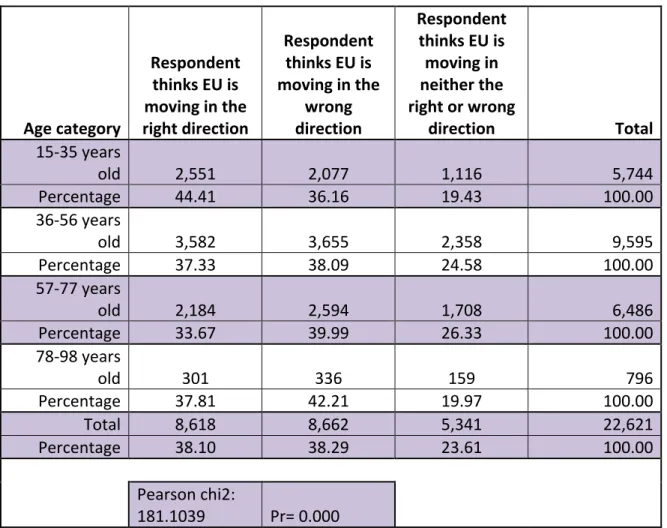
The second hypothesis that is being tested claims, “The older a citizen of the European Union is, the less supportive they are of continuing European Integration.” Figure 5.5, on the following page, tests this hypothesis.
Age category
Respondent thinks EU is moving in the right direction
Respondent thinks EU is moving in the
wrong direction
Respondent thinks EU is moving in neither the right or wrong
direction Total
15-‐35 years
old 2,551 2,077 1,116 5,744
Percentage 44.41 36.16 19.43 100.00
36-‐56 years
old 3,582 3,655 2,358 9,595
Percentage 37.33 38.09 24.58 100.00
57-‐77 years
old 2,184 2,594 1,708 6,486
Percentage 33.67 39.99 26.33 100.00
78-‐98 years
old 301 336 159 796
Percentage 37.81 42.21 19.97 100.00
Total 8,618 8,662 5,341 22,621
Percentage 38.10 38.29 23.61 100.00
Pearson chi2: 181.1039 Pr= 0.000
When one observes the cross tabulation in Figure 5.5 it is worth noticing that the percentage of respondents who feel that European Integration is moving in the wrong direction increases with age. Around 36% of respondents between the age of 15 and 35 believe European Integration is moving in the wrong direction, 38% of respondents between the ages of 36 and 56 believe this as well. When you reach the age bracket of 57 to 77 years old 40% of respondents believe European Integration is heading in the wrong direction and finally, 42% of respondents between the ages of 78 and 98 believe European Integration is heading in the wrong direction. However, it is important to point out that the opposite (that younger respondents would be more positive) is not true. Unlike the percentages for the wrong direction, the percentages attached to the “right direction” response are not linear.
The final hypothesis tested claims, “ The older a citizen of the European Union is the less trust they have towards the European Union.” Figure 5.6, found on the following page, tests this hypothesis.
Age category Respondent trust EU institutions
Respondent does not trust EU
institutions Total
15-‐35 years old 3,701 2,043 5,744
Percentage 64.43 35.57 100.00
36-‐56 years old 5,614 3,981 9,595
Percentage 58.51 41.49 100.00
57-‐77 years old 3,723 2,763 6,486
Percentage 57.40 42.60 100.00
78-‐98 years old 492 304 796
Percentage 61.81 38.19 100.00
Total 13,530 9,091 22,621
Percentage 59.81 40.19 100.00
Pearson chi2: 74.7970 Pr= 0.000
Unlike the previous two hypotheses, the final hypothesis test provides no noticeable trend among the percentages. The first age group (15 to 35 years old) and the last age group (78 to 98 years old) have relatively similar percentages claiming to have trust in the European Union. At around 60% both age groups make it impossible to present a linear pattern of trust based on age. The same can be said about the levels of no trust in the European Union. There is no linear pattern between the four age groups since the second age group (36 to 56 years old) and the third age group (57 to 77 years old) hold the highest percentages of “no trust” at around 40%.
While some contingency tables prove to hold trends amongst their percentages it is not safe to claim that these trends are solely caused by the variable of age. To confirm that age is the only possible variable that can control for these patterns we must control for confounding
variables- or one, in particular. In the following subsection we will conduct multivariate analysis to control for the potential confounding variable, education.
Section 5.3: Multivariate Analysis
As mentioned above, it would be poor analysis on my part to assume that there are no confounding variables affecting the relationship between age and a citizen’s opinion towards the European Union. As mentioned in Chapter two and four of this paper, the relationship between education and politics has been observed previous and has the influence to easily distort our data. For example, an elderly person who falls in the last age bracket, but who has studied past their 30s, could be more liberal than a young person who stopped studying before their 20s.
Therefore, it is important to control for this variable in my testing. To observe the distribution of age and the varying levels of education please refer to Appendix 5.1.
independent variable was treated as dichotomous and the consequent figures in this subsection represent the results.
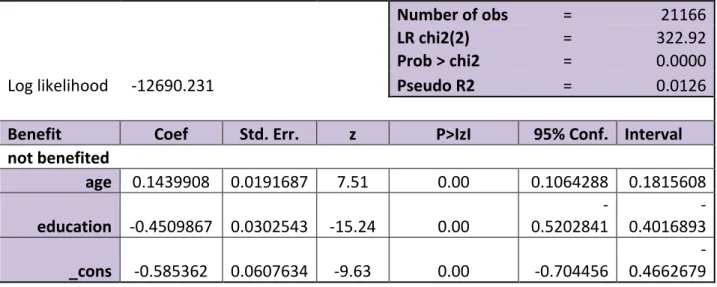
Figure 5.7, found below, represents the logistic regression between our dependent variable, opinion towards the European Union, and our two independent variables, age and education. The p-values for both independent variables are 0.000. Therefore, we can claim these variables as being statistically significant. The coefficient for the variable age is .144. This means that for each one-age category increase in age, we expect a .144 increase in the log-odds of the dependent variable, opinion toward the European Union, holding all other
independent variables constant. The coefficient for the variable education is -.461. For every one increase in education category, we expect a .461 decrease in the log-odds of the dependent variable, opinion.
Number of obs = 21166
LR chi2(2) = 322.92
Prob > chi2 = 0.0000
Log likelihood -‐12690.231
Pseudo R2 = 0.0126
Benefit Coef Std. Err. z P>ΙzΙ 95% Conf. Interval
not benefited
age 0.1439908 0.0191687 7.51 0.00 0.1064288 0.1815608
education -‐0.4509867 0.0302543 -‐15.24 0.00 0.5202841 -‐ 0.4016893 -‐
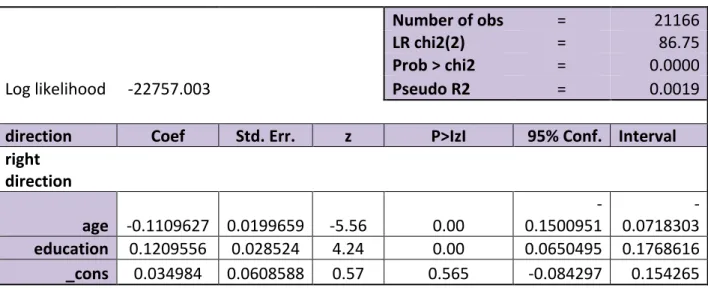
Figure 5.8, found below, represents the logistic regression between our dependent variable, support towards European Integration, and our two independent variables, age and education. The p-values for both independent variables are 0.000, which allows us to classify these variables as being statistically significant. The coefficient for the variable age is -.111. This means that for each one-age category increase in age, we expect a .111 decrease in the log-odds of the dependent variable, support towards European Integration (holding all other
independent variables constant). The coefficient for the variable education is .121. For every one increase in the education category, we expect a .121 increase in the log-odds of the dependent variable, support towards European Integration.
Number of obs = 21166
LR chi2(2) = 86.75
Prob > chi2 = 0.0000
Log likelihood -‐22757.003
Pseudo R2 = 0.0019
direction Coef Std. Err. z P>ΙzΙ 95% Conf. Interval
right direction
age -‐0.1109627 0.0199659 -‐5.56 0.00 0.1500951 -‐ 0.0718303 -‐
education 0.1209556 0.028524 4.24 0.00 0.0650495 0.1768616
_cons 0.034984 0.0608588 0.57 0.565 -‐0.084297 0.154265
Figure 5.9, found on the following page, represents the logistic regression between our dependent variable, trust in the European Union, and our two independent variables, age and education. The p-value for the variable age appears to be 0.215. This value is higher than 0.05 forcing us to maintain the null hypothesis that age has no correlation to trust in the European Union. The p-value for the independent variable education is 0.000. This value allows us to
classify this variable as being statistically significant. Since the test for the age variable does not prove statistically significant I will not discuss the coefficient for this variable. The coefficient for the variable education is -.360. This means that for every one increase in the education category we expect a .360 decrease in the log-odds of the dependent variable - trust in the European Union.
Number of obs = 21166
LR chi2(2) = 196.02
Prob > chi2 = 0.0000
Log likelihood -‐14250.195
Pseudo R2 = 0.0068
trust Coef Std. Err. z P>ΙzΙ 95% Conf. Interval
not trust
age 0.0219405 0.0177038 1.24 0.215 0.0127583 0.0566394 -‐
education -‐0.3604837 0.0265669 -‐13.57 0.000 0.4125539 -‐ 0.3084134 -‐
_cons 0.0750593 0.0551611 1.36 0.174 0.0330544 -‐ 0.183173
CHAPTER 6: DISCUSSION
The results from my hypotheses testing provide interesting contributions to my research question. With correlation testing, bivariate analysis and multivariate analysis I have been able to understand the relationship between my independent variable (age) and my dependent variables (outlook, support, and trust). The following section will interpret the results from my hypothesis testing as well as comment on the contribution this paper has made towards my research topic.
To effectively interpret the results from my statistical analysis I believe the best method would be to comment on each dependent variable separately. The first dependent variable that I tested was outlook on the European Union. If you can recall, this variable relied on the
Eurobarometer question that asked respondents to decide whether they felt their country benefited or did not benefit from membership to the European Union. If respondents felt their country had benefited they were classified as having a positive outlook toward the European Union and if they felt their country had not benefited they were assumed to have a negative outlook. The hypothesis testing predicted that older respondents would have a more negative outlook than younger respondents.
I discovered that there was a positive correlation between age and a respondent’s negative outlook towards the European Union. This contingency table matched my predicted hypothesis that the older a respondent became the more negative their outlook towards the European Union became. However, this result could be skewed by other independent variables so to control for this possibility I continued with a multivariate analysis. The results of the multivariate analysis proved that education was statistically significant in explaining a person’s outlook towards the European Union and was a better explanatory variable than age. Since the coefficient for age in my logistic regression was only .143 I can only claim that the correlation is positive, yet very weak. Therefore, I can only claim that an association between age and a citizens’ outlook towards the European Union exists but further testing would be required to fully understand how strong this association is.
The second dependent variable that I tested was support for European Integration. This variable relied on the Eurobarometer question, which asked respondents to decide whether European Integration was moving in the right or wrong direction. If respondents claimed European Integration was moving in the right direction they were classified as having support towards European Integration. If respondents answered that European Integration was moving in the wrong direction they were assumed to have little, to no, support for European Integration. The hypothesis predicted that older respondents would be less supportive of European
Integration than younger respondents.
of the association I created a contingency table and analyzed for trends between my two variables. I discovered that there was a negative correlation between age and a respondent’s support for European Integration. This contingency table matched my predicted hypothesis that the older a respondent became the less supportive they were of European Integration. To confirm that these results had not been skewed by other independent variables I continued with further testing and utilized multivariate analysis. The results of the multivariate analysis proved that education was statistically significant in explaining a person’s support for European
Integration. Since the coefficient for age in my logistic regression was only .111 I can only claim that the correlation between age and support for European Integration is negative and very weak. Therefore, I can only claim that an association between age and a citizens’ support towards European Integration exists but further testing would be required to fully understand how strong this association is.
My final dependent variable that I tested was trust of the European Union. If you can recall, this variable relied on the Eurobarometer question that asked respondents to decide whether felt trust or not trust for the European Union. If respondents claimed they trusted the European Union they were classified as having high trust in the European Union. If respondents classified themselves as not trusting the European Union they were assumed to have low levels of trust for the European Union. The hypothesis test predicted that older respondents would have less trust toward the European Union in comparison to younger respondents.
determine the direction of the association I created a contingency table and analyzed for trends between my two variables. Upon analyzing my contingency table I was unable to establish a pattern between age groups in relation to trust in the European Union. This contingency table did not match my predicted hypothesis that the older a respondent became the less trust they have towards the European Union. In an attempt to remain uniform with my other hypothesis testing, as well as my own curiosity to explore further, I continued with a multivariate analysis. The most noticeable statistic in my logistic regression was the fact my p-value for age was not statistically significant with a .215. This did not surprise me since I had not been able to establish a trend through my cross tabulation the subsection before. The results of the
multivariate analysis proved even more interesting in that education was statistically significant in explaining a person’s trust towards the European Union. This independent variable was an even better explanatory variable than age. Therefore, I can only claim that an association between age and a citizens’ trust towards the European Union exists but this association is in no way causal.
was mainly related to the influence of age on support for European Integration it would be easy to build upon the relationship between education and support.
After analyzing the contributions of this paper to political science research it is apparent that many more studies can be conducted to contradict or support the results of this paper. In the future a researcher could expand upon my research to include other confounding variables besides age, such as sex or nationality. By conducting multivariate analysis including this data one could gain a more complete picture of what affects a citizens’ support towards the European Union. Another interesting analysis could be preformed at a micro-level regarding age and the European Union. Instead of analyzing all twenty-seven (now twenty-eight) member states it could be beneficial to focus on one in more detail. For example, the United Kingdom would be a perfect case study. Since a referendum to remain in the European Union will be opened to the British public before 2017 one can analyze the relationship between age and British citizen’s support towards the European Union to predict the potential outcome of the referendum.
Another derivative of this study could lead to future political scientists utilizing different surveys, such as the European Social Survey or the European Values Review, to test both the positivist’ theory and the romantic-historical theory in regards to age and political support. Both studies provide researchers with important variables to test support for the European Union. A combined study utilizing all three data sets from the Eurobarometer, the European Social Survey, and the European Values Review would contribute a multiple-dimension analysis of this
Overall, the paper did not yield the expected results, but it has sparked an interest to dive deeper into the relationship between age and political support. Multiple studies can be
APPENDIX 4.1: DISTRIBUTION OF INDEPENDENT VARIABLE
Age Category Frequency Percent Cumulative
15-‐35 years old 5,744 25.39 25.39 36-‐56 years old 9,595 42.42 67.81 57-‐77 years old 6,486 28.67 96.48 78-‐98 years old 796 3.52 100.00
APPENDIX 4.2: DISTRIBUTION OF DEPENDENT VARIABLE (SUPPORT)
Respondents opinion on
the direction of the EU Frequency Percent Cumulative
Right Direction 8,618 38.10 38.1 Wrong Direction 8,662 38.29 76.39
Neither 5,341 23.61 100
APPENDIX 4.3: DISTRIBUTION OF DEPENDENT VARIABLE (OPINION)
Respondents thinks country benefits from EU
membership Frequency Percent Cumulative
Benefited 16,090 71.13 71.13 Not Benefited 6,531 28.87 100
APPENDIX 4.4: DISTRIBUTION OF DEPENDENT VARIABLE (TRUST)
Respondents trusts EU
institutions Frequency Percent Cumulative
Trust 13,530 59.81 59.81 Do Not Trust 9,091 40.19 100
APPENDIX 4.5: DISTRIBUTION OF OTHER INDEPENDENT VARIABLE
Education Category Frequency Percent Cumulative
No Education 123 0.58 0.58 Before 20s 14,587 68.92 69.5 Before 30s 5,970 28.21 97.7 Before 40s 337 1.59 99.3 After 40s 149 0.7 100.00
APPENDIX 5.1: CROSS TABULATION AGE AND EDUCATION
Age Category No Education Before 20s Before 30s Before 40s After 40s Education Categories Total
15-‐35 years old 7 2,661 1,646 32 0 4,346 36-‐56 years old 25 6,751 2,559 159 59 9,553 57-‐77 years old 63 4,605 1,605 123 77 6,473
78-‐98 years old 28 570 160 23 13 794
BIBLIOGRAPHY
Braungart, Richard G., and Margaret M. Braungart. "Life-course and generational politics." Annual Review of Sociology (1986): 205-231.
Brinegar,Adam P., and Seth K. Jolly. “Location, Location, Location: National Contextual Factors and Public Support for European Integration.” European Union Politics 6.2 (2005): 155-80.
Easton, David. "A Re-assessment of the Concept of Political Support." British Journal of Political Science 5.04 (1975): 435-457.
Eichenberg, Richard and Russell J. Dalton. “Europeans and the European Community: The Dynamics of Public Support for European Integration.” International Organization 47.4 (1993): 507-534.
European Commission. Eurobarometer 71.1 European Parliament and Elections, Economic Crisis, Climate Change and Chemic Products. Rep. no. 71.1. Brussels: Directorate-General Communication, 2009. Print.
Gabel, Matthew. “Public Support for European Integration: An Empirical Test of Five Theories.” The Journal of Politics 60.2 (1998): 333-354.
Glamser, Francis D. "The Importance of Age to Conservative Opinions: A Multivariate Analysis." Journal of Gerontology 29.5 (1974): 549-54. Print.
Glenn, Norval D., and Ted Hefner. "Further Evidence on Aging and Party Identification." Public Opinion Quarterly 36.1 (1972): 31-47. Print.
Hudson, Robert, and John Strate. "Aging and Political Systems." Handbook of Aging and the Social Sciences. Ed. Robert H. Binstock and Ethel Shanas. 2nd ed. New York: Van Nostrand Reinhold, 1985. 554-85. Print.
Rosenberg, Shawn W. "The structure of political thinking." American Journal of Political Science (1988): 539-566.
Swinford, Steven. "David Cameron's Plans for EU Referendum Are 'bad for the Economy', Mark Carney Warns." The Guardian. N.p., 16 Feb. 2014. Web. 16 Feb. 2014.