Multi actor roadmap to improve cyber security of consumer
used connected cars
Cyber Security Academy
Executive Cyber Security program
Drs. Herbert Leenstra
S1727834
Telephone number: 06-12946726
E-mail: [email protected]
Date of submission: 03-01-2017
Supervisor university:
Page 2 of 112
Abstract
The automotive industry will introduce the autonomous car into the consumer market in the near future. At this moment, several forms of connected cars are introduced. These
connected cars present the current state of the art on the path to the ultimate goal of the automotive industry: the consumer used autonomous car. Prior research shows that consumers have several concerns on the use of connected and autonomous cars. The system security of the connected car is one of these concerns. There are currently 7 million consumer used cars in possession of Dutch citizens. Consumer trust is key for a successful introduction of connected – and autonomous cars into the consumer market. These concerns have to be addressed by the automotive industry in order to successfully introduce the autonomous car. When we compare the consumer concerns with the actions of the automotive industry, it becomes clear that the security concern is currently not properly addressed. This threatens the successful introduction of autonomous cars in the future.
This research presents a multi actor roadmap which indicates what actions each actor in the automotive industry can take to address and improve the security of connected cars.
In order to do this we show that there are technical security threats on the current
implementation of connected cars. A separate paragraph describes the malicious actors that take advantage of these security flaws in the connected car design. The last part of our argument consists of the description of the actors and an analysis on their actions and interests. These elements, plus the consumer security concerns, deliver the design
requirements that are needed to construct a multi actor roadmap that shows what each actor can contribute to improve the security of the connected car.
Five important elements must be solved in order to generate a more cyber secure car. The first element is that the government must answer the question of car data ownership and the question on how long cars must be patched by the car manufacturers. The second element is the implementation by the branch organisations of an auto ISAC in Europe. The
Page 3 of 112
Acknowledgement
Page 4 of 112
Table of Contents
Abstract ... 2
Acknowledgement ... 3
1. Introduction ... 6
1.1 Problem relevance ... 7
1.2 Assumptions and definitions ... 11
1.3 Scope ... 11
1.4 The objectives of the study ... 13
1.5 Research question ... 14
1.6 Sub questions ... 14
1.7 Methodology ... 15
1.7.1 Research design ... 16
1.7.2 Data sources ... 16
1.7.3 Data collection techniques ... 17
1.7.4 Sampling techniques ... 18
1.7.5 Ethical considerations ... 18
1.7.5.1 Confidentiality ... 18
1.7.6 Informed consent ... 18
2 Technical attack vectors and threat actors ... 19
2.1 Technical attack vectors ... 19
2.2 Threat actors ... 26
3 Actor analysis ... 31
3.1 Actor overview ... 31
3.2.1 Car manufacturers ... 31
3.2.1.1 Economic factors from car manufacturer perspective... 33
3.2.2 Government ... 36
3.2.3 Insurance companies ... 40
3.2.4 Branch organisations ... 42
3.2.5 Network provider ... 43
3.2.6 Car user ... 46
3.2.6.1 Car users concerns... 47
4 Multi actor roadmap to improve connected car security ... 51
4.1 Car manufacturers ... 52
Page 5 of 112
4.3 Insurance companies ... 54
4.4 Branch organisations ... 54
4.5 Network provider ... 55
4.6 Car users ... 55
5 Reflection ... 56
5.1 Looking back ... 56
5.2 Looking forward ... 58
5.2.1 Car manufacturers ... 58
5.2.2 Government ... 59
5.2.3 Insurance companies ... 60
5.2.4 Branch organisations ... 60
5.2.5 Network provider ... 61
5.2.6 Car users ... 61
6 Conclusion ... 62
6.1 Conclusion ... 62
6.2 Future Research... 63
Bibliography ... 65
Appendices ... 70
Appendix 1: Survey ... 70
Survey part 1 ... 70
Survey part 2 ... 71
Survey part 3 ... 73
Appendix 2: Survey structure, process and results ... 76
Appendix 3: Requirements overview ... 107
Appendix 4: Interview overview ... 111
Page 6 of 112
1. Introduction
The automotive industry will introduce the autonomous car into the consumer market in the near future. At this moment, several forms of connected cars are introduced. These
connected cars present the current state of the art on the path to the ultimate goal of the automotive industry: the consumer used autonomous car. Prior research 1 shows that
consumers have several concerns on the use of connected cars. The system security of the connected car is one of these concerns. Consumer trust and social acceptance is key for a successful introduction of connected – and autonomous cars into the consumer market. 2
These concerns have to be addressed by the automotive industry in order to successfully introduce the autonomous car. When we compare the consumer concerns with the actions of the automotive industry, it becomes clear that the security concern is currently not properly addressed. Hackers can compromise the system security of the connected car. By hacking the connected car, hackers can influence the physical safety of the car user. This threatens the successful introduction of autonomous cars in the future.
The available literature on the cyber security of connected cars is limited. The literature that is available deals with either the technical aspects of hacking into connected car systems 3 or
deals with hacker profiling in general.4 The specific profiling of hackers of connected cars was not yet available. There is also no overall study available that deals with both aspects simultaneously. This research fills that gap. We analyse the technical attack vectors of the connected car and also profile the attackers. We look into the concerns of the car user and use that input as a guideline to construct a roadmap to improve the cyber security of the connected car. These three elements deliver requirements we use to construct a multi actor roadmap which indicates what actions each actor in the automotive industry can contribute to address and improve the security of connected cars.
The report by Dokic et al 5 mentions the issues on autonomous cars. The issues mentioned
concern data security, legal & liability, safety, economy and ethics. We cluster these
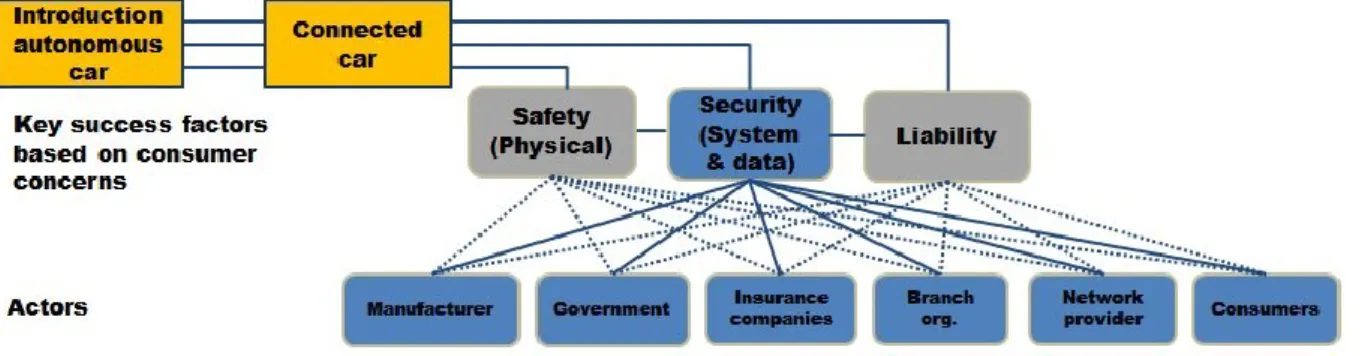
elements in Safety, Security and Liability. These issues are directly related to the consumer trust in the connected car. The following picture shows an overview of the relations between the automotive actors that are capable of addressing the consumer concerns in order to improve the security of the connected – and autonomous car.
Fig 1. Multi actor diagram indicating the actors in relation to the consumer concerns of the connected– and autonomous car
We show that there are technical security threats in the current implementation of connected cars. A separate paragraph describes the malicious actors that take advantage of the
security flaws in the connected car design. The next part of our argument consists of the description and analysis of the other actors, their behaviour and interests. These elements, plus the consumer security concerns, deliver the design requirements that are needed to
1ANWB, 2015
2Dokic, j., et al, 2015, p5 3
Checkoway, S et al., 2011; Valasek, C; Miller, C., 2013; Anderson, M., 2014; Smith, C. 2016
Page 7 of 112 construct a multi actor roadmap that shows what each actor can contribute to improve the security of the connected car.
1.1 Problem relevance
We can see the importance of the security of connected cars in daily lives. The Dutch CBS indicated that there are about 7 million consumer used cars in possession of Dutch
consumers. 6 The figures also show that about 71,5% of the Dutch households possesses at
least one consumer used car. 7 Connected cars are all around us in our society. We live in a
connected world in which all kinds of devices get connected to the internet. Cars are no exception and also follow this trend. The possibility of connecting the car to the internet makes the car even more valuable to people. As the research by Steg 8 shows, car users
value their car, and dislike public transport, for three reasons. The first reason is that car users perceive their car as a better functional instrument to fulfil their personal requirements. The other reasons are that the car represents important cultural and psychological values. For many car users, the car is a symbol of freedom and independence. The car is often seen as a symbol of status. Driving a car is perceived as pleasurable and to be preferred above public transportation. By adding more functions to the car, like connecting the car to the internet, the car becomes even more valuable to the car user.
Fig. 2. Global market for cars, in millions, by region 9
All car brands have recently introduced “main stream” connected cars. Examples of these are Volvo, Tesla, Nissan, Toyota, Volkswagen, Jeep, Chrysler and BMW. The consumer can interact with his connected car using mobile applications. The follow up in this trend is the careful introduction by car manufacturers of the autonomous car. In the autonomous car, the car user is no longer required to drive. The car drives and navigate by itself to the required destination. The main argument of introducing connected cars is about increasing the safety of the car. The claim is that the driver needs assistance in order to avoid accidents. The NHTSA published a report 10 that shows that 94% of all accidents were driver related. Smith
6CBS, Centraal Bureau voor de Statistiek, 2016. 7CBS, 2015
8Steg, L., 2003
9Jiang, T., et al, 2015 p6
Page 8 of 112
11 refers in his article to several studies from 1979 till 2013 which all show that the driver is a
major contributor to car accidents.
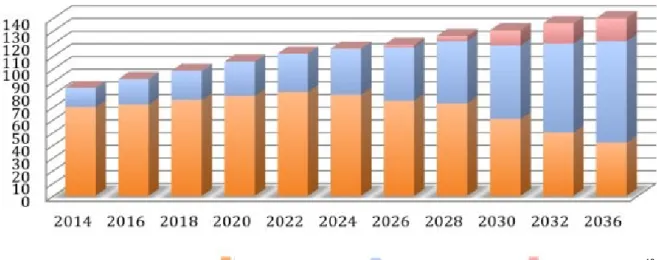
Fig. 3. Global Market for cars in mln, Traditional driven car, Semi-autonomous car, Autonomous car 12
IHS researchers predict 54 million autonomous cars in 2035. About 2.4 million of these cars will drive in Europe. 13 Car manufacturers traditionally focus on car safety and user features
like car navigation. The security element is, as is the current state of almost all cars, left out of the equation. This is remarkable because a recent international study by Kyriakidis 14 in
which 5000 people participated, shows that the three biggest consumer concerns are the possibility of misuse / hacking of the car software, legal issues and safety issues. Car manufacturers only address the car safety issue. The study also shows that 69 percent thinks that the autonomous car will have a market share of fifty percent before 2050. The results of this study are confirmed in a recent study by the ANWB in the Netherlands in 2015.
15 The Dutch respondents indicated to be concerned about the commercial use of collected
car data (88%). The second concern was about hacking the car software (84%) and 94% wanted protective legislation.
The study by Heide 16 predicts the introduction of the main stream autonomous car around
2021. The first argument used by the automotive industry for the rapid introduction of the connected car is that the car driver is unable to detect and respond quick enough to all the relevant traffic issues the driver encounters. The introduction of connected cars results in a more efficient use of the road and therefore result in less traffic jams. The third argument is that the car user has less stress in a connected car and more time to do other activities. These are exactly the claims Volvo makes in their autonomous car trials in 2017 in the UK and China. Volvo predicts less accidents, a reduction of traffic jams, less pollution and saving the valuable time of the car user. In case of the autonomous car, Volvo commits itself to make sure that in 2020 “no one will be seriously injured or killed in a new Volvo”. 17 The other
thing that makes the Volvo experiment interesting is that Volvo will use production cars
11Smith, B., 2013
12Jiang, T., et al, 2015 p6 13IHS Markit, 2014
14Kyriakidis, M. et al., 2015
15ANWB, 2015
16
Heide, A. et al., 2006
Page 9 of 112 instead of special prototypes. The drivers in this experiment are regular people and not engineers. In order to keep the car users safe several systems are made redundant. 18 Research by Kyriakidis in 2015 19 shows that the respondents of the developed countries
were also worried about the transmission of data from their car. The term “developed” in this study means that those countries have lower national accident statistics and the respondents have a higher income and higher education level. The study by Gonder 20 shows that the
collection of car data and the possibility to profile the car users is possible and might indeed cause a serious privacy concern. Enev concluded in his research 21 that a person could be
identified with an accuracy of 87% by analysing the car data of a single sensor (brake) and a 99% accuracy when the data of five sensors are combined.
Our study aims to address the concern about car security by introducing a multi actor roadmap to improve the security of connected cars. The benefit for society is that the
improvement of the security of the connected car will also improve the personal safety of the car user.
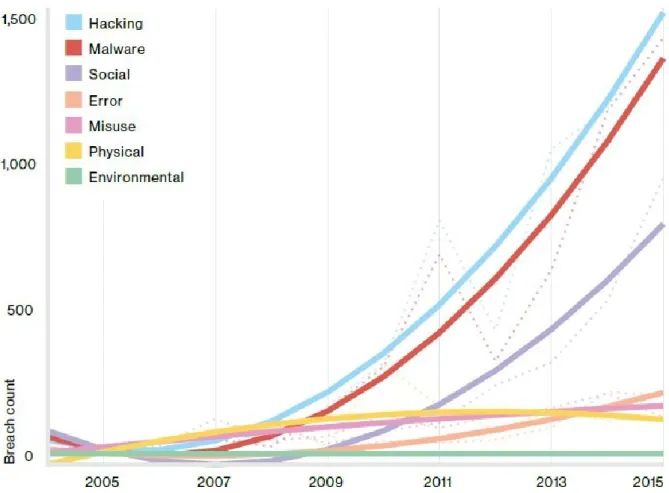
Fig. 4. Number of security breaches per threat action category over time, (n=9,009) 22
18Ross, P., 2016
19Kyriakidis, M. et al., 2015 20Gonder, J. et al. 2015 21Enev, M. et al, 2016
22
Page 10 of 112 The figure above shows the number of security breaches per threat category. The main source of security breaches can be found in hacking, malware and social engineering. Social engineering is out of scope of our research. In chapter 2 and 3 of our study we address the hacking and malware threats.
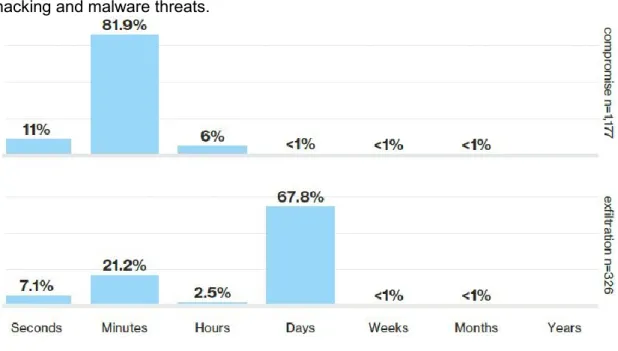
Fig. 5 Time to compromise a system and data exfiltration time.23
The figure above shows how quickly ICT systems are compromised. It takes the attacker minutes to days to exfiltrate the data he is after. The figure below shows that the time to compromise the security of a system, related to the time it takes to discover a security breach. The same applies to the security of the connected car. The security of a connected car can be breached, and it takes longer to detect such a security breach.
Fig. 6 Percent of breaches where time to compromise (green)/time to discovery (blue) was days or less24
Page 11 of 112
1.2 Assumptions and definitions
Our assumption is that all forms of connected – and autonomous cars are based on the same principles. We assume that all connected cars consist of the following elements. The first element is a car. This makes sense because without a car, you can’t have a connected car. The second element is that there must be some form of communication possibility to and from the car. In addition to that, we see that a lot of cars are connected via the internet. This is the actual “connection” in the term “connected car”. The third element is that the connected car contains computer chips. The automotive industry calls these chips ECU’s 25. An average
car has about 50-70 ECU’s which are connected by the controller area network (CAN). 2627
The fourth element is that a connected car contains software. This software is controlling all kinds of functions in a connected car. This includes the motor management, navigation and the entertainment systems. The fifth element of a connected car is some form of data storage. Otherwise the software and the data that runs through the applications could not function correctly. The last element is a volatile computer memory. Some of the calculations must be executed “in memory” because of the necessary processing speed to act “real time” on the car movement. When you look at it, a connected car is in fact a computer on wheels that can also transport people and goods.
Based on these assumptions we can better understand what a connected car is and investigate the possible attack vectors. In fact, we can now better understand how it is possible that connected cars get hacked. A connected car is just a computer on wheels connected to the internet. Computers connected to the internet can and will be hacked. The more “interesting” the connected target is, the more people will try to hack that computer. Connected cars are no different and will be attacked by hackers.
Although the terminology and definitions in literature differ 28, a connected car always
consists of the elements that are specified and described above. In short, a connected car is any car that has remote communication possibilities. The next definitions that needs
explaining is the difference between safety and security. We follow Burns in his analysis on safety and security. 29 We define safety as the condition of being protected from direct
(physical) harm. The term safety always involves a human being. The definition of security we use is, that it is the state of being free from danger or threat. The term security involves a system. We define hacking as gaining unauthorised access to (computer) systems.
Foundations, associations, special interest groups and generally accepted organisations that are seen as “organisations involved in- or active for the automotive sector” are hereinafter referred to as “branch organisations”.
1.3 Scope
The scope of this research is bound by several elements. The first element is limiting this research to cars. The term “vehicles” would be too broad because that in includes cars, drones, vessels and a wide variety of other devices. An example of this is the recently introduced autonomous vessel by the US navy that can operate by itself on the ocean for
24Verizon, 2016, p 10
25ECU, Electronic Control Unit 26Wijk van, M., 2016.
27
Geraets, M., 2016
Page 12 of 112 several months. 30 The second element is that we use the term “connected” cars.
Fig 7. Relation diagram between connected cars and autonomous cars
The figure above shows the relation between connected cars and autonomous cars. All autonomous cars are connected cars. Our study uses the term “connected cars” which includes the autonomous car. The automotive industry defines several stages of connected cars in which the last stage is a fully autonomous car. The automotive industry generally agrees that there are six stages of connected cars, as depicted below.
Fig. 8. Overview of stages of connected cars based on SAE standard J3016 and NHTSA. 31
Only the last stage contains a fully autonomous car. The problem with the six stages model is that the definitions for each stage are not clear within the automotive industry. In practice, the boundaries between these stages are not clearly defined. When one car manufacturer claims a car in stage 3, another car manufacturer claims that that is not the case and it is just a car in stage 2. The most commonly used models are of the SAE 32 and NHTSA. 33 The SAE
model consists of six stages of a connected car. The NHTSA model consists of five stages. We look into the cyber security of the connected car and for our research it does not matter in which stage a connected car is. We research the cyber security of connected cars in general. This includes all forms of connected cars including the autonomous car. We see the autonomous car as just another form of a connected car.
30
Anonymous, 2016
31SAE, 2014
32SAE, Society of Automotive Engineers http://www.sae.org/automotive/ 33NHTSA, National Highway Traffic Safety Administration http://www.nhtsa.gov
Page 13 of 112 The third element to limit our scope is, that we focus on the consumer used connected car. Out of scope are connected cars that are used in harbours, by the military and other non-consumer use. We want to improve the cyber security of the non-consumer used connected car.
Our research includes the relevant actors within the automotive industry that can influence and improve car security. We look at the car ecosystem and the actors that are involved. The fourth scoping element in our study is the limitation of actors to: car manufacturers,
government, insurance companies, branch organisations, network providers and car users. We determine the actions and motivation for each cluster of actors. When these elements are identified, a multi actor roadmap is constructed in order to improve the current security situation of connected cars. We show that the actor that has to start this change are the car manufacturers. 34 In order to help the car manufacturers to implement the lessons learned
from previous security breaches, a security roadmap is presented in a way the car manufacturers can use it to take this next step.
The last scoping boundary is geographical. The security aspects of the connected car is not a single nation problem, but a worldwide problem. By setting the geographical roadmap boundary to the Netherlands we are able to deliver a concrete example roadmap for the parties involved. The roadmap indicates which actions each actor can take to improve car security. We show that it is possible to construct a national cyber security roadmap to improve the security of connected cars.
1.4 The objectives of the study
An objective of this study is to deliver a multi actor roadmap to improve the cyber security of consumer used connected cars. We take the current situation of the cyber security of connected cars in the Netherlands as a starting point.
Literature shows that there are several possible attack vectors and a limited type of attackers that want to deliberately harm a connected car. The current actor landscape of the connected car is focused on safety and not on security. Because it is now possible to harm the safety aspect by breaching car security, it is time to act and address the cyber security aspects of the connected car. The constructed roadmap is based on the requirements we gather in the sub questions we defined.
For the qualitative part of this research we have defined several objectives. The first is to explore the possible attack vectors of a connected car. We answer questions like: Is it possible to hack the cyber security of connected cars? How can we cluster the technical vulnerabilities in connected cars in order to find and define solutions to prevent misuse of the connected car systems.
People often speak of “an evil hacker exploited vulnerability x”. What are the triggers of a person in order to become a hacker? What are the inhibitors, accelerators, and other factors for a person to become a hacker? Can we categorise these attackers? The second action is to categorise the possible attackers that are capable and motivated to breach the security of a connected car. This analysis gives us the hacker incentives that we can block in order to prevent people from hacking connected cars. These requirements are input for the multi actor roadmap.
Page 14 of 112 From our literature research the picture emerged of a standard pattern of behaviour of the automotive actors when confronted with a security breach. Of course it is not possible to examine all the automotive security breaches in the world. This research is limited to the security breaches that made it to the media. Describing several of these cases we show that a repetitive pattern of behaviour that is typical of the actors in the automotive industry when they are confronted with a security issue.
The introduction of the connected car also results in many new functionalities consumers can use. It delivers a new set of (legal) questions. There are liability questions, platooning issues of cars, privacy aspects and data storage questions. We will discuss the legal issues in short when we discuss the role of the Dutch government to improve the security of connected cars in the Netherlands.
These objectives come together in one overall goal. To create a multi actor roadmap to improve the cyber security for connected cars.
1.5 Research question
Based on that the question becomes how the automotive industry can improve the cyber security of civilian used connected cars. When we look at the current landscape on the connected car the main research question becomes:
This research question is broad and includes all consumer used connected cars. Car manufacturers built and sell connected cars on a global scale. In order to show that a multi actor roadmap to improve the security of the connected car can be created, we construct this roadmap for the Netherlands.
1.6 Sub questions
In order to answer the main research question we have to break the issue apart in several sub questions. There seems to be little awareness within the automotive industry on cyber security. This is also the picture that emerges from the interviews and the survey. We have to show that there are plausible technical attack vectors to breach the connected car security. This is the first sub question we have to answer.
1) What are the possible technical attack vectors to attack a connected car? We need this element in our argument in order to demonstrate that there are technical
vulnerabilities in connected cars that can be exploited. This analysis delivers the first requirements for the multi actor roadmap.
In the preliminary investigation in the automotive branch revealed that many actors find it hard to imagine that someone would deliberately hack the security of a connected car. We present an overview of the possible attackers of a connected car and describe their
motivation and capabilities. This element delivers the second sub question.
2) How can the possible attackers of connected cars be defined and categorised? With this element we show what the most likely attackers are and what drives them. This analysis delivers the inhibitors, catalysts and amplifiers of attackers. These elements are input for the multi actor roadmap.
Page 15 of 112 Another element that was revealed during this research was the predictable repetitive
patterns of behaviour of the actors in the automotive industry when confronted with a cyber security breach of a connected car. That fact delivers the next research sub question and the answer to this delivers the requirements needed to construct the multi actor roadmap.
3) Identify and describe the factors and incentives of the actors in the connected car ecosystem when they are confronted with security issues of connected cars. With this element we show that there are fixed patterns of behaviour by the actors of the connected car when confronted with a cyber security incident.
Based on the answers on these sub questions we define the requirements we need to construct a multi actor roadmap.
4) What are the possible roadmap items for the Dutch automotive industry to improve the cyber security of consumer used connected cars in the Netherlands?
1.7 Methodology
Page 16 of 112
Fig. 9 Methodology
1.7.1 Research design
This paragraph addresses the question how this research was constructed and executed. In this part of the research we show the initial research design including the used data sources, data collection techniques, reliability issues and ethical considerations. This qualitative research consists of several elements in order to get a clear picture of the different cyber security aspects of the connected car in its ecosystem. Interviews are part of this qualitative research. Other elements of this research are exploratory and descriptive. These parts are the attack vector analysis, the attacker analysis and the behaviour analysis of the actors in the automotive industry when confronted with security incidents. These elements deliver the requirements we need to construct a multi actor roadmap to improve the cyber security of the connected car. Because of that this thesis is part of design science.35
1.7.2 Data sources
The first data source element is a desk research on the available scientific literature. The complicating factor is that there is not much scientific research available on the cyber security of connected cars. To broaden the search for relevant information, non-scientific documents, conferences and videos are also be taken into account.
Page 17 of 112 The second data source element consists of interviews with experts and stakeholders within the automotive industry. The interviews are conducted to verify the information found in literature. By introducing the expert interviews we try to solve the void that is created with the scarce scientific research available. A survey is the third data source element in this research. The fourth and last data source consists of personal observations and insights during the interviews. See Appendix 4 for an overview of conducted interviews.
1.7.3 Data collection techniques
The desk research is conducted in a structured way. This research includes a literature search. The first step is to gather literature based on key word search. The used key words, and combination of key words, to search relevant literature are: connected car, autonomous car, automotive, security, hack, breach, black hat, testing, non-disclosure, network, CAN bus, architecture, security by design, security standard, legislation. The second step is to screen the gathered literature and make a selection based on subject relevance. In this process all non-car related literature is removed. The literature that remains is studied in full and forms the basis for our research. The third step is to look at the relevant literature and check the used references. Some of these references are also relevant for our own research. The fourth step is to look at the authors of the literature and look for more articles of these authors regarding the same subject. This snowball method delivered some additional literature. Some papers are excluded in this phase, based on their specific details that does not fit our research scope.
A preliminary screening on the available scientific research indicates that there is little scientific literature available in the research area of cyber security of connected cars. To cope with this lack of available literature, also non-scientific literature, newspaper articles, hacking video’s and hacking events are taken into account. The selection of these non-scientific documentation follows the same pattern as the non-scientific literature selection.
The literature review results are tested and compared in the expert / stakeholder interviews. In order to obtain the maximum “connection” possible with the interviewed person, we always interviewed “in person” at their own office. This was occasionally followed with an follow up interview by phone. An interview in person at their own office, makes the interviewed person feel at ease and the chance of obtaining relevant information increases. The downside of “interviews in person” is that it takes significantly more time to execute all these interviews. Getting into people’s busy agenda is also an extra barrier for these interviews. An Excel file is kept containing the logging of the all communication contacts with the experts in the automotive industry. The persons and organisations that refused to cooperate in this research are also logged in this file. Notes are taken from each interview including personal observations and gained insights during the interview. We chose to take notes and not to record the interviews. Previous experiences show that people tend to be careful in their choosing of words when confronted with a recording device.
Page 18 of 112 The survey questions are available in appendix 1. For a detailed overview of the survey structure, the survey process and survey results see appendix 2.The second part of each interview is structured and strictly follows the survey questions. The person that was interviewed, and other persons that are present in the meeting, obtained the survey questions on paper. Sometimes the person that was interviewed took an expert with him/her during the interview to assist them in answering the questions. The input of the interviewed person was logged. Only one interview + survey, including their remarks, is put into the dataset. The input of the other persons present is not in the dataset. This prevents cross contamination of the gathered interview / survey data. The researcher took notes of additional remarks that the interviewed person, or other persons present, adds during the interview. Each interview ended with the question who to contact in the automotive industry to obtain a full and fair overview of this research area. The last interview question was always a “catch all” question: “Do you have any other remarks on this subject that we missed in this interview?” This gave the interviewed persons the possibility to add items that are important to them.
1.7.4 Sampling techniques
This qualitative research started initially without a network or connections in the Dutch automotive industry. We started in March / April 2016 with a preliminary research in the field of the automotive industry to discover if there were enough people and organisations that could / would want to participate in this research to get a significant outcome. We started the initial search with TNO and used the snowball technique to discover the relevant stakeholders within the automotive industry. Each interviewed stakeholder was asked who we should consult next in order to generate an adequate overview of the automotive industry. We stopped gathering data at 11-11-2016.
1.7.5 Ethical considerations
We did not hack connected cars ourselves in this research, but we did speak to people that have hacked connected cars. We use this input of (hacking) experts to generate
requirements for the multi actor roadmap. 1.7.5.1 Confidentiality
During the interviews the respondents sometimes indicated that certain information was confidential. Such a remark was noted and that specific piece of information is not in this report. All conducted surveys are anonymous. Some people replied to the researcher that they filled out the survey and added extra comments in the mail. Of course these people realise that they are no longer anonymous participants because timestamp of mail including specific remarks makes a correlation possible.
1.7.6 Informed consent
Page 19 of 112
2 Technical attack vectors and threat actors
The first step in our analysis is to determine the technical attack vectors and cluster them. This gives us the answer on the first sub question what the possible technical attack vectors are to attack a connected car.
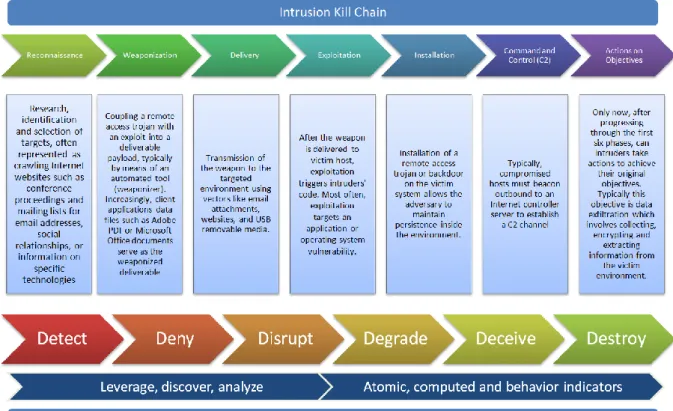
We start at looking at the kill chain. 36 The kill chain consists of seven stages. The attacker
must pass all seven stages in order to execute a successful attack on the connected car. The attacker can be stopped at each of these stages and the attack will fail. In this chapter we look at the possible attack vectors and motivation for the different types of attackers. By analysing these elements we gain insight in the criminal business case and the kill chain. The attacker has to complete every step in the kill chain to be successful. The defenders of a system have to stop the attacker at one of these steps. The elements that deliver the
possibility to stop an attacker, are the requirements we need to incorporate into the multi actor roadmap.
Fig 10 Kill chain37
Looking at the kill chain it becomes clear that the effort to protect the connected car by only implementing prevention measures will fail. The average lifespan of a car is more than 10 years. State of the art cyber security will be obsolete after 10 years. Cyber security can and will be compromised over time. A sufficient technical security solution to protect the
connected car should also try to detect the security breach and generate an appropriate response.
2.1 Technical attack vectors
In this paragraph we look into the possible technical attack vectors to attack a connected car. Anderson 38 investigated the security aspects of 21 different cars. His research shows that
there are three main components necessary to succeed in a successful hack attack on a car.
36
Hutchins, E. et al, 2011 Based on the Lockheed Martin Kill chain
Page 20 of 112 The first element is finding a way into the car. The second element is compromising an ECU
39 and the third element is finding a control feature that could be compromised. The report by
FireEye 40 also indicates a number of technical vulnerabilities. These overlap with the results
found by Anderson, Checkoway and Valasek. We use a slightly different approach that is based on prior research by Checkoway and Valasek. 41 These researchers present a broader view how car security can be compromised. The “Car Hackers Handbook” by Smith 42
presents an extensive overview of the possibilities to hack into connected cars. Before we look into the details we present a high level picture, indicating the attack clusters. In the next step we zoom in into the detailed hackable elements of the connected car. These
requirements are attributed to an actor and put into a multi actor roadmap to improve the security of the connected car. The figure below shows the identified high level attack clusters. You can also recognise the elements defined by Andersen. There are four main clusters. The first cluster is the direct physical attack possibility. In that case the attacker has direct access to all parts of the car. Car manufacturers should realise that their product is functioning in a hostile environment. Expert interviews 43 as well as hacker presentations
shown in public 44 indicate that an object that can be directly accessed can and will be
breached. There is no good defence against a direct physical attack. In the end the attacker wins. That means that your car is vulnerable when people have direct access to the car. This is the case when your car is in for maintenance, repairs or when you lend your car to other people.
Fig 11. Overview of the clustered attack vectors of a connected car based on research by Checkoway, et al., 2011 and the TU Automotive report 2016.
The second cluster concerns the indirect physical attacks. That means that a carrier of some sort is necessary to carry out the attack. This carrier can be an USB stick or CD with a special WMA song that compromises the car firmware. 45 Also the existence of SD cards in
39Electronic Control Unit 40FireEye, 2016
41Checkoway, S et al., 2011; Valasek, C; Miller, C., 2013 42Smith, C. 2016
43Smulders, A. 2016; Hoop, de A. 2016 44Mahaffey, M.R.K.et al. 2015
Page 21 of 112 cars like Tesla opens all kinds of new attack possibilities. 46 Some car manufacturers, like Fiat Chrysler Automobiles (FCA), teach their customers to download software patches on USB devices in order to patch vulnerabilities in connected cars.47 In our opinion this is not a
smart thing to do because you teach the end user that “it is ok to put an uncontrolled USB device in your car to update the firmware / software of the car”. This increases the possible attack surface of the connected car. Malware, like ransomware, spreads for example via e-mail and USB sticks. An attacker can sent a letter containing an infected USB stick with malware / ransomware to the car user with the request to patch the software of the car.
The third cluster is about the wireless attacks on a connected car. Bluetooth as well as attack on or via the mobile network are possible. The current application development for iOS and Android in which the car user can interact with his car gives, according to Kim et al., 48 an
abundant variety on attack possibilities. Weinmann describes fundamental mobile baseband attacks based on flaws in the protocol stack.49 These facts in combination with the fact that a
lot of mobile devices and smart phones are not and cannot be properly and timely patched,50
gives the attacker of the connected car an additional attack surface.
The fourth cluster is about sensor fooling. There are no known hacks documented in literature that indicate that you can compromise and take over a car by fooling the sensors. That’s why the line in the figure above is a red dotted line. Sensor fooling however is a real threat that can seriously harm the car user. Connected and autonomous cars often use Lidar
51. Research shows that camera based autonomous car systems and Lidar systems can be
fooled in an cheap and easy way. 52 These systems can be blinded or fooled with false
information that might cause accidents. GPS has also vulnerabilities that can be exploited. 53
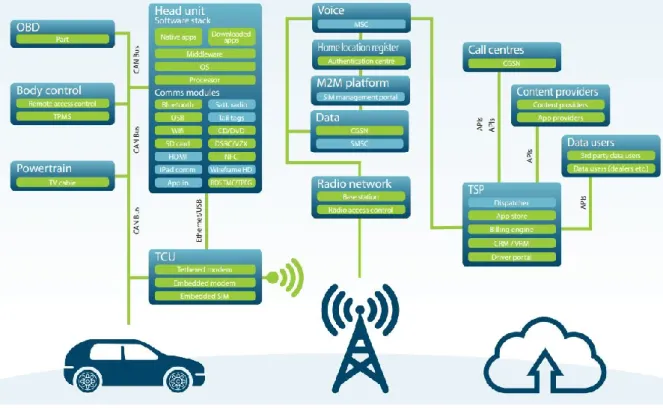
When we look into the communication architecture of the connected car, we see that there are several communication channels that are interconnected and also connected to the outside world. Looking at the ICT architecture of the connected car we see that any breach will lead to multiple access and tampering possibilities.54 The research by Zhang 55 describes
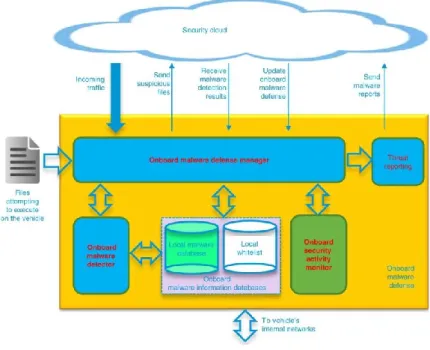
how connected cars could be infected and protected from malware attacks. This research indicates four general entry points. The first cluster of vulnerabilities are related to the architecture and design of the hardware and software of the connected car. Communication protocols and applications may also contain vulnerabilities and the last element of this cluster are the implementation failures. The second cluster of vulnerabilities are related to the
operating system of the connected car. This operating system is often some form of Linux.
46
Mahaffey, M.R.K.et al. 2015
47Fiat Chrysler Automobiles (FCA) https://www.fcagroup.com/en-US/Pages/home.aspx is the seventh largest
manufacturer of automobiles in the world. Car brands that are part of the FCA group are: Abarth, Alfa Romeo, Chrysler, Dodge, Fiat, Jeep, Lancia, Ram, SRT and Maserati. The update site for the FCA Uconnect service is
http://www.driveuconnect.com/software-update/ The end user can download new software on an USB device and update the firmware of the car. The access to the software download is based on the VIN number of the car. The VIN number of each car is visible from the outside of the car. FCA indicates that it takes about 30 to 45 minutes to update the car software.
48Kim, P. 2014 49Weinmann,R., 2012 50Husted, N. et al., 2011
51Lidar is “LIght Detection And Ranging” also known as “Laser Imaging Detection And Ranging” 52Petit, J., 2015
53
Nighswander, T., et al., 2012
Page 22 of 112 The next cluster consists of vulnerabilities that enter the car via software patches and
updates. When these software patches are infected the entire system gets infected. The last cluster contain the car users themselves. When the car user visits a malicious website or downloads an infected file the connected car can be infected.
Fig 12 Connected car overview - existing in-vehicle network architectures 56
The research of Jun Li 57
proposes an IDS, CAN See, that detects anomalies. Zhang suggests to protect the data of the connected car by checking each file to the gathered data in the security cloud. 58 Zhang’s
research has also a flaw. His research focus lies entirely on the protection of the car. The connected car ecosystem should be looked at as well.
56
Zhang, T. et al., 2014 p12
57Li, J., 2016
58Zhang, T. et al., 2014 p19
Page 23 of 112 Applying the knowledge of the attack vectors in combination with known vulnerabilities on cars results in the following figure below.
Fig. 14. Detailed overview of possible attack vectors of a connected car 2016 59
The figure above shows an overview of the possible attack vectors of the connected car. The figure shows that not only the connected car itself contains vulnerabilities, but car security can also be breached by other elements in the connected car communication chain. The car manufacturers, the network provider and the car dealer all play a role in improving the security of the connected car.
Research by Oosterbaan et al. in 2014 60 indicates that the current connected car
implementation contains an average car of 30 to 100 separate but interconnected systems. The security model of these implementations seem to follow the coconut model, a hardened shell and no extra security measures within or between the systems in the connected car. That seems a logical step in a non-connected car. The researchers state that car
manufacturers did not update their traditional security approach to the new connected car.
Miller and Valasek showed in 2014 a brand and type specific overview per car brand how easy it was to breach car security. This is depicted in the figure below.
59TU Automotive, 2016
Page 24 of 112
Fig 15. Car vulnerability overview by Miller and Valasek 2104 61
The first column “attack surface” refers to the first stages in the kill chain. That is the “reconnaissance, weaponisation and delivery” phase. The second column “Network
architecture” is represented in the “exploitation, installation and command & control” phase of the kill chain. The last column “Cyber physical” is represented by “command & control and actions on objectives” in the kill chain. The kill chain is overlaps several columns and there are no hard lines between the columns.
Many connected car brands have been hacked. Some examples to show our point:
Mitsubishi Outlander plug in hybrid (PHEV) was hacked in June 2016. Point of entry was the Wi-Fi connection62
. Initial reaction from Mitsubishi was “disinterest”. After the hackers involved the BBC, the car manufacturer responded and fixed the security issue.
BMW, Mercedes and Chrysler were hacked in July 2015. 63 The hackers used the hacking
toolkit called “Ownstar” to hack into the “OnStar” car management system of the connected
61Miller, C., & Valasek, C.,2014 62Lodge, D., 2016
Figure 15 shows three columns.
1) The column “Attack surface”, which includes all wireless attack vectors like Bluetooth, cellular, keyless entry systems. This is the first step to access the car.
2) The “network architecture” column indicates if the attacker can reach important systems (eg. steering, brakes etc) after the initial entry.
3) The column “Cyber Physical” means automated car systems (eg. Lane control) that are vulnerable for spoofing which results in loss of control over the car.
Page 25 of 112 car. 64 Although SSL 65 was used in the encrypted communication, the hackers could still intercepted and read the communication between the car and the OnStar servers. The hackers used a MitM attack 66. The car user tries to connect to the server and finds a fake
Wi-Fi access point nearby. When the connection is made via the fake access point, the attacker can intercept the communication and compromise the security. The following car brands were vulnerable for this kind of attacks: BMW Remote, Mercedes-Benz mbrace, Chrysler's Uconnect, and Dodge Viper’s Smartstart.
In February 2016 BMW was confronted with several vulnerabilities in the BMW's ConnectedDrive Web portal. Hackers could exploit vulnerabilities like XSS 67 and VIN
session hijacking to attack and change the car configuration.68 Security researcher B. Kunz
Mejri concluded that five months later, the issues still existed. XSS is a well-known issue in web portals. XSS is in the top 10 list by OWASP 69 for several years. XSS vulnerabilities are
well known common vulnerabilities and are easy to solve by developers of web portals.
Researcher T. Hunt showed in February 2016 that the Nissan Leaf app 70 was vulnerable and could be exploited. The Nissan user application uses the VIN number 71 to identify and
authenticate the car and the car user in the Nissan app. When a hacker enters another VIN number in the app, he can access another car. The Nissan app lacks any authentication. The Nissan Leaf is therefore easy to hack. Hackers can even write a script to disrupt the Nissan Leaf without any human intervention. The researcher contacted Nissan to report the issue. Nissan did not visibly react for about four weeks and then took the service offline. 72
In 2014 Miller & Valasek hacked a Jeep Cherokee over the internet exploiting the Uconnect wireless connection. 73 The car manufacturer, Fiat Chrysler Automobiles (FCA), responded
with a recall action of 1.4 million cars. 74 The FCA dealt with this and other hacks of the FCA
OwnStar system 75 by sending a letter to the car users containing an USB stick and the
question to update the software of the car to patch the vulnerability found. Car users could also download the updated car software from a website and patch the car themselves.
When we look at the technical attack vectors supported by the cases we discussed in this paragraph, we can conclude that connected cars contain vulnerabilities. Connected cars are computers on wheels and do have the same vulnerabilities as regular computer systems. Connected cars should be treated in the same way in order to protect these computers on wheels.
The requirements we derive from this technical attack vector analysis are: the connected car should have a layered defence. The car should have security zones, anomaly detection
63Cimpanu, C., 2015
64In December 2015 at the DEFCON 23 conference, researcher S. Kamkar presented his findings in a
presentation called “Drive it like you hacked it: New Attacks and Tools to wireless”
https://www.youtube.com/watch?v=UNgvShN4USU 65SSL – Secure Socket Layer
66MitM, Man in the Middle attack
67OWASP, 2016 XSS, Cross site scripting 68Cimpanu, C., 2016
69OWASP, Open Web Application Security Project https://www.owasp.org 70Hunt, T., 2016
71
VIN number, Vehicle Identification Number. The VIN number can be read from outside the vehicle and is mostly placed at the bottom of the windshield.
72Weise, E, 2016 73
Greenberg, A., 2015b, p1
Page 26 of 112 systems and redundancy in system with critical functions. The CAN bus 76 should only
connect those systems that must share data or communicate with each other. Non-essential systems, like entertainment systems, should not be on the same CAN bus as the motor management systems. This change in the architecture of the connected car must take place in order to improve the cyber security of the connected car. But we have to remember that the required adjustment of the connected car architecture is a trade-off based on the underlying law and commercial business case. Lessig 77 stated in his publication that the
implemented technology is a weighted balance between privacy, security of the individual on the one hand and the commercial business case of the organisation on the other hand. The identified requirements from this paragraph are summarised in the chapter on car manufacturers and network providers.
2.2 Threat actors
In this paragraph we analyse the threat actors that take advantage of the existing technical vulnerabilities of the connected car. The figure below presents an actor overview based on the connected car ecosystem. In this paragraph we look at the people that deliberately harm the connected car. These actors are indicated in red. The other actors are discussed in the next chapter.
Fig 16 Actor overview in the connected car ecosystem 78
We use the SABSA framework by Sherwood 79 to categorise and define the attacker of the
connected car. This framework was chosen because it shows the necessary elements that an actor has to possess to attack a connected car. When we understand these elements we can try to define requirements to block or limit these elements in order to stop an attacker
76
Wijk van, M., 2016. CAN bus, The Controller Area Network bus forms the communication data backbone in the car and connects all car systems.
77Lessig, L. 2006 p53
78The actor threat actor overview is based on literature: Gutierrez, M., 2014; Oosterbaan, W., Lei van der G.,
2014; Verizon, 2016
Page 27 of 112 before they compromise the security of a connected car. The essence of the SABSA actor analysis framework is shown in the picture below.
Fig 17 Overview of the relevant SABSA framework elements by Sherwood, 2004.
We analyse the following elements a hacker needs to execute a successful attack:
Capability, Motivation and Opportunity. These are indicated in blue in the figure above. The opportunity factor is described in the previous paragraph and includes the technical attack vectors. The next element is the motivation of the attacker. 80 The research by Gutierrez
shows that the following elements can explain why people hack cars. They hack first of all for fun. Another motivation is that an attacker hacks cars for criminal purposes, and to make money. The third motivation mentioned is for criminal purposes to kill someone and make it look like an accident. 81 The last motivation defined by Gutierrez is that someone wants to
make a statement. The research by Oosterbaan et al, 82 and Verizon 83 indicate the same
elements. The organised online criminals are after money, power and knowledge. They have the technical capabilities and are willing to invest financially. An additional advantage is that the criminal can execute the attack on the connected car without a physical presence.
The capability of the attacker is the last element in the SABSA framework we look at. An attacker must have hacking skills like knowledge and must be able to use the proper tools. Perseverance is another element that the attacker must possess. It might take some time to solve the security puzzle. An attacker must also be willing to invest financially in the attack. These three elements together, form the capability factor. We categorise the attackers based on the identified capabilities: skill and knowledge, perseverance, willingness to invest
financially.
80Gutierrez, M., 2014 81
Luh, R., 2013
Page 28 of 112 The yellow blocks in the figure indicate the Inhibitors, Catalysts and Amplifiers. Sherwood describes these factors as depicted in the table below.
Table 1 Sherwood, 2015, Catalysts, Inhibitors and Amplifiers 84
The problem with the SABSA model is that when we apply this model on our threat actors, we get a distorted picture of the threat landscape because some things are possible but the action that is theoretical possible lacks relevance. We add the factor “Relevance / interest in car hacking” to the model. When we apply the model the following picture emerges.
Table 2 Threat actor analysis on car hacking using the SABSA model.
When we plot these figures into a graph it becomes clear that not all hackers pose the same threat to the connected car. The outcome of this analysis, black hat hackers and ethical hackers are the persons most likely to hack a connected car, matches the results found in literature and the expert interviews. 85 The two most likely threat actors are the ethical hacker
and the black hat hacker. The third most likely actors are journalists looking for a story.
84Sherwood, N., 2015, Table 9-7
85Smulders, A. 2016; Hoop, de A. 2016; Visser, T., 2016
Type of attacker
Relevance / interest
in car hacking Knowledge
Financial
investment perseverance Score
Script kiddie / Disgruntled employee / car user 1 1 0 1 2
Cyber terrorist 0,5 2 2 2 3
Intelligence agency 0,5 2 2 2 3
Recreational hacker 1 1 1 1 3
Hacktivist 1 1 1 2 4
Journalist 2 1 1 1 6
Ethical hacker 2 2 2 2 12
Cyber criminal / Black hat 2 2 2 2 12
Page 29 of 112
Fig 18. Threat actor graph on car hacking using the SABSA model.
The black hat hackers want to earn money by extortion, malware and ransomware attacks. 86
In order to stop a black hat hacker, we must break the kill chain that results in a negative criminal business case. When car manufacturers have a “responsible disclosure” policy the ethical hacker, also known as “white hat hacker”, has a procedure to follow. Some
companies like Tesla 87 and GM 88 have these kind of “responsible disclosure” policies. The
ethical hacker does not want money, but recognition. In the Netherlands, the NCTV published in 2015 a guideline for responsible disclosure policies. 89 We see this on the
responsible disclosure page of Tesla on hacker fora. 90 When we look at the Tesla page it
states that “yes, offers bounties” and “yes, offers thanks” notification. The ethical hacker is happy with his name on a website “hall of fame”. These two elements are easy to realise and will potentially generate new security insights that the automotive industry can use to improve the current implementation of the connected car.
We must not overestimate the power of the attackers, but the general public must also understand that there is a risk. In order to inform and make the general public aware of the risks, the government must initiate an annual cyber security threat awareness campaign.
The roadmap requirements we derive from this analysis of the Threat actors are:
T1 The Dutch government must ensure that there is enough chance for the threat actor, or non-compliant to legislation automotive business, of being caught and brought to justice when a threat actors compromises the security of a connected car. This triggers the inhibitor factor “fear of capture”.
T2 As the previous chapter shows it is fairly easy to gain access to a connected car and compromise its security. The ease of access is also an amplifier for threat actors to hack a connected car. Improving the technical access barriers by encrypting the communication to and from the connected car is one element that will block this amplifier. The action for this lies with the network provider and the car manufacturer.
86
Oosterbaan, W., Lei van der G., 2014
87Anonymous, 2015, Also see Appendix 5
88Gallagher, S., 2016. GM means General Motors.
89NCTV, Nationaal Coördinator Terrorismebestrijding en Veiligheid “Leidraad Responsible Disclosure”
https://www.nctv.nl/actueel/nieuws/2015/Responsibledisclosurekansvoordigitalesamenleving.aspx 90https://hackerone.com/teslamotors 0 2 4 6 8 10 12
Relevance / interest in car hacking
Knowledge
Financial investment
perseverance
Page 30 of 112 T3 Making it harder to break the security measures of the connected car will increase the
cost of the attacker. An example of this is the implementation of segmentation in the connected car system design. This works as an inhibitor that blocks the amplifier “low cost of participation”. The action for this lies with the car manufacturer.
T4 In the communication and information campaign must send the message that
tampering with a connected car endangers the lives of the people in that car. This will influence the public opinion that it is not ok to breach the security of connected cars. This will work as an inhibitor that blocks the amplifier “belief in sympathetic public opinion”. This communication and information action lies with all actors involved, car manufacturers, government, insurance companies, branch organisations, network providers.
T5 Splitting the CAN bus of the car into two separate systems (one for motor management and one for other systems like entertainment and navigation) makes it harder for an attacker to gain access to the motor management of the car. This triggers the inhibitor “high level of technical difficulty”.
T6 Annual cyber security threat awareness campaign by the government to educate the general Dutch public on cyber security issues.
T7 Each car manufacturers must implement and publish a responsible disclosure policy T8 Car manufacturers must start a, preferably European, “hall of fame” for those ethical hackers that exposed cyber security vulnerabilities in connected cars and complied to the responsible disclosure policy.
Page 31 of 112
3 Actor analysis
In this chapter we examine the actors in the automotive industry that play a role in the construction and security of the connected car. We look in the actions and responsibilities of these actors, their interests and how they act on the security challenge of the connected car. The actor analysis leads to the design requirements that we need for the construction of the multi actor roadmap to improve the security of the connected car.
3.1 Actor overview
As presented in the previous chapter the figure below shows the actor overview based on the connected car ecosystem. 91 In the previous chapter we discussed the threat actors. In this
chapter we look at the other actors and indicate their interests in order to understand why they act as they do in the case of security of the connected car. We present several actual cases to illustrate the normal behavioural including the actions of our actors in the connected car case. The indicated actors we discuss in this chapter are: car manufacturers, the
government, insurance companies, branch organisations, network provider and car users.
Fig 19 Actor overview in the connected car ecosystem 89
3.2.1 Car manufacturers
We start with an analysis on the risk appetite of the car manufacturers. The most important thing for the car manufacturer is profit and business continuity. Security issues are only be addressed when it directly threatens the business of the car manufacturers. Important factors are car brand reputation, market share and financial figures. Car manufacturers weigh the impact of these three business factors in each separate security case. They weigh the security investments to prevent breaches and damage on the one hand, and the possible effects on car brand, market share and financial on the other hand. Car manufacturers have a moderate risk appetite. They do accept some damage and financial loss, but when this
91
Page 32 of 112 exceeds the expected financial impact, they act to safeguard their business. The risk appetite of the car manufacturers is an important factor to take into account when you want to trigger a change in behaviour of the car manufacturers. The expert interviews confirms our findings.
92
The car manufacturers seem to follow the 3D model before they act. The 3D model consists of three layers before the actor takes appropriate action: Deny, Delay, Detail. The first layer is “Denial”. The actor will deny that there is a case in which he has to act. Arguments that are used in this phase are: this is just a single case incident, we have never heard this before, the issue at hand is theoretical etc. The second stage of this model is “Delay”. In this phase the actor stretches the timelines as far as possible. They do this for several reasons like: raising the cost of a possible lawsuit and hoping the issue at hand solves itself in time. The actor may also start a lawsuit against the person who pointed out the issue. The third phase of the 3D models consists of looking into the “Details” of the case. Can we find a way around the issue at hand. This can be done by changing the definitions, the timeframe of the
incident, the geographical location and the applicable rules & regulations. The actor takes appropriate steps after dealing with these three steps in the 3D model. After implementing the required measures the actor states that mistakes are made. The incident happened “long ago” and it will never happen again.
In the LandRover case, four of our actors interact in a recognisable pattern. These actors are: the car user who unintentionally acts in an understandable but not so smart way. The car manufacturer that is reluctant to act. The insurance company that wants to reduce their loss. The criminal that takes advantage of the flaw in the system and steals the car. This case is about the high end LandRover Evoque that was presented in the media in 2015. 93
The facts of this case are confirmed by an expert in 2016. 94 In the LandRover case the car
user must click twice on his key to lock the car and activate the car alarm. In case the user only clicks once, the doors shut without activating the car alarm. Most car users were unaware of the fact they had to click twice to activate the alarm of the car. Criminals discovered this security flaw and started to steal LandRovers on a large scale. In fact, the chance a LandRover gets stolen in the Netherlands is 1 in 30, as the normal chance with other brands is 1 in 800. 95 In reaction the insurance companies started to demand extra
security measures to reduce their loss and started to put some pressure on LandRover. LandRover reacted and created a patch to overcome this security issue, but did not actively push the solution to the car users. The effect is that still today a significant number of LandRovers is not patched and the vulnerability still exists.
In another illustrative case the car user and the car manufacturer interact in another recognisable pattern. The justice system and the government are also actors in this case. The car user experiences a malfunction in the product and the car manufacturer tries to ignore this because the costs to fix this seem too high. In the end the case gets out in the media or in court, all kinds of experts look into the case and the car manufacturer still has to solve the product malfunction. On top of that the car manufacturer has to pay a fine to the authorities and promises it will never happen again. We already discussed the Chrysler 96
92Kerkhof, van M., 2016; Hoop, de A. 2016 93Weijer, B., 2015
94
Visser, T., 2016
Page 33 of 112 case. The Chrysler case is worth mentioning because of two reasons. The first reason is that hackers showed that the Chrysler could be hacked and that the vulnerability existed in many other cars as well. 97The second reason is the way Chrysler patched the security vulnerability
and informed the car user. When Chrysler was confronted with the security breach, the company reacted with a denial of the facts. Confronted with the evidence they released a patch on a website and sent a letter to their car users with the request to download the software and patch the vulnerability by using a USB stick. Although this might be a financially efficient way to inform and patch security vulnerabilities, it seems not a logical way to
implement security patches. The way the Chrysler patch was communicated, introduces a new attack vector for criminals. They can persuade the end user to install the malware / ransomware themselves by sending them a letter and an USB stick to “update” the car software.
Another case is the Toyota 98 class action lawsuit. The Toyota case started with a car user
who was confronted with a malfunction. This case started in 2005 with a Toyota Camry that crashed due to a defect in the electronic throttle control system of the car. The class action lawsuit against Toyota started in 2008. In 2010 Toyota recalled approximately 2,3 million cars with a gas pedal malfunctioning. Toyota had to pay 16.4 million US dollar to the NHTSA in April 2010, because they failed to report the problems with the malfunctioning of the gas pedals. The verdict of the class action in the Toyota case came in 2013. The verdict was that Toyota was liable for the product malfunction and that the company was reckless and
therefore had to pay 1.5 million dollar to each of the plaintiffs. Toyota CEO North America, Jim Lentz, said that the company learned to be more transparent, act more quick when confronted with product issues and not to mislead customers by concealing and making deceptive statements. 99 This pattern of behaviour is not unique to Toyota. Looking at recent
court cases, other car manufacturers seem to react in the same way when confronted with product liability issues. Future court cases involving connected cars, will be complicated because the safety and security aspects of a malfunction must be taken into account. What was the root cause for the malfunction? Was the security of the system enough? Was the car properly patched with the latest security patches? Is there a security standard the car
manufacturer should have implemented? Is it reasonable to hold the car manufacturer liable for the damage? It is reasonable to expect new business deriving from this trend. Experts and businesses will offer new proposals into the connected car market to fill this void.
3.2.1.1 Economic factors from car manufacturer perspective
This paragraph identifies the economic factors from the car manufacturing actor perspective that influences the cyber security of connected cars. The economic factors are determined in combination with the actors the car manufacturers interact with. These actors are the
government, insurance companies, branch organisations and car users. 100
The first and most important element is the positive business case of the car manufacturers by introducing car security of the car software. The business case in combination with the business continuity of the car manufacturer is weighed in order to determine if the investment is important enough. Security issues are only be addressed when it directly threatens the
97Greenberg, A., 2015b, p1
98Toyota class action lawsuit, Oklahoma, 2008; Toyota class action lawsuit, Oklahoma, 2013
99
Rechtin, M., 2014