Known-Groups Validity of the Patient-Reported Outcomes
Measurement Information System (PROMIS
®) in Adolescents and
Young Adults with Special Health Care Needs
Carrie R. Howell1, Heather E. Gross2, Bryce B. Reeve2,3, Darren A. DeWalt2,4, and I-Chan
Huang1
1Department of Epidemiology and Cancer Control, St. Jude Children's Research Hospital,
Memphis, TN
2Cecil G. Sheps Center for Health Services Research, University of North Carolina at Chapel Hill,
Chapel Hill, NC
3Department of Health Policy and Management, Gillings School of Global Public Health,
University of North Carolina at Chapel Hill, Chapel Hill, NC
4Department of Medicine, School of Medicine, University of North Carolina at Chapel Hill, Chapel
Hill, NC
Abstract
Purpose—To examine known-groups validity of the Patient-Reported Outcomes Measurement
Information System (PROMIS®) Short Forms (SFs) for adolescents and young adults with special health care needs (SHCN) using data collected from the PROMIS Linking Study.
Methods—292 adolescents aged 14–17.9 years and 300 young adults aged 18–20 years with
SHCN from the PROMIS Linking Study were used for analyses. Presence of SHCN was classified into 3 categories (medication use, service use, and functional limitations). HRQoL was measured with the PROMIS Pediatric and Adult SFs. Differences in health-related quality of life (HRQoL) domain scores between SHCN sample and the norms of the PROMIS pediatric and adult calibration samples, respectively, were compared using t-tests. Associations of HRQoL scores with the presence of individual SHCN categories were tested using linear regression.
Corresponding author: I-Chan Huang, PhD, Department of Epidemiology and Cancer Control, MS 735, St. Jude Children's
Research Hospital, 262 Danny Thomas Place, Memphis, TN 38105, ; Email: [email protected], Phone: (901) 595-8369, Fax: (901) 595-5845
Harry A. Guess, MD, PhD (deceased)
Alan Jette, PT, PhD, Stephen M. Haley, PhD (deceased) Vanessa Ameen, MD (deceased)
Conflict of interest:
No conflict of interest to all co-authors.
Ethical approval:
All procedures performed in studies involving human participants were in accordance with the ethical standards of the institutional and/or national research committee and with the 1964 Helsinki declaration and its later amendments or comparable ethical standards. The University of Florida Institution Review Board approved the study protocol. Informed consent was obtained from all individual
HHS Public Access
Author manuscript
Qual Life Res
. Author manuscript; available in PMC 2017 July 01.Published in final edited form as:
Qual Life Res. 2016 July ; 25(7): 1815–1823. doi:10.1007/s11136-016-1237-2.
A
uthor Man
uscr
ipt
A
uthor Man
uscr
ipt
A
uthor Man
uscr
ipt
A
uthor Man
uscr
Results—All HRQoL domain scores for the SHCN samples were significantly worse than the respective calibration samples. Adolescents and young adults with SHCN-related service use and functional limitations reported worse HRQoL than those without service use and functional limitations (p’s<0.01).
Conclusions—PROMIS Pediatric and Adult SFs possess satisfactory known-groups validity
related to SHCN status.
Keywords
Adolescents; Health-Related Quality of Life; Patient-Reported Outcomes Measurement Information System (PROMIS®); Special Health Care Needs; Young Adults
INTRODUCTION
Approximately 13% of children and youth in the US are living with special health care needs (SHCN) status [1], with 750,000 SHCN youth transitioning to adulthood each year [2]. SHCN is defined as individuals who have or are at risk for chronic physical, emotional, and developmental conditions that require health services at a rate higher than individuals without chronic conditions [3]. Health-related quality of life (HRQoL) is an important indicator to quantify outcomes of individuals with SHCN [4–6]. Patient-Reported Outcomes Measurement Information System (PROMIS®) [7] was designed to measure HRQoL and allows for tracking HRQoL changes over time including the transition from adolescence into adulthood. However, the comparative validity of the PROMIS scales between SHCN adolescents and young adults has not been established.
This study aimed to test the known-groups validity related to SHCN status for the PROMIS Pediatric and Adult Short Forms (SFs) in adolescents and young adults. Known-groups validity describes the ability of a scale to distinguish HRQoL between subgroups based on meaningful anchors [8]. First, we compared HRQoL of SHCN samples to the norms of the PROMIS pediatric [9] and adult calibration samples [10, 11]. We hypothesize that SHCN individuals will exhibit poorer HRQoL than the calibration samples. Second, we compared HRQoL in SHCN individuals by the presence of specific categories of SHCN [12]. We hypothesize that individuals with impairment in a specific SHCN category will exhibit poorer HRQoL than those without impairment.
METHODS
Study Design and Population
This study was a secondary data analysis based on the NIH-funded PROMIS Linking Study [13] that aimed to link the PROMIS Pediatric and Adult SFs to create comparable scores across adolescence and adulthood. In total, 292 adolescents and 300 young adults were recruited from the Texas Medicaid and Children’s Health Insurance Program and the Opinions for Good panel. Inclusion criteria were 14–17 years of age (adolescents) and 18– 20 years of age (young adults), identification with SHCN, and ability to communicate in English. SHCN status was assessed through the SHCN Screener (see below). An e-mail was sent to young adults for consent, and to parents of adolescents for consent and adolescents
A
uthor Man
uscr
ipt
A
uthor Man
uscr
ipt
A
uthor Man
uscr
ipt
A
uthor Man
uscr
for assent. Following consent, adolescents and young adults were asked to complete a 40-minute online survey. The protocol was approved by the Institutional Review Board of the University of Florida (data collection site).
Measures
SHCN Screener—The SHCN screener assesses 5 health consequences: 1) medication use;
2) use of medical, mental, and behavioral health services; 3) functional limitations that restrict individuals from participating in activities at the rate which unimpaired individuals do; 4) use of special therapy; and 5) use of treatment or counseling for emotional and developmental problems. After answering each main question, participants were asked: 1) whether the consequence is due to a specific health condition (i.e. physical, mental, behavioral) and 2) whether the condition is expected to last (or has lasted) at least 12 months. Three definitional categories of SHCN were further created: 1) medication use, 2) service use (i.e., use of medical, mental, and behavioral health services, special therapy, or treatment and/or counseling for emotional and developmental problems), and 3) functional limitations [14, 15]. The Screener possesses good psychometric properties [16] and is able to discriminate between individuals with and without chronic conditions [17].
PROMIS SFs—The PROMIS Pediatric and Adult SFs [7] were used to measure HRQoL.
Adolescents completed eight pediatric SFs and young adults completed seven adult SFs (see online supplement). Both Pediatric and Adult SFs contain similar HRQoL constructs of depressive symptoms, anxiety, anger, pain interference, and fatigue; peer relationships for adolescents which is conceptually similar to social health for adults; and mobility and upper extremity for adolescents which is comparable to physical functioning for adults. A recall period of the past seven days was used for all items. Scores for each SF were summed and converted to a T-metric with a mean of fifty and a standard deviation of ten based on the original pediatric [9] and adult calibration samples [10, 11]. The PROMIS SFs have shown good psychometric properties for the Pediatric [18] and Adult SFs [19].
Statistical Methods
Overall, age-specific and gender-specific mean PROMIS SF scores of adolescent
participants were compared to the norms of the PROMIS pediatric calibration sample (mean 50 and standard deviation 10) [9], and the overall and gender-specific mean PROMIS SF scores of the young adult participants were compared to the norms of the PROMIS adult calibration sample (mean 50 and standard deviation 10) [10, 11]. PROMIS adult calibration sample is representative of the US general population based on the sampling strategies and participant characteristics. Each participant was classified by presence of three definitional categories, separately. Independent sample t-tests were used to test differences in mean HRQoL domain scores by presence of individual SHCN categories. Multiple regression was performed to examine associations between presence of each SHCN category and each HRQoL domain with and without adjusting for covariates (age, gender, ethnicity, education, and chronic conditions).
A
uthor Man
uscr
ipt
A
uthor Man
uscr
ipt
A
uthor Man
uscr
ipt
A
uthor Man
uscr
RESULTS
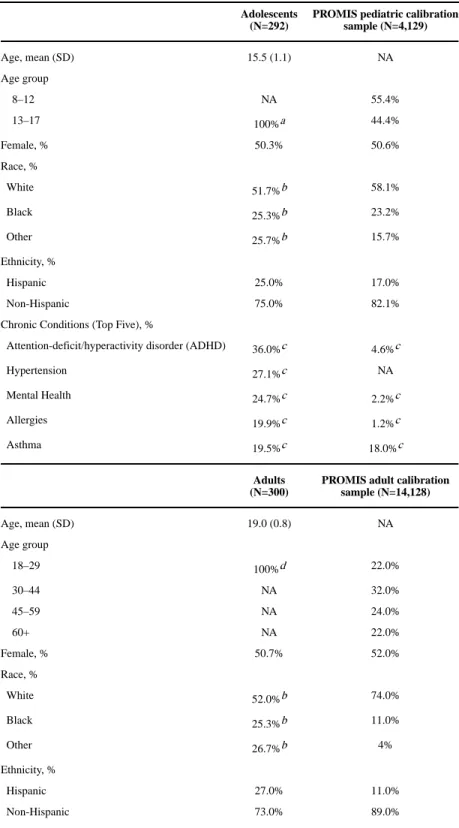
Adolescents had a mean age of 15.5 years (SD: 1.1), and 50.3% were female. Young adults had a mean age of 19.0 years (SD: 0.8), and 50.7% were female (Table 1). All HRQoL domain scores of SHCN adolescent and young adult samples were significantly impaired compared with the norms of the pediatric calibration sample and the adult calibration sample (Figure 1). Likewise, age-specific (Figure 1) and gender-specific HRQoL of SHCN
adolescent and young adult samples (Figure 2) were significantly impaired compared to the respective pediatric and adult calibration samples, except for pain interference SF in adolescent males. Adolescents and young adults with SHCN who indicated service use and functional limitations reported worse HRQoL scores on all SFs (p’s<0.01) than those who did not indicate using services or having functional limitations, except for social health SF in young adults (Table 2).
Multivariate analyses reveal functional limitation category was a significant predictor of worse HRQoL scores across all SFs (p’s<0.05) in both adolescents and young adults, except for social health in young adults (Model 1, Table 3). Service use was a significant predictor of worse HRQoL scores for all SFs in adolescents (p’s<0.05) and for anxiety, fatigue, pain interference, and physical functioning SFs (p’s<0.01) in young adults. Specifically, the magnitude of effect was higher in adolescents (vs. young adults) for service use category and higher for functional limitations category in young adults (vs. adolescents). Adolescent males reported better HRQoL scores on anxiety, fatigue, pain interference, mobility and upper extremity SFs than females (p’s<0.05) (Model 2, Table 3). Hypertension was associated with worse HRQoL scores among adolescents and young adults, with greater significance and magnitudes in adolescents across all SFs. Without covariates, the status of three SHCN categories explained the most variance in adolescents in anxiety and mobility (R2: 17% and 18%, respectively) while the three categories of SHCN explained more variance in young adults in pain interference and physical functioning (R2: 21% and 24%, respectively) (Model 1, Table 3).
DISCUSSION
Both PROMIS Pediatric and Adult SFs were able to discriminate between people with and without the presence of specific SHCN categories. Adolescents and young adults with SHCN reported worse HRQoL than the norms of the PROMIS pediatric adult calibration samples, respectively, across all PROMIS SFs. Our results parallel the previous
investigations where SHCN individuals reported poorer HRQoL than non-SHCN counterparts [20–22]. The differences in HRQoL between our SHCN samples and the calibration samples may be in part due to various characteristics. Compared to the
calibration samples, SHCN adolescents were characterized with older ages and more chronic conditions, and SHCN young adults were characterized with racial/ethnic minorities.
The PROMIS SFs did not distinguish medication use domain within SHCN individuals and this association was not statistically significant in the regression models. Similar to a previous study [16], this finding suggests a lower discriminatory power of the medication use domain related to the underlying health status compared to service use and functional
A
uthor Man
uscr
ipt
A
uthor Man
uscr
ipt
A
uthor Man
uscr
ipt
A
uthor Man
uscr
limitations domains of the SHCN screener. This non-significant finding also implies the effective medication use on the illness and disease control that leads to better functional status and HRQoL. The PROMIS Social Health SF was not able to discriminate within SHCN young adults classified as service use or functional limitations. Although one
previous study has shown acceptable known-groups validity of PROMIS Social Health SF in an older adult sample with chronic conditions [23], our findings suggest that the PROMIS Social Health SF may lack sensitivity to this dimension for younger adults with SHCN, and the contents of emotional support between younger and older adults with SHCN or chronic conditions may not be the same. Future qualitative investigation is warranted to address this issue.
SHCN explained more variance in anxiety and mobility domain scores for adolescents and more variance in pain interference and mobility domain scores for adults. This difference may be explained by developmental experiences in adolescents and young adults [24, 25]. Adolescence is an important stage of developing personality identity and independence, experiencing SHCN in adolescence can result in anxiety. In contrast, the greater association of SHCN with pain interference in adults than in adolescents may be due to pain being more prevalent and severe in young adults than in adolescents [26, 27].
In sum, HRQoL in adolescents and young adults measured by the PROMIS SFs were worse than the norms of the calibration samples. Additionally, PROMIS SFs were able to
discriminate between individuals classified by specific categories of SHCN. The robust known-groups validity related to SHCN status supports the application of PROMIS SFs in future research and practice.
Supplementary Material
Refer to Web version on PubMed Central for supplementary material.
Acknowledgments
PROMIS® was funded with cooperative agreements from the National Institutes of Health (NIH) Common Fund Initiative (Northwestern University, PI: David Cella, PhD, U54AR057951, U01AR052177; Northwestern University, PI: Richard C. Gershon, PhD, U54AR057943; American Institutes for Research, PI: Susan (San) D. Keller, PhD, U54AR057926; State University of New York, Stony Brook, PIs: Joan E. Broderick, PhD and Arthur A. Stone, PhD, U01AR057948, U01AR052170; University of Washington, Seattle, PIs: Heidi M. Crane, MD, MPH, Paul K. Crane, MD, MPH, and Donald L. Patrick, PhD, U01AR057954; University of Washington, Seattle, PI: Dagmar Amtmann, PhD, U01AR052171; University of North Carolina, Chapel Hill, PI: Darren A. DeWalt, MD, MPH, U01AR052181; Children’s Hospital of Philadelphia, PI: Christopher B. Forrest, MD, PhD,
U01AR057956; Stanford University, PI: James F. Fries, MD, U01AR052158; Boston University, PIs: David Scott Tulsky, PhD (University of Michigan, Ann Arbor), U01AR057929; University of California, Los Angeles, PIs: Dinesh Khanna, MD (University of Michigan, Ann Arbor) and Brennan Spiegel, MD, MSHS, U01AR057936; University of Pittsburgh, PI: Paul A. Pilkonis, PhD, U01AR052155; Georgetown University, PIs: Carol. M. Moinpour, PhD (Fred Hutchinson Cancer Research Center, Seattle) and Arnold L. Potosky, PhD, U01AR057971; Children’s Hospital Medical Center, Cincinnati, PI: Esi M. Morgan DeWitt, MD, MSCE, U01AR057940; University of Maryland, Baltimore, PI: Lisa M. Shulman, MD, U01AR057967; and Duke University, PI: Kevin P. Weinfurt, PhD, U01AR052186). NIH Science Officers on this project have included Deborah Ader, PhD, Susan Czajkowski, PhD, Basil Eldadah, MD, PhD, Lawrence Fine, MD, DrPH, Lawrence Fox, MD, PhD, Lynne Haverkos, MD, MPH, Thomas Hilton, PhD, Laura Lee Johnson, PhD, Michael Kozak, PhD, Peter Lyster, PhD, Donald Mattison, MD, Claudia Moy, PhD, Louis Quatrano, PhD, Bryce Reeve, PhD, William Riley, PhD, Peter Scheidt, MD, Ashley Wilder Smith, PhD, MPH, Susana Serrate-Sztein, MD, William Phillip Tonkins, DrPH, Ellen Werner, PhD, Tisha Wiley, PhD, and James Witter, MD, PhD. The contents of this article uses data developed under PROMIS. These contents do not necessarily represent an endorsement by the US Federal Government or PROMIS. See www.nihpromis.org for additional information on the PROMIS® initiative.
A
uthor Man
uscr
ipt
A
uthor Man
uscr
ipt
A
uthor Man
uscr
ipt
A
uthor Man
uscr
REFERENCES
1. van Dyck PC, Kogan MD, McPherson MG, Weissman GR, Newacheck PW. Prevalence and characteristics of children with special health care needs. Arch Pediatr Adolesc Med. 2004; 158(9): 884–890. [PubMed: 15351754]
2. Scal P, Ireland M. Addressing transition to adult health care for adolescents with special health care needs. Pediatrics. 2005; 115(6):1607–1612. [PubMed: 15930223]
3. McPherson M, Arango P, Fox H, Lauver C, McManus M, Newacheck PW, et al. A new definition of children with special health care needs. Pediatrics. 1998; 102(1 Pt 1):137–140. [PubMed: 9714637] 4. Eiser C, Morse R. A review of measures of quality of life for children with chronic illness. Arch Dis
Child. 2001; 84(3):205–211. [PubMed: 11207164]
5. Seid M, Yu H, Lotstein D, Varni JW. Using health-related quality of life to predict and manage pediatric healthcare. Expert Rev Pharmacoecon Outcomes Res. 2005; 5(4):489–498. [PubMed: 19807266]
6. Varni JW, Burwinkle TM, Lane MM. Health-related quality of life measurement in pediatric clinical practice: An appraisal and precept for future research and application. Health Qual Life Outcomes. 2005; 3:34. [PubMed: 15904527]
7. Ader DN. Developing the Patient-Reported Outcomes Measurement Information System (PROMIS). Med Care. 2007; 45(5):S1–S2. [PubMed: 18027399]
8. Fayers PM, Machin D. Scores and measurements: Validity, reliability, sensitivity. Quality of Life: The Assessment, Analysis and Interpretation of Patient-Reported Outcomes (Second). 2007:77–108. 9. Irwin DE, Stucky BD, Thissen D, Dewitt EM, Lai JS, Yeatts K, et al. Sampling plan and patient
characteristics of the PROMIS pediatrics large-scale survey. Qual Life Res. 2010; 19(4):585–594. [PubMed: 20204706]
10. Liu H, Cella D, Gershon R, Shen J, Morales LS, Riley W, Hays RD. Representativeness of the Patient-Reported Outcomes Measurement Information System Internet panel. J Clin Epidemiol. 2010; 63(11):1169–1178. [PubMed: 20688473]
11. Cella D, Riley W, Stone A, Rothrock N, Reeve B, Yount S, et al. The Patient-Reported Outcomes Measurement Information System (PROMIS) developed and tested its first wave of adult self-reported health outcome item banks: 2005–2008. J Clin Epidemiol. 2010; 63(11):1179–1194. [PubMed: 20685078]
12. Bethell CD, Read D, Stein RE, Blumberg SJ, Wells N, Newacheck PW. Identifying children with special health care needs: Development and evaluation of a short screening instrument. Ambul Pediatr. 2002; 2(1):38–48. [PubMed: 11888437]
13. Reeve B, Thissen D, DeWalt D, Huang IC, Liu Y, Magnus B, et al. Linkage between the PROMIS® pediatric and adult emotional distress measures. Qual Life Res. 2015:1–11. 14. Mulvihill BA, Altarac M, Swaminathan S, Kirby RS, Kulczycki A, Ellis DE. Does access to a
medical home differ according to child and family characteristics, including special-health-care-needs status, among children in Alabama? Pediatrics. 2007; 119(Supplement 1):S107–S113. [PubMed: 17272577]
15. Schmidt S, Thyen U, Petersen C, Bullinger M. The performance of the screener to identify children with special health care needs in a European sample of children with chronic conditions. Eur J Pediatr. 2004; 163(9):517–523. [PubMed: 15322869]
16. Carle AC, Blumberg SJ, Poblenz C. Internal psychometric properties of the Children with Special Health Care Needs Screener. Acad Pediatr. 2011; 11(2):128–135. [PubMed: 20227936]
17. Bethell CD, Blumberg SJ, Stein RE, Strickland B, Robertson J, Newacheck PW. Taking Stock of the CSHCN Screener: A Review of Common Questions and Current Reflections. Acad Pediatr. 2015; 15(2):165–176. [PubMed: 25486969]
18. DeWitt EM, Stucky BD, Thissen D, Irwin DE, Langer M, Varni JW, et al. Construction of the eight-item patient-reported outcomes measurement information system pediatric physical function scales: built using item response theory. J Clin Epidemiol. 2011; 64(7):794–804. [PubMed: 21292444]
19. Cella D, Riley W, Stone A, Rothrock N, Reeve B, Yount S, et al. The Patient-Reported Outcomes Measurement Information System (PROMIS) developed and tested its first wave of adult
self-A
uthor Man
uscr
ipt
A
uthor Man
uscr
ipt
A
uthor Man
uscr
ipt
A
uthor Man
uscr
reported health outcome item banks: 2005–2008. J Clin Epidemiol. 63(11):1179–1194. [PubMed: 20685078]
20. Canty-Mitchell J, Austin JK, Perkins SM, Qi RA, Swigonski N. Health-related quality of life in publicly insured children with special health care needs. Child Health Care. 2005; 34(1):1–18. 21. Gandhi PK, Thompson LA, Tuli SY, Revicki DA, Shenkman E, Huang IC. Developing item banks
for measuring pediatric generic health-related quality of life: An application of the International Classification of Functioning, Disability and Health for Children and Youth and item response theory. PLoS One. 2014; 9(9):e107771. [PubMed: 25268926]
22. Huang IC, Thompson LA, Chi YY, Knapp CA, Revicki DA, Seid M, Shenkman EA. The linkage between pediatric quality of life and health conditions: establishing clinically meaningful cutoff scores for the PedsQL. Value Health. 2009; 12(5):773–781. [PubMed: 19508660]
23. Hahn EA, DeWalt DA, Bode RK, Garcia SF, DeVellis RF, Correia H, et al. New English and Spanish social health measures will facilitate evaluating health determinants. Health Psychol. 2014; 33(5):490–499. [PubMed: 24447188]
24. Stam H, Hartman EE, Deurloo JA, Groothoff J, Grootenhuis MA. Young adult patients with a history of pediatric disease: Impact on course of life and transition into adulthood. J Adolesc Health. 2006; 39(1):4–13. [PubMed: 16781955]
25. Crain, W. Theories of Development: Concepts and Applications. 6th. Psychology Press; 2010. 26. Kennedy J, Roll JM, Schraudner T, Murphy S, McPherson S. Prevalence of persistent pain in the
U.S. adult population: New data from the 2010 national health interview survey. J Pain. 2014; 15(10):979–984. [PubMed: 25267013]
27. King S, Chambers CT, Huguet A, MacNevin RC, McGrath PJ, Parker L, MacDonald AJ. The epidemiology of chronic pain in children and adolescents revisited: A systematic review. Pain. 2011; 152(12):2729–2738. [PubMed: 22078064]
A
uthor Man
uscr
ipt
A
uthor Man
uscr
ipt
A
uthor Man
uscr
ipt
A
uthor Man
uscr
Figure 1.
Comparison of SHCN adults to the norms of the PROMIS adult calibration sample overall, and SHCN adolescents to the norms of the PROMIS pediatric calibration sample overall and by age subgroups†‡
†: Lower scores indicate worse HRQoL for peer relationships, mobility, and upper extremity; higher scores indicate worse HRQoL for other domains
‡: Upper and lower bars indicate the 95% confidence interval range
A
uthor Man
uscr
ipt
A
uthor Man
uscr
ipt
A
uthor Man
uscr
ipt
A
uthor Man
uscr
Figure 2.
Comparison of SHCN adolescents to norms of the PROMIS pediatric calibration sample, and SHCN adults to norms of the PROMIS adult calibration sample by gender subgroups†‡ †: Lower scores indicate worse HRQoL for peer relationships, mobility, and upper extremity; higher scores indicate worse HRQoL for other domains
‡: Upper and lower bars indicate the 95% confidence interval range
A
uthor Man
uscr
ipt
A
uthor Man
uscr
ipt
A
uthor Man
uscr
ipt
A
uthor Man
uscr
A
uthor Man
uscr
ipt
A
uthor Man
uscr
ipt
A
uthor Man
uscr
ipt
A
uthor Man
uscr
ipt
Table 1
Participant Characteristics (N=592)
Adolescents (N=292)
PROMIS pediatric calibration sample (N=4,129)
Age, mean (SD) 15.5 (1.1) NA
Age group
8–12 NA 55.4%
13–17 100%a 44.4%
Female, % 50.3% 50.6%
Race, %
White 51.7%b 58.1%
Black 25.3%b 23.2%
Other 25.7%b 15.7%
Ethnicity, %
Hispanic 25.0% 17.0%
Non-Hispanic 75.0% 82.1%
Chronic Conditions (Top Five), %
Attention-deficit/hyperactivity disorder (ADHD) 36.0%c 4.6%c
Hypertension 27.1%c NA
Mental Health 24.7%c 2.2%c
Allergies 19.9%c 1.2%c
Asthma 19.5%c 18.0%c
Adults (N=300)
PROMIS adult calibration sample (N=14,128)
Age, mean (SD) 19.0 (0.8) NA
Age group
18–29 100%d 22.0%
30–44 NA 32.0%
45–59 NA 24.0%
60+ NA 22.0%
Female, % 50.7% 52.0%
Race, %
White 52.0%b 74.0%
Black 25.3%b 11.0%
Other 26.7%b 4%
Ethnicity, %
Hispanic 27.0% 11.0%
Non-Hispanic 73.0% 89.0%
A
uthor Man
uscr
ipt
A
uthor Man
uscr
ipt
A
uthor Man
uscr
ipt
A
uthor Man
uscr
ipt
Hypertension 32.7%c NA
Attention-deficit/hyperactivity disorder (ADHD) 31.3%c NA
Mental Health 20.0%c NA
Asthma 19.0%c NA
Allergies 14.3%c NA
a
: Our sample restricted to 14–17.9 years of age
b
: Race over 100% due to multiple choices
c
: Chronic conditions were self-reported by parents (for SHCN adolescents) and SHCN young adults
d
A
uthor Man
uscr
ipt
A
uthor Man
uscr
ipt
A
uthor Man
uscr
ipt
A
uthor Man
uscr
ipt
T ab le 2Association between SHCN status by Screener def
initional domains and HRQoL
SHCN Category Medication Use Ser vice Use Functional Limitations No Y es T -Scor e No Y es T -Scor e No Y es T -Scor e Adolescents N=29 N=245 N=31 N=243 N=82 N=192 Depressi v e Symptoms 60.1 60.2 <−0.1 51.1 61.3 −5.3 *** 55.5 62.2 −5.0 *** Anxiety 58.9 58.2 0.8 48.6 59.5 −5.9 *** 53.1 60.5 −5.7 *** Anger 58.7 56.2 1.1 46.5 57.7 −5.6 *** 53.2 57.9 −3.2 ** F atigue 59.4 56.9 1.1 48.8 58.2 −4.2 *** 51.6 59.6 −5.3 *** P ain Interference 54.9 53.8 0.5 47.7 54.8 −3.7 *** 49.4 55.9 −5.1 *** Peer relationships † 38.4 39.2 −0.4 44.2 38.4 3.4 *** 41.8 37.9 3.3 ** Mobility † 40.4 41.2 −0.4 49.0 40.1 4.4 *** 47.4 38.4 6.8 *** Upper Extremity † 38.8 40.7 −0.8 48.9 39.4 3.9 *** 45.9 38.2 4.7 *** No Y es T -Scor e No Y es T -Scor e No Y es T -Scor e Adults N=21 N=279 N=27 N=273 N=104 N=196 Depression 55.6 59.9 −1.9 53.3 60.2 −3.5 *** 55.1 62.0 −5.9 *** Anxiety 58.5 61.4 −1.4 54.0 61.9 −4.3 *** 56.8 63.5 −6.3 *** Anger 55.9 58.3 −0.9 50.8 58.8 −3.5 *** 52.9 60.9 −6.0 *** F atigue 52.1 55.9 −1.7 47.8 56.4 −4.4 *** 51.5 57.8 −5.5 *** P ain Interference 57.8 57.3 0.2 48.6 58.2 −5.2 *** 51.6 60.4 −8.4 *** Social Health † 41.3 45.5 −2.0 * 46.9 45.0 1.0 46.0 44.7 1.2 Ph ysical Functioning † 42.3 42.7 −0.2 51.4 41.8 5.3 *** 48.7 39.4 9.1 ***
* p<0.05; **
A
uthor Man
uscr
ipt
A
uthor Man
uscr
ipt
A
uthor Man
uscr
ipt
A
uthor Man
uscr
ipt
***
p<0.001
† : Lo
wer scores indicate w
orse HRQoL for the domains with symbol; otherwise higher scores indicate w
A
uthor Man
uscr
ipt
A
uthor Man
uscr
ipt
A
uthor Man
uscr
ipt
A
uthor Man
uscr
ipt
T ab le 3 Multi variable linear re
gression testing association between SHCN def
initional domains and PR
OMIS Mean Domain Scores for Adolescents and Adults
A
uthor Man
uscr
ipt
A
uthor Man
uscr
ipt
A
uthor Man
uscr
ipt
A
uthor Man
uscr
ipt
Functional Limitations 6.0 *** 6.1 *** 5.6 *** 5.7 *** 7.1 *** 7.0 *** 5.1 *** 5.2 *** 7.8 *** 7.8 *** −1.2 −1.0 −8.2 *** −8.1 *** Age ---0.3 ---0.1 ---0.6 ---−0.4 ---−0.6 ---−1.6 * ---0.4 Male ---−2.3 * ---−1.4 ---−2.0 ---−2.6 * ---−1.9 ---−0.5 ---1.8 Hispanic ---0.7 ---0.8 ---0.1 ---0.9 ---0.2 ---−0.4 ---−1.1 Black a ---−1.8 ---−2.6 ---−2.0 ---−1.5 ---−0.8 ---0.7 ---0.3 Other race a ---−2.6 ---−2.3 ---−0.8 ---−1.0 ---−1.5 ---1.4 ---0.7Less than High School
c ---2.3 ---−0.3 ---−2.7 ---2.2 ---−0.4 ---<−0.1 ---−1.0 High School c ---<−0.1 ---−0.8 ---−2.4 ---−0.6 ---0.1 ---−1.8 ---0.6 ADHD ---0.8 ---0.4 ---1.5 ---0.9 ---−0.1 ---−0.9 ---1.6 Hypertension ---1.7 ---1.7 ---2.7 * ---0.5 ---1.7 ---−2.1 ---−2.5 * Mental Health ---2.8 * ---2.9 * ---1.6 ---1.7 ---−1.3 ---0.5 ---2.7 * Aller gies ---1.5 ---2.5 ---2.9 ---2.2 ---3.7 * ---0.5 ---−1.9 Asthma ---1.4 ---−0.3 ---1.0 ---0.1 ---−0.8 ---−3.5 * ---−2.0 R 2 12% 18% 14% 20% 12% 17% 12% 17% 21% 25% 2% 7% 24% 31%
* p<0.05; **
p<0.01;
***
p<0.001
† : Lo
wer scores indicate w
orse HRQoL for the domains with symbol; otherwise higher scores indicate w
orse HRQoL
a : Reference group = White b : Reference group = High school c : Reference group = Colle
ge or abo
v
e
M1: Model 1 included SHCN domains (medication use, service use, and functional limitations) M2: Model 2 included SHCN domains (medication use, service use, and functional limitations), age, gender
, race, ethnicity