DISCURSIVE FIELDS
Sarah Gaby and Neal Caren†
Social movement scholars have considered several political and cultural consequences of social movements, but have paid limited attention to whether and how social movements shape discourse. We develop a theory of discursive eruption, referring to the ability of radical movements to initially ignite media coverage but not control the content once other actors— particularly those that can take advantage of journalistic norms—enter the discourse. We hold that one long-term outcome of radical social movements is the ability to alter discursive fields through mechanisms such as increasing the salience and content of movement-based issues. We examine the way movements shape discourse by focusing on newspaper articles about inequality before, during, and after the Occupy Wall Street (OWS) movement. We analyze changes in the salience and content of coverage as well as shifts in actor standing and influence. Using 7,024 articles from eight newspapers, we find that the OWS movement increased media attention to inequality, shifting the focus of the discourse toward movement-based issue areas (e.g., the middle class and minimum wage). Further, we find that compared to the pre-OWS period, the influence of social movement organizations and think tanks rose in discourse on inequality. In addition, the discourse on inequality became more highly politicized as a result of the Occupy movement. These findings highlight the importance of social movements in shaping discourse and indicate that social movement scholars should further consider discursive changes as a consequence of social movements.
After September 2011, “We are the 99%”—a reference to the vast inequality between the wealthy and everyone else in the United States—became a household slogan seen everywhere from sidewalk graffiti to Facebook memes. The spread of the slogan points to the influence of its creator, the Occupy Wall Street (OWS) movement. Although OWS successfully mobilized around the country in Fall 2011, the movement fizzled out, declining drastically by Spring 2012. Thus, the question remains: Did Occupy have any long-term discursive impact, and, if so, what? More generally, are ephemeral radical movements likely to be influential over the long term?
The influence of social movements and organizations that employ radical ideologies and tactics remains contested in previous work. The influences of radical movement organizations are often minimized due to their insufficient resources and inability to integrate into existing political systems (Fitzgerald and Rodgers 2000). Although fleeting radical movements may not become integrated into the formal political process, they can still influence public opinion and political actions through discursive agenda setting (Polletta 2012). In this article, we examine the impact of a radical social movement organization on shaping public discourse. We expect that these types of movements are likely to be able to raise the salience of particular issues, but have much more modest abilities to shape media frames and their own standings (Gitlin 1980).
Although the Occupy movement declined by the end of 2011 and has since lost cohesion, we find that the one major enduring outcome of the movement is increased and altered attention to income inequality. Further, we find that while the movement was able to increase attention to
* A preliminary version of this paper was presented 2014 American Sociologcial Association Annual Meeting. We thank Edwin Amenta, Andy Andrews, Charlie Kurzman, David Meyer, Charles Seguin, members of the UNC Culture and Politics workshop, and the anonymous reviewers.
† Sarah Gaby is a Doctoral Candidate in the Department of Sociology at the University of North Carolina, Chapel Hill. Neal Caren is an Associate Professor of Sociology at the University of North Carolina, Chapel Hill. Please direct correspondence to Sarah Gaby at [email protected].
the issue, the radical, decentralized nature of the movement limited its ability to achieve lasting media standing (Gitlin 1980). OWS helped shape the discursive agenda, but other political actors, particularly think tanks, were better positioned to take advantage of the new oppor-tunities. Radical social movements can achieve long-term influence, but by quickly fading they are unable to take advantage of the opportunities they create. We call this phenomenon dis-cursive eruption, referring to the ability of radical movements to initially ignite media coverage (Seguin 2016), but not control the content once other actors, particularly those that can take advantage of journalistic norms enter the discourse (Gitlin 1980).
To understand the discursive consequences of social movements, we constructed an original database of 7,024 newspaper articles on inequality between 2002 and 2013. Since income inequality was the most pressing issue in the OWS movement, this set of articles provides an opportunity to trace discursive changes brought on by OWS, and those that persisted once the movement formally declined. We analyze both the volume of coverage on inequality and the content of that coverage, including actor standing. Our findings indicate that OWS generally increased attention to income inequality, which endured after the movement declined. Further, increased attention to inequality also changed the standing of who spoke on specific inequality topics. While the movement was prevalent in the discourse during its height, OWS was unable to remain in the conversation after its decline. Instead, political actors became increasingly engaged in the discourse following the politicization of inequality by the movement.
MOVEMENT-MEDIA INTERACTIONS
Social movements aim to shape policies and public opinion, often utilizing the media as a mechanism of influence. Movements typically seek media coverage, and specifically favorable coverage of their issues (Andrews and Caren 2010; Gamson and Wolfsfeld 1993). These groups need a means through which to communicate their messages and ideas to the public (Smelser 1963) and to elites (Andrews and Caren 2010), and the media often serves that role. Media attention may serve as an instrument for achieving other goals, but may in itself be a goal of social movements (Amenta, Caren, Olasky, and Stobaugh 2009). To gain media attention, social movements often take radical actions (Gitlin 1980). In doing so, however, they frequently gain unfavorable attention. Whether and how radical movements produce lasting influences through media coverage remains contested in past work.
Movements seek media attention, in part, to influence the public agenda and public opinion (McCombs and Shaw 1972; Rohlinger 2015). Media coverage can lead to increased public attention, which can set or change political agendas (Baumgartner and Jones 1993; Smith, McCarthy, McPhail, and Augustyn 2001). People primarily gain their understanding of issues and events secondhand through journalistic interpretations, and therefore influencing public opinion often requires gaining a particular type of media coverage. Identifying an issue as a social problem in the public agenda requires outcompeting many other potential issues to gain media and thereby public attention (Hilgartner and Bosk 1988). If successful, movements have the capacity to shape media discourse, public understanding, and public policy. For instance, despite several previous actors attempting to shape the discourse on the death penalty, adherents of the “innocence movement” were able to shift this discourse to focus on the potential inno-cence of death row inmates (Baumgartner, De Boef, and Boydstun 2008). By doing so, they heightened attention to the issue of the death penalty, increased the cases of exoneration, and changed public opinion and policy on the death penalty (Baumgartner et al. 2008).
public opinion and public policy. For instance, movement organizations that focused on issues at the fringes of public discourse gained control of and shaped discursive fields through dramatic displays (Bail 2012).
Radical flanks, or the radical actors within a social movement, can be leveraged strategically by the movement, and even integrated into its mainstream (Downey and Rohlinger 2008). Although at times radical activities may discredit more moderate approaches and appear threatening to the broader movement, these radical movement actors may also produce positive impacts on the movement. A positive radical flank effect takes place when radicals serve as a foil for moderates, or create opportunities that moderates can take advantage of to make gains (Haines 1984). In these instances, radical flanks help to strengthen the broader social movement. While disruptive or radical tactics can increase media coverage (Wilkes, Corrigall-Brown, and Myers 2010; Wouters 2013), past work shows contradictory evidence about the type of attention radical actions garner. The media are looking for clear presentation of messages and reasonable solutions, which often conflict with radical approaches (Sobieraj 2010). Further, social movements that align with mainstream values are more likely to become part of dominant media frames (Gitlin 1980). Movements that utilize nondisruptive tactics are found to receive more favorable media coverage (Amenta, Gardner, Tierney, Yerena, and Elliott 2012). Although negative coverage may be one outcome for radical movements, this type of coverage is not necessarily detrimental. Negative coverage of movement actors coincides with more extensive movement coverage (Taylor and Gunby 2016), and, while radical tactics may be stigmatized, the radical reputation of organizations may actually lead to positive coverage (Evans 2016).
Although there is no consensus on whether radical movements have any meaningful im-pacts, a few case studies have shown discursive eruption, or how radical groups can spark media attention, which takes on a life of its own outside of the movement’s control (Gitlin 1980; Rhodes 2007; Seguin 2016). In several cases, this effect was found to be negative for the movement (Gitlin 1980; Rhodes 2007). For instance, in the case of the New Left, gaining media attention led to negative judgment of the movement and served as a justification for state-based repression (Gitlin 1980). While in this case the movement was able to ignite initial coverage, the outcome of that coverage was harmful to the movement itself.
Lasting Discursive Influence
Even in cases where movements themselves are harmed by the coverage, radical move-ments may have long-term influences on discourse. Radical movemove-ments can put issues on the public and political agenda that outlive the movement and have a broader influence. For in-stance, movements may have a longer-term effect on language (Goodwin and Jasper 1999), and shape public discourse through coverage of their frames (Ferree 2003; Ferree, Gamson, Gerhards and Rucht 2002) and by constructing meaning (Gamson 1992; Gamson and Modigliani 1989). These outcomes can extend influence beyond the direct involvement of the movement.
THE INFLUENCE OF OCCUPY WALL STREET
Against a background of revolution and upheaval in other parts of the world, the Canadian not-for-profit magazine Adbusters printed an advertisement asking the public, “Are you ready for a Tahrir moment? On Sept 17, flood into lower Manhattan, set up tents, kitchens, peaceful barricades and occupy Wall Street.” The ad ran on July 13, 2011, which is often credited as the formal start of this radical social movement. This call was echoed by a diverse group of preexisting entities, ranging from the hacktivist collective Anonymous to the community labor coalition New Yorkers Against Budget Cuts. With the debt-ceiling deadline of midnight August 2, the group chose that day to incorporate a “General Assembly” as others simultaneously held a strategy session for Occupy Wall Street. The two groups joined in a demonstration at the Charg-ing Bull sculpture, which stands in BowlCharg-ing Green park in Lower Manhattan, at 4:30 p.m. Afterward, these two groups joined together to plan for the September 17 event.
On September 17, around 1,000 people attended the protest at Zuccotti Park. Smaller news media quickly began to cover the protest events. By September 21, The Guardian and the New York Times began reporting on the movement. A few weeks into the movement, CNN created a recurring highlight called “Occupy News” (Gitlin 2012). As the movement spread across the country (Caren and Gaby 2011), so did media coverage, “…to the front pages of newspapers and the tops of television newscasts” (Stelter 2011). Coverage of the movement became comparable to that of the Tea Party Movement during its peak period (Sartor 2011).
As a movement with radical ideology and disruptive tactics, OWS gained media coverage as anticipated. We would also expect, consistent with the presence of discursive eruption, that the volume of coverage of its primary issue, inequality, also increased.
H1: OWS increased the salience of inequality in the media.
There is some preliminary evidence of increasing coverage on inequality. In a study of the OWS’s impact, Milkman and colleagues (2013) analyzed its media coverage and found that during the Zuccotti Park occupation, media coverage of inequality was significantly higher. Discursive eruption likely occurred during this time period, with the movement able to spark media coverage of inequality. After the evictions, coverage fell but was more compared to the period before the movement (Milkman, Luce and Lewis 2012). Several pundits noted the increased attention to issues of inequality driven by the movement as well (Linkins 2011). OWS brought up the issue of inequality and “it’s not going away” (Milkman et al. 2012: 37).
Although the movement likely raised the media salience of inequality, coverage of par-ticular ideas remains dictated by media practices and journalistic norms (Gamson and Wolfsfeld 1993). As a result, there is no expectation that OWS’s discursive eruption operated differently from past movements in its ability to influence the content of discussion on their primary issue.
H2: OWS did not influence the content of the discourse around inequality.
In addition to limiting the ability to gain specific forms of coverage, media practices also influence who gains coverage, favoring elected and appointed officials (Gamson and Wolfsfeld 1993). Movement actors must compete for discursive influence with various other actors, including groups working on the same issue or those with competing viewpoints (Hilgartner and Bosk 1988). As a result, movement actors rarely enter news coverage. When media officials let outsiders into their reporting, they often look for authenticity through emotional and spon-taneous responses (Gamson and Wolfsfeld 1993; Sobieraj 2010). Often, however, activists perceive these same elements as factors that will limit coverage, so they reduce spontaneity and emotion in their interactions with the media (Sobieraj 2010).
H3: OWS was not able to increase the standing of social movement organizations in the media.
messaging led activists to create their own independent media including live streaming both planning and actions (Byrne 2012). Due to their weariness of mass media, some occupiers actively avoided engaging the media, even posting signs in their camps that read, “Don’t talk to the media…” (Carpenter 2012). The aversion to engaging with traditional media likely kept activists from authentically engaging with reporters.
Although difficult, social movements have the capacity under certain conditions to gain standing in the media, often through dramatic actions (Bail 2012). Therefore, it remains possible that the tactics employed by OWS could influence standing.
H4: OWS increased the standing of social movement organizations in the media.
Although the movement sought to avoid media coverage, reporters continued to visit occupations, often able to locate willing and, at least at times, authentic occupiers to interview.
The public nature of the occupations and the various groups of individuals involved often led to spontaneous and emotional activist interactions with the media. For instance, in an early article on the movement in the New York Times, the first sentence introduced Zuni Tikka, who they referred to as “…a default ambassador in a half-naked woman…” (Gitlin 2012). These representatives may have been able to increase the movement standing.
Unlike movement actors, the media give standing to political actors freely (Gamson and Wolfsfeld 1993). The media actively pursue political insiders, and, because journalists often seek balanced reporting, typically capture individuals on both sides of the political aisle (Sobieraj 2010). These norms, in part, limit the ability of movement actors to remain involved after initial discursive eruption.
H5: Post-OWS, left and right political actors are equally prominent in inequality discourse.
The OWS movement also coincided with the 2012 presidential campaign, in which dis-course on inequality played an important role. For instance, on the Today Show, Mitt Romney in his Republican presidential candidacy responded to increased attention on income inequality as a form of “envy” and “class warfare” (Luhby 2012). This provides limited evi-dence that raising the salience of the issue resulted in political actors on both sides of the aisle joining in the conversation. Media coverage of the political campaign likely further integrated political actors into the discourse on inequality.
Despite norms of coverage that lead the media to seek unbiased reporting, some issues tend to land more on the agenda of the political right or left. For instance, issue ownership exists in coverage around topics like civil liberties, civil rights, and social welfare, such that those issues lean towards more Democratic Party coverage (Petrocik, Benoit, and Hansen 2003). Issues around inequality are also likely to be “owned” by the political left, and therefore might lead to more coverage for the left.
H6: Post-OWS, left political actors are more prominent in inequality discourse.
Hypothesis 1, 3, and 5 are consistent with our theory of discursive eruption. We would expect that a radical, disruptive movement would be able to gain issue coverage, but not in-crease their standing or shift the partisan balance.
DATA AND METHODS
Nexis (in terms of distribution) and also included geographic variety and political diversity in editorial viewpoint. This produced 7,024 total articles.
Inequality is a major issue outside of social movements, and is covered by the media independently of social movements. However, reducing inequality was also one of the primary goals of the Occupy Wall Street movement. Inequality, then, is both an issue area that received attention prior to the movement, and one that the movement specifically sought to shape. While OWS was primarily focused on economic inequality, our preliminary analysis of the texts indicated that often times “inequality” was used without “economic” or “income”, even though in the context of the article it was clear the focus was on economic inequality. To ensure we included all discourse on economic inequality, we downloaded all articles containing any mention of inequality. Our corpus of articles includes mentions of inequality in non-economic contexts, such as race or gender, which we were able to identify using our topic modeling procedure described below.
To assist with the coding of article themes, we employed a topic model technique called non-negative matrix factorization (Lin 2007). Topic modeling is a machine learning method for identifying sets of commonly occurring words in texts (Blei 2012). In order to prepare the texts, we removed common words (e.g., the, and, or) and infrequently used words (i.e., those that were used in less than one percent of articles) following standard procedures. We used non-negative matrix factorization to extract thirty topics, groups of words or bigrams that were commonly found together in articles.2 As a robustness check we modeled the data with other cut points of possible topics (e.g., twenty-five and thirty-five), but found that thirty topics maximized topic coherence, although results at other points were similar.
Table 1 lists the thirty topics and the words associated with each. We hand clustered the topics into major themes after identifying the most commonly used words in each topic and reading articles that loaded heavily on the topics. We identified a total of fourteen major themes,
Table 1. Topics Extracted from 7,024 Newspaper Articles Mentioning “Inequality,” 2002-2013*
Theme Topic Key Words
Academia Academia book, social, political, history, war, books, university, society, professor, life, world, century, america, writes, conservatives, human, power, liberals, moral, capitalism
Art Art film, art, movie, museum, music, org, stars, www, films, story, 30, documentary, director, st, theater, directed, play, theatre, york, new york
Civil Rights
Affirmative Action
black, blacks, white, racial, race, african, whites, african americans, african american, affirmative action, affirmative, racism, civil rights, action, americans, civil,
discrimination, rights, color, court
Civil Rights
African American
king, rights, civil rights, civil, dr, martin, martin luther, luther, luther king, dr king, march, king jr, jr, rev, dream, memorial, movement, atlanta, march washington, rights movement
Economic Economic Policy
growth, economy, fed, spending, bernanke, debt, budget, government, inflation, cuts, deficit, fiscal, greenspan, financial, crisis, term, federal, policy, unemployment, rates
Economic Labor
workers, labor, jobs, unions, union, wages, trade, job, work, companies, employers, pay, wage, employees, manufacturing, employment, economy, benefits, worker, unemployment
Economic Middle Class
class, middle, middle class, rich, americans, mobility, poor, working, working class, income, economy, america, wealth, wealthy, upper, pew, jobs, families, society, incomes
Economic Middle Class
income, median, households, census, data, incomes, household, income inequality, average, report, gap, household income, 000, americans, bureau, share, wealth, rich, gains, growth
Economic Minimum Wage
wage, minimum, minimum wage, hour, wages, workers, increase, low wage, low, federal, wage workers, higher minimum, higher, raise, inflation, raising minimum, raise minimum, raising, 25, food
Economic Taxes tax, taxes, income, cuts, tax cuts, income tax, revenue, tax rate, rate, pay, tax rates, rates, budget, capital gains, tax code, code, wealthy, estate, estate tax, gains
Table 1. Cont’d
Economic Welfare children, poverty, poor, child, parents, families, family, food, programs, social, parent, mothers, education, welfare, single, low, kids, poverty rate, school, program
Education Education students, school, schools, education, teachers, college, high, student, high school, test, teacher, children, parents, colleges, district, educational, districts, public, math, grade
Gender Gender women, men, female, gender, girls, male, woman, men women, sexual, sex, work, feminist, family, sports, feminism, aids, boys, earn, mothers, study
Health Health
health, care, health care, insurance, health insurance, medical, coverage, medicare, costs, patients, doctors, government, medicaid, disease, benefits, cost, hospitals, social security, americans, hospital
International China china, chinese, beijing, hu, party, communist, wen, communist party, wang, hong kong government, rural, officials, shanghai, mao, corruption, hong, liu, official, li,
International International police, government, city, officers, india, violence, state, protesters, officials, israel, minister, killed, military, country, crime, 000, israeli, arrested, land, court
International Latin America
latin, brazil, latin america, chavez, venezuela, america, silva, da silva, da, chile, region, colombia, latin american, lula, bolivia, castro, argentina, trade, cuba, brazilian
International South Africa
africa, south africa, south, mandela, apartheid, africans, african, south african, johannesburg, aids, country, nelson mandela, african national, national congress, cape, nelson, white, hiv, cup, party
International United States
united, countries, states, united states, world, nations, trade, global, europe, india, european, growth, international, japan, foreign, development, united nations, germany, globalization, developing
Journalism Journalism says, don, think, know, ve, want, going, good, really, money, ll, things, say, got, didn, lot, work, thing, home, right
LGBT LGBT
marriage, gay, sex, couples, court, sex couples, sex marriage, state, supreme court, supreme, rights, law, married, civil, gay marriage, marriages, legal, new jersey, decision, jersey
New York New York
blasio, city, bloomberg, mayor, new york, york, yorkers, new yorkers, york city, thompson, brooklyn, cities, campaign, mayoral, council, michael bloomberg, manhattan, housing, park, residents
Occupy Occupy
occupy, protesters, wall street, street, movement, wall, occupy wall, park, protests, protest, zuccotti, occupy movement, zuccotti park, police, occupiers, tea, 99, tea party, street movement, oakland
Political Bush
bush, iraq, katrina, orleans, new orleans, administration, white house, war, president bush, hurricane, clinton, house, kerry, edwards, democrats, white, gulf, bush administration, federal, tax cuts
Political Immigration mexico, mexican, mexicans, mexico city, fox, immigration, immigrants, border, city, drug, united states, states, united, illegal, election, latin, manuel, corn, electoral, country
Political Obama
obama, speech, mccain, obama said, clinton, campaign, president obama, white house, barack, house, barack obama, election, republicans, white, administration, republican, roosevelt, address, americans, said obama
Political Parties
party, democrats, republicans, voters, republican, democratic, political, election, vote, conservative, politics, senate, government, parties, tea, campaign, liberal, candidates, tea party, elections
Political Republican Primary
romney, gingrich, mitt, mitt romney, campaign, bain, republican, voters, santorum, romney said, ryan, candidate, newt, primary, rick, iowa, candidates, bain capital, presidential, capital
Religious Religious church, pope, catholic, francis, religious, catholics, god, evangelical, christian, jesus, religion, catholic church, rev, faith, paul, bishop, christians, roman, abortion, john *
Topics and keywords generated by Non-Negative Matrix Factorization; authors generated topic names and theme groups.
Beyond the count and themes of articles, we were also interested in the political actors mentioned in each story. In order to identify the universe of political actors, such as politicians or social movement organizations, we used the Open Calais name entity recognition service, which produced a list of all entities mentioned in articles.3 After hand reviewing each potential actor produced by the algorithm and linking and normalizing the actor names, we hand coded all entities that were mentioned over ten times across all articles into categories and by political ideology where applicable. The categories we selected were based on major actors identified and included: politicians (e.g., Harry Reid) universities (e.g., Harvard University), corporations (e.g., Goldman Sachs), think tanks (e.g., Pew Research Center), global institutions (e.g., World Bank), social movement organizations (SMOs) (e.g., Tea Party), the White House (e.g., Obama), and Labor (e.g., Service Employees International Union). We also hand coded for political ideology, coding for left or right using a combination of partisan and issue affiliations. For example, Mitt Romney and George W. Bush were coded “right” and Bill and Hillary Clinton were coded “left.” The categorizations of these entities and their political ideologies (where relevant) were added to the database of articles and entities.
Our modeling strategy focused on the mentions of themes and actors in the articles prior to, during, and after the peak of the OWS. We analyzed the extent of coverage in each period as well as the difference in pre- and post-Occupy mentions. We tested whether there was a statistically significant difference in the percent of articles that covered specific themes or included actors using a test of proportions.
THE CHANGING DISCOURSE ON INEQUALITY
Analysis of newspaper articles on inequality produced results in several areas—overall coverage, content of coverage, and key actors—as well as how those factors changed over time. Total coverage of the term inequality across the set of newspapers as shown in figure 1, began at thirty- five articles per month on average from January 2002 to the start of OWS. The coverage then increased to 177 articles per month on average during the three-month height of the movement, and dropped to 104 articles per month on average following the movement’s decline. Although coverage declined after the height of the movement, the total mentions of inequality during 2012
(93 per month on average) and 2013 (98 per month on average) roughly tripled compared to coverage prior to the movement. This finding offers evidence for hypothesis 1, that OWS move-ment increased the salience of inequality in the media. These findings are also consistent with Milkman et al. (2013).
As mentioned above, we modeled the articles using topic-modeling techniques in order to categorize the content of coverage on inequality. In addition to the increasing total coverage of inequality, the post-Occupy period was marked by changing contexts for discourse around in-equality, presented in figure 2 on the following page. Below, table 2 shows coverage of economic topics related to inequality such as taxes, income, middle class, and minimum wage rose dramatically in the post-Occupy period. For example, the proportion of articles mentioning inequality on the topic of minimum wage increased fourfold between the pre-Occupy period and the post-Occupy period, while the middle-class topic doubled. In contrast, all declining topics were noneconomic themed. Proportional coverage on inequality issues around gender, LGBT, and affirmative action all declined between the pre- and post-Occupy period. This finding on the changing content of media coverage is in opposition to hypothesis 2.
Table 2. Distribution Over Time of Newspaper Inequality Themes. Count is the Number of Articles Coded as Having the Theme. Percentages Are of the Articles in Period Containing the Theme.
Topic Theme Count Pre-Occupy Occupy Post-Occupy Pre-Post Dif.
Republican Primary Political 216 0% 3% 6% 6%*
New York New York 140 1% 2% 3% 3%*
Occupy Occupy 285 0% 23% 3% 2%*
Minimum Wage Economic 109 1% 1% 3% 2%*
Income Economic 242 3% 6% 5% 2%*
Middle Class Economic 124 1% 4% 2% 1%*
Taxes Economic 361 5% 8% 7% 1%*
Welfare Economic 201 3% 2% 4% 1%*
Parties Political 253 4% 5% 5% 1%*
Labor Economic 220 4% 3% 4% 0%
Wall Street Economic 186 3% 5% 3% 0%
Art Art 177 3% 2% 3% 0%
Economic Policy Economic 240 5% 3% 5% 0%
African American Civil Rights 93 2% 1% 2% 0%
South Africa International 108 2% 1% 2% 0%
Immigration Political 42 1% 0% 1% 0%
Religious Religious 80 2% 1% 2% 0%
Obama Political 397 7% 7% 7% 0%
Bush Political 17 1% 0% 0% 0%*
Latin America International 68 2% 0% 1% -1%*
United States International 192 4% 4% 3% -1%*
Gender Gender 192 4% 2% 3% -1%*
LGBT LGBT 147 4% 1% 3% -1%*
China International 150 4% 1% 3% -1%*
Journalism Journalism 211 5% 3% 4% -2%*
Health Health 139 4% 1% 2% -2%*
Education Education 270 7% 3% 5% -2%*
International International 209 5% 5% 3% -2%*
Academia Academia 274 7% 3% 5% -2%*
Affirmative Action Civil Rights 186 6% 1% 3% -3%*
Figure 2. The Changes in Coverage of Inequality Themes Pre- and Post-OWS
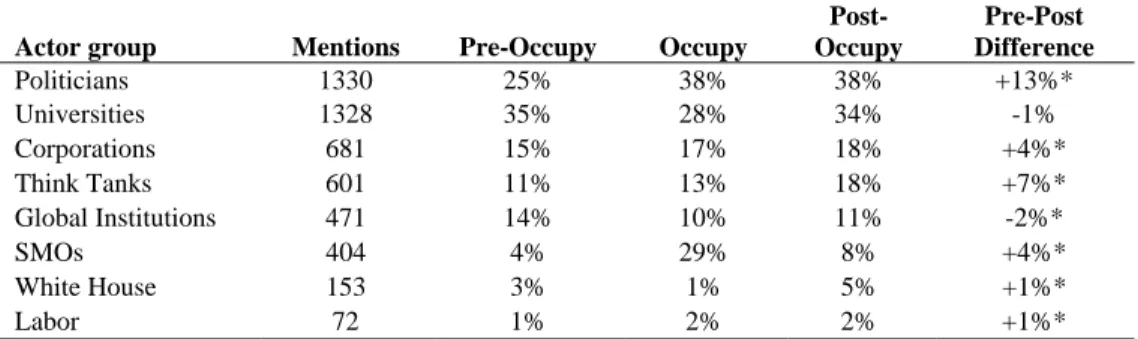
In order to test the third hypothesis about the role of social movement organizations in the media, we also analyzed whether changes occurred in actor standing. Using our hand-coded database of entities, we modeled the percent of mentions for actors of various forms, presented in figure 3. As shown in table 3, the standing for social movement organizations in media dis-course around inequality drastically increased during the active period of the movement. Once
Figure 3. Changes in Coverage of Actors in Inequality Articles Pre- and Post-OWS
0 10 20 30 Percent of Articles, Pre-OWS
Pe
rc
en
t o
f
A
rt
ic
le
s,
Po
st
-OW
S
Percent of Articles, Pre-OWS
Pe
rc
en
t o
f
A
rt
ic
le
s,
Po
st
-OW
Table 3. Actors Present in “Inequality” Newspaper Articles by Time Period.
Actor group Mentions Pre-Occupy Occupy
Post- Occupy
Pre-Post Difference
Politicians 1330 25% 38% 38% +13%*
Universities 1328 35% 28% 34% -1%
Corporations 681 15% 17% 18% +4%*
Think Tanks 601 11% 13% 18% +7%*
Global Institutions 471 14% 10% 11% -2%*
SMOs 404 4% 29% 8% +4%*
White House 153 3% 1% 5% +1%*
Labor 72 1% 2% 2% +1%*
*indicates statistically significant shift between pre- and post-coverage
the movement declined, social movement organizations doubled the percentage of articles on inequality in which they were mentioned, from 4% prior to the movement to 8% following the movement. This effect was likely driven by mentions of OWS itself. These findings dis-confirm hypothesis 3, thereby supporting paired hypothesis 4, that OWS increased the standing for social movement organizations in the media.
In general, the entity groups were relatively stable in percentage of mentions between the pre- and post-Occupy period, changing less than 5%. However, inclusion of think tanks in the public discourse on inequality nearly doubled, from being in 11% of articles during the pre-Occupy period to 18% during the post-pre-Occupy period. All of the twenty-three think tanks that we analyzed saw increases in coverage during this period, as shown in table 4. Of particular note, the Pew Research Center quadrupled its mentions in inequality articles from 14 to 61,
Table 4. Think Tanks Present in “Inequality” Newspaper Articles by Time Period. Organi-zations Sorted by Total Article. Article Count for Each Period Listed in Parentheses.
Think Tank Mentions Pre-Occupy Occupy Post-Occupy
Pew Research Center 82 #3 (n = 14) #4 (n = 7) #1 (n = 61)
Brookings Institution 72 #2 (n = 18) #1 (n = 11) #3 (n = 43)
Economic Policy Institute 71 #1 (n = 21) #5 (n = 6) #2 (n = 44)
Center on Budget & Policy Priorities 41 #5 (n = 8) #8 (n = 4) #4 (n = 29)
Tax Policy Center 38 #4 (n = 10) #3 (n = 7) #7 (n = 21)
Center for American Progress 35 #6 (n = 8) #7 (n = 4) #5 (n = 23)
Heritage Foundation 32 #20 (n = 1) #2 (n = 8) #6 (n = 23)
American Enterprise Institute 27 #8 (n = 7) #6 (n = 5) #9 (n = 15)
Cato Institute 17 #7 (n = 7) #15 (n = 1) #15 (n = 9)
Manhattan Institute 17 #9 (n = 4) #12 (n = 2) #12 (n = 11)
Urban Institute 15 #16 (n = 2) (n = 0) #11 (n = 13)
Congressional Research Service 14 (n = 0) (n = 0) #10 (n = 14)
Century Foundation 13 #14 (n = 3) #13 (n = 2) #16 (n = 8)
Council on Foreign Relations 13 #12 (n = 3) #17 (n = 1) #14 (n = 9)
Citizens for Tax Justice 11 #13 (n = 3) (n = 0) #17 (n = 8)
Third Way 11 #21 (n = 1) (n = 0) #13 (n = 10)
Center for Responsive Politics 11 #19 (n = 1) #10 (n = 3) #18 (n = 7) National Bureau of Economic Research 11 #15 (n = 2) #14 (n = 2) #21 (n = 7)
Hoover Institution 10 #11 (n = 3) #9 (n = 3) #23 (n = 4)
New America Foundation 10 #18 (n = 1) #11 (n = 2) #19 (n = 7)
Tax Foundation 9 #17 (n = 1) #16 (n = 1) #20 (n = 7)
becoming the most mentioned think tank in discourse on inequality. The left-wing Economic Policy Institute also increased, but not by as large of a margin. On the right, the Heritage Foundation, which had previously only been mentioned once in an inequality article, jumped to the sixth-place rank with 23 mentions after the peak of the movement. Corporations also increased from 15% to 18%, possibly as a result of movement targeting.
Although there was some shift in entity-group standing during the time period, it was not consistent across article themes. For instance, in table 5, we analyze how the political actors contributing to the conversation on specific economic-themed topics varied over time. Prior to the Occupy Movement, social movements were rarely mentioned in discourse on economic inequality. In contrast, think tanks were quite prominent during the pre-Occupy period—43% of welfare discourse mentioned think tanks, while 0% mentioned social movement organizations. During the Occupy movement, this shifted and social movement organizations were more prominent than think tanks in six of the nine economic topics. However, post-Occupy, think tanks regained their standing with more frequent mentions than social movement organizations in all of the topics. Only the middle-class topic included a non-trivial number of social movement organization mentions after the decline of the movement, while, more than 25% of each of the nine economic topics mentioned think tanks, including nearly 50% of the articles in the income topic area.
Table 5. Presence or absence of SMOs and Think Tanks in “inequality” articles by topic for economic themes over time*
Pre-Occupy Occupy Post-Occupy
Topic SMOs Think Tanks SMOs Think Tanks SMOs Think Tanks
Minimum Wage 0% 0% 11% 0% 3% 39%
Labor 2% 9% 22% 15% 1% 28%
Education 2% 7% 14% 5% 3% 26%
Income 0% 34% 21% 35% 3% 47%
Taxes 5% 32% 34% 27% 7% 42%
Economic Policy 6% 28% 14% 23% 5% 32%
Wall Street 0% 11% 33% 14% 8% 20%
Middle Class 0% 25% 9% 6% 12% 37%
Welfare 0% 43% 11% 22% 3% 26%
*Percent is the share of articles on the theme that mention each actor type. The more prominent organization type for each topic is bolded.
In addition to the entity types, we considered if there was a shift in standing for the political left or right as shown in table 6. We find that generally the coverage on inequality became more politicized in the post-Occupy period. The percentage of articles that mentioned partisans on both sides increased during the period of study, but the increase was relatively balanced between the left and right. This finding of increased politicization during the pre- and post-Occupy period confirms hypothesis 5, thereby not supporting the paired hypothesis 6. During the movement however, articles mentioning the left had a much larger share of the conversation, indicating a more democratic focus. However, once the movement declined, a partisan balance returned.
Table 6. Distribution of Political Views of Actors Present in “Inequality” Articles Over Time.
Actor group Mentions Pre-Occupy Occupy Post-Occupy Pre-Post Difference
Left 1229 23% 43% 32% 8%
While we observed actors on the left and right both gaining standing, this was not uniform across article themes. Notably, as seen in table 7, articles that discussed inequality using the middle-class topic shifted rightward. Prior to the Occupy movement, these articles were twice as likely to discuss liberal political actors (25% left compared to 13% right), while after OWS this topic became more prominent with conservative political actors (43% right compared to only 36% left). The median income topic area saw a similar rightward shift. In contrast, topics on Wall Street and minimum wage became increasingly associated with liberal political actors.
Table 7. Distribution of Political Views of Actors Present in “Inequality” Articles by Topic for Economic Themes Over Time.
Pre-Occupy Occupy Post-Occupy Diff.*
Topic Left Right Left Right Left Right
Middle Class 25% 13% 25% 53% 36% 43% -20%
Income 20% 10% 33% 25% 23% 26% -13%
Education 19% 9% 41% 18% 23% 22% -9%
Welfare 24% 12% 22% 39% 28% 21% -5%
Labor 26% 16% 41% 41% 25% 17% -3%
Taxes 29% 52% 54% 52% 42% 62% 2%
Economic Policy 44% 53% 36% 36% 49% 49% 8%
Wall Street 27% 39% 56% 35% 36% 27% 21%
Minimum Wage 0% 20% 44% 22% 47% 31% 36%
*Relative presence of left/right actors between the pre- and post-Occupy periods. Positive values shows leftward shift.
DISCUSSION
In this article, we examined changes in the way the media discussed “inequality” before, during, and after the Occupy movement. We find that discursive eruption occurs in inequality discourse, with OWS raising the salience of inequality, but remaining in the conversation only briefly before think tanks and other actors gained higher standing. There was a tremendous increase in mentions of the word “inequality” during the height of the Occupy movement. While media attention to inequality declined after the evictions, the new baseline level of attention was roughly three times that of the period before the movement, and this heightened level of attention did not diminish in 2013. These findings provide evidence of the ability of radical social movements to create long-lasting change by putting topics on the media’s agenda.
Not only has media attention to inequality increased, but the content of coverage has also changed. As we show, inequality is now more likely to be used in an economic context, with the largest increase in the topic associated with the minimum wage. Additionally, mentions of in-equality were prominent in coverage of three post-Occupy political campaigns: the Republican presidential primary of 2012, the 2012 general election, and the 2013 New York City mayoral election. We observed no campaigns prior to OWS where inequality was a prominent theme. This indicates that OWS increased elite attention to inequality, placing movement issues more prominently on the political agenda.
In addition, we found that inequality became more politicized over this period, with the media more likely to include mentions of ideological political actors. Mentions of left and right actors grew, and they received equal coverage in the post-Occupy period, likely as a result of the media bias towards balance. This provides further evidence of the Occupy movement’s ability to shape the political agenda by politicizing the inequality discourse.
tanks came to the forefront, shifting from being mentioned in one in ten inequality articles to almost one in five. A look at the Pew Research Center’s blog suggests that this increase in media attention may have been the result of a concerted effort by think tanks to shift the research agenda, or at least their research framing. The Pew blog lists 2 posts in 2009 on the topic of inequality, and the same low number in 2010. In 2011, however, they produced seven posts on the topic, followed by twenty-two in 2012 and thirty-seven in 2013. The production of material on inequality by the Pew Center suggests that organizations with the resources and skills to interact with the media were able to take advantage of this new discursive opportunity. In con-trast, Occupy, which lacked the same bureaucratic infrastructure and was unable to institu-tionalize, was largely sidelined after peak mobilization. Although OWS may have gained acceptance through regular appearances in the media, as Gamson (1990) leads us to expect, the movement itself did not remain in the media. However, the lasting impact of the recognition of inequality framing remained, but was carried forward by other actors like Pew. These findings demonstrate the process of discursive eruption—OWS ignited media coverage of inequality, but was not able to control the content once other actors and those positioned to take advantage of journalistic norms entered the discourse.
Movements are able to gain standing and a role in the discussion amongst political elites if they can get their issue into the media in a favorable way. For OWS, this was especially true because they leveraged existing interest and elite concerns in pursuit of their goal. The utilization of high-status individual and institutional interests provided increased credibility to the discussion on inequality, aiding further in this coverage (Cress and Snow 1996). Our findings also provide preliminary evidence that movements with weak organizational capacity may be able to gain influence through the media, counter to the access-influence model (Andrews 2001; 2004). Further, while arguments on lasting movement outcomes often focus on the creation of organizations, long-term impacts of movements may also exist as the result of discursive shifts. Therefore, if the movement had institutionalized, it likely would have been able to take advantage of the discursive eruption created by the movement itself.
One shortcoming of this study is that we only include mainstream newspapers. Some would argue that alternative media recently have gained an important role and that individuals and marginalized groups often turn to these alternative sources (Couldy and Curran 2003). While we agree that it is likely that the media landscape has changed and is changing, mainstream media remain extremely powerful, with much broader distributions than alternative media and more influence on elite actors. Major news sources still represent the vast majority of media con-sumed, and therefore remain relevant for understanding cultural changes.
A particular set of conditions specific to the movement and time period may have contributed to the ability of OWS to influence the discourse and produce a moderately positive form of discursive eruption. The positive influence of OWS may have been due to elite support of the movement, the length of mobilization, or particular features of the political context (e.g., a Democratic president in office). Further research is needed to clarify the conditions under which discursive eruptions are likely to occur and produce favorable results.
movement (beginning January 2012), White House press documents mentioned inequality twenty-four times, and twenty-six mentions the following year (White House, 2016). Likewise, there was no increase in Congressional attention to inequality during the pre-OWS period, with Congressional mentions of the term relatively constant during 2010 and 2011. Although other factors may influence changes in discourse, the Occupy movement undeniably played a major role in changing the discourse, as is evident by the changing nature of the coverage and the increased standing for the movement in inequality discourse during the peak period.
Although the Occupy Wall Street Movement did create a discursive shift, we do not want to overstate the extent of this outcome in creating social change. As is evidenced by the persistence and consistency of elite actors who participate in the discussion on inequality, OWS was unable to change the political field. That is, they may have shifted the content of the discussion and strengthened its place on the political agenda, but the movement neither changed the extent of income inequality nor what types of actors are entitled to participate in discussions about income inequality. Further, this increased attention to inequality did not translate into legislative action. Still, while radical social movements may not change political outcomes they may have lasting impacts through significantly altering discourse, leading to shifts in public opinion that can produce political change.
NOTES
1 The cities associated with each of the local papers did have an Occupy group during the height of the movement, as groups were primarily focused in large cities and state capitols, although over 400 unique groups were identified across the country (Caren and Gaby 2011).
2
We used the NMF implementation in scikit-learn. We tagged an article as being a particular topic if the NMF predicted value for that topic was greater than .05. Overall, 47% of articles were coded as being about one topic, 31% about two topics, and the remainder about three or more topics. Code available from the authors upon request. 3 We selected the Open Calais over other options including the named entity recognizer in Python’s NLTK or the Stanford Named Entity Recognizer because in our sample of pretest articles, the Open Calais returned the best results in terms of finding and disambiguating actors.
REFERENCES
Amenta, Edwin, Neal Caren, and Sheera Joy Olasky. 2005. “Age for Leisure? Political Mediation and the Impact of the Pension Movement on U.S. Old-Age Policy.” American Sociological Review 70: 516-538.
Amenta, Edwin, Neal Caren, Sheera Joy Olasky, and James E. Stobaugh. 2009. “All the Movements Fit to Print: Who, What, When, Where, and Why SMO Families Appeared in the New York Times in the Twentieth Century.” American Sociological Review 74: 636-656.
Amenta, Edwin, Neal Caren, Elizabeth Chiarello, and Yang Su. 2010. “The Political Consequences of Social Movements.” Annual Review of Sociology 36:287-307.
Amenta, Edwin, Beth Gharrity Gardner, Amber Celina Tierney, Anaid Yerena, and Thomas Alan Elliott. 2012. “A Story-Centered Approach to the Newspaper Coverage of High-Profile SMOs.”
Research in Social Movements, Conflicts and Change 33: 83-107.
Andrews, Kenneth T., and Michael Biggs. 2006. “The Dynamics of Protest Diffusion: Movement Organizations, Social Networks, and News Media in the 1960 Sit-Ins.” American Sociological Review 71: 752-777
Andrews, Kenneth T., and Neal Caren. 2010. “Making the News.” American Sociological Review 75: 841-866.
Armstrong, Elizabeth A. 2002. Forging Gay Identities: Organizing Sexuality in San Francisco, 1950– 1994. Chicago: University of Chicago Press.
Armstrong, Elizabeth A., and Mary Bernstein. 2008. “Culture, Power, and Institutions: A Multi- institutional Politics Approach to Social Movements.” Sociological Theory 26: 74-99.
Baumgarter, Frank, and Bryan Jones. 1993. Agendas and Instability in American Politics. Chicago: University of Chicago Press.
Baumgartner, Frank, Suzanna De Boef, and Amber Boydstun. 2008. The Decline of the Death Penalty and the Discovery of Innocence. New York: Cambridge University Press.
Blei, D. M. 2012. “Probabilistic Topic Models.” Communications of the ACM 55(4): 77-84.
Caren, Neal, and Sarah Gaby. 2011. “Occupy Online: Facebook and the Spread of Occupy Wall Street.” Social Science Research Network.
Couldry, Nick, and James Curran, Eds. 2003. Contesting Media Power: Alternative Media in a Networked World. Lanham, MD: Rowman & Littlefield.
Cottle, Simon. 2008. “Reporting demonstrations: The changing media politics of dissent.” Media, Culture & Society 30: 853-872.
Dan Cress and David Snow. 1996. “Mobilization at the Margins: Resources, Benefactors, and the Viability of Homeless Social Movement Organizations.” American Sociological Review 61: 1089-1109.
Davenport, Christian. 2010. Media Bias, Perspective, and State Repression: The Black Panther Party. New York: Cambridge University Press.
Ferree, Myra Marx. 2003. “Resonance and Radicalism: Feminist Framing in the Abortion Debates of the United States and Germany.” American Journal of Sociology 109 :304-344.
Ferree, Myra Marx, William Anthony Gamson, Jürgen Gerhards, and Dieter Rucht. 2002. Shaping Abortion Discourse: Democracy and the Public Sphere in Germany and the United States. New York: Cambridge University Press.
Gamson, William. [1975] 1990. The Strategy of Social Protest. Belmont: Wadsworth. ———. 1992. Talking Politics. Oxford University Press.
Gamson, William, and Andre Modigliani. 1989. “Media Discourse and Public Opinion: A Construc-tionist Approach.” American Journal of Sociology 95: 1-37.
Gamson, William, and Gadi Wolfsfeld. 1993. “Movements and Media as Interacting Systems.” Annals of the American Academy of Political and Social Science 528: 114-125.
Gitlin, Todd. 1980. The Whole World is Watching. Berkeley: University of California Press.
Giugni, Marco. 1998. “Was It Worth the Effort? The Outcomes and Consequences of Social Move-ments.” Annual Review of Sociology 24: 371-393.
Giugni, Marco, Doug McAdam, and Charles Tilly. 1999. How Social Movements Matter. Minneapolis: University of Minnesota Press.
Goodwin, Jeff, and James Jasper. 1999. “Caught in a Winding Snarling Vine: The Structural Bias of Political Process Theory.” Sociological Forum 14: 27-54.
Hilgartner, Stephen, and Charles L. Bosk. 1988. “The Rise and Fall of Social Problems: A Public Arenas Model.” American Journal of Sociology 94(1): 53-78.
King, Brayden G., Keith G. Bentele, and Sarah Anne Soule. 2007. “Protest and Policymaking: Explaining Fluctuation in Congressional Attention to Rights Issues, 1960-1986.” Social Forces 86(1): 137-163.
Koopmans, Ruud. 2004. “Movements and Media: Selection Processes and Evolutionary Dynamics in the Public Sphere.” Theory and Society 33(3/4): 367-391.
Koopmans, Ruud, Paul Statham, Marco Giugni, and Florence Passy. 2005. Contested Citizenship: Immigration and Cultural Diversity in Europe. Minneapolis: University of Minnesota Press. Lin, C.J. 2007. “Projected Gradient Methods for Nonnegative Matrix Factorization.” Neural
Compu-tation 19(10): 2756-2779.
Mansbridge, Jane. 1986. Why We Lost the ERA. Chicago: University of Chicago Press.
McAdam, Doug, John D. McCarthy, and Mayer N. Zald. 1996. Comparative Perspectives on Social Movements: Political Opportunities, Mobilizing Structures, and Cultural Framings. Cambridge: Cambridge University Press.
McAdam, Doug, Sidney Tarrow and Charles Tilly. 2001. Dynamics of Contention. New York and London: Cambridge University Press.
McCombs, Maxwell and Donald Shaw. 1972. “The Agenda-Setting Function of Mass Media.” Public Opinion Quarterly 36(2): 176-187
Meyer, Thomas. 2002. Media Democracy: How the Media Colonize Politics. Cambridge, UK: Polity Press. Meyer, David S., and Nancy Whittier. 1994. “Social Movement Spillover.” Social Problems 41: 277-298. Milkman, Ruth, Stephanie Luce, and Penny Lewis. January 2013. Changing the Subject: A Bottom-Up
Newport, Frank. 2015. “Americans Continue to Say U.S. Wealth Distribution Is Unfair.” Gallup. Oliver, Pamela E., and Gregory M. Maney. 2000. “Political Processes and Local Newspaper Coverage
of Protest Events: From Selection Bias to Triadic Interactions.” American Journal of Sociology
106(2): 463-505.
Piven, Frances Fox, and Richard Cloward. 1977. Poor People's Movements. New York: Pantheon Books. Rhodes, Jane. Framing the Black Panthers: The Spectacular Rise of A Black Power Icon. New York:
The New Press.
Rochon, Thomas. 1998. Culture Moves. Princeton, NJ: Princeton University Press.
Rohlinger, Deana, and Jordan Brown. 2013. “Mass Media and Institutional Change: Organizational Reputation, Strategy, and Outcomes in the Academic Freedom Movement.” Mobilization: An International Quarterly 18(1): 41-64.
Roscigno, Vincent, and William Danaher. 2001. “Media and Mobilization: The Case of Radio and Southern Textile Worker Insurgency, 1929 to 1934.” American Sociological Review 66: 21-48. Sartor, Tricia. 2011. “Media Coverage of Occupy vs. Tea Party.” Pew Research Center.
Schudson, Michael. 2001. “The Objectivity Norm in American Journalism.” Journalism 2(2): 149-170. Schuefele, Dietram. 1999. “Framing as a Theory of Media Effects.” Journal of Communication 49(1):
103-122.
Seguin, Charles. 2016. “Cascades of Coverage: Positive Feedback in Media Attention to Social Move-ment Organizations.” Social Forces. 94(3): 997-1020.
Smelser, Neil. 1963. The Theory of Collective Behavior. New York: Free Press.
Smith, Jackie, John D. McCarthy, Clark McPhail, and Boguslaw Augustyn. 2001. “From Protest to Agenda Building: Description Bias in Media Coverage of Protest Events in Washington, DC.” Social Forces 79(4): 1397-1423.
Soule, Sarah.A. 1997. “The Student Divestment Movement in the United States and Tactical Diffusion: The Shantytown Protest.” Social Forces 75: 855-882.
Soule, Sarah A., and Brayden G. King. 2006. “The Stages of the Policy Process and the Equal Rights Amendment, 1972-1982.” American Journal of Sociology 111: 1871-1909.
———. 2008. “Competition and Resource Partitioning in Three Social Movement Industries.”
American Journal of Sociology 113: 1568-1610.
Stelter, Brian. 2011. “A News Story is Growing with ‘Occupy’ Protests.” The New York Times. Tarrow, Sidney. 1998. Power in Movement: Social Movements, Collective Action and Politics.
Cambridge: Cambridge University Press.
Walker, Edward T., Andrew W. Martin, and John D. McCarthy. 2008. “Confronting the State, the Corporation, and the Academy: The Influence of Institutional Targets on Social Movement Repertoires.” American Journal of Sociology 114: 35-76.
Wang, Dan J., and Sarah A. Soule. 2012. “Social Movement Organizational Collaboration: Networks of Learning and the Diffusion of Protest Tactics, 1960–1995.” American Journal of Sociology 117: 1674-1722.