MISSING DATA IN NON-PARAMETRIC TESTS
OF CORRELATED DATA
Annie Green Howard
A dissertation submitted to the faculty of the University of North Carolina at Chapel Hill in partial fulfillment of the requirements for the degree of Doctor of Philosophy in the Department of Biostatistics.
Chapel Hill 2012
Approved by:
Shrikant Bangdiwala Lloyd J. Edwards Gerardo Heiss Gary Koch Paul Stewart
c
2012
Abstract
ANNIE GREEN HOWARD: MISSING DATA IN NON-PARAMETRIC TESTS OF CORRELATED DATA
(Under the direction of Shrikant Bangdiwala)
Many public health studies are designed to test for differences in repeated
measure-ments. Measurements on the same subject are not independent and therefore analysis
methods must take correlation into account. A number of tests have been developed to
analyze this type of data. Two prominent non-parametric methods, used often when
one is not willing to make any distributional assumptions about the data, include
Fried-man’s test and a variation on FriedFried-man’s test proposed by Koch and Sen that requires
no assumptions to be made about the correlation between measurements.
While both tests require complete and balanced data, in many studies missing data
can arise for a variety of reasons. Researchers have developed a number of methods
to adapt Friedman’s test to situations involving missing data when it can be assumed
that the missing data are missing completely at random. We propose applying these
same adjustments to the test statistic proposed by Koch and Sen to adapt this test to
deal with data that are missing completely at random. This method involves using the
sum of the reduced ranks, rather than the average rank, across all subjects to allow
for meaningful comparisons across subjects. An inflation factor is used to ensure the
missing data do not result in a substantial loss of power.
The assumption that the data are missing completely at random is often too strict
di-Friedman’s test and Koch and Sen’s test to informative missing data scenarios. The
method put forth in this paper involves the use of single imputation to impute missing
rank values along with a weighting scheme which assigns smaller weight to individuals
with more missing data. Guidelines and suggestions are put forward as to when this
new method would be preferred to the method currently used to address problems with
Acknowledgments
I wish to thank Dr. Shrikant Bangdiwala for his insight, encouragement and
friend-ship throughout this process. His confidence in my skills along with his guidance and
support have helped me to make it through both the ups and downs of this process.
Dr. Gary Koch has also been instrumental in the development in this research and I
would like to thank him for his input and ideas. I would also like to acknowledge Dr.
Lloyd Edwards, Dr. Gerardo Heiss, Dr. Paul Stewart and Dr. Stephan Weiland who
have offered many helpful suggestions and ideas that went into this dissertation.
I could not have completed this without the love and support of my family. In
particular, Id like to acknowledge my father Dr. George Howard who offered advice
and assistance at every stage of the process. His belief in me has and will continue to
be instrumental in my future success. I’d also like to thank my mother, Dr. Virginia
Howard, for the countless words of encouragement and support. In addition she has
lived her life in such a way that her career has served to help me in the development of
my personal and professional goals. My sisters, Marjorie Howard and Letitia Perdue
have offered nothing but unconditional love and support which has been invaluable
during this process.
I cannot thank enough the staff, faculty and students at UNC, particularly within
the Biostatistics Department. This has been a difficult but rewarding process and the
generosity, patience, acceptance and assistance of the friends I have made within this
Melissa Hobgood, Virginia Pate, Allison Deal and my fellow members both official and
unofficial of The Cave. I would also like to thank specifically the CSCC for their
flexi-bility and financial support. This work was supported in large part by Training Grant
Table of Contents
List of Tables . . . xii
List of Figures . . . xiv
1 Introduction and Literature Review . . . 1
1.1 Introduction . . . 1
1.1.1 Motivation . . . 1
1.1.2 Example . . . 2
1.2 Literature Review . . . 5
1.2.1 Notation and Assumptions . . . 5
1.2.2 Non-parametric Analysis of Complete and Balanced Data . . . . 5
1.2.3 Missing Data Mechanisms . . . 12
1.2.4 Missing Data in Repeated Measures Analysis . . . 15
1.2.5 Missing Data in Non-parametric Analysis . . . 29
1.3 Proposed Research . . . 32
1.3.1 Background and Motivation for the Research Problem . . . 32
1.3.2 Proposed Method . . . 33
2 MCAR: Without Assuming Compound Symmetry . . . 35
2.1 Introduction . . . 35
2.1.2 Notation, Assumptions and Terminology . . . 37
2.2 Reduced Rank Adjustment . . . 37
2.3 Inflation Factor for Ranks . . . 40
2.4 Simulations . . . 41
2.5 Results . . . 43
2.5.1 Type I Error Rates . . . 43
2.5.2 Power . . . 45
2.5.3 Asymptotic Behavior . . . 46
2.6 Data Example . . . 47
2.7 Discussion . . . 49
3 Informative Missing: Assuming Compound Symmetry . . . 53
3.1 Introduction . . . 53
3.1.1 Introduction and Motivation . . . 53
3.1.2 Notation, Assumptions and Terminology . . . 55
3.1.3 MCAR Data Using Friedman Methodology . . . 55
3.2 Method . . . 60
3.2.1 Imputation . . . 60
3.2.2 Subject-specific Weight for Ranks . . . 61
3.2.3 Test Statistic . . . 63
3.2.4 Calculation of Bias . . . 64
3.2.5 Comparison of Type I Error Rate . . . 65
3.2.6 Comparison of Power . . . 65
3.3 Simulations . . . 66
3.3.1 Generation of Data sets . . . 66
3.3.2 Imputation . . . 69
3.4 Results . . . 70
3.4.1 Type I Error Rate . . . 70
3.4.2 Power . . . 71
3.4.3 Asymptotic Behavior . . . 72
3.5 Data Example . . . 73
3.6 Discussion . . . 76
4 Informative Missing: Without Assuming Compound Symmetry . . 79
4.1 Introduction . . . 79
4.1.1 Introduction and Motivation . . . 79
4.1.2 Notation, Assumptions and Terminology . . . 80
4.1.3 MCAR Data Using Koch and Sen’s Methodology . . . 81
4.2 Method . . . 85
4.2.1 Imputation . . . 85
4.2.2 Subject-specific Weight for Ranks . . . 86
4.2.3 Test Statistic . . . 88
4.2.4 Calculation of Bias . . . 89
4.2.5 Comparison of Type I Error Rate . . . 90
4.2.6 Comparison of Power . . . 90
4.3 Simulations . . . 91
4.3.1 Generation of Data sets . . . 91
4.3.2 Imputation . . . 93
4.3.3 Calculation and Comparison of Type I Error Rate . . . 94
4.4 Results . . . 95
4.4.1 Type I Error Rate . . . 95
4.4.2 Power . . . 96
4.5 Data Example . . . 100
4.6 Discussion . . . 104
5 Proposed Guidelines and Future Research . . . 109
5.1 Summary and Guidelines . . . 109
5.2 Future Research . . . 110
5.2.1 Imputation Assumptions and Limitations . . . 110
5.2.2 Performance in Alternative Scenarios . . . 111
5.2.3 Alternative Tests . . . 113
Appendices . . . 114
A Chapter 2 . . . 115
A.1 Variance . . . 115
A.2 Covariance . . . 116
A.3 SAS Macro for Statistic with MCAR data . . . 117
A.4 Tables . . . 120
B Chapter 3 . . . 125
B.1 Variance . . . 125
B.2 Covariance . . . 126
B.3 Tables . . . 127
C Chapter 4 . . . 132
C.1 Variance . . . 132
C.2 Covariance . . . 133
C.3 SAS Macro for Statistic with Informative Missing data . . . 134
List of Tables
1.1 Repeated Measures Data Set with Missing Data . . . 6
1.2 Non-Parametric Test With Complete and Balanced Data . . . 8
2.1 Data Sets Generated . . . 42
3.1 Data Sets Generated . . . 67
4.1 Data Sets Generated . . . 108
A.1 Type I Error Rates . . . 120
A.2 Power Under a Linear Increase of 0.25 . . . 121
A.3 Power Under a Linear Increase of 1 . . . 122
A.4 Average Pain Scores By Period of the Day for IBS Study . . . 123
B.1 Type I Error Rates . . . 127
B.2 Power Under a Linear Increase of 0.25 . . . 128
B.3 Power Under the Alternative of a Linear Increase of 0.5 . . . 129
B.4 Complete Ranking of 4 Objects by 20 Subjects . . . 130
B.5 Ranking of 4 Objects by 20 Subjects with Missing Data . . . 131
C.1 Type I Error Rates - 10 Subjects . . . 137
C.2 Type I Error Rates - 50 Subjects . . . 138
C.3 Type I Error Rates - 100 Subjects . . . 139
C.4 Power Under a Linear Increase of 0.25 - 10 Subjects . . . 140
C.6 Power Under a Linear Increase of 0.25 - 100 Subjects . . . 142
C.7 Power Under a Linear Increase of 1 - 10 Subjects . . . 143
C.8 Power Under a Linear Increase of 1 - 50 Subjects . . . 144
C.9 Power Under a Linear Increase of 1 - 100 Subjects . . . 145
C.10 Avg. Difference in BM Pain Scores By Period of Day . . . 146
List of Figures
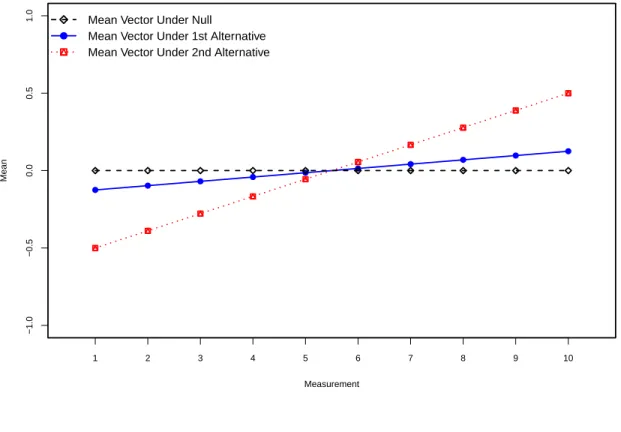
2.1 Mean Vectors for Null and Alternative Hypotheses . . . 43
2.2 Type I Error Rates . . . 44
2.3 Power (Under Linear Increase of 0.25) . . . 45
2.4 Power (Under a Linear Increase of 1) . . . 46
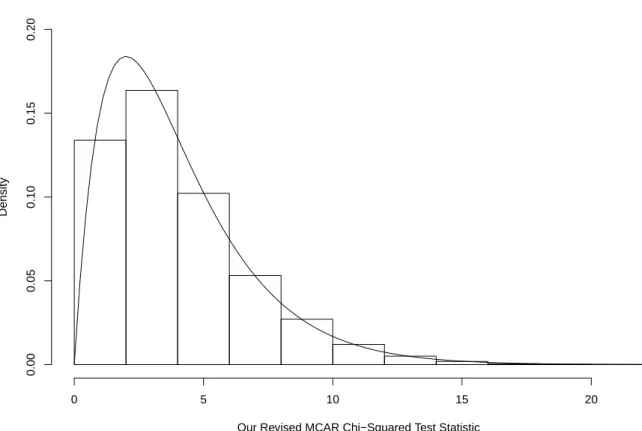
2.5 Asymptotic Behavior of Our Revised Test Statistic . . . 47
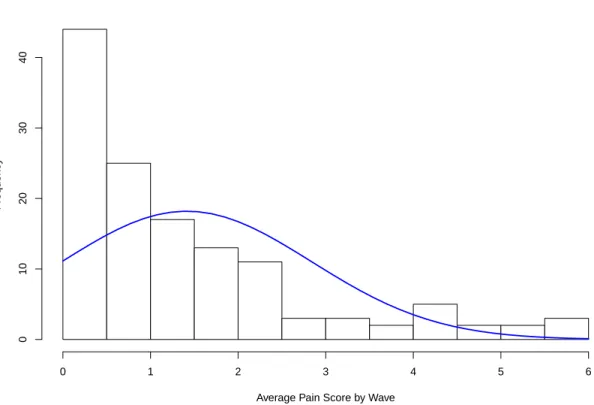
2.6 Histogram of Average Pain Score by Wave with Normal Curve . . . 49
2.7 Average Pain Score by Period of Day . . . 50
3.1 Mean Vectors for Null and Alternative Hypotheses . . . 69
3.2 Type I Error Rates by % Informative Missing - 10 Subjects . . . 71
3.3 Type I Error Rates by % Informative Missing - 50 Subjects . . . 72
3.4 Power by % Informative Missing (Increase of 0.25) - 10 Subjects . . . . 73
3.5 Power by % Informative Missing (Increase of 0.25) - 50 Subjects . . . . 74
3.6 Power by % Informative Missing (Increase of 0.50) - 10 Subjects . . . . 75
3.7 Power by % Informative Missing (Increase of 0.50) - 50 Subjects . . . . 76
3.8 Asymptotic Behavior of Our Revised Test Statistic . . . 77
3.9 Mean Rank for Each Object . . . 78
4.1 Mean Vectors for Null and Alternative Hypotheses . . . 94
4.2 Type I Error Rate by % Informative Missing - 10 Subjects . . . 96
4.4 Type I Error Rate by % Informative Missing- 100 Subjects . . . 98
4.5 Power by % Informative Missing (Increase of 0.25) - 10 Subjects . . . . 99
4.6 Power by % Informative Missing (Increase of 0.25) - 50 Subjects . . . . 100
4.7 Power by % Informative Missing (Increase of 0.25) - 100 Subjects . . . 101
4.8 Power by % Informative Missing (Increase of 1) - 10 Subjects . . . 102
4.9 Power by % Informative Missing (Increase of 1) - 50 Subjects . . . 103
4.10 Power by % Informative Missing (Increase of 1) - 100 Subjects . . . 104
4.11 Asymptotic Behavior of Our Revised Test Statistic . . . 105
Chapter 1
Introduction and Literature Review
1.1
Introduction
1.1.1
Motivation
Many public health studies are designed to test for a difference between repeated
measurements on the same subject. These studies can be useful in a number of different
contexts including, but not limited to, testing the reliability of a particular procedure
using repeated measurements on the same individuals, testing for a change in average
values or proportions over time, and testing for an effect of different treatments on the
same subject over a follow-up period. In all of these cases, measurements on the same
subject are not independent and therefore analysis methods must take into account
the correlation between measurements taken on the same subject. Recently, some of
the analytic approaches for this type of data analysis have been generalized to account
for missing data. In large sample studies, these methods have been proven to produce
accurate type I error rates in certain scenarios although the preferred analysis method
differs depending on a number of factors.
Non-parametric methods are one of the approaches for which these adaptations
only been developed for scenarios where one can assume the correlation between any
two measurements on the same subject is the same. This is problematic for many
repeated measures studies, particularly longitudinal studies, when one can often make
the assumption that the correlation between two measurements that are close together
in time are likely to be more strongly correlated than measurements farther apart in
time.
These non-parametric adjustments that seek to minimize bias and preserve the
ac-curacy of type I error rates have been proven to be effective only when the probability
an observation is missing does not depend on the outcome or covariate values,
com-monly referred to as missing completely at random (MCAR). Some researchers have
investigated the power of these adjusted tests, finding the reduction in power not to be
an of great concern in the case of MCAR data (Kenward and Roger, 1997; Schluchter
and Elashoff, 1990; Catellier and Muller, 2000; Manor and Zucker, 2004; Kawaguchi
and Koch, 2010).
In practice the reasons for missingness, if even known, can be complex and
assum-ing MCAR can potentially lead to accuracy problems when testassum-ing hypotheses. Often
in studies involving repeated measurements, missingness is informative, meaning
miss-ingness depends on the actual outcome values themselves. Current methods have not
been adapted to deal with this missingness scenario and there is a strong potential for
biased results when attempting to make inference when incorrectly assuming that the
data are MCAR.
1.1.2
Example
The first example this research will address is a longitudinal study testing for a
the same number of measurements planned to be recorded for each subject. A
contin-uous outcome is to be measured at each of these time points. Measurements closer in
time tend to be more highly correlated than measurements further apart in time and
therefore equal correlation between any two measurements is highly unlikely.
Specif-ically we will be looking at a study in which investigators were interested in testing
if pain scores differed throughout a day. Participants with irritable bowel syndrome
(IBS) were asked to record pain scores (on a scale from 0 to 10) at wake up, morning,
midday, evening and bedtime. Measurements were collected over a large number of
days and so pain scores were collapsed by averaging pain scores for each period of the
day across all days. Occasionally patients forgot to record pain scores. If the pain score
was missing for more than 40% of all days for a particular period the average pain score
for that subject at that period of the day was set to missing. In the larger context,
it is important to note that missing data occur in longitudinal studies in a number of
contexts. In this case, it is reasonable to assume the chance of a subject reporting a
missing value is unrelated to the outcome value.
The second example involves a situation where a number of judges were each asked
to rank a number of objects. In this scenario, since the objects are naturally ranked,
non-parametric methods are a natural choice of analysis. Researchers are interested in
testing for a preference in objects. Therefore, one is interested in testing if the rank
for each object is the same, although differences between judges are not of interest.
In this scenario, some judges felt uncomfortable ranking one or more of the objects.
This could happen when one object was noticeably better or worse than the remaining
objects. Therefore, one would expect that these missing ranks were more likely to be
higher ranks. This scenario would be similar to one in which lab measurements were
collected on the same subject at one clinic visit and researchers tested for a within
were taken at the same time, to be highly correlated. In the case of a particular lab
outcome, we assume that the results from each aliquot, coming from the same subject,
will be equally correlated with all other aliquots. Some loss of data is expected in this
study as some aliquots were lost or broken during the transportation of the samples to
the lab. In addition with this data set, the lab equipment cannot measure certain lab
values when values fall outside of a pre-specified value, in the case of this study when
the lab values are extremely high.
The final example examined in this research involves a similar situation to that
described in the first example. Researchers were interested in testing to determine if
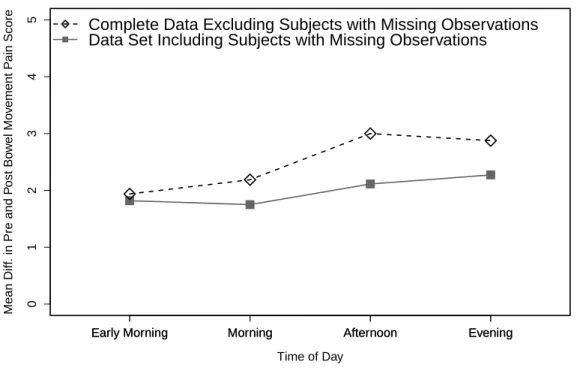
there was a difference in the difference in pre and post-bowel movement pain scores
throughout the day. Subjects suffering from irritable bowel syndrome (IBS) were asked
to rank pain on a scale from 0 to 10 before and after every bowel movement. Based
on the time stamp of these measurements, the difference in pre and post-bowel pain
scores were classified as early morning, morning, afternoon or evening. This study
en-rolled both diarrhea predominant (IBS-D) and constipation predominant IBS (IBS-C)
patients. IBS-C patients were more likely to have missing data when they were
ex-periencing IBS symptoms. A missing value for these participants was often indicative
of a higher pre-bowel pain score as they were experiencing constipation. As such, one
expects missing measurements to be higher than the non-missing counterparts. A
sim-ilar situation can develop in any longitudinal trial with missing data. While subjects
may miss a visit randomly, some also drop out of studies due to a change in location or
health status. If a patient drops out of the study due to health status, this can be due
to either the participant’s health improving or declining to a point that they are no
longer interested or able to participate in the study. These improvements or declines
can be associated with better or worse outcome values, often denotes by extremely high
1.2
Literature Review
1.2.1
Notation and Assumptions
We will generalize this research to a study designed with n planned measurements
recorded for each of the k subjects. We denote the jth measurement for the ith
indi-vidual as the scalar Yij and Xij denotes any additional covariates collected on the ith
subject along with thejth outcome measurement. These X
ij values can either vary by
measurement or can be constant within a subject. For our research, we will assume all
covariates are constant within a subject and therefore that Xij =Xi for all i.
Missing outcome values occur often in repeated measures studies. Any scenario
involving missing data also involves a loss of information and therefore analysis with
missing data will often differ from the analysis of the data if it was a complete data
set. Missing data is a very common occurrence and one that must be accounted for in
order to minimize bias and loss of efficiency both of which are associated with missing
data. To classify missingness, a variable Rij is specified as an indicator variable to
denote if Yij is missing. Rij takes the value of 1 if the Yijth observation is observed
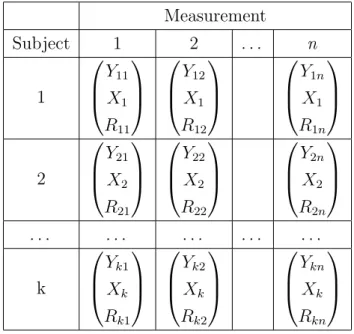
and 0 otherwise. Table 1.1 below illustrates that all the information gathered can be
summarized by reporting these three values (Yij, Xij, andRij).
The notation Yi will denote the full vector of missing and observed responses for
the ith subject (Y
i1, Yi2, . . .Yin) and the notation Ri will denote the corresponding
vector for the indicators Rij. Each of these vectors has n elements, corresponding to
the n measurements taken on each subject.
1.2.2
Non-parametric Analysis of Complete and Balanced Data
There are a number of situations in which there are problematic and potentially
Table 1.1: Repeated Measures Data Set with Missing Data
Measurement
Subject 1 2 . . . n
1 Y11 X1 R11 Y12 X1 R12
Y1n
X1
R1n
2 Y21 X2 R21 Y22 X2 R22
Y2n
X2
R2n
. . . . k
Yk1
Xk
Rk1
Yk2
Xk
Rk2
Ykn Xk Rkn
values may be inappropriate. A number of non-parametric approaches to the repeated
measures analysis have been adapted to deal with such scenarios. The earliest methods
focused on data in which each subject had the same number of measurements, known
as balanced data, and data where there were no missing values, known as complete data
(Friedman, 1937; Koch and Sen, 1968). While there are methods to test for differences in
measurement within a subject if the effects are different between subjects, this research
will be focusing on methods that assume the measurement effect is constant across all
subjects.
Within this subset of methods, the preferred method depends on assumptions one
is willing to make. One such assumption involves, what Koch and Sen refer to as, the
additivity of subject effects. When this assumption is true, it is reasonable to believe
that comparisons of between block rankings are meaningful. This involves assuming
that the difference between two ranked measurements on the same subject is comparable
Sen, 1968; Stokes, Davis and Koch, 2000). If one assumes the additivity of subject
effects, methods take this into account and adapt their methods so rank comparisons
between subjects are used. The most widely accepted class of these testing methods
involves the use of aligned rank tests. The premise behind all these tests is that some
function of the data for the subject, usually a measure of location, is subtracted from
all the Yij values. These differences are then treated as the outcome variables and are
ranked within a subject (Stokes, Davis and Koch, 2000; Hodges and Lehmann, 1962;
Sen, 1968; Lehmann and D’Abrera, 2006; Koch and Sen, 1968).
Friedman’s Test
One of the most widely-used non-parametric methods, Friedman’s test, utilizes
par-tial rank transformation methods to test for the hypothesis of no difference in
measure-ments within a subject while assuming no additivity of subject effects. In studies where
compound symmetry can be assumed, Friedman’s statistic tests the measurement
ef-fect while controlling for any subject efef-fect. This test does not require the normality
assumptions of parametric methods and also minimizes the effect of the between
sub-ject variability, allowing tests to focus on measurement effect (Friedman, 1937; Stokes,
Davis and Koch, 2000).
Friedman’s method assumes that all outcome variables Yij come from an
n-variate continuous cumulative distribution functionFi whereFi =Gi(y−bi+θj). The
focus of this test is in testing for a measurement effect while controlling for subject.
Therefore hypothesis testing involve testing ifθj = 0 for allj, under the constraint that
P
θj = 0. No additional covariates are included in analysis and therefore no Xi’s are
involved in the test statistic.
Friedman’s test replaces the original measurement values by within subject ranks.
Yij would be replaced with within subject rank, which will be denoted rij where
rij = 1,2, ...ni. For complete and balanced data sets, we assume the total number
of non-missing measurements is the same for all subjects. Thus, for any subject i,
ni =n. It is important to note that Pnj=1rij = n(n2+1) for all k subjects. The data in
Table 1.1 can be summarized in a new format, which allows for a display of the same
data in a new format show in Table 1.2 below:
Table 1.2: Non-Parametric Test With Complete and Balanced Data
Measurement Subject 1 2 . . . n
1 r11 r12 r1n
2 r21 r22 r2n
. . . . k rk1 rk2 rkn
If there was no difference in measurements collected on the same subject, one would
expect each rank to be equally likely to be located in each of the n columns.
There-fore, under the null hypothesis of no measurement effect, one would expect the mean
rank for each column to come from a distribution with a mean of the average rank,
n+1
2 . The variance of this distribution under the null hypothesis can be calculated to
be n122−k1, where k denotes the number of subjects. Friedman’s test statistic, based off these values for the mean and variance, is:
12k n(n+ 1)
n
X
j=1
¯ rj −
1
2(n+ 1)
2
where ¯rj is the average rank of the jth column. In small studies, it is best to use
the exact permutation distribution to test the null hypothesis of no trend across the
columns, or in the case of longitudinal data no trend over time. However, when the
distribution withn−1 degrees of freedom.
Tied outcome variables can be dealt with by assigning the tied ranks at random
to each of the tied measurements. However, the mid-rank method is a more common
method that allows for the utilization of more information. This method involves giving
tied measurements the average value of the ranks for which two or more observations
are tied (Friedman, 1937).
This method, with the use of the mid-rank option for ties, is equivalent to combining
Kruskal-Wallis tests while conditioning on subject which is equivalent to a stratified
Mantel-Haenszel tests with column scores being equal to within subject ranks. Since
Friedman’s test can only be used in the case of complete and balanced data, in this case
only the stratified Mantel-Haenszel statistic equivalent to Friedman’s statistics. Both
involve tests to determine if mean responses differ using within subject rank scores
rather than actual measurement values (Landis, Heyman and Koch, 1978; Stokes, Davis
and Koch, 2000).
Koch and Sen’s Test
If it is not reasonable to assume a compound symmetric correlation structure, Koch
and Sen have proposed an alternative to Friedman’s test. This method also uses partial
rank transformation and therefore the data structure is identical to that shown in
Ta-ble 1.2. Where the two methods differ is in terms of the permutation-based distribution
under the null hypothesis. In Friedman’s test, when the correlation is equal between
any two measurements within a subject, the distribution of the ranks under the null
hypothesis is based off of the fact that each permutation of ranks is equally likely
within each subject. The distribution used for the test statistic in Koch and Sen’s test
is based off of the premise that when compound symmetry is violated, the unique pair
and Sen’s test, the distribution under the null hypothesis allows for only two possible
permutations of ranks within a subject. The first possible permutation is the observed
permutation and the second is the exact opposite permutation, specified explicitly
be-low. For both of these permutations the correlation between any two measurements is
the same, thereby preserving the correlation structure (Koch and Sen, 1968).
ri = (ri1, ri2, ..., rin)
ri = (n+ 1−ri1, n+ 1−ri2, ..., n+ 1−rin)
These two permutations for the ithsubject are the only two permutations that have
the same correlation as the observed data for theithsubject. Each of these permutations
are assumed to be observed with equal probability under the null hypothesis that there
is no difference in measurements within a subject. Koch and Sen’s method tests for a
measurement effect while controlling for subject, and therefore the results are combined
across all subjects to get an estimated average effect across all subjects. Interest lies
in tests involving Twhich is a n x 1 vector with elements Tj = k1 k
P
i=1
rij.
Under the null hypothesis of this distribution, the expected value of Tj can be
calculated based on the expected value of rij which is equal to n+12 .
E[Tj] =
1 k
k
X
i=1
E[rij] =E[rij] = ((rij)P r(rij =rij) + (n+ 1−rij)P r(rij =n+ 1−rij))
= rij
1
2 + (n+ 1−rij) 1 2 =
Under the assumptions required for Koch and Sen’s test, the covariance matrix of
T, anxn matrix, will be denoted as V with each element vjj0 calculated as:
vjj0 =Cov(Tj, Tj0) = Cov(
1 k
k
X
i=1
rij,
1 k
k
X
i=1
rij0) = 1 k 2 k X i=1
Cov(rij, rij0)
= 1
k2
k
X
i=1
(E[(rij −E[rij])(rij0 −E[rij0])])
= 1
k2
k
X
i=1
E[rijrij0]−
n+ 1 2 2! = 1 k2 k X i=1
(rijrij0)
1
2 + (n+ 1−rij)(n+ 1−rij0) 1 2−
n+ 1 2
12!
= 1 k2 k X i=1
2rijrij0
2 −
rij(n+ 1)
2 −
rij0(n+ 1)
2 +
(n+ 1)2
2 −
1
2(n+ 1) 2 2 = 1 k2 k X i=1
rijrij0 −
rij(n+ 1)
2 −
rij0(n+ 1)
2 +
n+ 1 2 2! = 1 k2 k X i=1
rij −
(n+ 1)
2 rij0−
(n+ 1) 2
Koch and Sen developed a generalized statistic which allows for the testing of any
linear contrast C of the vectorT, which consists of all n Tj elements, for whichCj =
0 where j0 = (1, ...,1). The form of the generalized statistic is stated in terms of
the contrast matrix as T0C0(CVC0)−1CT. Under the null hypothesis k1/2T is an asymptotically multivariate normal vector of rank n−1. Therefore, the test statistic
T0C0(CVC0)−1CT has an asymptotically chi-squared distribution with n−1 degrees
1.2.3
Missing Data Mechanisms
Missing Covariates
Although in some studies missing covariates can also be a problem, we will be
assuming no missing covariates in our examples. Background on dealing with missing
covariates is included for completeness since this can present substantial concerns.
Var-ious methods exist to address the problems that arise from missing covariates, but for
simplicity we will deal with studies that have complete covariate data. Missing
covari-ates can potentially be an issue in all types of studies; however, in repeated measures
scenarios it can often have a greater impact on the analysis, as one missing covariate
can affect multiple observations on one participant. One method used to address these
concerns involves replacing the missing covariate with the mean or median value of
the covariate. An alternative method involves replacing the missing value by the
pre-dicted value generated by regressing the covariate with missing values on all observed
covariates. More recently, methods often used for dealing with missing outcome values
have been adapted for use in dealing with missing covariates values, including
max-imum likelihood methods, weighted estimating equations and multiple imputations.
However, these are not directly incorporated into the basic repeated measures
mod-eling procedures in many computer-programming packages, including SAS. These can
be done separately from repeated measures analysis computing procedures, although
they are more computationally intensive, particularly the more complex methods, and
these methods do require additional assumptions. In order to simplify analysis, the
most common method of dealing with missing covariates is that all observations for a
participant are deleted if one or more covariates are missing, which can lead to a much
smaller sample size and to biased estimates unless the covariates are missing
com-pletely at random (Horton and Kleinman, 2007). This research will consider data with
Missing Completely at Random (MCAR)
When outcome variables are missing completely at random (MCAR), the
proba-bility of a subject having a missing value for an observation does not depend on the
subject’s observed values or the covariates. MCAR data are defined explicitly to be
data in which the indicator vector for missingness, Ri, is independent of both Yi and
Xi. This is equivalent to stating P r(Ri|Yi, Xi) = P r(Ri) (Fitzmaurice, Laird and
Waire, 2004). As a number of analyses require the assumption that missing data are
MCAR, this assumption is often assumed even though it requires the strictest
assump-tions.
In studies with repeated measures over time, participants have a higher
proba-bility of missing later visits due to fatigue or lack of interest as the study continues. In
these studies missing data are often classified at MCAR since missingness depends only
on time, which is often treated as a design variable in the case on longitudinal studies.
Unlike covariates, design variables are specified by the investigator and predetermined
for use in the study design. If time is fixed and treated as a design variable, the
miss-ingness depends on a fixed variable and therefore not on the observed or unobserved
data. Therefore time is not included in the covariate matrix and the missingness is
MCAR (Fitzmaurice, Laird and Waire, 2004).
Covariate Dependent Missingness or Missing at Random (MAR)
Covariate dependent missingness, commonly referred to as missing at random (MAR),
occurs when the probability of a subject having a missing value does not depend on
the actual missing outcome values but could depend on a subject’s covariates. Stated
explicitly, covariate dependent missingness is defined to occur when P r(Ri|Yi, Xi) =
and is still considered likely in studies involving repeated outcome measurements.
As-suming MCAR requires less strict assumptions and therefore fewer methods of analysis
are valid. Under the assumption of covariate dependent missingness, the distribution of
the data used for analysis, the observed, is not the same as the population of interest.
Therefore, the parameter estimates will be biased when using least squares methods
and will only be accurate with maximum likelihood methods when the distribution of
the outcome is correctly specified (Fitzmaurice, Laird and Waire, 2004).
Non-ignorable or Informative Missingness
As knowing that an observation is missing reveals no information about the
ac-tual missing values, both MCAR and covariate dependent missingness are commonly
referred to as non-informative or ignorable missing data. In these cases knowing the
actual missing values is not needed to conduct valid analyses. In contrast, the third
type of missing data, missing not at random (MNAR), is commonly referred to as
informative or non-ignorable missingness. In this situation P r(Ri|Yi,Xi) cannot be
simplified, meaning the probability of a subject having a missing value depends on the
actual unobserved missing values. In this case, not incorporating information about
the missing data will yield biased results. There is not currently a computationally
simple method when dealing with this type of data for statistical estimation and
test-ing. The most common method, which is extremely difficult to do with great accuracy,
requires specifying models both for the response as well as the missing data mechanism.
This requires definingP r(Ri|Yi, Xi) accurately and explicitly (Fitzmaurice, Laird and
Monotonic vs. Non-Monotonic Missingness
All three of these categories can be further classified, if the order of the repeated
measures has meaning, by specifying the missing data as monotonic or non-monotonic.
If having a missing value forces all subsequent values for a subject to be missing as
well, the missing mechanism is considered to be monotonic. This is commonly referred
to as drop-out or loss to follow up in longitudinal studies. In contrast, non-monotonic
missing data occur when a measurement can be observed after a missing measurement
was reported for that subject. When missing data are non-monotonic, non-informative
missingness is easier to assume and more likely to be valid. For example, when a subject
drops out it is difficult to assume the reason for drop out is completely unrelated
to the subject’s missing outcome values. In contrast, if a subject has intermittent
missing data, it is easier to assume the missingness is unrelated to the missing outcome
values. Additionally, for subjects with intermittent missingness, the observed data
which occurred after the missing data can help in making assumptions about the true
missing values with greater accuracy (Fitzmaurice, Laird and Waire, 2004).
1.2.4
Missing Data in Repeated Measures Analysis
Complete-Case Analysis
There are a number of methods for dealing with missing data. The simplest
ap-proach is known as complete-case analysis, in which any subject with one or more
observations missing is excluded from the analysis. Only data from subjects who have
no missing data are included in the analysis. Using this method with informative
miss-ing data will result in noticeably biased results. If for example participants with high
values were more likely to drop out of a study, the missingness is informative and any
only situation in which complete case analysis would produce unbiased analyses would
be MCAR, as that is the only situation in which dropping those with missing data
would be dropping a random sample of the population. However, even with MCAR
data, the decrease in sample size could lead to a substantial decrease in power. With
small samples, the loss of even a small number of observations can have an important
effect. However, due to the ease of analysis and interpretation, complete case analysis
is still considered an option of handling missing data (Fitzmaurice, Laird and Waire,
2004).
Repeated Measures ANOVA
Repeated measures analysis of variance (ANOVA) requires complete and balanced
data and is therefore is often used in conjunction with complete case analysis. This
method assumes the correlation between an individual’s measurements are based on the
individual’s underlying tendencies that remain the same for all measurements. This is
one of the earliest methods developed but due to ease of computation and
interpreta-tion, this method is still commonly used even though it requires making assumptions
that may not always be valid. Repeated measures ANOVA assumes the individual
has a latent response which is the same for all measurements thereby assuming some
individuals tend to have overall higher or lower outcomes than the population. This
method forces the data to have a compound symmetric correlation matrix, meaning
the correlation is the same between any two time points. Compound symmetry is
par-ticularly questionable in longitudinal studies as one would expect measurements taken
further apart in time to have weaker correlation than measurements closer in time
Single Imputation
An additional approach to handling missing data is imputation, in which each
miss-ing value is replaced by some estimated value. There are many approaches to
impu-tation. The simplest case is that of single imputation, in which the missing value is
replaced with one value generated as an estimate of the true unobserved value. Within
this category, imputation can be broken down further into within individual
imputa-tion, where the estimates are gathered from the individual with the actual missing
value, or between individual imputations, in which information from the entire
sam-ple or a portion of the samsam-ple is used to estimate the missing value for an individual.
Missing values for an individual of a particular subgroup, for example females, may be
imputed to be the overall mean of that particular subgroup. One of the most common
within individual single imputations for monotonic missing data is last observation
carried forward (LOCF), in which a subject’s last known measurement is substituted
for all successive missing values. However, the assumption of a stable outcome after
drop out is unrealistic and the standard errors are smaller than they would be in the
case of non-missing data. A number of other functions of the data, both within the
individual as well as data from the overall sample, can replace the missing data. Some
of the more frequently used values for single imputation include the mean value for
a subject, the baseline value, or a worse or best case value, known as extreme case
analysis (Fitzmaurice, Laird and Waire, 2004).
Multiple Imputation
Single imputation methods do not take into account the variation and uncertainty
of predicting an unobserved value. Multiple imputation methods have been developed
to address this concern. These methods involve replacing the missing value with a
number of possible values for the missing value, generally somewhere between 3 and
10, are generated (Schafer, 1999). The methods of generating these imputed values
can greatly affect the analyses. All methods rely on using the observed data to predict
the missing data. One of the more common methods involves generating the
imputa-tions from an estimated proper prior distribution generated from the observed data.
For more complex situations, Markov Chain Monte Carlo (MCMC) methods can be
used. Both methods require multivariate normality; however, with minor departures,
accurate inferences can still be made using these estimates (Horton and Lipsitz, 2001).
One complete data set is generated from each one of the generated estimates of
the missing value. The complete data sets created from these multiple estimates of the
missing values are then used to determine parameter estimates and variances. Denoting
the parameter estimate or the combination of parameter estimates as Q, m
imputa-tions would result in m estimates of Q, denoted as Qˆ, with each having a variance
estimator U. These multiple Qˆ estimates are then averaged to create a point
esti-mate for Q. The estimate of the variance of this point estimate incorporates both the
between-imputation and within-imputation variance. In the multivariate case, where
ˆ
Q is a vector of values, the within-imputation varianceU¯ is the average of the m
co-variate matrices U. The between imputation B is m1−1
m
P
t=1
(Qˆt −Q¯)(Qˆt −Q)¯ T. The
total variance can then be expressed as T = U¯ + (1 +m−1)B. If we define k to be
the number of elements in Q, then inference can be made by comparing the
statis-tic (Q¯−Q0)TT−1(Q¯−Q0)
k to an F distribution with k numerator degrees of freedom and
v = (m −1)(1 +m−1)tr(BT−1)/k −2 denominator degrees of freedom. In multi-variate cases, especially with only a small number of imputations, it becomes more
complicated as the between-imputation covariance matrix would not be of full rank
when the number of imputations is less than or equal to the number of elements in Q.
Generalized Estimating Equations
Methods have been developed that analyze all observed data without imputing
the missing values or excluding subjects with missing data. One of these methods
involves the use of generalized estimating equations, known also as marginal models,
which extends generalized linear model theory to correlated data. As in generalized
linear models, a link and a variance function are specified that connect the outcome
to a linear combination of covariates. These methods do not require any distributional
assumptions be made about the outcome variable but rely on quasi-likelihood methods
in order to estimate parameters and test hypotheses. Instead of making assumptions
about the distribution of the outcome variable, a correlation structure must specified
(Liang and Zeger, 1986). When dealing with a continuous outcome, which we will be
focusing on in this research, the mean model is defined as
µi =E[Yi|Xi] =Xiβ
The specification of the variance component involves the specification of the
corre-lation structure. The general covariance matrix of Yi is specified as
Vi =φA
1 2
iWi(α)A
1 2
i
where Ai is an ni x ni matrix with the elements consisting of the variance of Yi along
the diagonal. Here Wi is the working correlation matrix; an ni x ni matrix which
is a function of the correlation parameters α. Once these are specified, the equation
below can be solved in order to get parameter estimates, for both mean and covariance
parameters.
k
X
i=1
dµ0i
In this equationVidenotes the covariance matrix andµidenotes the estimate of the
mean for the ith individual. Here we note that dµ
0 i
dβ is an s x s matrix where s denotes
the number of mean parameters in the model as β is an s x 1 vector. The estimate
for the covariance matrix is calculated based on the working correlation matrix. The
model-based estimate of the covariance matrix is specified as:
k
X
i=1
dµ0i dβV
−1
i dµi
dβ !−1
If the working correlation matrix is misspecified, this estimate of the covariance
matrix will be incorrect and the standard errors of the estimates will be inaccurate.
Even when the correlation structure is misspecified and the standard errors are invalid,
the mean parameter estimates are accurate since the mean model is separate from the
covariance model. However, inference about the parameter estimates will be invalid.
As a solution, an empirical estimator, commonly referred to as the sandwich estimator
has been derived and can be a more accurate estimator of the covariance ofYi
k
X
i=1
dˆµ0i dβ
ˆ
Vi−1dµˆi dβ
!−1 k
X
i=1
dµˆ0i dβ
ˆ
Vi−1(Yi−µˆi)(Yi −µˆi) 0
ˆ
Vi−1dµˆi dβ
! k
X
i=1
dµˆ0i dβ
ˆ
Vi−1dµˆi dβ
!−1
If the working correlation matrix is relatively accurate, the results can be more
effi-cient than when using the model based estimator. Although there are many advantages
to using generalized estimating equations, including the use of all observed data, these
methods will yield unbiased estimates only in the case of MCAR (Stokes, Davis and
Koch, 2000; Fitzmaurice, Laird and Waire, 2004).
Mixed Models
With recent computing advances, mixed models has become one of the most
is commonly expressed by the following equation where i= 1,2, ...k:
Yi = Xiβ+Zibi +i
Suppose Yi is the ni x 1 vector of non-missing outcomes for the ith subject andXi
is the fixed effect design matrix containing the covariates of interest. In this model, Zi
is defined as a subset of theXi matrix known as the random effects design matrix. We
define bi as the vector of unobserved random effects for the ith subject and i as the
unobserved vector of within-subject error. In this modelbi and i are assumed to have
multivariate normal distributions and to be independent of each other. We can write
this as follows:
bi i
:N
0 0 , σ2 b 0
0 σ2
If the Zi matrix is a ni x 1 column of ones, the model is simplified. Based on these
assumptions, the covariance matrix forYi can be defined asPi = σb2110 +σ2I where
1 is a ni x 1 matrix and I denotes a ni x ni identity matrix. In the simplest case of
mixed models, the components of the model are divided into between and within subject
components. The between subject components are considered to be fixed effects, which
are the true values of the population. The within subject effects, commonly referred to
as random effects, are the random deviation of the subject from the population average.
In this case the pair wise correlation for any two observations within an individual is the
same and by including only a random intercept we are forcing a compound symmetric
correlation structure on the data. Each individual has the same population mean and
differs from this mean by a random intercept.
In more complex mixed models the overall mean, the effect of measurement, and
any number of other regression coefficients are allowed to vary by subject. This is
(Fitzmaurice, Laird and Waire, 2004).
Treatment of Missing Data
Mixed models and GEE have risen to the forefront as the primary methods of
addressing missing data. Since both methods do not require a equal number of
obser-vations per individual, they allow for unbalanced and therefore missing data. However,
mixed modeling is usually preferred over GEE in the case of small samples for a
num-ber of reasons. First, stronger assumptions about missing data are needed to use GEE,
which limits GEE to situations involving covariate-dependent MCAR. Mixed modeling
requires less strict assumptions and therefore is applicable for both MCAR and MAR
mechanisms (Hedeker and Gibbons, 2006). Additionally the covariance matrix based
on GEE estimates may not be positive definite. A number of simulation studies with
missing data suggest that the likelihood methods of mixed models provide less bias and
smaller mean squared errors than the quasi-likelihood methods used in GEE (Catellier
and Muller, 2000).
Additionally, mixed models allow for a distinction of between and within subject
variances without having to estimate a large number of covariance parameters. Thus,
mixed models are preferred for longitudinal studies which have a large number of time
points or a flexible timing for visits. Since correlation within a cluster, or within an
individual, is incorporated in the model by the use of random effect, mixed models are
ideal in the case of unbalanced data. Mixed models not only allow for a decomposition
in variance, into between and within variation, but they also allow for testing of fixed
effects while allowing for the variation to differ depending on the individual
(Fitzmau-rice, Laird and Waire, 2004). However, the tests associated with both mixed models
and generalized estimating equation models rely on asymptotic properties and therefore
Small Sample Studies
Some researchers have failed to explicitly define what they constitute to be small
samples, and of those who do there, is some variation in terms of the definition. Some
researchers have focused on defining small samples according to the overall number
of observations while others have defined small samples by the number of subjects.
Additionally, small sample sizes can be more or less of a problem depending on the
number of parameters of interest, if there is an interest in the interaction terms, and
what hypotheses are of interest. When dealing with mixed models, guidelines have
been suggested that require a minimum of 30 sampling units and 30 repeated
measure-ments on each unit to avoid small sample concerns. However, this is often incredibly
impractical especially in the case of longitudinal studies and therefore these guidelines
are often ignored (Bell et al., 2010). Some researchers have referred to studies with
30 or 40 subjects as small studies while others have defined small studies to involve
as few as 10 or 12 subjects. These studies still had anywhere from 30 to 136 overall
number of observations (Fouladi and Shieh, 2004; Catellier and Muller, 2000; Akritas
and Brunner, 1997; Zucker, Lieberman and Manor, 2000).
There are two common approaches for dealing with small samples and missing data.
The first method uses mixed modeling techniques with small sample adjustments to
preserve the validity of tests. The second method involves ranking the response variable
and using non-parametric methods to make inference. This allows for a relaxation in
terms of assumptions about the distribution of the outcome variable and minimized the
influence of outliers, which may be more influential in small studies (Friedman, 1937;
Koch and Sen, 1968). Research on both of these methods has been developed in order to
preserve type I error rates in small studies. However, there are still some problems with
accuracy in certain scenarios depending on the combination of the covariance structure
what hypothesis is being tested. While most of this research has focused on the type I
error rate, some have presented power results for certain scenarios as well (Schluchter
and Elashoff, 1990; Catellier and Muller, 2000; Manor and Zucker, 2004; Mehrotra, Lu
and Li, 2010).
Since current mixed modeling techniques allow for missing data, substantial research
has been done using parametric methods to adjust large sample methods to be more
efficient for small samples. Generally these methods have been tested in scenarios for
which the mixed model assumptions, primarily that the outcome variable has a
mul-tivariate normal distribution, is true (Catellier and Muller, 2000; Fouladi and Shieh,
2004; Gao, 2007). There has been, however, some research that has attempted to
exam-ine the performance for outcomes with alternative distributions. These have resulted in
relatively good results in terms of preserving type I error in particular scenarios (Manor
and Zucker, 2004).
Some of the earliest small sample statistics involved adjustments to the likelihood
ra-tio statistic. The first of these adjustments involved a general formula, using Bartlett’s
method of weighting the likelihood ratio statistic. With this weight, the moments of
the likelihood ratio statistic are moved closer to the chi-squared distribution to which
they are compared (Lawley, 1956). In small samples, the impact of nuisance
param-eters on the likelihood statistic can be significant. Therefore, an adjusted likelihood
that involves the likelihood conditional on the nuisance parameters was developed (Cox
and Reid, 1987). Bartlett’s correction has been applied to the statistic based on this
adjusted likelihood. When directly comparing these two methods, Bartlett’s correction
alone tends to produce a slightly inflated type I error rate and the adjusted likelihood
proposed by Cox and Reid was overly conservative particularly for small samples.
How-ever, Bartlett’s correction in combination with the adjusted likelihood statistic produces
2004; Zucker, Lieberman and Manor, 2000). Using the likelihood ratio statistics, even
an adjusted version, only allows for comparison between two nested models. Therefore,
these methods are limited in the type of hypotheses that can be tested. Additionally,
all of these studies were tested for using unbalanced data thereby suggesting that the
validity of these results is limited to MCAR data (Manor and Zucker, 2004; Zucker,
Lieberman and Manor, 2000).
In comparison, the Wald statistic allows for the testing of a much broader class
of hypotheses and the research suggests that adjustments to the Wald statistic yield
a comparable type I error rate to tests done based on the likelihood ratio statistic
(Fouladi and Shieh, 2004). In the case of likelihood ratio tests, only maximum
likeli-hood methods can be used to test fixed effects. One aspect involved with adjustments
to Wald tests is the use of restricted maximum likelihood (REML) rather than
max-imum likelihood (ML) estimation. These estimation methods are often used in large
sample methods but can also improve the small sample behavior of tests. Maximum
likelihood methods generally behave well when sample size is large; however, in the case
of small samples these results underestimate the variance and produce biased results.
These problems with the variance estimate in ML methods arises even in the case of
complete data (Manor and Zucker, 2004; Fitzmaurice, Laird and Waire, 2004). Since
the precision of a test relies on accurate variance estimates, many methods of adjusting
tests to small samples use restricted maximum likelihood estimates. Maximum
likeli-hood methods use estimates of the mean model to estimate the variance without taking
into account the uncertainty associated with the estimates of the mean model. The log
likelihood of the mixed model maximized by ML estimates is shown below:
L=constant− 1
2
X
i
ln|Σi| −
1 2
X
i
(Yi−Xiβ)0Σ
−1
By comparison REML methods remove the estimate of the mean model from the
calculation of the estimate of the variance and thereby remove some of the bias. The
log likelihood maximized by REML methods is
L=constant− 1
2
X
i
ln|Σi| −
1 2ln X i
Xi0Σ−i 1Xi
−1 2 X i
ri0Σ−i 1ri
where
ri = Yi−Xi
X
i
Xi0Σ−i 1Xi
!−1 X
i
Xi0Σ−i 1Yi
!
When direct comparisons were made, REML statistics proved to be consistently
better at preserving the type I error rate than uncorrected maximum likelihood
esti-mates (Schluchter and Elashoff, 1990; Manor and Zucker, 2004). As an alternative to
uncorrected ML methods, some researchers have suggested adjusting the actual ML
statistic for small samples in order to account for bias. After allowing for a
correc-tion factor for the ML test statistic, REML and adjusted ML estimates proved to
produce comparable type I error rates as well as similar power curves in certain
scenar-ios (Schluchter and Elashoff, 1990). However, REML estimates are less likely to have
inflated type I error rates in the case of non-normal outcomes (Catellier and Muller,
2000; Manor and Zucker, 2004).
A number of correction factors for Wald statistics have been proposed to improve the
small sample behavior of both ML and REML tests. Most of these adjustments involve
comparing the Wald statistic to critical values from a t or an F-distribution rather than
a chi-squared distribution. There are numerous variations of this method that involve
weighting this test statistic or using a different degrees of freedom. Changes to the
degrees of freedom usually involve changing the denominator degrees of freedom when
investigated which choice of weight or denominator degrees of freedom is better at
pre-serving type I error rate in different scenarios with both MCAR and MAR data. The
preferred method depends strongly on study design, covariance structure, hypothesis
of interest, choice of REML or ML, and the correlation of outcome variables (Catellier
and Muller, 2000; Schluchter and Elashoff, 1990).
For studies with fixed time points and missing data, researchers have suggested the
best choices for the adjustments, in terms of both weights and denominator degrees of
freedom, involve a function of the number of non-missing observations. Depending on
a number of different factors, these adjustments can be improved upon when the
num-ber of groups, numnum-ber of repeated measurements, and the numnum-ber of overall subjects
are also taken into account in deriving the weight or the denominator degrees of
free-dom (Catellier and Muller, 2000; Schluchter and Elashoff, 1990). However, even with
this additional information taken into account, it has been noted that studies with fewer
observations, more repeated measurements, higher correlation between measurements,
and more missing data still have problems with inflated type I error rates. Specifically,
one study examined sample sizes with up to 10% missingness and with higher levels
of missingness the type I error rates are considerably inflated (Catellier and Muller,
2000).
For studies without fixed time points, there is no way of defining a participant with
complete data so alternative methods must be used. All of these methods involve an
adjustment to the degrees of freedom of the test. There are six common options that
are often considered: the na¨ıve degrees of freedom, the residual degrees of freedom,
the separation of the degrees of freedom into between and within subject components,
the containment method, the Satterwaite approximation and the Kenward-Rogers
freedom as if the sample comes from a balanced design has been proven to be an
ef-fective method of controlling the type I error in certain MCAR small sample scenarios
when testing fixed effects. In this na¨ıve method, the denominator degrees of freedom
are determined as if the tests were simply done using ANOVA with subject specific
parameters specified by subject’s specific linear regression. An additional option
in-volves making the degrees of freedom the total number of observations minus number
of between subject parameters in the model. This choice, known as the residual degrees
of freedom, yields the same degrees of freedom for a study with many subjects with
few observations per subject as for a study with few subjects but many observations
per subject. To combat this issue and to account for differences in these two
scenar-ios, an alternative option is to use the between and within degrees of freedom. This
method separates the denominator degrees of freedom into two different parts that are
used in different hypothesis testing scenarios. The degree of freedom for the
between-subject hypotheses is the number of between-subjects minus the number of between-between-subject
effects in the model (Manor and Zucker, 2004). An additional option, the
contain-ment method, allows the degrees of freedom for a fixed effect to depend on whether
or not there is a corresponding random effect for that fixed effect. If there are, then
the degrees of freedom is the rank contribution of the random effect to the
X Z
matrix (SAS/STAT(R) 9.2 User’s Guide, Second Edition). Otherwise the degrees of
freedom are the residual degrees of freedom mention above, which is the total number
of observations minus the rank of
X Z
. One of the most effective methods at
pre-serving type I error in small samples is the Satterthwaite approximation. This method
approximates the degrees of freedom to be 2Si4
Appr(V ar(S2
i))
where Si2 = V ar( ˆβi) (Manor
and Zucker, 2004). Kenward and Roger adjusted the Satterwaite approximation so the
uncertainty about the estimate of the covariance matrix was taken into account. The
is calculated, the covariance matrix is inflated (Kenward and Roger, 1997). This
ad-justment lowers the bias and improves the type I error rate, although again in specific
situations the error rate remains inflated (Fouladi and Shieh, 2004; Kenward and Roger,
1997). Only this method and the Satterthwaite approximation are a function of the
observed data. A small sample simulation study, which did not test the Kenward-Roger
method, found the Satterwaite and the na¨ıve REML method performed the best in the
particular small sample MCAR scenarios. However, even these methods had problems
with inflated type I error rates in certain scenarios (Manor and Zucker, 2004).
1.2.5
Missing Data in Non-parametric Analysis
Friedman’s test was developed to analyze data with one observation per cell. This
applies only to situations with balanced data with no missingness and exactly one
ob-servation per subject for each measurement. Methods have been developed to adapt
Friedman’s test to more general scenarios. These adaptations generally focus on one of
two situations although some do incorporate both. The first of these involves data with
more than one observation per cell and the second involves missing data while dealing
with at most one observation per cell. The focus of this research will be on applications
of the second type.
Durbin has been recognized as one of the first researchers to investigate
alterna-tive to Friedman’s test with missing data. However, his methods do require an equal
number of observations per subject (Durbin, 1951). As it is more common in the case
of missing data to have an uneven number of observations per subject, research has
further developed these methods to allow for incomplete and unbalanced data. The
majority of these methods have focused on inflating or weighting the contribution of
each subject to the statistic by some function of the number of observations the
Bernard and van Elteren adapted Durbin’s model for scenarios with an arbitrary
number of observations for any subject at any time. This statistic completes the k x
n table used in Friedman’s test by forcing the rank of any missing observation to be
zero and then ranking all other observations from 1 toni. The ranks for theith subject
are then weighted by a factor of
n3
i−
P
γ
γ3t
iγ
12ni(ni−1) where tiγ is the number of ties of size γ for
subjecti. Based on the calculated mean and variance of the distribution of these ranks,
a statistic is generated which for large samples under the null hypothesis is compared
to a chi-squared statistic withn-1 degrees of freedom (Bernard and Elteren, 1953). The
complexity of these calculations has led many researchers to attempt to find simpler
methods for dealing with these scenarios (Prentice, 1979; Mack and Skillings, 1980;
Skillings and Mack, 1981; Rai, 1987; Wittkowski, 1988).
Van Elteren developed a more usable statistic to deal with scenarios with only two
measurements. Friedman’s test involves combining data across subjects to determine if
the average rank for measurements are different. Van Elteren’s test, which is two
mea-surement form of the Friedman’s test, involves testing a linear combination of within
subject Wilcoxin rank sum tests. A general test statistic was proposed with no specific
linear combination specified. A locally most powerful test was derived which involved
a linear combination that inflated the test statistic for each subject based on some
function of the number of measurements collected for that subject. The inflation factor
of (ni+ 1)−1 yielded the most powerful test for the hypothesis of no difference between
two populations, or in the case of longitudinal studies, two time points (Elteren, 1960).
When there is a true constant effect across subjects, van Elteren’s method was
devel-oped to preserve type I error rate and with the intention to have better power than
the alternatives (Mehrotra, Lu and Li, 2010). However, if within strata samples sizes
are small, Van Elteren’s statistic has been shown to have low power (Kawaguchi and
Just as a method involving a combination of Wilcoxin rank sum statistics
condi-tioning on subject has been developed, methods have been developed that are
combina-tions of Kruskal-Wallis statistics conditioning on subject. These are stratified
Mantel-Haenszel tests, which as mentioned previously are equivalent to Friedman’s test in the
case of complete data. However, unlike Friedman’s test these can deal with missing
data in the case of MCAR data (Landis, Heyman and Koch, 1978; Stokes, Davis and
Koch, 2000). In a case such as one we are focusing on, with a continuous outcome
and one in which only one observation per time point is possible, Van Elteren type
adjustments to these tests have been developed. These adjustments, of applying an
inflation factor of (ni+ 1)−1 to the ranks of each subject, have been tested in scenarios
involving incomplete and unbalanced study designs with great success. These values,
just as those provided for the two measurement case by Van Elteren, improve the power
by inflating the contribution of subjects with fewer observations (Prentice, 1979).
Us-ing this inflation factor in the statistical calculations is equivalent to selectUs-ing different
scores in stratified Mantel-Haenzel methods. This Van Elteren inflation factor,
com-bined with the ranks, is commonly referred to as the modified ridit scores and the use
of these methods has become widely used as SAS and other statistical packages have
made it part of standard software (SAS/STAT(R) 9.2 User’s Guide, Second Edition,
N.d.).
A number of other researchers have proposed alternative inflation factors to deal
specifically with Friedman-type statistics, although most were established to ease
com-putation. Overall the most effective methods work well with MCAR data as they assign
a subject a weight inversely proportional to their sample size which allows for subjects
with smaller number of observations to contribute more than in unadjusted tests (Mack