MSB/Chemistry/GITAM/HYD Page 1 Unit-III : Fuel Technology: Calorific Value and Solid Fuels
Solid Fuels:
Def: Fuels are the substances which produce heat on combustion. Heat generated may be utilized directly or converted into mechanical or electrical energy, which can be used for domesic and industrial purpose.
Classification of coal.
Primary Fuels:-
Solids - wood, coal Liquid - crude Petroleum Gas - Natural gas Secondarty Fuels(derived)
Solids - coke, Charcoal. Liquids - Kerosene, diesel, petrol
Gas - water Gas, Producer gas, Coke oven gas
Characteristics of Fuels-
Good characteristic of fuels are
1. High calorific values
2. Dry and low moisture content
3. Moderate ignition temperature. Low ignition temperature can cause fire accident.
4. Must leave less ash after combustion
5. Combustion speed of a good fuel should be moderate
6. It should be easily available and cheap in cost. 7. Should not give poisonous gases after combustion 8. Easy to transport
9. Handling should be easy
10.Fuel must be efficient without smoke.
Calorific Value-Units
The amount of heat produced by the combustion of unit mass or unit volume of fuel is called the calorific value of the fuel. Units- Cal/gm or Kcal/Kg; KJ/Kg.
High Calorific Value :- It is defined as the amount of heat energy produced by the combustion of unit mass of a fuel when the combustion products are allowed to cool at room temperature
Low Calorific Value: - It is defined as the amount of heat energy produced by the combustion of unit mass of a fuel when the combustion products are allowed to eascape out.
Bomb Calorimetric method:-
MSB/Chemistry/GITAM/HYD Page 2
APPARATUS:-A bomb calorimeter consists of a thick steel cylinder or bomb, which can be closed with a needle valve. There is a gas inlet valve for oxygen. Two platinum wires are fixed in the cap for sending current for ignition coil. One of them carries a graphite/platinum cup and ignition coil connects the cup and other platinum wire. The bomb calorimeter is kept in a known quantity of water contained another outer brass calorimeter. The brass calorimeter is kept inside a non-conducting jacket over ebonite blocks. A sensitive thermometer and a stirrer also provided and they are kept
dipping in the water.
Working:- A known weight of the fuel in the platinum/graphite cup is taken, the bomb is charged with
oxygen up to 25 atm of pressure using oxygen valve. The initial temp of the apparatus is noted. The platinum wires are connected to a wire source of current and ignition of the fuel is initiated by passing a current through ignition coil. The fuel burns completely and heat evolved is absorbed by water in the outer calorimeter, which is constantly stirred. The final temperature of water is noted.
CALCULATION OF GCV:-
Mass of solid/liquid fuel = m kg
Mass of water taken = w1 kg
Water equivalent mass of calorimeter and other accessories = W2 kg
Total weight = (w1+ w2) kg
Intitial temp = t1 K
Final temp = t2 K
Heat lost by m kg of a fuel = heat gained by calorimeter + water = mass X sp.heat X increase in temperature
= (w1+w2) X 4.187 X (t2-t1)KJ
Gross calorific value = (w1+w2 ) X 4.187 X (t2-t1) / M
MSB/Chemistry/GITAM/HYD Page 3 CALCULATIUON OF NET CALORIFIC VALUE:- the net calorific
value of a fuel can be calculated if the percentage of hydrogen in the fuel is known.let the percentage of hydrogen be x.
H2 + ½ O2 àààà H2O
2kg 18 kg
Since 2 kg of hydrogen produces 18 kg steam, x kg of hydrogen will produce = 18/2 X x kg of steam.
100 kg of fuel which contains x kg of hydrogen will produce 9x kg of steam.
1kg fuel produces = 9x? 100 = 0.09x kg of steam
Latent heat of steam = 587 X 40187 X KJ Kg-1
Therfor heat liberated by condensation of 0.09 x kg steam = 0.09x X 587 X 4.187 kJ
NCV = GCV – HEAT OF CONDENSATION OF STEAM FORMED FROM 1 KG OF FUEL.
= [ GCV-0.09 x X587 X 4.187 ]KJ Kg-1
Ranking of coal:-
Coal:-It is the most important solid fuel.it is formed by the action of heat, pressure and bacteria on buried vegetable matter, for a very long period of time.
Various stages of coal formation are
WOOD àààà PEAT àààà LIGNITE àààà BITUMINOUS àààà ANTHRACITE
During the coalification process,
• Carbon content and calorific value increase from wood to anthracite.
• Volatile matter moisture, hydrogen and oxygen contents decrease.
(1) PEAT:- It is a fibrous jelly mass containing 80-90% moisture. Dried mass contain - C = 57%, H= 6% , O=35 % and the rest ash. Its calorific value is 22,600 KJ/Kg on dry basis.
(2) LIGNITE:- It is soft and brown in colour containing 20-60% moisture. Dried sample contains C=60-70%, O=20%. Its calorific value is 23,000 to 29,000 KJ/Kg. It is used as domestics fuels, for steam production and also for the production of producer gas.
(3) BITUMINOUS:- The color of bituminous coal ranges from pitch black to dark grey. Calorific value is 29,000-35,500 kj/kg. It is subdivided into 3 types
(A)Sub-bituminous coal :-. C=75-83%,O=10-20% with high moisture and volatile matter. Calorific value is 29,000 kj/kg. (B) Bituminous coal:- C=78-90 %, calorific value is 33,000- 34,000
MSB/Chemistry/GITAM/HYD Page 4 metallurgical coke, coal gas for steam production and
domestic use.
(C) Semi-bituminous coal: - It contains high carbon content and low volatile matter, its calorific value is 35,000 KJ/Kg.
(D)ANTHRACITE:- It contains C=92-98 %, volatile matter = 8% and very less moisture. It is very strong and hard. Its calorific value is 36,000-38,000 kj/kg. It is used in metallurgical processes and also for producing steam.
Analysis Of Coal:- Two types of analysis
a. PROXIMATE ANALYSIS and b. ULTIMATE ANALYSIS
PROXIMATE ANALYSIS: - In this method the amount of moisture, volatile matter, ash and fixed carbon content present in coal are determined approximately.
1. Moisture Content:-W1 g of finely powdered coal is heated to 105ᴼC in a crucible for an hour. The process is repeated till the constant weight is obtained.
% of Moisture =Loss of weight of coal/weight of coal X 100
2. Volatile Matter: - The above sample is heated to 950ᴼC in absence of air for 7 minutes in a crucible covered with lid. The loss in mass is reported as % volatile matter.
% of Volatile matter= Loss in weight due to removal of volatile matter/weight of coal X 100
3. Ash Content:-Coal free from moisture and volatile matter is burnt in an open crucible at 700ᴼC in a muffle furnace. The residue is reported as in % ash.
% of Ash = Mass of residue/Mass of coal X 100
4. Fixed Carbon :-
% of Fixed carbon = 100 - % of (moisture +volatile + ash)
SIGNIFICANCE OF PROXIMATE ANALYSIS:-
1. Moisture in the fuel takes some heat for evaporation. Hence there is reduction in calorific value, so the presence of moisture is undesirable.
2. High volatile matter coal burns with a long sooty flame, and with low calorific value. Volatile matter also influences the design of the furnace since the higher the volatile matter, large is the combustion space required.
3. Ash content reduces the calorific value. It also produces clinkers which causes irregularity in the supply of oxygen/ air for burning.
4. Higher the % of fixed carbon, greater the calorific value and better the quality of coal.
ULTIMATE ANALYSIS:-
MSB/Chemistry/GITAM/HYD Page 5 1. Carbon and Hydrogen: A weighted sample of coal(W) is burnt
in presence of oxygen in a combustible apparatus. Carbon is
converted to carbon-dioxide and hydrogen to and water
respectively. Water is absorbed in pre-weighted CaCl2 tube
and carbon dioxide in KOH tube. The increase in mass tubes is
determined.
CaCl2 + H2O à CaCl2.7H2O
H2 + 1/2 O2 à H2O 2g 18g
% of Hydrogen = Increase in weight of CaCl2 x 2/18 x100 Weight of Coal
2KOH + CO2 --à K2CO3 + H2O C + O2 à CO2 12 g 44 g
% of Carbon = Increase in weight of KOH x 12/44 x 100
Weight of Coal
2. Nitrogen: A weighted sample of coal is digested with
conc.H2SO4 and K2SO4 in a kjeldhals flask. It is then heated
with KOH and the liberated ammonia is distilled and absorbed
in a known volume of standard sulphuric acid. Ammonia
neutralises the sulphuric acid. The unused acid is then
estimated by titrating against standard sodium hydroxide. The
percentage of nitrogen is calculated as follows:
% of Nitrogen = Vol. of H2SO4 x Normality x 1.4
Weight of Coal
3. Sulphur:- Sulphur is estimated gravimetrically in terms of BaSO4.
% of Sulphur = Weight of BaSO4 x 32 x 100
Weight of Coal 233
4. Ash :- Coal free from moisture and volatile matter is burnt in an open crucible at 700ᴼC in a muffle furnace. The residue is reported as in % ash.
% of Ash = Mass of residue/Mass of coal X 100
5. % of Oxygen = 100 - % of (C + H + S + N + ash ).
Synthesis of Coke:-
60-MSB/Chemistry/GITAM/HYD Page 6 65%, with carbon -60%, volatilematter 30 %, moisture-2% and
ash- 8%.
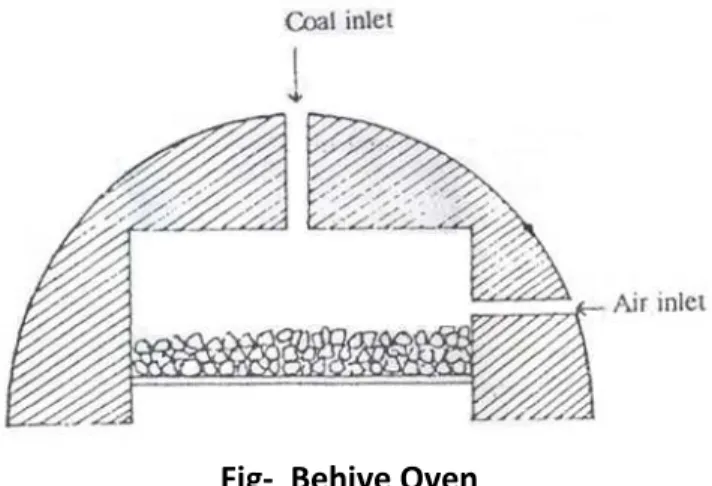
In this process valuable by-products like coal gas, ammonia, napthalene, benzene are not recovered.
Fig- Behive Oven
OTTO-HOFFMAN- BY PRODUCT OVEN METHOD:-
In this process coal is heated externally. Valuable by products like coal gas, ammonia, napthalene, benzene etc., are recovered. The carbonization reaction takes less time than bee-hive oven method.
By product oven consists of a number of silica chambers each about 10-12m long and 3-4m high and 0.4 wide. They are erected side by side with space between them for circulation of hot gas to heat the chambers, each chamber is provided with charging hole at the top an outlet for by-product gas and a door at each end for discharging coke.
Coal is fed into the chamber and closed tightly to prevent the access of air. The oven is heated to 1200ᴼC by burning producer gas. The flue gas is passed through the brick walls to raise its temperature. The heated brick preheats the incoming producer gas. The heating is continued until the evolution of volatile matter ceases. The carbonization gets completed in about 24 hours.
The red hot coke is rammed out and wet quenched by spraying water or dry quenched by passing non-reactive gases like nitrogen. Dry quenching makes the coke strong, denser and non- reactive
MSB/Chemistry/GITAM/HYD Page 7
RECOVERY OF BY-PRODUCTS:-
The gas obtained from the oven is called coke oven gas which comprises of ammonia, hydrogen sulphide, naphthalene, benzene and coal tar.
• The gas is first passed through another tower in which ammonia is sprayed, dust and coal tar gets collected.
• Next the gas is passed through another tower in which water is sprayed; here ammonia is collected as ammonium hydroxide.
• Naphthalene is collected by passing the gas through a tower in which water at low temperature is sprayed.
• Benzene and others homologue are separated by spraying petroleum. The remaining gas is passed through ferric oxide to recover hydrogen sulphide gas.
Assignment
Questions:-1. What is fuel? Mention the characteristics of a good fuel?
2. Define calorific value of a fuel. Describe its determination by calorimetric method?
3. Explain the proximate analysis of coal and it’s significant?
4. What is coal? Present the classification of coal? 5. Describe the Ultimate analysis of coal?
6. Describe Otto Hoffman’s by product oven method of manufacturing coke?