Modern Cryptography, Probabilistic
Proofs and Pseudorandomness
(Second Edition – author’s copy)
Oded Goldreich
Department of Computer Science and Applied Mathematics
Weizmann Institute of Science, Rehovot,
Israel
.
to Dana
c
Copyright 2000 by Oded Goldreich.
You can start by putting thedo not disturbsign.
Cay, inDesert Hearts (1985).
The interplay between randomness and computation is one of the most fas-cinating scientific phenomena uncovered in the last couple of decades. This interplay is at the heart of modern cryptography and plays a fundamental role in complexity theory at large. Specifically, the interplay of randomness and computation is pivotal to several intriguing notions of probabilistic proof systems and is the focal of the computational approach to randomness. This book provides an introduction to these three, somewhat interwoven domains (i.e., cryptography, proofs and randomness).
Modern Cryptography. Whereas classical cryptography was confined to the art of designing and breaking encryption schemes (or “secrecy codes”), Modern Cryptography is concerned with the rigorous analysis of any system which should withstand malicious attempts to abuse it. We emphasize two aspects of the transition from classical to modern cryptography: (1) the widening of scope from one specific task to an utmost wide general class of tasks; and (2) the move from an engineering-art which strives on ad-hoc tricks to a scientific discipline based on rigorous approaches and techniques. In this book we provide an introduction to the foundations of Modern Cryptography. We focus on the paradigms, approaches and techniques used to conceptualize, define and provide solutions to natural cryptographic prob-lems. We also survey some of the fundamental results obtained using these paradigms, approaches and techniques. The emphasis of the exposition is on the need for and impact of a rigorous approach.
Probablistic Proof Systems. Various types ofprobabilisticproof systems have played a central role in the development of computer science in the last decade. These proof systems share a common (untraditional) feature – they carry a probability of error; yet, this probability is explicitly bounded and
IV
can be reduced by successive application of the proof system. The gain in allowing this untraditional relaxation is substantial, as demonstrated by three well known results regardinginteractive proofs, zero-knowledge proofs, andprobabilistic checkable proofs: In each of these cases, allowing a bounded probability of error makes the system much more powerful and useful than the traditional (errorless) counterparts.
Focusing on the three types of proof systems mentioned above, but going also beyond them, we survey the basic definitions and results regarding prob-abilistic proofs. Our exposition stresses both the similarities and differences between the various types of probabilistic proofs.
Pseudorandomness. A fresh view at the question of randomness was taken in the theory of computing: It has been postulated that a distribution is pseudorandom if it cannot be told apart from the uniform distribution by any efficient procedure. This paradigm, originally associating efficient pro-cedures with polynomial-time algorithms, has been applied also with respect to a variety of limited classes of such distinguishing procedures.
Starting with the general paradigm, we survey the archetypical case of pseudorandom generators (withstanding any polynomial-time distinguisher), as well as generators withstanding space-bounded distinguishers, the deran-domization of complexity classes such as BPP, and some special-purpose generators.
An underlying assumption
Much of the contents of this book depends on the widely believed conjecture by whichP 6=N P. This dependency is explicitly stated in some of the results which make even stronger assumptions (such as the existence of one-way functions), and is implicit in some results (such as the PCP Characterization of NP) which would become uninteresting ifP=N P.
On the nature of this book
This book offers an introduction and extensive survey to each of the three areas mentioned above. It present both the basic notions and the most im-portant (and sometimes advanced) results. The presentation is focused on the essentials and does not ellaborate on details. In some cases it offers a novel and illuminating perspective. The goal is to provide the reader with
1. A clear and structured overview of each of these areas.
2. Knowledge of the most important notions, ideas, techniques and results in each area.
It is hoped that the book may be useful both to a beginner (who has only some background in the theory of computing), and to an expert in any of these areas.
Organization
In Chapter 1 we survey the basic concepts, definitions and results in cryp-tography. In particular, we survey the basic tools of cryptography – compu-tational difficulty, pseudorandomness and zero-knowledge proofs – and the basic utilities – encryption, signatures, and general cryptographic protocols. Chapters 2 and 3 provides a wider perspective on two concepts mentioned in Chapter 1. Specifically, Chapter 2 surveys various types of probabilistic proof systems including interactive proofs, zero-knowledge proofs and prob-abilistically checkable proofs (pcp). (The overlap with Chapter 1 is small,
and the presentation is quite different.) Likewise, Chapter 3 surveys various notions of pseudorandom generators, viewing the one discussed in Chapter 1 as an archetypical instantiation of a general paradigm.
The three chapters may be read independently of each other. In particu-lar, each starts with an individual brief introduction to the respective subject matter. As hinted above, although the chapters do overlap, the perspectives taken in them are different. Specifically, Chapter 1 treats the theoretical foun-dations of a practical discipline, and so the presentation departs from practice and emphasizesthe importance of rigorous treatment for sound practice(and not merely per se). In contrast, Chapters 2 and 3 depart from the theory of computing and emphasize the intellectual contents of the material (rather than its practical applicability). The fact that different perspectives co-exist in the same book, let alone in the same author, is indicative of the nature of the theory of computing.
The three chapters are augmented by four appendices and an extensive bibliography. Most importantly, Appendix A provides some basic background on computation and randomness.
We mention that important relations between randomness and compu-tation were discovered also in other domains of the theory of compucompu-tation. Some examples are given in Appendix B.
edition
This is the second edition of the book. It benefits from corrections to some errors pointed out by a few readers. In addition, Section 3.6.5 has been revised in view of some recent exciting developments (most importantly, the extractor of [353]).
Website for notices regarding this book
We maintain a website listing corrections of various types. The location of the site is
http://www.wisdom.weizmann.ac.il/∼oded/book1.html
Relation to another book by the author
A frequently asked question refers to the relation of the current book to our planned textbook Foundations of Cryptography, fragements of which have appeared in [171]. The current book is almost unrelated to the planned text-book. The only relation is that Chapter 1 provides a 30-page overview (or summary) to what may become a 600-pages textbook on the Foundations of Cryptography. In fact, the structure of Chapter 1 (specifically, Sections 1.2– 1.7) mimics the structure of the planned textbook. For further update re-garding the state of the planned textbook, see
http://www.wisdom.weizmann.ac.il/∼oded/foc-book.html
Much of the material was written while visiting the Laboratory for Computer Science of MIT.
A preliminary version of Chapter 1 has appeared in the proceedings of Advances in Cryptology – Crypto97, Springer’s Lecture Notes in Computer Science (1997), Vol. 1294, pages 46–74.
Parts of the material presented in Chapter 2 have appeared in the pro-ceedings ofSTACS97, Springer’s Lecture Notes in Computer Science (1997), Vol. 1200, pages 595–611.
As for personal acknowledgments, I will only mention some of the people to whom I am most indebt for my professional development. These include Benny Chor, Shimon Even, Shafi Goldwasser, Leonid Levin, Silvio Micali, and Avi Wigderson.
.... very little do we have and inclose which we can call our own in the deep sense of the word. We all have to accept and learn, either from our predecessors or from our contemporaries. Even the greatest genius would not have achieved much if he had wished to extract everything from inside himself. But there are many good people, who do not understand this, and spend half their lives wondering in darkness with their dreams of originality. I have known artists who were proud of not having followed any teacher and of owing everything only to their own genius. Such fools!
[Goethe,Conversations with Eckermann, 17.2.1832]
Preface III
Notes for the second edition VII
1 The Foundations of Modern Cryptography 1
1.1 Introduction. . . 1
1.2 Central Paradigms . . . 5
1.2.1 Computational Difficulty . . . 7
1.2.2 Computational Indistinguishability . . . 8
1.2.3 The Simulation Paradigm . . . 8
1.3 Pseudorandomness . . . 9
1.3.1 The Basics . . . 10
1.3.2 Pseudorandom Functions . . . 11
1.4 Zero-Knowledge. . . 12
1.4.1 The Basics . . . 12
1.4.2 Some Variants . . . 14
1.5 Encryption . . . 16
1.5.1 Definitions . . . 16
1.5.2 Constructions . . . 18
1.5.3 Security beyond passive attacks. . . 20
1.6 Signatures . . . 21
1.6.1 Definitions . . . 22
1.6.2 Constructions . . . 23
1.6.3 Two variants . . . 25
1.7 Cryptographic Protocols . . . 25
1.7.1 Definitions . . . 26
1.7.2 Constructions . . . 27
1.8 Some Notes . . . 28
1.8.1 General notes . . . 28
1.8.2 Specific notes . . . 32
1.9 Historical Perspective . . . 35
1.10 Two Suggestions for Future Research . . . 37
XII CONTENTS
2 Probabilistic Proof Systems 41
2.1 Introduction. . . 41
2.2 Interactive Proof Systems . . . 43
2.2.1 Definition . . . 43
2.2.2 The Role of Randomness . . . 45
2.2.3 The Power of Interactive Proofs. . . 45
2.2.4 The Interactive Proof System Hierarchy . . . 49
2.2.5 How Powerful Should the Prover be? . . . 50
2.3 Zero-Knowledge Proof Systems . . . 51
2.3.1 A Sample Definition . . . 52
2.3.2 The Power of Zero-Knowledge. . . 53
2.3.3 The Role of Randomness . . . 55
2.4 Probabilistically Checkable Proof Systems . . . 56
2.4.1 Definition . . . 56
2.4.2 The Power of Probabilistically Checkable Proofs . . . 57
2.4.3 PCP and Approximation . . . 60
2.4.4 More on PCP itself. . . 61
2.4.5 The Role of Randomness . . . 64
2.5 Other Probabilistic Proof Systems . . . 64
2.5.1 Restricting the Prover’s Strategy . . . 64
2.5.2 Non-Interactive Proofs . . . 67
2.5.3 Proofs of Knowledge . . . 68
2.5.4 Refereed Games . . . 68
2.6 Concluding Remarks . . . 68
2.6.1 Comparison among the various notions. . . 69
2.6.2 The Story . . . 70
2.6.3 Open Problems . . . 74
3 Pseudorandom Generators 77 3.1 Introduction. . . 77
3.2 The General Paradigm . . . 80
3.3 The Archetypical Case . . . 81
3.3.1 A Short Discussion . . . 83
3.3.2 Some Basic Observations . . . 83
3.3.3 Constructions . . . 86
3.3.4 Pseudorandom Functions . . . 90
3.4 Derandomization of time-complexity classes . . . 91
3.5 Space Pseudorandom Generators . . . 93
3.6 Special Purpose Generators . . . 97
3.6.1 Pairwise-Independence Generators . . . 98
3.6.2 Small-Bias Generators . . . 100
3.6.3 Random Walks on Expanders . . . 101
3.6.4 Samplers . . . 103
3.6.5 Dispersers, Extractors and Weak Random Sources . . 106
3.7.1 Discussion . . . 109
3.7.2 Historical Perspective . . . 110
3.7.3 Open Problems . . . 112
A Background on Randomness and Computation 113 A.1 Probability Theory – Three Inequalities . . . 113
A.2 Computational Models and Complexity classes . . . 116
A.2.1 P, NP, and more . . . 116
A.2.2 Probabilistic Polynomial-Time . . . 117
A.2.3 Non-Uniform Polynomial-Time . . . 120
A.2.4 Oracle Machines . . . 122
A.2.5 Space Bounded Machines . . . 123
A.2.6 Average-Case Complexity . . . 124
A.3 Complexity classes – Glossary . . . 124
A.4 Some Basic Cryptographic Settings . . . 126
A.4.1 Encryption Schemes . . . 127
A.4.2 Digital Signatures and Message Authentication . . . . 128
A.4.3 The RSA and Rabin Functions . . . 130
B Randomized Computations 133 B.1 Randomized Algorithms . . . 134
B.1.1 Approx. Counting of DNF satisfying assignments. . . 134
B.1.2 Finding a perfect matching . . . 135
B.1.3 Testing whether polynomials are identical . . . 138
B.1.4 Randomized Rounding applied to MaxSAT . . . 139
B.1.5 Primality Testing . . . 140
B.1.6 Testing Graph Connectivity via a random walk . . . . 141
B.1.7 Finding minimum cuts in graphs . . . 142
B.2 Randomness in Complexity Theory . . . 143
B.2.1 Reducing (Approximate) Counting to Deciding . . . . 143
B.2.2 Two-sided error versus one-sided error . . . 145
B.2.3 The permanent: Worst-Case vs Average Case . . . 146
B.3 Randomness in Distributed Computing. . . 147
B.3.1 Testing String Equality . . . 148
B.3.2 Routing in networks . . . 149
B.3.3 Byzantine Agreement . . . 150
B.4 Bibliographic Notes. . . 151
C Two proofs 153 C.1 Parallel repetition of interactive proofs . . . 153
C.2 A generic Hard-Core Predicate . . . 158
C.2.1 A motivating discussion . . . 159
C.2.2 Back to the formal argument . . . 161
XIV CONTENTS
D Related Surveys by the Author 165
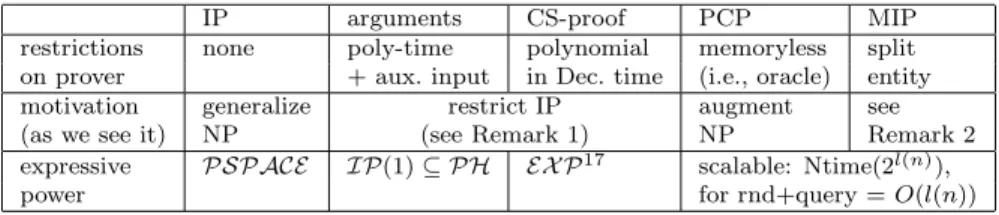
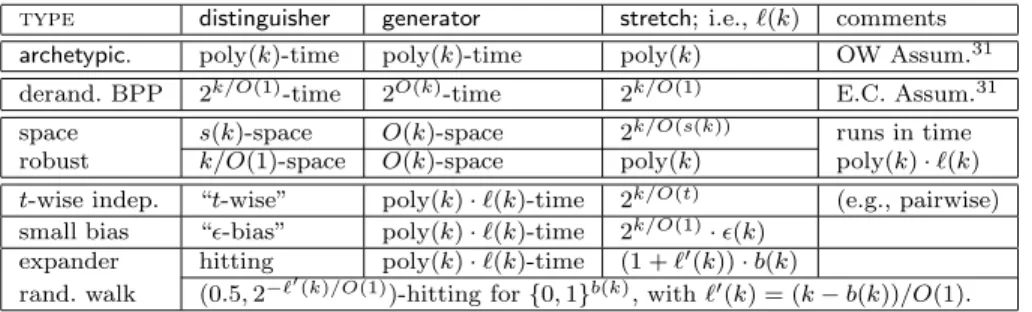
1.1 The Fiat–Shamir Identification Scheme [151] – basic version. 15 1.2 The Blum–Goldwasser Public–Key Encryption Scheme [69]. . 20 2.1 Comparison of various proof systems . . . 69 3.1 Pseudorandom generators at a glance . . . 109
Chapter 1
The Foundations of
Modern Cryptography
It is possible to build a cabin with no foundations, but not a lasting building.
Eng. Isidor Goldreich (1906–1995)
Summary – In our opinion, the Foundations of Cryptogra-phy are the paradigms, approaches and techniques used to con-ceptualize, define and provide solutions to natural cryptographic problems. In this chapter, we survey some of these paradigms, approaches and techniques as well as some of the fundamental results obtained using them. Special effort is made in attempt to dissolve common misconceptions regarding these paradigms and results.
Throughout this chapter, we assume some familiarity with modern cryp-tography; specifically with the basic settings of private-key and public-key cryptography. The unfamiliar reader is referred to Appendix A.4 for the adequate background.
1.1
Introduction
Cryptography is concerned with the construction of schemes which are robust against malicious attempts to make these schemes deviate from their pre-scribed functionality. Given a desired functionality, a cryptographer should
design a scheme which not only satisfies the desired functionality under “nor-mal operation”, but also maintains this functionality in face of adversarial attempts which are devised after the cryptographer has completed his/her work. The fact that an adversary will devise its attack after the scheme has been specified, makes the design of such schemes very hard. In particular, the adversary will try to take actions other than the ones the designer had envisioned. Thus, our approach is that it makes little sense to make assump-tions regarding the specificstrategy that the adversary may use. The only assumptions which can be justified refer to the computationalabilities of the adversary. Furthermore, it is our opinion that the design of cryptographic systems has to be based onfirm foundations; whereas ad-hoc approaches and heuristics are a very dangerous way to go. A heuristic may make sense when the designer has a very good idea about the environment in which a scheme is to operate, yet a cryptographic scheme has to operate in a maliciously selected environment which typically transcends the designer’s view.
Providing firm foundations to Cryptography has been a major research project in the last two decades. Indeed, the pioneering paper of Diffie and Hellman [122] should be considered the initiator of this project. Two major (interleaved) activities have been:
1. Definitional Activity: The identification, conceptualization and rigorous definition of cryptographic tasks which capture natural security con-cerns; and
2. Constructive Activity: The study and design of cryptographic schemes satisfying definitions as in (1).
The definitional activity provided a definition of secure encryption [201]. The reader may be surprised: what is there to define(beyond the basic setting formulated in [122])? Let us answer with a question (posed by Goldwasser and Micali [201]): should an encryption scheme which leaks the first bit of the plaintext be considered secure? Clearly, the answer is negative and so some naive conceptions regarding secure encryption (e.g., “a scheme is secure if it is infeasible to obtain the plaintext from the ciphertext when not given the decryption key”) turn out to be unsatisfactory. The lesson is that even when a natural concern (e.g., “secure communication over insecure channels”) has been identified, work still needs to be done towards a satisfactory (rigorous) definition of the underlying concept. The definitional activity also undertook the treatment of unforgeable signature schemes [203]: One result of the treat-ment was the refutation of a “folklore theorem” (attributed to Ron Rivest) by which “a signature scheme that is robust against chosen message attack cannot have a proof of security”. The lesson here is that unclear/unsound formulations (i.e., those underlying the above folklore paradox) lead to false conclusions.
1.1. INTRODUCTION 3
of a “pseudorandom generator”. Although ad-hoc “pseudorandom gener-ators” which pass some ad-hoc statistical tests may be adequate for some statistical samplings, they are certainly inadequate for use in Cryptography: For example, sequences generated by linear congruential generators are easy to predict [75, 158] and endanger cryptographic applications even when not given in the clear [44]. The alternative suggested by Blum, Goldwasser, Micali and Yao [72, 201, 364] is a robust notion of pseudorandom generators – such a generator produces sequences which arecomputationally indistinguishable
from truly random sequences, and thus, can replace truly random sequences in any practical application. We mention that the notion of computational indistinguishability has played a central role in the formulation of other cryp-tographic concepts (such as secure encryption and zero-knowledge).
The definitional activity has identified concepts which were not known before. One well-known example is the introduction of zero-knowledge proofs by Goldwasser, Micali and Rackoff [202]. A key paradigm crystallized in making the latter definition is the simulation paradigm: A party is said to have gained nothing from some extra information given to it if it can generate (i.e., simulate the receipt of) essentially the same information by itself (i.e., without being given this information). The simulation paradigm plays a central role in the related definitions of secure multi-party computations (with respect to varying settings such as in [274, 31, 200, 82, 51, 91]).
The definitional activity is an on-going process. Its more recent targets include session-key problems [51, 52, 35], mobile adversaries (a.k.a “Proactive Security”) [300, 92, 218], Electronic Cash [97, 99, 157, 307, 338], Coercibil-ity [88, 85], Threshold Cryptography [121], and more.
in-vert) [203, 49]. Using the assumption that RSA is hard to invert, one can construct pseudorandom generators [72, 364], zero-knowledge proofs for any NP-statement [186], and multi-party protocols for securely computing any multi-variant function [366, 187].
A major misconception regarding theoretical work in Cryptography stems from not distinguishing work aimed at demonstrating the plausibility of ob-taining certain goals from work aimed at suggesting paradigms and/or con-structions which can be used in practice. For example, the general results concerning zero-knowledge proofs [186] and multi-party protocols [366, 187], mentioned above, are merely claims of plausibility: What they say is that any problem of the above type (i.e., any protocol problem as discussed in Section 1.7) can be solved in principle. This is a very valuable piece of in-formation. Thus, if you have a specific problem which falls into the above category then you should know that the problem is solvable in principle. However, if you need to construct a real system then you should probably construct a solution from scratch (rather than employing the above general results). Typically,some tools developed towards solving the general prob-lem may be useful in solving the specific probprob-lem. Thus, we distinguish three types of results:
1. Plausibility results: Here we refer to mere statements of the type “any NP-language has a zero-knowledge proof system” (cf., Goldreich, Micali and Wigderson [186]).
2. Introduction of paradigms and techniques which may be applicable in practice: Typical examples include construction paradigms as the “choose
n out of 2n technique” of Rabin [309], the “authentication tree” of Merkle [267, 269], the “randomized encryption” paradigm of Gold-wasser and Micali [201], proof techniques as the “hybrid argument” of [201] (cf., [171, Sec. 3.2.3]), and many others.
3. Presentation of schemes which are suitable for practical applications:
Typical examples include the public-key encryption schemes of Blum and Goldwasser [69], the digital signature schemes of [132, 128, 111], the session-key protocols of [51, 52], and many others.
1.2. CENTRAL PARADIGMS 5
of work required to violate the security of the resulting scheme.1 We stress that this translation can be invoked for any value of the security parameter. Doing so determines whether a specific construction is adequate for a specific application under specific reasonable intractability assumptions. In many cases the answer is in the affirmative, but in general this does depend on the specific construction as well as on the specific value of the security parameter and on what is reasonable to assume for this value. When we say that a result is suitable for practical applications (i.e., belongs to Type 3 above), we mean that it offers reasonable security for reasonable implementation values of the security parameter and reasonable assumptions.
Other activities. This chapter is focused on the definitional and con-structive activities mentioned above. Other activities in the foundations of cryptography include the exploration of new directions and the marking of limitations. For example, we mention novel modes of operation such as split-entities [59, 121, 271], batching operations [150], off-line/on-line signing [132] and Incremental Cryptography [39, 40]. On the limitation side, we men-tion [223, 180]. In particular, [223] indicates that certain tasks (e.g., secret key exchange) are unlikely to be achieved by using a one-way function in a “black-box manner”.
Organization
Although encryption, signatures and secure protocols are the primary tasks of Cryptography, we start our presentation with basic paradigms and tools such as computational difficulty (Section 1.2), pseudorandomness (Section 1.3) and zero-knowledge (Section 1.4). Once these are presented, we turn to encryp-tion (Secencryp-tion 1.5), signatures (Secencryp-tion 1.6) and secure protocols (Secencryp-tion 1.7). We conclude with some notes (Section 1.8), a short historical perspective (Section 1.9), two suggestions for future research (Section 1.10) and some suggestions for further reading (Section 1.11).
PART I :
Basic Tools
1.2
Central Paradigms
Modern Cryptography, as surveyed here, is concerned with the construction ofefficient schemes for which it isinfeasible to violate the security feature. Thus, we need a notion of efficient computations as well as a notion of in-feasible ones. The computations of the legitimate users of the scheme ought
1 The only exception to the latter statement is Levin’s observation regarding the
be efficient; whereas violating the security features (via an adversary) ought to be infeasible. Our notions of efficient and infeasible computations are “asymptotic”: They refer to the running time as a function of the security parameter. This is done in order to avoid cumbersome formulations which refer to the actual running-time on a specific model for specific values of the security parameter. As discussed above one can easily derive such specific statements from the asymptotic treatment. Actually, the term “asymptotic” is misleading since, from the functional treatment of the running-time (as a function of the security parameter), one can derive statements foranyvalue
of the security parameter.
Efficient computationsare commonly modeled by computations which are polynomial-time in the security parameter. The polynomial bounding the running-time of the legitimate user’s strategy is fixed and typically explicit and small (still in some cases it is indeed a valuable goal to make it even smaller). Here (i.e., when referring to the complexity of the legitimate user) we are in the same situation as in any algorithmic research. Things are different when referring to our assumptions regarding the computational re-sources of the adversary. A common approach is to postulate that the latter are polynomial-time too, where the polynomial isnota-priori specified. In
other words, the adversary is restricted to the class of efficient computations and anything beyond this is considered to beinfeasible. Although many def-initions explicitly refer to this convention, this convention is inessential
to any of the results known in the area. In all cases, a more general (and yet more cumbersome) statement can be made by referring to adversaries of running-time bounded by any function (or class of functions). For example, for any functionT:
N
7→N
(e.g.,T(n) = 2√3n), we may consider adversaries which on security parameternrun for at mostT(n) steps. Doing so we (im-plicitly) define as infeasible any computation which (on security parameter
n) requires more thanT(n) steps. A typical result has the form2
If RSA withn-bit moduli cannot be inverted in time T(n) then the following construction (using security parameter n) is se-cure against adversaries operating in timeT′(n) =T(g(n))/f(n),
wheref andg−1 are explicitly given polynomials.
However, most papers prefer to present a simplified statement of the form “if RSA cannot be inverted in polynomial-time then the following construction is secure against polynomial-time adversaries”. This is unfortunate since it is the specific functionsf and g, which are (sometimes explicit and) always 2Actually, the form below is over-simplified. The actual statement refers also to the
suc-cess probabilities of both attacks. It reads: If RSA withn-bit moduli cannot be inverted in timeT(n), with success probability greater thanǫ(n), then the following construction (us-ing security parametern) cannot be broken by adversaries operating in timeT′(n) with suc-cess probability greater thanǫ′(n), whereT′(n) andǫ′(n) are related toT(g(n)) andǫ(g(n)) via explicit polynomial expressions andg−1is an explicitly given polynomial. Specifically,
T(g(n)) = poly(n, T′(n))/poly(ǫ′(n)) andǫ(g(n)) = poly(ǫ′(n))/poly(n, T′(n)). Typically,
1.2. CENTRAL PARADIGMS 7
implicit in the proof, that determine the practicality of the construction.3 The smaller f and g−1, the better. Our rule of thumb is that results with
g−1(n) = O(n) (e.g., g(n) = n/2) are practical, whereas results with, say,
g−1(n) =n4(i.e.,g(n) =√4n) are to be considered merely plausibility results. Lastly, we consider the notion of anegligible probability. The idea behind this notion is to have a robust notion of rareness: A rare event should occur rarely even if we repeat the experiment for a feasible number of times. That is, if we consider any polynomial-time computation to be feasible then any functionf:
N
7→N
so that (1−f(n))p(n) > 0.99, for any polynomial p, is considered negligible (i.e.,f is negligible if for any polynomialpthe functionf(·) is bounded above by 1/p(·)). However, if we consider the functionT(n) to provide our notion of infeasible computation then functions bounded above by 1/T(n) are considered negligible (in n).
In the rest of this chapter we adopt the simpler convention of defining infeasible computations as ones which cannot be conducted in polynomial-time. (However, we explicitly state the level of practicality of each of the results presented.) The interested reader is referred to [257] for a more general treatment.
1.2.1
Computational Difficulty
Modern Cryptography is concerned with the construction of schemes which are easy to operate (properly) but hard to foil. Thus, a complexity gap (i.e., between the complexity of proper usage and the complexity of defeating the prescribed functionality) lies in the heart of Modern Cryptography. How-ever, gaps as required for Modern Cryptography are not known to exist – they are only widely believed to exist. Indeed, almost all of Modern Cryp-tography rises or falls with the question of whether one-way functions exist (e.g., see [214, 175, 321, 279, 186] for positive results and [249, 321, 299] for negative ones). One-way functions are functions which are easy to evaluate but hard (on the average) to invert.
Definition 1.1 (one-way functions [122]): A functionf:{0,1}∗7→{0,1}∗is calledone-wayif
• easy direction: there is an efficient algorithm which on inputxoutputs
f(x).
• hard direction: givenf(x), wherexis uniformly selected, it is infeasible to find, with non-negligible probability, a preimage of f(x). That is, any feasible algorithm which tries to invert f may succeed only with
3The importance ofexplicitlyrelating the security of the resulting scheme to the
negligible probability, where the probability is taken over the choices of
xand the algorithm’s coin tosses.
Warning: The above definition, as well as all other definitions in this chap-ter, avoids some technicalities and so is imprecise.4 For precise definitions, the interested reader is referred to other texts (see Section 1.11).
Some known constructions require special types of one-way functions: One-way permutations are length-preserving 1-1 (one-way) functions, com-monly viewed as collections of finite permutations, each having its own do-main. Such a collection is specified by efficient algorithms for selecting a (succinct representation of a) permutation from the collection, for sampling the domain of a given permutation, and – of course – for evaluating a given permutation. Some construction require one-way permutations with a trap-door. That is, the permutation-selection algorithm generates a representation of the permutation along with some trapdoor information, so that it is easy to invert the permutation given this trapdoor but it remains hard to do so when only given the representation of the permutation. The RSA (cf., [320] or Appendix A.4) is a popular candidate trapdoor permutation.
1.2.2
Computational Indistinguishability
A central notion in Modern Cryptography is that of “effective similarity”. The underlying idea is that we do not care if objects are equal or not – all we care is whether a difference between the objects can be observed by a feasible computation. In case the answer is negative, we may say that the two objects are equivalent as far as any practical application is concerned. Indeed, it will be our common practice to interchange such (computationally indistinguishable) objects.
Definition 1.2 (computational indistinguishability [201, 364]): Let X =
{Xn}n∈N andY ={Yn}n∈N be probability ensembles such that eachXn and
Yn ranges over strings of lengthn. We say thatX andY arecomputationally indistinguishableif for every feasible algorithm A the difference
dA(n)def= |Pr[A(Xn) = 1]−Pr[A(Yn) = 1]| is a negligible function inn.
1.2.3
The Simulation Paradigm
A key question regarding the modeling of security concerns is how to express the intuitive requirement that an adversary “gains nothing substantial” by
4 In this case, the missing technicality is requiring thatf does not shrink its input too
1.3. PSEUDORANDOMNESS 9
deviating from the prescribed behavior of an honest user. The approach initiated in [201, 202] is that the adversarygains nothing if whatever it can obtain by deviating from the prescribed honest behavior can also be obtained in an appropriately defined “ideal model”. The definition of the “ideal model” captures what we want to achieve in terms of security, and so is specific to the security concern to be addressed. For example, an encryption scheme is considered secure (against eavesdropping) if an adversary which eavesdrops a channel on which encrypted messages are sent, gains nothing over a user which does not tap this channel. Thus, the encryption scheme “simulates” an ideal private channel between parties.
A notable property of the above simulation paradigm, as well as of the entire approach surveyed here, is that this approach is very liberal with re-spect to its view of the abilities of the adversary as well as to what might constitute a gain for the adversary. For example, we consider an encryption scheme to be secure only if it can simulate a private channel. Indeed, failure to provide such a simulation doesnotnecessarily mean that the encryption
scheme can be “broken” in some intuitively harmful sense. Thus, it seems that our approach to defining security is overly cautious. However, it seems impossible to come up with definitions of security which distinguish “break-ing the scheme in a harmful sense” from “break“break-ing it in a non-harmful sense”. Firstly, even in a specific application, the notion of a “harmful breaking” is a very evasive one (and typically becomes clear only after the system is broken). More importantly, whatever is harmful is application-dependent, whereas a good definition of security ought to be application independent (as otherwise using the scheme in any new application will require a full re-evaluation of its security).
1.3
Pseudorandomness
In practice “pseudorandom” sequences are used instead of truly random se-quences in many applications. The underlying belief is that if an (efficient) application performs well when using a truly random sequence then it will perform essentially as well when using a “pseudorandom” sequence. However, this belief is not supported by previous characterizations of “pseudorandom-ness” (e.g., such as passing the statistical tests in Knuth’s book [238] or having large linear-complexity5). In contrast, the above belief is an easy corollary of defining pseudorandom distributions as ones which are computationally indistinguishable from uniform distributions.
5 The linear complexity of a sequence is defined as the length of the shortest Linear
1.3.1
The Basics
We are interested in pseudorandom sequences which can be determined by and generated from short random seeds. That is,
Definition 1.3 (pseudorandom generator [72, 364]): Let ℓ:
N
7→N
be sothat ℓ(n) > n, ∀n. A pseudorandom generator, with stretch function ℓ, is an efficient (deterministic) algorithm which on input a random n-bit seed
outputs aℓ(n)-bit sequence which is computationally indistinguishable from a uniformly chosenℓ(n)-bit sequence.
We stress that pseudorandom sequences can replace truly random sequences not only in “ordinary” computations but also in cryptographic ones. That is,anycryptographic application which is secure when the legitimate parties
use truly random sequences, is also secure when the legitimate parties use pseudorandom sequences. Various cryptographic applications of pseudoran-dom generators will be presented in the sequel, but first let us consider the construction of pseudorandom generators. A key paradigm is presented next. It uses the notion of ahard-corepredicate [72] of a (one-way) function: The predicateb is a hard-core of the functionf if b is easy to evaluate butb(x) is hard to predict fromf(x). That is, it is infeasible, givenf(x) whenxis uniformly chosen, to predictb(x) substantially better than with probability 1/2. Intuitively,b“inheritsin a concentrated sense” the difficulty of inverting
f. (Note that ifbis a hard-core of an efficiently computable 1-1 function f
thenf must be one-way.)
The iteration paradigm [72]: Let f be a 1-1 function which is length-preserving and efficiently computable, andb be a hard-core predicate off. Then
G(s) =b(s)·b(f(s))· · ·b(fℓ(|s|)−1(s))
is a pseudorandom generator (with stretch function ℓ), where fi+1(x) def=
f(fi(x)) and f0(x)def= x. As a concrete example, consider the permutation
x 7→ x2modN, where N is the product of two primes each congruent to 3 (mod 4). We have GN(s) = lsb(s)·lsb(s2modN)· · ·lsb(s2
ℓ(|s|)−1 mod
N), where lsb(x) is the least significant bit of x (which by [8, 359] is a hard-core of the modular squaring function). We note that for any one-way permutation f′, the inner-product mod 2 of xand r is a hard-core of
f(x, r) = (f′(x), r) [183]. Thus, using any one-way permutation, we can easily construct pseudorandom generators.
The iteration paradigm is even more beneficial when one has a hard-core function rather than a hard-core predicate: his called a hard-core function
of f if h is easy to evaluate but, for a randomx∈ {0,1}∗, the distribution
1.3. PSEUDORANDOMNESS 11
generatorG′(s) = h(s)·h(f(s))·h(f2(s))· · ·. In particular, assuming the intractability of the subset sum problem (for suitable densities) or of the decoding of random linear codes, this paradigm was used in [222, 152] to construct very efficient pseudorandom generators. Alternatively, encouraged by the results in [8, 216], we conjecture that the first n/2 least significant bits of the argument constitute a hard-core function of the modular squaring function forn-bit long moduli. This conjecture yields an efficient pseudoran-dom generator: G′
N(s) = lsbN(s)·lsbN(s2modN)·lsbN(s4modN)· · ·, wherelsbN(x) denotes the 0.5 log
2N least significant bits ofx.
A plausibility result [214]: Pseudorandom generators exist if (and only if) one-way functions exist. Unlike the construction of pseudorandom gener-ators from one-way permutations, the known construction of pseudorandom generators fromarbitrary one-way functions has no practical significance. It is indeed an important open problem to provide an alternative construction which may be practical and still utilize anarbitrary one-way function.
1.3.2
Pseudorandom Functions
Pseudorandom generators allow to efficiently generate long pseudorandom sequences from short random seeds. Pseudorandom functions (defined be-low) are even more powerful: They allow efficient direct access to a huge pseudorandom sequence (which is not feasible to scan bit-by-bit). Put in other words, pseudorandom functions can replace truly random functions in any application where the function is used in a black-box fashion (i.e., the adversary may indirectly obtain the value of the function at arguments of its choice, but does not have the description of the function and so is not able to evaluate the function by itself).6
Definition 1.4 (pseudorandom functions [175]): A pseudorandom function
is an efficient (deterministic) algorithm which given an n-bit seed, s, and an n-bit argument, x, returns an n-bit string, denoted fs(x), so that it is infeasible to distinguish the responses of fs, for a uniformly chosens, from the responses of a truly random function.
That is, the distinguisher is given access to a function and is required to distinguish a random function f :{0,1}n
7→ {0,1}n from a function chosen uniformly in {fs :s∈ {0,1}n}. We stress that in the latter case the distin-guisher isnotgiven the description of the functionfs(i.e., the seed s), but
rather may obtain the value offs on anyn-bit string of its choice.7
6 This is different from the Random Oracle Modelof [50], where the adversary has a
directaccess to a random oracle (that is later “implemented” by a function, the description of which is given also to the adversary).
7Typically, the distinguisher stands for an adversary that attacks a system which uses a
Pseudorandom functions are a very useful cryptographic tool (cf., [176, 166] and Section 1.5): One may first design a cryptographic scheme assum-ing that the legitimate users have black-box access to a random function, and next implement the random function using a pseudorandom function. We stress that the description of the pseudorandom function is given to the legitimate users but not to the adversary. (The adversary may be able to obtain from the legitimate users the value of the function on arguments of its choice, but not the function’s description.)
From pseudorandom generators to pseudorandom functions [175]: LetGbe a pseudorandom generator with stretching functionℓ(n) = 2n, and let G0(s) (resp., G1(s)) denote the first (resp., last) n bits in G(s) where
s∈ {0,1}n. We define the function ensemble
{fs:{0,1}|s|7→{0,1}|s|}, where
fs(σ|s|· · ·σ2σ1) = Gσ|s|(· · ·Gσ2(Gσ1(s))· · ·). This ensemble is
pseudoran-dom.
Alternative constructions of pseudorandom functions have been suggested in [283, 285].
1.4
Zero-Knowledge
Loosely speaking, zero-knowledge proofs are proofs which yield nothing be-yond the validity of the assertion. That is, a verifier obtaining such a proof only gains conviction in the validity of the assertion. Using the simulation paradigm this requirement is stated by postulating that anything that is fea-sibly computable from a zero-knowledge proof is also feafea-sibly computable from the valid assertion alone.
1.4.1
The Basics
The above informal paragraph refers to proofs as to interactive and random-ized processes.8 That is, here a proof is a (multi-round) protocol for two parties, called verifier and prover, in which the prover wishes to convince the verifier of the validity of a given assertion. Such an interactive proof
should allow the prover to convince the verifier of the validity of any true assertion, whereasnoprover strategy may fool the verifier to accept false
as-sertions. Both the abovecompletenessandsoundnessconditions should hold
are obtained from the legitimate users of the system who,unlike the adversary, know the seeds. The definition implies that the adversary will not be more successful in its attack than it could have been if the system was to use a truly random function. Needless to say that the latter system is merely aGedanken Experiment(it cannot be implemented since it is infeasible to even store a truly random function).
8 The formulation applies also to “proofs” in the ordinary sense of being strings (i.e.,
1.4. ZERO-KNOWLEDGE 13
with high probability (i.e., a negligible error probability is allowed). The prescribed verifier strategy is required to be efficient. No such requirement is made with respect to the prover strategy; yet we will be interested in “rel-atively efficient” prover strategies (see below). Zero-knowledge is a property of some prover-strategies. More generally, we consider interactive machines which yield no knowledge while interacting with an arbitrary feasible adver-sary on a common input taken from a predetermined set (in our case the set of valid assertions).
Definition 1.5 (zero-knowledge [202]): A strategy A is zero-knowledge on inputs fromS if, for every feasible strategyB∗, there exists a feasible compu-tationC∗ so that the following two probability ensembles are computationally indistinguishable:
1. {(A, B∗)(x)} x∈S
def
= the output ofB∗ when interacting withA on com-mon input x∈S; and
2. {C∗(x)} x∈S
def
= the output ofC∗ on input x∈S.
Note that whereasA and B∗ above are interactive strategies,C∗ is a non-interactive computation. The above definition does not account for
aux-iliary information which an adversary may have prior to entering the in-teraction. Accounting for such auxiliary information is essential for using zero-knowledge proofs as subprotocols inside larger protocols (see [180, 188]). Another concern is that we prefer that the complexity ofC∗be bounded as a function of the complexity ofB∗. Both concerns are taken care of by a more strict notion of zero-knowledge presented next.
Definition 1.6 (zero-knowledge, revisited [188]): A strategy A is black-box zero-knowledgeon inputs fromSif there exists an efficient(universal) subroutine-calling algorithm U so that for every feasible strategy B∗, the probability ensembles {(A, B∗)(x)}
x∈S and {UB
∗
(x)}x∈S are computationally indistin-guishable, whereUB∗
is algorithm U using strategyB∗ as a subroutine. Note that the running time ofUB∗
is at most the running-time ofU times the running-time ofB∗. Actually, the first term may be replaced by the number of timesU invokes the subroutine. Almost all known zero-knowledge proofs are in fact black-box zero-knowledge.9
9 The only exception we are aware of are contrived protocols constructed in [180] (for
A general plausibility result [186]: Assuming the existence of commit-ment schemes, there exist (black-box) zero-knowledge proofs for membership in any NP-language. Furthermore, the prescribed prover strategy is efficient, provided it is given an NP-witness to the assertion to be proven. This makes zero-knowledge a very powerful tool in the design of cryptographic schemes and protocols.
Zero-knowledge as a tool: In a typical cryptographic setting, a user, referred to asA, has a secret and is supposed to take some steps depending on its secret. The question is how can other users verify that A indeed took the correct steps (as determined byA’s secret and some publicly known information). Indeed, ifAdiscloses its secret then anybody can verify that it took the correct steps. However,Adoes not want to reveal its secret. Using zero-knowledge proofs we can satisfy both conflicting requirements. That is,
Acan prove in zero-knowledge that it took the correct steps. Note thatA’s claim to having taken the correct steps is an NP-assertion and thatA has an NP-witness to its validity (i.e., its secret!). Thus, by the above result, it is possible forA to efficiently prove the correctness of its actions without yielding anything about its secret. (However, in practice one may want to design a specific zero-knowledge proof, tailored to the specific application and so being more efficient, rather than invoking the general result above. Thus, the development of techniques for the construction of efficient zero-knowledge proof systems is still of interest – see, for example, [179, 80, 145, 235, 118, 112, 297, 324, 194, 113].)
1.4.2
Some Variants
Perfect zero-knowledge arguments: This term captures two deviations from the above definition; the first being a strengthening and the second being a weakening. Perfect zero-knowledge strategies are such for which the ensembles in Definition 1.5 are identically distributed (rather than computa-tionally indistinguishable). This means that the zero-knowledge clause holds regardless of the computational abilities of the adversary. However, argu-ments (aka computationally sound proofs) differ from interactive proofs in having a weaker soundness clause: it is infeasible (rather than impossible) to fool the verifier to accept false assertion (except with negligible probabil-ity) [78]. Perfect zero-knowledge arguments for NP were constructed using any one-way permutation [282].
appli-1.4. ZERO-KNOWLEDGE 15
universal parameter: A compositeN, product of two (secret) primes.
private-key (of useru): A uniformly chosenxu∈ {1, ..., N}.
public-key: (of useru): yu=x2umodN.
protocol for useruto identify itself. (basic version)
1. Prover uniformly selectr∈ {1, ..., N}, and sendssdef= r2modN to the verifier.
2. The verifier uniformly select a challengeσ∈ {0,1}, and sends it to the prover. 3. Prover replies withzdef= r·xσ
umodN.
4. The verifier accepts if and only ifz2≡s·yσ
u (modN).
The above protocol is a zero-knowledge proof of knowledge of a modular square root ofyu.
Sinceuis supposedly the only party knowing the square root ofyu, succeeding in this protocol
is taken as evidence that the prover isu. The zero-knowledge clause guarantees that interacting
withuaccording to the protocol, does not leak knowledge which may be used to impersonate u. For more details see [202, 151, 138].
Figure 1.1: The Fiat–Shamir Identification Scheme [151] – basic version.
cations where one of the parties may be trusted to select the abovementioned reference string (e.g., see Section 1.5.3). Non-interactive zero-knowledge ar-guments for NP were constructed using any trapdoor permutation [144, 236].
Zero-knowledge proofs of knowledge [202, 151, 37]: Loosely speak-ing, a system for proofs of knowledge guarantees that whenever the verifier is convinced that the prover knowsX, thisX can be efficiently extracted from the prover’s strategy. One natural application of (zero-knowledge) proofs of knowledge is foridentification[151, 138]. Figure 1.1 depicts the Fiat-Shamir Identification Scheme [151] (which is based on the Goldwasser-Micali-Rackoff
zero-knowledge proof system for Quadratic Residuosity [202]).
Relaxations of Zero-knowledge: Important relaxations of zero-knowledge were presented in [146]. Specifically, inwitness indistinguishable proofs it is infeasible to tell which NP-witness to the assertion the prover is using. Un-like zero-knowledge proofs, this notion is closed under parallel composition. Furthermore, this relaxation suffices for some applications in which one may originally think of using zero-knowledge proofs.
1.5
Encryption
Both Private-Key and Public-Key encryption schemes consists of three effi-cient algorithms: key generation, encryptionand decryption. The difference between the two types is reflected in the definition of security – the secu-rity of a public-key encryption scheme should hold also when the adversary is given the encryption key, whereas this is not required for private-key en-cryption scheme. Thus, public-key enen-cryption schemes allow each user to broadcast its encryption key so that any user may send it encrypted mes-sages (without needing to first agree on a private encryption-key with the receiver). Below we present definitions of security for private-key encryp-tion schemes. The public-key analogies can be easily derived by considering adversaries which get the encryption key as additional input. (For private-key encryption schemes we may assume, without loss of generality, that the encryption key is identical to the decryption key.)
1.5.1
Definitions
For simplicity we consider only the encryption of a single message; how-ever this message may be longer than the key (which rules out information-theoretic secrecy [333]). We present two equivalent definitions of security. The first, calledsemantic security, is a computational analogue of Shannon’s definition ofperfect secrecy[333]. The second definition views secure encryp-tion schemes as ones for which it is infeasible to distinguish encrypencryp-tions of any (known) pair of messages (e.g., the all-zeros message and the all-ones message). The latter definition is technical in nature and is referred to as
indistinguishability of encryptions.
1.5. ENCRYPTION 17
a-priori information on the plaintext). The definition of semantic security postulates all of this. The equivalent definition of indistinguishability of en-cryptions is useful in demonstrating the security of candidate constructions as well as for arguing about their usage as part of larger protocols.
The actual definitions: In both definitions we consider (feasible) adver-saries which obtain, in addition to the ciphertext, also auxiliary information which may depend on the potential plaintexts (but not on the key). ByE(x) we denote the distribution of encryptions of x, when the key is selected at random. To simplify the exposition, let us assume that on security parameter
nthe key generation produces a key of lengthn, whereas the scheme is used to encrypt messages of lengthn2.
Definition 1.7 (semantic security (following [201])): An encryption scheme issemantically secureif for every feasible algorithm,A, there exists a feasible algorithm B so that for every two functions f, h : {0,1}∗7→ {0,1}∗ and all probability ensembles,{Xn}n∈N, whereXn ranges over {0,1}n
2 ,
Pr[A(E(Xn), h(Xn)) =f(Xn)]<Pr[B(h(Xn)) =f(Xn)] +µ(n) whereµis a negligible function. Furthermore, the complexity of B should be related to that ofA.
What this definition says is that a feasible adversary does not gain anything by looking at the ciphertext. That is, whatever information (captured by the functionf) it tries to compute from the ciphertext, can be essentially com-puted as efficiently from the available a-priori information (captured by the functionh). In particular, the ciphertext does not help in (feasibly) comput-ing the least significant bit of the plaintext or any other information regardcomput-ing the plaintext. This holds for any distribution of plaintexts (captured by the random variableXn).
Definition 1.8 (indistinguishability of encryptions (following [201])): An encryption scheme has indistinguishable encryptionsif for every feasible algo-rithm,A, and all sequences of triples,(xn, yn, zn)n∈N, where|xn|=|yn|=n2 and|zn|is of feasible (inn)length, the difference
dA(n)def= |Pr[A(E(xn), zn) = 1]−Pr[A(E(yn), zn) = 1]| is a negligible function inn.
Probabilistic Encryption: It is easy to see that a securepublic-key en-cryption scheme must employ a probabilistic (i.e., randomized) enen-cryption algorithm. Otherwise, given the encryption key as (additional) input, it is easy to distinguish the encryption of the all-zero message from the encryption of the all-ones message. The same holds forprivate-keyencryption schemes when considering the security of encrypting several messages (rather than a single message as done above).10 This explains the linkage between the above robust security definitions and therandomization paradigm(discussed below).
1.5.2
Constructions
It is common practice to use “pseudorandom generators” as a basis for private-key stream ciphers. We stress that this is a very dangerous practice when the “pseudorandom generator” is easy to predict (such as the linear congruential generator or some modifications of it which output a constant fraction of the bits of each resulting number – see [75, 158]). However, this common practice becomes sound provided one uses pseudorandom generators (as defined in Section 1.3). An alternative, more flexible construction follows.
Private-Key Encryption based on Pseudorandom Functions: The key generation algorithm consists of selecting a seed, denoteds, for such a function, denoted fs. To encrypt a message x∈ {0,1}n (using key s), the encryption algorithm uniformly selects a stringr∈ {0,1}nand produces the ciphertext (r, x⊕fs(r)). To decrypt the ciphertext (r, y) (using keys), the decryption algorithm just computesy⊕fs(r). The proof of security of this encryption scheme consists of two steps (suggested as a general methodology in Section 1.3):
1. Prove that an idealized version of the scheme, in which one uses a uniformly selected functionf:{0,1}n
7→ {0,1}n, rather than the pseu-dorandom functionfs, is secure.
2. Conclude that the real scheme (as presented above) is secure (since otherwise one could distinguish a pseudorandom function from a truly random one).
Note that we could have gotten rid of the randomization if we had allowed the encryption algorithm to be history dependent (e.g., use a counter in the role ofr). Furthermore, if the encryption scheme is used forfifocommunication
between the parties and both can maintain the counter value then there is no need for the sender to send the counter value.
10Here, for example, using a deterministic encryption algorithm allows the adversary to
1.5. ENCRYPTION 19
The randomization paradigm [201]: We demonstrate this paradigm by presenting several constructions of public-key encryption schemes. First, suppose we have a trapdoor one-way permutation, {pα}α, and a hard-core predicate, b, for it.11 The key generation algorithm consists of selecting at random a permutation pα together with a trapdoor for it: The permuta-tion (or rather its descrippermuta-tion) serves as the public-key, whereas the trapdoor serves as the private-key. To encrypt a single bitσ(using public keypα), the encryption algorithm uniformly selects an element,r, in the domain ofpαand produces the ciphertext (pα(r), σ⊕b(r)). To decrypt the ciphertext (y, τ) (using the private key), the decryption algorithm just computesτ⊕b(p−1
α (y)) (where the inverse is computed using the trapdoor (i.e., private-key)). The above scheme is quite wasteful in bandwidth; however, the paradigm under-lying its construction is valuable in practice. Following are two important examples.
First, we note that it is better to randomly pad messages (say using padding equal in length to the message) before encrypting them using RSA, than to employ RSA on the plain message. Such a heuristic could be placed on firm grounds if aconjectureanalogous to the one mentioned in Section 1.3 is supported. That is, assume that the firstn/2 least significant bits of the argument constitute a hard-core function of RSA with n-bit long moduli. Then, encrypting n/2-bit messages by padding the message with n/2 ran-dom bits and applying RSA (with ann-bit moduli) on the result constitutes a secure public-key encryption system, hereafter referred to asRandomized RSA.
Secondly, following [69], we present an alternative public-key encryption scheme, which can be based on any trapdoor permutation. In contrast to the scheme presented above, the current scheme is not wasteful in bandwidth. The encryption scheme augments the construction of a pseudorandom gener-ator, given in Section 1.3, as follows. The key-generation algorithm consists of selecting at random a permutation pα together with a trapdoor. To en-crypt then-bit string x(using public keypα), the encryption algorithm uni-formly selects an element,s, in the domain ofpαand produces the ciphertext (pn
α(s), x⊕Gα(s)), whereGα(s) =b(s)·b(pα(s))· · ·b(pnα−1(s)). (We use the notation pi+1
α (x) = pα(piα(x)) and p− (i+1)
α (x) = p−α1(p−αi(x)).) To decrypt the ciphertext (y, z) (using the private key), the decryption algorithm first recoverss=p−n
α (y) and then outputsz⊕Gα(s).
Assuming that factoring Blum Integers (i.e., products of two primes each congruent to 3 (mod 4)) is hard, one may use the modular squaring func-tion in role of the trapdoor permutafunc-tion above (see [69, 8, 359, 153]). This yields a secure public-key encryption scheme (depicted in Figure 1.2) with efficiency comparable to that of RSA. Recall that RSA itself is not secure (as it employs a deterministic encryption algorithm), whereas Randomized RSA
11Hard-core predicates are defined in Section 1.3. Recall that by [183], every trapdoor
private-key: Two primesp, q, each congruent to 3 (mod 4).
public-key: Their productNdef= pq.
encryption of messagex∈ {0,1}n:
1. Uniformly selects0∈ {1, ..., N}.
2. Fori= 1, .., n+ 1, computesi←s2i−1modNandσi= lsb(si).
The ciphertext is (sn+1, y), wherey=x⊕σ1σ2· · ·σn.
decryption of the ciphertext (r, y) :
Precomputed:dp= ((p+ 1)/4)nmodp−1,dq= ((q+ 1)/4)nmodq−1,
cp=q·(q−1modp), andcq=p·(p−1modq).
1. Lets′←rdpmodp, ands′′←rdqmodq.
2. Lets1←cp·s′+cq·s′′modN.
3. Fori= 1, .., n, computeσi= lsb(si) andsi+1←s2i modN.
The plaintext isy⊕σ1σ2· · ·σn.
(One may think ofnas being equal the length ofN, but this is not essential to the scheme. The largern, the more efficient the scheme becomes. Recall, however, that the security of the scheme depends on the length ofN(and not onn).)
Figure 1.2: The Blum–Goldwasser Public–Key Encryption Scheme [69].
(defined above) is not known to be secure under standard assumption such as intractability of factoring (or of inverting the RSA function).12
1.5.3
Security beyond passive attacks
The above definitions refer only to a “passive” attack in which the adversary merely eavesdrops on the line over which ciphertexts are being sent. Stronger types of attacks, in which the adversary is active, may be possible in various applications. In particular, we discuss two notions of Chosen Ciphertext At-tacks. In the first type (cf., [287]), the adversary may obtain the plaintexts of ciphertexts of its choice (as well as ciphertexts of plaintexts of its choice), and its task is to obtain information about the plaintext of a different ciphertext (to be presented in the future). In the second and stronger notion (cf., [314]), the adversary is given a target ciphertext ahead of time, and may obtain the plaintexts of anyother ciphertext of its choice.
The private-key encryption scheme based on pseudorandom functions (de-scribed above) is secure also against Chosen Ciphertext Attacks of the first type. Public-key encryption schemes secure against Chosen Ciphertext
At-12Recall that Randomized RSA is secure assuming that the n/2 least significant bits
1.6. SIGNATURES 21
tacks of the first type can be constructed, assuming the existence of trap-door permutations and utilizing non-interactive zero-knowledge proofs [287] (which can be constructed under this assumption [144]). Public-key encryp-tion schemes secure against Chosen Ciphertext Attacks of the second type are exactly those which are non-malleable (see below) under such attacks.
Loosely speaking, an encryption scheme isnon-malleable if it is infeasible for an adversary, given a ciphertext, to produce a valid ciphertext for a related plaintext [123]. That is, the adversary is deemed successful if it produces a certain ciphertext, regardless of whether it knows to which plaintext it cor-responds or not. In case of public-key encryption, non-malleability implies security in the sense discussed above. Non-malleability also comes in several flavors corresponding to what the adversary may obtain prior to attempting to produce a violating ciphertext. We focus on the strongest notion of Cho-sen Ciphertext Attack, where the adversary may obtain the plaintext of any ciphertext of its choice (as long as it is different that the target ciphertext given ahead of time). It is easy to turn any secure private-key encryption scheme into one which is secure and non-malleable under such Chosen Ci-phertext Attacks, by using a message authentication scheme on top of the encryption (i.e., authenticate the ciphertext using amac).13 Analogous
(se-cure and non-malleable under such attacks) public-key encryption schemes are known to exist assuming the existence of trapdoor permutation [123].
For a detailed discussion of the relationship among the various notions of secure encryption the reader is referred to [36].
1.6
Signatures
Again, there are private-key and public-key versions both consisting of three efficient algorithms: key generation, signing and verification. (Private-key signature schemes are commonly referred to asmessage authentication schemes
orcodes (mac).) The difference between the two types is again reflected in
the definition of security (i.e., whether the adversary is given access to the verification-key). This difference yields different functionality (even more than in the case of encryption): Public-key signature schemes (hereafter re-ferred to as signature schemes) may be used to produce signatures which are
universally verifiable(given access to the publicly available verification-key of the signer). Private-key signature schemes (hereafter referred to as message authentication schemes) are only used to authenticate messages sent among a small set ofmutually trustingparties (since ability to verify signatures is linked to the ability to produce them). Put in other words, message authen-tication schemes are used to authenticate information sent between (typically two) parties, and the purpose is to convincethe receiverthat the information was indeed sent by the legitimate sender. In particular, message authen-tication schemes cannot convince a third party that the sender has indeed
sent the information (rather than the receiver having generated it by itself). In contrast, public-key signatures can be used to convince third parties: A signature to a document is typically sent to a second party so that in the future this party may (by merely presenting the signed document) convince third parties that the document was indeed generated/sent/approved by the signer.
1.6.1
Definitions
We consider very powerful attacks on the signature scheme as well as a very liberal notion of breaking it. Specifically, the attacker is allowed to obtain signatures to any message of its choice. One may argue that in many appli-cations such a general attack is not possible (as messages to be signed must have a specific format). Yet, our view is that it is impossible to define a gen-eral (i.e., application-independent) notion of admissible messages, and thus a general/robust definition of an attack seems to have to be formulated as sug-gested here. (Note that at worst, our approach is overly cautious.) Likewise, the adversary is said to be successful if it can produce a valid signature toany
message for which it has not asked for a signature during its attack. Again, this defines the ability to form signatures to possibly “nonsensical” messages as a breaking of the scheme. Yet, again, we see no way to have a general (i.e., application-independent) notion of “meaningful” messages (so that only forging signatures to them will be consider a breaking of the scheme).
Definition 1.9 (unforgeable signatures [203]):
• A chosen message attack is a process which on input a verification-key can obtain signatures(relative to the corresponding signing-key)to messages of its choice.
• Such an attack is said tosucceeds(in existential forgery)if it outputs a valid signature to a message for which it hasnotrequested a signature during the attack.
• A signature scheme is secure (or unforgeable)if every feasible chosen message attack succeeds with at most negligible probability.
![Figure 1.2: The Blum–Goldwasser Public–Key Encryption Scheme [69].](https://thumb-us.123doks.com/thumbv2/123dok_us/8186039.2170143/36.918.147.613.156.436/figure-the-blum-goldwasser-public-key-encryption-scheme.webp)