I) Outcomes 1 & 2 – SOUND & Wave Interactions
A. Sound (Video: ..\Waves Video.asx - 3:40-6:35)
1) Sound -Energy that causes the molecules of a medium to vibrate.
. . . is a longitudinal wave.
--Speed of sound – depends on the medium. . . sound is faster in most solids than in liquids and slowest in gasses.(Video: ..\ Waves Video.asx- 6:35-9:08)
[Higher density = lower speed / Higher elasticity (restoring forces) = faster speed]
i) In air = about 760 mph. Sound travels 0.2 mile per second. [So, sound travels 1 mile in 5 seconds]
ii) In water = about 3,300 mph iii) In rock = about 13,000 mph
2) Properties of sound:
a) Loudness: The intensity or loudness of a sound is determined by the Amplitude of a sound wave, OR how tall or short the wave is.
- Tall sound waves push hard against your ear drum (and vice versa).
- Measured in decibels.
b) Pitch: (Frequency)
The pitch (high or
low) is determined by the how wide the wavelengths are apart (which also determines frequency).
- Narrow wavelengths make the eardrum vibrate quickly (and vice versa).
c) Octave – Two times the
frequency of another note.
Illustration of loud and soft sounds
B) Sound and Wave Interactions (how waves behave)
(Video: ..\Waves Video.asx - 12:10-16:44) 1) Absorption – Wave energy being stopped.
Example: Black shirt absorbing all visible light. 2) Transmission – Wave energy passing through a medium.
Examples: 1) Light through anything transparent 2) sound through air/water/solids
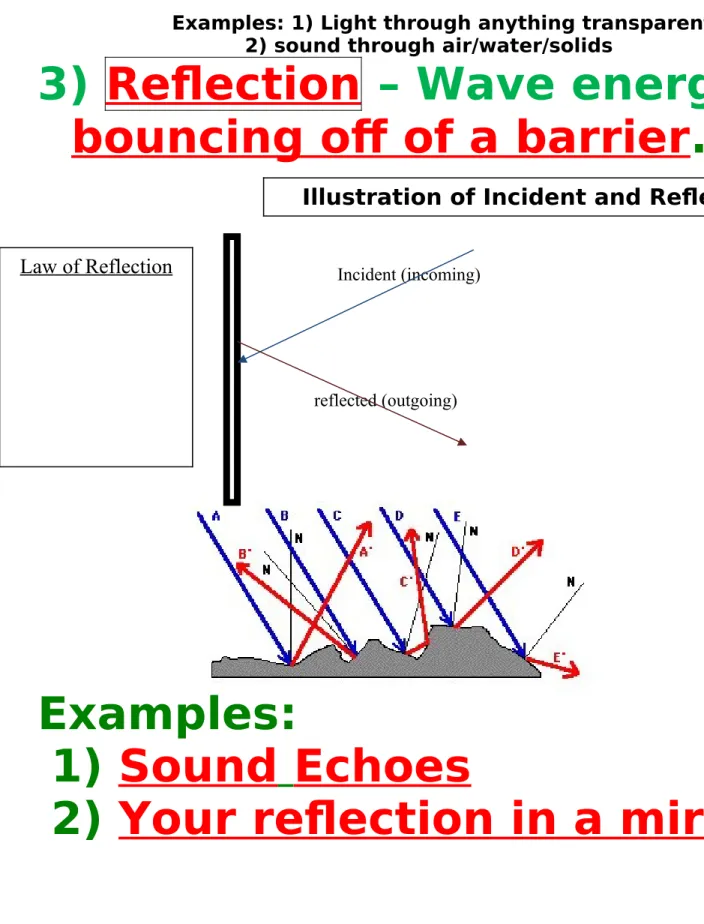
3) Reflection – Wave energy bouncing off of a barrier.
Examples: 1) Echoes 2)Your reflection in a mirror 3) A blue shirt is blue because it reflects blue and absorbs the other
colors.
4) Refraction – Wave energy that passes through a medium will change direction because it changes speed. Examples: 1) Light through a lens 2) “Broken pencil” in water 5) Diffraction – Wave energy bending around a barrier.
Example: Laser light spreading out around a pencil.
6) Interference – What happens when two or more waves arrive at the same time.
Two types: Constructive Interference (multiplies the energy)
and Destructive Interference (negates the energy). (Video: Interference: ..\Waves Video.asx-16:44-18:50)
7) Resonance – The ability of an object to vibrate by absorbing energy from the object’s natural frequency.
(Video: ..\Waves Video.asx - 16:12-16:44) Examples: 1) Resonance boxes
2) The falling bridge video 3) breaking glass with sound
Illustration of Incident and Reflected Rays
..\Bridges - Tacoma Narrows Collapse.mov
(1:30-3:07)
A)
SOUND
1)
Energy that causes the
molecules of a medium to
vibrate. . . is a longitudinal
wave.
(Video: ..\Waves Video.asx - 3:40-6:35)
1) Sound - Energy that causes the molecules of a medium to vibrate.
. . . is a longitudinal wave.
Speed of sound –
depends on the
medium
. . .
Sound in a vacuum (bell jar):
Speed of sound – depends on the medium. . .
sound is faster in most
solids
than in
liquids
and
slowest in
gasses
.
Speed of sound – depends on the medium. . . sound is faster in most solids than in liquids and slowest in gasses.
[Higher density =
slower
speed / Higher elasticity
(restoring force) =
faster
Speed of sound – depends on the medium. . . sound is faster in most solids than in liquids and slowest in gasses.
(Higher density = lower speed / Higher elasticity = faster speed)
In air = about
760 mph
.
Sound in air travels about
0.2
Speed of sound – depends on the medium. . . sound is faster in most solids than in liquids and slowest in gasses.
(Higher density = lower speed / Higher elasticity = faster speed)
In air = about 760 mph. Sound
in air travels about .2 mile per
second.
[So, sound travels
1mile
in 5
seconds]
Speed of sound – depends on the medium. . . sound is faster in most solids than in liquids and slowest in gasses.
(Higher density = lower speed / Higher elasticity = faster speed)
In air = about 760 mph. Sound in air
travels about .2 mile per second.
[So, sound travels 1mile in 5 seconds]
In
water
= about 3,300 mph
In
rock
= about
(Higher density = lower speed / Higher elasticity = faster speed)
In air = about 760 mph.
In water = about 3,300 mph
In rock = about 13,000 mph
2) Properties of sound:
a) Loudness: The intensity
(or loudness) of a sound is
determined by the
Amplitude
Normal resting position 2) Properties of sound:
a) Loudness: The intensity or loudness of a
sound is determined by the Amplitude of
a sound wave
,
OR
how
tall
or
short
the
2) Properties of sound:
a) Loudness: The intensity or loudness of a sound is
determined by the Amplitude of a sound wave, OR how
tall
or short the wave is.a) Loudness: The intensity or loudness of a sound is
determined by the Amplitude of a sound wave, OR how
tall
or short the wave is.- Tall sound waves push hard against your ear drum (and vice versa).
- Loudness is measured in units
called
decibels
.
Loud sound
wave
Soft sound
wave
- Tall sound waves push hard against your ear drum (and vice versa).
- Measured in decibels.
b) Pitch (aka
Frequency
):
The
pitch (high or low) is
determined by how
wide
the
wavelengths
are apart
(which also determines
frequency).
Illustrations of a Sound Wave’s Pitch
b) Pitch: (Frequency)The pitch (high or low) is determined by the how wide or narrow the wavelength is (which also determines frequency).
- Narrow wavelengths (high
pitch) make the eardrum
vibrate
quickly
(and vice
versa).
Human hearing
range = 20 - 20,000
Hz
Bass tests 25- 65 Hz:
http://www.youtube.com/
watch?v=1l79-fPVgkE&feature=related
Low pitch
sound
High pitch
60 – 14,000 Hz:
http://www.youtube.com/watch?
v=FB_V0_wMnGI
Dogs hearing range =
up to 40,000 Hz
c) Octave –
Two times the
c) Octave – Two times the frequency of another note.
B) Wave Interactions – “
how
waves behave
.”
B) Wave Interactions – “how waves behave.”
1)
Absorption
– Wave energy
is
stopped
.
Examples:
For
Light:
B) Wave Interactions – how waves behave. 1) Absorption – Wave energy being stopped.
Example: Black shirt absorbing all visible light.
2) Transmission
– Wave
energy
passing through a
2) Transmission – Wave energy passing through a medium.
Examples:
1)
Light through anything
2) Transmission – Wave energy passing through a medium.
Examples:
1) Light through anything transparent
(clear)
2)
Sound through
Incident (incoming)
reflected (outgoing)
Examples: 1) Light through anything transparent 2) sound through air/water/solids
3)
Reflection
–
Wave energy
bouncing off of a barrier
.
Examples:
1)
Sound
Echoes
2)
Your reflection in a mirror
Illustration of Incident and Reflected Rays
Examples: a) Sound Echoes
b) Your reflection in a mirror
c) A
blue
(or
red
or
green
)
shirt is
blue
because it
reflects
blue
and
absorbs
Examples: 1) Echoes 2)Your reflection in a mirror 3) A blue shirt is blue because it reflects blue and absorbs the other
colors.
4)
Refraction
– Wave energy
that
passes through a
medium
will
change speed
causing it to
change
direction
.
(Video ..\Waves Video.asx from13:37-14:06)
4) Refraction – Wave energy that passes through a medium will change speed causing it to change
speed.
Examples:
1)
Light through a
Examples: 1) Light through a lens 2) “Broken pencil” in water
5)
Diffraction
– Wave energy
bending around a barrier
.
(Video ..\Waves Video.asx from 14:06-14:26)
Diffraction: http://www.youtube.com/watch?v=kH57Di7Sj0c
Example:
Laser light
spreading out around a
pencil
.
5) Diffraction – Wave energy bending around a barrier.
Example: Laser light spreading out around a pencil.
6)
Interference
– What
happens when
two or more
6) Interference – What happens when two or more waves arrive at the same time.
Two types:
Constructive
Interference
(
amplifies
the energy) &
Destructive
Interference
(
cancels
the energy).
Destructive interference: http://www.youtube.com/watch? v=J4qFPComzoo
6) Interference – What happens when two or more waves arrive at the same time.
Two types: Constructive Interference (multiplies the energy) and Destructive Interference (negates the energy).
7) Resonance – The ability of
an object to
vibrate by
absorbing energy
from the
object’s
natural frequency
.
7) Resonance – The ability of an object to vibrate by
absorbing energy from the object’s natural frequency.
(Video: ..\Waves Video.asx - 16:12-16:44)
Examples:
1) ……. pick a few ……..
2) The falling bridge video
3) breaking glass with sound
..\Bridges - Tacoma Narrows Collapse.mov (1:30-3:07)