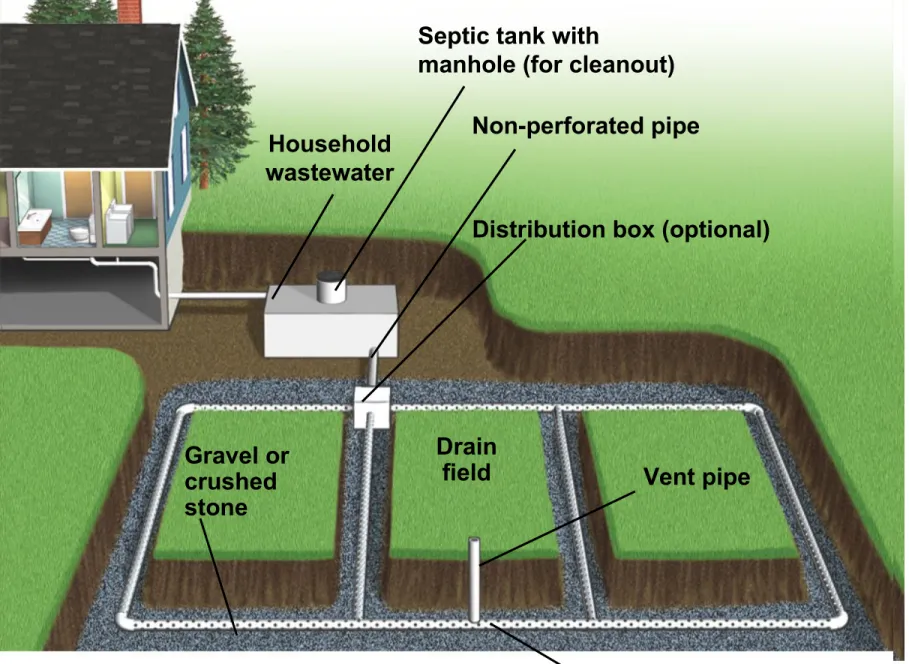
SEPTIC TANKS
Septic tanks are used in areas where there are no combined sewers.
Septic tanks
(cesspools) must be emptied each year. Old tanks can crack and leak coliform bacteria into
Figure 9-28
Page 196
Household wastewater
Perforated pipe Distribution box (optional) Septic tank with
manhole (for cleanout)
Drain
field Vent pipe Non-perforated pipe
SEWAGE TREATMENT
• Sewage treatment
means removing
impurities so that the
remaining waste water
can be safely returned
to the surface waters
(river, bay, ocean) and
become part of the
natural water cycle
again.
• sewage treatment
separates solids from
liquids by physical
PRIMARY TREATMENT
• solids like wood,
paper, rags and
plastic are removed
by screens, washed,
dried and taken
away for safe
disposal at a
licensed waste tip.
Grit and sand, which
would damage
pumps, are also
PRIMARY TREATMENT
SLUDGE TREATMENT
• Sludge is an excellent soil conditioner and is used as a fertilizer on
farmland. However, it needs additional treatment to make it suitable. This treatment is called anaerobic digestion and takes place in large, enclosed tanks. NYC sludge has too many heavy metals (Hg, Pb, Cd, Cu) and may not be used as a soil amendment for food resources in NY State.
• The rate of digestion is increased by heating the sludge to a temperature where naturally occurring bacteria (microorganisms) respond to these
comfortable conditions and feed on other bacteria. On cooling, the well-fed bacteria die off, and the sludge is suitable for use on agricultural land.
• A by-product of the sludge digestion process is methane gas. This can be burned to produce electricity. The electricity can be used to heat more
sludge or to provide heat and light for the treatment works. Sometimes more energy is produced than is required. The surplus is sold to local electric
SECONDARY TREATMENT
• a biological process which relies
on naturally occurring
microorganisms acting to break
down organic material and purify
the liquid.
• In a simple sewage treatment
process, micro-organisms are
encouraged to grow on stones
over which the sewage is trickled.
They feed on the bacteria in the
sewage and purify the water.
These treatment units are called
SECONDARY TREATMENT
• The rate of this process can be increased by
pumping air into tanks of sewage where the aerobic digesters float freely and feed on the bacteria.
These treatment units are called aeration tanks.
• Following either form of secondary treatment, the waste water is settled in tanks to separate the
Raw sewage from sewers Bar screen
Grit
chamber Settling tank Aeration tank Settling tank
Chlorine disinfection tank Sludge Sludge digester Activated sludge Air pump (kills bacteria)
To river, lake, or ocean
Sludge drying bed
Disposed of in landfill or ocean or applied to cropland, pasture, or rangeland
Primary Secondary
TERTIARY TREATMENT
• Extra treatment is
needed to give the waste water a final "polish".
This is known as tertiary
treatment. Various methods may be used, including sand filters, reed beds or grass plots (artificial treatment
wetlands). Disinfection, using ultra violet light to kill bacteria, is another method, and is being used at a number of coastal sewage
Carbon Filtration
There are two principal mechanisms by which activated carbon removes contaminants from water; absorption, and catalytic reduction, a process
involving the attraction of negatively charged
contaminant ions to the positively-charged
activated carbon. Organic compounds are removed by absorption and residual disinfectants such as
Types of organisms Dissolved oxygen (ppm) Biological oxygen demand
Normal clean water organisms (Trout, perch, bass,
mayfly, stonefly)
8 ppm (mg/L)
Trash fish (carp, gar, leeches) Fish absent, fungi, sludge worms, bacteria (anaerobic) Trash fish (carp, gar, leeches)
Normal clean water orga
nisms
(Trout, perch, bass, mayfly, stonefly)
8 ppm
Clean Zone
Decomposition Zone Septic Zone Recovery Zone Clean Zone
POLLUTION FROM SEWAGE
SEWAGE:
•poses a threat to public health because it carries disease-causing agents (cholera bacteria, hepatitis, Eschericia coli (coliform bacteria).
•Causes nutrient-loading (organically-rich) into surface waters.
MONITORING SEWAGE
Standard test for for total coliform
(TCOL) and fecal coliform (FCOL) bacteria. The number of colonies formed are counted.
STANDARDS: (EPA)
1. Drinking Water – 1 coliform bacteria:100 mL of water
DISPOSAL OF SEWAGE
SLUDGE
1. ANAEROBIC DIGESTION – anaerobic bacteria break down organics into methane gas (NH4) and CO2. Methane is trapped and used to heat the digester to 95F.
END PRODUCT = Soil conditioner for gardens (humus).
2. FERTILIZER – sludge is rich in plant nutrients and can be dried (pelletized) and sold as a fertilizer.
WATER POLLUTION
CONTROL LAWS
1988 – Ocean Dumping Ban Act – barred ocean dumping of sewage sludge at the 200 mile marker. All cities were in compliance by 1988 EXCEPT for NYC, who were permitted to dump until June, 1992.