The handle http://hdl.handle.net/1887/20466
holds various files of this Leiden University
dissertation.
Author: Lelieveld, Gert-Jan
Emotions in negotiations
The role of communicated anger and
disappointment
Cover Design: Saskia de Been
Emotions in Negotiations:
The role of communicated anger and disappointment
PROEFSCHRIFT
ter verkrijging van
de graad van Doctor aan de Universiteit Leiden,
op gezag van de Rector Magnificus prof. Mr. P. F. van der Heijden,
volgens besluit van het College voor Promoties
te verdedigen op dinsdag 29 januari 2013
klokke 13:45
door
Gert-Jan Lelieveld
geboren op 25 juli 1984
Promotiecommissie:
Promotores:
Prof. Dr. E. van Dijk
Universiteit Leiden
Prof. Dr. I. van Beest
Universiteit van Tilburg
Co-promotor:
Prof. Dr. G. A. van Kleef
Universiteit van Amsterdam
Overige leden:
Prof. Dr. C. K. W. de Dreu
Universiteit van Amsterdam
Prof. Dr. N. Ellemers
Universiteit Leiden
Contents
Chapter 1
General Introduction
7
Chapter 2
Affective reactions to anger and disappointment
25
Experiment 2.1
30
Experiment 2.2
39
Chapter 3
Behavioral and neural reactions to emotions of
others
51
Experiment 3.1
54
Chapter 4
Disappointed in you, angry about your offer
67
Experiment 4.1
70
Experiment 4.2
74
Chapter 5
When communicating disappointment helps and
hurts
87
Experiment 5.1
93
Experiment 5.2
101
Experiment 5.3
107
Chapter 6
General Discussion
119
References
135
Samenvatting (Summary in Dutch)
155
Summary in English
161
Dankwoord
165
Curriculum Vitae
167
Chapter 1
Chapter 1
No childhood passes without being reprimanded by parents for things done
wrong. We all know what it felt like when one of our parents was angry about something we did. Also, hardly anyone is a stranger to what a disappointed parent feels like. Often people feel worse after their parents say they are disappointed in them, than after they
express anger. You might remember the thought of sitting across the kitchen table from your parents, hearing your parents say that they are not angry with you, but “just”
disappointed. That they expected more from you and that you are capable of so much more. Indeed, the expression “I am not angry with you, I’m just disappointed” is often used to make people feel bad about what they have done, in hopes of changing their behavior.
But is it true that communicating disappointment is better than communicating anger when you desire behavioral change in others? And if so, why is this the case? This dissertation answers these questions, by pitting the interpersonal effects of anger against
the interpersonal effects of disappointment. Anger and disappointment may on the one hand elicit behavioral change in others in favor of the expresser of the emotion. On the
other hand, anger and disappointment may also elicit a tendency in others to act in a self-interested manner, which may lead them to continue their current course of action. This dissertation will demonstrate why and under what conditions the communication of anger
and disappointment is advantageous or detrimental. The studies are situated within competitive bargaining contexts, because such contexts are ideal for investigating how and
why communicating anger and disappointment affect interpersonal outcomes.
The social functions of emotions
Although the purpose of the present dissertation is to investigate the effects of
communicated emotions, it may first be relevant to understand what constitutes an emotion. Unfortunately, there is no conclusive answer to this question. Although research has made progress in trying to conceptualize emotions, there is still no definition that
every emotion researcher would agree on. Most theorists hold that emotions are the result of an evaluation (an appraisal) of some event relevant to a particular concern or goal (Frijda, 1986). These evaluations can be positive or negative. Emotional phenomena are
describe evaluative feelings, such as feeling good or bad (Parkinson, Totterdell, Briner, &
Reynolds, 1996). These subjective feelings may include moods or emotions. Emotions differ from moods in that they are always about something, whereas moods “simply are” (Frijda, 1994). Emotions are directed toward a specific person, object or event, whereas moods are
less specific. Moods are also often less intense and longer lasting than emotions are (Ekman, 1984). Furthermore, emotions are characterized by distinct subjective experiences, physiological reactions, and action tendencies (Ekman, 1993; Levenson,
Ekman, & Friesen, 1990; Parkinson, Fischer & Manstead, 2005). Discrete emotions are therefore often more informative than diffuse moods, both to the individual experiencing
them and to observers.
Until recently, emotions were regarded as detrimental or disruptive forces that interfere with rational making, instead of as social tools that facilitate
decision-making. It was better to suppress your emotions, and keep a poker face during social interactions with others than to let your emotions influence your own or others’ behavior. Increasingly, however, this thought has made way for a functional approach to emotions
(Frijda, 1986). This approach emphasizes that emotions are not just distractions, but instrumental means that help prioritize goals and prepare individuals to respond to
changes in the environment (Keltner & Haidt, 1999; Van Kleef, De Dreu, & Manstead, 2010).
Most emotion research has focused on the intrapersonal effects of emotions. This
research has focused on the functions of emotions for one’s own thoughts, behavior and intentions. Examples of questions that have been answered in this area of research are
how one’s feelings of envy affect product evaluation (Van de Ven, Zeelenberg, & Pieters, 2010), whether angry bargainers are more competitive in negotiations than happy bargainers (Forgas, 1998), and how fear influences judgments of certainty and risk (Lerner
& Keltner, 2001). Many of these intrapersonal effects of emotions may involve social situations.
In this dissertation, I take a different approach by not only considering the effects of emotions in a social context, but actually investigating how emotions affect other people. In this dissertation, I investigate the social functions of emotions. According to
can have consequences for the behavior of the receiver of the emotion. Besides having an
impact on one’s own behavior, thoughts, and feelings, emotions may thus also have
interpersonal effects, such that the communication of emotions may affect others’
behavior, thoughts, intentions, and/or feelings.
To enhance understanding of these interpersonal effects of emotions, I draw on the Emotion as Social Information (EASI) model by Van Kleef et al. (2010) (see also Van Kleef, 2009; Van Kleef, Van Doorn, Heerdink, & Koning, 2011). The EASI model extends the
general notion that emotions affect others’ behavior and intentions, by specifying two processes through which emotions may influence the behavior of others. Emotions affect
others not only by providing relevant information about the intentions and/or feelings of the sender (the inferential path of the model), but also by affecting the emotions of others (the affective path of the model).
First, as noted above, expressed emotions may have informational value. Different emotions arise in response to different situations and different behaviors of others (Frijda, 1986; Lazarus, 1991). Discrete emotions thus communicate different information to
observers. Happiness, for instance, may signal that one is happy with the current situation, which may lead others to continue their current course of action. Similarly, sadness signals
a loss, which may lead others to offer help. In a classic demonstration of these inferential processes (Sorce, Emde, Campos, & Klinnert, 1985), infants had to decide whether or not to cross a visual cliff to reach a toy. On the other side of the cliff, their mother either
expressed fear or anger, or joy or interest. Results revealed that infants were more likely to cross the visual cliff when their mother was showing a positive emotion (joy or interest),
compared to when their mother showed a negative emotion (fear or anger).
Besides this informational value of emotions, emotions may also wield interpersonal influence by eliciting affective reactions in others (Barsade, 2002; Dimberg &
Öhman, 1996; Friedman et al., 2004; Lelieveld, Van Dijk, Van Beest, & Van Kleef, 2012; Van Kleef et al., 2010), which can influence subsequent behavior. Displays of contempt, for
instance, evoke shame in others (Gilbert & Andrews, 1998), which may elicit withdraw or avoidance behavior. Similarly, anger has been shown to evoke fear in others (Dimberg & Öhman, 1996), which may elicit a tendency to avoid the angry person. One way emotions
emotions spread directly from expresser to observer via processes of mimicry and afferent
feedback. A person’s happiness, for instance, can be “caught”, which leads others to become happy themselves. Emotions can also influence others’ behavior by eliciting complementary emotions in them, which may influence subsequent behavior (Van Kleef et
al., 2008). In this situation a person’s emotions evoke different but corresponding emotions in others (Van Kleef et al., 2008). Displays of anger, for instance, can elicit fear-related responses (Dimberg & Öhman, 1996). In Chapter 2, I will return to this issue by
explaining how and when emotions (i.e., anger and disappointment) may affect others’ behavior via emotional reciprocity and how and when emotions may affect others’
behavior via emotional complementarity.
The EASI model converges with other social functional approaches to emotion when it comes to the notion that the interpersonal effects of emotions cannot be explained
simply in terms of their valence (i.e., whether the emotional expression is positive or negative). They should instead be understood in terms of the unique social information that they convey. The findings in this dissertation are in correspondence with the EASI
model, because I focus on inferential as well as affective reactions to emotions of others, and I show that anger and disappointment (two negative emotions) have specific and
distinct effects on others. The findings in this dissertation can, however, also be seen as an extension of the EASI model, by 1) showing that this difference between inferential and affective processes is not always that clear (Chapter 2 and 4), by 2) focusing on the
underlying neural mechanisms of the interpersonal effects of emotions (Chapter 3), and by 3) solving an apparent inconsistency that exists in social functional analyses of emotions
(Chapter 5).
As noted above, I situate my studies within bargaining contexts. These contexts are perfect to study the interpersonal effects of emotions, because they lend themselves to
different responses to different emotions. That is, negotiation settings are mixed-motive, such that people in these situations can cooperate to receive high joint outcomes, but also
compete to satisfy personal concerns (Schelling, 1960). Emotion displays can play an important role in bargainers’ decisions to either cooperate or compete. Secondly, in negotiations both parties are highly dependent on one another for their outcomes. Specific
(Van Kleef, De Dreu, & Manstead, 2004a, b). Finally, negotiation settings are perfect
settings to vary relational and situational aspects that may influence how emotional expressions affect others. The interpersonal effects of emotions may be dependent on the relation between the expresser and the observer of the emotion. For instance, an
emotional expression from an in-group member may have different effects on one’s behavior than an emotional expression from an out-group member (see Chapter 5). Situational aspects may also determine how a communicated emotion affects others. For
instance, whether the target of an emotional expression negotiates for his/herself or for a constituency may determine whether an emotional expression elicits positive or negative
outcomes (see Chapter 5). Negotiation settings allow researchers to vary those relational and situational aspects quite easily, while at the same time keeping experimental control. For these reasons, the studies reported in this dissertation are situated in bargaining
contexts. Now, I will first review relevant literature on the effects of emotions in negotiations.
Emotions in negotiations
A negotiation is “a discussion between two or more parties with the apparent aim of resolving a divergence of interests” (Pruitt & Carnevale, 1993, p. 2). It is often a heated
and highly emotional process. In the last decades, researchers have indeed shown that emotions play a significant role in negotiations.
Intrapersonal effects of emotions
Initially, research in this area focused on the intrapersonal effects of emotions.
Most of these studies found that bargainers experiencing negative emotions tend to act more competitively (with exceptions, see Ketelaar & Au, 2003), whereas bargainers experiencing positive emotions tend to act more cooperatively.
One of the first studies on the role of affect in negotiations focused on the effects of positive affect (Carnevale & Isen, 1986). Subjects in this study negotiated as buyers and
sellers of appliances, and positive affect was either induced or not. Positive affect was induced by instructing participants to sort funny cartoons in two piles. The findings showed that positive affect reduced contentious tactics and increased joint benefit.
(Baron, 1990) and cooperative negotiation strategies (Baron, Fortin, Frei, Hauver, & Shack,
1990).
Later work on the effects of negative affect has shown different yet compatible results regarding the effects of negative emotions. Allred, Mallozzi, Matsui, and Raia (1997)
examined the effects of feeling angry and feeling compassion. Their participants performed a computer-mediated negotiation and negotiated about four different issues. Results showed that experiencing high levels of anger and low levels of compassion posed several
disadvantages. Angry participants had less desire to work with their opponent in the future, achieved fewer joint gains and were more competitive. Other work also showed
that negative affect decreases initial offers (Baron et al., 1990) and increases rejection of ultimatum offers (Pillutla & Murnighan, 1996).
One set of studies directly compared the experience of positive and negative affect
in negotiations, and showed compatible results (Forgas, 1998). Subjects either learned that they had performed well on a test (which induced positive affect), or poorly (which induced negative affect). In both interpersonal and intergroup negotiations, negative affect
led people to become more competitive, whereas positive affect led people to adopt a more cooperative bargaining strategy.
Positive emotions thus seem to have a more beneficial influence on the bargaining process than negative emotions. However, as noted above, it is also important to look beyond valence and study the effects of discrete emotions in negotiations. Recently,
research has started to compare the effects of different negative emotions in negotiations. Nelissen, Leliveld, Van Dijk, and Zeelenberg (2011) compared the effects of the experience
of fear and guilt. They found that both emotions led people to offer more, but for different reasons. Fearful bargainers made higher offers to avoid rejection, whereas guilty people made higher offers because they were concerned with their opponent’s outcomes (see also
De Hooge, Zeelenberg, & Breugelmans, 2007; Ketelaar & Au, 2003).
Another set of recent studies compared the effects of disappointment and regret in
a bargaining game. Regret and disappointment were either induced by autobiographical recall or by imagined scenarios. Results showed that regret increased offers in a bargaining game, whereas disappointment caused bargainers to make less generous offers (Martinez,
Zeelenberg, & Rijsman, 2011).
experience of specific emotions differentially affects one’s bargaining behavior. Although
initial evidence showed that negative emotions lead bargainers to act more competitively, later research investigating discrete emotions showed that not all negative emotions have similar effects on people. As we shall see below, there has only recently been a shift in the
literature from only addressing the intrapersonal effects of emotions in negotiations, to also studying the interpersonal effects of emotions.
Interpersonal effects of emotions
Research on the interpersonal effects of emotions in negotiation began with a series of studies by Van Kleef et al. (2004a). Participants in their studies bargained with simulated opponents in a computer mediated negotiation. In several rounds of offers and
counteroffers, participants received either angry or happy emotional expressions from their opponent. Negotiators with a happy opponent inferred that their opponent was lenient and easy to get. This led participants to make little concessions. Angry emotional
expressions, however, signaled toughness and high limits. When a bargainer is perceived to have high limits, opponents do not expect that he/she will give in much during the
negotiation. This may lead opponents to give in themselves, to not let the negotiation end in impasse. Indeed, Van Kleef et al. (2004a) showed that participants who were faced with angry bargainers made higher concessions than participants who were faced with a
neutral or happy bargainer. This first study thus showed that it is better to express anger than to express happiness in a negotiation. In line with the inferential path of the EASI
model, bargainers used the information that anger and happiness conveyed as input for their decisions.
Later, the same authors (Van Kleef et al., 2004b) provided more direct support for
this notion. In three studies they showed that participants were only affected by the information that anger and happiness conveyed if they were motivated to consider the information. Participants negotiated in the same negotiation paradigm as in Van Kleef et al.
(2004a). The authors showed that when participants had a low need for cognitive closure, a lot of time to make their decisions, and low power (all indicators of a high motivation/ability to process information), they used the information that anger and
happiness conveyed as input for their decisions. This led participants to concede more to angry than to happy bargainers. However, when participants had a high need for cognitive
motivation/ability to process information), they were less affected by the information that
the emotions conveyed.
In line with findings by Van Kleef et al (2004a, b), Sinaceur and Tiedens (2006) showed that communicating anger elicited higher offers than not communicating any
emotion. In a scenario study and a face-to-face negotiation study where one participant was trained to communicate anger, the authors manipulated whether participants had poor alternatives or good alternatives. They showed that participants gave in more to
angry opponents than to opponents not communicating any emotion, but only when they had poor alternatives. This was explained by the finding that anger signals toughness.
When bargainers have poor alternatives, they have to give in to their tough negotiator, to avoid impasse.
This first line of studies thus showed that communicating emotions may affect the
bargaining behavior of opponents. However, as I have stressed before, it is important to consider the effects of specific emotions and to not only investigate emotions that differ in valence, such as anger and happiness. Few studies have considered the interpersonal
effects of different negative or different positive emotions in negotiations. One study that did investigate the interpersonal effects of different negative emotions, compared the
effects of the appeasement emotions guilt and regret with the effects of the supplication emotions disappointment and worry (Van Kleef, De Dreu, & Manstead, 2006a). Appeasement emotions may arise when bargainers claim too much in a negotiation, and
are subsequently willing to compensate for that. This may lead opponents to stand firm and act competitively. Supplication emotions, on the other hand, serve as a call for help,
which may elicit support. The authors indeed showed that when participants faced an opponent that communicated appeasement emotions, they made low offers. However, when participants faced an opponent that communicated supplication emotions,
participants made more generous offers.
This work was an important first step in investigating the interpersonal effects of
different negative emotions in negotiations. It showed that it is important to look beyond the valence of an emotion to see how it affects others, and treat each emotion as a distinct predictor of behavior in negotiations. Based on this work and previous work that also
dissertation focuses on comparing the interpersonal effects of discrete negative emotions.
More specifically, I focus on the two negative emotions anger and disappointment.
Anger and disappointment
This dissertation specifically focuses on anger and disappointment, because they
are two of the most often communicated emotions (Van Dijk & Zeelenberg, 2002b). From a practical perspective it is thus highly relevant to study the effects of the communication of these emotions. From a theoretical perspective it is also relevant to study the interpersonal
effects of these two emotions. Anger and disappointment are both emotions that are reactions to undesirable behavior of others, and at the same time desire behavioral change
of others (Van Dijk & Zeelenberg, 2002b). The goal of communicating both emotions is thus to change the behavior of others. Because anger and disappointment have the goal to influence others and change others’ behavior, it is important to investigate how these two
emotions operate and under which conditions they achieve that goal. At first site, anger and disappointment are two very similar emotions. Both emotions are negative and are
reactions to undesirable outcomes (Frijda, Kuipers, & Ter Schure, 1989). However, when taking a closer look, both emotions are very distinct in terms of their underlying appraisal patterns (Frijda et al., 1989). Below I will review previous literature that shows how these
two negative emotions differ from each other. First, I will discuss the emotion anger, including its intra- and interpersonal effects and then the emotion disappointment with its intra- and interpersonal effects.
What do we know about anger?
Anger arises when a person’s goals are frustrated (Berkowitz, 1993; Carver & Harmon-Jones, 2009; Dollard, Doob, Miller, Mowrer, & Sears, 1939; Lewis, Alessandri, & Sullivan, 1990). It can be caused by the absence of a positive outcome, as well as by the
presence of a negative outcome (Van Dijk, Zeelenberg, & Van der Pligt, 1999). Anger mostly arises when others are blamed for the goal blockage (Roseman, Antoniou, & Jose, 1996). It
may, for instance, arise in an individual when he/she is intentionally hurt by another person.
With regard to the intrapersonal effects of anger, research has shown that it is
an emotion that elicits approach tendencies (Carver & Harmon-Jones, 2009; Harmon-Jones,
2004) and feelings of control (Roseman et al., 1996). As I noted above, in negotiations feelings of anger fuel competitiveness. Moreover, anger has been shown to increase the rejection of offers (Pillutla & Murnighan, 1996) and to decrease joint gains and the desire
to work together in the future (Allred et al., 1997).
Research on the interpersonal effects of anger, has shown that anger communicates power (Tiedens, 2001). Angry individuals are perceived to have a higher
status and a higher salary than individuals expressing other negative emotions, such as sadness. Furthermore, whereas the first series of studies by Van Kleef and colleagues on
the interpersonal effects of anger showed that communicating anger pays in negotiations, because it signals toughness and high limits, later research has shown that anger may also backfire. When anger is communicated by a low-power negotiator (Van Dijk, Van Kleef,
Steinel, & Van Beest, 2008; Van Kleef, De Dreu, Pietroni, & Manstead, 2006b), anger elicits less generous offers. Similarly, Van Kleef and Côté (2007) showed that when anger is communicated in an inappropriate manner, it may backfire. The authors showed that when
there is no norm prohibiting the expression of anger (i.e., when anger is communicated appropriately), anger elicits high offers from others. However, when there is a norm
prohibiting expressions of anger (i.e., when it is communicated inappropriately), anger elicits low offers because inappropriate expressions of anger elicit negative affective reactions and retaliatory tendencies. Moreover, a study on multiparty negotiations showed
that angry bargainers are often excluded from coalitions because expressions of anger undermine liking (Van Beest, Van Kleef, & Van Dijk, 2008). The authors showed that
communicating anger only elicited high offers in targets in the rare occasion that targets chose to form a coalition with the angry bargainer or when they had no other choice than to form a coalition with the angry opponent. In short, expressions of anger can have
positive effects in bargaining situations because they signal power, toughness, and ambitious limits, but they may also backfire because they elicit negative affective reactions
and retaliatory responses from targets.
What do we know about disappointment?
Disappointment arises when progress towards a goal is below expectations (Carver & Scheier, 1990; Van Kleef & Van Lange, 2008) and/or when a desired outcome is
the presence of a negative outcome, and more by an absence of a positive outcome (Van
Dijk et al., 1999). It involves feelings of powerlessness, a tendency to turn away from an event, and wanting to do nothing (Zeelenberg, Van Dijk, Manstead, & Van der Pligt, 1998a). Van Dijk and Zeelenberg (2002a, b) also showed that disappointment is associated with
appraisals of unexpectedness, wanting something pleasurable, and thinking that one was morally right. According to disappointment theory (Loomes & Sugden, 1986), before people make a decision, they are able to anticipate their post-decisional disappointment.
This anticipated disappointment is taken into account when people make decisions (see also Zeelenberg et al., 1998b). Disappointment is thus associated with the process of
counterfactual thinking (i.e., people compare the actual situation to the “what could have been” situation; Roese, 1997).
With regard to the intrapersonal effects of disappointment, research has focused
on the effect of the experience of disappointment on people’s behavior in the trust game (Tzieropoulos, Grave de Peralta, Bossaerts, & Gonzalez Andino, 2011). The results showed that the experience of disappointment led individuals to trust the other person less and to
expect less from the other person. Also, as noted above, one study investigating the effects of disappointment in negotiations showed that the experience of disappointment
decreases prosocial behavior and increases competitiveness (Martinez et al., 2011). In line with disappointment theory, Van Dijk, Zeelenberg, and Van der Pligt (2003) demonstrated that people’s behavior is also affected by the anticipation of disappointment. They showed
that, to regulate disappointment, people lowered their expectations about obtaining a certain outcome on a test. However, people only did this when the test was self-relevant
(and not when it was only relevant for other people) and when they received feedback on the test immediately (instead of after a delay).
It is disappointing how little is known about the interpersonal effects of
disappointment. Research on the interpersonal effects of disappointment in social dilemma’s has shown that communicating disappointment increases cooperation in others
(Wubben, De Cremer, & Van Dijk, 2009). Disappointed individuals were perceived as forgiving, and the targets of disappointment were not only cooperative in the first interaction, but this also carried over to future cooperative decisions with the same
supplication emotions (including disappointment) elicit generous offers from opponents
(Van Kleef et al., 2006a). Van Kleef and Van Lange (2008) demonstrated that people do so to satisfy the disappointed person’s needs.
There are thus indications that, although anger and disappointment have some
similarities, these two emotions have distinct effects. Little, however, is known about the underlying mechanisms responsible for the differential effects of anger and disappointment. In this dissertation, I compare the interpersonal effects of anger and
disappointment in negotiations, and show that in certain situations they affect the behavior of opponents in the same way - but via different mechanisms - and in certain
situations they affect the behavior of opponents in different or even opposite ways. I investigate the underlying mechanisms in terms of behavior (Chapters 2, 4, and 5), but also in terms of brain activation (Chapter 3). That is, besides showing that expressions of anger
and disappointment influence others by providing information and/or evoking emotions in others, I also show that they activate different brain regions in others.
fMRI research on emotions and negotiation
Research on the interpersonal effects of emotions has focused primarily on the affective, cognitive, and behavioral effects of communicated emotions. Moreover,
investigations of the underlying mechanisms that explain why targets of communicated emotions show certain behavior have relied only on self-reported perceptions, thoughts, emotions, and/or motivations. Although such self-report measures are good predictors of
behavior, they are only a proxy of how people really experience emotions of others. First of all, self-report measures may sometimes suffer from social desirability issues, so that participants may not report their true thoughts, emotions, and/or motivations correctly
because they give socially desirable answers. Second, self-reports are not assessed during emotional expressions of others, but instead afterwards.
To reduce social desirability and to measure people’s responses during the emotional expressions, I turn to functional magnetic resonance imaging (fMRI). fMRI is a procedure that looks at blood flow in the brain to detect areas of activity. When there is
processing as it unfolds over time, and it enables researchers to investigate the underlying
neural mechanisms that are associated with observable behavior.
Another important contribution of fMRI is that it can show that there are processes that rely on the same underlying neural systems, which cannot be identified
based on behavioral data. Eisenberger, Lieberman, and Williams (2003), for instance, showed that the social pain associated with being socially excluded produces activity in a similar network of brain regions as the experience of physical pain (see also DeWall et al.,
2010; Lelieveld, Gunther Moor, Crone, Karremans, & Van Beest, 2012; Peyron, Laurent, & Garcia-Larrea, 2000). In this dissertation I did not only use fMRI to investigate differences
between the interpersonal effects of anger and disappointment, I also used the technique to investigate whether the effects of the two emotions also rely on similar underlying processes. The latter was done by comparing the effects of anger and disappointment to
the effects of a positive emotion: happiness. For these reasons, in Chapter 3, I use fMRI to investigate the underlying neural mechanisms of the interpersonal effects of anger and disappointment.
In this dissertation, I focus on the communication of anger and disappointment within a social context. Although previous work does focus on how the emotions of other
people activate different brain regions, they tend to lack social context (Fischer & Van Kleef, 2010). Prior neuroimaging studies on emotion communication have mainly focused on the understanding of the neural mechanisms that support the processing of emotional
faces (for an overview see Fusar-Poli et al., 2009; Sabatinelli et al., 2011; Vuilleumier, & Pourtois, 2007; Wager, Luan Phan, Liberzon, & Taylor, 2003). These studies have reported
activation of the amygdala when individuals view emotional facial expressions, mostly in the case of negative emotions such as fear and anger (Breiter et al., 1996; Hariri, Tessitore, Mattay, Fera, & Weinberger, 2002; Morris et al., 1996; Sato, Yoshikawa, Kochiyama, &
Matsumura, 2004). These findings are very interesting and add to the literature of the interpersonal effects of emotions. However, to discover how our brains and our behavior
are affected by others it is important to create a social context, where emotions are communicated based on earlier behavior within that social context.
Emotions play a pivotal role in negotiations, but few neuroimaging studies have
These studies, for instance, showed that receiving unfair proposals is associated with
increased activation in the insula, anterior cingulate cortex (ACC) and dorsolateral prefrontal cortex (DLPFC) (see Rilling & Sanfey, 2011; Sanfey, 2007 for reviews). It is unclear, however, how this relates to specific emotions like anger and disappointment.
Taken together, previous neuroimaging studies have either focused on the communication of emotions without taking the social context into account, or on negotiation behavior in economic games, without taking communicated emotions into
account. In Chapter 3 of this dissertation, I aim to fill this gap in the literature by investigating how the communication of anger and disappointment differentially affects
opponent’s behavior and whether this is associated with activation in different brain networks in a bargaining setting.
Overview of the present dissertation
In the present dissertation, studies are reported that were designed to investigate the interpersonal behavioral and neural effects of anger and disappointment in negotiation
settings. The four chapters are based on individual papers that have been published or have been submitted for publication. Each chapter can therefore be read separately. The consequence is that there may exist some overlap between the chapters.
The first empirical chapter (Chapter 2) focuses on the affective reactions to anger and disappointment in negotiations. Whereas previous research focused mainly on the information that anger and disappointment communicate to others, the studies reported in
Chapter 2 investigate which emotions are evoked by anger and disappointment and how these evoked emotions predict subsequent behavior. Anger and disappointment can evoke reciprocal emotions (i.e., anger can evoke anger in others, and disappointment can evoke
disappointment), but they can also evoke different, but corresponding emotions (i.e., complementary emotions) in others (see Van Kleef et al., 2008). In Chapter 2, the findings
show that power is a key determinant of whether reciprocal or complementary emotions are evoked. As described earlier, previous research has shown that anger may backfire when it is communicated by a low-power bargainer (Van Dijk et al., 2008; Van Kleef et al.,
2006b). In Chapter 2, the power position of the person expressing anger or disappointment is manipulated in an ultimatum bargaining setting. The findings indeed show that power is a crucial determinant of whether the communication of anger pays or
targets when it is communicated by a high-power bargainer, but it evokes a reciprocal
emotion (anger) when communicated by a low-power bargainer. The reciprocal anger leads targets to offer less, whereas the complementary fear leads targets to offer more. The effects of disappointment, on the other hand, are not dependent on the expresser’s power
position. The findings show that disappointment evokes guilt in opponents, which leads these opponents to offer more. Communicating disappointment may thus be more advisable than communicating anger, because anger only elicits high offers when it is
communicated by high-power bargainers, whereas disappointment elicits high offers when communicated by high- as well as low-power bargainers.
In line with the findings of Chapter 2, the results of Chapter 3 show that it is better to communicate disappointment than to communicate anger in a negotiation setting. In Chapter 3, the neural mechanisms involved in the interpersonal effects of anger and
disappointment are investigated and compared to the interpersonal effects of happiness. Whereas previous research focused only on the neural mechanisms associated with emotions without a social context, or on bargaining settings without having any
information about opponents or their emotions, Chapter 3 combines these lines of research and focuses on the effects of communicated emotions in a bargaining setting.
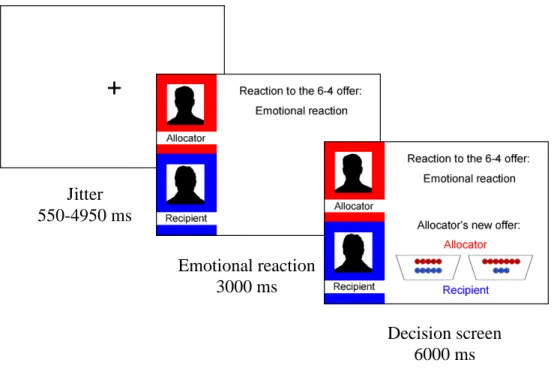
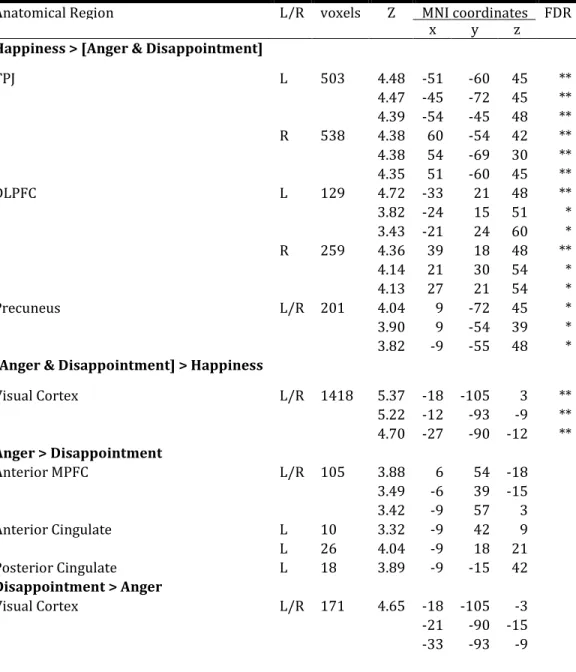
First, the effects of valence are investigated by comparing the neural regions associated with receiving negative emotional reactions (i.e., anger and disappointment) to neural regions associated with a receiving positive emotional reactions (happiness). Furthermore,
Chapter 3 zooms in on the different negative emotions, to see whether anger and disappointment affect other’s brain regions differently. The results show that anger elicits
more self-serving offers in opponents than happiness or disappointment. When comparing the positive emotion happiness to the negative emotions anger and disappointment, results show increased activation in regions associated with perspective taking (the
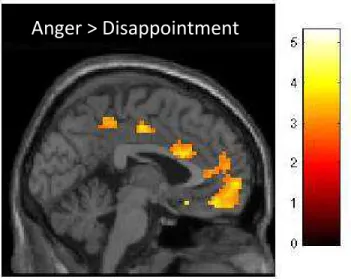
temporoparietal junction). When zooming in on the two negative emotions, findings show that compared to disappointment, expressions of anger increase activation in regions
associated with self-referential thinking (i.e., thinking about others’ actions in terms of how these can affect the self) and (emotional) conflict. These regions are the anterior medial prefrontal cortex and the ACC.
pays or not, may critically depend on how the emotion is communicated. Previous
behavior has, for instance, shown that communicating anger inappropriately may backfire and result in lower offers (Van Kleef & Côté, 2007). In Chapter 4, it is proposed that behavioral effects are dependent on the target of the emotion, that is, whether emotions
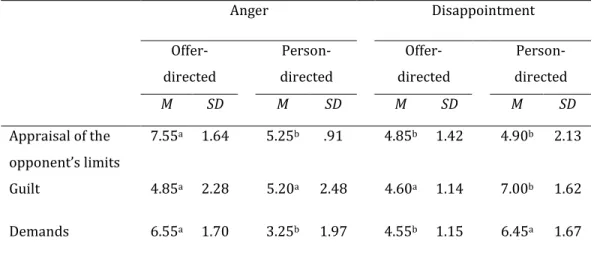
are directed at the offer or the person. Results show that the two negative emotions anger and disappointment have opposing effects in negotiations: anger pays when it is directed at the offer, but disappointment pays when it is directed at the person. Offer-directed
anger elicits higher offers than person-directed anger, because people infer higher limits from opponents who communicate offer-directed anger. Person-directed disappointment
elicits higher offers in others than offer-directed disappointment, because it evokes higher feelings of guilt.
Finally, Chapter 5 combines the research of the first three empirical chapters, by
showing why and under what conditions communicating disappointment pays and backfires. One of the most striking differences between the intrapersonal effects of anger and disappointment is the level of experienced power associated with each emotion. As
noted above, previous research has shown that whereas anger is associated with feelings of power (e.g., Roseman et al., 1996), disappointment is associated with feelings of
weakness and powerlessness (Van Dijk and Zeelenberg, 2002a, b; Zeelenberg, Van Dijk, Manstead, & Van der Pligt, 1998a). The findings of Chapter 5 show that disappointment also communicates weakness to others. The results of three experiments demonstrate that
the interpersonal effects of disappointment depend highly on 1) whether the expresser is an in- or an out-group member, and 2) the type of negotiation (i.e., whether it is an
individual versus a representative negotiation), because these factors determine whether expressions of disappointment elicit feelings of guilt in targets. When disappointment does not evoke guilt (i.e., when the expresser is an out-group member or in representative
negotiations), the communicated weakness elicits a tendency to act in a self-interested way. When disappointment does evoke guilt (i.e., when the expresser is an in-group
member or in individual negotiations), the weakness that disappointment communicates elicits a tendency to act pro-socially. These findings resolve the question of why and under what conditions communicating disappointment backfires and extend the literature on
communicated power/weakness.
social functional accounts of emotions. Furthermore, I discuss the general implications of
Chapter 2
Affective reactions to anger
and disappointment
This chapter is based on: Lelieveld, G. -J., Van Dijk, E., Van Beest, I., & Van Kleef, G. A. (2012). Why anger and disappointment affect other’s bargaining behavior differently: The
Chapter 2
When making decisions we are often dependent on others. Conflicts that arise in
such situations are often resolved by negotiation, “a discussion between two or more parties with the apparent aim of resolving a divergence of interests” (Pruitt & Carnevale, 1993, p.2). This definition, however, does not capture the fact that negotiations are often
highly emotional. In this article, we examine how negotiators respond to their opponent’s emotions. We focus on the effects of two common emotions in negotiation, anger and
disappointment (Van Dijk & Zeelenberg, 2002b), and examine how angry versus disappointed reactions shape a target’s negotiation behavior by eliciting reciprocal and/or complementary emotions.
The social functions of emotions
Emotions have long been regarded as disruptive forces that interfere with rational
decision-making. Increasingly, researchers have come to acknowledge the functional aspects of emotions (Van Kleef, De Dreu, & Manstead, 2010). According to social-functional perspectives (Keltner & Haidt, 1999; Morris & Keltner, 2000; Parkinson, 1996; Van Kleef et
al., 2010), emotions contain crucial information about feelings and intentions of the expresser, which can have behavioral consequences for observers. Moreover, emotion displays can evoke complementary or reciprocal emotions in others that help to respond to
social events (Keltner & Haidt, 1999; Van Kleef, De Dreu, & Manstead, 2004a). Emotions may thus affect others via two processes: by providing information that others may use as input to their decisions and by eliciting affective reactions (Van Kleef et al., 2010).
Previous research on negotiations has focused mainly on how bargainers make informational inferences following opponents’ emotions. Although anger and
disappointment are both reactions to undesirable outcomes, they communicate different information (Bell, 1985; Frijda, Kuipers, & Ter Schure, 1989; Van Dijk & Zeelenberg, 2002b). Earlier findings showed that because angry bargainers are seen as tough
negative consequences (e.g., conflict escalation), which may lead them to concede to avoid
impasse.
Disappointment, on the other hand, is thought to have a “supplication” function (Van Kleef, De Dreu, & Manstead, 2006a). Supplication emotions serve as a call for help
(Clark et al., 1996; Timmers, Fischer, & Manstead, 1998). Previous research found that negotiators with disappointed opponents inferred that the other had received too little (Van Kleef & Van Lange, 2008) and was hoping for more (Thompson, Valley, & Kramer,
1995). Consequently, disappointment led opponents to make concessions to satisfy the other’s needs.
Affective reactions towards anger and disappointment
In addition to the informational value of anger and disappointment, emotional expressions can also wield interpersonal influence by eliciting affective reactions in
observers (Barsade, 2002; Dimberg & Öhman, 1996; Friedman et al., 2004; Van Kleef et al., 2010). The anger or disappointment communicated by opponents may elicit emotions in
negotiators that subsequently influence their negotiation behavior. In the current article, we set out to investigate this affective link. We argue that emotional reactions may influence negotiators’ emotions and subsequent behavior in two ways: via emotional
reciprocity and/or via emotional complementarity.
Emotional reciprocity refers to the process by which one individual comes to feel
the emotions of another (e.g., via emotional convergence or emotional contagion; see
Hatfield, Cacioppo, & Rapson, 1994; Hess & Blairy, 2001). In the current context emotional reciprocity means that if one negotiator is angry, the other negotiator comes to experience anger as well. Likewise, if one negotiator is disappointed, the other also feels disappointed.
A second way by which one person’s emotions influence others’ emotions has been termed emotional complementarity. Emotional complementarity refers to “the
situation where one person’s emotions evoke different but corresponding emotions in others” (Van Kleef et al., 2008, p.1315). One of the presumed social functions of complementary emotional responses is to reduce the intensity of others’ emotions and to
promote well-adjusted personal relationships (Keltner & Haidt, 1999). For instance, displays of contempt evoke shame in others (Gilbert & Andrews, 1998), which in turn may reduce the intensity of the contempt and thereby improve the interpersonal relation. By
interaction and create social stability (Morris & Keltner, 2000; see also Tiedens & Fragale,
2003).
The complementary emotion that is most consistently associated with anger is fear (Dimberg & Öhman, 1996; Van Kleef et al., 2004a), which makes sense considering
that anger is typically associated with aggression (Averill, 1982) and thus poses a threat to observers (Sinaceur & Tiedens, 2006). Indeed, empirical work has demonstrated that both verbal and nonverbal expressions of anger can evoke fear in observers (e.g., Dimberg &
Öhman, 1996; Moody, McIntosh, Mann, & Weisser, 2007; Van Dijk, Van Kleef, Steinel, & Van Beest, 2008; Van Kleef et al., 2004a).
Unlike anger, disappointment does not evoke fear in others. Instead, we argue that disappointment evokes the complementary emotion of guilt. Previous work has associated disappointment with feelings of weakness (Van Dijk & Zeelenberg, 2002b). It therefore
does not communicate a potential threat, which makes it unlikely to evoke fear in others. Previous research showed that disappointment communicates that one has received too little and was hoping for more (Thompson et al., 1995; Van Kleef & Van Lange, 2008). This
may evoke a sense of social responsibility in others, which is a key antecedent of guilt (Baumeister, Stillwell, & Heatherton, 1994; Mallett & Swim, 2007). Guilt arises when
individuals feel they have violated some expectation or norm (Leith & Baumeister, 1998). Expressions of guilt can help repair relationships because they signal that the “victim” is important to the “transgressor”. Guilt may thus hold a promise of better treatment in the
future (Baumeister et al., 1994; Van Kleef et al., 2006a). In accordance with this reasoning, Lelieveld, Van Dijk, Van Beest, Steinel and Van Kleef (2011) showed that expressions of
disappointment may evoke guilt in others, which elicits a concern for the other.
In short, in this article, we study how affective reactions to other’s emotions subsequently affect behavior. This complements prior approaches that concentrated on
the informational inferences (e.g., the inference that anger may communicate high limits). By doing so, we do not claim that affective reactions are not based on inferences. Our
analysis acknowledges that other’s emotions may instigate a direct emotional reaction, but may also partly be based on inferential processes (e.g., when we infer from other’s disappointment that he/she had expected more from us, and consequently feel guilty).
fear, disappointment may evoke the reciprocal emotion disappointment and the
complementary emotion guilt.
Behavioral consequences and the role of power
So what determines whether people reciprocate or complement opponents’
emotions? We propose that one key determinant is the relative power of the bargainers. Social power reflects the relative capacity to modify and/or influence other’s outcomes (Fiske, 1993; Keltner, Van Kleef, Chen, & Kraus, 2008). We argue that the relative power of
the bargainers is more essential for the interpersonal effects of anger and less for disappointment.
When anger is expressed by a person in a relatively high-power position, it entails a threat (Van Dijk et al., 2008). The potential consequences of expressed anger for low-power individuals are severe, because they have limited control over their outcomes. As a
result, angry reactions by powerful opponents lead negotiators to fear that their outcomes will be reduced (Sinaceur & Tiedens, 2006; Van Kleef, De Dreu, Pietroni, & Manstead,
2006b). Fear has been shown to render bargainers risk averse (Lerner & Keltner, 2001) and to make them more likely to avoid conflict (Bell & Song, 2005), which leads them to make higher offers.
When a negotiator receives an angry reaction from an opponent in a low-power position, the potential consequences are less likely to be severe. When the opponent has little control over the outcomes, anger poses less of a threat. As a result, bargainers who
are confronted with angry reactions of a low-power opponent experience less fear compared to those confronted with the anger of a high-power opponent. In such situations, anger is more likely to evoke reciprocal anger (e.g., Barsade, 2002; Friedman et al., 2004;
Kopelman, Rosette, & Thompson, 2006; Van Dijk et al., 2008; Van Kleef & Côté, 2007). Angry reactions by low-power negotiators are thus more likely to backfire. The experience
of (reciprocal) anger has been shown to elicit competitiveness (Forgas, 1998; Pillutla & Murnighan, 1996) and a desire for retaliation (Van Kleef & Côté, 2007), which is typically reflected in lower offers. Power may therefore be a key factor that determines whether
anger is complemented or reciprocated and thus successful or not. If the consequences for own outcomes are severe (i.e., when anger is reported by a high-power person), anger may pay, and when consequences are mild (i.e., when anger is reported by a low-power
We reasoned that these effects of anger do not generalize to disappointment.
Previous research has shown that disappointment evokes a concern for others by evoking guilt, even in competitive settings (Lelieveld et al., 2011). Reactions to disappointment are thus less based on the immediate consequences for own outcomes, and more on a concern
for the outcomes of the disappointed other. When the concern about own outcomes is reduced and social responsibility increases, the relative power position of the other person may become less important. Indeed, bargainers can feel a concern for high-power
opponents, but research has shown that bargainers also feel social responsibility for low-power opponents (Handgraaf, Van Dijk, Vermunt, Wilke, & De Dreu, 2008). Therefore, we
hypothesize that disappointed reactions evoke the complementary emotion guilt in others, in high- as well as low-power positions. Guilt triggers a tendency to improve relationship quality and reduce competition (Baumeister et al., 1994; Leith & Baumeister, 1998). In
addition, guilt has been shown to motivate people to make amends (Baumeister et al., 1994) and stimulate concessions (Ketelaar & Au, 2003). Disappointed reactions should therefore elicit generous offers from targets, regardless of the disappointed bargainer’s
power position.
We investigated our hypotheses in two experiments in which we manipulated the
relative power position of the bargainers. To examine the effects of power distributions, we used a bargaining context that is commonly used to investigate motivated bargaining behavior; the ultimatum bargaining context. The ultimatum bargaining game (UBG,
developed by Güth, Schmittberger, & Schwarze, 1982) models the final phase of bargaining, where bargainers make a “take it or leave it” offer. With its simple structure,
the UBG is very suited to studying motivated bargaining behavior and the structural effects of power as well as effects of emotional reactions (see Van Dijk et al., 2008).
Experiment 2.1
In Experiment 2.1 we manipulated the relative power position of the opponent.
Half of the participants negotiated with high-power opponents and half with low-power opponents. Both groups received an angry reaction, a disappointed reaction or no reaction (which was the control condition). We propose that anger reported by a high-power
mediated by fear. When anger does not pose a threat (in the low-power condition), anger
may thus likely backfire because it may not evoke fear. We propose that reporting anger in a low-power position elicits lower offers, in comparison to reporting no emotion. We expect this effect of opponent’s emotion in the low-power anger and control conditions to
be mediated by reciprocal anger.
We predict that the effects of disappointment are not moderated by power. Regardless of power, we expect participants to report more guilt in the disappointment
condition than in the anger and control conditions (see also Lelieveld et al., 2011). Consequently, we do not expect a difference in offers between the high- and low-power
disappointment conditions. Feelings of guilt lead participants to offer more to disappointed opponents than to angry or neutral opponents. First, we will focus on the participants with high-power disappointed opponents and test whether they make higher
offers because they feel guilty. To do so, we will compare the high-power disappointment condition to the high-power control condition and expect the effect of opponent’s emotion to be mediated by guilt. Second, we will investigate whether disappointment reported by a
low-power opponent also elicits high offers. We will compare the low-power disappointment condition to the low-power angry and control conditions, to see whether
the effect of opponent’s emotion in these conditions is mediated by guilt.
In addition, we measured the perceived limits to see whether, in addition to the emotional effects of anger and disappointment, informational inferences also play a role in
participant’s behavioral reactions. Previous research has shown that anger influences opponents via perceived limits (see Van Kleef et al., 2004a, b), but such effects have not
been demonstrated for disappointment. In particular, one might wonder whether people offer more to high-power opponents (reporting anger or disappointment) than to low-power opponents, because they believe that high-low-power opponents are unlikely to settle
for less.
Method
Design and participants
We used a 3 (opponent’s emotion: anger vs. disappointment vs. control) × 2
Procedure
Upon arrival, participants were informed that they would participate in a study on bargaining, and that they would be paired with another participant. They learned that
members of each dyad were referred to as person X and person Y and that they were assigned the letter X. The rest of the procedure can be divided into four phases.
In phase one, before they received information about the bargaining situation (see
phase two), participants produced behavior which supposedly caused the opponent’s emotional reaction. Participants read six general statements about bargaining behavior.
Participants indicated to what extent they agreed with these statements (cf. Van Dijk et al., 2008). Example statements were “During negotiations strategy plays an important role” and “During negotiations my own outcomes are important”. Subsequently, participants
learned that their ratings on the statements were sent to Y, so that Y could form an opinion about the person they were dealing with. This was explained by pointing out that in reality people often have some information about the other party.
In phase two, participants received information about the bargaining situation. All participants learned that they, X, would bargain with Y over the distribution of 100 chips.
Participants learned that they were assigned the role of allocator and that the chips had different values for the allocator and the recipient. One chip was worth 10 eurocents to them, but only 5 cents to the recipient. Introducing this asymmetry (see also Van Dijk et al.,
2008; Van Dijk & Vermunt, 2000) creates some ambiguity about what should be considered a fair allocation, which reduces bargainers’ tendency to just propose a 50-50
split of the money (which often happens in ultimatum bargaining; see Camerer & Thaler, 1995). Participants learned that they would make an offer to Y by indicating how they wanted to allocate the chips. If Y agreed, the chips were distributed accordingly.
Next, we manipulated power. In the high-power opponent conditions, participants learned that if the recipient turned down the division, both X and Y would not receive anything. In the low-power opponent conditions, participants learned that if the recipient
rejected the division, it would be reduced by 10%. For example, if the allocator proposes an 80-20 distribution and the recipient rejects the offer, both still receive 90% of the chips they would have received (in this case the allocator would receive 72 chips and the
recipient 18). It is apparent that in the latter situation, the consequences of rejection are less severe and thus that the relative power of the recipient is weakened (see also
In phase three the manipulation of the recipient’s emotion was induced.
Participants were led to believe that meanwhile (during the time they received instructions about the bargaining game) the recipient had typed a reaction after reading the participant’s answers to the bargaining statements. Participants read that the recipient
did not know that the reaction would be sent back to the participant. This was done to ensure that participants believed that the emotional reactions reflected the emotions as experienced by the opponent, and not emotions that were altered for self-presentational or
strategic reasons (see Van Kleef et al., 2004a). In the angry opponent condition, participants read: “Now that I’ve read what X typed, it makes me quite angry. This is
unpleasant. I am really annoyed”. In the disappointment conditions participants read “Now that I’ve read what X typed, I feel quite disappointed. This is unpleasant. I am really disappointed”. The angry and disappointed emotional statements were adapted from
previous research on the effects of emotional communication in negotiations (e.g., Sinaceur & Tiedens, 2006; Van Dijk et al., 2008; Van Kleef et al., 2004a, b, 2006a). In the control condition participants were not told anything about Y’s opportunity to give a reaction and
also did not receive one (although in phase one, they did learn that their opponent was forming an opinion).
In phase four, participants made their ultimatum offer. Subsequently, they completed a post-negotiation questionnaire with manipulation checks and items designed to measure participants’ emotions and the perception of the opponent’s limits. All items
were answered on 7-point scales.
To check the emotion manipulation, participants were asked to indicate how
angry/disappointed they thought their opponent was. The manipulation of recipient’s relative power was checked by asking participants about the relative power of X and Y (1 =
X had more power; 7 = Y had more power).
We assessed participant’s emotions by asking them how angry/disappointed/guilty/fearful they felt during the negotiation. We measured the
perception of the opponent’s limits by asking what they thought the opponent’s lowest acceptable number of chips would be. In addition, to rule out that a difference in intensity or appropriateness was driving the effects, we asked participants how negative they
negative/appropriate). Perceived appropriateness was not assessed in the control
condition. Finally, participants were debriefed and received 3 euros.
Results
Manipulation checks
Recipient’s emotion. A 3 (opponent’s emotion) × 2 (opponent’s power) ANOVA on the anger ratings yielded only a main effect of opponent’s emotion, F(2, 108) = 63.33, p < .001, η2 = .54. Tukey’s tests (ps < .001) showed that participants in the angry opponent
condition rated their opponent as more angry (M = 6.16, SD = 1.26) than did participants in the disappointed opponent condition (M = 3.84, SD = 1.93), who in turn rated their opponent as more angry than did participants in the control condition (M = 2.08, SD =
1.46).
The 3 × 2 ANOVA on the disappointment ratings only revealed a main effect of opponent’s emotion, F(2, 108) = 61.92, p < .001, η2 = .53. Tukey’s tests (ps < .001) showed
that participants in the disappointed opponent condition judged the opponent as more disappointed (M = 6.16, SD = 1.35) than did participants in the angry opponent condition (M = 4.63, SD = 1.57), who in turn judged the opponent as more disappointed than
participants in the control condition (M = 2.42, SD = 1.50).
Recipient’s power. A 3 × 2 ANOVA revealed only a main effect of opponent’s power, F(1, 108) = 42.60, p < .001, η2 = .28, indicating that high-power opponents were perceived to be more powerful (M = 4.20, SD = 1.93) than low-power opponents (M = 1.98,
SD = 1.66).
These findings suggest that the manipulations of opponent’s emotion and opponent’s power were successful.
Offer
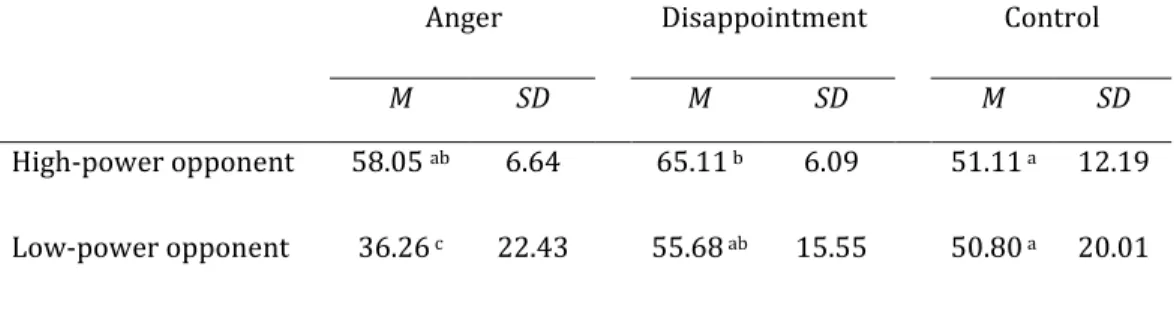
A 3 × 2 ANOVA yielded main effects of opponent’s emotion, F(2, 108) = 7.47, p < .005, η2 = .12, and opponent’s power, F(1, 108) = 13.58, p < .001, η2 = .11. More importantly, these main effects were qualified by an interaction, F(2, 108) = 4.76, p < .05, η2 = .08 (see
Table 2.1. Number of chips offered to the opponent as a function of opponent’s emotion
and opponent’s power (Experiment 2.1)
Anger Disappointment Control
M SD M SD M SD
High-power opponent 58.05 ab 6.64 65.11 b 6.09 51.11 a 12.19
Low-power opponent 36.26 c 22.43 55.68 ab 15.55 50.80 a 20.01
Note. Means with different superscripts differ significantly (ps <.05, analyzed with
simple-effect analyses).
As expected, in the anger condition offers to high-power opponents were higher (M = 58.05, SD = 6.64) than offers to low-power opponents (M = 36.26, SD = 22.43), F(1, 108) = 19.48, p < .001, η2 = .15. This difference between offers to high- and low-power
opponents was not significant in the disappointment (p = .06) and control conditions (p = .95).
Moreover, in the low-power opponent conditions, participants offered fewer chips to angry opponents (M = 36.26, SD = 22.43) than to disappointed opponents (M = 55.68, SD
= 15.55, p < .001) or opponents from the control condition (M = 50.80, SD = 20.01, p <
.005). In the high-power opponent conditions participants offered more chips to disappointed opponents (M = 65.11, SD = 6.09) than to opponents from the control
condition (M = 51.11, SD = 12.19, p < .01), and they offered somewhat more chips to angry opponents (M = 58.05, SD = 6.64) than to opponents from the control condition, although this difference was not significant (p = .17).
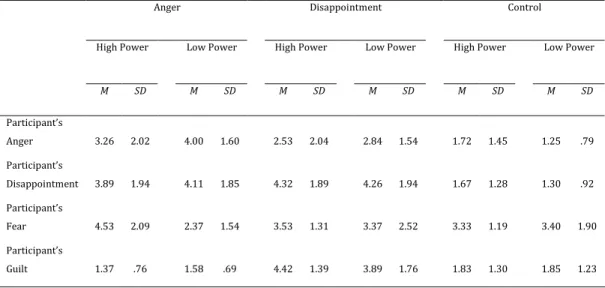
Participants’ emotions
Anger. A 3 × 2 ANOVA yielded only a main effect of opponent’s emotion, F(2, 108) = 16.66, p < .001, η2 = .24 (see Table 2.2). As predicted, Tukey’s tests (ps < .05) showed that