Experimental investigation on the temperature dependence of the nuclear level density parameter
Balaram Dey,1Deepak Pandit,1Srijit Bhattacharya,2K. Banerjee,1N. Quang Hung,3N. Dinh Dang,4Debasish Mondal,1 S. Mukhopadhyay,1Surajit Pal,1A. De,5and S. R. Banerjee1,*
1Variable Energy Cyclotron Centre, 1/AF-Bidhannagar, Kolkata-700064, India 2Department of Physics, Barasat Govt. College, Barasat, N 24 Pgs, Kolkata-700124, India
3School of Engineering, Tan Tao University, Tan Tao University Avenue, Tan Duc Ecity, Duc Hoa, Long An Province, Vietnam
4Theoretical Nuclear Physics Laboratory, Nishina Center for Accelerator-Based Science, RIKEN, 2-1, Hirosawa,
Wakocity, Saitama 351-0198, Japan
and Institute for Nuclear Science and Technique, Hanoi, Vietnam 5Department of Physics, Raniganj Girls’ College, Raniganj-713358, India
(Received 7 January 2015; revised manuscript received 9 April 2015; published 30 April 2015)
The effect of temperatureTand angular momentumJon the inverse level density parameterkhas been studied by populating the compound nucleus 97Tc in the reaction 4He+ 93Nb at four incident beam energies of 28, 35, 42, and 50 MeV. For all four energies, the value ofkdecreases with increasingJ. TheT dependence ofkhas been compared for two angular momentum windows with different theoretical predictions as well as with the finite-temperature BCS calculation which takes into account the quasiparticle-number fluctuations in the pairing field (FTBCS1). Interestingly, the experimental data are in good agreement with the theoretical calculations at higherJbut deviate from all the calculations at lowerJ.
DOI:10.1103/PhysRevC.91.044326 PACS number(s): 25.70.Jj,25.70.Gh,24.10.Pa I. INTRODUCTION
The nucleus is a many-body quantum system which experiences many different configurations even when fairly small excitation energy is provided. It is now a very well-known fact that the density of a quantum mechanical state increases rapidly with excitation energy and soon becomes very large. As a result, the nucleus leaves the discrete region and enters the region of quasicontinuum and continuum. Due to this complexity, statistical concepts and models are not only appropriate but also crucial for comprehension and prediction of various nuclear phenomena. Intriguingly, nuclear level densities are indispensable in the study of nuclear reaction cross sections, nuclear reaction rates [1] which are needed for astrophysical calculations (inputs in modeling stellar evolution and nucleosynthesis), fission or fusion reactor design, transmu-tation of nuclear waste, and production of radioactive isotopes in therapeutic uses in nuclear medicine. Along with that, they also provide information about thermodynamic quantities such as temperature and entropy as well as pairing correlations in nuclear structure study [2]. The knowledge of nuclear level density is also very crucial while extracting the parameters of giant dipole resonances built on highly excited states of the nuclei [3,4]. However, the characterization of nuclear level density (NLD) in the regions of high excitation energy, angular momentum, and different nuclear shapes is in large part phenomenological. The most commonly used analytical expression for calculating NLD is based on the work of Bethe [5] for a system of noninteracting fermions. The Fermi gas model determines the NLD for a spherical nucleus of mass numberAat excitation energyE∗and angular momentumJ
and is used in theCASCADEcode [4,6,7] as
ρ(E∗,J)= 2J+1
12I3/2 √
aexp (2 √
aU)
U2 . (1)
Here U=E∗−Erot− is the available thermal energy. Erot is the energy bound in rotation and I is the effective moment of inertia. The excitation energy is shifted back by the pairing energywhich is calculated internally. The NLD parameter a is related to the single-particle level density in the region of the Fermi energy and is correlated to the mass of the nucleus as a=A/k, where k is the inverse level density parameter. The temperature dependence of the NLD parameter has been investigated by various theoretical approaches [8–12] and experimental methods [13–17]. It is found from the experimental analysis of nuclear resonances and evaporation spectra that for cold nuclei,k∼8 MeV; but for high temperatures likeT =5 MeV,kis around 13 MeV. The understanding of this behavior has been attempted by taking into account the effects of correlation, i.e., theT dependence of the frequency-dependent effective mass as well as the finite size effect, the momentum dependence of the effective mass, the effects of continuum, and the shell effects [8,11,12].
deformed nuclei (185Re* and169Tm*) the value ofkdecreased substantially at the lower excitation energy, while for a near-spherical nucleus (201Tl) it remains the same at the two excitation energies. The results indicated a strong correlation between collectivity and ground-state deformation.
Recently, there have been ample experimental efforts to comprehend the spin dependence of the level density parameter. In a few measurements of angular momentum gated neutron evaporation spectra inA∼119, 97, and 62, it was seen that thekvalue decreased with increase inJ which indicated that level density increases withJ [7,20]. On the other hand, the inverse level density parameter extracted from the α evaporation spectra in theA∼180 andA∼120 mass regions showed that the value ofkis either constant or increases with angular momentum [21,22]. However, theoretical calculation for similar masses shows that the k value should increase with angular momentum for all the systems [23]. Interestingly, the γ-multiplicity gated proton spectra in A∼105 showed a drastic dependence on fold. The spectra acquired a broad structure at higher multiplicity folds for proton energies beyond∼15 MeV which was explained by a prescription of a localized enhancement of NLD [24]. Thus, extremely exciting but conflicting experimental results on the spin dependence of the level density parameter motivate one to carry out further investigations.
In this work we report on the angular momentum gated neutron evaporation spectra at different excitation energies (30–50 MeV) for the reaction 4He + 93Nb. The specific advantage of using a light ion reaction is that the major residues are of similar nature and in our case they are 95Tc, 94Tc, and 93Tc depending on the excitation energy of the
compound nucleus. However, for excitation energies above 42 MeV, another channel contributes (∼20%) due to (α,α2n) populating 91Nb. Nevertheless, the deformations of all the nuclei populated in the decay chain are similar and are of the order ofβ ∼0.05. The shell effects are also very small and similar. Therefore, the neutron evaporation spectra will have the contribution from similar kind of nuclei only.
II. EXPERIMENTAL DETAILS
The experiment was performed at the Variable Energy Cyclotron Centre, Kolkata, using theαbeam from the K-130 cyclotron. A self-supporting 1 mg/cm2thick target of 99.9% pure93Nb target was used. Four different beam (4He) energies of 28, 35, 42, and 50 MeV were used to populate the compound nucleus 97Tc at the excitation energies of 29.3, 36.0, 43.0, and 50.4 MeV, respectively. The maximum populated angular momenta for fusion were 16, 18, 19, and 20 , respectively. The evaporated neutrons from the compound nucleus (CN) were detected by a liquid organic scintillator (BC501A) based neutron detector [25] that was placed at a distance of 1.5 m from the target position and at an angle of 125◦ to the beam axis. Along with the BC501A neutron detector, a 50-element low-energy γ-multiplicity filter [26] was also used to estimate the angular momentum populated in the compound nucleus as well as to get a fast start trigger for neutron time-of-flight (TOF) measurement. The multiplicity filter was split into two blocks of 25 detectors each, in a
staggered castle type geometry to equalize the solid angle for each multiplicity detector element, and placed at a distance of 5 cm above and below the center of the target. The efficiency of the multiplicity setup was 56% as calculated usingGEANT4 simulation. A level-1 trigger (A) was generated from the multiplicity filter array when at least one detector each from the top and bottom blocks fired in coincidence above a threshold of 250 keV. Another trigger (B) was generated when the signal in BC501A detector crossed a threshold of 250 keV. An online coincidence of these two triggers (A and B) ensured the selection of neutron events and rejected the backgrounds. The TOF technique was employed for neutron energy measurement. The neutron-γ ray discrimination was achieved by both pulse shape discrimination (PSD) and TOF techniques. To keep the background of the detectors at a minimum level, the beam dump was heavily shielded with lead bricks and borated paraffin. A CAMAC electronics and VME based data acquisition system were used to simultaneously record the energy and time information of the detectors.
III. DATA ANALYSIS AND RESULTS
The TOF spectrum was converted to an energy spectrum using the promptγ peak as a time reference. The efficiency correction for the BC501A neutron detector was performed usingGEANT4 simulation [27]. In order to extract the inverse level density parameter from the experimental neutron spectra, the theoretical neutron energy spectra were calculated em-ploying the statistical model code CASCADE [6]. The level density parameter prescription of Ignatyuk et al. [28] was adopted which takes into account the nuclear shell effects at
Counts 0
1000 2000 3000 4000 5000 6000
F = 2 F = 3 F > 3
Elab = 28 MeV
Angular Momentum ( )
0 10 20 30 40
0 1000 2000 3000 4000 5000 6000
F = 2 F = 3 F > 3
Elab = 50 MeV (a)
(b)
En (MeV)
101 102 103 104
35 MeV
F=3 F=2
F>4
101 102 103 104
42 MeV
F=3 F=2
F>4
2
4
6
8
101 102 103 104
50 MeV
F=3 F=2
F>4
101 102 103 104
2
4
6
8
F=2 F=2
F=3 F=3
F>4 F>4
F=3 F=2
F>4
F=3 F=2
F>4
F=3 F=2
F>4
28 MeV
Y
ield / 0.5 Me
V
(a)
(b)
(c)
(e)
(h) (d)
(f)
(g)
35 MeV
42 MeV
50 MeV 28 MeV
FIG. 2. (Color online) [(a)–(d)] Neutron evaporation energy spectra (filled triangles) along with theCASCADEpredictions (con-tinuous line) for different folds (F) at incident energies of 28, 35, 42, and 50 MeV for4He+ 93Nb system. [(e)–(f)] Neutron evaporation energy spectra (filled triangles) along with the Maxwellian fitting (continuous line) for different folds (F) at incident energies of 28, 35, 42, and 50 MeV for 4He+ 93Nb system.F =2 andF=3 data have been multiplied by 100 and 10, respectively.
low excitation energy and connects smoothly to the liquid drop value at high excitation energy. The transmission coefficients for statistical calculation were obtained from the optical model. The potential parameters for neutron, proton, andαwere taken from Refs. [29], [30], and [31], respectively. The experimental fold distribution measured using the 50-elementγ-multiplicity filter was converted to the spin distribution using GEANT4 simulation applying the approach discussed in Ref. [26]. The simulated spin distributions deduced from the experimental fold distributions were used as inputs for different folds. The angular momentum distributions for different folds at 28 and 50 MeV incident energies are shown in Fig.1. The moment of inertia of the CN was taken asIeff =I0(1+δ1J2+δ2J4), where I0 is the moment of inertia of the spherical nucleus. The role of the deformation parametersδ1 andδ2 was found to be inconsequential and the shapes of the neutron energy spectra were mostly dependent on the inverse level density parameter. The value ofkhas been extracted from the best-fit statistical model calculations using a χ2 minimization in the energy range of 3–7 MeV (Fig. 2). The extracted kare given in TableIfor different angular momenta and excitation energies.
TABLE I. Average temperature and average angular momentum along with the level density parameter for the4He+ 93Nb system at different beam energies.
E∗ J T A/k
System (MeV) (MeV) (MeV−1)
12±5 1.18±0.03 A/(8.5±0.5) 4He+ 93Nb 29.3 14±6 1.06±0.04 A/(8.3±0.3) @Elab=28 MeV 16±5 1.03±0.02 A/(8.0±0.5) 13±4 1.47±0.02 A/(9.7±0.5) 4
He+ 93Nb 36.0 15±5 1.41±0.03 A/(9.5±0.3) @Elab=35 MeV 18±5 1.35±0.04 A/(8.2±0.4) 14±5 1.52±0.05 A/(9.0±0.4) 4He+ 93Nb 43.0 16±5 1.43±0.02 A/(8.1±0.4) @Elab=42 MeV 19±6 1.38±0.04 A/(7.8±0.5) 14±5 1.60±0.02 A/(9.2±0.5) 4
He+ 93Nb 50.4 16±5 1.55±0.02 A/(8.5±0.4)
Elab=50 MeV 20±5 1.50±0.03 A/(8.2±0.4)
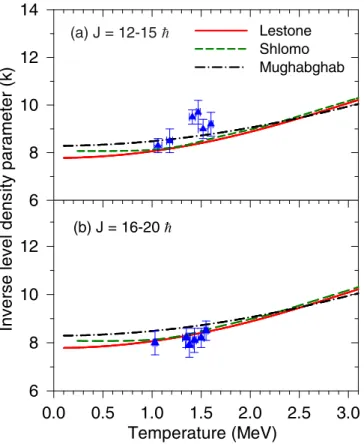
It is very interesting to note that the values ofkdecrease with increasing angular momentum for all the incident energies (Fig.3). The result is in contrast to the theoretical calculations obtained under the framework of statistical theory of hot rotating nuclei which predicts that k should increase with angular momentum [23]. However, the trend of the angular momentum dependence measured in this work is consistent with the previous measurements for 62Zn [20] and 119Sb [7]. The inverse level density parameter as a function of temper-ature, for two angular momentum windows, has also been compared with the different theoretical calculations predicted by Shlomo [8], Lestone [9], and Mughaghab [10] (Fig.4). It should be mentioned that the prediction of Shlomo was taken for theA=110 mass region [8] whereas the other two predic-tions were calculated for theA=97 mass using the formula given in Refs. [9,10]. Since, the neutron evaporation spectra include neutrons from different nuclei in the decay chain, the average temperatures for different excitation energies were
12 14 16 18 20
7 8 9 10
Angular momentum ( )
12 14 16 18 20
Inverse level dens
ity
parameter (k)
7 8 9 10 11
(a) Elab = 28 MeV (b) Elab = 35 MeV
(c) Elab = 42 MeV (d) Elab = 50 MeV
Inverse level dens
ity
parameter (k)
6
8
10
12
14
Lestone Shlomo Mughabghab
Temperature (MeV)
0.0
0.5
1.0
1.5
2.0
2.5
3.0
6
8
10
12
(a) J = 12-15
(b) J = 16-20
FIG. 4. (Color online) Temperature dependence of kcompared with different theoretical calculations.
calculated by fitting the experimental data with the Maxwellian function√Eexp(−E/T). It needs to be mentioned that none of the theoretical predictions include the J effect. As can be seen from Fig. 4, the inverse level density parameter increases with temperature for all the predictions. However, the data at higher angular momenta match very well with the prediction but are at disparity at lower angular momenta. This outcome was unexpected since the theoretical predictions do not include the J effect and, thus, experimental data and theoretical calculations should have matched at lowerJ. The results indicate that the level density is suppressed at lower angular momenta. This deviation cannot be attributed to the effect of collectivity because the level density is not enhanced but suppressed compared to the Fermi gas model.
Recently, the temperature dependence of the level density was studied in hot medium-mass nuclei, which undergo a noncollective rotation about the symmetry axis [32]. The numerical calculations within the finite-temperature BCS (FTBCS) and FTBCS1 theories have shown the pairing reentrance in the pairing gap at finite angular momentum M (M is the zprojection of total angular momentum) and temperature T. The FTBCS1 theory includes the effects due to quasiparticle-number fluctuations in the pairing field at T = 0 MeV. Both the FTBCS and FTBCS1 theories take into account the z-projection of angular momentum at T = 0 MeV. The pairing reentrance changes the T dependence of the level density from a convex function to a concave one. Similar calculation was performed to observe whether the pairing reentrance plays any important role in the case
Inverse level densit
y
parameter (k)
7 8 9 10 11
Col 12 vs Col 13 Col 16 vs Col 17 Col 1 vs Col 2
Temperature (MeV)
0.6 0.8 1.0 1.2 1.4 1.6 1.8 2.0 6
7 8 9 10
FTBCS1 FTBCS Exp. data
(a) J = 12-15
(b) J = 16-20
FIG. 5. (Color online) Temperature dependence ofkcompared with the calculations of FTBCS and FTBCS1.
of 97Tc. It was observed that the FTBCS gaps collapse at a certain critical temperature, whereas the FTBCS1 gaps do not. Starting fromM=12the FTBCS1 proton gap shows the pairing reentrance effect, that is, the pairing gap reappears and remains finite atT >0.3 MeV andM12. The value ofk was extracted from the excitation energies using the relation k=4AE∗/S2. Since, the nucleus 97Tc is not spherical but slightly prolate and the calculations were carried out under the assumption of a spherical nucleus for which thezprojection M of the total angular momentum J coincides with J, the results of theoretical calculations have been renormalized to match the corresponding data point at the lowestJ for both the selected angular momentum window. As can be seen from Fig.5, the increase ofkwithT observed in the data is also reproduced by the results of theoretical calculations although the latter agree better with the data for the higherJ window whereas for the lowerJwindow the theory underestimates the two data points atT =1.41 MeV (J =15) and 1.47 MeV (J =13). The FTBCS and FTBCS1 predict similar results, indicating that pairing reentrance might have a minor effect on the inverse level density parameter in this case. However, to have a thorough understanding of the effect of collectivity and pairing reentrance on the decrease ofkwith increasing angular momentum, much more theoretical and experimental studies are needed. Moreover, it may be noted that the effect of angular momentum onkis not observed for higher masses [21,22,33] but is only apparent in low- and medium-mass A120 nuclei [7,20]. Hence, more experimental data at both high- and low-mass regions are required to understand this behavior.
IV. SUMMARY AND CONCLUSIONS
42, and 50 MeV to study theTandJdependence of the inverse level density parameterk. It was observed thatkdecreased with increasingJfor all excitation energies. TheT dependence ofk was studied by selecting two angular momentum windows and compared with different theoretical calculations. Intriguingly, the results of all the theoretical calculations agree well with the data at the higherJ window but differ from the experimental data at the lowerJ window.
ACKNOWLEDGMENTS
The authors gratefully acknowledge helpful discussions with Professor J. N. De. The theoretical calculations within FTBCS and FTBCS1 were carried out using RIKEN Integrated Cluster of Clusters (RICC). N. Quang Hung acknowledges the support by the National Foundation for Science and Technology Development (NAFOSTED) of Vietnam through Grant No. 103.04-2013.08.
[1] T. Rauscher, F.-K. Thielemann, and K.-L. Kratz,Phys. Rev. C
56,1613(1997).
[2] E. Melbyet al.,Phys. Rev. Lett83,3150(1999). [3] Balaram Deyet al.,Phys. Lett. B731,92(2014).
[4] S. Bhattacharya, D. Pandit, B. Dey, D. Mondal, S. Mukhopad-hyay, S. Pal, A. De, and S. R. Banerjee,Phys. Rev. C90,054319
(2014).
[5] H. A. Bethe,Phys. Rev.50,332(1936); ,Rev. Mod. Phys.9,69
(1937).
[6] F. Puhlhofer,Nucl. Phys. A280,267(1976). [7] K. Banerjeeet al.,Phys. Rev. C85,064310(2012).
[8] S. Shlomo and J. B. Natowitz,Phys. Lett. B252,187(1990); ,Phys. Rev. C44,2878(1991).
[9] J. P. Lestone,Phys. Rev. C52,1118(1995).
[10] S. F. Mughabghab and C. L. Dunford, BNL-NCS-65712, Conference 981003, 1998 (unpublished).
[11] M. Prakash, J. J. Wambach, and Z. Y. Ma,Phys. Lett. B128,
141(1983).
[12] J. N. De, S. Shlomo, and S. K. Samaddar,Phys. Rev. C57,1398
(1998).
[13] K. Hagelet al.,Nucl. Phys. A486,429(1988).
[14] M. Goninet al.,Phys. Lett. B217,406(1989); ,Phys. Rev. C42,
2125(1990).
[15] A. Chbihi et al., Phys. Rev. C 43, 652 (1991); ,43, 666
(1991).
[16] B. J. Fineman, K.-T. Brinkmann, A. L. Caraley, N. Gan, R. L. McGrath, and J. Velkovska,Phys. Rev. C50,1991(1994). [17] D. Fabriset al.,Phys. Rev. C50,R1261(R)(1994).
[18] A. V. Ignatyuk, K. K. Istekov, and G. N. Smirenkin, Sov. J. Nucl. Phys.29, 450 (1979).
[19] P. Royet al.,Phys. Rev. C88,031601(R)(2013). [20] P. Royet al.,Phys. Rev. C86,044622(2012).
[21] Y. K. Gupta, D. C. Biswas, B. John, B. K. Nayak, A. Saxena, and R. K. Choudhury,Phys. Rev. C80,054611(2009). [22] Y. K. Gupta, B. John, D. C. Biswas, B. K. Nayak, A. Saxena,
and R. K. Choudhury,Phys. Rev. C78,054609(2008). [23] M. Aggarwal and S. Kailas,Phys. Rev. C81,047302(2010). [24] A. Mitra, D. R. Chakrabarty, V. M. Datar, Suresh Kumar, E. T.
Mirgule, H. H. Oza, V. Nanal, and R. G. Pillay,Nucl. Phys. A
765,277(2006).
[25] K. Banerjeeet al.,Nucl. Instrum. Methods Phys. Res., Sect. A
608,440(2009).
[26] D. Pandit, S. Mukhopadhyay, S. Bhattacharya, S. Pal, A. De, and S. R. Banerjee,Nucl. Instrum. Methods Phys. Res., Sect. A
624,148(2010).
[27] S. Agostinelliet al.,Nucl. Instrum. Methods Phys. Res., Sect. A506,250(2003).
[28] A. V. Ignatyuk, G. N. Smirenkin, and A. S. Tishin, Sov. J. Nucl. Phys.21, 255 (1975) [Yad. Fiz.21, 485 (1975)].
[29] C. M. Perey and F. G. Perey,At. Data Nucl. Data Tables17,1
(1976).
[30] F. G. Perey,Phys. Rev.131,745(1963).
[31] L. Mcfadden and G. R. Satchler,Nucl. Phys. A84,177(1966). [32] N. Quang Hung and N. Dinh Dang,Phys. Rev. C84,054324
(2011).

![FIG. 2. (Color online) [(a)–(d)] Neutron evaporation energy spectra (filled triangles) along with the CASCADE predictions (con-tinuous line) for different folds (F) at incident energies of 28, 35, 42, and 50 MeV for 4 He + 93 Nb system](https://thumb-us.123doks.com/thumbv2/123dok_us/8200960.2174330/3.884.71.429.98.559/neutron-evaporation-triangles-cascade-predictions-different-incident-energies.webp)