LANGUAGE EXPERIENCE PREDICTS PRONOUN COMPREHENSION IN IMPLICIT CAUSALITY SENTENCES
Elyce Dominique Williams
A thesis submitted to the faculty at the University of North Carolina at Chapel Hill in partial fulfillment of the requirements for the degree of Doctor of Philosophy in the
Department of Psychology & Neuroscience.
Chapel Hill 2020
ii © 2020
iii ABSTRACT
Elyce Dominique Williams: Language Experience Predicts Pronoun Comprehension in Implicit Causality Sentences
(Under the direction of Jennifer Arnold)
iv
ACKNOWLEDGEMENTS
v
TABLE OF CONTENTS
LIST OF TABLES ... vii
LIST OF FIGURES ... viii
LIST OF ABBREVIATIONS ... ix
INTRODUCTION ...1
The Linguistic Context and Pronoun Comprehension ...2
How Does Predictability Arise?...5
Linguistic Experience and Language Comprehension ...10
Contributions of Other Individual Difference Measures in Language Comprehension ...13
The Current Study ...15
EXPERIMENT 1 ...20
Methods...20
Participants ...20
Materials and Measures ...20
Procedure ...24
vi
Results ...26
Experiment 1 Discussion ...31
EXPERIMENT 2 ...33
Methods...33
Participants ...33
Materials and Measures ...33
Procedure ...34
Data Analysis ...34
Results ...34
Experiment 2 Discussion ...40
GENERAL DISCUSSION ...40
APPENDIX A: Additional Tables ...51
APPENDIX B: Additional Figures ...56
vii
LIST OF TABLES
Table 1. Two Experiments: The Congruent Clause Continuation Task and
The Novel Clause Continuation Task ...17
Table 2. Exp. 1 Example of a target item ...22
Table 3. Exp. 1 SES Measures ...29
Table 4. Exp. 1 Internal reliability of the SES measures ...29
Table 5. Exp. 1 Pearson Correlation r values. ...29
Table 6. Statistical model for SES effect and interaction in Experiment 1 ...31
Table 7. Exp. 2 Example of a target item ...34
Table 8. Exp. 2 SES measures ...37
Table 9. Exp. 2 Internal reliability of the SES measures ...38
Table 10. Exp. 2 Pearson Correlation r values ...38
Table 11. Statistical model for verb bias effect and ART effect in Experiment 2 ...39
Table 12. Statistical model for verb bias effect and SES effect in Experiment 2 ...39
Table 13. Stimuli for Experiment 1 ...51
Table 14. Stimuli for Experiment 2 ...53
viii
LIST OF FIGURES
Figure 1. Figure reprint from Arnold et al. (2018), Exp. 1, page 45 ...10
Figure 2. Figure reprint from Arnold et al. (2018), Exp. 1, page 47 ...11
Figure 3. Predicted print exposure effect with a semantic vs. a syntactic bias ...18
Figure 4. Predicted print exposure effect with both a semantic and a syntactic bias ...18
Figure 5. Example of a critical question ...23
Figure 6. Example of a content question ...23
Figure 7. Experiment 1 verb bias and ART interaction ...27
Figure 8. Experiment 1 average selection of the character congruent with the verb bias ...28
Figure 9. Experiment 1 SES and ART interaction ...30
Figure 10. Experiment 2 verb bias and ART interaction ...36
Figure 11. Experiment 2 average selection of the character congruent with the verb bias ...37
Figure 12. Author Recognition Task ...56
Figure 13. Experiment characters ...57
Figure 14. Preview of the ladder measure ...58
Figure 15. Preview of the income measure ...59
ix
LIST OF ABBREVIATONS
ART Author Recognition Task
IC Implicit Cause (or Implicit Causality)
1
INTRODUCTION
Apart from a discourse context pronouns are inherently ambiguous. Understanding how people interpret pronouns is a window into a larger question of how people understand language. In a coherent discourse there can be a number of different syntactic and semantic features which aid comprehension. For instance, in a sentence fragment like, Matt feared Will because he…the pronoun, he is ambiguous because either Matt or Will could make sense as a continuation. So when faced with referential ambiguity like in the example above, how do people resolve this?
Pronoun resolution can be guided by a number of things. For example, pronoun
resolution can be guided by gender, which in the example above is not particularly useful. It can be guided by structural/syntactic features like the grammatical subject (Brennan, 1995; Gordon, Grosz, & Gilliom, 1993; Nappa & Arnold, 2014), such that people might have a preference to assign the pronoun to Matt. Additionally, pronoun resolution can be guided by semantic features, like the implicit causality of verbs (Garvey and Caramazza, 1974). For instance, in the example above the verb fearedalong with the word because might lead people to assign the pronoun to Will, the implicit cause (Kehler & Rohde, 2013).
The current study asks whether there are individual differences in how people use the syntactic and semantic features of implicit causality sentences for anaphoric pronoun
2
exposure/experience and language skill. Previous research has shown that individual differences in how people use syntactic features to interpret ambiguous pronouns is related to the amount of print exposure individuals have had (Arnold, Strangmann, Hwang, Zerkle, & Nappa, 2018; Langlois & Arnold, 2020). In studying the relationship between language experience and
pronoun resolution, print exposure can be used to approximate language experience. The current study uses print exposure as a proxy for written language experience.
Secondarily, the current study also examines whether the use of syntactic and sematic cues for pronoun resolution differs according to individuals’ socioeconomic status (SES). There is reason to believe that print exposure is correlated with SES since both are related to reading and language skill (SES; Hecht & Close, 2002; Hoff 2003; Peterson & Pennington, 2015; Cheng & Wu, 2017). Therefore, if print exposure is related to individual differences in how people use the linguistic context for pronoun comprehension, I want to be sure that the modulation of this effect is truly related to print exposure over and above any effects of SES.
The Linguistic Context and Pronoun Comprehension
3
accessible in the context, subjects are also considered predictable in that there is a strong
likelihood that they will be mentioned again in the discourse (Arnold, 1998, 2010). If something is likely to be mentioned again that contributes to its accessibility, in turn contributing to the preference to interpret the pronoun as referring to the subject (Arnold 1998, 2001).
Other features of the discourse that can guide pronoun comprehension are semantic features like the implicit causality of verbs. Consider the following examples. There are probable continuations for each of these sentences that will support both Matt and Will as the referent of
the pronoun:
(1) Matt feared Will because he...
(2) Matt amazed Will because he...
For example: (1a) “…because he liked to appear in unexpected places,” and (1b) “…because he
was easily scared,” are both acceptable continuations. In (1a) the pronoun refers to Will and in
(1b) the pronoun refers to Matt. However, while both continuations are plausible, research shows
that if presented with (1) on average people will have a greater bias for the object. Here this is
represented by an interpretation of Will as the referent of the pronoun, and if presented with (2)
on average people will have a greater bias for the subject i.e. an interpretation of Matt as the
referent of the pronoun (Kehler & Rohde, 2013; Hartshorne & Snedeker, 2013). One account for
this comes from Garvey and Caramazza (1974) and Garvey, Caramazza, and Yates (1976). This
research posited that these biases can be attributed to a feature of verbs called implicit causality.
This feature implicates one of the two arguments connected to the verb as being the underlying
cause of an action or state, while the other argument is the recipient. Some verbs such as “fear”
implicate causality to the object and other verbs such as “amaze” implicate causality to the
4
Other accounts of implicit causality posit that the inferences that people make stem from
non-linguistic social judgments and/or information about the entities in the causal event. For
example, the interpretation in (1b) might stem from non-linguistic judgments made about Matt
and Will that would warrant a continuation not congruent with the implicit cause of the verb (Au,
1986; Brown and Fish, 1983; Corrigan, 2001, 2002, 2003; LaFrance, Brownell, & Hahn, 1997).
Additionally, in instances where the explanation in the second clause is incongruent with the bias
of the verb (e.g. 1b), although it is plausible, people are slower to process the sentence than if the
explanation in the second clause is congruent with the bias (e.g. 1a). This is referred to as the
congruency effect (Caramazza, Grober, Garvey, & Yates 1977; Cozijn, Commandeur, Vonk, &
Noordman, 2011; Garvey & Caramazza, 1974). In any case, although there is some discord
concerning how people arrive at these causal judgments, scholars can generally land on the
understanding that there are particular types of events which evoke implicit cause re-mention and
implicit cause pronoun interpretations (Hartshorne, 2014).
Given that people can use the linguistic context for causal judgments and inferences,
what is the time course of the implicit cause effect? One viewpoint asserts earlier effects of the
verb bias, such that before any disambiguating information is reached, one entity, the implicit
cause, is more accessible and considered a likely candidate for re-mention. Other accounts posit
that the implicit cause effect does not occur until after disambiguating information is integrated
(Cozijn, Commandeur, Vonk, & Noordman, 2011; Garnham, Traxler, Oakhill, & Gernsbacher, 1996; Long & De Ley, 2000; Järvikivi, van Gompel, & Hyönä, 2017; Koornneef & Van Berkum, 2006; McDonald & MacWhinney, 1995; Pyykkönen & Järvikivi, 2010). Therefore, if it is the case that the effect of implicit causality causes one entity to be more in focus, or more
5
& Caramazza, 1974; Kehler et al., 2008; Kehler & Rohde, 2013; Stevenson et al., 1994) because we know that pronouns tend to refer to the most accessible entity (Arnold, 1998, 2010; Brennan, 1995).
In addition to referential expectation that comes from the verb, coherence relations are important because they describe a particular relationship between two clauses and can influence referential expectations. Consider this example: Matt admired Will. He…. Although there is no connector word linking the two clauses, we can infer a causal coherence relation, such that the pronoun He in the second clause is likely to refer to Will and explain what is admirable about him (Kehler et al., 2008, 2013). While the connector word is not necessary to form a coherence relation, choice of a connector word (e.g. and then, so, because) greatlyinfluences the perception of the coherence relation. Expectation for a causal continuation is strengthened when there is a
because that links the first and second clause. When the second clause is describing an
explanation of the first clause, research shows that this is when you typically get the strongest implicit causality biases. For that reason many implicit causality studies (as well as the current study) make this relation explicit by using the word because which signals an explanation
relationship and prompts an expectation to continue speaking about the cause (Au, 1986; Ehrlich, 1980; Kehler & Rohde, 2013; Stevenson et al., 1994).
How Does Predictability Arise?
6
frequency in which we encounter them is known as the Expectancy Hypothesis (Arnold, 1998; 2001; 2010). Consider this example, Matt went to the grocery store with Liz… Comprehenders are likely to have an idea of who or what they think will be mentioned next. Research shows that reference to the grammatical subject tends to occur more frequently than other positions,
particularly in natural language use (Arnold, 1998; 2001; 2010). In encountering high
frequencies of subject mention and subject re-mention, it is probable that comprehenders become predisposed to a pattern of subject reference and thus develop a bias that people are likely to re-mention or continue talking about the subject. Therefore, the Expectancy Hypothesis supports the idea that many people would interpret the pronoun, “he” in this example as referring to the character in the subject position, i.e. Matt.
On the other hand, Kehler et al. (2008) and Kehler and Rohde (2013) have a model in which one component of that model accounts for the probability that a particular entity in the discourse will be mentioned. In their model they talk about likelihood of mention in terms of semantics, specifically they track who is likely to be mentioned under the semantic constraints of implicit causality sentences. For example, if you hear, Ana admired Liz because… as the listener you are likely to believe whoever is most likely the cause of the admiration will be mentioned again. The semantic structure hypothesis says that there is a direct relationship between the fixed meaning of a specific verb and the implicit cause bias of that verb (Hartshorne & Snedeker, 2013). Thus semantic cues in the linguistic context can contribute to referential interpretation and predictions about likelihood of mention.
7
which an entity may be referred to in different forms, including pronouns. Additionally, these two models differ in that the Expectancy Hypothesis accounts for predictability arising from the relative frequency in which an entity is encountered over the course of the lifetime. One way this hypothesis is tested is by measuring the frequency of occurrence in natural language (i.e.
corpora). The Kehler et al. (2008, 2013) model accounts for predictability arising as a result of verb semantics and the linguistic context in which a particular entity is more in focus and deemed likely to be mentioned again. One method that has been used to test this model is through sentence completion tasks where the task serves as a proxy for what we might expect in natural language. The relevance of these two models to the current study is not necessarily in comparing the differences, but as two plausible explanation for what I am testing, which is the occurrence of individual differences in pronoun resolution that is related to one’s experience and primarily, one’s language experience.
The Frequency Account, the Semantic Account, and Individual Differences
The Expectancy Hypothesis might support an explanation of individual differences where people with more print exposure encounter instances of implicit cause re-mention more
frequently than those with less print exposure. As a result, in the context of an implicit cause sentence, those with greater print exposure might be more likely to interpret an ambiguous pronoun with an implicit cause interpretation than those with less print exposure.
8
process and produce words and structures that are less frequent (Montag & McDonald, 2015; Seidenberg, 1985; Wells, Christiansen, Race, Acheson, & MacDonald, 2009).
Research suggests that when experience is manipulated within the context of an experiment, adults are able to incorporate recent experience with less common structures and adapt to these patterns (Wells et al., 2009; Fine & Jaeger, 2013).For example, Thothathiri and Snedeker (2008) used priming of less commonly used syntactic structures and tracked eye gaze of participants showing that people are sensitive to exposure even over a short period of time i.e. within the time frame of the experiment. People demonstrated a bias to interpret temporary ambiguities that were congruent with the syntactic structure of which they had been primed. This was particularly interesting to see demonstrated with the sentence primes that appeared in the less commonly used syntactic structure.
9
Ana. Ana bought a sweater (non-subject reference)or Matt went to the mall with Ana. Matt bought a sweater (subject reference). Inter-mixed with the unambiguous name references participants received ambiguous-reference sentences like: Ana went to the movies with Liz. She bought the popcorn.
The results of experiment 2 revealed an effect of exposure, but importantly the effect was only present as an interaction with print exposure, where only participants with greater print exposure showed an adaptation effect. This was assessed by how participants answered
comprehension questions about the second sentence in the ambiguous stimuli, for example: Did Liz buy the popcorn? These results are interpreted cautiously however, because in a follow up study only the results of experiment 1 replicated. Speculatively, these results suggest that there is something about more print exposure perhaps related to development of skill in grappling with abstract patterns of reference, such that people with greater print exposure are more likely to adapt to and generalize patterns of reference from short exposure to both frequent and less frequent referential patterns than those with less print exposure.
10 Linguistic Experience and Language Comprehension
Print exposure is one proxy measure for written language experience, which is easier to measure than spoken language experience. There is recent evidence that print exposure in particular correlates with differences in pronoun comprehension. This recent evidence comes from Arnold et al. (2018) which shows that individuals with greater print exposure are more apt to follow the subject bias under certain linguistic conditions. In experiment 1 of Arnold et al.
(2018), participants watched a series of videos where in the critical trials the experimenter
introduced two same gendered characters and told a short story about them. For example,
participants might hear: Panda Bear is having pizza with Puppy. He wants the pepperoni slice.
Participants were then asked to identify who wanted the pepperoni slice, which would indicate
their comprehension of the pronoun in an ambiguous context. Critically, Arnold et al. (2018)
explored how participants’ pronoun comprehension would be affected when the short stories
were accompanied by a gaze cue (see figure 1. below). The gaze trials had three conditions:
looks to the subject, looks to the neutral object, and looks to the non-subject. Results of the study showed that the participants chose the subject 93% in the gaze-at-subject condition, 87% in the neutral condition, and 67% in the gaze-at-non-subject condition.
Figure 1. Critical trial: 3 gaze conditions with same gendered characters. Arnold et al. (2018). Figure reprinted from Arnold et al. (2018), experiment 1, page 45.
11
The critical findings that serve as motivation for the current study however, are the results of the Author Recognition Task (ART). The author recognition task is the task they used to measure print exposure (Stanovich & West, 1989; Moore & Gordon, 2015). In this task
participants are given a selection of names and asked to identify those which belong to authors.
In this task half of the names are author names and half are not. Participants are also told not to
guess because their score will be penalized for incorrect selections. Their performance on the
task is calculated by subtracting the number of incorrect names from the number of correct
names that they identify.
Arnold et al. (2018) observed that the ART predicted the rate of selecting the character in subject position. Across all gaze conditions as participants’ ART score increased, so did
selection of the subject character. While there were no significant interactions, one interesting thing to note is that numerically the effect of ART was the strongest during the non-subject gaze condition when the experimenter gazed at the second mentioned character. Figure 2 plots the percentage of subject responses in each condition, graphically displaying that low-ART participants showed a lower subject bias than high-ART participants in all conditions.
12
Scores on the ART are a gross measure of exposure to literature, as the idea is that the
more authors recognized the more print exposure one is likely to have had. While we
acknowledge that this assessment is not a direct measure of how much written language people
have been exposed to or how skilled of a reader they are, this task has been shown to correlate
with related measures of reading and reading skill, for example: verbal comprehension, word
identification, word naming, reading speed and vocabulary (Stanovich & West, 1989; Cunningham & Stanovich, 1991, 1997; Moore & Gordon, 2015).
Over the course of a lifetime people will gain experience with language in a number of different formats, e.g. through speaking and through reading. Studies have shown that spoken language is a predictor of reading ability and particularly reading comprehension (Scarborough, 2001), and that speaking ability skills also predict literacy skills across different age groups. For example, phonological and morphological abilities in spoken language have predicted variability in people’s understanding of written language (Thompkins & Binder 2003).
Exposure to written language has also been shown to affect spoken language ability. Research shows that high print exposure is correlated with greater vocabulary, speed of
processing vocabulary and ability to decipher phonetic information (Cunningham & Stanovich, 1991, 1992; Stanovich & West, 1989; Mani & Huettig, 2014). Exposure to different types of complex structures encountered in reading impacts ability to comprehend and produce complex spoken language. Children who experience greater print exposure tend to become increasingly more adult-like in their use of complex structures, such as in their use of passives (Montag & Macdonald, 2015).
The findings of Arnold et al. (2018), which showed a subject bias that differed in strength
13
exposure and language ability (e.g. Cunningham & Stanovich, 1991, 1992; Stanovich & West, 1989; Mani & Huettig, 2014), led me to further inquire about the relationship between individual differences in print exposure and referential comprehension. Specifically, how might these findings extend to implicit cause stimuli? Could there be a connection to the frequency with which one encounters implicit cause reference and how much print exposure they have had? Will this finding extend to semantic inferences at all? This line of questioning lead to the development of the current study. Although both the frequency account and the semantic constraint account discussed in the prior section are speculative, they provide potential explanation to explain the presence of an individual difference effect if there is one.
Contributions of Other Individual Difference Measures in Language Comprehension It is also important to note that there are other widely explored areas apart from print exposure that have been used to study how and why individuals differ, and in particular how individuals differ in different facets of language comprehension. This is necessary to discuss as individual differences in this area could potentially explain some of the difference in
performance found in the current study.
14
final interpretation of the target word. They also collected reading time data. Results demonstrated that there was a significant correlation between verbal working memory and language comprehension. Those who demonstrated greater working memory capacity were able to better reconcile the temporary ambiguities they faced during the language comprehension task.
The current study did not include a measure of working memory, but I note that Arnold et al. (2018) did include working memory assessments and did not find an effect of memory in their task. Even still, because our design does not include a working memory measure we will not be able to absolutely rule out that there is an effect of working memory. Our goal is not to show that print exposure matters to the exclusion of other individual differences, but rather it is to test what effect it has, if any.
However, as a control measure I will test another measure of individual difference, socioeconomic status (SES). Research shows that socioeconomic status and particularly mother’s education predicts measures of language skill like vocabulary. For example, children with high SES show greater improvement in their vocabulary than low SES children over a period of time (Hoff, 2003). Considering the main analysis of the current study is to see if individual differences in print exposure explains differences seen in pronoun comprehension, it is important to know whether or not any ART effects found can be attributed to SES. In this study, SES is a composite score made of measures of parental education, household income and participants’ subjective sense of their standing relative to their community. These measures were chosen because they are commonly used in the SES literature (Bradley & Cowryn, 2002;
15
measures relate to one another by calculating Cronbach’s Alpha for internal validity and Pearson’s Correlation.
Based on the finding of Arnold et al. (2018), I do not expect that if I find an effect of ART that it will be explained by SES. In experiment 2 and 3 of Arnold et al. (2018) they added a measure of SES consisting of parental education and family income to see if it would explain any individual differences in pronoun comprehension. Results showed that neither parental education nor household income correlated with ART in this study. Critically, while mother’s education was numerically related to pronoun interpretation, when added to the model with ART, only ART was significant. This showed that SES was not explaining any of the variance that was explained by ART.
The Current Study
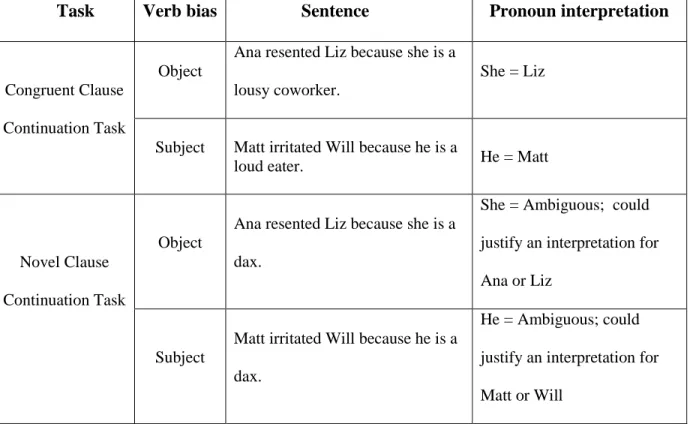
The current study uses spoken stimuli to explore how individuals differ in their pronoun interpretation in the presence of implicit causality verbs, and whether this relates to how they differ in their levels of print exposure. To date, there are no other studies that evaluate individual differences in pronoun comprehension in the context of implicit causality verbs using spoken stimuli and measuring print exposure. I examined this question in two experiments, the Novel Clause Continuation Task and the Congruent Clause Continuation Task because they shed light on differences in how people use implicit causality as they are processing the information available to them (see table 1).
16
participants vary in their determination of which character is co-referential with the pronoun, if at all. This task will show whether people rely on the semantic cue for pronoun interpretation, or a syntactic cue e.g. a potential subject bias. Essentially there is no “correct” answer for these sentences, so it allowed us to test for an individual difference effect, but also how likely people are to follow one interpretation over the other when either interpretation can be supported.
Additionally, finding an implicit cause bias in this experiment would provide support for the focus account of implicit causality, in that it would suggest that people are formulating judgments of who the pronoun is referring to in the absence of disambiguating information. Although this cannot be directly measured because no online measures were collected, some accounts posit that people may be formulating predictions about who the referent is at least up until or before they encounter the pronoun. Critically, since neither the pronoun nor the novel word carry any disambiguating information, an implicit cause interpretation would have to be made just on the information available from the verb and the clausal connector i.e. because.
Experiment 2 tests for the effect of print exposure using two-clause sentences where the subordinate clause ends with disambiguating information congruent with the verb bias. For example, Ana resented Liz because she is a lousy coworker. Here, “Liz”is the most likely
17
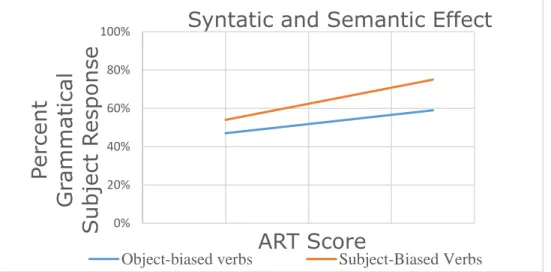
Using these two experimental designs will allow us to see if individual differences arise when the semantic bias is more or less supported by the context. If participants with greater exposure tend to make more semantic inferences we might expect their interpretation of the pronoun to be overall more consistent with the verb bias. Generally, we would expect to see this in our congruent- clause continuation task. On the other hand, in our novel-clause continuation task we will be able to see whether one bias persists more strongly over the other because they will not have any disambiguating information to rely on. This could result in a subject bias, as in Arnold et al. (2018) or if both effects are there, they might be negated. See figures 3 and 4 below for a depiction of a prevailing IC bias, a prevailing subject bias and what it might look like if both effects are present.
Table 1. Two experiments: Congruent Clause Continuation Task and the Novel Clause Continuation Task.
Task Verb bias Sentence Pronoun interpretation
Congruent Clause
Continuation Task
Object
Ana resented Liz because she is a
lousy coworker.
She = Liz
Subject Matt irritated Will because he is a
loud eater. He = Matt
Novel Clause
Continuation Task
Object
Ana resented Liz because she is a
dax.
She = Ambiguous; could
justify an interpretation for
Ana or Liz
Subject
Matt irritated Will because he is a
dax.
He = Ambiguous; could
justify an interpretation for
18
Figure 3. Predicted print exposure effects with a syntactic bias, i.e. subject bias vs. with a semantic bias i.e. implicit cause verb bias. This figure shows the percent at which participants might select the grammatical subject as the referent of the pronoun as ART score increases. We see performance based on the verb type participants will encounter and what this might look like if there was a prevailing bias.
Figure 4.Predicted print exposure effects with both a syntactic bias i.e. subject bias and with a semantic bias i.e. implicit cause verb bias. This figure shows the percent at which participants might select the grammatical subject as the referent of the pronoun as ART score increases. We see performance based on the verb type participants will encounter and what this might look like if both biases are present.
Pilot studies of both experiments were run to see if the methodology for these
experiments would at the least show a basic effect of verb bias. Participants received written 0% 20% 40% 60% 80% 100%
Perc
ent
Gr
ammat
ical
Subject
R
esp
onse
ART Score
Syntatic and Semantic Effect
Object-biased verbs Subject-Biased Verbs
0% 20% 40% 60% 80% 100% Pe rce n t G ram m at ical S u b je ct R esp o n se ART Score
ART Effect modulated by a Syntactic Bias
Object-biased verbs Subject-Biased Verbs
0% 20% 40% 60% 80% 100% Pe rce n t G ram m at ical S u b je ct R esp o n se ART Score
ART Effect modulated by a Semantic Bias
19
short stories like Ana resented Liz because she is a….The basic structure of each pilot
experiment was nearly the same, with the critical difference being the information given in the second clause of the short story, in the novel clause experiments it would be “…she is a dax,” in the congruent clause experiment, it could be something like, “….she is a lousy coworker.” Following each short story participants received two comprehension questions, with the critical question asking, “who is a dax,” or “who is a lousy coworker?”
20
EXPERIMENT 1 Methods
Participants
This experiment was administered via Amazon Mechanical Turk to 75 participants. 11 participants were excluded for incorrect ART, 3 participants were excluded for incorrect fillers, and 1 participant was excluded for both. All participants were native English speakers, at least 18 years of age, and were paid $1.25 for a completed study.
Materials and Measures
The experiment was designed in Qualtrics. In the main task, participants heard an audio recording of the stimuli along with pictures of the mentioned characters. After listening to the audio clip they answered two multiple choice comprehension questions about the content of the stimuli. Following the main task they completed the Author Recognition Task (ART).
21
implicit cause sentences. Participants saw sentences like: Liz and Will were on vacation.Liz watched TV with Will because she is a dax.
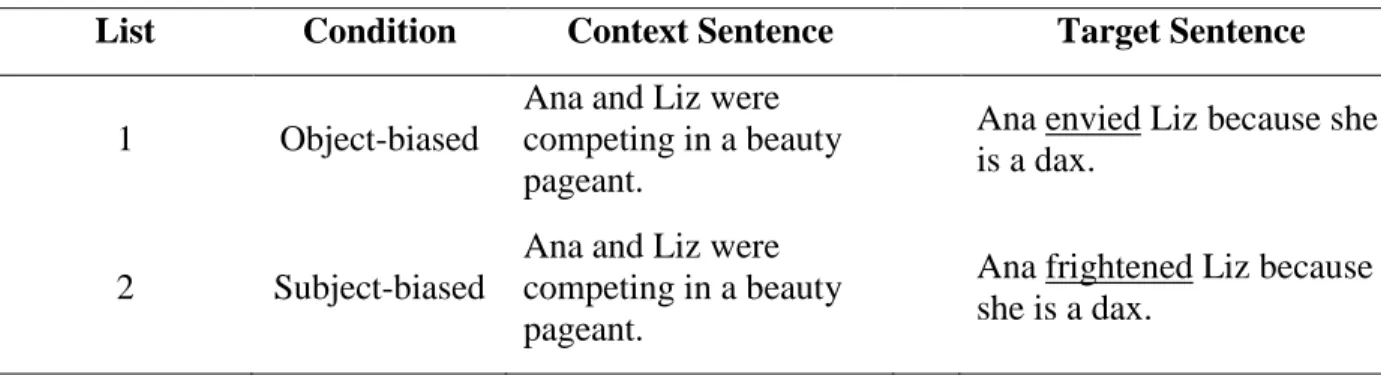
There was a total of 12 target items which appeared in two versions: one in which the second sentence contained a subject-biased verb, and one in which the second sentence contained an object-biased verb. Thus two lists were created with one version of an item per list (see table 2). As an example, list 1 might contain the short story Ana and Liz were competing in a beauty pageant. Ana envied Liz because she is a dax (object-biased), and list 2 might contain the sentences Ana and Liz were competing in a beauty pageant. Ana frightened Liz because she is a dax (subject-biased). Lists were counterbalanced for order of presentation i.e. there was a forward and backward version for a total of 4 lists. For all items see the Appendix. The two versions of the target items were the same in that they shared the same context sentence. Context sentences were manipulated within-subject such that participants heard all context sentences. Verb type was manipulated within-subject such that they heard both object- and subject-biased items, specifically each participant heard six object-biased items and six subject-biased items.
22
measures of frequency for the verbs via the SUBTL word frequency database as well as valence ratings via Warriner, Kuperman, & Brysbaert (2013). See the Appendix for biases, ratings, and frequencies.
Table 2. One target item appears across two list, differentiated by verb type.
List Condition Context Sentence Target Sentence
1 Object-biased
Ana and Liz were competing in a beauty pageant.
Ana envied Liz because she is a dax.
2 Subject-biased
Ana and Liz were competing in a beauty pageant.
Ana frightened Liz because she is a dax.
There were two types of questions for both target and filler items.Critical questions always asked, who is a dax? The other question was a content question that also functioned as a check question for both target and filler items. These questions asked about some given
information in the second clause of the sentence. For example, in the sentences Liz and Ana were working out at the gym.Liz loathed Ana because she is a dax, the participant saw a content question like Did Ana loathe Liz? In this example, the answer would be No. These questions were designed to be easily answered if participants were paying attention to the sentence.Both the critical question and the content question were formatted similarly, in that they were multiple choice questions with two answer options (see figures 5 and 6 below).
23
appeared equally in each position. Whether they received a critical question or a content question first or second was also counterbalanced.
Figure 5. Example of a critical question
Figure 6. Example of a content question
24
characters were mentioned an equal number of times as the first mentioned character i.e. the grammatical subject (five times per list), and as the second mentioned character i.e. the object (5 times per list). See the Appendix for a list of written stimuli and character images. Audio and images were presented on the same page followed by two comprehension question on the next page with two forced-choice answer choices per question. Audio recordings auto-played and the button to advance to the next page did not appear until 5 seconds after the duration of the audio to ensure that participants listened. Each question appeared on a separate page.
Author Recognition Task
The last task participants completed was the Author Recognition Task. We used a modified version of this task developed by Peter Gordon, which was based on previous versions of the task (Stanovich & West, 1989; Acheson, Wells, & MacDonald, 2008; Moore & Gordon, 2015). This task consists of an array of 126 names, 63 of which are author names, 63 of which are foils. Participants are asked to select only the names that are author names and they are instructed not to guess. (See Appendix).
Procedure
25
Participants then completed demographic questions about socioeconomic status, age, gender, ethnicity/race, vision, language experience and English language proficiency. They then proceeded to the main task, which began with two practice questions. They then went on to complete the main task and then the author recognition task. At the end of the experiment they received an end of survey message thanking them for their time and the randomly generated number to record on the Amazon Mechanical Turk site for payment.
Data Analysis
I ran a mixed effects logistic regression using SAS pros glimmix with a binary distribution and a logit link. The dependent measure was whether the participant selected the grammatical subject as the referent of the pronoun or not. It was coded as a binary measure with 1 for a grammatical subject selection and 0 for no grammatical subject selection. Predictors included verb bias which was a binary predictor (1 = subject-biased; 0 object-biased), ART scores, which were grand-mean centered, and a composite measure of SES, which was composed of an average z-score calculated from three measures (income, subjective measure of relative social standing, and parental education). Considering possible effects of nesting, participant and item were included as a random intercepts for all models. Random slopes of verb bias were included by participant and item, and random slopes of ART and SES were included by item as those predictors were added to the models. Random slopes for Verb bias and SES by item were removed because they were estimated to be 0.
The results of Cronbach’s alpha and the correlational analysis (see table 4 and 5) for the SES measures showed that parental education was weakly correlated with the other two
26
these measures are commonly used, so these measures were used in the SES composite score for the analysis.
Results
A total of 75 participants were run for experiment 1, but only 60 participants were included in the statistical analyses. Participants were excluded if over 50% of their responses on the Author Recognition Task were incorrect. This was calculated by taking the proportion of incorrect to correct responses of each participant. Second, participants were excluded if they got less than an average of 75% correct on filler items. This was calculated by coding correct vs. incorrect responses, 1 and 0 respectively and calculating the average correct responses per participant.
I first ran a basic model to see if there would be an effect of verb bias on the rate of grammatical subject responses. There was a significant main effect of verb bias (β = 2.638, SE = 0.3328, t = 7.93, p <.0001). Participants were more likely to identify the subject as the referent of the pronoun in the subject-bias condition (62.5%, SE = .0437) than in the object-bias condition 14.4%, SE = .0252).
The primary question of this experiment was whether individuals’ pronoun interpretation would vary by their performance on the author recognition task and whether this variation would be correlated with variation in an implicit cause bias, a subject bias, or both. Grand-mean
27
variable this is represented by greater grammatical subject interpretation as ART score increased in the subject bias condition and less grammatical subject interpretation as ART score increased in the object bias condition (Fig. 7).
Figure 7. Participants show stronger semantic bias as ART score increases.
Additionally, I found that participants displayed an overall object bias. When the verb was biased participants interpreted the pronoun as referring to the character in the object-position (85.56%) more often than they interpreted the pronoun as referring to the character in the subject-position (62.5%) when the verb was subject-biased (Fig. 8). This is in contrast to other reports of an overall subject bias in sentence completion studies, where participants had to provide continuations to implicit clause sentence fragments (Kehler & Rohde, 2008; Stevenson, Crawley, & Kleinman, 1994).
-0.2 0 0.2 0.4 0.6 0.8 1
-10 0 10 20 30 40 50
A
ver
age Gr
amm
ati
cal
Subject
Sel
ec
ti
on
ART Score
Verb Bias X ART Score
Object-Biased Verbs Subject-Biased Verbs
28
Figure 8. This figure shows how often participants interpreted the pronoun as referring to the character congruent with each verb bias.
Lastly, I analyzed whether participants varied by Socioeconomic Status (SES). I measured SES by creating a composite score, which included a measure of household income, the higher of mother and father education, and a subjective measure of social standing, in which participants identified how they believed they compared to others in their community via a ladder scale (see appendix for example).
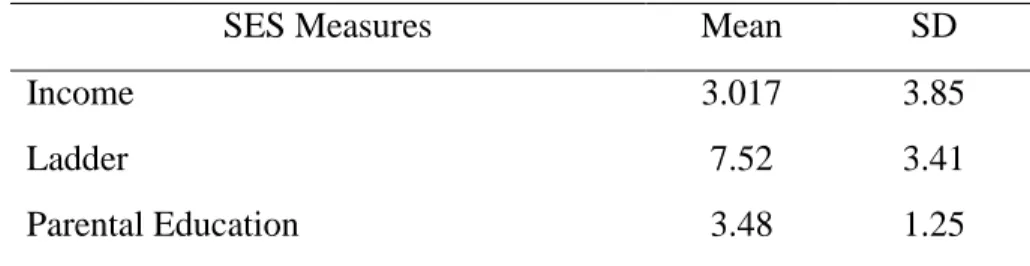
For both the ladder scale and income, I calculated z-scores for each participant. Income was coded on a scale of 1 to 21, where 1 represents a household income of less than $50,000 and 21 represents a household income of over $1,000,000. Mother and Father Education was coded on a scale of 1 to 5, with 1 being they did not graduate high school and 5 being they obtained a graduate/professional degree. I then selected the higher score of each participant’s parent, which I used to calculate the z-score for parental education. The SES score for each participant was created by taking the average of the z-scores for the three measures. The mean and SD for each are presented below in table 3. To determine the internal reliability of each of these measure with
0 0.2 0.4 0.6 0.8 1
object subject
A
ver
age
Cong
ruent
Char
act
er
Sel
ecti
on
Verb Bias Condition
Average Selection of the Character
29
one another, I calculated Cronbach’s Alpha (table 4) as well as the correlation between each of the measures (table 5).
Table 3. SES Measures
SES Measures Mean SD
Income 3.017 3.85
Ladder 7.52 3.41
Parental Education 3.48 1.25
Table 4. Internal reliability of the SES measures
Note: Reliability is weak, ≥ .8 is considered good internal reliability
Table 5. Pearson Correlation r values.
SES Measures Income Ladder PE
Income 1 .309* .183*
Ladder 1 .208*
Parental Education 1
Note: Correlation between Ladder and Income shows moderate strength, all others are weak. * indicates significance at p value of .01.
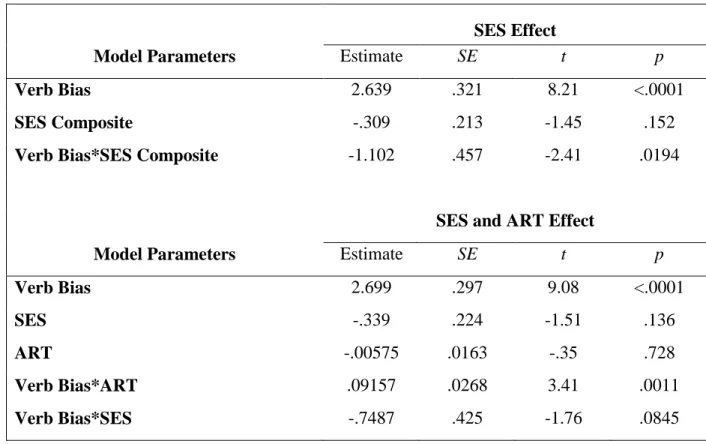
I tested the effect of SES by adding both SES and the interaction between SES and verb type to the model. Results showed that there was no effect of SES (p = .1524) when verb bias was included as a predictor. There was however, an interaction between SES and verb bias condition (see Table 6). I then added grand-mean centered ART score to the model as predictor and the ART x verb bias interaction. Results again showed no main effects of SES or ART, and
Reliability Measures
N Cronbach’s
Alpha
30
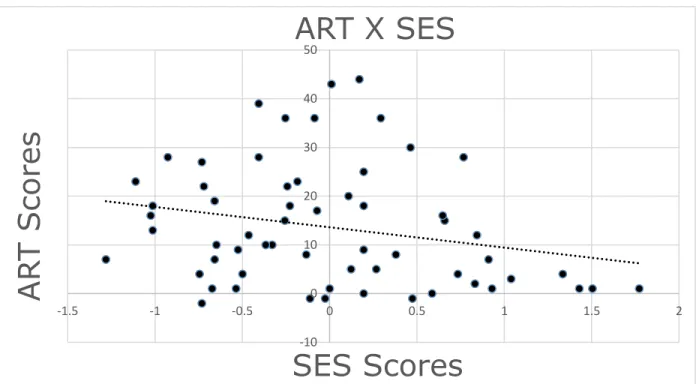
only the ART x Verb Bias remained significant. The SES x Verb Bias interaction was not significant (see Table 6 for both interactions). Results also showed that ART and SES were negatively correlated with one another, which is not consistent with what we would expect (r = -.303, p = .0185) (see figure 9).
Figure 9. ART score is on the y-axis and SES composite score is on the x-axis. -10
0 10 20 30 40 50
-1.5 -1 -0.5 0 0.5 1 1.5 2
AR
T
Sco
re
s
31
Table 6. Statistical model for SES effect and interaction in Experiment 1 SES Effect
Model Parameters Estimate SE t p
Verb Bias 2.639 .321 8.21 <.0001
SES Composite -.309 .213 -1.45 .152
Verb Bias*SES Composite -1.102 .457 -2.41 .0194
SES and ART Effect
Model Parameters Estimate SE t p
Verb Bias 2.699 .297 9.08 <.0001
SES -.339 .224 -1.51 .136
ART -.00575 .0163 -.35 .728
Verb Bias*ART .09157 .0268 3.41 .0011
Verb Bias*SES -.7487 .425 -1.76 .0845
Experiment 1 Discussion
In experiment 1, I investigated whether individual differences in print exposure were related to interpretation of ambiguous pronouns in the context of implicit causality sentences that end in a novel word. Results of this experiment indicated a semantic bias effect, such that overall people tended to assign the pronoun to the character consistent with the implicit cause bias. Critically, there was an interaction between verb bias and ART which showed that those with higher ART scores followed a stronger semantic bias than those with lower ART scores. Results indicated no subject bias and no significant relationship with individual difference in ART.
32
reading/language skill. Results also showed that socioeconomic status did not significantly predict ambiguous pronoun resolution. There was however, a significant interaction between verb bias and SES. The interaction was in a direction that I would not have predicted, it showed that those with higher SES were less likely to follow a semantic bias in their pronoun interpretation than those with lower SES. However, when ART was added to the model the SES and verb bias interaction went away while the ART and verb bias interaction remained significant.
33
EXPERIMENT 2 Methods
Participants
This experiment was administered via Amazon Mechanical Turk to 85 participants. 6 participants were excluded for incorrect ART, 5 participants were excluded for incorrect fillers, and 14 participant was excluded for both. All participants were native English-speakers, at least 18 years of age, and were paid $1.25 for a completed study.
Materials and Measures
Experiment 1 and 2 were the same except for three important differences. The first difference was that the second clause of the second sentence in each critical item in experiment 2 continued with disambiguating information congruent with the verb bias rather than a novel word (see Table 7). For example: Ana and Liz were performing in a beauty pageant. Ana envied Liz because she is a beautiful woman. The second important difference was instead of 8 there were 12 filler items: 6 different gender “with” (joint-action) filler items, where joint-action is referring to the two characters engaging in some action together and 6 different gender transfer verb filler items.
1) “With” (joint-action) filler example: Ana and Matt were washing paint brushes.Ana painted with Matt because she is an art teacher.
2) Transfer verb filler example: Will and Ana were at McDonald’s.Will took the fries from Ana because she was full.
34
makes sure there would be some variation in participant responses, and so that participants would not fall into a pattern of responding.
Again, just as in experiment 1 every item consisted of two sentences. The third difference however, was that the critical questions always asked about the disambiguating information in the second clause rather than the novel word, for example, who is a beautiful woman? These are the questions in which we were able to see how the participant interpreted the pronoun given the disambiguating information in the second clause in addition to the IC verb bias (for target items).
Table 7. One target item appears across two list, differentiated by verb type.
List Condition Context Sentence Target Sentence
1 Object-biased
Ana and Liz were competing in a beauty pageant.
Ana envied Liz because she is a beautiful woman.
2 Subject-biased
Ana and Liz were competing in a beauty pageant.
Ana frightened Liz because she is a beautiful woman.
Procedure
The procedure for Experiment 2 is the same as the procedure in Experiment 1
Data Analysis
The data analysis for Experiment 2 is nearly the same as the procedure in Experiment 1 except that random slopes for ART were removed by item because they were estimated to be 0.
Results
35
average of 75% correct on filler items. This was calculated by coding correct vs. incorrect responses, 1 and 0 respectively and calculating the average correct responses per participant.
As in experiment 1, I ran a basic model to see if there would be an effect of verb bias the rate of subject selection. There was a significant main effect of verb bias such that participants were more likely to identify the subject as the referent of the pronoun in the subject-bias condition (79.2%, SE .032) than in the object-bias condition (8.6%, SE .018) (See Table 11).
The primary question of this experiment was the same as experiment 1, to see whether individuals’ pronoun interpretation would vary by their performance on the author recognition task and whether this variation would be according to an implicit cause semantic bias, and/or a subject bias. Grand-mean centered ART scores were added to the model, as well as the
36
Figure 10.Participants show stronger semantic bias as ART score increases.
Similarly to experiment 1, I found that when the verb was object-biased participants interpreted the pronoun as referring to the character in the object-position (91.39%) more often than they interpreted the pronoun as referring to the character in the subject-position (79.2%) when the verb was subject-biased (Fig. 11).
-0.2 0 0.2 0.4 0.6 0.8 1
-10 0 10 20 30 40 50 60
A
vereage
Gr
amm
ati
cal
Subject
Sel
ec
ti
on
ART Score
Verb Bias X ART Score
37
Figure 11. This figure shows how often participants interpreted the pronoun as referring to the character congruent with each verb bias.
Lastly, as in experiment 1, I analyzed whether participants varied by Socioeconomic Status. The same method was used to calculate the SES composite score. The mean and SD for each are presented below in table 8. See table 9 and table 10 for Cronbach’s Alpha and the correlation between each of the measures, respectively.
Table 8. SES Measures
SES Measures Mean SD
Income 3.23 4.33
Ladder 8.25 2.87
Parental Education 3.4 1.07
0 0.2 0.4 0.6 0.8 1
object subject
A
ver
age
Congrue
nt
Bi
as
R
es
po
ns
e
38 Table 9. Internal reliability of the SES measures
Note: Reliability is weak, ≥ .8 is considered good internal reliability
Table 10. Pearson Correlation r values.
SES Measures Income Ladder PE
Income 1 .275* -.0094
Ladder 1 .125*
Parental Education 1
Note: Correlation between Ladder and Income is approaching moderate strength, all else are weak. Parental Education and Income are not significantly correlated. * indicates significance at a p value of .01.
Just as in Experiment 1, results showed that there was no effect of SES (p = .224) when verb bias was included as a predictor. Unlike Experiment 1 there was no interaction between SES and verb bias condition (p =.3304). I added grand-mean centered ART score to the model as a predictor and the ART x verb bias interaction. Results again showed no main effects of SES or ART, and only the interaction between ART x Verb Bias, was significant (p = .0027) (See table 12). As in Experiment 1, the relationship between ART and SES showed a significant negative correlation (r = -.2844, p < .0276).
Reliability Measures N Cronbach’s
Alpha
39
Table 11. Statistical model for Verb Bias effect and ART effect output for Experiment 2 Basic Verb Bias Effect
Model Parameters Estimate SE t p
Verb Bias 4.053 .3786 10.7 <.0001
ART Effect
Model Parameters Estimate SE t p
Verb Bias 4.1877 .3786 11.06 <.0001
ART .002785 .012 .23 .8192
Verb Bias*ART .09308 .0284 3.28 .0014
Table 12. Statistical Model for Verb Bias effect and SES effect
SES Effect
Model Parameters Estimate SE t p
Verb Bias 4.109 .3775 10.88 <.0001
SES Composite -.3117 .2454 -1.27 .2243
Verb Bias*SES Composite -.5427 .553 -.98 .3304
SES and ART Effect
Model Parameters Estimate SE t p
Verb Bias 4.236 .3806 11.13 <.0001
SES -.2979 .2419 -1.23 .236
ART -.00122 .01248 -0.1 .922
Verb Bias*ART .09165 .02974 3.08 .0027
40 Experiment 2 Discussion
In experiment 2, I investigated whether individual differences in print exposure were related to interpretation of ambiguous pronouns in the context of implicit causality sentences. As in experiment 1, results of this experiment indicated a semantic bias effect, such that overall people tended to assign the pronoun to the character consistent with the implicit cause bias. Critically, there was an interaction between verb bias and ART which showed that those with higher ART scores followed a stronger semantic bias than those with lower ART scores. Results indicated no subject bias effect and no significant relationship between a subject bias and individual differences on the ART. Again, I tested whether socioeconomic status would predict ambiguous pronoun comprehension. Results showed that socioeconomic status did not significantly predict ambiguous pronoun resolution nor did it reveal any individual differences in pronoun comprehension.
GENERAL DISCUSSION
The current study explored whether there were individual differences in ambiguous pronoun resolution in the context of implicit causality verbs. The results of both experiment 1 and 2 showed that participants’ pronoun resolution varied by their scores on the Author
Recognition Task (ART), a proxy for print exposure. Participants with higher ART scores tended to show a stronger semantic bias in both experiments, whereas those with lower ART scores showed more variation i.e. a weaker semantic bias. Secondarily, the results of the SES analysis ultimately showed that SES did not explain any individual difference effects over and above the ART.
41
differences in pronoun comprehension (Arnold et al. 2018; Daneman & Carpenter, 1980; Francey & Cain, 2015; Langlois & Arnold, 2019). More specifically, it contributes to the growing body of literature that links individual differences in pronoun resolution to print
exposure via the ART (Arnold et al. 2018; Arnold, Castro-Schilo, Zerkle, Rao, 2019; Langlois & Arnold, 2019). Critically, these findings contribute something new to the literature by showing that individual differences in pronoun resolution by way of print exposure extends to implicit causality sentences. To my knowledge, this has not been done before.
Previous work has demonstrated that on average, people tend to have a bias that the implicit cause will be mentioned again (Brown and Fish, 1983; Garvey, Caramazza, and Yates, 1976; Kehler, Kertz, Rohde, & Elman, 2008; Stevenson, Crawley, & Kleinman, 1994). For example, in a sentence fragment like John admired Bill because he…people are likely to complete this sentence in such a way that the pronoun refers to Bill, the implicit cause. So the question then is: what is it about print exposure that contributes to the variation we see in how people apply implicit cause interpretations in pronoun resolution?
Here I consider two accounts for how print exposure might contribute to pronoun
frequency-42
based account in line with the Expectancy Hypothesis that as we are exposed to language over a lifetime, we become predisposed to common patterns of reference that in turn influence our expectations (Arnold, 1998; 2001; 2010). Interestingly, following the assumptions of this frequency-based account, this begs the question of why we did not find an individual difference effect related to a grammatical subject interpretation of the pronoun. If people who read more are more likely to encounter subject re-mention, then we would hypothesize that an individual difference effect would appear here as it did in both Langlois and Arnold (2020) and Arnold et al. (2018). This suggests that something beyond frequency might be accounting for the results that we see and that maybe semantic and syntactic biases are learned in different ways.
43
This leads into the second account that might explain the presence of an individual difference effect with implicit causality sentences. The second account proposes that semantic constraints matter for predicting the re-mention of a particular referent. This is in line with a semantic-based account, such as the one proposed by Kehler et al. (2008) and Kehler and Rohde (2013). Their model accounts for the probability that a particular entity in the discourse will be mentioned, and suggests that people are tracking likelihood of mention in terms of semantics. This would mean that under the semantic constraints of implicit causality sentences the implicit cause is most likely to be re-mentioned. For example, if you hear, Ana admired Liz because… as the listener you are likely to continue with whoever is most likely the cause of the admiration.
This could be interpreted to mean that print exposure matters because it is related to one’s ability to make semantic inferences perhaps on a case by case basis as opposed to tracking
relative frequencies of mention. This suggests that given the features of the context, high print exposure people are better able to use the information at hand to make inferences about
likelihood of mention. This is in line with findings showing that language skills are strengthened with greater language exposure (Cunningham & Stanovich, 1991, 1992, 2001; Mani & Huettig, 2014; Montag & Macdonald, 2015; Stanovich & West, 1989; Wells, Christiansen, Race,
44
Francey & Caine (2014) showed that children with poor reading comprehension skills were less skilled at resolving pronouns in gender ambiguous cases than children with better reading comprehension skills. They used sentences that required implicit cause inferences by using because as the clause connector. Participants heard sentences like: Michael handed a thank you note to Adrian, after the party, because he was polite. They were then asked a pronoun comprehension question like: who was polite? Critically, their findings showed that when the gender cue was available (i.e. two different-gendered characters), the children with lesser reading skills showed results approaching those with greater reading skill. This means that they
understood that pronouns refer back to a specific entity. However, their ability to correctly identify the antecedent suffered when the gender cue was no longer available (i.e. two-same-gendered characters). When the pronoun referred to the character in the subject position less skilled reader correctly identified the antecedent of the pronoun less often on average (M = 5.76) compared to more skilled readers (M = 6.24). Similarly, when the pronoun referred to the
character in the object position less skilled reader correctly identified the antecedent of the pronoun less often on average (M = 5.94) compared to more skilled readers (M = 7.59). Thus when additional inferential steps were required to resolve the pronoun by making use of other features of the linguistic context, those with poor reading skills showed a greater deficit compared to the more skilled readers.
So perhaps those with higher ART scores are more skilled at using available semantic information to make inferences because they have more experience doing so as a result of more opportunities to practice doing this via greater print exposure. Long and De Ley (2000)
45
found that skilled readers were faster at identifying names congruent with the bias than less skilled readers, and were significantly more accurate in their responses to the probes. Results also showed that less skilled readers only showed an effect of implicit causality on pronoun resolution after they had integrated information from both clauses. These result suggest that there are processing costs for less skilled readers. Additionally the results from Long and De Ley (2000) suggest that less skilled readers rely on the congruent information because making semantic inference from the verb and the coherence relation is more difficult for them to do, perhaps because they have had less print exposure and thus less practice.
In an ERP study Dai et al. (2019) showed that responses to gender-incongruent pronouns in causal, hypothetical, and counterfactual statements were modulated by print exposure.
46
Counterfactual statements tend to serve two functions: affective functions such that they relay personal feelings and intentions and/or procedural functions. Both functions involve having to make causal inferences and reason beyond the content of the statement (Dai et al., 2019). Speculatively based on post-experiment interviews, Dai et al. (2019) proposed that those with high print exposure were more inclined to elaborate the counterfactual statements in order to resolve conflicts and consider an alternative interpretation. On the other hand, Dai et al. (2019) proposed that those with low print exposure tend to process the referential relations of the three statement types in a similar way, as erroneous. They opt for a more shallow representation of the discourse, which is a less costly (e.g. use of less cognitive resources) anaphoric interpretation.
In regard to the current study, perhaps high print exposure means exposure to different contexts in which individuals engage in higher order cognitive processes such that they have more practice with considering alternative referential interpretations and making semantic inferences as they encounter the information, while those with low print exposure are less likely to engage because of less practice engaging higher order processes. In the currents study we see that those with low print exposure show a less discrete pattern of response in their referential interpretations as compared to those with higher print exposure, and maybe a potential
explanation for this is that those with less print exposure are less likely to expend the resources to engage with more taxing semantic contexts, like implicit cause.
47
from this study did not show individual difference in how people interpreted the pronoun given the semantic bias of the verb. They did however, find a goal bias effect, in that overall people tended to have a preference for the goal as the referent of the pronoun. Also in contrast to the current study, but in line with the results of Arnold et al. (2018), results showed an individual difference effect with a subject bias. They found that as ART score increased so did
interpretation of the pronoun as the subject.
Langlois and Arnold (2020) argue that their findings suggest that the goal bias is not learned through print exposure, but is instead determined by semantic information available in the stimuli. It might be the case that in both studies people are using the semantic context to determine which entity is likely to be mentioned again, but then critically what explains the presence of an individual difference effect how people use comprehend pronouns in implicit cause sentences and not transfer verb sentences? Perhaps it has something to do with the nature of this particular type of semantic information (i.e. transfer verbs) that makes it inherently easier to process than other semantic information (i.e. implicit cause verbs). While the stimuli in my study were not very complex, I speculate that the results from the current study, Long and De Ley (2000) and Dai et al. (2019) support the semantic-based account in regard to an individual effect because implicit causality structures are harder to resolve than goal/source structures. In real world situation both linguistically and non-linguistically we are exposed to circumstances that would instantiate goal/source events, which might make them inherently easier to
48
elaborate the counterfactual statements and consider alternative interpretations and intentions, while those with low print exposure opt for a more shallow representation of the discourse, which uses less cognitive resources, the same reasoning could extend to resolutions of reference using the implicit cause. Both Langlois and Arnold (2020) and the current study provide first steps in regard to print exposure effects, so there are open questions that neither of these studies can fully address without future research. Importantly, in sum, whether the individual difference effect seen is explained by a frequency-based account or a semantic-based account is speculative and further experimentation would have to be done as both are plausible accounts.
The current study also study looked at whether individuals’ pronoun resolution would vary with respect to their socioeconomic status (SES). I wanted determine whether the ART effect that was found could instead be explained by participants’ SES. Both socioeconomic status (Hecht & Close, 2002; Hoff, 2003; Peterson & Pennington, 2015; Cheng & Wu, 2017) and the author recognition task have been shown to correlate with measures of reading skill, so as a secondary analysis SES was included as a possible predictor of individual differences. Results showed that in experiment 1 (i.e. the novel clause exp.) there was no main effect of SES, but there was a significant interaction between SES and Verb bias. However, it did not correspond to what we would predict based on previous literature (Hecht & Close, 2002; Hoff, 2003; Peterson & Pennington, 2015; Cheng & Wu, 2017). Results showed the opposite of what we would expect, in particular that those with higher SES were less likely to follow a semantic bias than those with lower SES. Importantly, however when ART was included as a predictor along with the interaction of ART with verb bias, the SES and verb bias interaction was no longer
significant. Critically the ART and verb bias interaction remained significant even in the
49
any SES interactions. Therefore, we conclude that the ART effects found in this study are not being explained by SES. This conclusion is supported by the results of experiment 1 and 2 together, including results showing a negative correlation between SES and ART in both experiments.
In closing, it is also important to address a key methodological difference between the two experiments. The fact that we see similar implicit cause effects occur in each experiment suggests that there is something over and above the information in the last clause of the implicit cause sentences that leads to an implicit clause bias. This is supported by the focusing account of implicit causality, which generally asserts that the implicit cause effect occurs before any
disambiguating information is reached (Cozijn, Commandeur, Vonk, & Noordman, 2011;
Järvikivi, van Gompel, & Hyönä, 2017). It is important to note that I cannot disentangle the verb and the coherence relation as all of my stimuli used the clausal link “because.” I used it knowing that it would signal an explanation relationship and prompt an expectation to continue speaking about the cause when paired with implicit cause verbs (Au, 1986; Stevenson et al., 1994; Kehler & Rohde, 2013; Guan & Arnold, in press).
These results imply that exposure is related in some way to how people grapple with the
semantic information they are given regardless of the information (novel or congruent) in the
second clause, in regard to making inferences about who will be referred to next. This is in line