BIA EDUCATION RESEARCH BULLETIN, YEAR 1976
Vol. 4, No. 1, January 1976
Indian Control of Schools 1
Jon C. Wade
Federal Responsibility in the Field of Indian Education 6 Barry K. Berkson
Curriculum Development in the Bureau of Indian Affairs – 13 A General Discussion.
Thomas R. Hopkins, Lyle G. Elton and Carlee Lowry
Alaska’s Cross-Cultural Education Development Program 20 D. M. Murphy
Vol. 4, No. 2, MAY 1976
Graduating Senior Options, Kotzebue High School 22 Charles E. Wall
Brief History of Cherokee Schools 1804 — 1976 24 T.J. DuPree
A Comparison of English as a Second Language Program and 31 Normal Classroom Instruction With Indian Students in Reading
Carl R. Cooley, Bob M. Vanosdol, D.M. Johnson
Perceptions of the TRIA Definition of BIA Instructional Aide 42 Competence Held by Instructional Aides and Their Supervisors
Norris Arden Thomson
Vol. 4, No. 3, September 1976
Linguistics in Practice: The Navajo Reading Study Program 44 Bernard Spolsky
Learning Principles 51
Bruce S. Pray, Sr.
Dissertation Abstract, The Relationship of Perceived Community 60 Educational Viewpoints and Pupil Control Ideology Among Teachers
Gerald Ellis Gipp
Dissertation Abstract, American Indian Education: Cultural 62 Pluralism or Assimilation
INDIAN CONTROL OF SCHOOLS by
Jon C. Wade
"Consistent with our policy that the Indian community should have the right to take over the control and operation of federally funded programs, we believe every Indian community wishing to do so should be able to control its own Indian schools. “1
This paper is not an attempt to minimize the President's words, but is an effort to be realistic about the issue of community control of schools whether by Indians or anyone else, and to suggest a model for maximum community influence.
In any discussion on "controlling something", the legal parameters must be considered. Those parameters include the Constitution of the United States. And even though at no point does it expressly refer to education, it should not be concluded that it in no way relates to or affects education. Article I, Section 10 and the First, Fifth and Fourteenth Amendments bear most directly on the operation of schools and are those sections that protect the so-called inherent rights of individuals.
The basic function of state constitutions is to define the powers of state legislatures. The courts constantly say that the power of the state legislatures over the public school systems of the respective states is plenary. Thus, the restrictions of the Constitution must be considered along with restrictions of the state constitution when examining the validity of educational decisions.
If we are talking about non-public schools, the courts have ruled that states must allow them to exist (Pierce vs Society of Sisters). In doing so, the Court put forth a doctrine of great importance to American education — the fundamental liberty of parents and guardians to direct the upbringing and education of the children under their control. However, the Court emphasized that the state had the power reasonably to regulate all schools and to set up qualifications for teachers and require that certain studies essential to citizenship be taught to all.2
States have qualifications for such personnel as cooks, bus drivers, etc., too. These people are protected from unreasonable dismissal.
Thus far, I have been speaking of legal limitations on the power of local boards of education. Let us move now to extra-legal controls. Regional or national school accreditation associations, colleges and universities, and labor management, to name a few, demand a certain product out of your school if that product is to function within their domain of influence. Thus, if students are to go to college or into the world of work, they must possess skills that will allow them to function successfully. Again, the school board's latitude is narrowed.
1
President Richard Nixon, Message to the Congress, July 8, 1970.
2
Local, state, and national teachers' associations are another force with which boards of education must deal. This is a force that is demanding more decision making authority within the school.
A third area of decision making control lies in the community itself. The politics of the community influences school board decisions. The community decisions makers vary from community to community, but rarely does the school board make a decision unilaterally. This fact is particularly true when we are talking about local boards of education on an Indian reservation. Further, those studies that have focused on the power structure of schools have documented the political nature of school decision making, as well as, the interrelatedness of educational issues and other community matters.3
Fourthly, no organization has control of itself unless it has control over its financial resources, both the acquisition of and its allocation within the system. Indian school boards, not unlike many other school boards, are not fiscally independent. They must rely on what the Congress, the state, and private sources allocate to them.
In conclusion, no community lives unto itself. Today, communities are increasingly open social systems. As open systems, they are dependent entities in a society of interdependent communities. Such interdependence magnifies the difficulties confronting the practitioners of community power as they attempt to work within it. In short, local community control of schools is a myth.
The emphasis should be on community management of schools. How then do school boards fulfill their management obligations? Basically in two ways:
1) they are the legitimate front for relationships with their public, and 2) they have internal operational responsibilities.
The selection of top administrative leadership, allocating of fiscal resources, and examination of the system's product are examples.
Why should "community management" be desired? Will there be increased cognitive achievement on the part of students? I think not. There is little evidence to indicate a correlation between community influence and student achievement. Cohen says, "unfortunately, however, there is no evidence that the level of parent participation in schools is related to students' achievement."4
"Minority ethnocentrism is a modest risk, and possibly a healthy counter-force to the previous generations of majority ethnocentrism, that resulted in poor self-image and lack of confidence on the part of minority group students."5
However, the biggest reason for Indian community management of school is that stated by the President, Abt mentions it, and it's the basis for the Bureau of Indian Affairs' draft entitled Model Agreement — School Boards 6 —namely, the right of American Indians to decide how and for what their children are to be educated. "American Indians have the right to control their own schools as much as any other American community. If they wish to exercise that right, the government should give them every support in doing so."7
That right must face a political reality however. The opportunity of Indians to manage public schools in urban/off-reservation districts is dictated by the state and is not a goal that can be reasonably realized under our present system of educational governance. The opportunity of Indians to manage Federal or private schools is a more realistic goal subject to the legal limitations mentioned earlier.
At this point, I would like to suggest a model that may accomplish our task.
The reservation Indian community which cannot or does not assume control of the existing public school system located on their reservation might consider the following model.
This model calls for the management of schools by Indian people as provided by a Tribal System of Schools consisting of (1) federated community educational governments and (2) an umbrella reservation-wide educational government.
These would come into existence by a charter from the tribal council. The charter would provide a reservation-wide board of education with limited responsibilities and local boards of education with power to perform most of the traditional functions of a school board.
Presently, there is a desire for autonomy within many of the community school boards. If then, these community schools were to be operated wholly on their own, we would experience the same disadvantages we find in our small rural districts throughout the Midwest. Schools would be left with marginal programs and little opportunity to make efficient use of the specialized personnel. Moreover, this would ignore the interdependence of the communities to each other and the total reservation.
For the tribal council to create a reservation-wide school board with total responsibility for the conduct of all schools would negate local responsibility.
5
Abt Associates, System Analysis, Program Development, and Cost-Ef f e c ti v e n e s s M o d e l i n g o f In d i an E d u c ati o n f o r th e B u r e au of Indian affairs, Volume I, Summary and Recommendations, Abt Associates Inc., Cambridge, Mass., 1969, p. 25.
6
My recommended alternative would be a combination of the two before mentioned choices.
At first glance, this proposed systems of educational governance may not seem noteworthy. However, its uniqueness lies in its move from the traditional role the tribal council has played in education to the creation by the council of a legal body outside the council. This system will recognize the authority of the council while providing for a delegation of responsibility away from it.
Specifically, the reservation-wide educational government would have responsibility for such functions as securing construction resources and building school facilities; long range planning; establishing attendance boundaries; collecting and allocating fiscal resources to support the community educational government; and requiring standards.
The community educational government in having responsibility for the operation of their local school would hire personnel, establish curriculum, assign staff, make policy, and spend money.
This federated system calls for a structure by which the tribal council can meet its commitment to the education of reservation children and, at the same time, provide for extended opportunities for parental access to that structure.
I would like to take another step toward what could be. It is understood that the state has the responsibility to provide a public school opportunity for all children of the state and that the state has established an educational system for this purpose which in many cases does include reservation areas.
The idea has been advanced that tribal government create a system of educational governance for the reservation. The Federal government may recognize this system for its business with the Tribe. Federal recognition does not imply anything about state recognition.
But, the idea is expanded if the state recognizes and adopts, through negotiation, the system created by each tribe as the state's arm for providing public education within and for the reservation. The tribal system may or may not conform to what already exists. It must provide for all children.
Acceptance of this idea will not be easy, but its advantages are great. The following are examples:
1) Increased Indian management of schools.
2) Increased Indian involvement and participation in the education process.
This model is built on a philosophy of finding a reasonable balance between the rights of the individual and the needs of the state (tribe). The welfare of the state (tribe) is served by the creation of an enlightened citizenry. At the same time, parents have the right to .make a reasonable selection of the type of education they desire for their children. The needs of the state (tribe) must be fulfilled by a citizenry that possesses a high degree of knowledge about the world as well as basic appreciation toward his own society.
It is my belief that the implementation of this model could increase the opportunities for the individual development and personal success needed by this Nation of its Indian citizens.
BIBLIOGRAPHY
Abt, System Analysis, Program Development, And Cost-Effectiveness Modeling of Indian Education For The Bureau of Indian Affairs, Volume I, Summary and Recommendations, Abt Associates, Inc., Cambridge, Mass., 1969.
Campbell, Roald F., Luvern L. Cunningham, Roderick F. McPhee, Raphael 0. Nystrand, The Organization and Control of American Schools, Charles E. Merrill, Columbus, Ohio, 1970.
Campbell, Roald F., Donald H. Layton, Policy Making For American Education, The University of Chicago, Chicago, Ill., July 1969.
Cohen, David K., "The Price of Community Control," Theory Into Practice, VIII, No. 4, October 1969.
Draft, School Contract Assistance Team - Model Agreement —School Boards, Bureau of Indian Affairs, Washington, D.., April 1971.
President Richard Nixon, Message to the Congress, July 8, 1970.
Reutter, E. Edmund, Robert R. Hamilton, The Law of Public Education, The Foundation Press, Inc., Mineola, New York, 1970.
Robinson, William N., American Education: Its Organization and Control, Charles E. Merrill, Columbus, Ohio, 1968.
F E D E R A L R E S P O N S I B I L I T Y I N T H E F I E L D O F
INDIAN EDUCATION
by
Barry K. Berkson1
Does the United States have a legal obligation to educate American Indians? If there is such an obligation, does it extend to all Indians, regardless of whether they may reside on a reservation or in a city? What about blood quantum? Would it have any bearing on the question if the Indian blood quantum was less than full; less than 1/2; or, less than 1/4? Would tribal affiliation have a bearing?
If there is such an obligation on the part of the United States, how much of an education would be required — through high school; through college`?
Perhaps there is limited obligation. Perhaps there is no real legal obligation at all. Perhaps there is a moral obligation.
It would appear that by this time, many articles would have been written, discussing these questions in depth; but surprisingly, I have found very little printed matter directed to the heart of the principal question.
C O N G R E S S IO N A L R E C O G N IT IO N OF A FEDERAL OBLIGATION
As a beginning point, we know that Congress of the United States has appropriated Federal funds for Indian education for better than 150 years, commencing in the year 1802, with the grand sum of $15,000.00.2 It is interesting to contrast this sum of money with the nearly $145,000,000.00 appropriated by Congress for Bureau of Indian Affairs Indian Education Programs alone in Fiscal Year 19753; not to mention other sizeable funds appropriated by Congress for Indian education programs such as Johnson-O'Malley4 and funds appropriated to the Office of Indian Education5. In view of the long-established practice of the Congress of the United States to make annual appropriations of federal funds for the benefit of Indian education, it is safe to conclude that the Congress does recognize some kind of Federal obligation in the field of Indian education. There are other Congressional enactments, some of which have been on the statute books a long time, which further reflect the fact that Congress does indeed recognize a special commitment to Indian education. For example, in an 1819 statute, which is still effective, Congress authorized the President to employ teachers to teach Indian children reading, writing, arithmetic, and agriculture6. In 1889, Congress directed the President, with the advice and consent of the Senate, to appoint a Superintendent of Indian Schools'. In 1908, the Congress directed that all expenditures of money appropriated for Indian school purposes shall be under the direction of the Commissioner of Indian Affairs, subject to the supervision of the Secretary of the Interior.8
Although we have identified a Federal obligation in Indian education, Congress has enacted several pieces of legislation which recognize the obligation of the States to serve the educational needs of Indians. For example, a 1929 law authorized the Secretary of the In t e r i o r t o a l l o w a ge n t s o f t h e S t a t e s t o e n t e r u p o n In d i a n reservations to enforce the penalties of State compulsory school attendance laws against Indian children and parents.9 Previous to that law, the Congress directed that no appropriations, except appropriations made pursuant to treaties, could be used to educate children of less than 1/4 degree Indian blood, whose parents are citizens of the United States and of the State wherein they live, and where there are adequate free school facilities provided? 10This law is interesting from several aspects; one being that it attempted to set up some kind of eligibility standards for Indians to receive assistance for education; the other being the fact that Congress recognized that many Indians did, in fact, receive free public school education by many of the States at that time. It would appear that this law would have formed the basis for the Bureau's regulations governing school enrollment eligibility, as set forth in 25 CFR 31. Section 31.1 of that part restricts enrollment in Bureau-operated schools to children of one-fourth or more degree of Indian blood, who reside on or near Indian reservations, or on trust or restricted lands, except where there are other " ... appropriate facilities available to them ... " However, it appears that the Act of April 30, 19088 was used to form the basis of the Bureau's school enrollment regulations. The 1908 Act gives the Commissioner of Indian Affairs broad authority over the supervision, direction, and expenditure of moneys appropriated for Indian education, including rule-making authority, subject of course to the supervision of the Secretary of the Interior.
By various court decisions through the years, Indians residing on reservations are now entitled to attend state public schools as a matter of right.11 " Congress has been very much aware of this fact, and has provided subsidies from time to time to assist states in better serving the needs of Indian education? 12
Therefore, although Congress has recognized a federal obligation to promote Indian education, it is also cognizant of the States' obligation in the same field.
TREATY RIGHTS
Undoubtedly the obligation that Congress feels in Indian education can be traced historically to the educational provisions written into many of the Nation's treaties with Indian tribes. The most common such treaty provision required the United States to erect on the reservation a schoolhouse for every thirty children.13 Some treaty obligations were of a continuing nature, and others were limited to a specified amount of funds and to a set number of years the funds were to be made available. The Treaty with the Cherokee Nation contained the following provision:
"... It is further agreed by the United States, to pay two thousand dollars, annually, to the Cherokees, for ten years, to be expended under the direction of the President of the United States in the education of their children in their own country, in letters and the mechanic arts; also, one thousand dollars towards the purchase of a Printing Press and Types to aid the Cherokees in the progress of education, and to benefit and enlighten them as a people, in their own, and our language (p. 313)" 14
When we hear people speak of "treaty obligations to the Indians," it doesn't really mean very much, because treaty provisions differ as between tribes, and some tribes had no treaties whatsoever. Treaty provisions with respect to education must be examined on a treaty-by-treaty basis to determine what the specific provision ,says, and whether a possible obligation still exists thereunder.
As you might expect, there are not many court decisions which have explored the treaty obligations of the United States in the field of Indian education. However, there is one recent case which merits discussion.
Some of you may have heard of the Intermountain School Case during the period 1971-197315. During that period of time, Intermountain School was an all Navajo boarding school with over 1700 Navajo students. It was, and still is, primarily a high school, with emphasis on vocational training. The Intermountain School Case involved a class action suit filed in April of 1971 in U.S. District Court, Salt Lake City, Utah, against the Commissioner of Indian Affairs and other named defendants. Plaintiffs attempted to have the court close the school, primarily because it allegedly violated the Navajo Treaty of 1868. The Plaintiffs in this action were the Intermountain School Chapter of the National Indian Youth Council, and four students enrolled at the school. The students were members of the Navajo Tribe of Indians, and officers of the local NIYC chapter. The NIYC at the national level is a non-profit corporation, which receives financial support from various donors such as the Field Foundation, the Lutheran Church, the Methodist Church, and the U.S. Office of Education. The NIYC was organized to combat by peaceful, non-violent means the discrimination, racism, and other social problems affecting Indians generally, and Navajos at Intermountain School in particular.
All defendants in the suit were officials of the Bureau of Indian Affairs, both at the Central Office level and at the Intermountain School, with the exception of one person who was employed by the U.S. Public Health Service. All of the defendants were represented by the U.S. Department of Justice, since the suit was, in effect, a suit against the United States.
As indicated, the thrust of the complaint was that the location and operation of the school was in violation of the Navajo Treaty of 1868. Portions of the Treaty pertinent to the case read as follows:
"ARTICLE VI. In order to insure the civilization of the Indians entering into this treaty, the necessity of education is admitted, especially of such of them as may be settled on said agricultural parts of this reservation, and they therefore pledge themselves to compel their children, male and female, between the ages of six and sixteen years, to attend school; and it is hereby made the duty of the agent for said Indians to see that this stipulation is strictly complied with; and the United States agrees that, for every thirty children between said ages who can be induced or compelled to attend school, a house shall be provided, and a teacher competent to teach the elementary branches of an English education shall be furnished, who will reside among said Indians, and faithfully discharge his or her duties as a teacher. The provisions of this article to continue for not less than ten years."
The Complaint stated that despite the plain requirements of the Treaty, the United States has failed to build adequate schools on the Navajo Reservation, and has failed to provide competent teachers residing thereon, and the continued operation of the Intermountain School, being situated off the Reservation and being staffed with incompetent teachers, is therefore in violation of the treaty and should be closed.
destruction of the Navajo culture;
(3) Students being discouraged from practicing traditional Navajo religion, but instead encouraged to take the Christian religion to such a degree that the school is, in fact, an illegal sectarian school;
(4) Student members of the Native American Church not being allowed to conduct their sacred peyote ceremonies, in violation of their First Amendment rights;
(5) The school having a practice, of injecting thorazine into the bodies of
intoxicated students, being a highly dangerous practice and unnecessary, and violating First Amendment rights.
There are still other allegations in the Complaint of unlawful acts committed by school employees, from beating students to sexually attacking them.
At the time this suit was filed, it received much National publicity, both in newspapers and in television, and many people became familiar with the shocking allegations of the Complaint. There was practically no news coverage to any other aspect of the case, and unfortunately, very few people to this day have knowledge of the Court's final decision.
As indicated above, the case was tried in the U.S. District Court in Salt Lake City, Utah. That Court wrote a lengthy decision in favor of the United States, which decision was appealed to the U.S. 10th Circuit Court of Appeals, located in Denver, Colorado. The Circuit Court wrote a decision affirming the decision of the District Court, and Plaintiffs promptly appealed to the U.S. Supreme Court, in Washington, D.C. The U.S. Supreme Court refused to hear the case, and this had the effect of giving greater weight to the decisions of both the District Court and the Circuit Court, than had no appeal been made to the Supreme Court.
Essentially, the Intermountain School case was dismissed on jurisdictional grounds, principally because it was an unconsented suit against the federal government, barred by the doctrine of sovereign immunity.16 The Court concluded that the Plaintiffs had a proper administrative remedy under regulations promulgated by the Department of the Interior, governing appeals from actions of Bureau officials.17
Of particular interest to Indian educators is the fact that the trial court had much to say about the legal interpretation of the Navajo Treaty provisions relating to education. First of all, the court said that in interpreting a treaty provision, courts must look at more than just the treaty provision itself. Because of the plenary power of Congress over Indian tribes, courts must also look to legislation enacted subsequent to the treaty.18 Consequently, the courts will not construe a treaty in a manner inconsistent with a subsequent federal statute.19 But even more important, the trial court said that the interpretation given treaties by the Executive Department merits important consideration and will be given great weight.20 The court took special note of the fact that the Intermountain School was initially established by a 1949 Act of Congress, 21 and said that this statute and other legislation22clearly evidence an intent on the part of Congress to provide off-reservation schooling for Indian youth, and have the effect of altering the treaty provisions to the contrary. The court made the following observation:
Even if the Treaty were the sole source of defendants' discretion, there would be no basis for a conclusion that defendants have exceeded their discretion. The terms of the Treaty, which require that teachers and schools be provided on the reservation for children between the ages of six and sixteen, do not state, or even necessarily imply, a prohibition against the establishment of additional off-reservation schools, especially schools primarily for children over the age of fifteen. The thrust of Article VI seems to have been simply to provide education for Indian youth, rather that to prescribe where and in what particular manner that education should be provided under the varying and unforeseeable circumstances of the century which has passed since its signing..
As to the power of Congress over Indian education, the court said:
.. In its role as creator of the wardship status of the Indians Congress has undertaken to provide education for them and has made the initial policy determination that at least some of the schools established for the Indians shall be located off the reservation and that consenting parents may cause their children to attend such schools. The establishment of off-reservation schools is an appropriate means by which the federal government protects its guardianship and is a considered program undertaken in discharge of the obligations of that guardianship. Such a program should not be impaired by interference from the judiciary . . .
The trial court was very sensitive to the role of the .judiciary branch of government as opposed to the role of the executive branch of government, and made the following observation:
"... Therefore, the decision by a court of law to transplant an off-reservation school would both require an initial policy determination of a kind clearly for nonjudicial discretion and an expression of lack of the respect due coordinate branches of government. Fourth, embarrassment from the stand repeatedly taken by the Executive would certainly ensue. The courts are not in the business of determining, for example, where federal schools are to be located, what classes should be taught, the appropriate nature and extent of student counseling services to be provided or how, in any other respect, school administrators exercise their lawful discretion. To do so would be to disparage and embarrass a coor-dinate branch of government. .
The decision of the U.S. Circuit Court of Appeals 23 upheld the decision of the trial court on every point, but strongly emphasized the power of the Executive Branch in carrying out statutory obligations relating to Indian Affairs. In this connection, the Circuit Court said:
"... The trial court's dismissal is further buttressed by the rule that great deference should be afforded to interpretations by the agency charged with the duty of carrying out statutory mandates. Udall, Secretary of the Interior v. Tallman, 380 U.S. 1, 85 S. Ct. 792, 13 L.Ed. 2d 616 (1965); Garvey v. Freeman, 397 F. 2d 600 (10th Cir. 1968). Credence should be particularly "accorded those who are working with treaties. Kilovrat v. Oregon, 366 U.S. 187, 81 S.Ct. 922, 6 L.Ed.2d 218 (1961). Courts cannot substitute their judgment for that of those working with Indians, empowered to exercise discretion. Board of Com'rs of Pawnee County, Oki. v. United States, 139 F.2d 248 (10th Cir. 1943).
Indian affairs, we hold that the trial court did not err in dismissing the amended complaint."
CONCLUSION
In conclusion, it is my opinion that federal responsibility to Indian education can be defined in the first instance by the mandates of Congress, as reflected in its legislative enactments, and in particular by its annual appropriation acts; and in the second instance, by the manner in which those enactments are carried out by the federal agencies concerned. Based on the Intermountain School case, treaty provisions will not be ignored by the courts. On the contrary, they will be examined closely to determine the basic intent of the parties. However, in the event that subsequent Congressional legislation is in conflict with a treaty provision, it appears the courts are inclined to give more weight to the subsequent legislation.
Finally, as to education programs presently being conducted by the Bureau of Indian Affairs, it is my opinion that the courts are not likely to interfere, so long as such programs are consistent with current Congressional enactments.
BUDGET LINE ITEM NAME CHANGE JUSTIFICATION
Using the Johnson-O'Malley contracting authority, the Bureau has provided financial assistance to public schools educating Indian children. Regulations governing this program are promulgated in 25 C.F.R., Part 33. However, with the passage of P.L. 93-638, new regulations will be published which will expand the population to be served under these contracts.
No longer will the program serve only public school enrollees, but it will benefit all who are recognized by the Secretary as being eligible for Bureau services.
Therefore, it is our request that the line-item, "Assistance to Public Schools," be changed to "Johnson-O'Malley Educational Assistance."
BIBLIOGRAPHY
1. The author has served as an attorney for the Office of the Solicitor, U.S. Department of the Interior, since 1960. The views expressed herein are those of the author and do not necessarily reflect the views of the U.S. Department of the Interior.
2. Act of March 30, 1802; 2 Stat. 139
3. Act of August 31, 1974; 88 Stat. 803
4. Act of April 16, 1934; 48 Stat. 596; 25 USC Secs. 452-456 5. Act of August 31, 1974; 88 Stat. 818
6. Act of March 3, 1819; 3 Stat. 516; 25 USC Sec. 271
7. Act of March 2, 1889; 25 Stat. 1003; 25 USC Sec. 272
8. Act of April 30, 1908; 35 Stat. 1185; 25 USC Sec. 231; see also, Act of February 14, 1920; 41 Stat. 410; 25 USC Sec. 282
10. Act of May 25, 1918; 40 Stat, 564; 25 USC Sec. 297
JONES v. ELLES, 8 Alaska 146 [1937]
PIPER v. BIG PINE SCHOOL DISTRICT, 193 Cal. 664; 226 P. 926 [1924]
12. Public Law 81-115 and Public Law 81-874. See also, those Acts cites in notes 3 and 4 above
13. Treaty of October 21, 1867, with Apaches, Kiowas, and Comanches [15 Stat. 589] 14. Treaty of May 6, 1828
15. NATIONAL INDIAN YOUTH COUNCIL, et al. v. BRUCE, 366 F. Supp. 313 [1973]; 485 F. 2d 97 [1973]; CERTIORARI denied May 28, 1974, 417 U.S. 920
16. The trial court cited DUGAN v. RANK, 372 U.S. 609 [1963]; LAND v. DOLLAR, 330 U.S. 731 [1947], and other cases
17. 25 CFR 2
18. The trial court noted that after 1871, Congress unilaterally changed its manner of dealing with tribes from treaty to statute
19. The trial court cited WHITNEY v. ROBERTSON, 124 U.S. 190 [1888]; and BAKER v. CARR, 369 U.S. 186 [1962]
20. The trial court cited KOLOVRAT v. OREGON, 366 U.S. 187 [1961] 21. Act of March 17, 1949; 63 Stat. 14
CURRICULUM DEVELOPMENT IN THE BUREAU OF INDIAN AFFAIRS - A GENERAL DISCUSSION
by
Thomas R. Hopkins, Lyle G. Elton, Carlee S. Lowry
During the past few months there have been several inquiries made by various individuals and agencies concerning curriculum development in BIA Education. What follows is a general definitive article concerning the current operating conception of curriculum development as related to the Bureau's Education program.
For purpose of the BIA, curriculum is defined simply as the planned activities of the school with special emphasis on what takes place between the teacher and the student. Curriculum development is the shared responsibility of a number of individuals including the teacher, principal, student, parent, Area Office, and Central Office. As described above in the Student Rights and Responsibilities program, each level of BIA Education has a different responsibility.
At the Central Office, curriculum development is vested in the Director of Education who in turn assigns it to Divisions. Each Central Office Division has some responsibility in curriculum development. For instance, the Division of Continuing Education works with special education as related to physically and mentally handicapped. The Division of Evaluation, Research, and Development works with traditional content areas and with special programs that are being implemented in schools. For instance, this division handled the Student Rights and Responsibilities program and is working on bilingual and early childhood education. The Division of School Facilities has responsibilities for curriculum developments as related to new facilities. Basic responsibility for curriculum development at the instructional level is delegated to Area Offices who in turn work with Agencies and schools. Areas assume responsibility for the actual instructional program. It is at this level that teachers are hired, that curriculum content is reviewed and determined, and basic matters relating to the students carried out. In effect, Area Offices operate as school districts whereas the Central Office serves the role of a traditional state department of education.
One aspect of curriculum development that is important to the overall function pertains to materials and training. The following information is a report of some of the curriculum developments of the Indian Education Resources Center. In so doing it should be understood that the information reflects those activities of the IERC and do not reflect the entire efforts in curriculum development of the total Bureau of Indian Affairs Education activity. As pointed out in the above definitive statements, the bulk of curriculum development is carried on in BIA at Area Offices, Agency Offices and especially schools. What is reported below is related to the Central Office curriculum development activities of BIA.
Education Resources Center:
CURRICULUM BULLETINS
No. 1 SOCIAL STUDIES IN BIA SCHOOLS: A POSITION PAPER by Max F. Harriger, 1968.
No. 2 WRITING TO CREATE OURSELVES, Language Arts Branch, 1969.
No. 3 BILINGUAL EDUCATION FOR AMERICAN INDIANS, Volume 1, Language Arts Branch, 1971.
No. 1 ENGLISH FOR AMERICAN INDIANS, Language Arts Branch, Composite of selections from Fall, 1968; Winter, 1969; Spring, 1969, of English for American Indians.
No. 5 A KINDERGARTEN CURRICULUM GUIDE FOR INDIAN CHILDREN,
Mariana Jessen, 1970, Reprint 1972.
No. 6 TEACHING ENGLISH TO SPEAKERS OF CHOCTAW, NAVAJO AND
PAPAGO, Language Arts Branch, 1969.
No. 7 ART AND INDIAN CHILDREN, David Young, 1970.
No. 8 ENVIRONMENTAL AWARENESS FOR INDIAN EDUCATION, David Young,
1970.
No. 9 ENVIRONMENTAL AWARENESS, AN ACTION APPROACH, Division of
Instructional Services and Curriculum Development, 1971.
No. 10 ANALYTICAL BIBLIOGRAPHY OF NAVAJO READING MATERIALS,
Language Arts Branch, 1970 (updated in No. 1 No. 13).
No. 11 AN ANNOTATED BIBLIOGRAPHY OF YOUNG PEOPLE'S BOOKS ON
AMERICAN INDIANS, Language Arts Branch, 1972.
No. 12 AN ANNOTATED BIBLIOGRAPHY OF YOUNG PEOPLE'S BOOKS ON
AMERICAN INDIANS, Language Arts Branch, 1973.
No. 13 BILINGUAL EDUCATION FOR AMERICAN INDIANS, Volume 2 — Navajo Language Arts Branch and The Navajo Reading Study (UNM), 1973.
No. 1i SAFETY EDUCATION CURRICULUM, Branch Curriculum by C. S. Lowry, 1973.
No. 15 PROCEEDINGS, NATIONAL INDIAN BILINGUAL EDUCATION CONFERENCE, R. Robert, Ed. 1974.
No. 16 EDUCATIONAL LEADERSHIP, W. Tiffany, 1974 (In preparation).
No. 17 BIA SCHOOL BOARD HANDBOOK: A GUIDE FOR COMMUNITY
INVOLVEMENT IN EDUCATIONAL PROGRAMS, 1974.
No. 18 GUIDELINES FOR TEACHING CONCEPTS OF FAIRNESS, JUSTICE AND DEMOCRACY IN BIA AND TRIBAL CONTRACT SCHOOLS, August 1975.
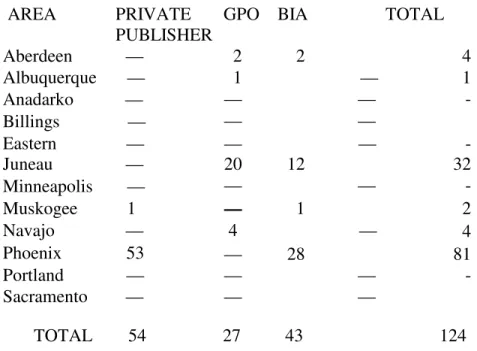
Table 1 Survey of Curriculum Materials Developed, Printed, and Disseminated from Area Offices
AREA PRIVATE GPO BIA TOTAL
PUBLISHER
Aberdeen — 2 2 4
Albuquerque — 1 — 1
Anadarko — — —
-Billings — — —
Eastern — — —
-Juneau — 20 12 32
Minneapolis — — —
-Muskogee 1 — 1 2
Navajo — 4 — 4
Phoenix 53 — 28 81
Portland — — —
-Sacramento — — —
TOTAL 54 27 43 124
The details of the survey are presented below according to the respective Area Offices. It should be noted that there are twelve Area Offices in the BIA with six of them reported as being involved in developing, printing and disseminating curriculum materials.
CURRICULUM MATERIALS PRODUCED BY BIA AREA OFFICES
ABERDEEN AREA OFFICE
Art and Indian Children of The Dakotas
Brochures
1. "News About Booze" 2. "Mr. Alcohol" 3. "Lice"
ALBUQUERQUE AREA OFFICE
"Profile" Albuquerque Newsletter
JUNEAU AREA OFFICE
Activities For Alaska's Kindergarten and Primary Grades Village Helpers
Stories of The Season My Blue Book
My Red Book My Yellow Book
Nome Agency Title Newsletter
The Bethel Agency Remediation Project Savoonga Noapak — Past and Present The Three R's In The Bush
My First Grade Book
Teaching Oral English To Non-English Speakers This Land
Are You Going Away?
Teaching Manuals and Vocabulary Listing Unalakeet — Title I Project
There are 12 culturally oriented materials produced and supported by the Juneau Area Office. These publications are in Native Languages.
MUSKOGEE AREA OFFICE
Muskogee Area — BIA An Institute For Indian School Personnel
Effective Human Relationships and Communications An Aid To Understanding Heritage, June 16 to July 3, 1975.
NAVAJO AREA OFFICE
Science Guidelines Language Arts Guidelines, Booklet 1 & 2 Math Guidelines Social Studies
PHOENIX AREA OFFICE Locally Produced
1. Curriculum Ideas For The Modern Kindergarten 2. Setting Up A Kindergarten
3. Title Programs Newsletter 4. Tribal Education Newsletter
Table 6 — Summary of Materials Mailed from IERC FY 1974 and FY 1975
ITEM NUMBER PERCENT
Curriculum Bulletins 639 1.8%
Language In American Indian Education 114 .2
Research and Evaluation Report Series 2,293 6.3
BIA Research Bulletin 6,600 18.1
IERC Bulletin 26,400 72.3
Other IERC Publications 458 1.3
36,504 100.0
ALASKA'S CROSS-CULTURAL EDUCATION DEVELOPMENT PROGRAM
by D. M. Murphy
In Alaska in 1970 there were six Native Americans certificated to teach. In the 1975-76 school year there are nearly fifty, with another nineteen who are academic seniors expected to receive the B.Ed. degree and teaching certificate by next summer. Although this number still only represents about 5% of the professional educators in rural Alaska, where the Native children and youth compose 80% of the school enrollment, the eight-fold increase over the past five years is remarkable.
The primary reason for this dramatic increase of Indian and Eskimo teachers in the State is the existence of a fieldbased- teacher education program known as X-CED/ARTTC. The acronym stands for the Cross-Cultural Education Development/Alaska Rural Teacher Training Corps programs. Originally called ARTTC, when all undergraduate students in the program were financially assisted by funds from U.S. Office of Education's Teacher Corps and Career Opportunities Program, the X-CED was added to connote a broader context when enrollment was opened to persons who were self-supporting or assisted from other sources, thus enabling the basic funds to be focused on curriculum development and delivery, student and faculty travel, and other program activities.
Today, of the sixty full-time undergraduates (of whom all but four are Alaska Natives) seventeen are provided stipends from Teacher Corps. The majority of the remainder of the Native students are assisted by Basic Educational Opportunities grants or Bureau of Indian Affairs scholarships, or a combination of both.
Economically, the program appears to make sense to the Bureau of Indian Affairs in Alaska. One factor is that about 67% of the Native students who begin the program complete it and emerge with the bachelor degree. To date, all who have earned the B.Ed. have been certificated or certifiable, and all who have applied for teaching or other educational positions have been employed. Over 75% are teaching in rural schools; some are engaged in adult education, some are working in the Regional Corporations, and one is teacher in an Urban Native Studies program.
Beyond the preparation of Alaska Native educators (and others who are committed to working with Native children in rural communities), the program has developed, and is delivering, a new curriculum in cross-cultural education. The transplanting of the more conventional on-campus curriculum to a field setting was deemed inadequate to meet the need for preparing persons to teach children of the many diverse cultures of the broad society. The curriculum is interdisciplinary in nature; that is, it draws upon the disciplines of anthropology, linguistics, psychology, sociology, and English and, using Education in the sense of an applied field, brings them to focus on the analysis of complex socio-cultural and economics issues.
The development of such a curriculum, the design of the content therein, and the teaching of it demands that those who are responsible for such efforts be experienced and highly trained persons who are either from the cultures being worked with or extremely knowledgeable and sensitive thereof. Second, they must reside in the locales where the schools, teachers, parents, children, and other citizens live and collectively concern themselves with educational processes and problems. Third, they must convene together, a difficult and costly matter in Alaska, for purposes of interaction and synthesis of a variety of input from colleagues, teachers, students, and the communities. Fourth, they must engender the respect of fellow University faculty and the administration, yet continuously earn and maintain the high regard of the communities in which they work.
The task of the program's administration is to assure collaborative planning and maintain the sense of responsibility to the clientele. The program is governed by a Consortium, the numbers of which represent a variety of educations interests including the postsecondary institutions, Native organizations, citizens of the regions where the program operates, students, teachers' and administrators' organizations, the State Dept. of Education, and the Bureau of Indian Affairs. The job includes articulating the wishes and perspectives of all involved into proposals for federal funding and into the state budgetary processes.
Selection of students, limited to the capacity of the faculty, is a regional affair, handled by Panels composed of residents of the respective regions. Students are assisted by the faculty in securing financial assistance, to which the B.I.A. has been extremely responsive. Since there are no room, board, or other fees or charges except tuition, scholarship funds accrue to the students who are the able to support themselves and their families while simultaneously enhancing their communities' economy through purchase of food, fuel, and other necessities.
GRADUATING SENIOR OPTIONS KOTZEBUE HIGH SCHOOL
by Charles E. Wall
In the 1970-71 school year the Kotzebue Bureau of Indian Affairs Day School (Nome Agency, Juneau Area, Alaska) graduated its first class of seniors. Since that time there have been five graduating classes with a total of eighty-three graduates.
Also, in 1970 a full time guidance counselor was added to the staff with one of the duties being to develop and operate a career information and guidance service for all students. This service was provided through both group and individual guidance sessions. Group `rap' sessions were used for career orientation with groups of twenty to thirty students in grades seven through twelve. Each year as the students progressed towards graduation the `rap' sessions became more detailed as to specific jobs and career clusters. A major outcome of the group sessions was individual conferences with the students as each become more and more interested in gathering data about a particular career field. By the senior year detailed information concerning the wide range of financial aide was well covered.
Career assemblies were arranged with recruiter/trainers in the skilled building trades, college officials, and military recruiters. Various business concerns as well as State and Federal agencies also presented assemblies to discuss with the students their personnel needs and the qualifications needed for direct employment or entry into their training program.
The counselor arranged for students to meet with the BIA Employment Assistance Officer and the State of Alaska Manpower Center Director. These two agencies are very important for the students wishing to opt for technical training or looking for employment.
During group `rap' sessions conducted by the counselor the options open to those needing or wanting to interrupt their formal educational program prior to graduating from high school were presented. Many individual conferences were held with these students in which the various avenues to a high school diploma were explored.
Following is a graph of the wide range of student options after receiving career information.
Graduation Number Entered Entered Military Full Local Full Non- Seasonal Year Graduates College Tech Trg Serv Employ Local Emp Subsistence
1970-71 12 7 1 0 2 1 1
1971-72 15 6 1 5 0 1 2
1972-73 15 5 6 1 2 1 0
1973-74 21 7 1 0 7 2 4
1974-75 20 8 5 0 4 1 2
Totals 83 33 14 6 15 6 9
Summary of options:
40% entered college
17% entered technical training 7% entered military service
18% elected full time local employment 7% took full time non-local
11% opted for seasonal employment and subsistance living
BRIEF HISTOR Y OF CHEROKEE SCHOOLS 1804 — 1976
by T. J. Dupree
As early as 1804 the Moravian Missionary Society of United Brethren, a religious group, started school for 8 Cherokee Indian children at Spring Place in northwestern Georgia. The Moravians were more interested in converting "heathen" Indians to their brand of Christian belief. However, the Cherokee insisted that classroom instruction in the three R's also be included.
Around 1816 the President of the United States was told about the Cherokee efforts for educating their children and directed the Indian agent in that area to build a larger school building and quarters for a teacher. The purpose of the school was to teach farming to boys and homemaking to girls in addition to some reading, writing and arithmetic.
By 1831 there were three missionary groups operating 11 schools in Cherokee country, but mostly in Georgia. These groups were Moravian, Baptist and Presbyterian. Their source of funds came from federal, tribal and missionary appropriations.
Cherokee formal education came to a standstill during the forced removal of the Cherokees to Oklahoma Territory in 1838. However, the interest of the Cherokee people to provide education for their children went with them to the new territory, and they started a public school system as soon as they were settled in their new homes in the settlement which was to be later called Tahlequah.
Col. Will Thomas tried to start Qualla Town Academy, a school for Cherokee children in North Carolina in the late 1850's, but this effort was cut short by the Civil War, and it was not until 1880 that the Society of Friends (Quakers) started negotiations to contract with the Federal government and the Cherokee Tribe to establish schools in what is now Qualla Boundary.
Quakers in charge of the schools expressed dissatisfied friction with Superintendent Henry W. Spray as early as 1887. He had been formerly head of the Maryville, Tennessee, Normal School. So, evidently he was also a Quaker because a committee of Quakers "kindly asked him and his wife, Anna Gray, to resign at the end of the fiscal year 1891." But, Gray refused to leave. He finally had to leave, but was appointed Superintendent by the Federal Government Indian Office in 1899 and stayed on until 1903. This time his resignation was forced by Chief Jarret Smith.
The Cherokee Schools continued primarily as elementary and vocational oriented schools from 1st through 9th grades. Federal construction and expansion took place between 1906 and 1910. These are the old frame buildings still standing on Yellow Hill.
Between 1910 and 1934 the school emphasis, in addition to vocational and trades training, was expanding boarding schools and suppression of native language use in school. However, soon after the new commissioner of Indian Affairs, Collier, was appointed there were some dramatic changes made in Indian education. The semi-military air was removed from schools. Use of native language; emphasis was placed on community day schools instead of boarding schools, but more importantly the curriculum in schools began to change.
It was not until after the Second World War that the tourist trade began to expand at Cherokee and with it a demand was made for native crafts such as basketry, woodcarving, pottery, etc. Even though the production vocational training eventually was abandoned, the crafts development continued to grow and is still going strong at present. Most of this is in basket weaving and woodcarving.
The boarding part of the Cherokee Central School was closed in June of 1954. Mr. T.J. DuPree was the last person in charge of the dormitories as Teacher-Adviser. The boarding school population had diminished to 55 or 60 students who were mostly from Seminole and Choctaw tribes. Roads were improved and bus routes were expanded.
At present all of the Cherokee Indian children who do not attend public schools in Jackson, Swain and Graham counties, attend Cherokee elementary and Junior-Senior High Schools. These are still operated by the Bureau of Indian Affairs.
In 1962 the outlying day schools were consolidated into one sturdy and fairly modern red brick elementary school at Cherokee (Old Yellow Hill). The curriculum and classroom structure remained traditional until 1970. Cherokee elementary school now is no longer the simple, graded, self-contained country school it was 6 or more years ago. It is a highly complex educational operation providing specialized educational services to between 760 and 800 students.
One of the first major changes was made by the Policy Advisory Committee or P.A.C. which has a voting membership of a majority of parents and minority of professional persons. The majority includes three Tribal Council members who are also on the Advisory School Board. The change was from the Arkansas Follow-Through Model to the Englemann-Becker Model in Kindergarten through second, and later third grades.
In the meantime the school administration, together with the Advisory School Board, developed broad educational goals for Cherokee Schools. They are as follows:
1. To provide quality educational opportunities for each student so that highest individual potential in academic achievement will be reached at the end of high school.
2. To reduce social promotions to a bare minimum, and use. them only when necessary and with the consent of the parents involved.
3. To upgrade the quality of the instructional staff through educational leave, pre-service and in-service workshops plus adult education opportunities and conferences.
4. To do everything possible to help Cherokee children reach educational achievement levels competitive with comparable children in non-Indian communities.
In order to achieve the above broad goals within a few short years, changes had to be started with parents, teachers and student attitudes. Also, restructuring the outmoded traditional curriculum, and securing adequate funding. Several of these things are now taking place to some degree and must continue to be emphasized and supported by the parents, the school staff, school administrators, tribal officials and especially the School Boards.
To achieve the above 4 major broad goals the following must take place:
1. There must be full enrollment of school age children, and a sustained effort must be made to cut down wasteful absenteeism.
2. The instructional staff must be able to hold the full attention of pupils for reasonable lengths of intensive instructional time with frequent short breaks in between.
3. The instructional staff must master the best methods and materials available to meet the educational needs of the students.
4. The school administration must provide adequate funding, leadership, teacher accountability methods, and student accountability methods.
6. The number of pupils per teacher, or instructor, must be reduced as low as budgets will allow. The smaller the teacher-pupil ratio, the greater is the concentration of effort.
7. Parental involvement and community support are essential for achieving high quality educational goals. Any community, whether it be town, city, reservation, school district or whatever, receives only as much quality education as it encourages and demands of its children, its educational institutions, and it is willing to pay for in time, effort, energy and funds. The know-how is available but the effort is sometimes weak in some places.
The changes were made gradually during a 6-year period until at present there are 4 basic educational programs going on simultaneously in the elementary school and several in the Junior-Senior High School.
The first, one, as mentioned earlier, is the Follow-Through Engelmann-Becker Model used in Kindergarten through the third grades. This is the largest of the elementary programs with 418 students in 17 classrooms. This is administered by P.A.C. through the BIA principal, a teacher-supervisor and a P.A.C. hired F-T Director. BIA provides all of the classroom teachers except one substitute teacher hired by P.A.C., which also provides most of the classroom aides except 5 permanent ones hired by BIA and 4 temporaries hired by Title I contract. Teachers and aides receive intensive training in methods and use of E-B DISTAR materials (DISTAR is an acronym for Direct Instructional System of Teaching and Remediation.) The materials are sequentially progressive in difficulty with about 160 lessons per school year in each of Levels I, II, & III. We call the Kindergarten year the first year or PHASE I, PHASE II is the second year in school or the first grade, etc. The sub levels are designated A, B, C, D, and up to U. The groups within a particular classroom are designated as Eagles, Deer, Buffaloes and Bears, and are changed periodically. The E-B Model is a well structured and well disciplined approach to early elementary school education. This is what the Cherokee people want, and would like to have the E-B Model through the 6th grade. However, DISTAR materials have only been developed through the 3rd grade and H.E.W. cannot or will not help financially for Follow-Through programs beyond the 3rd grade, at least at present. The F-T, P.A.C. contract with the E-B Model, which is based at the University of Oregon, calls for an on-site full-time consultant who provides pre- and in-service training, continuous checks on student achievement programs, criterion reference testing statistics, suggestions for improvement and reports to the school administrators. The results have been gratifying as achievement tables will show later in this article. This is so because most, if not all, of the ingredients for quality education
are there:
1. It is non-graded throughout, materials, from level to level on a continuous sequential progression from lesson to lesson, and movement forward is made when 85%
2. It is departmentalized for structure, either within a large group or within a class group, with small groups going to a teacher or a paraprofessional for specific instruction in a certain area of reading, arithmetic or language.
3. Modern methods of instruction, designed to hold maximum pupil attention, are used. 4. There is parent involvement and active participation in P.A.C. and in classrooms. 5. Adequate supervision by administrators and consultants is
there to help teachers and aides do a better job.
6. Continuous criterion reference testing is there to find where the instructional program needs strengthening, and where the child needs help.
7. Modern methods of encouraging children to attend school regularly are there. 8. Small group instruction, for maximum concentration of effort, is there.
9. Cooperative efforts for quality education are there between the Tribal Council, the Advisory School Board, , P.A.C., School Administration, Agency education, instructional staffs, and Follow-Through.
The second major program was probably the most difficult to implement. It was in organizing the modified, non-graded and departmentalized intermediate levels. The children are of 4th, 5th and 6th grade age. PHASE V includes Levels RM, M, N, 0. PHASE VI includes Levels RP, P, Q, and R. PHASE VII includes RS, S, T, and U. There is no denying that we had our "growing pains" in adjusting to this new program from the old graded, self-contained structure. Two years were spent in preparing teachers, developing curriculums, talking to parent groups, purchasing materials, etc., before going into the new program. It started with one-half day the first year in September, 1973, and for the full school day the second year.
We already knew what the weaknesses of the old system were, and that the Cherokee people were dissatisfied with the poor academic progress made by a majority of the children during the past 50 to 75 year history of the schools. We finally received sufficient funds to put a trained aide in each of the classrooms in the intermediate levels starting in September of 1975.
the self-contained graded system had many, many years to prove itself and school dropout rates, social promotions, and failures kept going up, it was time to try something else. Perhaps the non-graded system is not the only answer, nor even the best answer toward achieving quality education. But, it is working in the Follow-Through E-B Model, and there is no earthly reason why it should not work in intermediate levels and even the Junior-Senior High School. There is a gradual improvement in student achievement each year.
The third major program is the Public Law 89-10 Title I which has been providing remedial educational services in reading, arithmetic, language, learning disabilities, speech, hearing, and a small self-contained SPED classroom for very slow students. It concentrates efforts to helping children who for one or more reasons have fallen behind. And, there are many reasons for other than being a naturally slow learning student. Some of these are poor school attendance, short attention spans, poor study habits, lack of self-discipline, low motivation, low aspiration toward education in the home, emotional disturbance, lack of self-confidence and poor nutrition in early formative years. These are in addition to poor instructional methods, and social promotions. Lately, we find that otherwise normal children sometimes have "hang-ups" when dealing with specific abstract symbols such as the printed letter, word or number. Others have difficulty assimilating sounds into meaningful communication.
Children participating in Title I are selected from the lowest achievers in reading, arithmetic and language in the intermediate levels up through high school. The object is to find their weak academic areas and to attempt to remediate them and gradually work them out of the Title I program and into the regular program full-time. Title I is contracted to Smoky Mountain Mental Health in Western North Carolina and they are doing a good job.
The fourth and newest of the programs is in Learning Disabilities financed through title VI funds. A two-year pilot program of this type was contracted to Tennessee Wesleyan University starting in September of 1973. Other BIA areas sent personnel to observe the project during its second year of operation at Cherokee. About 415 students were referred and screened for learning disabilities. Of these, there were 120 that were found to have one or more learning disability to some degree. 31 of the more severe cases were selected from the 120 for therapy. The project was originally funded to take care of only 30. Title I added another 30 the following year.
The two year pilot project ended in June of 1975, and a one year Title VI, L.D. project was contracted to Western Carolina University for 1975-76. This Title VI project provides a diagnostic-prescriptive and training center. It has also added tutoring services for multi-handicapped home-bound children. In some cases where an otherwise normally intelligent child was found to have a learning disability, and was found early enough, the child gained a whole year in reading ability after receiving 30 days of reading therapy. All of elementary, Title I and VI are housed in a new, large comfortable building put up during the summer of 1975.
finally completed and occupied in the fall of 1975. It is indeed a far cry from the first log cabin one room Moravian school house in 1804. The 600 student new structure is one of the most modern in functional design and architectural beauty in the Bureau of Indian Affairs and certainly in Western North Carolina.
In closing I would like to say that Cherokee Schools are not the same dull institutions they were 6 to 10 or more years ago. BIA and people anywhere have never seen anything such as the rebirth in education taking place here. Educators and students from within and outside of North Carolina visiting our schools are amazed at our advanced programs and overall student programs.
We must never allow Cherokee Schools to become second and third rate again. The only way this can be accomplished is by continued community interest, parent involvement, BIA and tribal positive leadership, selection and training of well qualified instructional staffs, and of course, adequate funding.
A COMPARISON OF
ENGLISH AS A SECOND LANGUAGE PROGRAM AND
NORMAL CLASSROOM INSTRUCTION WITH INDIAN STUDENTS
IN READING
by Carl R. Cooley Bob M. Vanosdol
D.M. Johnson
The ability of Indian students to learn English as a second language (ESL) has been a subject of controversy especially in areas where the students are from reservations and thus those who are limited in obtaining an English background. These students for the most part do not learn English until they are exposed to a public school. To these students English is a foreign language which must be learned in order for them to cope with non-Indian cultures.
Studies in Indian education have revealed the need for special programs in teaching the English language to Indian students. However, very little research has been done to see if the effects of such a program would really improve, to any extent, the ability of the Indian student to succeed in a "normal" public school (Bass, 1969). The need for additional research concerning English being taught as a second language to Indian students has been expressed in the literature (Bass, 1969).
Bowd (1972), in a study of Indian students in Canada, suggested that the principal reason for language problems in school was inadequate exposure to English rather than the use of the native language. He makes the following comment that the most apparent need for Indian boys that were tested is special training in the English language.
Research has attempted to show that the normal classroom procedures are insufficient for teaching English to Indian students due to their limited verbal stimulation in English and their cultural differences. Theoretically, if programs that emphasize English as a second language were devised, based on the need of the students, then the students would better understand and would be able to cope with the English language and the multi-cultural society.
PURPOSE
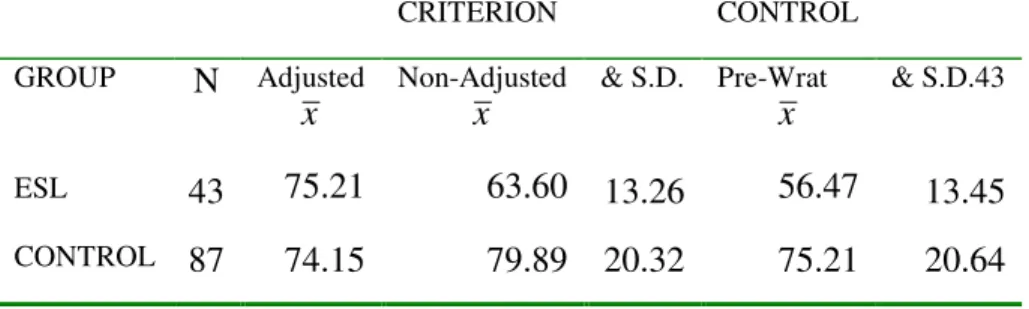
The purpose of this study was to investigate the following: (1) Will the Indian students' English vocabulary, comprehension, and scholastic ability be affected in a program which teaches English as a second language? (2) Is there a difference between the reading level advancement (RLA) as measured by a reading vocabulary test and/or comprehension test? (3) Will the reading levels and grade point (gpa) for Indian students be related?