WHAT KIND OF NATION? WHAT KIND OF MUSIC?: GENRE, AESTHETICS, AND NATIONALISM IN PUERTO RICAN HIP HOP
Barkley Heuser
A thesis submitted to the faculty at the University of North Carolina at Chapel Hill in partial fulfillment of the requirements for the degree of Master of Arts in the Department of Music in
the College of Arts and Sciences.
Chapel Hill 2016
iii ABSTRACT
Barkley Heuser: What Kind of Nation? What Kind of Music?: Genre, Aesthetics, and Nationalism in Puerto Rican Hip Hop
(Under the direction of Michael Figueroa)
Puerto Rico’s status in relation to the United States has been fraught since 1898, when it became a US territory. Despite declining support on the Island for political independence, the rhetoric of independence has continued to hold a prominent place in public discourse and cultural production. In this thesis, I argue that Puerto Rican rap acts as a discursive field in which the idea of an independent Puerto Rican nation is shaped and contested. I first examine the politics of genre, focusing on Vico C, Tego Calderón, and Calle 13 as case studies highlighting the
significance that genre has for the reception of musical representations of the nation. I then turn to an analysis of the music of Calle 13, specifically allusion and vocal flow, as a means towards understanding how that group musically imagines a Puerto Rico that aligns with the ideals of the Puerto Rican Independence Party.
iv
ACKNOWLEDGEMENTS
I would like to thank first and foremost my thesis advisor, Mike Figueroa, for his invaluable guidance over the course of this project. In our meetings he helped me to work out what I wanted to say with this and offered some much-needed perspective and encouragement throughout. Thanks also go to my other committee members. Andrea Bohlman is incredibly generous with her time, and I always come away from our conversations full of exciting
v
TABLE OF CONTENTS
LIST OF FIGURES ... vi
INTRODUCTION ...1
A Brief Historical Sketch ...2
The Changing Nature of Nationalism on the Island ...5
A Musical Intervention ...9
CHAPTER 1: THE POLITICS OF GENRE ...15
Vico C and Early Underground ...17
Underground’s Broader Reception ...20
The Rise of Reggaeton ...24
Tego Calderón and a Reggaeton Alternative ...27
Calle 13’s More Acceptable Nation ...35
CHAPTER 2: MUSICAL ALLUSION AND MATTERS OF FLOW ...42
Alluding to Latin America ...44
From Flow to Flow—Implications of Positive Psychology for the Political Power of Hip Hop ...53
Matters of Flow and Why Flow Matters ...57
EPILOGUE ...69
vi
LIST OF FIGURES
1 INTRODUCTION
This thesis is about hip hop and its relationship to nationalism on the Island of Puerto Rico. The stakes are high given that Puerto Rican nationalism operates almost entirely within the cultural sphere—support for political independence has been consistently waning since the 1930s. A distinct Puerto Rican culture is thus understood by many nationalists on the Island as the strongest bulwark against total assimilation into the United States. Music, as Puerto Rico’s most visible cultural export—signifying the Island for both non-Puerto Ricans and the large Puerto Rican diaspora—provides a discursive field central to the imagining of the nation. Many artists, including some discussed in this thesis, are aware of music’s potential as a political space in which the imagined Puerto Rican nation can be shaped and contested. This imagining can be performed in part through the literal content of the lyrics. Some artists choose to engage directly with socipolitical themes and issues in their lyircs—in what I refer to as explicitly political songs—while others perform songs with less direct engagement with sociopolitical issues.
2
suggesting characteristics of the imagined nation, as well as increase engagement on the part of listeners. In this thesis, I argue that an examination of genre and aesthetics in Puerto Rican rap reveals some of the tensions inherent in the Island’s nationalism. In addition to crafting political lyrics, artists take advantage of rap’s extra-linguistic features to articulate a more affective idea of the Puerto Rican nation.
A Brief Historical Sketch:
Nationalist rhetoric in modern Puerto Rico draws heavily on the Island’s history as a Spanish colony. For independentistas, those in favor of a politically independent Puerto Rico, this Spanish origin serves as one of the primary proscriptions to continuing political association, in whatever form, with the Anglo-rooted United States. The United States attempted to purchase Puerto Rico from Spain in the late nineteenth century, seeing its potential as a strategic naval position in the Caribbean, but the offer was rejected by the Spanish government. Spain was finally forced to cede the Island to the United States in 1898 following the Spanish-American War, and from that point on Puerto Rico has been subject to the rule of the US federal
government. At the end of the war, the United States portrayed itself as the liberator of oppressed Spanish colonies in Puerto Rico, Cuba, and the Philippines, these islands merely saw one
3
other goals the replacement of Spanish with English and the development of modern capitalist structures on the Island.
For the first half of the twentieth century, Puerto Rico functioned with little autonomy. Its governor and upper legislative house were appointed by the US Congress, and although Puerto Ricans elected the members of their lower legislative chamber, there was in actuality neither self-governance nor self-determination.1 This period also saw several attempts at political separation, with motions coming both from the Puerto Rican legislature and members of the US Congress, but each of these attempts was ultimately rejected by the US federal government. Instead, in 1917 Puerto Ricans were granted US citizenship, thus tightening the social and political bond between the Island and the United States. The Island’s political status did not significantly change until 1947, when the United States granted Puerto Ricans the right to elect their own governor. In 1950, the Island was permitted to call a referendum on the adoption of a Puerto Rican constitution, which was approved two years later by a democratic majority. In accordance with this new constitution, Puerto Rico became an Associated Free State (Estado Libre Asociado, or ELA),2 with the option of changing its political status at any point through a democratic referendum.3 Puerto Rico is subject to US federal laws except where specified otherwise. The ELA has a non-voting representative in the US House of Representatives who acts in an advisory role, a point of contention for many Puerto Ricans given that the Island is
1 Despite there being a semi-autonomous Puerto Rican legislature and governor, their power is limited. The US
Congress still controls many of the same things that it does for US states, including: trade, treaty, immigration, broadcast regulations, and currency. The US Congress is also able to rule on the constitutionality of Puerto Rican laws and holds the authority to determine the Island’s political status.
2 In English, Puerto Rico is usually described as a Commonwealth, but this is due to a lack of appropriate English
alternatives. Commonwealth does not accurately capture the nature of the Island’s political status (Diaz 2006), and so throughout this paper I use “ELA” to describe Puerto Rico’s current political status.
3 A referendum for a change of political status, even if passed by the Puerto Rican public, must still be approved and
4
governed by laws passed by the US Congress. Most of the local governance is carried out by a democratically elected Puerto Rican governor and bicameral legislature. This status has continued, relatively unchanged, into the second decade of the twenty-first century.
This is not to say that the status of the ELA has been uncontentious. The UN has repeatedly asserted Puerto Rico’s right, as a culturally independent nation, to democratic self-determination (Diaz 2006), and there have been four referenda on Puerto Rico’s political status since 1952. The one consistent trend in these plebiscites is that the preference for statehood increases in each successive vote. In 2012, the most recent referendum, 61.3% of voters preferred US statehood while only 5.5% favored independence (Cruz 2014). This reticence towards independence could be largely motivated by fears of economic instability (Cruz 2014; Picó 2014), but independence is also complicated by the growing social and cultural ties between Puerto Rico and the United States that are established and maintained by the almost 50% of all Puerto Ricans who live on the US mainland at any given time, many of them engaging in what Jorge Duany (2000) calls “circular, commuter, or revolving door migration:”
Circular migration can be defined operationally as a series of sequential moves in various directions for extended periods of time. This bilaterat movement of people creates a porous border zone between Puerto Rican and Nuyorican communities, which migrants continually cross and transgress, sometimes several times a year. Estimates of the volume of circular migration between the Island and the U.S. mainland range from 10 to 45 percent of the total flow. (19)
5
The debate over Puerto Rico’s sovereignty—the status-question—remains unresolved in 2016.4 Rather than abating or fading into the background of political life on the Island, it has recently again become a prominent topic in public discourse. At the time of writing, Puerto Rico is experiencing an economic crisis so dire that many, including the Island’s governor, see the Island as perched on the cusp of humanitarian crisis (DeBonis 2015). The ELA is poorer than the poorest US state (Pringle 2012). Unemployment is double that of the mainland United States. Public debt has reached a level where it is no longer serviceable, and the government is struggling to provide basic services. It has begun defaulting on debt repayments, for which it anticipates lawsuits brought by creditors since, under current law, Puerto Rico is not permitted to declare bankruptcy.5 Faced with deteriorating conditions on the Island, many of those Puerto Ricans who can afford to do so are simply migrating to the mainland United States, thus making it even more difficult for the Puerto Rican government to meet its obligations.6 This leaves the Puerto Rican government with few options other than waiting for the US Congress to act on a relief package or similar program. It is likely that a Federal Control Board will be established in an attempt to take control of and guide the Island’s finances back to solvency, but even this solution cannot but highlight Puerto Rico’s lack of agency and right to self-determination (Walsh 2016a).
The Changing Nature of Nationalism on the Island:
Early in the twentieth century, there was far greater popular support for political
independence (Soto-Crespo 2006), but a major shift occurred in 1946 when Luis Muñoz Marín—
4 Otherwise diverse political parties often align around the status-question. It can be the distinguishing feature of an
otherwise diffuse political conglomeration.
5 All of this information is pulled from recent reporting in the press concerning the current Puerto Rican financial
crisis. For a detailed discussion of the crisis, see Hinojosa (2016).
6
the Puerto Rican poet and statesman, who both designed the ELA’s constitution and acted as its first governor—shocked many of his supporters by declaring that he was no longer an
independentista (Azank 2012). He felt that stronger ties with the US federal government would benefit Puerto Ricans economically and socially, but was still wary of complete assimilation into the United States. Many of his critics accused him of giving up on the idea of a Puerto Rican nation, but he instead argued that rather than defining the nation as a political entity grounded in a specific geographic territory, it could be defined solely by its cultural production and practice (Soto-Crespo 2006). This approach also allows for the inclusion of the large diasporic
community that self-identifies as Puerto Rican and presages the decline in independentismo’s popularity.7
Cultural nationalism did not originate with Muñoz Marín, but it had previously been integrated into the Island’s political nationalist movement. In the 1930s for example, the
Generación del Treinta (Generation of 1930)—a nationalist movement comprising various poets and authors—combined both political and cultural nationalism in their ideology. They described the Puerto Rican nation as being founded on five primary premises: the Spanish language; the idea that the island territory contains the nation; origins rooted in the Island; a unique blend of Spanish, African, and indigenous history and heritage that defies US assimilation; and the Island’s unique folklore (Duany 2002).8 The first and primary characteristic in their list is language, and this emphasis on language helps to explain why music, poetry, and literature have been the primary spheres in which the Puerto Rican cultural nationalist project has operated.
7 Significant to diasporic identity is that, unlike many other immigrant groups in the United States, Puerto Ricans
tend not to use hyphenated descriptors such as Puerto Rican-American, even if they have been born and raised on the US mainland. This tendency further supports the idea of a strictly cultural foundation for the nation.
8 For a more detailed understanding of the Generación del Treinta’s ideology, see Antonio S. Pereira’s Insularismo:
7
Despite the decoupling in the 1950s—instigated by Muñoz Marín—of Puerto Rican cultural and political nationalism, the rhetoric of political nationalism continues to have an exaggerated presence in public discourse given that less than 6% of the population support independence as a feasible alternative to the ELA. Cruz (2014) offers a number of different arguments why this might be the case: the rhetoric of political nationalism helps to physically ground the more up-rooted cultural nationalism; political nationalism connects to larger
intellectual trends in Latin America that see Puerto Rican independence as a moral necessity; and supporting political nationalism allows artists and individuals to tap into the cultural caché that accompanies an intellectual position at society’s periphery. These are all plausible arguments, but they alone cannot fully account for the continued presence of the rhetoric of independence in cultural production. This task is instead better accomplished by accounting for the ways in which cultural and political nationalism complement each other, and for this reason music is a fruitful field of inquiry. Music has long played a role in representing Puerto Rico. The music and culture of the jíbaro, the nineteenth-century Hispanic Puerto Rican peasant common to the Island’s interior, has long been adopted by independentistas as an icon of the nation. Later in the twentieth-century, salsa music became a sonic signifier for the Island, even though it was initially disputed due to its origins in diasporic Afro-Puerto Rican communities. But from plena
and the cuatro to salsa and reggaeton, Puerto Rican musical representations have been contested by those on the Island and in the diaspora, because each is capable of presenting a different image of the nation.
8
impractical because of the ever-increasing reliance of the Island on the US federal government for social programs and economic stimulus; a political separation from the United States would risk pushing Puerto Rico into economic collapse at the same time that it removed the option for Puerto Ricans to leave the Island in search of economic opportunity in the mainland United States.9 Furthermore, a number of prominent former independentistas have left the movement precisely because they see the nationalist project as a conservative ideology that would simply shift the seat of colonial power from the US federal government to a more conservative native ruling upper-class, potentially reversing progress made on a number of progressive causes affecting disenfranchised groups such as, for example, Afro-Puerto Ricans or LGBTQ communities (Cruz 2014). Cultural nationalism is not immune to this risk, as it often tends towards an exclusionary normativity; Afro-Puerto Ricans, for example, are frequently left out of the culturally-constructed nation, especially since Puerto Rican cultural nationalism traditionally centers on the figure of the jíbaro, the inland peasant of European ancestry (Duany 2000). This exclusion reinscribes the racial hierarchies already prevalent on the Island, which privilege “white” features as an ideal. Additionally, increasingly circular migration between Puerto Rico and the United States threatens the sharp distinction between metropole and colony as Puerto Ricans maintain cultural practices acquired in the US, which significantly have included urban musics such as salsa and hip hop, even after returning to Puerto Rico.10
The ELA maintains a certain level of autonomy, but the absence of de jure colonial status does not necessarily preclude a de facto colonial relationship founded on US cultural hegemony and Puerto Rican economic dependence. Independentismo no longer holds a prominent place in
9 An even more pressing concern given Puerto Rico’s more recent severe economic crisis. See White (2015), Walsh
(2016a; 2016b), Mahler and Confessore (2015).
9
the platforms of any of the ELA’s major political parties (Picó 2014), but it continues to have a voice in Puerto Rico’s cultural production, especially among the middle and intellectual classes (Moreno 2009). So, the idea of nation in Puerto Rico cannot be dismissed, but it must be reconfigured to better reflect the growing divorce between the concepts of political and cultural sovereignty (Cruz 2014) and the transnational character of a diasporic community held together by cultural practice (Appadurai 1996).
A Musical Intervention:
On September 23, 2005, FBI agents surrounded a small farmhouse in Hormigueros, Puerto Rico. They were after 72-year-old Filiberto Ojeda Ríos, founding member of the Ejército Popular Boricua (the “Boricua Popular Army”), a militant Puerto Rican independence group more commonly known as Los Macheteros (“the machete-wielders”).11 Ojeda Ríos had long been living underground as a wanted man; in the mid-1980s he had skipped bail after being arrested by police for suspected ties to a number of bombings, shootings, and a $7 million armored car heist in the mainland United States (Fahrenthold and Marino 2005). But as time passed, he had become less cautious, occasionally appearing in public in Puerto Rico to give speeches supporting the cause of Puerto Rican independence from the United States. On that afternoon of September 23, 2005, when the FBI moved against Ojeda Ríos, both sides fired shots, and Ojeda Ríos was hit. Medical examiners estimate that he died from blood loss within fifteen minutes of suffering a gunshot wound around 6:08pm, but federal agents did not enter the house until the following morning. The US Department of Justice claimed that the delay resulted
11 This in reference to the labor force that supported the sugar industry, at one time Puerto Rico’s primary industry.
10
from agents’ concerns for their own safety, fearing that there might be another gunman or improvised explosive devices inside (Martin and Schnedar 2006), but a report authored by the Puerto Rican Civil Rights Commission concluded that the delay was meant to deny Ojeda Ríos needed medical attention, thus implicating the US federal government in murder (Comisión de Derechos Civiles del Estado Libre Asociado de Puerto Rico 2011).
Responses to Ojeda Ríos’ proliferated across the Island. Even among Puerto Ricans who did not sympathize with independentismo, there was a sense that the FBI was unjustified in the way that it handled the raid (The Washington Post 2005).12 In addition to raising questions of legality, the Puerto Rican press also represented the FBI operation as charged with symbolic meaning and as an attack on the very idea of Puerto Rican independence: the raid occurred on the 137th anniversary of the Grito de Lares uprising, the first (short-lived) successful Puerto Rican independence rebellion against Spain (Ortúzar 2015).
In parallel with press coverage of the killing of Ojeda Ríos was a song released by the Puerto Rican hip hop group Calle 13 titled “Querido F.B.I.” (“Dear F.B.I.”).13 René Pérez Joglar—Calle 13’s vocalist, who performs under the stage name Residente—claims that he was so angered by the news of Ojeda Ríos’ murder that he could not sleep that night. He felt he needed to respond in some way, and so he stayed up through the night writing and recording the song, working quickly enough to be able to release “Querido F.B.I.” as a free download within thirty hours of the raid. This quickly-composed song is often credited with bringing both Calle 13 and Puerto Rican independentismoto a much broader audience than had previously been the
12 Calle 13’s understanding of the public’s reaction to the raid was that Puerto Ricans were generally satisfied that
the US federal government had eliminated someone perceived as a dangerous terrorist, even as they were unhappy with the way that it was handled (González 2013).
13 I refer to them throughout the paper as hip-hop artists rather than reggaetoneros. While the group was initially
11
case, introducing hip hop to a more independentismo-minded intellectual class and raising the cause of independentismoamongst people of the caseríos—the Island’s poor urban
neighborhoods, typically populated by a disproportionately high percentage of Afro-Puerto Ricans(Moreno 2009; Davila 2005).14 Listening to the song, it is not hard to imagine why it made such an impact: a nearly ubiquitous two-bar drum beat backed by a static bass synthesizer plays though the track as the only accompaniment to Residente’s crescendoing vocal delivery. As the track plays, his voice becomes gradually louder and hoarser. The listener must wait nearly two minutes before a chorus section offers any respite from the mounting tension. The
increasingly complex voice-music interaction further adds to this effect as Residente urges the Puerto Rican people to join him in armed resistance against the US federal government.15
By beginning their career with this song, Calle 13 signaled a change of course for reggaeton.16 Some reggaeton musicians, such as Tego Calderón on his album El Abayarde (2003), had focused on the politics and social struggle of those in the caseríos, but never had reggaetoneros been so aggressively committed to independentismo (Díaz-Zambrana 2010). The agressive political expression of “Querido F.B.I.” was especially striking given the widespread success of some of the song’s immediate predecessors: dance club hits such as Daddy Yankee’s “Gasolina” and N.O.R.E.’s “Oye mi canto.” Calle 13 continued throughout their career to write socially- and politically-engaged songs—even more so on their later albums such as Entren Los Que Quieran (2010)and Multi_Viral (2014)—earning the support and endorsement of Puerto Rico’s official independentista movement led by the Partido Independentista Puertorriqueño
14 “Caseríos” is term used to refer to poor urban neighborhoods. Generally, Afro-Puerto Ricans tend to comprise a
higher percentage of the population of the caseríos than of the population of the Island more generally.
15 Heavily criticized for the content of this track, Residente has maintained in interviews that, though the track’s
lyrics suggest violence, he was not literally inciting violence but rather making a critique and expressing his outrage at the events.
12
(PIP), in spite of the PIP’s rejection of other independentista rappers and reggaetoneros. Part of Calle 13’s popularity within the PIP is due to their reputation as a politically-engaged hip hop group, but it also results from the character of the Puerto Rican nation that they put forward in their music, which differs from that of other artists such as Tego Calderón.
In 2013, Democracy Now!’s Juan González asked Residente about the increasingly political nature of their songs—in other words, about where this political engagement was coming from. Residente immediately brought up the Island’s political status: “I was raised in a pretty politicized environment, because of the political situation in Puerto Rico, because we are a colony of the United States” (González 2013b).17 Many scholars have written about Puerto Rican poetry as a decolonizing force and as a space of resistance to US hegemony (see, e.g., Dowdy 2010; Azank 2012; Cruz 2014; Duany 2000)—and indeed many rappers, including Residente, have likened themselves to poets. But little scholarly inquiry has been turned specifically towards the political work of reggaeton and hip hop, perhaps the most significant and far-reaching Puerto Rican verbal art of the past quarter century.18
Not all Puerto Rican hip hop is necessarily political in nature, but this music’s prominent place in public discourse and popular experience makes it an important discursive field for the Island’s cultural politics. Many Puerto Rican artists have used hip hop as a means of imagining and critiquing the nation in different ways—whether Calle 13’s advocacy for a Latin American Puerto Rico or Tego Calderón’s critique of what he sees as the Island’s exclusionary racial democracy. This thesis examines the means by which Puerto Rican rap artists use music as a discursive field in which the nation can be imagined and contested.
17 All translations are by the author unless otherwise noted.
18 See chapter 1 for a detailed discussion of the politics of genre, especially the divide between reggaeton and hip
13
In the first chapter, I focus on the politics of genre—especially the distinction made between reggaeton and hip hop—and the reasons why many politically-engaged Puerto Rican hip hop artists, as designated by both the artists themselves and by popular criticism, are
disassociated from reggaeton despite sharing strong aesthetic similarities with the genre. I focus on three artists—Vico C, Tego Calerdón, and Calle 13—because they are three of the most politically outspoken and well-known artists in Puerto Rico. Ultimately I argue that hip hop is understood as a more viable representative of the nation while reggaeton is politically neutralized because of the differences in the two genres’ race and class associations. As Juan Flores (1992) shows, Afro-Puerto Rican cultural expression has long been denied a role in shaping a national cultural ideal. He writes that: “It took the towering presence and symbolic passing of a black popular musician of the uncontested stature of [Rafael] Cortijo to force the questions of African and working-class culture onto the agenda of everyday Puerto Rican life” (188). Flores goes on to show how the trend towards rooting national culture in Afro-Puerto Rican and working-class culture has been resisted by the Island’s political and cultural elite, with some commentators insisting that Afro-Puerto Ricans are in need of “uplift” that can only be provided by Eurocentric cultural practices (190), and others denying any African influence in Puerto Rican culture—for example, on a trip to Spain Rafael Hernández Colón, then govenor of the Island, “took the occasion to refer to the African contriution to Puerto Rican culture as a ‘mere rhetorical adscription’” (Flores 1992, 191). The struggle to claim a space for Afro-Puerto Ricans in the national imagination continues, and is reflected in the genre politics of hip hop and reggaeton.
14
within a larger Latin American context in a way that rhetorically disassociates the Island from the United States. Finally, I turn to an examination of flow, defined by the style of a rapper’s vocal delivery and the way that it interacts with the pista (in Spanish-language rap, the term for the underlying musical track). I consider hip hop flow within the context of positive
15 CHAPTER 1: THE POLITICS OF GENRE
Genre matters, and the boundaries between different genres are often fiercely defended (see Krims 2000). Rather than just conceptualizing genres as being static structures built around a set of shared musical characteristics or style, they can also be understood as active processes (Orozco González 1992), as negotiated by the network of actors involved in a music scene— including producers, fans, artists, journalists, record store owners (Holt 2007)—and as fluidly moving between different cultural structures and meanings (Lena 2012). Jennifer Lena (2012) offers an example of this approach when she writes that musical genres are “systems of
orientations, expectations, and conventions that bind together industry, performers, critics, and fans in making what they identify as a distinctive sort of music” (Lena 2012, 6). Her work highlights some of the ways that genre is negotiated and shows how those actors negotiating genre are doing so from a variety of social and professional positions. Political ideologies often play a large role in this process. As Lena points out, political ideology, not stylistic features, is the main feature that distinguishes the North American genres she researches—straight-edge punk, white power rock, and riot grrrl—from one another.
Genre, understood in this way as a politically-inflected ongoing process of negotiation that is related to but not determined by musical style, becomes a medium of understanding social and cultural configurations and meanings. Within the context of Puerto Rican rap broadly
16
disparage reggaeton while reggaetoneros respond in kind.19 An examination of this contested border, of the ways that artists and fans understand and negotiate genre, reveals many of the socio-political structures operating on the Island. Toward that end I turn now to three related genres that have together formed Puerto Rico’s rap scene—underground, reggaeton, and hip hop.
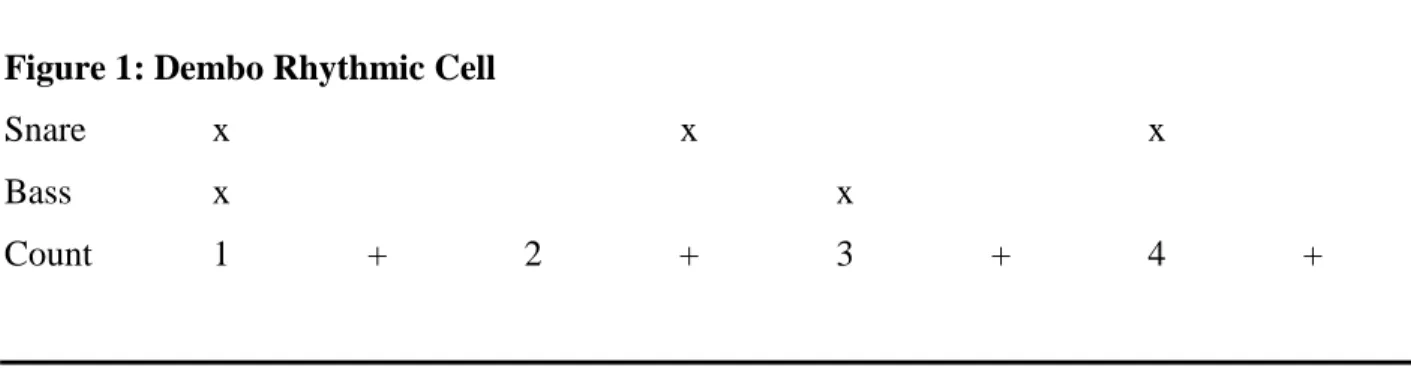
Of the three genre designations, underground is the least specific with regard to style or content. 20 It generally refers to the rap scene in Puerto Rico in the 1980s-90s, and all Puerto Rican rap from this time can be broadly described as underground. In the mid-1990s, a particular sound—defined predominantly by the dembo rhythm (see Figure 1)—became more prevalent in underground. Around 2000, this sound became known as reggaeton. By 2005, Reggaeton’s international commercial success had encouraged a degree of standardization. Many
reggaetoneros were using a standardized aesthetic and writing lyrics that were politically neutral. As a result politically-engaged artists, some of them former reggaetoneros, began describing their music as hip hop as a strategy of disassociating themselves from what they perceived as reggaeton’s homogeneity and materialism. The boundaries and politics of genre on the Island, and the ways that those genres relate to Puerto Rican nationalism, can be traced through the careers of three of the most prominent socially-engaged Puerto Rican artists: Vico C, Tego Calderón, and Calle 13.
19 I use “self-described” because many hip hop artists will claim that they are not reggaetoneros, even while fans and
the industry claim that they are.
20 The English word “underground” is used in Puerto Rico as a noun referencing a genre of music, not as an
17 Vico C and Early Underground:
When early underground musicians brought recordings and stylized hip hop performance to the Island in the 1980s, largely through processes of circular migration between the Island and New York, the music was met with suspicion. According to Raquel Z. Rivera (1997),
mainstream Puerto Rican society viewed it as an American cultural product, completely distinct from the Island’s culture. Even though diasporic Puerto Ricans were involved in hip hop’s early development in New York, the relationship between hip hop and the Puerto Rican nation was complicated by the ambivalence of those on the Island towards those living abroad—primarily in New York, though more recently in Florida as well—whom some on the Island distrusted as not truly Puerto Rican, as somehow corrupted by their separation from the Island and their
integration into Anglo and African American culture (Rivera-Rideau 2015). The Puerto Rican diaspora in the United States was often viewed as more representative of African American culture than of the culture of the Island.21 This helps to explain resistance to the genre in Puerto Rico as a product of cultural imperialism, as a foreign imposition. After all, many of the young artists who formed the early hip hop scene around San Juan were Puerto Rican migrants from the United States.
The rapper Vico C (b. 1971), was one of these young Puerto Rican artists. Born in Brooklyn to Puerto Rican parents, he had already become interested in hip hop and African American culture by the time he moved to San Juan with his parents. He was not the first to introduce hip hop to the Island, but because of his prominence in the early scene he is
21 This despite the fact that many stateside Puerto Ricans, especially those with lighter skin, had trouble fully
18
retrospectively credited by fans and artists as one of the rappers who made it possible for hip hop to be Puerto Rican music, primarily through his use of Spanish rather than English in his rapping (Pacini Hernandez 2009)—especially significant in regard to Puerto Rican nationalism given the Spanish language’s prominence in conceptions of a national culture. As one of the first rappers to use Spanish, he is cited as a major influence by many later Puerto Rican hip hop artists
(including Tego Calderón and Calle 13).22
The sound of Vico C’s songs varies greatly across the span of his long career. From the mid-1980s through to the present, Vico C has recorded songs with a sound associated both with US hip hop—hear, for example, “La Recta Final” (“The Straight Line”) 1989)—and
reggaeton—for example, “Capicú” (2003). Vico C occasionally incorporates the sounds of other Puerto Rican musical genres, most notably salsa. His song “Aquí la que falló fue usted” (“You were the one who failed here”) (2009)—performed with Andy Montañez of the well-known Puerto Rican salsa group El Gran Combo—has hardly any of the stylistic features characteristic of hip hop or reggaeton, but such songs stand as exceptions in his overall output.
Vico C is widely respected by later rappers as el filósofo (the philosopher) for the themes and issues he addresses in his songs.23 Whereas the lyrics of many underground songs from the 1980s and early 90s were characterized by hyper-sexuality and aggression (Pacini Hernandez 2009), Vico C’s songs featured political and social justice themes. For example, in “El Filósofo”, from Misión: La Cima (“Mission: the Summit”) (1994), he criticizes Puerto Rico’s political system.
22 For example, in 2015 Calle 13’s Residente posted to social media a picture of himself with Vico C, taken at a
Tego Calderón concert to which they had both been invited as guest performers. Residente’s caption read: “En Puerto Rico todos empezamos a rapear gracias a este tipo, por eso hay que pedirle la bendición siempre.” (“In Puerto Rico we all began to rap thanks to this guy. That’s why you always need to ask his blessing.”)
23 Though the name is perhaps taken from his song “El filósofo,” in which he raps “Soy el filósofo” (“I am the
19 “El Filósofo,” Vico C24
La política es verdad y es engaño En esta epoca te hace daño Criminalidad cada cuatro años Esos políticos son muy extraños Ofrecen las cosas y nunca las cumplen En las elecciones que nadie los culpen Palabras bien falsa ellos siempre dicen Nacionalistas siempre los maldicen Muy mala cosa va en esta era Y la política es la falla primera Tengo en mi mente una solución
Que el FBI investigue la movida de la corrupción
Politics is truth, and it’s trickery In this age it will do you harm. Criminality every four years, Those politicians are very strange
They offer things and never follow through In the elections, nobody faults them They are always telling lies
The nationalists are always cursing them. Really bad things are happening these days And politics is the first at fault
I have in mind a solution
Let the FBI investigate all the corruption.
Vico C accuses politicians of being corrupt lying charlatans, but notably excludes nationalists in this group (“The nationalist are always cursing them”). Internal critiques leveled at political
structures within Puerto Rico are prevalent in Vico C’s work; he often highlights some of the struggles of daily life in the caseríos and the lack of action by those in power. He occasionally makes a statement regarding the status-question, both in his songs and in his public appearances, but he displays a certain amount of ambivalence towards the issue. For example, in 1994 he participated in old San Juan’s Fourth of July Celebration—in celebration of US independence— but at that same celebration he refused to sign an American flag for a fan, saying that he only signed flags with one star (i.e. the Puerto Rican flag; see R. Z. Rivera 1997, 247). In the mid-1990s, Vico C converted to evangelical Christianity following a near-lethal motorcycle accident that led to struggles with substance addiction. His subsequent albums, starting with Aquel que había muerto (He Who had Died) (1998), typically align with his new religious ideals. While not
24 Translations throughout this thesis are literal. I have generally made no attempt to translate the poetics of the
20
all of the songs are explicitly political or oriented towards social justice themes, they are generally seen by fans as distinct from the more misogynist and consumer-oriented songs characteristic of later underground and reggaeton artists, for example Winsin y Yandel’s “Sexy Movimiento” (“Sexy Movement”) (2007). Though Vico C was not the only underground artist characterized by songs committed to social justice or political struggle, as the most well-known he is representative of some of the musical characteristics and consciousness-raising work within the underground scene.
Underground’s Broader Reception:
Musical genres are shaped and distinguished by more than just aesthetic phenomena. They carry with them the values and ideologies that produced and shaped them. Petra Rivera-Rideau’s Remixing Reggaetón: The Cultural Politics of Race in Puerto Rico (2015) is one of the only extended scholarly works tracing a broad history of reggaeton in Puerto Rico, especially as it relates to race. She emphasizes the ways that reggaeton artists use music to disrupt a
privileging of whiteness on the Island. I rely on her work heavily throughout this chapter, drawing on both its information and analysis. As Rivera-Rideau points out, early hip hop artists in Puerto Rico did introduce elements of African American culture and racialization to the scene. This racialization is significant for the ways that it contrasts with Puerto Rican narratives of racial mixture and harmony founded in the ideals of mestizaje. Mestizaje is an ideology common throughout Latin America that posits contemporary Latin American populations and societies as all sharing common European, Indigenous, and African ancestry. According to the ideology of mestizaje, this mixture has produced race-less societies where all members are equal.25 Rivera-Rideau (2015) connects much of the racial rhetoric surrounding underground music to mestizaje,
25 For more on mestizaje and music, see for example Aharonián (1994), Cunin (2014), Wong (2012), and Moore
21
showing how it positions blackness as a US import, since Puerto Ricans could not actually be “black” due to the process of harmonious racial mixing. This kind of rhetoric served to further marginalize inhabitants of the caseríos, primarily Afro-Puerto Ricans, by suggesting that they could not be authentic Puerto Ricans because of their embrace of an Afro-centric racial identity. The racialized language deployed against underground in the press highlights the popular link between the genre and African Americans. A condemning 1996 editorial by Edwin Reyes (1944-2000)—a poet and columnist for Claridad, a weekly independentista newspaper—described underground as beginning in the “black and Hispanic ghettos of North America. [It is a] primitive form of musical expression that lends itself perfectly to broadcasting the most
primordial forms of emotion” (quoted in Rivera-Rideau 2015, 46). Reyes’ disparaging comments towards underground, as well as other negative public responses, echo those made towards Afro-Puerto Rican music in 1988, when an intense public debate erupted over the renaming of San Juan’s Centro de Bellas Artes (Fine Arts Center) after Rafael Cortijo, renowned Afro-Puerto Rican salsero and champion of Afro-Puerto Rican cultural practices. Juan Flores (1992) cites Marcelino Canino—professor of folklore—as writing that “though musicians of the stature of Mozart found inspiration in the dances and tunes of the common folk, Cortijo’s music can only be described as ‘vulgar’ and ‘lumpen’” (190). Canino went on to argue that this music “only denigrated [the black race] further” (190). Resistance towards Afro-Puerto Rican cultural
practices, especially popular musics, was thus already a recurring phenomenon on the Island, and underground’s reception was but one of many episodes in that pattern.
22
there were no concerted efforts to censor or eradicate it—so long as it was confined to the caseríos, which were already stereotyped as plagued by crime and delinquency. The term itself, “underground”, highlights the music’s marginal status. Artists and fans circulated songs through the exchange of home-recorded cassette tapes, and the music largely circumvented the structures of a commercial music industry (Rivera-Rideau 2015, 21). However, in the 1990s underground gradually began to exceed containment within the boundaries of the caseríos, becoming popular among young middle-class Puerto Ricans. Once it left the caseríos and started becoming more popular among young, middle-class—often lighter-skinned—Puerto Ricans, underground was much more visible and commanded more attention in news media and the Island’s public discourse.
In response to this growing popularity, many Puerto Rican commentators mobilized the disparaging rhetoric surrounding rap in the US against underground in Puerto Rico. The genre was linked to materialist consumer culture, violence, delinquency, and drug use (Rivera-Rideau 2015).26 Also motivating the campaign against underground, however, was the desire to suppress new conceptions of blackness that ran counter to the normative narrative of a peaceful and egalitarian racial mixture (Rivera 1997). This became most apparent in the mano dura contra el crímen campaign,27 a program founded in 1993 in response to widespread concern over
perceived increases in crime—especially violent crime—on the island. Both the police and the National Guard overwhelmingly targeted the caseríos, establishing outposts within those
neighborhoods and conducting raids into private homes, which only served to further stigmatize these neighborhoods in the popular imagination as dangerous places overrun with criminals. The
26 As Rivera-Rideau (2015) points out, possession of underground cassettes was even allowed as evidence
admisssable in court when trying a suspect for other crimes.
23
mano dura directly targeted underground as well. By 1995 the genre had earned broader public attention, and recordings were being sold in record stores instead of just spreading through an informal economy (Rivera-Rideau 2015). The Puerto Rican Drugs and Vice Control Bureau began conducting raids on these shops to confiscate underground records, and the government established strict censorship laws to try to stamp out the still-marginal underground scene.
Because the genre was, in the mid-1990s, still primarily practiced by people at the racial and class margins, the new laws met with little resistance from those with the power to stop them. Furthermore, both independentistas and statists saw underground fans and artists as
24
middle- and upper-class fans. But by that point, it was already being referred to as “reggaeton.” The international success of some reggaetoneros and their producers hastened the codification of this new distinct genre that had outgrown its status as a sub-style of underground.
The Rise of Reggaeton:
Vico C, though considered the pioneer ofPuerto Rican hip hop, is also considered a foundational figure for reggaeton on the Island. The boundary between the two genres is fluid, if it exists at all, which makes it easy for both raperos and reggaetoneros to claim him as their own.28 This fluidity also makes it possible for individual artists to negotiate their position relative to either underground (or later, hip hop) and reggaeton.
Many fans throughout the US and Latin America now perceive reggaeton as a
quintessentially Puerto Rican musical genre, but its development was a transnational process that occurred in spaces of cultural exchange between Jamaica, Panama, the United States, and Puerto Rico (Marshall 2009). In the 1990s, reggae en español (Spanish language reggae) was already an established, if heterogeneous, genre around the Spanish-speaking Caribbean basin. Although Puerto Rico did have a well-established roots reggae scene (Gaztambide-Fernández 2004), far more central to the development of reggaeton was the popularity of Jamaican dancehall, as mediated through Panamanian artists (Marshall 2008).29 Throughout the twentieth century,
28 Some scholars, such as Wayne Marshall (2009) at times write as if the two are synonymous, with the term
“reggaeton” coined in the late 1990s to describe what to that point had been referred to as underground. While this may have been true in the 1990s, reggaeton’s commercial success led to a standardization that, in general, was far less eclectic and heterogeneous than early underground. Because conceptions of reggaeton are now largely shaped by commercial superstars such as Daddy Yankee and Yandel who rely heavily on a techno dance-club aesthetic, I find it helpful to maintain a distinction between underground and reggaeton.
29 As Gastambide-Fernández (2004) writes, in contrast to the dancehall-inspired reggaeton, Puerto Rico’s roots
25
Panama was home to a large Jamaican population that had first arrived during the construction of the Panama Canal. These immigrant communities maintained familial and cultural ties to
Jamaica, and so Panamanian artists were exposed to the latest trends in reggae, including dancehall in the 1980s (Marshall 2008). It is here in Panama that reggaeton’s ubiquitous dembo rhythm came to prominence, especially through reggae en español singer El General’s cover of Jamaican dancehall artist Shaba Ranks’ “Dem Bow.”30
As Wayne Marshall (2009) explains, the dembo rhythm superimposes dancehall’s 3-3-2 rhythm over hip hop’s steady downbeat emphasis (see Figure 1). A heavy bass drum sounds on beats 1 and 2, marking the measure with two evenly-spaced pulses, while the snare drum plays the syncopated 3-3-2 above it. This combined syncopation is often heard as characteristically Afro-Caribbean (Marshall 2009).31
Figure 1: Dembo Rhythmic Cell
Snare x x x
Bass x x
Count 1 + 2 + 3 + 4 +
The connection to the African diaspora was further strengthened in Puerto Rico by dembo’s prominence in the music of the caseríos. The mixtapes of DJ Playero (b. 1964)— a central figure
30 Ranks’ song is nationalist piece that equates “deviant” sexual practices—for example, homosexuality or oral
sex—with imperialism. Those “sexual deviants” are portrayed as undermining Jamaican identity and sovereignty. In its transnational spread, however, these initial connotations have been lost. Dembo is now used as a strictly sonic descriptor, whether to reference the genre or the specific rhythm (Marshall 2008).
31 The 3-3-2 syncopation of the snare alone also sonically alludes to Afro-Caribbean music through its likeness to
26
in the underground scene who was instrumental in underground’s development into reggaeton and its spread throughout the Island—demonstrate the growing ubiquity of dembo in
underground music through the 1990s.32 Many soon-to-be reggaeton stars first appeared on these highly-regarded mixtapes. Dembo is prominent throughout, but it is essentially the only rhythmic backing used by the later tapes.33 This increasing dominance of dembo demonstrates a gradual shift from an eclectic underground to what would shortly be named “reggaeton”—which, just like underground, stood as an icon of Afro-Latino identity, especially given its history rooted in multiple African diaspora musics.
In 2004, there was a major change in reggaeton, brought on by the international success of Daddy Yankee’s “Gasolina.” This song was played on radio throughout the United States, Europe, and Latin America—as well as in Puerto Rico—and it became a popular club hit (Marshall 2009). Following the success of “Gasolina,” its production team Luny Tunes— comprising Victor Cabrera and Francisco Saldana, Dominican-born producers who met in Massachusetts and moved to Puerto Rico when they began their music careers—launched a number of other hit singles by artists such as Don Omar, Ivy Queen, and Tego Calderón. The Luny Tunes sound, which featured dembo throughout and relied on a timbral palette drawn more from electronica than hip hop, became the new standard around which the genre coalesced. In this way reggaeton became sonically more standardized at the same time that it became more commercial. Many critics, including artists such as Tego Calderón and Calle 13, have since lamented in songs and interviews what they perceive as the genre’s homogeneity, apoliticism,
32 Most of these mixtapes are not commercially available. However, some have been uploaded to site like youtube.
A search for DJ Playero will bring up several examples, typically titled Playero [#].
33 Consider, for example, Playero 37, <https://www.youtube.com/watch?v=p4AMJkKFaPI> (accessed 10 March
27
and materialism. Despite initially being classified as reggaeton by critics and fans, both of those artists attempted to disassociate themselves from the genre and align themselves with hip hop as a socially- and politically-engaged alternative.
Tego Calderón and a Reggaeton Alternative:
In 2004, Vico C released his album En Honor a la Verdad (In Honor of the Truth), which included “El Bueno, el malo, y el feo” (“The Good, the Bad, and the Ugly”). This song featured Eddie Dee (b. 1977), also a major figure in the early underground and reggaeton scenes, and Tego Calderón (b. 1972), a relative newcomer whose debut album had only come out two years earlier. The song features an electronic synthesizer ostinato, heavy bass downbeats, a synthesized string section, and Afro-Caribbean hand drum. All of this sounds over a dembo rhythmic track. Unlike some of the more club-oriented reggaeton singles released that year, “El Bueno, el malo, y el feo” is explicitly political in its social critique. For example, Calderón in his verse calls out Puerto Rico’s inherent prejudice against Afro-Puerto Ricans and those from the caseríos.
“El Bueno, el malo, y el feo,” Tego Calderón
Y esos que están culpándonos,
Ahorrándonos, hablando basofía, marginándonos En vez de ser Tego el que te canta
Podría ser Tego el que te asalta. Saco de trampa. Lucho pa' que mi hija nunca pase hambre Por eso tienen que matarme.
And those that are faulting us,
Saving us, talking trash, marginalizing us Instead of being Tego who sings for you, I could be Tego who assaults you. A freeloader. I fight so my daughter doesn’t go hungry, For this they have to kill me.
28
he is black, he is stereotyped as someone who might commit assault.34 Finally, Calderón seeks to highlight the hypocrisy of Puerto Rican social structures and government policy by insinuating that Afro-Puerto Ricans and those of the caseríos are not being targeted because of their actions or behaviors—he is, after all, only trying to get by, feed his daughter—but because of their racial and class identities. “El Bueno, el malo, y el feo” highlights many of the major trends that set Calderón apart from many of his reggaeton contemporaries. Performing in this song with Vico C and Eddie Dee, he aligns himself with political artists who were active in the hip hop scene of the caseríos before the rise of reggaeton brought the genre to the mainstream.
Born in the San Juan neighborhood of Santurce, Calderón moved first to Rio Grande— the caserío where his father grew up—and then to Rio Piedras, where he spent most of his youth.35 His father was committed to raising Afro-Puerto Rican consciousness on the Island, and he would regularly take both Tego and his sister Kenya to Loíza to participate in various Afro-Puerto Rican cultural practices—including bomba, plena, and bajando los santos.36Calderón studied percussion at the Escuela Libre de Música, a Puerto Rican high school specializing in music studies, but before graduating he moved with his father to Miami and finished his formal education at a Miami public school. According to Calderón, although he did not take his music studies seriously while at the Escuela Libre, he still credits the experience with refining his ear and exposing him to a wide variety of music and dance that he otherwise would not have
34 Another possible reading of this line understands it as a threat. Addressing those who marginalize and denigrate
Afro-Puerto Ricans, he warns that he could easily go from singing to them to assaulting them. However, given the line’s context within the song, I hold to my initial reading which highlights problems of representation.
35 All of these towns, including Loíza, are within 20 miles of each other in the northeast corner of the Island.
36 “Calling down the Saints.” The phrase refers to the Santería practice of inviting spirit possession through music. It
29
encountered, thus contributing to his musical eclecticism (R. Z. Rivera 2004).37 After finishing high school, he remained in Miami working odd jobs. It was there that Calderón says he came to know hip hop. Enamored by rappers such as Rakim and KRS-One, Calderón initially tried to write hip hop songs in English.38 It was only upon returning to Puerto Rico, when he heard Vico C and—as he describes them—less talented MCs on the radio rapping in Spanish, that he began to explore rapping in his native language (R. Z. Rivera 2004).39
Within a few years, he made his first public performance on Canal 18’s television
program Viernes de Rap (Rap Fridays), but it was still about a decade before he released his first studio album, El Abayarde (2003).40 From the beginning, Calderón sought—both rhetorically and to a certain extent aesthetically—to avoid being labelled as reggaeton. In an interview, he reflected on the difficulty he had building his career in the 1990s:
No me estaba enfocando, porque lo que estaba sucediendo en la escena de la isla era el reggaetón y a mí lo que me gustaba era el hip hop y yo iba totalmente opuesto a lo que estaba sucediendo. Entonces por eso se me hizo tan difícil. Porque yo me negué a cantar reggaetón. (R. Z. Rivera 2004)
I wasn’t focused, because what was happening in the Island’s scene was reggaeton and what I liked was hip hop, and I was totally opposed to what was going on. So that’s why it was so difficult for me. Because I refused to sing reggaeton. (R. Z. Rivera 2004)
Despite his initial refusal to perform reggaeton, he did record several songs in that style on El Abayarde (2003). Three of the songs on the album are produced by Luny Tunes, and these fit
37 In his in-depth interview with Raquel Z.Rivera, Calderón specifically mentions classical music and ballet, as well
as other popular styles.
38 The two rappers he names as major influences in his art, Rakim and KRS-One, are both important figures in NY’s
early hip hop scene who are known for their viruosity as MCs and their socially conscious lyrics (the latter especially applies to KRS-One).
39 Most of the biographical information in this section is gleaned from Raquel Z. Rivera’s excellet interview with
Calderón, which took place in 2003 at La Casita de Chema in the Bronx.
40 An Abayarde is a type of insect similar to a fire ant—it is small but has a painful bite. In Puerto Rico, it can also
30
squarely within a reggaeton style defined by prominent use of dembo, the timbre and placement of the instruments in the pista, and in part by highly sexualized lyrics. In an interview with R. Z. Rivera (2004), Calderón tries to separate himself from reggaeton even in these songs.
Explaining “Lleva y trae,” one of the reggaeton songs from El Abayarde produced by Luny Tunes which features a back-and-forth between a male and female rapper, Calderón said:
Escribí la parte de la muchacha y me gusta porque hice a las muchachas sentir parte del disco. […] Yo lo escribí porque quería que supieran que yo también siento respeto por las féminas y que son bien importantes en lo que es la sociedad como tal. [Las muchachas] también tienen su carácter y su genio, y quise incluirlas ahí en mi disco. (R. Z. Rivera 2004)
I wrote the woman’s part, and I like it because it makes women feel like they are part of the album. […] I wrote it because I wanted them to know that I also respect women and feel that they are really important in society as such. [Women] also have their own character and their genius, and I wanted to include them there on my album. (R. Z. Rivera 2004)
Calderón thinks of reggaeton as an overwhelmingly machisto genre that, even when it does make space for women, only objectifies them. In demonstrating his respect for women, he is also disassociating himself from reggaeton. Some Puerto Rican hip hop fans pushed back against his apologetics, accusing him of “selling out” by including more mainstream reggaeton tracks. Calderón understands it differently: because he had already proven himself to the hip hop community he was free to try out reggaeton as a way to further his career and as a way to bring new listeners to his more socially-conscious hip hop tracks (R. Z. Rivera 2004).41
Calderón is also differentiated from other reggaetoneros through his explicit commitment to Afro-Puerto Rican and Afro-diasporic communities.42 Some of this commitment comes across in his musical aesthetic. On El Abayarde (2004) he included a song titled “Loíza” that
41 This argument is also be used in the apologetics of Calle 13 in their attempts to explain some of their more
mainstream reggaeton songs.
42 See for example, his editorial in the New York Post (Calderón 2007), in which he denounces the racism in Latin
31
incorporates bomba as part of the underlying rhythmic track. He has said that, even though many warned him not to include bomba—either in “Loíza” or in the many bomba interludes
throughout the album—he believed it was important both to acknowledge Afro-Puerto Rican culture and to help keep those traditions alive by validating them for younger Puerto Ricans who might see them as something exclusively of their parents’ generation (R. Z. Rivera 2004). The town of Loíza, originally a settlement for freed slaves, acts as a metonym for the entire Afro-Puerto Rican population and is still widely considered—in official promotional material meant to promote tourism, in the press, and by many artists—the center of Afro-Puerto Rican culture on the Island. There are several festivals in the town that celebrate the Afro-Puerto Rican
community, and folkloric tourism is an important part of the town’s economy (Hiraldo and Ortega-Brena 2006). Calderón’s reference to the town of Loíza can therefore be understood as a political statement. In the lyrics of “Loíza,” he not only aligns himself with the Afro-Puerto Rican community, but he also calls out some of the structural biases that work against the interests of the people of Loíza.
“Loíza,” Tego Calderón
Ando sin prisa
Pero tu lentitud me coleriza Y el que no brega con Loíza Me quiere hacer pensar
Que soy parte de una trilogía racial
Donde to’ el mundo es igual, sin trato especial […]
No todos somos iguales en terminos legales Y eso está probao en los tribunales
En lo claro la justicia se obtiene con cascajos Por eso estamos como estamos
I go in no hurry,
But your slowness makes me angry And the one who doesn’t stand with Loíza Wants to make me think
That I am part of a racial trilogy
Where everyone is equal, without special treatment. […]
We are not all equal under the law And this is proven in the courts.
In plain daylight justice is bought with coin And that’s why we are how we are
32
regional identifications (E. Rivera 2008). As Calderón sings in “Loíza,” he believes that there is widespread prejudice, both social and legal, against Afro-Puerto Ricans, despite the official insistence that all Puerto Ricans come out of the same mixture of Spanish, Indigenous, and African ancestry. By insisting on a racialized Afro-Puerto Rican identity, both rhetorically in the lyrics and sonically in the inclusion of bomba, Calderón claims a space for Afro-Puerto Ricans in public discourse and representations of the nation, in the process undermining what Maritza Q. Rivera (2006) identifies as mestizaje’s tendency to disempower Latin America’s racially-marginalized populations.
In addition to championing Afro-Puerto Rican identity, Calderón is a fierce
independentista. Throughout his career he has spoken out in favor of Puerto Rico breaking from the United States entirely to form a fully independent nation-state. Puerto Rican
independentismo embraces the ideology of mestizaje, and there is some fear amongst liberal Puerto Ricans that any social changes that were to come about as a result of independence would work against the interests of marginalized populations that do not conform to the normative vision of Puerto Rico, as represented by the jíbaro. Calderón’s Afro-centric politics, then, are at odds with mainstream independentismo. Rivera-Rideau (2015) attempts to reconcile Calderón’s work with independentista rhetoric by arguing that the Afro-Puerto Rican elements included in Calderón’s songs are a part of “folkloric blackness.” As such, she argues, they can be
33
Besides relegating blackness to the past, this distancing [accomplished by folkloric blackness] also involves locating it within specific places in Puerto Rico (for example, the town of Loíza […]), imagined to be distinct from the rest of the island. Confining folkloric blackness to restricted places and time implies that blackness is irrelevant to contemporary Puerto Rican society, while simultaneously acknowledging the African heritage that is part of Puerto Rico’s racially mixed identity. (Rivera-Rideau 2015, 10) It follows, then, that Bomba—because it is not a part of the lived experience of most inhabitants of the caseríos—is not a threat to independentismo’s racial rhetoric. Rivera-Rideau’s reliance on folkloric blackness in her interpretation of the politics of Calderón’s music ignores, however, the extra-musical elements that frame an audience’s experience of songs such as “Loíza.” All of Calderón’s rhetoric—in his lyrics, interviews, and public appearances—shapes an audience’s stance towards his music, and thus towards the interpretation of his inclusion of Afro-Puerto Rican elements. His general championing of Afro-Puerto Rican communities and condemnation of metstizaje ideology (Calderón 2007) resists a hearing that understands Afro-Puerto Rican musical signifiers as nothing more than a nostalgic nod towards the past, as upholding the idea of racial democracy.
Whether or not one hears Calderón’s music as a type of folkloric blackness amenable to the politics of the PIP—the largest pro-independence political organization on the Island— Calderón has openly condemned the PIP along with the rest of the Island’s politicians. He made news in 2015 when, in frustration, he walked off the set of Univision’s Los 6 de la Tarde—a
live-broadcast evening talk show—when Héctor Ferrer, former Partido Popular Democrático
34
Calderón’s critiques of the Puerto Rican government.43 Before leaving, Calderón accused not just Ferrer, but all of Puerto Rico’s politicians of an ignorance of the everyday lived experience of many Puerto Ricans and likened Puerto Rico’s politicians to mafiosos.44 He claimed that the PIP was no better than the other parties when it came to looking out for the interests of all Puerto Ricans. In January 2016, Calderón again made news when he endorsed David Bernier, leader of the PPD, for governor. Calderón said over twitter: “My brother DAVID BERNIER WHY ARE YOU GETTING INVOLVED WITH THIS? But fuck it, I’m with you!!!”45 He also criticized the PIP candidate, Maria Lourdes Santiago, saying “she doesn’t do anything”46 (“Tego Calderón Apoya a David Bernier” 2016). Calderón’s support for a PPD candidate, someone publicly in favor of the current ELA status, provoked criticism from many of his fans, especially given his vocal support of independence (“Tego Calderón va a Todas Por Defender a David Bernier” 2016).
In this way, Calderón confounds the typical political divide on the Island by supporting independence, but not the party that builds its platform around independence. He focuses his attention on the domestic policies that will have a greater effect on the lived experience of Puerto Ricans generally. His use of folkloric blackness in his music does not make him palatable to the PIP, nor does anything about either his songs or his self-representation suggest this is his goal. In his public rhetoric he actively disassociates himself from the independentistas because the
independence they offer would do little to help poor or Afro-Puerto Ricans, and would do
43 His critiques included issues such as the way that drug penalties targeted the poor and the ways that lax firearms
restrictions were damaging poor neighborhoods.
44 For a video of this conversation, see <https://www.youtube.com/watch?v=YSx8MPhrR6U>.
45 “Mi hermano DAVID BERNIER PA QUE TE METISTE EN ESO? Pero me@jodi contigo estoy!!!”; also
significant is Calderón’s Twitter username, “Cortijo Vive en Mí” (“Cortijo Lives in Me”), which references Rafael Cortijo.
35
nothing to address the underlying structures of racism and oppression present in Puerto Rican political and social life. For Calderón, part of this underlying structure is a mental colonization that encourages consumerism above all else (R. Z. Rivera 2004). Although he does not see any objective features distinguishing reggaeton from hip hop as entirely different genres (R. Z. Rivera 2004), embracing hip hop over reggaeton does allow him to separate himself from the latter’s perceived commercialism and materialism, thus making it easier for him to present himself as a politically-engaged artist.
Calle 13’s More Acceptable Nation:
Calle 13 is one of Puerto Rican’s best-known musical groups—judging by album sales— both at home and abroad. They first came to prominence with “Querido F.B.I.” shortly before the release of their first album in 2005. They have since gone on to produce five full-length albums, the most recent of which is Multi_Viral (2014). Calle 13’s core musicians are René Pérez Joglar (lead vocalist) and Eduardo Cabra Martínez (instrumentalist/composer), stepbrothers who go by the stage-names Residente and Visitante, respectively. Other musicians are brought on as
needed, especially for live performances. Calle 13 regularly tours with a twelve-part ensemble of musicians— who play a range of instruments, including bass guitar, guitar, drum kit, brass, and percussion—and has collaborated with other artists from various parts of Latin America (Rohter 2010). They have received widespread popular and critical acclaim, including twenty-two Latin Grammy awards and three Grammys to date. This speaks to their prominence as public figures both on the Island and throughout the Spanish-speaking world.