119
Designing Learning Elements Using the Multiliteracies Approach in an ESL
Writing Classroom
SARJIT KAUR School of Humanities Universiti Sains Malaysia, Penang
[email protected] MALINI GANAPATHY
Penang Free School, Penang
GURNAM KAUR SIDHU Faculty of Education, Universiti Teknologi MARA
Shah Alam, Selangor
ABSTRACT
Teaching English language literacy skills in contemporary ESL classrooms is evolving dynamically in cohesion with the multiplicity of communication channels, media, cultural and linguistic diversity (Kalantzis & Cope, 2009). Students engage with different texts according to their social and private contexts which include web-based stories, interactive stories, hyper narratives in computer games, internet, podcasting, online news, e-mail, text messaging, MSN, Facebook, Twitter, Skype and weblogs. These new practices fundamentally change students’ learning processes in the ESL classroom as they interact with various multimedia and deal with the multiplicity of communication channels and social networking. In addressing these new challenges, ESL students require new approaches to understand literacies used in making meanings from multimodal communication elements which is relevant when integrated into teachers’ pedagogical practices. This paper situates the framework of the Multiliteracies approach in reframing ESL teachers’ pedagogical repertoires with the aim of enhancing students’ writing performance. Using classroom observations and interviews, this qualitative case study examines the effectiveness of ESL teaching of writing using the Multiliteracies approach among 37 Chinese students in a secondary school in Penang, Malaysia. The results confirm the need for teachers to negotiate literacies through broad repertoires of multimodal pedagogical practices in the secondary school context as these elements promote positive learning outcomes. The implications of this study suggest that the Multiliteracies approach to writing lessons planned in accordance to the learning element results in pedagogical practices which are multimodal in nature and these appeal to students’ interest and motivate them to improve their writing performance.
Keywords: multi-channelled communication technologies; ESL writing performance; multiliteracies approach; multimodal practices; literacy skills
INTRODUCTION
120 (Pandian 2007, Satchinanthan 2009, Normah Othman 2009, Mukundan 2011, Mohd. Saat Abbas et al. 2011).
The current pedagogical practices employed by teachers in the secondary school system based on the lesson plan demonstrate the inconsistencies between current writing practices and writing outcomes that are required of students who actively engage in digital environments outside school hours (Ganapathy & Kaur 2011, Nurzali Ismail 2011, Meng 2011, Arafeh Karimi 2011). Hence, the Learning Element (LE) which is used in this study (instead of the traditional lesson plan) paves the way to the “emerging knowledge society that requires a radically new approach to learning” as globalisation intertwines with new and modern technological implications (Kalantzis & Cope 2009). To date, few studies have taken a close look at the adoption and diffusion process of Multiliteracies initiatives in ESL classrooms (Tan & McWilliam 2009).
In recent years, researchers have engaged in important dialogues about the need for students to develop broad repertoires of literacy practices that are not only confined to the traditional ability of reading and writing (Tan 2006, Pillai 2007, Cope & Kalantzis 2009, Cole & Moyle 2010). In the current era of Information and Communication Technologies, the teaching of literacy has taken on new and modern technological implications especially for students. With rapid transformations occurring in today’s interconnected technological world, it is relevant to integrate the teaching and learning of literacy skills within electronic and digital environments. Within this backdrop, The New London Group (1996) had introduced the Multiliteracies theory to address the rapid changes in the conception of literacy due to globalisation, technology and increasing cultural and social diversities. The Multiliteracies theory takes into consideration important aspects of pedagogy, diversity and multimodality and these key features are used by Kalantzis and Cope (2005) to form the basis of their Learning by Design Model (LBDM). In coining the term multiliteracies, The New London Group (1996, p.17) aimed to seek a more “equitable social and cultural participation that connects with the real world”. The plurality of literacy refers to the many ways in which “literacy is employed and the many things with which it is associated with in a community or society and throughout the life of an individual” (UNESCO 2006, p.13).
The MLITA in the educational context is a concept designed to examine the possibilities of learning that helps students connect with the changes in technology and the ways in which communication technology has changed and what it means to be a literate person in the 21st century (The New London Group 1996). The MLITA is incorporated in the LBDM and it enables educators to design the learning experiences that constitute a variety of pedagogical practices that align to the theory of multiliteracies and multimodal meaning-making. Teachers must now cope with more diverse students who possess various dispositions, sensibilities and learning needs (Burrows 2005). The LBDM fundamentally promotes the idea of design where there is a combination of knowledge processes, encompassing four elements that include experiencing, conceptualising, analysing and applying.
121 approach was able to address the challenges in transforming conventional learning settings to more relevant learning environments that will be appropriate to the students’ real world contexts to seek answers to the following research question: What are ESL teachers’ perceptions of teaching continuous writing utilising Learning Elements designed by using the Multiliteracies approach.
THE MULTILITERACIES THEORY: CONCEPT AND APPLICATIONS
According to Tan and McWilliam (2009, p.4), multiliteracies initiatives propel pedagogical practices in the classroom that address students’ preferred current mode of learning that relates to their social engagement. It also reiterates the following key objectives of the MLITA:
to facilitate the development of students’ individual and collaborative interests and abilities through the use of new digital media that are highly engaging and relevant to the students’ lifeworld;
to provide students with the opportunity to learn in an environment that is more flexible and less prescriptive than a structured traditional classroom, in turn allowing students to explore their passions and make competent choices regarding their learning;
to create opportunities for students to develop knowledge and skill sets relevant to the 21st century, including digital literacies, communicative competence, and abilities to lead and work in teams, so as to enhance the students’ future career and professional opportunities; and
to allow students to take ownership of their own learning process and outcomes through
self-directed learning, and at the same time, engage in this process of knowledge construction with a broader community of peer learners.
This study takes into account the objectives of the MLITA in the teaching and learning process during the implementation of the Learning Elements (LEs). The multiliteracies theory promotes the idea that knowledge and meaning are historically and socially located and thus can be considered as ‘designed’ artefacts. Cope & Kalantzis (2000, p.178) construe design as a dynamic process, a process of subjective self-interest and transformation, consisting of:
a. The Designed (the available meaning-making resources, and patterns and conventions of meaning in a particular cultural context);
b. Designing (the process of shaping emergent meaning which involves representation and recontextualisation—this never involves a simple repetition of The Designed because every moment of meaning involves the transformation of the Available Designs of meaning);
c. The Redesigned (the outcome of designing, something through which the meaning-maker has remade themselves and created a new meaning-making resource—it is in this sense that we are truly designers of our social futures).
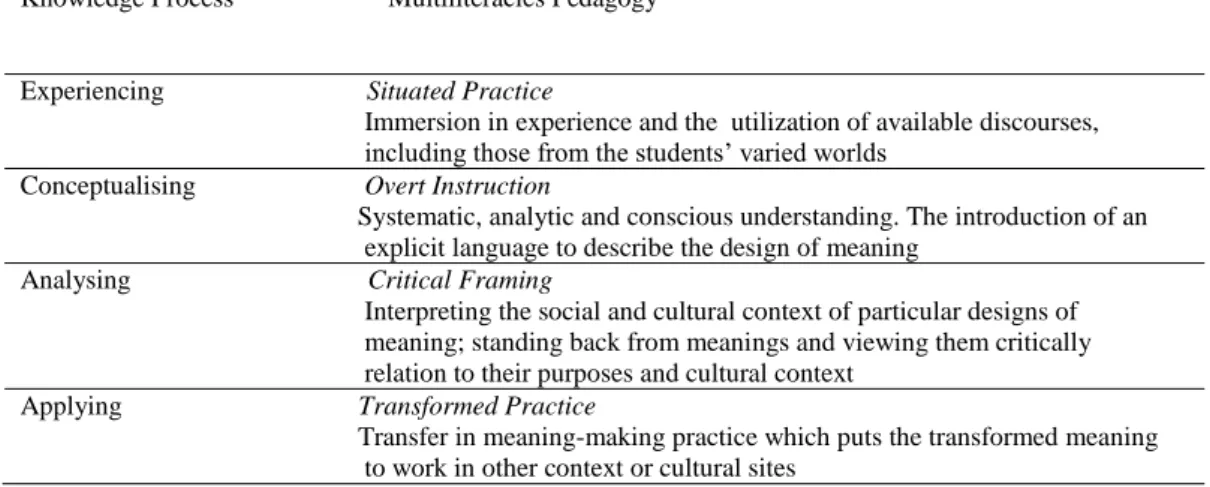
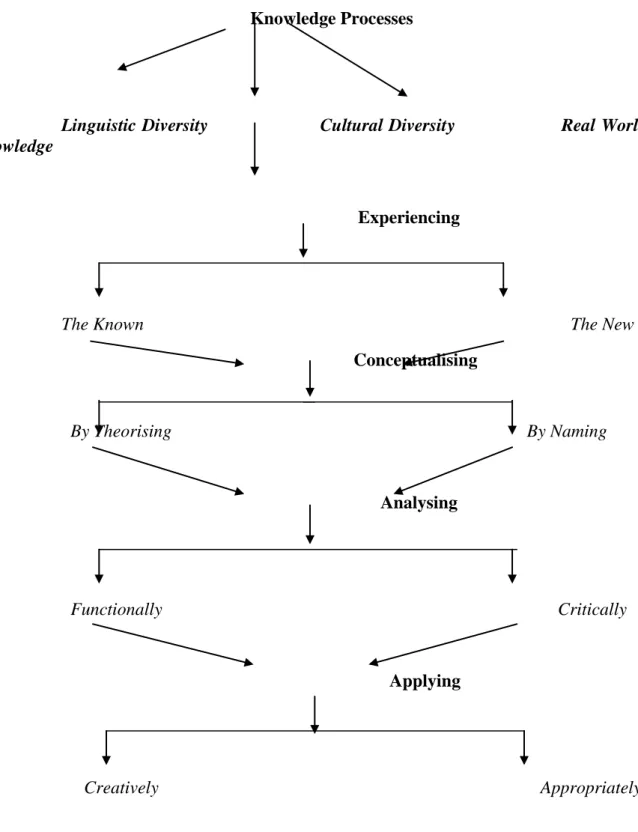
122 which functional ‘grammars’- metalanguages which describe and explain patterns of meaning” are required: Linguistic Design, Visual Design, Audio Design, Gestural Design, Spatial Design and Multimodal Design, in which meanings are made in relation to different modes of meaning. Particularly with the rise of new ICTs, these different modes of meaning are increasingly interrelated—in email, in desktop publishing, in video and in multimedia and hypermedia. This means that literacy teaching has to move well beyond its old, disciplinary boundaries. There are various factors in the LBDM which underlies the multiliteracies framework and that facilitates planning of effective learning experiences and outcomes. Responding to the changing dynamics of new times, the pedagogy of multiliteracies in the LBDM promotes students’ higher order thinking skills through the various pedagogical choices in this framework which are termed as knowledge processes. The knowledge processes encompass cognitive skills such as conceptualising, experiencing, applying and analysing. In this model, literacy includes multimodal texts involving the elements of linguistic, visual, auditory, gestural and spatial designs (Cope & Kalantzis 2009). According to Kalantzis and Cope (2004, p. 39), “pedagogy is the stuff of knowing and knowing is what connects the stuff of the mind with the stuff of the world. Knowing is a way of acting, a way of thinking and a way of meaning”. These various channels of knowing are construed as different ‘movements’ or moments in the learning process. In this model, when a sequence of Knowledge Movements or Processes has achieved a certain degree, even if only momentary, it is termed as pedagogy.
TABLE 1. Mapping the multiliteracies pedagogy with knowledge process in the LBDM
(Source: Kalantzis & Cope 2005) Knowledge Process Multiliteracies Pedagogy
Experiencing Situated Practice
Immersion in experience and the utilization of available discourses, including those from the students’ varied worlds
Conceptualising Overt Instruction
Systematic, analytic and conscious understanding. The introduction of an explicit language to describe the design of meaning
Analysing Critical Framing
Interpreting the social and cultural context of particular designs of meaning; standing back from meanings and viewing them critically relation to their purposes and cultural context
Applying Transformed Practice
Transfer in meaning-making practice which puts the transformed meaning to work in other context or cultural sites
123 Knowledge Processes
Linguistic Diversity Cultural Diversity Real World Knowledge
Experiencing
The Known The New
Conceptualising
By Theorising By Naming
Analysing
Functionally Critically
Applying
Creatively Appropriately
FIGURE 1: Knowledge Processes in the Multiliteracies Pedagogy
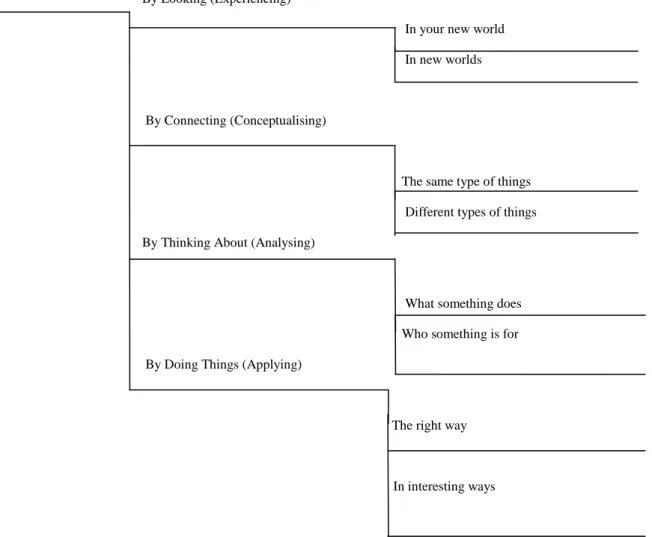
124 The following figure explicates the various “movements” or moments in the learning process:
Knowing Things
By Looking (Experiencing)
In your new world In new worlds
By Connecting (Conceptualising)
The same type of things Different types of things
By Thinking About (Analysing)
What something does Who something is for By Doing Things (Applying)
The right way
In interesting ways
FIGURE 2. Different movements in the learning process
(Source: Kalantzis and Cope 2004, p. 39)
125 the clusters responded to the LBD framework by viewing it as a potential to transform their teaching to be exciting in an innovative way.
In the Malaysian context, Ahmad Suhaimi Mohd Zaid (2004) carried out an exploratory study on the use of the Multiliteracies Approach in the teaching of English in selected schools in the state of Perak. His study aimed to gauge the acceptance level of the teachers and students from the four schools (two secondary schools and two primary schools) involved in the Multiliteracies Project organised by researchers from Universiti Sains Malaysia, Penang. It also investigated whether the MLITA could be accepted by teachers and students involved in the study and whether it could be incorporated within the Malaysian education system. The secondary and primary school teachers focused on developing LEs on the topics Changing Scenes and Celebrating a Festival respectively. The findings revealed that the teachers supported the MLITA as a successful pedagogical approach and all 129 students surveyed in the study reported feeling immersed in their activities and said that they really enjoyed their lessons in comparison to the normal lessons that were traditional in nature. The responses from teachers reflected a positive outlook of this new approach and had reached the point of recommending this approach to other teachers. Consequently, the responses from students and teachers were also encouraging as there was evidence that the MLITA is very much applicable within the context of the Malaysian classrooms.
Naidu et al. (2006) used the MLITA to teach Year 5 ESL pupils in a Tamil school in Penang. As part of the ‘Multiliteracies in Education’ project, the school teachers were given assistance in preparing the LE in order to carry out the following learning objectives for their class: read a text titled “A Picnic at the Waterfall” and answer comprehension questions, use a dictionary, carry out text completion exercises, write an essay, participate in a ‘word maze’ activity and sing songs, organize a real picnic, design an invitation card and create a scrap book or develop a picture dictionary. All the students expressed a high level of enthusiasm in participating in the planned activities as they involved a range of multimodal teaching and learning tasks. They preferred learning English using the MLITA rather than the traditional lessons they had been having prior to this where they felt less engaged in the learning and teaching process.
METHODOLOGY
The principal data collection methods in this study were interviews and classroom observations. The research site was a Chinese secondary co-educational school in Georgetown, Penang. In adhering to ethical considerations and as requested by the school’s principal, the identity of the school was kept confidential. The Chinese secondary school was then labeled as ‘school A’. The students in this school have to master three languages which are Bahasa Melayu (the first official language), English (the second official language) and Mandarin, which is the main language of instruction.
126 of students in terms of their academic achievement and consisted of students who obtained above average and average scores in their PMR examination the year before.
In a preliminary interview with the Head of the English Panel at the school, it was found that students in school A showed a lack of interest in their writing activities and were passive during their English lessons. The Head of the English Panel and the ESL teachers who were interviewed expressed their enthusiasm to be participants of this study in the hope of benefitting in terms of getting to know more about using the Multiliteracies Approach in teaching writing skills to their students. The selected teachers consisted of experienced teachers who had a minimum of five years work experience of ESL teaching. The Head of the English Panel selected the action research teacher to conduct the study based on her experience as an ESL teacher. Besides that, the determining factor for choosing the action research teacher was on the basis that her class was selected as the sample for this study. The selection of the three ESL teachers for the classroom observation task (on a voluntary basis) using the Teacher Rating Sheets (TRS hereafter) took into consideration the following criteria:
TABLE 2. Selection of ESL classroom observers
No. Criteria for Selection No. of Subjects
1. ESL teachers with 11-20 years of experience: Teacher A
Teacher B
1 1
2. ESL teachers with less than 10 years of experience:
Teacher C
1
The rationale for using the number of years of work experience in teaching ESL as a basis for selection was that the Head of the English panel was of the view that the teachers with more than 30 years of teaching practice do not use ICT for teaching. Furthermore, it was noted that these teachers do not use the process approach to teach writing and instead prefer to use the product approach. The Head of the English Panel was keen to have the teachers gain exposure to the teaching of continuous writing based on the MLITA. Their teaching schedules were revised to accommodate this study in order to allow them to conduct the classroom observations. The design of the Teacher Rating Sheet (TRS) was adapted from the Designs Guide by Kalantzis and Cope (2004) and was used by the observers to gauge the effectiveness of the MLITA in the ESL writing classroom. The assessment scheme of the TRS is significant in this study as the categories used in the TRS constitute an integral component of the conceptual framework of the Multiliteracies theory. The assessment criteria in the TRS are displayed in Table 3 below:
TABLE 3. Assessment Criteria in Teacher Rating Sheet (TRS)
Assessment Criteria Example of Skills
Demonstrations of experiential knowledge
Students’ ability to use their previous knowledge to interpret the essay topic Demonstrations of conceptual
knowledge,
Students’ ability to understand the requirements of the essay topic after researching
Demonstrations of analytical knowledge
127
Conitnued
ideas in relation to the essay topic after researching
Demonstrations of applied knowledge Students’ ability to construct thesis
statements, topic sentences and
supporting details and fulfill the requirements of the writing genre
Multiliteracies. Students’ ability to integrate multimodal
meanings in their various presentations: graphics, gestures, spatial, linguistic, visual & audio
RESEARCH PROCESS
A total of six learning elements which were prepared using the MLITA were observed by the 3 ESL teachers over a period of 28 weeks (May – November 2010). Prior to this, the researchers conducted four training workshops (January – March 2010) for the action research teacher and the 3 ESL classroom observers to familiarize them with the Multiliteracies framework and in using the Teacher Rating sheet (TRS) to assess students’ engagement in writing in English using the MLITA. The action research teacher designed the six LEs during the workshop with guidance from the researchers (refer to Appendix I). During the workshop sessions, the action teacher prepared several drafts of the LEs until the final version was approved by the researchers. In addition, the stipulated writing genres taught adhered to the existing English syllabus. Discussions on the intricacies of the proposed design of the LEs following the MLITA helped the action teacher to employ appropriate strategies to teach writing to her ESL students. The designed LEs were closely reviewed by the researchers to ensure that key elements of the MLITA were incorporated in the various knowledge processes. The LEs were constructed based on the essay requirements in the SPM continuous writing section which specifically covers the following six genres in Paper 1: Reflective, Descriptive, Narrative, Argumentative, Factual and Free Style essays. The classroom observers were given detailed information on the assessment criteria underlying the implementation of the TRS to evaluate students’ progress in the writing classroom. A total of 6 classroom observations were carried out by the 3 ESL teachers (one for each LE). This number of observations is in line with the justification provided by Crano and Brewer (2002) who highlight that the number of observers is dependent on the context and requirements of the study. In this study, the researchers trained the 3 ESL teachers on using the TRS to evaluate students’ progress in the writing classroom. The construction of interview questions for the ESL teachers as respondents was given due consideration with regards to the research question and conceptual framework of this study. This procedure involved segregating themes and issues in relation to the area of study which is closely aligned to the teaching and learning of writing using the MLITA.
128 conducted the classroom observations took approximately one hour. The researchers conducted the interviews with the action research teacher and classroom observers after the completion of the six LEs.
DATA ANALYSIS
In relation to the purpose of the study, a micro analysis approach using the meaning condensation method (Kvale 1996) to analyse data was used for the interviews. The aim of this form of analysis was to locate emergent themes through various perceptions of the participants in the interviews. The results of the interviews were deductively described since the sample size was small. Results were described descriptively based on the notes taken during the focus group interviews and counter checked with the tape recording transcripts to ensure accuracy. Key ideas were immediately summarised after the focus group interviews in order to provide central ideas for data analysis which Babbie (2007) points out as vital in highlighting initial responses of participants’ comments.
The responses of the action research teacher were similarly analysed deductively. The analysis looked into various aspects that encompassed the manner in which the action research teacher and classroom observers perceive the effectiveness of the MLITA in teaching writing and if there were any similarities or differences in their opinions. An integration of the research question and selected questions from the interview schedule formed a basis for organising the analysis and presentation of the interview data. This was due to the assumption that the analysis of each individual’s perceptions of the MLITA to teach writing were of equal importance and valid.
FINDINGS
THE RESULTS OF THE INTERVIEW SESSION WITH THE CLASSROOM OBSERVERS
The ESL teachers with 11-20 years of teaching experience were labeled as teacher A (Tr A) and teacher B (Tr B) and the teacher with less than 10 years of experience was labeled as teacher C (Tr C). When they were asked to comment if the MLITA can be an effective measure in overcoming students’ weaknesses in writing, they gave the following opinions:
I was always under the impression that ICT was a nuisance. After observing students presenting their Powerpoint slides and Video clips, I am astounded at the way it reinforces students’ understanding of writing skills. Similarly, other presentations too have proven that ICT is a helping tool in researching for ideas in writing. The MLITA opens up avenues for a new whole experience of teaching writing in challenging, interesting and exciting ways. Students’ weakness are definitely solved through the MLITA especially their creativity and writing skills. (Tr A)
The MLITA has the potential to strengthen students’ writing performance through the knowledge processes that is an aid to creativity of ideas in the writing process and the process approach is great. We always practice the product approach to writing as it is convenient but not helpful in
overcoming students’ weaknesses in writing effectively. (Tr C)
129
So far in my career I have never seen such an approach. Why so cos it is so effective in helping students to identify thesis statements, topic sentences and supporting details in interesting ways. The LE is the platform to help students in their writing performance. The knowledge processes truly promote writing experiences that help students overcome their weaknesses. (Tr B)
The three ESL teachers unanimously stated that the knowledge processes in the LE were the most beneficial aspects in the teaching of writing. In principle, the teachers felt that when the writing activities were mapped against the knowledge processes, it created a positive impact during the writing lessons that were taught using the MLITA. Furthermore, it was found that students benefited from the way they were taught about thesis statements, topic sentences and supporting details:
Normally, for continuous writing, we teach students to straight away identify main ideas for the topic or sometimes just ask them to start writing without researching for ideas. The MLITA lessons have enlightened me on the importance of this aspect. (Tr C)
I am also of the same opinion. By teaching students to construct thesis statements, topic sentences and supporting details, the framework of the different writing genres are strengthened and students become confident in writing. (Tr A)
COLLABORATIVE ACTIVITIES IN THE TEACHING OF WRITING
The teachers also expressed positive perceptions in relation to the collaborative activities that were conducted during the writing lessons that were taught using the MLITA:
I do carry out activities for my writing classes sometimes but the MLITA writing lessons have given me new ideas as to how we could engage students in activities especially through ICT. The various activities encourage students to display their talents through drawings, pictures and other interesting graphics that reinforce their ideas that they going to put in writing. I think such collaborations among students bring a lot of benefit to students. (Tr B)
For the past 33 years, I have used the product approach to teach writing and
just used to the idea of discussing the main points of a topic. Sometimes the topic is given and students are asked to write the essays out. The different types of activities during the MLITA writing lessons were very creative itself and helped students with their own creativity. It strengthened students’ ability to research ideas from the internet, locate related information and weave it in their thesis statement, topic sentences and supporting details. The debate session was great in helping students to argue their stand and support it logically. The role play was simply fantastic in highlighting the plot of the narrative essay as students had hands on experience of what they going to write. (Tr A)
130
STUDENTS’ ENGAGEMENT LEVEL
The following are the responses of the classroom observers in relation to students’ engagement level during the presentation sessions of the six LEs during their English lessons:
The average and weak students were very much engaged in all the six activities with the help of the above average students. Though they were not competent in their speaking, these students were still successful in communicating their ideas. We were able to see that the outline of each genre of essay were well researched, discussed and laid out in the different
forms of presentations. (Tr C)
It’s undoubtedly a fact that students were highly engaged in all the activities at the pre-writing stage. The TRS is reflective of this. Their excitement, joy and motivation is a proof. (Tr A)
I must admit that the activities in the MLITA writing lessons were
interactive and so students were naturally engaged in the meaningful tasks. I found that students were excited during their presentations especially the role play. Their plot was well acted out. Interesting. (Tr B)
STUDENTS’ LEARNING OUTCOMES
The following excerpts report on students’ writing abilities during their writing lessons using the MLITA:
When we used the TRS to assess students’ work, their ratings reveal that students are able to fulfill the requirements of the MLITA and this I believe will be reflective in their writing performance. Positive learning outcomes are ensured. So am confident of positive performance in students’ continuous writing essays. (Tr A & Tr C)
While I can see the benefits of using the MLITA, I am a little unsure if I have the ability to design effective LEs without the help of others. Using the TRS to evaluate the students’ learning outcomes did help me see the potential benefit of this approach though. (Tr A)
The framework of the TRS that is reflective of the MLITA is evident enough to reflect students’ writing performance. Students were able to successfully demonstrate the elements positively and this itself shows that the pre-writing stage is a platform for students to successfully perform well in their continuous writing essays. (Tr B & Tr C)
GENERAL PERCEPTIONS OF THE MLITA
When teachers were asked if the MLITA was practical in the teaching of writing, they provided the following responses:
Practical, yes. The MLITA is related to our students’ interests. The LE is effective in advocating effective ways for students to acquire writing skills. The effects of the MLITA are positive also in promoting effective pedagogies for the teaching of writing. I would like to try it out with my students too. (Tr B)
131
I too think likewise. MLITA can also be advocated in the teaching of reading. Will be as effective I’m sure. (Tr C)
I was skeptical of the MLITA initially. My perception changed after observing students in the second LE. It’s really workable with our students and practical for our education system since we are moving towards
student centred teaching and learning environment. (Tr A)
The excerpts below highlight the teachers’ comments on students’ writing skills:
I noticed that students’ activities done at the pre-writing stage will surely enhance students’ framework for writing their continuous essays. It’s the basis for the developments of content points in the body. Students always tend to write out of point. This approach ensures that students get their
points well sorted out before they embark on their writing. (Tr A)
Yes precisely. This is very important. Students are most of the time easily
carried away with the title of the essay and write as they wish so long as they fulfill the number of words. The MLITA ensures that students go through intensive activities mapped against the knowledge processes in the pre-writing stage, while writing and post writing stage. In this way,
students’ writing skills improve through the systematic approach. (Tr C)
Students’ interest and motivation in carrying out all the activities will definitely enable students to master writing skills. Half the battle is won. Normal writing lessons are boring for students as it is the product approach. They do not look forward to writing lessons. During the presentation sessions at the pre-writing stage, the TRS assessments prove that students’ mastery of the writing skills are well aligned to the MLITA framework which I feel ensures students success. (Tr B)
CONCLUSION
The results of this study highlight ESL teachers’ positive perceptions in relation to the collaborative activities which integrated ICTs and other multimedia. This study reveals that when the teacher’s pedagogical approach is appealing and addresses students’ interests, then students are motivated to learn and this can bring about positive learning outcomes. The collaborative activities that integrate ICT as a pedagogical supplement can serve as a basis for teachers in terms of incorporating it in the current exam-oriented writing system, which is vital to promote students’ engagement and creativity and thus positively impact their learning outcomes.
132 and learning of writing to adhere to the blueprint of the Tenth Malaysia Plan (2011-2015). The findings of this study correlates with the findings of previous studies that advocated the benefits in using the Multiliteracies Approach in ESL classrooms (Ahmad Suhaimi Mohd Said, 2004; Pandian & Balraj, 2005; Burrows, 2005; Ganapathy, 2007; Tan & McWilliam, 2009).
REFERENCES
Ahmad Suhaimi Mohd Said. (2004). Multiliteracies: An exploratory study on the use of the Multiliteracies approach in the teaching of English in selected Perak schools. Unpublished MA thesis. Penang: Universiti Sains Malaysia.
Arafeh Karimi. (2011). 21st century learning and instruction with web 2.0 technologies: A conceptual framework. Paper presented at Exploring Leadership and Learning Theories in Asia Conference. Penang: Universiti Sains Malaysia, February.
Babbie, E. (2007). The Practice of Social Research. United States of America: Thomson.
Burrows, P. (2005). The role of the teacher as theory-enactor and author-publisher. In Mary Kalantzis, Bill Cope & the LBD Project Group. LBD. (pp 159-176). Melbourne: Common Ground Publishing.
Cole, D. R. and Moyle, V. (2010). Cam-capture literary and its incorporation into multiliteracies. In D.V. Pullen & D.R. Cole (Eds.). Multiliteracies and technology enhanced education: Social practice and the global classroom (pp 116-132). Australia: IGI Global.
Cope, B. & Kalantzis, M. (2000). Introduction to Multiliteracies: The beginning of an idea. In B.Cope & M. Kalantzis (Eds.), Multiliteracies: Literacy Learning and the Design of Social Futures (pp 3-8). South Yarra, Australia: MacMillan Publishers.
Cope, B. & Kalantzis, M. (2009). Ubiquitous learning: An agenda for educational transformation. In B.Cope & M. Kalantzis (Eds.), Ubiquitous Learning (pp 3-14). USA: University of Illinois.
Crano, W.D. & Brewer, M.B. (2002). Principles and Methods of Social Research. London: Routledge.
Ganapathy. (2007). Using the multiliteracies approach to promote learner engagement in an ESL classroom: A case study in a selected school in Penang. Unpublished MA thesis. Penang: Universiti Sains Malaysia. Ganapathy, M. & Kaur, S. (2011). EFL students’ continuous writing performance using the Multliteracies
approach: Evaluating possibilities. Paper presented at Exploring Leadership and Learning Theories in Asia Conference. Penang: Universiti Sains Malaysia, February 2011..
Gee, J.P. (2004). Situated Language and Learning: A Crtique of Traditional Schooling. New York: Routledge. Kalantzis, M. and Cope, B. (2004). Designs for Learning. E–Learning. Vol 1 (1), 1-56.
Kalantzis, M. & Cope, B. (2005). Learning By Design. Melbourne: Victorian Schools Innovation Commission and Common Ground.
Kalantzis, M. & Cope, B. (2009). Language Education and Multiliteracies. In May, S. and Hornberger N. H. (Eds). Encyclopedia of Language and Education. Language Policy and Political Issues: Education in Springer Science+Business Media LLC. Vol 2, No. 1, 195–211.
Kaur, S. & Ganapathy, M. (2010). Using the Multiliteracies approach to promote learner engagement in an ESL Classroom: A case study of a secondary school in Penang. Thoughts 2010, No. 14, 57-74.
Koo, Y. L. (2005). Pluliteracy in diverse contexts: Literacy practices around pluralistic texts. In A.Pandian, Kabilan, M. K. and S. Kaur (Eds.). Teachers, Practices and Supportive Cultures (pp 226-236). Serdang: Universiti Putra Malaysia Press.
Kvale, S. (1996). Interviews: An introduction to Qualitative Research Interviewing. Thousand Oaks, CA: Sage. Mc Niff, J. & Whitehead, J. (2010). You and Your Action Research Project, (3rd Edition). New York:
Routledge.
Meng Yew Tee (2011). Cultivating technological pedagogical content knowledge through SECI-based problem-based learning. Paper presented at Exploring Leadership and Learning Theories in Asia Conference. Penang: Universiti Sains Malaysia, February.
Mohd. Saat Abbas, Suzihana Shaharan and Yahya Che Lah. (2011). The teaching of writing: Looking at the real classroom scenes. In A. Pandian, Toh, C.H. and Shaikh Abdul Malik Mohamed Ismail (Eds.). Curriculum Development, Materials Design and Development (pp 127-140). Penang: Penerbit Universiti Sains Malaysia.
133
Naidu, L., Subramaniam, A. , Kaur, S., Koo, Y.L. & Cara, C. (2006). Learning Element: A Picnic. Published Learning Element in the Learning by Design research project. Melbourne: Common Ground Publishing.
Normah Othman. (2009). Teaching and assessing three types of direct writing in Malaysian EFL classrooms: A survey of EFL teachers’ opinions. English Language Journal. Vol 3 (4), 115-124.
Nor Shidrah Mat Daud, Nurhairan Mat Daud & Noor Lide Abu Kassim. (2005). Second Language Writing
Anxiety: Cause or Effect? Retrieved November 25, 2012 from
http://www.melta.org.my/hoc/secondlanguage_writinganxiety.pdf
Nurzali Ismail. (2011). Using communities of practice to study Malaysian students’ use of digital technologies for learning. Paper presented at Exploring Leadership and Learning Theories in Asia Conference. Penang: Universiti Sains Malaysia, February.
Pandian, A. and Balraj, S. (2005). Approaching LBD as an agenda for Malaysian schools. In M. Kalantzis, B. Cope & Learning by Design Project Group. LBD (pp. 283-313). Melbourne: Common Ground Publishing.
Pandian, A. (2007). ICT and the teaching/learning of English in secondary schools: On track or off track? Featured Country Presentation. Paper presented at the 5th Asia TEFL International Conference. Malaysia: Putra World Trade Centre, July.
Pillai, S. (2007). New literacies, new identities: Changing landscapes within language studies. 3L: The Southeast Asian Journal of English Language Studies. Vol 13, 1-8.
Sachithanantham, T. M. (2009). The Learning element: A sustainable lesson planning tool. Paper presented at the Sixth International Conference, Penang, Malaysia, October 2009.
Tan, K. E. (2006). Writing English essays within dominant discourses in Malaysian schools. Jurnal Pendidik dan Pendidikan. Vol 21 (3), 23-45.
Tan, P.L. & McWilliam, E. (2009). From literacy to multiliteracies: Diverse learners and pedagogical practice. Pedagogies: An International Journal. Vol 4 (3), 213-225.
Tenth Malaysia Plan. (2011-2015). The Economic Planning Unit (2010). Prime Mnister’s Department: Putrajaya, Selangor.
Thang, S.M., Ting, S.L. & Nurjanah Mohd Jaafar. (2011). Attitudes and motivation of Malaysian secondary students towards learning English as a second language: A case study. 3L: The Southeast Asian Journal of English Language Studies. Vol 17 (1), 40-54.
The New London Group. (1996). A pedagogy of Multiliteracies: Designing social futures. Harvard Educational Review. Vol 66, No. 1, 60-92.
The New London Group. (2000). A pedagogy of Multiliteracies: Designing social futures. In Bill Cope and Mary Kalantzis. (Eds). Multiliteracies: Literacy Learning and the Design of Social Futures (pp. 9-38). South Yarra: Macmillan Publishers Australia Pty Ltd.
134
APPENDIX I
A Summary of the Learning Elements (LEs) used in the writing lessons using the Multiliteracies Approach (MLITA)
LE No.
Topic Writing Genre Learning Tasks MLITA activities
1. Science and Technology Reflective Essay
(Title: Modern Inventions and their impact on human beings)
Write a reflective essay cohesively and coherently on modern inventions and their impact on human beings based on relevant thesis statements, topic sentences and supporting details
a)Powerpoint presentation of essay framework on thesis statement, topic sentences and supporting details. b)Peer conferencing: feedback through email c)Essays published on class website
2. People Free Style Essay
(Title: Teenage Fashions)
Write a free style essay cohesively and coherently on teenage fashions based on relevant thesis statements, topic sentences and supporting details
a) Mind map presentation of essay framework on thesis statement, topic sentences and supporting details. b) Peer conferencing: feedback through MSN and Skype
c)Essays published on individual students’ Facebook.
3. People Descriptive Essay
(Title: Describe a person who has made a deep impression on you)
Write a descriptive essay cohesively and coherently on a person who has made a deep impression on you based on relevant thesis statements, topic sentences and supporting details
a) Graphic presentation of essay framework on thesis statement, topic sentences and supporting details. b) Peer conferencing: Feedback through Facebook c) Essays published in school magazine
4. Values Narrative Essay
(Title: Write a story ending
with…….honesty pays.
Write a narrative essay cohesively and coherently on a story ending with……honesty pays.
a) Role play on the plot of the narrative
b) Peer conferencing through Skype or MSN
c) Essays pinned on the school bulletin board
5. Social Issues Argumentative
Essay
(Title: Teenagers today are only interested in entertainment. Do you agree? Support your opinion)
Write an argumentative essay cohesively and coherently on your opinion as to whether teenagers today are only interested in entertainment.
a) Debates
b) Peer conferencing: Feedback through email c) Essays are published on personal blogs
6. Environment Factual Essay
(Title: Global warming is becoming an issue in our world today. Discuss)
Write cohesively and coherently on global warming based on relevant thesis statements, topic sentences and supporting details
a) Video clips on global warming