Muthubabu K. et al JMSCR Volume 06 Issue 11 November 2018 Page 781
Comparative Study between Endoscopic Sinus Surgery Using
Microdebrider & Conventional Techniques with Its Impact on Pulmonary
Function Tests - A Randomized Control Trial
Authors
Muthubabu K.
1*, Sravanthi P.
2, Gayathri S.
3, Saai Ram Thejas
4, Vinayak R.
5,
Srinivasan M.K.
6, Assadi Rekha
7, Sindu M.
81
Associate Professor, Meenakshi Medical College, Hospital & Research Institute - Kanchipuram, Tamil Nadu, India
2
Assistant Professor, Meenakshi Medical College, Hospital & Research Institute - Kanchipuram, Tamil Nadu, India
3,4,5,7,8
Meenakshi Medical College, Hospital & Research Institute - Kanchipuram, Tamil Nadu, India.
6
Professor and HOD, Meenakshi Medical College, Hospital & Research Institute - Kanchipuram, Tamil Nadu, India
*Corresponding Author
Muthubabu K.
Associate Professor, Meenakshi Medical College, Hospital & Research Institute, Karaipettai Post, Enathur, Kanchipuram, Tamil Nadu, India PIN – 631552
Email: [email protected], Phone Number - +919894773173
Abstract
The nasal airways and their close association to paranasal sinuses are an integral part of the Respiratory Tract. Mucociliary clearance is the predominant clearance mechanism for both upper and lower airways. The two components of mucociliary clearance are cilia and the secretions above them. It is known that CRS coexists in as many as 40–75% of patients with BA. Treatment options for CRS include medical therapy, surgical intervention or both. According to recent guidelines, ESS is the most favourable surgical approach in patients who fail to respond adequately to medical therapy. To assess the extent of improvement in CRS following ESS (either microdebrider or conventional) and if it brings an improvement in the Pulmonary Function Tests. This also assesses symptom scores, endoscopic appearances and CT findings pre-operatively and post-operatively. This study was carried out at the outpatient Department of Otorhinolaryngology and Head & Neck Surgery in Meenakshi Medical College, Hospital & Research Institute, Tamil Nadu. Patients were consented and started on medical treatment with systemic steroids for two weeks and topical nasal steroids for one month. If the disease persisted after medical therapy, patients were equally randomized into two groups of 30 each - microdebrider and conventional technique. Subjective symptoms of CRS were based on the CRS criteria. Symptoms score were given with Lund-Mckay symptoms scoring, pre-operatively one week before and post-operatively two months after surgery. Lund–Mckay CT Scoring System separately assessed the extent of opacification of sinuses. PFT was assessed using Spirometer (KOKO Legend). There was a statistically considerable difference in the FEV1 values in microdebrider ESS than conventional ESS. Microdebrider ESS is considered superior
when we have to address the co-existence of lower airway diseases along with CRS.
Keywords: Functional Endoscopic Sinus Surgery, Chronic Rhinosinusitis, Pulmonary Function Tests, Microdebrider.
www.jmscr.igmpublication.org Impact Factor (SJIF): 6.379
Index Copernicus Value: 79.54 ISSN (e)-2347-176x ISSN (p) 2455-0450
Muthubabu K. et al JMSCR Volume 06 Issue 11 November 2018 Page 782
Introduction
The existence of upper and lower respiratory diseases together is common. Asthma and sinusitis are both recognized in ancient literature. The nasal airways and their closely associated paranasal sinuses are an integral part of the respiratory tract.1-2 Airborne particles and gases are continually exposed to the upper and lower respiratory tracts. It’s very important to have a good host defence mechanism. Physical barriers, mucociliary clearance systems and cellular or humoral immune processes combine to protect the lung from damage.
The patient may first present to the Otolaryngologist when there are abnormalities of these mechanisms even before serious bronchopulmonary involvement occurs.
Mucociliary clearance is the predominant clearance mechanism for both upper and lower airways. The two components of mucociliary clearance are cilia and the secretions above them. The cilia beat in a coordinated fashion with a ciliary beat frequency of 12–14 beats per second. Two layers of mucus are present over the ciliated cell; an outer thick, viscoelastic, semisolid mucus layer, which the cilia do not directly strike, and an inner layer of watery serous fluid. Because of the low viscosity of the layer of watery serous fluid, the cilia can beat normally and move the watery lower layer, affecting movement of the upper thick layer. Changes in these properties affect movement of the mucus blanket and play a major role in pulmonary and sinus disease.
In the upper respiratory tract, cilia propel mucus, bacteria, and the particles trapped in mucus to the nasopharynx, where the mucus drops to the hypopharynx and is swallowed. In the lower respiratory tract, the cilia that line the trachea and bronchial tree similarly move the mucus blanket up the trachea and into the hypopharynx for swallowing.3A close association has been suggested between sinusitis and lower respiratory disorders like bronchial asthma. It is known that chronic sinusitis coexists in as many as 40–75% of patients with asthma.
Study done by Shaaban et al had shown that allergic rhinitis was associated with increased onset of bronchial hyper responsiveness, and less chance for remission except in those treated for rhinitis.4 Treatment options for Chronic Rhinosinusitis (CRS) include medical therapy, surgical intervention or a combination of both. According to recent guidelines, the surgical approach is done for patients who fail to respond adequately to medical therapy. The most frequently used surgical technique is endoscopic sinus surgery (ESS).
The aim of this study is to assess the extent of improvement in chronic sinusitis following surgical treatment in the form of ESS (either with microdebrider or using conventional technique) and also if it can bring about a significant improvement in the pulmonary function tests of patients.
The objective also includes comparison of symptom score, endoscopic appearance and CT findings pre-operatively and post-pre-operatively.
Patients who agreed to randomization were consented, included in the study and started on medical treatment with systemic steroids for two weeks and a topical nasal steroid one month. Patients in whom disease persisted after medical therapy were chosen for the surgical procedure.
Materials and Methods
This present study entitled “Comparative Study between Endoscopic Sinus Surgery using Microdebrider & Conventional Technique with its impact on Pulmonary Function Tests- A Randomized Control Trial” was conducted in Meenakshi Medical College, Hospital & Research Institute from January 2016 to September 2017.
Study Design: Prospective randomized control study.
Inclusion Criteria
Age: 10-75 years.
Patients with Sinonasal Polyps.
Patients with Chronic Rhino Sinusitis (CRS) not responding to Medical Treatment.
Exclusion Criteria
Muthubabu K. et al JMSCR Volume 06 Issue 11 November 2018 Page 783 Bleeding disorders.
Complications of CRS.
Sample size: 60 (Group 1 : 30 – Microdebrider and Group 2 : 30 – Conventional method).
Subjective symptoms and findings of CRS were based on the CRS criteria5 and were divided into major and minor factors. A CRS diagnosis requires presence of at least 2 major factors or one major factor with 2 or more minor factors (TABLE 1) or nasal purulence on examination. Facial pain is not considered to be a symptom of CRS without other nasal signs and symptoms. The signs and symptoms must persist for at least 12 weeks to qualify as CRS.
Table 1 Diagnostic criteria for CRS
Major Symptoms Minor
Symptoms
Facial Pain/Pressure Facial Congestion/ Fullness
Nasal Obstruction/Blockage Nasal
Discharge/Purulence/
Discoloured Posterior Drainage Hyposmia/Anosmia
Purulence On Nasal Examination
Headache Fever Halitosis
Fatigue Dental Pain
Cough Ear Pain/ Pressure/Fullness
Symptoms score is given with the help of Lund – Mckay6 symptoms scoring system both pre operatively one week before surgery as well as post operatively two months after surgery.
Facial pain / Pressure (0-10) Headache (0-10)
Nasal block / Nasal congestion (0-10) Nasal Discharge (0-10) Olfactory Disturbance (0-10)
Overall Discomfort (0-10)
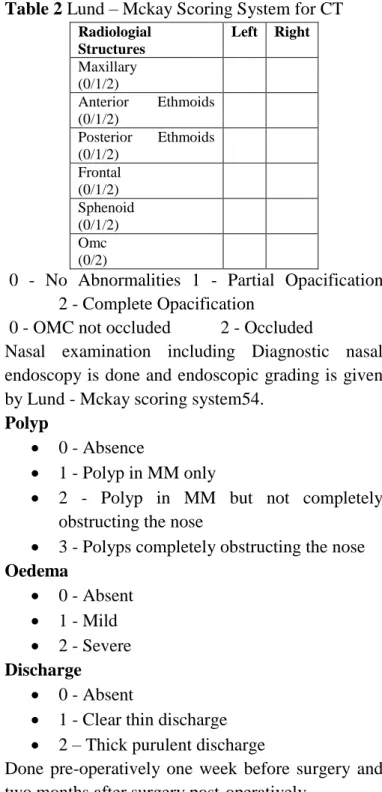
The symptoms are scored out of 60 both pre-operatively and post-pre-operatively after two months. Lund–Mckay CT Scoring System6 separately assesses the extent opacification of the individual sinuses and Osteomeatal Complex and a score of 2, 1 or 0 is respectively allotted based on if there is complete, partial or no opacification. During the study, CT scans of paranasal sinuses were done and assessed on the basis of Lund-Mckay criteria for each sinus with a maximum score of 24 pre-operatively 1 week before surgery and post-operatively 2 months after surgery.
Table 2 Lund – Mckay Scoring System for CT
Radiologial Structures
Left Right
Maxillary (0/1/2)
Anterior Ethmoids (0/1/2)
Posterior Ethmoids (0/1/2)
Frontal (0/1/2)
Sphenoid (0/1/2)
Omc (0/2)
0 - No Abnormalities 1 - Partial Opacification 2 - Complete Opacification
0 - OMC not occluded 2 - Occluded
Nasal examination including Diagnostic nasal endoscopy is done and endoscopic grading is given by Lund - Mckay scoring system54.
Polyp
0 - Absence
1 - Polyp in MM only
2 - Polyp in MM but not completely obstructing the nose
3 - Polyps completely obstructing the nose
Oedema
0 - Absent 1 - Mild 2 - Severe
Discharge
0 - Absent
1 - Clear thin discharge 2 – Thick purulent discharge
Done pre-operatively one week before surgery and two months after surgery post-operatively.
Muthubabu K. et al JMSCR Volume 06 Issue 11 November 2018 Page 784 A written and informed consent was obtained from
the patients before ESS by conventional/ microdebrider assisted technique. Patients were provided with an information sheet which includes the details of the disease, procedure, risks and possible outcomes. The CT score based on the Lund and Mckay classification was calculated. PFT was conducted.
ESS was performed under general anaesthesia. Local anaesthesia was infiltrated by injection of 2% Lignocaine into the uncinate process, greater palatine foramen and middle turbinate. Zero degree - 4 mm and 5 mm Hopkins rod telescope were used in the surgery as it is easy to become disoriented with angled endoscopes though the latter are necessary for inspecting recesses and performing middle meatal antrostomy or operating the frontonasal recess.
Post-operative scoring system of Lund – Kennedy:
Scarring left (0,1,2) Scarring right (0,1,2) Crusting left (0,1,2)
Crusting right (0,1,2)
Scarring:
0 - Absent 1 - Mild 2 - Severe
Crusting:
0 - Absent 1 - Mild 2 - Severe
Results
Table 3 Distributions of Patients According to Sex
SEX GROUP 1 GROUP 2 TOTAL
MALE 19 15 34(56.6%)
FEMALE 11 15 26 (42.3%)
Out of the 60 patients, females constituted 34 out of which 55.9% underwent microdebrider ESS and the remaining 44.1% underwent conventional ESS . Males constituted 26 out of which 42.3% underwent Microdebrider ESS and the remaining 57.7 % underwent conventional ESS.
Table 4 Pre-Operative Findings in both groups
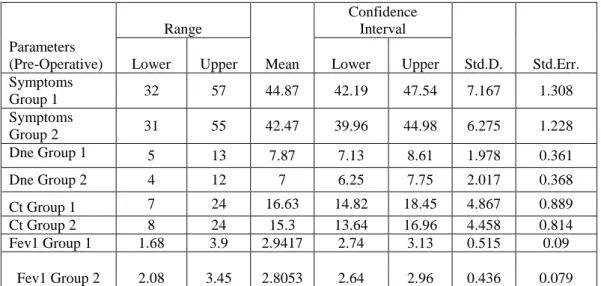
The Pre-Operative FEV1 for microdebrider ranges from 1.68 to 3.90. The mean is 2.9417 with a confidence interval of 2.7490 to 3.134 and the standard deviation for this sample is 0.515.
The Pre-Operative FEV1 for conventional ranges from 2.08 to 3.45. The mean is 2.8053 with a confidence interval of 2.6424 to 2.8096 and the standard deviation for this sample is 0.43625.
Parameters (Pre-Operative)
Range
Mean
Confidence Interval
Std.D. Std.Err.
Lower Upper Lower Upper
Symptoms
Group 1 32 57 44.87 42.19 47.54 7.167 1.308
Symptoms
Group 2 31 55 42.47 39.96 44.98 6.275 1.228
Dne Group 1 5 13 7.87 7.13 8.61 1.978 0.361
Dne Group 2 4 12 7 6.25 7.75 2.017 0.368
Ct Group 1 7 24 16.63 14.82 18.45 4.867 0.889
Ct Group 2 8 24 15.3 13.64 16.96 4.458 0.814
Fev1 Group 1 1.68 3.9 2.9417 2.74 3.13 0.515 0.09
Muthubabu K. et al JMSCR Volume 06 Issue 11 November 2018 Page 785
Table 5 Post-Operative Findings in both groups
Image 1 Microdebrider Handpiece
Image 2 Endoscopic Picture of Microdebrider In Use
Image 3 Conventional Instruments
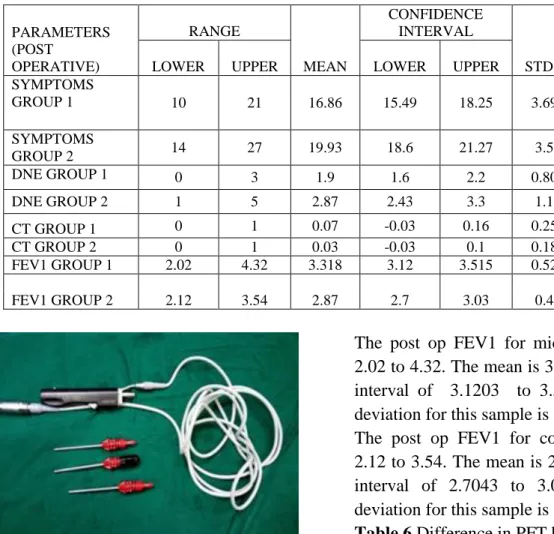
The post op FEV1 for microdebrider ranges from 2.02 to 4.32. The mean is 3.3180 with a confidence interval of 3.1203 to 3.5157 and the standard deviation for this sample is 0.52935.
The post op FEV1 for conventional ranges from 2.12 to 3.54. The mean is 2.8707 with a confidence interval of 2.7043 to 3.0370 and the standard deviation for this sample is 0.44541.
Table 6 Difference in PFT between Groups
Comparison between difference in pre and postoperative FEV1 Values for each procedure is done.
The mean of difference in FEV1 values for microdebrider ESS is 0.3763.
The mean of difference in FEV1 values for conventional ESS is 0.0653. The difference was found to be statistically significant using 2 tailed t test 0.000 (p value < 0.05).
Discussion
Sinusitis has a self-reported incidence of 135 per 1,000 of the population per year and was the principle reason for almost 12 million physician office visits during 1995 7-10. Sinusitis is one of the main reasons for which an antibiotic is prescribed
PARAMETERS (POST
OPERATIVE)
RANGE
MEAN
CONFIDENCE INTERVAL
STD.D. STD.ERR.
LOWER UPPER LOWER UPPER
SYMPTOMS
GROUP 1 10 21 16.86 15.49 18.25 3.693 0.674
SYMPTOMS
GROUP 2 14 27 19.93 18.6 21.27 3.57 0.652
DNE GROUP 1 0 3 1.9 1.6 2.2 0.803 0.147
DNE GROUP 2 1 5 2.87 2.43 3.3 1.16 0.213
CT GROUP 1 0 1 0.07 -0.03 0.16 0.254 0.046
CT GROUP 2 0 1 0.03 -0.03 0.1 0.183 0.033
FEV1 GROUP 1 2.02 4.32 3.318 3.12 3.515 0.529 0.096
FEV1 GROUP 2 2.12 3.54 2.87 2.7 3.03 0.44 0.08
PROCEDU RE
N MEAN STD.D. STD.ERROR MEAN
PFT DIFF.
Microdebri
der 30 .3763 .07365 .01345 Convention
Muthubabu K. et al JMSCR Volume 06 Issue 11 November 2018 Page 786 and for lost productivity in the work force 10. The
present work was undertaken in the Department of Otorhinolaryngology & Head and Neck surgery, Meenakshi Medical College Hospital & Research Institute to study the impact of two methods of ESS on the pulmonary function of 60 patients suffering from CRS. The clinical and laboratory data from the study cases were recorded as per the proforma. The study included patients of varied age groups, of varied socio-economic status, of both sexes. The results were then compared with available literature.
Symptoms Score
The mean difference of symptom score for group 1 was found to be 28.0 and group 2 found to be 22.53. Therefore, all the patients had an improvement in their symptoms irrespective of the group to which they have been randomized. But the difference between the improvement of symptoms found to be statistically significant implying Microdebrider assisted ESS gives more relief in patient symptoms.
Endoscopic Scores
The mean of endoscopic score post operatively for both the groups post op were 1.90 and 2.87 respectively for group 1 and 2 which shows significant improvement indicating the clearance of disease without any sequel.
CT Findings
The mean of pre-operative CT score of group 1 and 2 were 16.63 and 15.3 respectively in this study. According to modified Lund scoring system, in the present study patients had the score in the range of 7-24 and 8-24 for group 1 and group 2 respectively. Contrary findings were noted by Bhattacharya et al 11
. Whereas, in a study conducted by Wang et al., 118 (51.3%) cases had the score in the range of 0–4 12
. These findings suggest that majority of the patients have presented to the hospital at a relatively early stage of the disease. Whereas the patients in rural population of Kanchipuram did not seek medical attention early.
PFT Findings
In the present study, it is noted that there is increase in mean postoperative FEV1 for both the groups 3.318 and 2.87 from the preoperative value of 2.94 and 2.80.
The difference between the FEV1 values pre-operatively and post-pre-operatively were measured and compared between two groups. The mean difference was 0.376 and 0.065 for Groups 1 and 2 respectively. The independent student T test showed statistically significant difference.
Both the group showed increase whereas the group 1 showed statistically significant increase compared to group 2. Hence, we can conclude microdebrider assisted ESS better in terms of improving pulmonary function test.
Conclusion
Age of the patients suffering from CRS ranged from 12 to 70 years with the mean age of 35.5 years.
CRS was most commonly seen affecting women out numbering men.
In both methods, there was statistically considerable difference symptomatically in Microdebrider assisted endoscopic sinus surgery than the conventional method.
In both the methods, radiological score difference was good without any statistical difference. Hence both methods are equally good for clearing the disease.
In both the methods, endoscopic score difference was good without any statistical difference. Hence both methods are equally good for clearing disease.
There were no surgical complications in any of the method.
In both methods after surgery, there was statistically considerable difference in FEV1 values in microdebrider assisted endoscopic sinus surgery than conventional method. Hence microdebrider assisted ESS is considered better in terms of addressing co-existence of lower airway diseases along with CRS.
References
Muthubabu K. et al JMSCR Volume 06 Issue 11 November 2018 Page 787 2. Togias A (2003) Rhinitis and asthma:
evidence for respiratory system integration. J Allergy Clin Immunol 111: 1171–83.
3. Ikeda K, Tanno N, Tamura G (1999) Endoscopic sinus surgery improves pulmonary function in patients with asthma associated with chronic sinusitis. Ann OtolRhinolLaryngol 108: 355–9.
4. Shaaban R, Zureik M, Soussan D, Anto JM, Heinrich J, Janson C, Ku¨nzli N, Sunyer J, Wjst M, Burney PG (2007) Allergic rhinitis and onset of bronchial hyper responsiveness: a population-based study. Am J Respir Crit Care Med 176: 659–66.
5. Rachelefsky GS (1999) National guidelines needed to manage rhinitis and prevent complications. Ann Allergy Asthma Immunol 82(3): 296–305.
6. Lund VJ, Mackay IS (1994) Outcome assessment of endoscopic sinus surgery. J R Soc Med 87: 70–2.
7. Kaliner MA, Osguthorpe JD, Fireman P, Anon J, Georgitis J, Davis ML (1997) Sinusitis: bench to bedside. Current findings, future directions. J Allergy Clin Immunol 99 (6 pt 3): S829–S848 (Published erratum appears in J Allergy Clin Immunol 1997, 100: 510).
8. Osguthorpe JD, Hadley JA (1999) Rhinosinusitis: current concepts in diagnosis and management. Med Clin North Am 83: 27–42.
9. United States Department of Health and Human Services, Public Health Service, Agency for Health Care Policy and Research, Center for General Health Services Intramural Research (1994) Annual expenses and sources of payment for health care services. Government Printing Office, Washington D.C. AHCPR publication 93-0007.
10.Benson V, Marano MA (1998) Current estimates from the National Health Interview Survey, 1995. Vital Health Stat 10 (199): 1–221.
11.Bhattacharyya N, Fried MP (2003) The accuracy of computed tomography in the diagnosis of chronic rhinosinusitis. Laryngoscope 113: 125–9.