www.ijemst.com
Teachers’ Remarks on Interactive
Whiteboard with LCD Panel Technology
Ömer Koçak1, Aslan Gülcü2 1
Erzincan University 2Atatürk University
To cite this article:
Kocak, O. & Gulcu, A. (2013). Teachers’ remarks on interactive whiteboard with LCD panel
technology.
International Journal of Education in Mathematics, Science and Technology,
1
(4), 294-300.
This article may be used for research, teaching, and private study purposes.
Any substantial or systematic reproduction, redistribution, reselling, loan, sub-licensing,
systematic supply, or distribution in any form to anyone is expressly forbidden.
Authors alone are responsible for the contents of their articles. The journal owns the
copyright of the articles.
Volume 1, Number 4, October 2013, 294-300
ISSN: 2147-611X
Teachers’ Remarks on Interactive Whiteboard with LCD Panel
Technology
Ömer Koçak1
, Aslan Gülcü*2
1
Erzincan University 2Atatürk University
Abstract
This study investigated the opinions of teachers about using interactive whiteboards with an LCD panel that was installed in classrooms within the FATIH educational project. The study was conducted at six high schools in which installation of interactive whiteboards with an LCD panel in classrooms was completed and teachers who received training in order to use these whiteboards. One hundred and twenty one teachers participated in this study. The data was gathered using open-ended questions. Qualitative data obtained with open-ended questions was analysed using phenomenographic analysis method. Teachers were positive about using interactive whiteboards with an LCD panel in education. Teachers stated that the interactive whiteboard with an LCD panel was used throughout whole course. "Visualization" of an interactive whiteboard with an LCD panel is often expressed to as an acclaimed feature by teachers. The needs to remedy the lack of software and technical problems have been stated by the teachers.
Key words: Interactive Whiteboard, Interactive Whiteboard of LCD panel, FATIH Project, Teachers Thoughts, Teachers
Introduction
Today, significant changes and improvements occur in the field of information technologies. Using developing technology in teaching-learning process is inevitable. The individuals, teaching and learning under these circumstances, need to be equipped with skills such as reaching information fast, organizing, evaluating and presenting the information (Akkoyunlu, 1995). The teacher is one of the important factors in providing efficient learning in the teaching-learning process (Baki, Yalçınkaya, Özpınar & Uzun, 2009).
When organizing a learning and teaching environment, teachers should take into consideration the needs and expectations of the students, have certain skills and knowledge to benefit from the technology (Akkoyunlu, 2002). All kinds of tools and equipment that are used in order to degrade the level of content when it is instructed to the students are involved in education technology. Teachers use lots of educational materials in the learning-teaching process such as traditional blackboards, overhead projectors, computers, videos, animation and educational software (Akpınar, 2004). One of these technologies is interactive whiteboard technology that has started to be used frequently. The interactive whiteboards, which were first produced in 1991, started to be used in education towards the end of the 1990s. Smart board and electronic boards are alternative names for interactive whiteboards (Şad, 2012). Many countries have started to conduct studies in order to use interactive whiteboards in education. England was the first country to use interactive whiteboards in education and this country made great investments to equip schools with interactive whiteboards (Armstrong, Barnes, Sutherland, Curran, Mills & Thompson, 2005). With “the Movement of Increasing the Chances and Improving the Technology”, the Turkish abbreviation of which is FATİH, which was put into practice in 2010 to involve this technology in learning-teaching process, it is planned to give an interactive LCD panel board to 570,000 classrooms, to prepare the network substructure and to give tablet PC to teachers and students (MEB, 2012). Interactive whiteboards generally consist of a touch sensitive screen, computer and projection device (Shenton & Pagett, 2008). Today, interactive whiteboards with various features are being produced by numerous
295 IJEMST (International Journal of Education in Mathematics, Science and Technology)
companies. Within the scope of the FATİH project, a mechanism consisted of 3 apparatuses were placed in classrooms. On the right of the mechanism is a stable traditional board, on which chalk is used, a mobile blackboard, on which board markers are used, and there is interactive LCD panel board to its left.
The advantages and disadvantages of using an interactive whiteboard in education have been researched by many researchers. Interactive whiteboards are increasing the quality of education and making lessons enjoyable, motivating and interesting. It will be beneficial to use interactive whiteboards in education despite technical malfunctions (Elaziz, 2008). Interactive whiteboard technology will be the junction point of pedagogy and technology (Smith, Higgins, Wall & Miller, 2005).
According to the results of the research done by Lewin, Somekh and Steadman (2008) in England between 2004-2006; teachers and students adopted a positive attitude to the use of interactive whiteboards in education, it is determined that there is an increase in the success of the students, teachers are trying to improve new pedagogic methods to provide a better understanding of their lessons. In the two classes constituted in the study carried out by López (2010); the difference in the level of success between the digital learning class in which the interactive whiteboard is used and the traditional class is analysed, and the obtained result is that the success of students in the digital learning class are higher than the students in the traditional class.
Bulut and Koçoğlu (2012) analysed the opinions of teachers on interactive whiteboards; it was noted that adequate education should be given to teachers, and it was recommended that the use of interactive whiteboards will increase students’ attention to the lesson. In another study Paragină, Paragină and Jipa (2010) expressed that the interactive whiteboard is more beneficial in terms of visual learning and practicing was reached, and educational software, the development of online resources are necessary and it is important for teachers to attract the attention of students. In a similiar study conducted by Isman, Abanmy, Hussein, Saadany and Abdelrahman (2012); it was noted that the use of interactive whiteboards increases the motivation and success of the students and facilitates understanding, and it was noted that teachers need professional support to use interactive whiteboards more efficiently.
Türel (2012) researched the negative approaches, needs and problems of teachers regarding interactive whiteboards; it was noted that interactive whiteboards make teachers and students more passive, make learning dependent on computers, installation and technical malfunctions take time, it became harder to control the class, and teachers do not have enough information about the features of interactive whiteboards.
In this study teachers’ views regarding the use of interactive whiteboards in education by considering the studies in the literature were examined. The research questions to obtain these views were as follows:
1) What is teachers’ level of use of technological devices?
2) What is teachers’ level of technology use in the teaching-learning process?
3) What are teachers’ views about the hardware components of interactive whiteboards? 4) What are teachers’ views about the use of interactive whiteboards in education? 5) In which part of the lesson are interactive whiteboards used mostly?
6) What is the necessity of using LCD interactive whiteboards?
7) What are the positive and negative aspects of interactive whiteboards? 8) Which features of interactive whiteboards are used more and less?
Method
Model of the Study
Phenomenographic research method, which is one of qualitative research methods, is used in this study. With phenomenographic research method, how the individuals present their feelings and perceptions that they create about the concepts in their minds with their own expressions is analyzed. It is expressed as “the method of monitoring the essence”. Phenomenography aims to create categories as a result of turning perceptions about the events into expressions (Demirkaya & Tomal, 2008; Şimşek 2012).
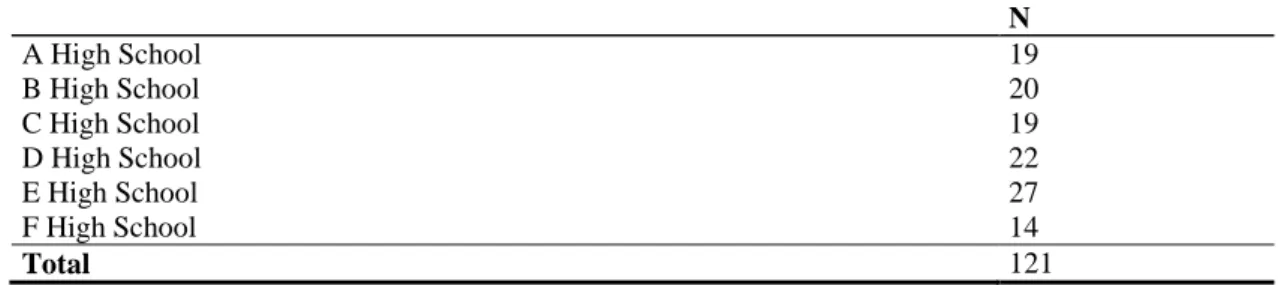
Participants
Table1. Schools and Number of Teachers
N
A High School 19
B High School 20
C High School 19
D High School 22
E High School 27
F High School 14
Total 121
Data Collection Instruments
In the phenomenographic research method, the data is collected via group interviews, observations, paintings, open-ended questions or historical documents (Erten, Kiray & Sen-Gumus, 2013; Yildiz-Duban, 2013). In this study, data was collected through open ended questions.
Validity and Reliability
The consistency between the results of different measurements by using a means of measurement shows the reliability rate of that means. Reliability is directly related to quantitative researches. In the qualitative researches, the reliability depends of the accuracy and comprehensiveness of the data (Uzuner, 1999). The validity is the ability of the means to measure the feature, which is desired to be researched, without involving other features (Şimşek, 2012). The open-ended questions used in our study were created by a domain expert and researcher by researching the litterateur. The validity and reliability of 11 open-ended questions were evaluated by three domain experts and their present status was acquired by making the necessary regulations.
Data Analysis
The qualitative data acquired in this study were analysed by using phenomenographic analysis method. The data acquired with written materials in phenomenological analysis process are firstly transcripted. Transcript is acquired by analysing the identifications made by different individuals about the same concepts and assembling the same or similar expressions under identification categories (Demirkaya & Tomal, 2008). In this process, a domain expert and a researcher is worked with. Pre-classifications were made after the responses of the teachers were read a few times by the researcher. The classifications were carried on by basing on these pre-groups acquired together with domain expert and categories were created.
Findings
The question ‘What are the technological devices that you use in everyday life?’ aims to obtain information about teachers’ technology use tendencies. Table 2 shows the devices that they use, their frequency and percentages.
Table 2. The Distribution of the Technological Devices the Teachers use in their Daily Lives
N %
Computer 31 25.6
Computer - Smart phone 30 24.8
Computer - Cell phone - Tablet PC 26 21.5
Computer - Cell phone 22 18.2
None 3 2.5
Computer - Smart phone - Tablet PC - MP4 3 2.5
Computer - Tablet PC 3 2.5
Computer - Smart phone - Smart TV 1 0.8
Computer - Smart phone - MP4 1 0.8
Computer - Cell phone – Printer 1 0.8
297 IJEMST (International Journal of Education in Mathematics, Science and Technology)
It was stated that the vast majority of the students use computers, whereas the use cell phones, smart phones and tablet PCs. 3 teachers stated that they do not use any technological devices.
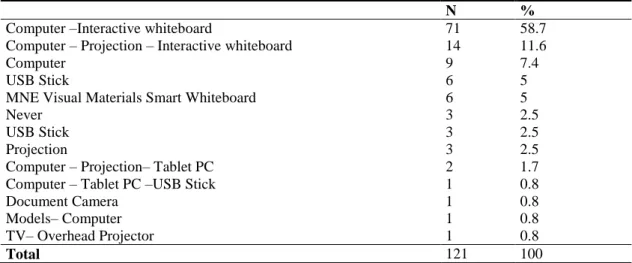
Table 3 shows the frequency and percentage of the answers to the question ‘What are the technological materials that you use in your lessons?’
Table 3. The Distribution of the Technological Materials Teachers Use in Classrooms
N %
Computer –Interactive whiteboard 71 58.7
Computer – Projection – Interactive whiteboard 14 11.6
Computer 9 7.4
USB Stick 6 5
MNE Visual Materials Smart Whiteboard 6 5
Never 3 2.5
USB Stick 3 2.5
Projection 3 2.5
Computer – Projection– Tablet PC 2 1.7
Computer – Tablet PC –USB Stick 1 0.8
Document Camera 1 0.8
Models– Computer 1 0.8
TV– Overhead Projector 1 0.8
Total 121 100
58.7% of teachers stated that they use “computers and interactive whiteboards”. Apart from this, computers, projection and interactive whiteboards are the other technological materials teachers used in their lessons. 3 teachers stated that they do not use any technological materials.
The teachers’ views on the hardware technology of interactive whiteboards were examined with the question ‘What are your views on interactive whiteboard technology?’ and the following views were obtained.
It takes a lot of time to install.
It is much more difficult to write on the screen than on a blackboard.
It would be better if it could be controlled via a mouse or a remote control rather than the screen. Sound quality is not good.
The touch-operated technology of the interactive whiteboard needs to be developed.
Students cannot see the whiteboard clearly because of reasons such as brightness level, dimension, location and its external reflection.
It tires students’ and teachers’ eyes.
Technical problems occur (freezing, power cut etc.) It takes a lot of time to prepare material.
However, the majority of teachers stated that the present hardware is sufficient.
Most of the teachers stated that they look at the usage of interactive whiteboards in education in a positive light, to the question, ’What is your view about the use of interactive whiteboards in education?’ It is viewed that interactive whiteboards visualize the lesson, motivate the students, save time and are suitable for the modern world. It is advised that teachers use interactive whiteboards much more.
61.1% of teachers replied, ‘Yes, and it is a necessity.’ to the question ‘Would you look for the condition of interactive whiteboards for the lessons in your classroom and if so, why?’ They stated that it is fast and fun; also it is time-saving and convenient. Although 37.2% of the teachers answered ‘No.’, they stated that it is required for the classroom environment.
The question, ’Do you need the traditional blackboard besides the interactive whiteboard (why?)’ was asked and 72.7% of teachers stated that they need the traditional blackboard. They stated that they could write on it easily and they preferred it while lecturing. 15.7% of teachers stated that they do not need a traditional board. 11.6% of teachers stated that they sometimes need it.
of teachers stated that it depends on the lesson subject, that is, at the beginning, in the middle, at the end of the lesson or while summarizing the subject. However, 9.1% of teachers stated that they only use it at the end of the lesson or while-summarizing the subject.
With the question ‘In which parts of the lessons (lecturing, activity, homework, problem-solving etc.) do you use interactive whiteboards?’ relevant data was obtained. 28.9% of teachers stated that they use it while teaching, doing activities, solving problems and giving feedback to homework. Nevertheless, 18.2% of teachers stated that they used it while teaching and problem solving. It was expressed that displaying the prepared documents was time saving, especially during problem solving. 9.1% of teachers stated that they used interactive whiteboards while teaching and doing activities, while 9.1% of teachers stated that they only used it while doing activities, and the rest of the teachers stated that they used it in various parts of the lessons, such as revising, getting students’ attention, teaching abstract terms, solving sample questions or making assessments.
Here are some views stated by teachers as the positive aspects of interactive whiteboards: Visualising,
Time-saving, Motivation, Efficient education, Interesting, Rich content,
It provides convenience.
Especially, ’the visualising feature’ is the main positive feature expressed by the teachers. Time-saving, providing convenience and arousing motivation are also positive features stated by teachers. Having an internal sound system, providing rich content, students’ preference and providing fast and multiple options are the positive aspects of interactive whiteboards.
As far as the cons of interactive whiteboards are concerned, some teachers stated that it does not have any cons. Those are some negative aspects that teachers stated:
Technical problems, lack of infrastructure, Time wasting,
It tires the eyes and causes headaches. Usage out of purpose
Software deficiency, It requires preparation,
The touch screen does not work well.
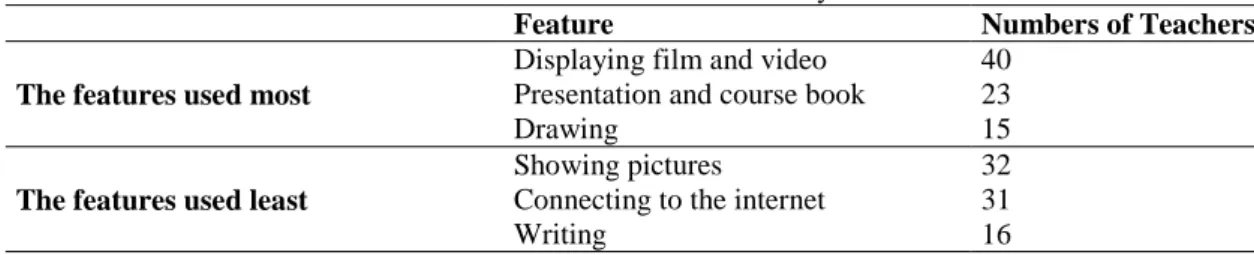
Apart from those, some negative aspects of the LCD interactive whiteboard such as diminishing students’ writing skills, making students passive, causing laziness and restraining creativity are stated by the teachers. It was asked that the teachers prioritise the features of interactive whiteboards that they used. The three most and least used features by teachers are shown in Table 4.
Table 4. The three most and least used features by teachers
Feature Numbers of Teachers
The features used most
Displaying film and video 40 Presentation and course book 23
Drawing 15
The features used least
Showing pictures 32
Connecting to the internet 31
Writing 16
299 IJEMST (International Journal of Education in Mathematics, Science and Technology)
Discussion and Conclusion
With this study, some remarkable outcomes about teachers’ thoughts related to the usage of interactive whiteboards have been revealed. Most of the teachers were positive about using interactive whiteboards with an LCD panel in education. They stated that the interactive whiteboard with an LCD panel was generally used throughout whole course.
Most teachers stated that they use technology actively in their daily life and they do not avoid technology. It could be said that teachers are in favour of technology use in education and they try to adapt technology to the lesson. This result supports the research by Kutluca and Ekici (2010). It can be concluded from the data obtained that the effect of teachers’ usage technology in daily life are related to their using technology in the lesson.
The structure of interactive whiteboards being sufficient although with such negative aspects as, due to the brightness and reflection, it cannot be seen by students, its tiring to both the teachers’ and students’ eyes were expressed by teachers. The necessity of improvement in touchable technology of the interactive whiteboard was frequently stated by teachers. It was stated that interactive whiteboard use in education is very positive from the point of ‘visualising’, but when it comes to cons, breaking down, deficient software and constant use would cause boredom and make classroom management difficult. As was stated by the teachers joining our research, the necessity of training for teachers to fully use interactive whiteboards could be seen as another suggestion/negative aspect (Altınçelik, 2009; Isman et al, 2012). Teachers indicated that interactive whiteboards are a necessity, although the traditional board cannot be abandoned. It has been thought that the technical difficulties and requirement of preparation for the lesson causes teachers to use the traditional board. Teachers have reacted positively to combining the interactive whiteboard and the traditional board.
The teachers stated that they generally used the interactive whiteboard during the whole lesson. Teachers indicated that they used interactive whiteboards while teaching, doing activities, solving problems and giving feedback to homework. It was indicated that it saved time, especially when writing questions. Visualising the lessons and providing multimedia devices are positive features stated by the teachers. ‘Providing convenience’, ‘Reaching the source of information from the shortcut’ and ‘Improving the students’ imagination’ were shown as positive aspects by the teachers. (Altınçelik, 2009; Isman et al. 2012). Interactive whiteboards make the lesson more entertaining and interesting and arouse the students’ motivation.
Although the majority of teachers stated that the interactive whiteboard did not have any negative aspects, lack of infrastructure and technical difficulties were expressed as the negative points. Although many teachers stated that interactive whiteboards saved time, some teachers stated that they wasted time because of technical and installation difficulties. Software, material and resource deficiency were stated as negative sides. In terms of health issues, tiring eyes, students’ not looking for a long time, causing headaches and the fear of them giving off radiation are the cons stated by the teachers.
Teachers stated that ‘Displaying film and video’, ‘Course-book’ and ‘Drawing’ are the features they used most. That result supports one of the positive aspects of the visualising feature of the interactive whiteboard. ‘Showing pictures’ and ‘Connecting to the internet’ are selected as the least used features. This outcome disputes the ‘The writing feature is the most commonly used’ obtained by Altınçelik (2009).
As a result, 121 teachers joined our study and the result that they have positive views about the interactive whiteboard is achieved. However, they indicated that technical difficulties and software deficiencies need to be resolved. Within the project ‘FATİH’ the teachers have been trained to use interactive whiteboards. However, it has been suggested that training be given for resolving the technical difficulties which teachers indicated as negative. Besides, it has been suggested that the required training be given in point of material creation and achievement.
References
Akkoyunlu, B. (1995). Bilgi teknolojilerinin okullarda kullanımı ve öğretmenlerin rolü. Hacettepe Üniversitesi
Eğitim Fakültesi Dergisi, 11, 105–109.
Akkoyunlu, B. (2002). Öğretmenlerin internet kullanımı ve bu konudaki görüşleri. Hacettepe Üniversitesi
Akpınar, Y. (2004). Eğitim teknolojisiyle ilgili öğrenmeyi etkileyebilecek bazı etmenlere karşı öğretmen yaklaşımları. The Turkish Online Journal of Educational Technology, 3(3), 124-134.
Altınçelik, B. (2009). İlköğretim Düzeyinde Öğrenmede Kalıcılığı ve Motivasyonu Sağlaması Yönünden Akıllı Tahtaya İlişkin Öğretmen Görüşleri. Yüksek Lisans Tezi, Sosyal Bilimler Enstitüsü, Sakarya Üniversitesi, Türkiye.
Armstrong, V., Barnes, S., Sutherland, R., Curran, S., Mills, S., & Thompson, I. (2005). Collaborative research methodology for investigating teaching and learning: The use of interactive whiteboard technology.
Educational Review, 57(4), 457-469.
Baki, A., Yalçınkaya H. A., Özpınar, I., & Uzun, S. Ç. (2009). İlköğretim matematik öğretmenleri ve öğretmen adaylarının öğretim teknolojilerine bakışlarının karşılaştırılması. Turkish Journal of Computer and Matematics Education. 1(1), 67-85.
Bulut, İ. & Koçoğlu, E. (2012). Sosyal bilgiler öğretmenlerinin akıllı tahta kullanımına ilişkin görüşleri (Diyarbakır ili örneği). Dicle Üniversitesi Ziya Gökalp Eğitim Fakültesi Dergisi, 19(2012), 242-258. Demirkaya, H. & Tomal N. (2008). Öğretmen adaylarinin burdur gölü algilamalari: Fenomenografik bir
araştirma. Ondokuz Mayıs Üniversitesi Eğitim Fakültesi Dergisi, 25, 1-11.
Elaziz, M. F. (2008). Attitudes of Students and Teachers towards the Use of Interactive Whiteboards in EFL Classrooms. Yüksek Lisans Tezi, Yabancı Dil Olarak İngilizce Öğretimi Bölümü, Bilkent Üniversite,
Türkiye.
Erten, S., Kiray, S.A., & Sen-Gumus, B. (2013). Influence of scientific stories on students ideas about science and scientists. International Journal of Education in Mathematics, Science and Technology, 1(2), 122-137.
MEB. (2012). http://fatihprojesi.meb.gov.tr, 18.02.2013.
Isman, A., Abanmy, F. A. A., Hussein, H. B., Saadany, A., & Abdelrahman, M. (2012). Saudi secondary school teachers attitudes' towards using interactive whiteboard in classrooms. The Turkish Online Journal of Educational Technology-TOJET,11(3), 286-296.
Lewin, C., Somekh, B., & Steadman, S. (2008). Embedding interactive whiteboards in teaching and learning: The process of change in pedagogic practice. Education and Information Technologies, 13(4), 291-303.
López, O. S. (2010). The digital learning classroom: Improving english language learners’ academic success in mathematics and reading using interactive whiteboard technology. Computers & Education, 54(4), 901-915.
Paragină, F., Paragină, S., & Jipa, A. (2010). Interactive whiteboards in Romania. Procedia-Social and Behavioral Sciences, 2(2), 4059-4063.
Smith, H. J., Higgins, S., Wall, K., & Miller, J. (2005). Interactive whiteboards: boon or bandwagon? A critical review of the literature. Journal of Computer Assisted Learning, 21(2), 91–101.
Shenton, A. & Pagett, L. (2008). From ‘bored’ to screen: The use of the interactive whiteboard for literacy in six primary classrooms in england. Literacy, 41(3), 129-136.
Şad, S. N. (2012). An attitude scale for smart board use in education: Validity and reliability studies. Computers & Education, 58(3), 900-907.
Şimşek, A. (2012). Araştırma Modelleri. Ali Şimşek (Ed.), Sosyal Bilimlerde Araştırma Yöntemleri (pp. 80– 107). Eskişehir: Anadolu Üniversitesi Yayınları.
Türel, Y. K. (2012). Teachers’ negative attitudes towards interactive whiteboard use: needs and problems.
Elementary Education Online, 11(2), 423-439.
Uzuner, Y. (1999). Niteliksel Araştırma Yaklaşımı. Ali Atıf Bir (Ed.), Sosyal Bilimlerde Araştırma Yöntemleri
(pp. 173-193). Eskişehir: Anadolu Üniversitesi Yayınları.