220
INTERACTION WHILE COMPLETING
COMMUNICATIVE TASKS IN AN EFL CLASSROOM
Golda J. Tulung
Universitas Sam Ratulangi
Kampus Unsrat, Bahu Manado, Indonesia 95115
Abstract: Drawing on qualitative observation data from a case study of an EFL classroom for pre-medical students in an Indonesian university, this ar-ticle examines the oral discourse generated through peer interaction while completing two types of communicative tasks in terms of how much lan-guage was generated, including the amount of the L2 generated and the use of the L1. Findings indicate that the use of communicative tasks in this spe-cific EFL context appears to provide students with opportunities for L2 pro-duction and to diminish L1 use in class. This is largely determined by the communicative tasks used and the EFL context.
Keywords: oral discourse, peer interaction, communicative tasks, an EFL classroom
lan-guage outside of the classroom is very limited, though they may have access to the internet and English TV programs.
Obviously, one of the problems in learning a foreign language, particularly English as a foreign language (EFL), has always been providing quality lin-guistic input to learners. In such contexts, learners get exposure to the L2 pri-marily in the language classroom. One possibility of providing input and inter-action opportunities to students is through communicative task-based instruc-tion. In task-based instruction, learners use the language to transact tasks rather than primarily learning individual language items (Foster, 1999). As students transact tasks, they are engaging in activities which focus on meaning and re-quire both comprehension and production of the language, activities which have been shown to promote their language learning. Skehan (1998, p. 95), in a synthesis of the essential characteristics from other definitions, defines task as an activity in which:
• meaning is primary;
• there is some communication problem to solve;
• there is some sort of relationship to comparable real-world activities;
• task completion has some priority;
• the assessment of the task is in terms of outcome.
Most of the research on interaction during communicative tasks has taken place in ESL classrooms with students representing diverse first languages where English is necessarily the language of communication. Furthermore, much of it has been carried out in well-controlled experimental settings, focus-ing on learners, and particularly on the language they produce (see Mackey, 2007). However, there is relatively little research to date that focuses on the use of communicative tasks in actual working classrooms in an EFL setting and on student discourse (Hasan, 2006).
teaching about the learners’ use of the L1 rather than the L2. Storch and Al-dosari (2010) report on students’ use of L1 mainly for the purpose of task man-agement and vocabulary facilitation and De la Colina and Mayo (2009) indi-cate the importance of L1 as a learning tool.
This article is based on a detailed qualitative case study (Tulung, 2008) of peer interaction and non-native teacher talk in an EFL classroom during the implementation of communicative tasks with Indonesian pre-medical students. It turned out that the tasks worked effectively well in this setting. However, this article focuses only on the oral discourse generated through peer interaction while completing the tasks, particularly from the perspective of how much guage was generated during peer interaction. This includes the amount of lan-guage generated and the use of L1 during peer interaction.
METHOD
The study involved one course section with a teacher and 27 students, and covered both the sessions when they worked on selected communicative tasks and the regular whole-group sessions. All the students in this class were cate-gorized as having an “intermediate” English proficiency level based on the placement test. In addition, they had passed the Academic Reading course tak-en in the previous semester. Their ages ranged from 18 to 20 years and most of them were in their first year of study at the Faculty of Medicine. Among the 27 students, only eight were studied in depth since they were the ones who partic-ipated in all four tasks (in two or three groups with rotating members).
students were all provided with a reading text on which their decision making was to be based regarding patients’ cases. Due to this design, when completing both task types the students not only spoke spontaneously, but also sometimes read from a text. Hence, the nature of their oral language generated in general was analyzed as either spontaneous (i.e. when students talked spontaneously) or reading/partial reading (i.e. when students read verbatim from a text).
FINDINGS AND DISCUSSION
Findings
This section considers the oral discourse generated through peer interac-tion from the perspective of how much language was generated through the use of communicative tasks in peer interaction. The first subsection deals with the amount of L2 use (in the form of word counts) and the second subsection deals with L1 use. The analysis of the word counts was based on how the students used the L2, that is, spontaneously or by reading, and the use of L1. The use of a shared L1 is particularly important since the context of the study allowed the participants to consciously or sub-consciously use it. For each subsection, an analysis of task type and individual differences is also presented.
Word Counts
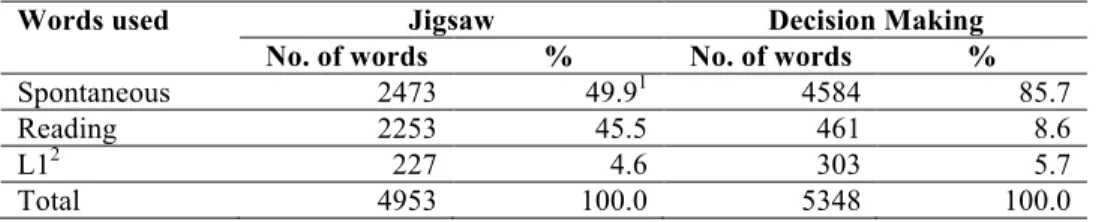
The following table shows the total number and percentage of words used spontaneously, read, or spoken in L1 by the students in small groups during jigsaw and decision making tasks. It reveals one aspect of task difference in-volving the relative amount of spontaneous language vis-à-vis reading and L1 use.
Table 1. Word Counts in Jigsaw and Decision Making Tasks (n=8)
Words used Jigsaw Decision Making
No. of words % No. of words %
Spontaneous 2473 49.91 4584 85.7
Reading 2253 45.5 461 8.6
L12 227 4.6 303 5.7
Total 4953 100.0 5348 100.0
As can be seen from Table 1, the total number of words in the jigsaw tasks is somewhat less than in the decision making tasks, with a difference of 395 words. This means the students talked a little bit less in the jigsaw tasks than in the decision making tasks. In terms of the numbers of words used, however, the students used spontaneous language almost twice as much in the decision mak-ing tasks as in the jigsaw tasks, and read aloud almost five times more often in the jigsaw tasks as in decision making tasks. They used the L1 similarly in the two task types, possibly slightly more in the decision making tasks than in the jigsaw tasks (5.7% compared to 4.6%). Within the task types themselves, in the decision making tasks the students mostly talked spontaneously compared to when they were reading: 85.71% compared to 8.62%. This shows how effec-tive the decision making tasks were for generating spontaneous speech. This is very different in the jigsaw tasks where there seems to be a balance between students’ use of spontaneous language and reading: 49.93% and 45.49%, re-spectively. This shows the role of reading that had an advantage in enabling practice of more difficult language interactively.
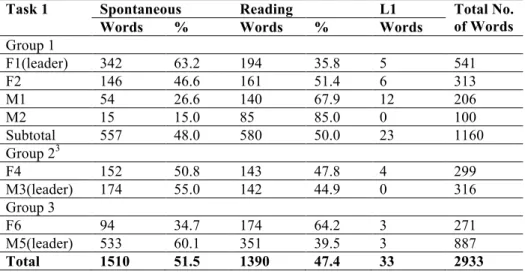
Tables 2 and 3 below show the distribution of spontaneous language use versus reading, and L1 use in the jigsaw tasks in terms of word counts. These analyses show individual and group patterns of language use, during the two
1 All numbers in decimals have been rounded to the nearest first decimal place.
jigsaw tasks, including the influence of leadership roles on individual language use and differences within group patterns. The shaded area indicates which stu-dent was the leader of her/his group.
Table 2. Distribution of Spontaneous Language Use versus Reading Word Counts in Communicative Task 1 (Jigsaw) (n=8)
Task 1 Spontaneous Reading L1 Total No.
of Words
Words % Words % Words
Group 1
F1(leader) 342 63.2 194 35.8 5 541
F2 146 46.6 161 51.4 6 313
M1 54 26.6 140 67.9 12 206
M2 15 15.0 85 85.0 0 100
Subtotal 557 48.0 580 50.0 23 1160
Group 23
F4 152 50.8 143 47.8 4 299
M3(leader) 174 55.0 142 44.9 0 316
Group 3
F6 94 34.7 174 64.2 3 271
M5(leader) 533 60.1 351 39.5 3 887
Total 1510 51.5 1390 47.4 33 2933
Table 3. Distribution of Spontaneous Language Use versus Reading Word Counts in Communicative Task 3 (Jigsaw) (n=8)
Task 3 Spontaneous Reading L1 Total No.
of Words
Words % Words % Words
Group 1
F1 171 56.2 106 34.8 27 304
F6 54 25.4 154 72.6 4 212
M2 33 18.5 115 64.6 30 178
M5(leader) 441 68.3 109 16.9 95 645
Subtotal 699 52.2 484 36.1 156 1339
Group 2
F2(leader) 96 41.5 125 54.1 10 231
Table continued
F4 64 40.2 95 59.7 0 159
M1 44 27.1 90 55.5 28 162
M3 60 46.5 69 53.5 0 129
Subtotal 264 38.7 379 55.6 38 681
Total 963 47.7 863 43.6 194 2020
As can be seen from the tables, in general the students showed a relatively balanced use of spontaneous language and reading in both jigsaw tasks. While the leaders of the groups tended to use spontaneous language more frequently (55% to 68.3%) than reading (16.9% to 44.9%), the other members used spon-taneous language less frequently (15% to 56.2%) than reading (34.8% to 85%). In terms of the total number of words per individual, the leaders of the groups in every case had more word production, ranging from 231 to 887 words, than the other members, ranging from 100 to 313 words. This means they talked more than the other members. In addition, Table 3 particularly shows within group differences in terms of group dynamics. While Group 1 seemed to have a dominating leader (M5), who produced almost 50% of the total number of words in his group, Group 2 appeared to have a democratic leader (F2), who produced about 30% of the total number of words in her group.
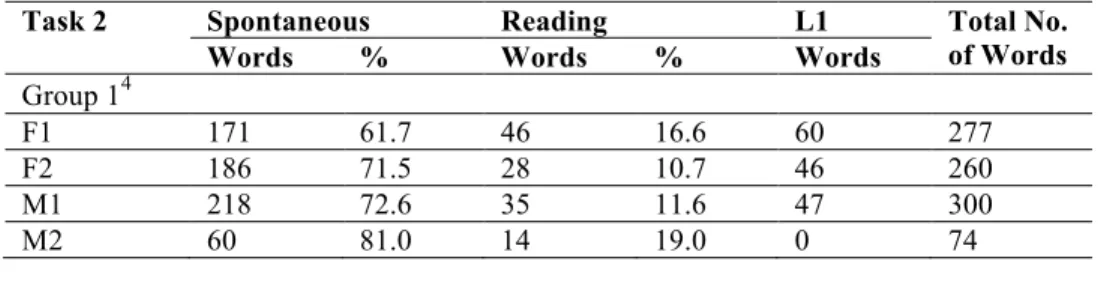
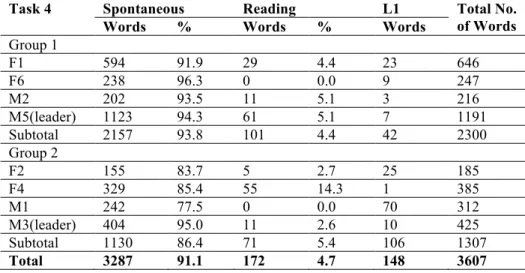
Tables 4 and 5 below show the distribution of spontaneous language use versus reading word counts, and L1 use in the decision making tasks. These analyses describe the patterns of language use, role of leadership, and individu-al/group differences during the decision making tasks. The shaded area again indicates which student was the leader of her/his group.
Table 4. Distribution of Spontaneous Language Use versus Reading Word Counts in Communicative Task 2 (Decision Making) (n=8)
Task 2 Spontaneous Reading L1 Total No.
of Words
Words % Words % Words
Group 14
F1 171 61.7 46 16.6 60 277
F2 186 71.5 28 10.7 46 260
M1 218 72.6 35 11.6 47 300
M2 60 81.0 14 19.0 0 74
Table continued
Group 25
F4 67 71.2 26 27.6 1 94
M3(leader) 52 51.5 49 48.5 0 101
Group 3
F6 19 37.2 32 62.7 0 51
M5(leader) 524 89.7 59 10.1 1 584
Total 1297 74.5 289 16.6 155 1741
Table 5. Distribution of Spontaneous Language Use versus Reading Word Counts in Communicative Task 4 (Decision Making) (n=8)
Task 4 Spontaneous Reading L1 Total No.
of Words
Words % Words % Words
Group 1
F1 594 91.9 29 4.4 23 646
F6 238 96.3 0 0.0 9 247
M2 202 93.5 11 5.1 3 216
M5(leader) 1123 94.3 61 5.1 7 1191
Subtotal 2157 93.8 101 4.4 42 2300
Group 2
F2 155 83.7 5 2.7 25 185
F4 329 85.4 55 14.3 1 385
M1 242 77.5 0 0.0 70 312
M3(leader) 404 95.0 11 2.6 10 425
Subtotal 1130 86.4 71 5.4 106 1307
Total 3287 91.1 172 4.7 148 3607
As can be seen from the tables, in general the students seemed to use spontaneous language more frequently than reading in both decision making tasks. Both the leaders of the groups and the other members tended to use spon-taneous language much more frequently (51.5% to 96.3%) than reading (0% to 48.5%). In terms of the total number of words per individual, the leaders of the groups had more word production, ranging from 101 to 1191 words, than the other members, ranging from 51 to 385 words; however, in one case, the leader (M3 in Task 2, Table 4) exceptionally produced almost as many read as
taneously spoken words. This was because he usually read part of the patients’ cases before asking the other members’ opinions regarding the treatments. In addition, Table 5 particularly shows group differences in terms of group dy-namics. While Group 1 seemed to have a dominating leader (M5) since he pro-duced more than 50% of the total number of words in his group, Group 2 ap-peared to have a democratic leader (M3) with about 30% of the total number of words produced in his group. Unfortunately this pattern cannot be verified in Task 2, Table 4, due to the group members in Task 2 that included other stu-dents who did not belong to the sample.
L1 Use
Students’ use of L1 is particularly essential to explore since the EFL con-text of the study allowed the students to consciously or sub-consciously use it. The previous subsection presents counts of L1 words used in both task types: 227 words or 4.6% in the jigsaw tasks and 303 words or 5.7% in the decision making tasks. This unfortunately does not give the full counts since the stu-dents occasionally turned off the tape while completing the tasks. But it shows that L1 was sometimes used by almost all students in the two task types, and as the students reported, they used more L1 in the decision making tasks when debating than in the jigsaw tasks.
This subsection looks at the L1 use differently in terms of the kinds of things the students do in the L1 by giving examples from the transcripts of both task types. Basically the students used the L1 in order to complete the tasks when they stumbled over the L2 vocabulary. In this subsection, the L1 use is differentiated between mere translating into the L1 and expressing ideas in the L1.
In terms of translating, students sometimes voluntarily provided transla-tions in the L1, but they did this only once in a while in either task type. Exam-ple 1 shows the words “retired” and “policeman” were voluntarily translated into the equivalent L1 words “pensiunan” and “polisi” by M5 and F6, respec-tively. The following conventions are used when examples from the transcripts are presented.
# on the left margin line counts by five
S an unidentified student
Ss more than one unidentified student
M male student
F female student
# after M/F student identification
/ between students when it was difficult to determine who said an
utterance
[ in front of students when two students said an utterance
simulta-neously
Bold when an utterance was read from a text
Italics when an utterance was in the L1
(Italics) when an utterance was translated into the L2 equivalent
/…/ when an utterance was written as pronounced
(…) when additional information was given
{…} when certain analysis was provided
[…] when an utterance was added
… when an utterance was omitted
Example 1 Translating into the L1 in Communicative Task 1 (Jigsaw), Group 3
M5: He is a retired policeman.
F5: He is?
M5: retired, pensiunan (retired) F6: retired?
M5: retired policeman, retired
F6: polisi (policeman)
In terms of expressing ideas in the L1, the students did this while they were dealing with task management and task content, and in both cases they ei-ther replaced the unknown L2 vocabulary with the L1, or discussed an issue almost entirely in the L1. Task management refers to the procedures of the task, particularly when the students were dealing with how to start doing the task, keep it going, and finish it. Task content refers to the specific topic of the task or the information presented in the tasks.
something. This occurred a few times, specifically in the decision making tasks, as shown in Example 2 below.
Example 2 Brief use of the L1 when dealing with task management in Com-municative Task 4 (Decision Making), Group 2
M1: Um I think must start from the chief. F2: M1, jang bermain kwa (please don’t play).
M1: Patient two, to? (right?)
F2: Patient one.
However, L1 interventions were relatively lengthy when the students wanted to figure out the task procedure, and this occurred a few times in both task types. Example 3 below captures the longest exchanges in the L1 when dealing with task management in a jigsaw task, and Example 4 shows the typi-cal length in exchanges dealing with task management in a decision making task.
Example 3 Extended use of the L1 when dealing with task management in Communicative Task 3 (Jigsaw), Group 1
M5: Cuma baca-baca? Cuma baca-baca? (Just reading? Just reading?)
F1: Yang pasti nda (Of course not only that)
M5: Cuma baca-baca dang? Nya ada beking diagnosis (Just reading then? No need to come up with a diagnosis).
F1: Ya mungkin diagnosisnya nephronic syndrome (Well maybe the diagno-sis is nephronic syndrome).
M5: Trus nda ada, torang bukan mo cari diagnosis to? (So, there’s no, we don’t need to find out the diagnosis, right?)
F1: Ini depe diagnosis to (This is the diagnosis, right).
M5: So ada di sini (It’s in here).
F1: So ada di sini. Io, trus depe diagnosis apa? (It’s in here. Right, so what’s the diagnosis?)
M5: Ini? (This?)
F1: Io, ini dia pe diagnosis (Yes, this is the diagnosis).
M5: Maksudku torang nda mo cari, nda usah cari apa depe diagnosis bagitu (I mean we don’t need to find out, don’t need to come up with the diag-nosis ourselves like that).
F1: Oh
F1: Sekarang (Now) patient two.
M5: Ok, patient two. Cuma baca saja (Just simply read). F1: Up to you, you are the chairman.
Example 4 Extended use of the L1 when dealing with task management in Communicative Task 4 (Decision Making), Group 2
M1: Patient three dulu (first).
M3: Kase berurut jo (Just rank them in order). F2: Hm?
M3: Se berurut jo yang paling penting (Just rank them in order who is the most important). More important.
M1: Ok, I think patient three
As can be seen from the examples, the students used the L1 when they had trouble expressing ideas in the L2 regarding task management. They did this by mixing it with the L2 or completely using the L1 in a single exchange or in more than two exchanges. When it was in more than two exchanges, as in Ex-amples 3 and 4, a negotiation regarding the way to do the tasks usually oc-curred. After they solved the problem, they got back to using the L2 and usual-ly continued with the topic of the previous discussion without translating back into the L2 what they had said in the L1.
The use of L1 in terms of idea expression was also found when the stu-dents were dealing with task content. It was relatively brief when the stustu-dents were only replacing certain word(s) or phrase(s) in the L1 to complete their ut-terances. This sometimes occurred in both task types, as shown in Examples 5 and 6 below. Example 5 shows how F2 used the word “tantu” in the L1 instead of “of course” as part of the answers to F1’s questions in a jigsaw task. Example 5 Brief use of the L1 when dealing with task content in
Communica-tive Task 1 (Jigsaw), Group 1
F1: The doctor diagnose? F2: Tantu (of course) painful. F1: And advice?
F2: Tantu (of course) when he carries bundles.
Example 6 Brief use of the L1 when dealing with task content in Communica-tive Task 4 (Decision Making), Group 2
M5: What about in her status, he’s a poor woman.
F1: Status is, status, status is not mempengaruhi (influential). M5: How, how she can pay
Another brief use of L1 dealing with task content was when the students were negotiating meaning. This was typical in the jigsaw tasks, as illustrated in Example 7 below. The phrase “per liter ini” in the L1 in line 4 and the word “apa” in line 7 serve as signals of the negotiation of meaning involved.
Example 7 Brief use of the L1 when dealing with task content in Communica-tive Task 3 (Jigsaw), Group 2
F4: Results of the investigation, lab tests show, lab tests show alkaline phosphotase (pause) one hundred and sixty units, one hundred and sixty units
M1: per liter ini? (is this per liter?)
F4: per liter. Cholestrol, choles, cholecystography shows a non-functioning gall bladder, gall bladder.
M1: Choles apa? (what)?
F4: Cholecystography shows a non-functioning, functioning gall bladder.
However, the L1 was used relatively extensively in task content when the students were discussing an issue. This usually occurred in the decision mak-ing tasks. Example 8 below captures the longest exchanges in the L1 when dealing with task content.
Example 8 Extended use of the L1 when dealing with task content in Com-municative Task 2 (Decision Making), Group 1
F1: Ini obat pengobatan terhadap penisilin, bukan penisilin yg hipersensitif to? (This medicine is for penicillin, it’s not a hypersensitive penicillin, right?)
M1: Alternative to penicillin in hypersensitive patient
F1: Io, tapi ngana ingat dia ini sakit apa, dia ini meningitis karna pneumo-coccus.
M1: Kalu orang alergi pa penisilin, rupa ngana alergi penisilin (If someone is allergic to penicillin, like if you are allergic to penicillin).
F1: Io (Yes).
M1: Dia kase eritomisin (He is given erythomycin).
F1: Io tapi ini sembuhkan ini, bukan sembuhkan ini (Yes, but this cures this, not this one).
M1: Dia bukan mo sembuhkan ngana pe alergi (It is not to cure your allergy).
F1: Io (Yes).
M1: Ah, nda mangarti lei (Well, you don’t get it).
F2: Yah (Well), co-trimoxazole.
M7: So, you think M1 erythomycin is same with penicillin, ya? M1: Yes.
M7: Can cure apa (what), apa yg penisilin bisa (what penicillin can).
M1: Io stow (Yes, maybe). Maybe.
M7: Jang pake stwo kwa (Don’t say maybe, ok?).
F2: Penicillin, just the same. He’s allergic to penicillin. Erythomycin is the same 25 to penicillin?
As can be seen from the example, the students were using the L1 when they had trouble expressing ideas regarding task content in the L2. They did this by completely using the L1 in more than two exchanges; in other cases by mixing the L1 and L2 in a single exchange or more. When they did this, it was usually to make a decision regarding a topic. In other words, they were negoti-ating the content. Hence, reasoning, agreeing, and disagreeing occurred. After they solved the problem, they got back to using the L2 and usually continued with the topic without translating back into the L2 what they had said in the L1.
Discussion
students’ use of spontaneous language and reading aloud, while in the decision making tasks the students mostly talked spontaneously compared to the time spent reading. This means that though both task types provided them with op-portunities for interaction and learning which the students made use of, the de-cision making tasks provided them with more opportunities for spontaneous language use. In other words, the findings reveal how task type influences the kind of language students produced (Crookes & Gass, 1993) including the amount and type of interactional features (Kasanga, 1996). But it was also dis-covered that individual differences affected the amount of language generated, particularly in decision making tasks.
Interactive language use during task implementation was in part influ-enced by the L1 use, one of the familiar issues arising during small or pair group work (Carless, 2004; Carless & Gordon, 1997). Due to the learning con-text of EFL where the students shared the same L1 among themselves, use of the L1 seemed to be inevitable in their production during task completion. In both task types the L1 was sometimes used to simply translate or express ideas dealing with task management and task content. When dealing with task man-agement in both task types, the students tended to use the L1 briefly to instruct the others or suggest that the others do something, and to use it extensively to figure out task procedures. When dealing with task content, they tended to use it briefly to negotiate meaning, which was typical in the jigsaw tasks, and to use it more extensively to discuss an issue, which was typical in the decision making tasks.
CONCLUSIONS AND SUGGESTIONS
This article reports on the use of communicative tasks in an EFL class-room. It describes the nature of EFL university students’ oral discourse gener-ated through peer interaction while completing two types of communicative tasks (jigsaw and decision making) in terms of the amount of language gener-ated and the use of L1 during peer interaction. Task design involved both read-ing written texts, which provides more complex language, and speakread-ing in small groups, which gives the opportunity to communicate and interact; a nec-essary condition in EFL settings where language input and opportunity for pro-duction are limited. The findings of the study show that jigsaw and decision-making tasks generated a considerable amount of interactive language as stu-dents interacted and cooperated during task implementation, and the two task types complemented each other. In jigsaw there seemed to be a balance be-tween students’ use of spontaneous language and reading, while in decision making the students mostly talked spontaneously compared to their oral pro-duction when reading. In addition, analysis of the use of L1 shows that the L1 was sometimes used in both task types to simply translate or to express ideas dealing with task management and task content.
Overall, the use of communicative tasks in this specific EFL context ap-pears to provide students with opportunities for L2 production, spontaneously or interactively by reading; and to diminish L1 use in class but not completely eliminate it since it also serves as an important tool for their learning. This is largely determined by the communicative tasks used and the EFL context.
REFERENCES
Carless, D. (2004). Issues in teachers’ reinterpretation of a task-based
innova-tion in primary schools. TESOL Quarterly, 38(4), 639-662.
Carless, D., & Gordon, A. (1997). Hong Kong primary teachers’ perceptions of the difficulties in implementing task-based language teaching. Journal of Basic Education, 7(1), 139-160.
De la Colina, A., & Mayo, M. (2009). Oral interaction in task-based EFL learn-ing: The use of the L1 as a cognitive tool. International Review of Applied Linguistics in Language Teaching, 47, 325-345.
Foster, P. (1999). Task-based learning and pedagogy. ELT Journal, 53(1),
69-70.
Hall, J. K., & Walsh, M. (2002). Teacher-student interaction and language learning. Annual Review of Applied Linguistics, 22, 186-203.
Hasan, A. S. (2006). Analysing bilingual classroom discourse. The
Interna-tional Journal of Bilingual Education and Bilingualism, 9(1), 7-18.
Kasanga, L. A. (1996). Peer interaction and L2 learning. The Canadian
Mod-ern Language Review, 52(4), 611-639.
Mackey, A. (2007). Introduction: The role of conversational interaction in
se-cond language acquisition. In A. Mackey (Ed.) Conversational interaction
in second language acquisition (pp. 1-26). Oxford: Oxford University Press.
Skehan, P. (1998). A cognitive approach to language learning. Oxford: Oxford
University Press.
Storch, N., & Aldosari, A. (2010). Learners’ use of first language (Arabic) in
pair work in an EFL class. Language Teaching Research, 14(4), 355-375.
Tarone, E., & Swain, M. (1995). A sociolinguistic perspective on second
lan-guage use in immersion classrooms. The Modern Language Journal,
79(2), 166-178.
Tulung, G.J. (2008). Communicative task-generated oral discourse in a second
language: A case study of peer interaction and non-native teacher talk in an EFL classroom. (Unpublished PhD dissertation, University of Ottawa, Ottawa, Canada).
Wang, W., & Wen, Q. (2002). L1 use in the L2 composing process: An
explor-atory study of 16 Chinese EFL writers. Journal of Second Language