TECHNICAL UNIVERSITY OF CLUJ-NAPOCA
ACTA TECHNICA NAPOCENSIS
Series: Applied Mathematics, Mechanics, and Engineering Vol. 61, Issue II, June, 2018
EFFECT OF TEMPERATURE ON THE MECHANICAL PROPERTIES OF
EXTRUSION GLASS FIBER REINFORCED POLYAMIDE 6.6
COMPOSITES (GFRPA 6.6)
Adrian POPESCU, Liana HANCU, Emilia SABAU
Abstract: The polymeric materials and the composite polymeric materials reinforced with glass fiber are used nowadays on a large scale in various domains of activities. For example, these are extended in aeronautics and aerospace industry, and also in automotive field. Most of the polymeric pieces are obtained by injection, but there also exist parts that need another kind of technology, such as, the extrusion technology, used in this paper. The parts resulted by extrusion are used on a large scale in the installation industry. In this paper we will analyze the influence of the extrusion temperature upon the mechanical characteristic of the polymeric parts from polyamide 6.6 reinforced with 10% fiber glass. We will take in consideration the processing temperatures which have the biggest influence (metering zone temperature and forming zone temperature) upon the extruded product. In order to analyze and determined the optimal values of the temperatures taken into account we will use Design Expert soft.
Key words: temperature, extrusion variables, mechanical properties, glass fiber, polyamide 6 composite.
1. INTRODUCTION
The author chose to analyze in this document, the materials from the reinforced polymers class, namely polyamide. This type of polymer was selected because it can be found in a wide range on the world marked and because there was the need of the necessity of increasing the mechanical characteristics of the industrial products. We should respect the followings so we can choose a properly equipment in order to process a peculiar product: the material itself, the geometry form and the proper dimensions, an even the number of parts. The main task of this document is to upgrade the properties and the mechanical characteristics for the extruded products made of polyamide 6.6 reinforced with 10 wt. % glass fiber (GFRPA 6.6 - 10 wt. %). One of the upgrading solutions is the optimization of the temperature for a typical extrusion process. It is known that the processing temperature is a parameter of major importance for this kind of process [12].
Many applications from the current researches are based on the optimization of the manufacturing parameters.
It’s very important to take the right choice of input parameters because this will with influence the mechanical characteristics and the final product [1,2,3,4,13,14]. In order to be efficient in designing, but, in the same time to be able to take into account the economical side, we must have an efficient design strategy. This issue has been approached by other researchers in their works [5,6,7,8,9,10,11].
Taking in considering the manufacturer‘s indications for GFRPA 6.6 - 10 wt.%, it is recommended a temperature’s interval and not a certain value. For the metering zone this interval is between 270 ÷ 290°C, and for the forming zone 260 – 280 °C. It is important to establish the temperatures for the metering and for the forming zone because the quality of the product is highly achieved in these areas.
It will be possible to determine optimal temperatures both for the metering and the forming zone, with the help of the ANOVA software (Analysis of variance) [12].
improving technological processes, for optimization and technology development. This method belongs to Response Surface Methodology – RSM. It has the ability to verify if a certain value belongs to the model or it doesn’t belong [3,12].
We treat the most RSM applications as particular situations in which we admit that a lot of input data can influence the characteristics or the performances of the process. Some of them are considered response or dependent variables. Sometimes, the input variables are independent variable.
2. EXPERIMENTAL METHOD
We used in this study, a software application Design Expert. We will use specific terms in this research. The tensile stress of extruded products will be called a dependent variable. The two process parameters (A – the metering zone temperature and B – the forming zone temperature) will be called independent variables.
If we use the response surface method, there will occur the first phase of establishing the conditions for optimization, and then there is created the response surface between process variables and objective function.
The procedure is very fast because it is used as a simple function, called the response surface.
The precision of the optimal solution rests on the approximation precision of the response surface.
The selection of parameters is made, in the response surface method, usually, by designing experiments. The numerical analyze is repeated so many times as many experiments are provided in the design.
The response surface is constructed based on these results. The purpose of the planning op the experiment is to establish values of independent variables so we can exploit their variation in space.
It was adopted a central planning-type second-order compositional 2k where k = 2 (k-number of independent variables) in order to obtain the experimental data representative for the extrusion process In this case the GFRPA 6.6 - 10 wt.% material has been optimized.
A number of 13 experiments (virtual experiments, numerical simulation) were gotten after inserting the minimum and the maximum values of the independent variables. Moreover, the values of the dependent variable (tensile stress) are gotten by performing the numerical analysis.
In order to comply with the SR EN ISO 527 – 2000, we need to realize a minimum of 5 tests for each experiment. We started by testing the samples at tensile stress [12]. We manually introduced in table 1 the data for the response variable were.
Table 1
The strategy for the experiments planning strategy (CCD)
No. of
exp. Independent variable real value-Temperature [° C]
Response variable Tensile stress σ[MPa]
Metering zone - A Forming zone - B GFRPA 6.6 - 10 wt.%
1 270 280 55.3
2 280 270 62.8
3 290 260 50.2
4 270 260 62.5
5 294 270 53.4
6 280 256 55.6
7 266 270 57.4
8 280 270 64.8
9 280 270 63.3
10 280 270 64.1
11 280 270 63.5
12 290 280 58.7
Analyzing the values from the above table and comparing with the results obtained after PA 6 unreinforced, we can draw a diagram (figure 1) which highlights the influence of the reinforcing fibers upon the material resistance. From the shown diagram we can notice an increasing of the mechanical resistance of 14.89% for a PA 6 reinforcement with 10 % fiber glass.
If for a PA 6 unreinforced we can obtain an average of the mechanical strength of 56,4 MPa, the presence of the fiber glass in proportion of 10% makes this mechanical resistance to increase to the value of 64,8 MPa. If this content of the reinforcement fibers continues to grow it is obvious that even the mechanical resistance will register a significant increasing.
Fig. 1.Influence of glass fibers on PA 6 tensile stress
3. INPUT DATA GOTTEN FOR “DESIGN
EXPERT” SOFTWARE
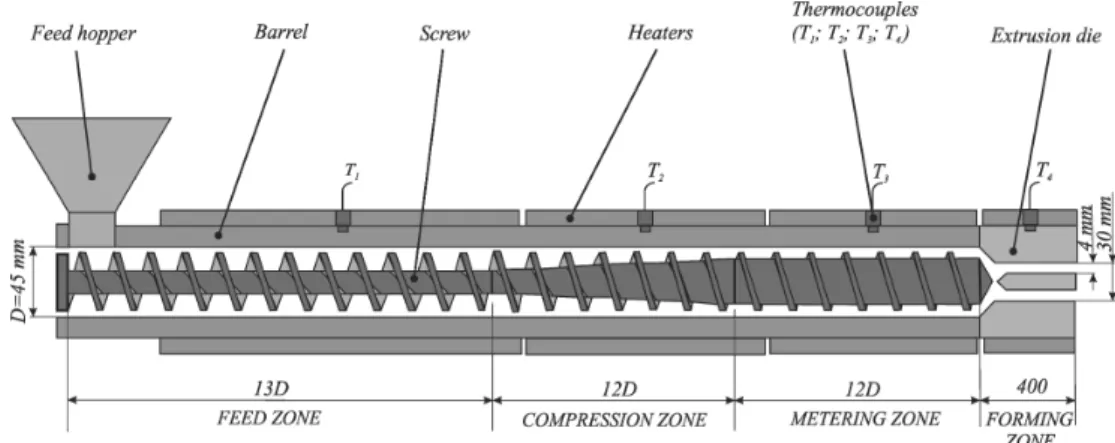
There was used for the experiments an extruder Cincinnati Monos +45 mode type (figure 2). This equipment has a single screw with a diameter of 45 mm. The geometry of the extruder is a specific one belonging to the last generation. It has a bimetallic cylinder created from special alloys. This type of alloy is resistant at corrosion and abrasion.
This kind of equipment provides an excellent homogeneity of the melted material due to the complexity of the worm gear’s geometry and to the extremely precise control of the temperatures for all four specific areas of the extrusion process the four areas are: the feeding area, the compressing area, the metering zone and the shaping area.With this kind of extruder, there be produced the tubes with diameters between 20 – 2000 mm and with different wall thickness. We realized for this experiment a tube with the exterior diameter of 30 mm and with the wall thickness of 4 mm. The processing temperature of the extruder can be set up until it reaches out the maximum value of 400°C for each area, separately.
We used a special mill to cut the samples for the tensile test, from each tube corresponding to each type of material.
We established the processing temperatures accordingly to the experimental plan established with ANOVA test analysis.
Using thermocouples T3, T4, respectively there can be set the values of the independent variables.
The samples were cut from the tubes, according to SR EN ISO 527 – 2000. The dimensions are: L3= 150 mm, L1= 60 mm, R= 60 mm, b1= 10 mm, b2= 20 mm, h= 4 mm, L0=50 mm, L= 115mm (figure 32). For cutting the samples we used a specially designed dies which were mounted on a hydraulic press. We used a tensile test machine Instron type 3366 to realize the tensile.
Fig. 3.Sample according to SR EN ISO 527-2000
We determined the arithmetic average values of the tensile stress for each experiment in order to determine the mathematical model of the tensile strength σ according to the temperatures
A and B for the chosen material. We introduced these values I in the Design Expert program.
4. NUMERICAL RESULTS
In order to determine the best model that describes the mathematical relationship between the dependent variable and the independent variables, we used the following methods: the Fischer statistical method, the determination of the coefficient R2, and the adjusted factor of determination R2adj.
Below you can find in table 1 an ANOVA test where the mathematical models are compared for GFRPA 6.6 - 10 wt.%.
We examined for each source the probability ("Prob> F") in order to see if it is below 0.05. This value represents the maximum permissible level of statistical significance. After we did the analyzes, it resulted that the Quadratic model vs. 2FI is the most important because "Prob> F"= 0.0001, all the other models
are above 0.05 which represents the significant statistical level ("Linear vs Mean"=0.4662; "2FI vs Linear"=0.1003). This means that all the others models are excluded with the exception of Quadratic vs. 2FI model which is significant. We will consider the coefficient of determination R2 and the predicted residual error sum of the squares (PRESS - Predicted Residual Error Sum of Squares), to ensure the effectiveness of selected model.
PRESS is a measure that shows the ability of the model in approximating each point in the space of independent variables.
R2 is the dispersion measure taken from the average value. Considering the fact that "R Squared" value is closer to the unit value, a better model approximates the response function. Basically, the Quadratic model was selected for GFRPA 6.6 - 10 wt .%. In this case R Squared = 0.9642.
First, we establish the type of the mathematical model in order to approximate the dependent variables, and then we have to check whether a term should be part in the model or it should not.
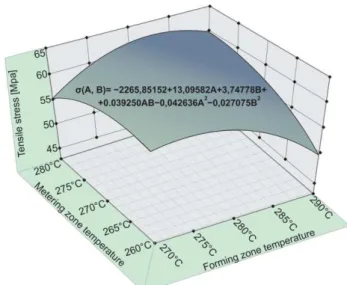
Fischer 37.75 Value of Statistics shows that the model is significant. There is only a 0.01% probability that average model lies outside the confidence interval.
Fig. 4. Tensile stress variation
σ (A, B) = 2265.85152 + 13.09582 A + 3.74778 B + 0.039250 AB 0.042636 A2 –
0.027075 B2. (1)
where:
σ – Tensile stress [MPa];
A – Metering zone temperature [°C]; B – Forming zone temperature [°C].
5. CONCLUSIONS
The temperature process must be properly set if we want to achieve GFRPA 6.6 - 10 wt.% optimum melt homogeneity and maximum tensile resistance.
We realized that the tensile stress minimal value is obtained only when the difference between the temperature from the metering and the forming areas has a maximum value (ex: T3= 290 °C and T4= 260 °C).
When the results from the forming zone are bigger, there can appear the metering’s zone extrusion installation danger. Moreover, the extruded profile calibration becomes hard to handle. When the metering’s zone temperature is 280 °C and the forming’s zone temperature is 270 °C we can get the maximum tensile stress value. In this experiment, apart from the excellent mixing of the material due to the low temperature, an optimal extrusion pressure is formed in the profile zone and, therefore, a good extruded profile calibration.
As a closure, we can state that the metering’s zone temperature must be 280 °C and the forming’s zone temperature must be 270 °C. if we want to get a higher tensile stress for a reinforced fiber glass extruded polymer (GFRPA 6.6 - 10 wt.%), the metering’s zone temperature must be higher than the forming’s zone temperature.
Anyway, this difference shouldn’t have a big because if we don’t want to damage the extrusion equipment and, consequently, to compromise the technological process. The temperature is a very important factor in manufacturing products from reinforced polyamide. The bottom line is that we can manufacture products with a high quality if we know the optimum values of. Furthermore, we can also, extend the researchers for other degrees of reinforcement for PA 6.6 polymers.
6. REFERENCES
[1] Sabau E., Popescu A., Vilău C..Mechanical behavior of composite materials using the finite element analysis, MATEC Web Conf.
Volume 137, 2017, Modern Technologies in Manufacturing (MTeM 2017 - AMaTUC), Article Number: 08006, Number of page(s): 6, Section: Processes of Plastics and Composite Materials, DOI: https://doi.org/10.1051/matecconf/20171370 8006, Published online 22 November 2017. [2] Camelia M., Popescu A.. The design of a
plastic injection mold for The Part “Tensile test specimen”, Journal: Acta Technica
Napocensis-Series: Applied Mathematics, Mechanics, And Engineering, ISSN 1221-5872, pg. 319-324, Vol 60, No 2 (2017). [3] Popescu A., Iancău H., Bere P., Simon M..
Experimental and theoretic research regarding optimization extrusion process for polymers reinforced fiber (PA 6.6 – 30 % GF), Journal: Acta Technica
Napocensis-Series: Applied Mathematics, Mechanics, And Engineering, ISSN 1221-5872, pg.239-244, Vol 55, No 1 (2012).
[4] Radu S.A., Balc N., Popescu A., Panc N.A.. Experimental determination of surface roughness of parts obtained by rapid prototyping, The 3rd Virtual International
Conference on Advanced Research in Scientific Areas (ARSA-2014), Publisher: EDIS - Publishing Institution of the University of Zilina, ISBN: 978-80-554-0958-0, ISSN: 1338-9831, Zilina, Slovakia, December 1 - 5, pg. 342345, 2014.
[5] Sabau E., Bâlc N., Bere P.. Mechanical behavior of new composite materials reinforced by waste glass fibre, Advanced
Engineering Forum, Trans Tech Publications, Vols. 8-9, pg. 309-316, Switzerland, 2013. [6] Sabău E., Bâlc N., Bere, P., Nemeș O.. New
materials from waste glass fibre, Studia
Universitatis Babes-Bolyai Seria CHEMIA, ISSN 1224-7154, pp. 201-208, LVII, 4 / 2012.
reinforced composites, Revista Materiale
Plastice, 47 (2), ISSN 0025/5289, 2010. [8] Ceclan V. A., Bere P., Borzan M., Grozav S.,
Borzan C.. Development of Environmental Technology for Carbon Fibre Reinforced Materials Recycling, Revista Materiale
Plastice,♦ 50♦ No. 2, Bucuresti, pg. 79-83,
2013.
[9] Popan I. A., Conţiu G., Campbell I.. Investigation on standoff distance influence on kerf characteristics in abrasive water jet cutting of composite materials, MATEC Web
Conf. Volume 137, Modern Technologies in Manufacturing (MTeM 2017 - AMaTUC) DOI
https://doi.org/10.1051/matecconf/20171370 1009, 2017.
[10] Popan I. A., Bâlc N., Popan A. I.. Preliminary study on occurrence of composite material delamination processed by abrasive water jet cutting, MATEC Web
Conf. Volume 121, 8th International Conference on Manufacturing Science and Education – MSE 2017 "Trends in New Industrial Revolution" DOI
https://doi.org/10.1051/matecconf/20171210 2010, 2017.
[11] Popan I. A., Popan A. I.. Experimental study on manufacturing complex parts from composite materials using water jet cutting,
Journal: Acta Technica Napocensis-Series: Applied Mathematics, Mechanics, And Engineering, ISSN 1221-5872, pg. 319-324, Vol 60, No 2 (2017).
[12] Popescu A.. Contribuţii privind îmbunătăţirea procesului de extrudare a materialelor compozite polimerice armate cu fibre scurte, Teză de doctorat, Cluj
Napoca,Volumul 1, lSSN 1221-5872, Pagini 217, Editura U .T.Press, 2011.
[13] Panc N., Hancu L., Balc N.. Research regarding the improvement of the performance of rubber dies, Proceedings of
the World Congress on Engineering 1, 783-786, 2011.
[14] Bocanet V. Panc N.. The influence of hole finishing strategies on quality,MATEC Web
of Conferences,vol.137, 2017.
PROIECTAREA UNEI MATRIŢE DE INJECTAT PENTRU REPERUL “EPRUVETA PENTRU
INCERCAREA LA TRACŢIUNE”
Rezumat: Materialele polimerice și materialele polimerice compozite armate cu fibră de sticlă sunt utilizate astăzi pe
scară largă în diferite domenii de activitate. De exemplu, acestea sunt extinse în industria aeronautică și aerospațială, dar și în domeniul auto. Majoritatea pieselor polimerice sunt obținute prin injectare, dar există, de asemenea, părți care necesită un alt tip de tehnologie, cum ar fi tehnologia de extrudare utilizată în această lucrare. Piesele obţinute prin extrudare sunt utilizate pe scară largă în industria instalaţiilor. În această lucrare vom analiza influența temperaturii de extrudare asupra caracteristicilor mecanice ale pieselor polimerice din poliamidă 6.6 armată cu10% fibră de sticlă. Vom lua în considerare temperaturile de prelucrare cu cea mai mare influență asupra produsului extrudat (temperatura zonei de omogenizare și temperatura zonei de formare). Pentru optimizarea valorilor temperaturilor luate în considerare, vom folosi programul Design Expert.
Adrian POPESCU, Lecturer, Phd., Technical University of Cluj-Napoca, Department of
Manufacturing Engineering, [email protected].
Liana HANCU, Professor, Technical University of Cluj-Napoca, Department of Manufacturing
Engineering, [email protected].
Emilia SABAU, Lecturer, Phd., Technical University of Cluj-Napoca, Department of Manufacturing