Original Research Article
Analysis of cross matching to transfusion ratio of blood components in
blood bank SKIMS, Soura: a prospective one year study
Supinder Kour
1, Irm Yasmeen
1*, Aleem Jan
1, Balwinder Singh
2INTRODUCTION
Transfusion of blood and blood products is one of the most frequently performed procedures during hospitalization. Blood transfusion services plays a pivotal role in the resuscitation and management of patient.1
Blood transfusion was identified by the American Medical Association as one of the top five most frequently overused
therapies.2 Blood obtained from voluntary
non-remunerated blood donors is a scarce and precious resource, which must be effectively managed and stocked.3
The patterns of blood transfusion have changed considerably in the recent years due to advances in blood banking techniques, increased frequency of complex surgical procedures, aging populations, initiatives aimed at
1Department of Blood Transfusion Medicine, SKIMS, Soura, Srinagar, Jammu and Kashmir, India 2Medical Officer, Government of Jammu and Kashmir, Srinagar, Jammu and Kashmir, India
Received: 05 July 2019
Revised: 03 August 2019
Accepted: 08 August 2019
*Correspondence:
Dr. Irm Yasmeen,
E-mail: [email protected]
Copyright: © the author(s), publisher and licensee Medip Academy. This is an open-access article distributed under the terms of the Creative Commons Attribution Non-Commercial License, which permits unrestricted non-commercial use, distribution, and reproduction in any medium, provided the original work is properly cited.
ABSTRACT
Background: Blood requisitions received in blood bank for elective and emergency procedures from surgery, trauma, Obstetrics and Gynaecology Department are often associated with excessive demand for cross matching of blood which is often more than the required blood and blood components. In this study, our goal was to use the blood stocks more efficiently and reduction in the wastage due to over dating and to prevent injudicious pre-operative cross-matching and utilization of blood.
Methods: This was a prospective study conducted in the Department of Blood Transfusion and Immunohematology of Sher-i-Kashmir Institute of Medical Sciences (SKIMS), Soura, Srinagar over a period of one year with effect from September 2017 to August 2018. Source was requisition forms and blood bank records of patients who underwent elective procedures in the hospital. For the purpose of analysis, departments were categorized into surgical and allied branches i.e Cardiovascular Surgery (CVTS), Neurosurgery, General Surgery and Obstetrics and Gynaecology. Department wise utilization of blood Components cross matching to Transfusion ratio (C/T), transfusion probability (T%) and Transfusion Index (TI) were calculated. Data was entered and analyzed using Microsoft excel window 2010. The obtained data was evaluated and presented in the tabular and diagrammatic forms.
Results: A total of 3940 requests for cross matching of blood and its components were received for 3072 patients. Out of these, 2048 units were transfused. The total C/T Ratio, Transfusion Probability (T%) and Transfusion Index (TI) was 1.92, 42.5% and 0.6 respectively.
Conclusions: To reduce the injudicious usage of blood, blood transfusion services need to adopt blood conserving policies. Efforts should be made to adopt more conservative transfusion thresholds, periodic feedback to improve blood ordering, conduct regular auditing, handling, distribution and utilization practices of this scarce resource.
Keywords: Maximum surgical blood ordering schedule, Transfusion index, Transfusion probability
improving health care standards and a decrease in donor availability because of stringent screening criteria.3,4
The transfusion of blood and blood products is an integral and essential part of hospital services. The blood requisition in elective and emergency procedures from surgery, trauma and Obstetrics and Gynaecology departments are often associated with excessive demand for cross matching of blood which is often more than the required blood and blood products.5 It is very necessary
that this scarce and expensive commodity be used accurately and logically. However with the growing evidences based support and the use of restrictive transfusion strategies, patient blood management has emerged as a multidisciplinary approach to optimize the care of patient who may need transfusion. The elective surgeries utilize around 30% of cross matched blood and are considered one of the areas of hospital wastage of its vital resources. Many studies have been conducted on blood ordering and transfusion practices in elective surgery and have demonstrated over ordering and under-utilization of blood.6-8 The need of blood in hospitals
continues to exceed the volume collected by the transfusion services. Studies have shown that there is frequently a gross over-ordering of blood of elective surgical interventions, in excess of actual and anticipated need.7 This leads to substantial cost and burden to the
transfusion services. In addition over ordering leads to non-availability of cross matched units while reserved for specific patient. Over ordering of blood leads to financial loss for the patient and hospital, increases in cost during hospital stay and increase in demand for blood. A number of studies have shown meaningful reduction in cross match request, number of units cross -matched and units transfused after MSBOS was implemented and group type were introduced.7
Therefore, our study was conducted to investigate the blood ordering pattern and transfusion practices and subsequently incorporate a blood ordering schedule which streamlines the use of blood and blood products for the elective and emergency surgical procedures and therefore, decrease over ordering of blood.
Aims and objectives of this study was conducted to use the blood stocks more efficiently and reduction in the wastage due to expiry of blood components, to prevent injudicious pre-operative undesired cross-matching of blood by calculating various blood utilization indices.
METHODS
This study was a prospective study which was conducted in the Department of Blood Transfusion and Immunohematology of Sher-i-Kashmir Institute Of Medical Sciences (SKIMS), Soura, Srinagar which is a 500 bedded tertiary care hospital catering patients from all parts of the state, over a period of one year with effect from September 2017 to August 2018 after getting clearance from Institutional Ethical Committee.
Source of data
Source was requisition forms and blood bank registers of patients who underwent elective procedures in the hospital for which blood was ordered. For the purpose of analysis, departments were categorized into surgical and allied branches i.e. cardiovascular surgery, neurosurgery, general surgery and obstetrics and gynaecology.
Blood utilization indices were computed by the following equations
Crossmatch to transfusion ratio (C/T ratio)
Number of units cross-matched/number of units transfused. A ratio of less than 2.5 is considered indicative of significant blood usage.
Transfusion probability (%)
Number of patients transfused/number of patients cross-matched ×100. A value of 30% or more was considered indicative of significant blood usage.
Transfusion index (TI)
Number of units transfused/ number of patients cross-matched. A value of greater than 0.5 signifies blood usage.
Maximum Surgical Blood Ordering Schedule (MSBOS): 1.5×TI.
Inclusion criteria
• List of commonly performed elective surgical procedures.
• Number of Red cells units ordered for cross matching for the said procedure.
Exclusion criteria
• Emergency surgical procedures like Road traffic accidents, ruptured ectopic pregnancy, Intracranial hemorrhages, liver laceration, intestinal perforation etc. during emergency were not included.
Data was entered and analyzed using Microsoft excel window 2010. The obtained data was evaluated and presented in the tabular and diagrammatic forms.
RESULTS
females 1966(63.9%) and males were 1106(36.0%).
Patient’s age ranges from 18-60 years with mean 39.9 years. Maximum number of patients belongs to age group 46-60 years (51.9%) followed by 31-45 years (30.0%) and 18-30 years (18.0%). Maximum number of blood transfusions were received in the age group of 46-60 years (51.0%). Maximum cross-matched units were of blood group O positive (20.17%) and maximum transfused blood group was B positive (22.99%). Comparison of blood units cross matched and transfused and various transfusion indices in elective surgeries of various departments. (Table 1 and 2).
Table 1: Comparison of blood units cross matched and transfused in elective surgeries.
Departments
Total number of crossmatch (n=3940)
Total number of
transfusions (n=2048)
C/T ratio (1.92:1)
CVTS 1072(27.2%) 529(25.8%) 2.02:1 Neurosurgery 874(22.1%) 372(18.1%) 2.34:1 General
surgery 1016(25.7%) 553(27.0%) 1.83:1 Obs/Gynae 978(24.8%) 594(29.0%) 1.64:1
Table 2: Transfusion Indices in elective procedures in various departments.
Departments No. of units No. of patients C/T Ratio T% TI
C/M Transfused C/M Transfused
CVTS 1072 529 801 412 2.02 51.4% 0.6
Neurosurgery 874 372 653 248 2.34 37.9% 0.5
General Surgery 1016 553 909 336 1.83 36.9% 0.6
Obs and Gynae 978 594 709 311 1.64 43.8% 0.8
Total 3940 2048 3072 1307 1.92 42.5% 0.6
This table depicts that maximum cross match to transfusion ratio was seen in neurosurgery department (2.34) followed by CVTS (2.02), General surgery (1.83) and obs/gynae (1.64). Overall C/T ratio was 1.92 which indicates efficient blood usage by all the departments of our hospital. Maximum transfusion probability (T%) was seen in CVTS department (51.43%) followed by Obs and Gynae department (43.8%), Neurosurgery (37.97%) and General surgery (36.9%) with overall T% of 42.5% indicating judicious use of blood.
Transfusion Index (TI) was maximum in Gynae and obs department (0.8) followed by CVTS and general surgery (0.6), and least TI was seen in neurosurgery (0.5). Overall TI was 0.6 which indicates that blood was efficiently used by our hospital.
DISCUSSION
Blood utilization indices helps in formulating the maximum surgical blood ordering schedule accurately for each department.9 It is quite challenging to maintain a
balance between the ongoing blood demand and supply. Appropriate use of blood or blood components is an extremely cost-effective practice but holding blood units for elective surgery and then not transfusing the requested blood, adds to the testing cost for the patient, and overburdening a blood bank. There is a great likelihood of low supply because of blood units kept on hold for 48-72 hrs. as per many institutional policies.10 Blood banks face
an ever-increasing demand for blood and its components when this demand exceeds the resources of the blood bank.
Blood transfusion which could be massive at times, is the fundamental facet in the management of trauma patients and is a lifesaving exercise.11
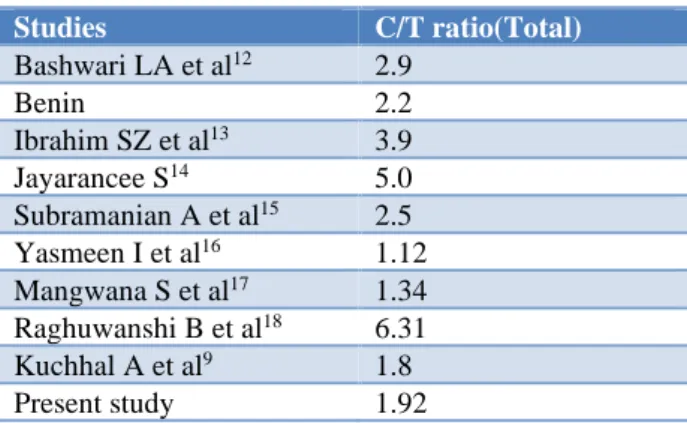
Table 3: Comparison of cross-matching to Transfusion ratio among different studies.
Studies C/T ratio(Total)
Bashwari LA et al12 2.9
Benin 2.2
Ibrahim SZ et al13 3.9
Jayarancee S14 5.0
Subramanian A et al15 2.5
Yasmeen I et al16 1.12
Mangwana S et al17 1.34
Raghuwanshi B et al18 6.31
Kuchhal A et al9 1.8
Present study 1.92
with our study. However, some studies have reported much higher C/T ratios as shown in (Table 3).
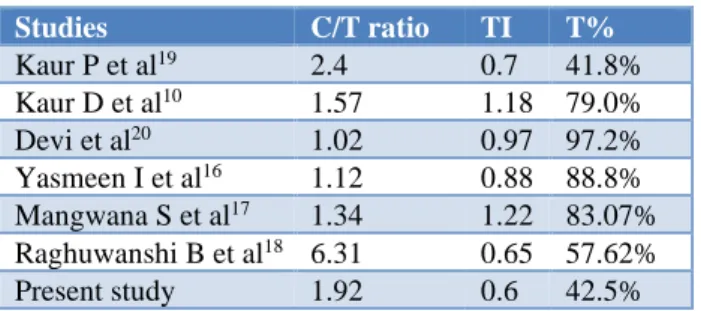
Transfusion probability (T%) for various departments of this hospital i.e. CVTS, Neurosurgery, General surgery and Obstetrics and gynaecology were 51.43%, 37.97%, 36.9% and 43.8% respectively with overall T% of 42.5%. The TI for various departments of our hospital i.e. CVTS, Neurosurgery, General surgery and Obstetrics and gynaecology were 0.6, 0.5, 0.6 and 0.8 respectively with overall TI of 0.6. Value of T% and TI was highly comparable with the studies (Table 2 and 4). In this study significant blood utilization using all three indices were obtained in various departments i.e. CVTS, Neurosurgery, General surgery and Obstetrics and Gynaecology.
Table 4: Comparison of quality indicators for blood utilization among different studies.
Studies C/T ratio TI T%
Kaur P et al19 2.4 0.7 41.8%
Kaur D et al10 1.57 1.18 79.0%
Devi et al20 1.02 0.97 97.2%
Yasmeen I et al16 1.12 0.88 88.8%
Mangwana S et al17 1.34 1.22 83.07%
Raghuwanshi B et al18 6.31 0.65 57.62%
Present study 1.92 0.6 42.5%
However, appropriate use of blood and blood components is an extremely cost-effective practice but holding blood unit for elective surgery and then not transfusing leads to fritter away the reagents and overload on the blood bank. Preoperative over ordering of blood has been reduced by recommending type and screen, group and save policy.
Benefit of such policies recommended by American association of blood bank includes reduced cost of reagents which are being used for cross-matching procedures, reducing the workload of the laboratory personnel and most important is the unnecessary loss of cross matched blood due to outdating. Type and screen are one of the methods to reduce the unnecessary cross-matching of blood and to further reduce this, MSBOS has been formulated.
CONCLUSION
Blood transfusion is a life saving measure in various medical and surgical conditions. To reduce the injudicious usage of blood, efforts should be made to adopt more conservative transfusion thresholds, periodic feedback to improve blood ordering, handling, distribution and utilization practices of this scarce resource and conducting regular audits that will ultimately reduce the burden of physical and human resources of a health care facility and increased cost of medical care and also reduce the stress on the blood transfusion services.
Funding: No funding sources
Conflict of interest: None declared
Ethical approval: The study was approved by the Institutional Ethics Committee
REFERENCES
1. Vibhute M, Kamath SK, Shetty A. Blood utilisation in elective general surgery cases: requirements, ordering and transfusion practices. J Postgraduate Med. 2000;46(1):13.
2. Goodnough LT, Maggio P, Hadhazy E, Shieh L, Hernandez‐Boussard T, Khari P, et al. Restrictive blood transfusion practices are associated with improved patient outcomes. Transfusion. 2014;54(10pt2):2753-9.
3. Zimmermann R, Buscher M, Linhardt C, Handtrack D, Zingsem J, Weisbach V, et al. A survey of blood component use in a German university hospital. Transfusion. 1997;37(10):1075-83.
4. Ali A, Auvinen MK, Rautonen J. Blood donors and blood collection: The aging population poses a global challenge for blood services. Transfusion. 2010;50(3):584-8.
5. Raghuwanshi B, Pehlajani NK, Sinha MK, Tripathy S. A retrospective study of transfusion practices in a Tertiary Care Institute. Ind J Anaesth. 2017;61(1):24. 6. Sowayan SA. Use of blood in elective surgery: an area of wasted hospital resource. Annal Saudi Med. 1994;14(4):326-8.
7. Friedman BA, Oberman HA, Chadwick AR, Kingdon KI. The maximum surgical blood order schedule and surgical blood use in the United States. Transfusion. 1976;16(4):380-7.
8. Olawumi HO, Bolaji BO. Blood utilization in elective surgical procedures in Ilorin. Trop J Health Sci. 2006;13(1):15-7.
9. Kuchhal A, Negi G, Gaur DS, Harsh M. Blood utilization practices in elective surgical patients in a Tertiary Care Hospital of Uttarakhand. Global J Transfusion Med. 2016;1(2):51.
10. Kaur D, Kandwal M. Blood utilization and quality indicators–Trend at a superspeciality hospital in Northern India. Haematol Transfusion Intern J. 2016;2(3):00037.
11. Tayara BK, Al-Faraidy MH, Al-Sayel FA, Al-Omran AS, Sadat-Ali M. Blood utilization in orthopedic and trauma practice. Int J Applied Basic Med Res. 2015;5(2):111.
12. Bashawri LA. Pattern of blood procurement, ordering and utilization in a University Hospital in Eastern Saudi Arabia. Saudi Med J. 2002;23(5):555-61.
13. Ibrahim SZ, Mamdouh HM, Ramadan AM. Blood utilization for elective surgeries at main University Hospital in Alexandria, Egypt. J Am Sci. 2011;7(6):683-9.
15. Subramanian A, Rangarajan K, Kumar S, Sharma V,
Farooque K, Misra MC. Reviewing the blood ordering schedule for elective orthopedic surgeries at a level one trauma care center. J Emergencies, Traumaand Shock. 2010;3(3):225.
16. Yasmeen I, Ahmed I, Sidhu M. Pattern of blood component cross-matching and their utilization in a tertiary care hospital of Jammu region. Int J Res Med Sci. 2018;6(4):1337.
17. Sadhana M, Neha B, Pinky Y, Rakesh C. Optimization of blood transfusion services: Analysis of blood requisition and utilization practices in cardiac surgical patients in a tertiary care hospital, India. Glob J Trans Med. 2017,2(1):47-51.
18. Raghuwanshi B, Pehlajani NK, Sinha MK, Tripathy S. A retrospective study of transfusion practices in a Tertiary Care Institute. Ind J Anaesth. 2017;61(1):24.
19. Kaur P, Basu S, Kaur G, Kaur R. An analysis of the pattern of blood requisition and utilization-A tertiary care centre. NJIRM. 2013; 4(2): 123-27.
20. Devi KM, Barindra Sharma A, Dorendro Singh L et al. Quality indicators of blood utilization in a tertiary care centre in Northeastern India. IOSR J Dent Med Sci. 2014; 13(1): 50-52.