THERMOMECHANICAL STUDY ON 42CRMO4 STEEL FORMABILITY
Mariana POP, Adriana NEAG, Dan FRUNZA, Florin POPA
Abstract: To better understand the tensile deformation and fracture behavior of 42CrMo4 steel during hot processing, uniaxial tensile tests at elevated temperatures and different strain rates were performed. The behavior of 42CrMo4 steel was studied by hot tensile tests with the deformation temperature range of 700 – 1000 °C and strain rate range of 0.006 - 0.1 s-1. Effects of deformation condition on the flow behavior, microstructure evolution and fracture characteristic were analyzed. The results indicated that the flow stress was sensitive to the deformation condition. Scanning electron microscope (SEM) images showing both the fracture surfaces and the matrix near the fracture section indicated the ductile nature of the material. However, the fracture mechanisms varied according to the deformation condition, which influences the dynamic recrystallization (DRX) condition.
Key words: hot tensile test, tensile strength, strain rate, ductile fracture, SEM.
1. INTRODUCTION
42CrMo4 (AISI 4140) is a low-alloy steel widely used in various applications for example: forged parts; automotive, oil and gas industry
elements; bolted assemblies; welded
components; etc. [1]. Former studies shown that this material has high strength, a good fatigue behaviour and machinability [2,3]. 42CrMo steel may be heat treated over a wide range of temperature to give the combined advantages of proper hardness, strength and ductility [4]. At higher temperatures in the hot working range (T > 0.6 TM), mechanical behavior is different from plastic deformation at cold and warm working temperatures (where the change in microstructure is largely a distortion in the grains). In the hot working regime, creep and work softening can occur from elf-diffusion (diffusion creep), dynamic recovery, and dynamic recrystallization. The two main mechanisms of work softening in the hot working regime are dynamic recovery and dynamic recrystallization. Dynamic recovery and dynamic recrystallization occur during metalworking operations such as hot rolling,
extrusion and forging. They are important because they lower the flow stress of the material, thus enabling it to be deformed more easily and they also have an influence on the texture and the grain size of the worked material. At temperatures where thermally activated deformation and restoration processes occur, the microstructural evolution will be dependent on the deformation temperature (T) and strain rate (ε̇) in addition to the strain (ε).The strain rate and deformation temperature are often incorporated into a single parameter – The Zener–Hollomon parameter (Z), which is defined as:
= (1)
where Q is an activation energy.
In order to develop advanced manufacturing techniques requires information regarding hot-working characteristics of the material. The proper hot-working temperature and strain rate must be established to produce high-quality wrought products of complicated geometries. Hot Tensile Test (HTT) is the method of testing the material properties at high temperature. The tensile ductility (e.g., fracture strain), the flow stress, and cavity formation conditions should be
TECHNICAL UNIVERSITY OF CLUJ-NAPOCA
ACTA TECHNICA NAPOCENSIS
Series: Applied Mathematics, Mechanics, and Engineering
established as a function of temperature and strain rate. Formability curves shows the degree of deformation which the material can tolerate without failure.
The flow stress of a metal is influenced by: chemical composition, metallurgical structure, phases, grain size, segregation, and prior deformation processes, such as temperature of deformation, strain and strain rate. Thus, the flow stress, σ, is influenced by the temperature, T, strain, ε, the strain rate,ε̇ and the microstructure, S.
= ( , , ,
)
(2)The major advantage of the hot-tension test is that its stress/strain state simulates the conditions that promote cracking in many industrial metalworking processes.
In order to study the workability for 42CrMo steel, the compression/tension deformation behaviors of 42CrMo steel were investigated over wide ranges of forming temperature and strain rate [4-12].
Hot formation processes are very complex. The mechanisms of work hardening (WH), dynamic recovery (DRV) and dynamic recrystallization (DRX) occur in the metals and alloys during the hot deformation [13-15].
The understanding of the relationship between the thermo-mechanical parameters and DRX behavior of metals and alloys is of great importance for designers of metal forming processes (hot rolling, forging and extrusion). The dynamic recrystallization (DRX) can refine the grain during the hot deformation. For the control of microstructures and the improvement of mechanical properties, the DRX has a great significance [5-8,13,15,16].
Fracture under conditions of uniaxial tensile load results in the formation of essentially equiaxed dimples bounded by a lip or rim [*]. Depending on the microstructure and plasticity of the material, the dimples can exhibit a very deep, conical shape or can be quite shallow [*]. The microvoids nucleate at regions of localized strain discontinuity, associated with second phase particles, inclusions, grain boundaries, etc. [*]. Dimple shape is governed by the state of stress within the material as the microvoids form and coalescence [*].
There is a significant interest in modelling the evolution of microstructure during the hot deformation of metals which undergo dynamic recovery. The aims are to predict both the microstructures and the flow stresses of materials processed under the wide range of conditions employed in industrial processing.
In several practical cases, the ultimate ductile fracture strain determined with tensile test is a material plasticity measure. In this case, the plasticity has to be defined as an ability of a material to accommodate high permanent strains until fracture appears where this strain reaches certain value called ultimate fracture strain. The strain value until fracture depends not only on the material type, but also on other several factors, as: strain speed, strain history, material starting structure, temperature, specimen geometry, etc.
In the present study, the deformation behavior of 42CrMo steel is investigated by uniaxial hot tensile tests. Tests related to mechanical properties performed at different temperatures are presented in the form of engineering stress-strain diagrams.
2. MATERIAL AND EXPERIMENTAL PROCEDURE
In this study an extruded 42CrMo4 commercial steel, quenched and temperate was investigated. Chemical compositions of the studied material (wt.%) is listed in Table 1. The sorbitic microstructure of the as-received steel is shown in Figure 1.
Table 1 Chemical compositions of 42CrMo4 steel (wt.%).
C Si Mn Mo Cr S P
0.4 2 0.2 5 0.7 5 0.2 2 1. 1 <0.03 5 <0.03 5
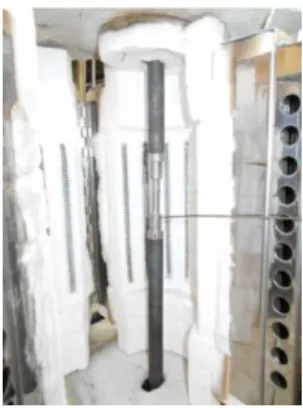
The hot tensile tests were carried out on a hydraulic Heckert machine. Figure 2 shows the hot tensile testing apparatus and the sample.
Fig. 1 Optical micrograph of as-received 42CrMo4 steel.
Fig. 2 Hot tensile testing apparatus and the sample.
The round tension test samples used to study the material behaviour at elevated temperatures were machined from the as-received bar steel and the size and shape are presented in Fig. 3. In order to investigate the flow behaviors of the 42CrMo4 steel, four different deformation temperatures (700, 800, 900, and 1000 ºC) and three different strain rates (0.006, 0.02 and 0.1 s-1) were selected.
Firstly, the samples were heated to the deformation temperature at a heating rate of 300 K/min and held for 10 min before loading. Before testing thermocouples (type K) are welded onto the samples to measure the temperature during testing.
Then, the samples wereuniaxially extended under the designed deformation temperatures and strain rates. After deformation, the samples were water quenching immediately in order to freeze the microstructure.
Fig. 3 Dimensions of the samples used in the uniaxial tensile tests (mm).
3. EXPERIMENTAL RESULTS AND
DISCUSSIONS
a) Hot tensile behavior of 42CrMo4 steel
The true stress-true strain curve is generally used to analyze the plastic deformation properties of materials. These curves results from the experimental diagram force-displacement (Fig.4). The Cauchy stress and the real strain were calculated as:
σ=F/A (3)
= (4)
The elongation to fracture and the area reduction can reflect the formability of alloys:
= (5)
= (6)
where F is the force, A0 is the initial
cross-section area, A is the final cross-cross-section area of the sample, l0 is the initial gauge length of the samples and l1 is the gauge length of the fractured samples.
Fig.4 Experimental force-displacement curves for different temperatures and 0,006 [s-1] strain rate.
The typical hot tensile true stress-strain curves of 42CrMo4 steel under different deformation conditions (strain rate and
0 2 4 6 8 10 12
0 5 10 15 20 25 30
F
o
rc
e
[k
N
]
Displacement [mm]
temperature) are presented in Fig. 5 and Fig. 6. It can be easily observe significant effects of deformation temperature and strain rate on the flow behavior of 42CrMo4 steel. The flow stress gradually decreases with the decrease of strain rate or the increase of deformation temperature. The reason is that the low strain rate cause a longer time for energy accumulation. In the same time high temperature leads to the nucleation and growth of dynamically recrystallized grains and dislocation annihilation [13] and as result the flow stress is reduced. In the initial stage (Fig. 5), the true stress-true strain curves under relatively high strain rates (0.02 and 0.1 s-1) increases to the maximum
value. In the second stage, growth is followed by a sharp drop till the sample fracture. The work hardening and dynamic softening stages can be easily observed here. For a relatively low strain rates of 0.006 s-1, the flow stress increases
sharply in the first stage of deformation and then easily to a maximum valuewith increasing true strain. The flow curves independent of strain rate are characterized by a peak after which sharply decreases till the final fracture. There is a significant increase of ultimate tensile stress by increasing the strain rate. The maximum value of the ultimate tensile stress is 380 MPa for a strain rate of 0,1 s-1.
Fig. 5 Hot tensile true stress-strain curves at 700 ºC and different strain rate.
The flow curves obtained at temperatures above 700 ºC (Fig. 6 a) and b)), are characterized by flow softening and bring the curves to the steady state condition.
The influence of temperature and strain rate on the maximum ultimate tensile stress is shown in Fig. 7. We have observed that in all studied deformation conditions by increasing the temperature the maximum stress decrease from
190 MPa at 700 °C to 30 MPa at 1000 °C and 0.006 s-1 stain rate. At higher strain rates, the maximum stress has a more pronounced decrease. That can be explained by the fact that the 42CrMo4 steel at low strain rate provides long time for energy accumulation and high deformation temperature increases the thermal activation process of the alloy. These phenomena accelerate the movement of dislocation, as a result the dynamic softeningis improved and the maximum stress decrease.
Fig. 6 Hot tensile true stress-strain curves at different temperatures: a) strain rate 0.02 s-1; b) strain rate 0.1 s-1.
Fig. 8 shows the fracture morphology at the deformation temperature of 1000 °C and strain
rates 0.006 s-1, 0.02 s-1 and 0.1 s-1. By increase
the strain rate, the sample fractures by the localized necking. The fracture morphology is with a large deformation gradient and high section reduction rate. Fracture strain can be used to evaluate the ductility of metals or alloys. Fig. 9 shows the influence of deformation temperatures on fracture strain for different strain rates. The fracture strains are very sensitive to the deformation temperature and strain rate. For the tested temperatures under all strain rates (0.1, 0.02, 0.006 s-1), the fracture
for the improvement of ductility of alloys when the deformation temperature is relatively high. Under low strain rates (0.006 s-1), the increase in
fracture strain is not so high because the low strain rate easily makes the fine recrystallized grains grow up rapidly, which decrease the ductility of the material.
Fig.7 Influence of deformation parameters on maximum stress.
Fig.8 Fractured samples at 10000C: a) strain rate 0.006 s-1; b) strain rate 0.02 s-1; c) strain rate 0.1 s-1.
Fig. 9 Fracture strain vs. temperature for different strain rates.
The influence of the strain rate at different deformation temperatures on hardness is presented in Fig. 10. For deformation temperature below 900 °C was observed an
increase of hardness by increasing the strain rate, but at higher temperature the influence is not as important. Also, by increase the deformation temperature the influence on hardness decrease.
Fig. 10 The influence on hardness of the strain rate at different deformation temperatures.
a) SEM fractography
In order to investigate the effects of the thermo-mechanical parameters on microstructures evolution, fractographic examination were carried out by SEM microscope. Both the deformation temperature and the strain rate have an important influence on the size and morphological appearance of the breaking surface as is seen in SEM images from Fig. 11.
Fig. 11 SEM images showing the fracture surfaces at low magnification at A) 700 °C: a) 0.006 s-1; b) 0.1 s-1; B) 900 °C: c) 0.006 s-1; d) 0.1 s-1; C) 1000 °C: e) 0.006 s-1;
f) 0.1 s-1.
were perpendicular to the loading direction. As in previous work [20], this steel presents significant reduction in area (r) with the increase of strain rate, prior to fracture.
SEM images of the fracture surface for the samples tested at different temperatures and strain rates are presented in Fig 12.
Fig. 12 SEM images showing the fracture surfaces at high magnification at A) 700 °C: a) 0.006 s-1; b) 0.1 s-1;
B) 1000 °C: c) 0.006 s-1; d) 0.1 s-1.
The fracture occurs intergranular and all the fracture surfaces are covered with dimples, which indicate the ductile nature of the material at these deformation conditions. This is so because ductile fracture mainly involves the growth and coalescence of voids nucleated at those micron scale particles, thus leading to the dimpled character of the fracture surface. With increasing deformation temperature, the samples reduction in area and the size of the dimples becomes larger (with an increase in lip dimension Fig. 12h). Consequently, the number of dimples on the fracture surfaces decreases, which is extremely obvious when the temperature goes up from 700 °C to 1000 °C. An
important number of dimples (with dimension
less than 10 μm) were observed on the samples tested at 800°C. Compared to other deformation temperatures, austenitic transformation takes place at this temperature, the size of the new formed grains is reduced and thus the voids generated by the intercrystalline fracture are of small dimensions. Increasing the strain rates and the temperature at 900°C and 1000°C, respectively, increases by coalescence the size of the voids and the dimples. At high strain rate under the deformation temperature of 1000 °C (as shown in Fig. 12h), the serpentine sliding features appear on the inner walls of dimples, which results from the sliding process on the free surface of dimples.
4. CONCLUSIONS
The hot deformation behavior of 42CrMo steel was investigated by tensile tests at different deformation temperature and strain rates. The effects of deformation parameters on the mechanical properties, microstructural evolution and fracture characteristics were studied.
In this study, hot tensile tests were conducted at temperatures in range of 700-1000 C and strain rates of 0.006–0.1 s−1 to study the
mechanical and microstructural aspects of the hot deformation behavior of 42CrMo4 low alloy steel. The major results of this research can be summarized as follows:
According to Fig. 6, at the initial deformation stage, there is an obvious work hardening stage observed. After that, the flow stress increases to a maximum and then decreases to a steady state value for the alloy deformed at 900 and 1000 °C, respectively. This phenomenon is characteristic for hot working accompanied by dynamic recrystallization. Continuous strain hardening was observed at the deformation temperature of 700 °C in Fig. 6. This is because the effect of work hardening is stronger than the effect of dynamic softening. Variations of the peak stress with temperature and strain rate are shown in Fig. 7. The peak stress increases with the increase of strain rate and the decrease of deformation temperature.
Localized necking and microvoid
coalescence under all the deformation conditions induced the ductile fracture of samples.
Improving the 42CrMo steel fracture behavior can be achieved by increasing the deformation temperature and decreasing strain rate.
5. REFERENCES
[1] D. Chaouch, S. Guessasma , A. Sadok , Finite Element simulation coupled to optimisation stochastic process to assess the effect of heat treatment on the
mechanical properties of 42CrMo4 steel, Materials and Design, 2012; 34: 679-684. [2] M. Nouari, A. Molinari, Experimental verification of a diffusion tool wear model using a 42CrMo4 steel with an uncoated cemented tungsten carbide at various cutting speeds, Wear, 2005; 259: 1151–9. [3] P. Starke, F. Walther, D. Eifler, New fatigue
life calculation method for quenched and tempered steel SAE 4140, Mater. Sci. Eng. A, 2009; 523:246–52.
[4] Y.C. Lin, Yan-Xing Liu, Ge Liu, Ming-Song Chen, Yuan-Chun Huang, Prediction of Ductile Fracture Behaviors for 42CrMo Steel at Elevated Temperatures, JMEPEG, 2015; 24: 221–228.
[5] Y.C. Lin, M.S. Chen, J. Zhong, Study of Static Recrystallization Kinetics in a Low
Alloy Steel, Comput. Mater. Sci., 2008; 44: 316–321.
[6] Y.C. Lin, M.S. Chen, Study of
Microstructural Evolution During Static Recrystallization in a Low Alloy Steel, J. Mater. Sci., 2009; 44: 835–842.
[7] G.Z. Quan, Y. Wang, Y.Y. Liu, J. Zhou,
Effect of Temperatures and Strain Rates on the Average Size of Grains Refined by Dynamic Recrystallization for As-Extruded 42CrMo Steel, Mater. Res., 2013; 16: 1092–1105.
[8] M.S. Chen, Y.C. Lin, X.S. Ma, The Kinetics of Dynamic Recrystallization of 42CrMo Steel, Mater. Sci. Eng. A, 2012; 556: 260–266.
[9] Y.C. Lin, M.S. Chen, J. Zhong,
Microstructural Evolution in 42CrMo Steel During Compression at Elevated Temperatures, Mater. Lett., 2008; 62: 2132–2135.
[10] Y.C. Lin, M.S. Chen, J. Zhong, Study of Metadynamic Recrystallization Behaviors in a Low Alloy Steel, J. Mater. Process. Technol., 2009; 209: 2477–2482.
[11] Y.C. Lin, M.S. Chen, J. Zhong, Prediction of 42CrMo Steel Flow Stress at High Temperature and Strain Rate, Mech. Res. Comm., 2008; 35: 142–150.
[12]. Y.Y. Li, S.D. Zhao, S.Q. Fan, B. Zhong,
Plastic Properties and Constitutive Equations of 42CrMo Steel During Warm Forming Process, Mater. Sci. Technol., 2014; 30: 645–652.
[13]Yuan-Chun Huang, Y.C. Lin, Jiao Deng, Ge Liu, Ming-Song Chen, Hot tensile deformation behaviors and constitutive model of 42CrMo steel, Materials & Design, 2014; 53: 349–356.
[14] Y.C. Lin, X.M. Chen, A crtitical review of experimental results and constitutive descriptions for metals and alloys in hot working, Mater Des 2011; 32: 1733–59. [15] A. Momeni, K. Dehghani, G.R. Ebrahimi,
Modeling the initiation of dynamic recrystallization using a dynamic recovery model, J Alloy Comp, 2011; 509: 9387– 93.
recrystallization kinetics under non-isothermal conditions, Comp Mater Sci., 2010; 49: 773–81.
[17] Z.Q. Sheng, R. Shivpuri, Modeling flow stress of magnesium alloys at elevated temperature, Mater. Sci. Eng. A, 2006; 419: 202–208.
[18] R.E. Smallman, R.J. Bishop, 2002. Modern Physical Metallurgy and Materials Engineering, Sixth ed. Butterworth– Heinemann.
[19] Y.C. Lin, Ming-Song Chen, Jue Zhong,
Effect of temperature and strain rate on the compressive deformation behavior of 42CrMo steel, J. Mater. Process. Technol., 2008; 205: 308–315.
[20] M. Pop, D. Frunza, F. Popa, A. Neag,
Aspects Regarding the Hot Fracture Behavior of 42CrMo4 Alloy, Roumanian Journal of Phisycs, 2017; 62: 1-13. [*] ASM Handbook, Vol 12, Fractography, ASM
International.
Studiu termo-mecanic asupra deformabilitati otelului 42CrMo4
Rezumat: In vederea studiului comportarii la deformare si la rupere a oțelului 42CrMo4, au fost efectuate incercari uniaxiale de tracțiune la temperaturi și viteze de deformare diferite. Comportamentul oțelului 42CrMo4 a fost studiat prin teste de tracțiune la cald in intervalul de temperaturi de deformare cuprins între 700 - 1000 ° C și intervalul de viteze de deformare de 0,006 - 0,1 s-1. Au fost analizate influenta condițiilor de deformare asupra curbelor de curgere, a evoluției microstructurii și caracteristicilor ruperii materialului. Experimentele au arătat că tensiunea de curgere este influentata semnificativ de temperatura si viteza de deformare. Imaginile de microscopie electronica (SEM), care prezintă suprafețele de rupere, indica comportarea ductilă a materialului.
Mariana POP, Ass. Prof. Dr. Eng., Technical University of Cluj-Napoca, Department of Materials Science and Engineering, 103-105 Muncii Blvd, 400641 Cluj-Napoca, Romania, E-mail: [email protected], Phone: 0040 264 401 628
Adriana NEAG, Ass. Prof. Dr. Eng., Technical University of Cluj-Napoca, Department of Materials Science and Engineering, 103-105 Muncii Blvd, 400641 Cluj-Napoca, Romania, E-mail: [email protected], Phone: 0040 264 401 628
Dan FRUNZA, Ass. Prof. Dr. Eng., Technical University of Cluj-Napoca, Department of Materials Science and Engineering, 103-105 Muncii Blvd, 400641 Cluj-Napoca, Romania, E-mail: [email protected], Phone: 0040 264 401 628