Topology and Form Finding
via Genetic Algorithms
Nick Coburn and Michael Goldenberg
Senior Project
Abstract
The following presents an approach to early applications of the Galapagos program as a means to optimize structural forms. The process was conducted with Rhino’s Grasshopper program, the structural analysis plug-in, Karamba, and the genetic algorithm solver, Galapagos. This topological form finding process was based on flexible parameters that modified brace and column locations, and diaphragm size and positions.
Grasshopper and Karamba
Grasshopper is a visual coding environment within Rhino3D composed of
pre-coded components placed on a canvas that interact with the Rhino modeling
space. Grasshopper is unique in that there is no traditional code writing and there is
no code to “run.” Instead all components are constantly running, so any changes
can be seen in real time within Rhino.
Basic Structural Elements
A truss and a shear wall are shown here. Dimensions and the number of bays for
the truss can be changed instantly. Karamba was used to paint the principal stress
lines shown on the shear wall; blue for compression and green for tension.
Karamba Form Finding
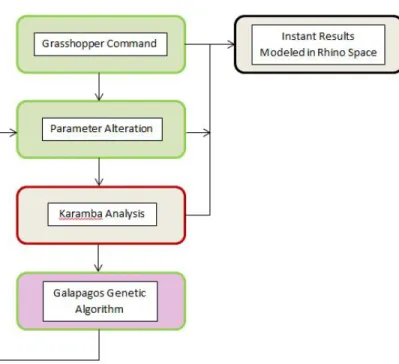
Graphic of Analysis Process
> Grasshopper Input creates a visual model in
Rhino space, changes seen in real time
> Karamba plugin allows model to be
structurally analyzed
Genetic Algorithm Explanation
Galapagos Function
Galapagos Connections
Curve to Point Optimization
In our first test utilizing Galapagos we
created random points and a simple
parabolic curve, and had galapagos
match the curve to the points by
minimizing the distance from the curve
and the points. In this case the fitness
output of Galapagos connects to a
component outputting the distance
between the curve and the points, and
the genomes are the X and Y
coordinates of the vertex. This was
completed without using any of
Karamba’s structural analysis to get a
basic understanding of Galapagos.
Combining Galapagos with Karamba Analysis
Although not a practical application,
we next tasked Galapagos with
moving point loads to find a maximum
moment in a beam. This was our first
attempt at combining Galapagos with
Karamba and was to verify that we
could trust the program. As would be
predicted,
Galapagos
ended
up
placing all loads on top of each other
at the center of the beam, so we felt
comfortable moving forward.
Before
Simple Braced Frame
Next we began testing on a simple braced
frame, now with two adjustable variables:
the location of either end of the brace
along the frame. Fitness is minimization of
deflection. Again the results are what we
would expect, as Galapagos created the
basic braced frame we see everyday.
Before
Complex Frame
Next we moved to a more complex structural form: 2 stories, 5 editable braces, a central opening, as well as moving interior supports and columns. This type of form was to expand on the original, simple form while still utilizing increased amount of genomes on top of incorporating a hypothetical opening an architect/designer might task an engineer to design around. This showed us how many more iterations it takes for Galapagos to find a reasonable solution when given a multitude of variables to adjust. This also was our first example of seeing how an
automated, genetic solver found a solution that doesn’t seem logical if an engineer was tasked with reducing deflection in this system with the same parameters.
Before
Galapagos Connections
Here you can see that
Galapagos attaches to
many more variables than
in the simple frame. This
not only caused the
Galapagos Output
This image of Galapagos’ output
during its runtime shows the program
converging to a common solution.
With this semi-complex structures with
multiple variables, Galapagos took
about 14 generations just to converge.
Even after that, Galapagos did not
Diaphragm w/ 5 Supports
Before
After
From the LFRS, we then transitioned to diaphragms. In this instance the variables being altered are the location of the supports with the goal of reducing overall deflection in the system. This again led to a very long converging process and a large total amount of generations produced before a “fittest” solution was found. This was because each support counted as two variables since they could be
First 3D Structure/First Building Optimization
Before
After
Michell Structure
Tower 3
Shown here is the third
iteration
of
the
same
process, with again a
slightly different final form.
This was run to test the
variance among solutions
and
to
make
sure
High Rises
High Rise 1 - Form Differences
Before After
High Rise 1 - Deflection Differences
Before After
High Rise 1 - Material Utilization Differences
Before After
High Rise 2 - Form Differences
Before After
High Rise 2 - Deflection Differences
Before After
High Rise 2 - Material Utilization Differences
Before After
High Rise 3
High Rise 3 - Form Differences
Before After
High Rise 3 - Displacement Differences
Before After
High Rise 3 - Material Utilization Differences
Before After
High Rise 3
Global, Cultural, Social, Environmental, Economic, &
Constructability Considerations
Files
Plugins Required:
Karamba (may have to simplify Grasshopper model if using free version of Karamba)
● https://www.karamba3d.com/
MeshEdit
● https://www.food4rhino.com/app/meshedit
Download Link to All Files: