Psychological Stress and Other Potential Triggers for
Recurrences of Herpes Simplex Virus Eye Infections
Herpetic Eye Disease Study GroupObiectlve: To assess psychological stress and other
fac-tors as possible triggers of ocular herpes simplex virus
(HSY) recurrences.
in which the exposure week log was completed late
af-ter the onset of symptoms.
Design: A prospective cohort study nested in a
random-ized, placebo-controlled, clinical trial.
Results: Thirty-three participants experienced a study
out-come meeting these criteria. Higher levels of
psychologi-cal stress were not associated with an increased risk of
recurrence (rate ratio, 0.58; 95% confidence interval,
0.32-1.05; P=.07). No association was found between any of
the other exposure variables and recurrence. When an
analysis was performed including only the recurrences
(n=26) for which the exposure week log was completed
late and after symptom onset, there was a clear indication
of retrospective overreporting of high stress (P = .03) and
systemic infection (P= .01). Not excluding these cases could
have produced incorrect conclusions due to recall bias.
Setting: Fifty-eight community-based or university
sites.
Participants: lmmunocompetent adults (N = 308), aged
18 years or older, with a documented history of ocular
HSY disease in the prior year and observed for up to 15
months.
Exposure Varlables: Psychological stress, systemic
in-fection, sunlight exposure, menstrual period, contact lens
wear, and eye injury recorded on a weekly log. The
ex-posure period was considered to be the week before
symp-tomatic onset of a recurrence.
Concluslons: Psychological stress does not appear to be
a trigger of recurrences of ocular HSY disease. If not
ac-counted for, recall bias can substantially overestimate the
importance of factors that do not have a causal
associa-tion with HSY infecassocia-tion.
Main Outcome Measure: The first documented
re-currence of ocular HSY disease, with exclusion of cases
Arch Ophthalmol. 2000;118:1617-1625A complete list of the members of the Herpetic Eye Disease Study Group appears in a box on page 1624. None of the authors has a proprietary interest in any of the drugs used in this study.
H
ERPESSIMPLEXvirus (HSY)
is a leading cause of eye
infections and visual
loss.
1•2An important
con-tributor to visual loss from
HSY infection is its recurring nature.
Sev-eral factors have been suggested as
poten-For editorial comment
see page 1682
tial triggers of recurrent ocular, orofacial,
or genital HSY disease, including upper
res-piratory tract infection,
3•4fever,
5•6sun-light,7·
8seasonal conditions,3•
9-11emo-tional factors,
1 2-15psychological stress,
14•1 6•19trauma,
20and menstruation.
2 1However,
re-sults from these studies have been
incon-sistent, and only a few studies have
as-sessed ocular HSY recurrences.
In a randomized,
placebo-con-trolled, clinical trial, we found that 12
months of oral acyclovir therapy was
ben-eficial in reducing the incidence of ocular
HSY recurrences in participants with a
re-cent history of active ocular HSY disease.
In both treatment groups, the number of
prior episodes of HSY eye disease was the
only baseline or historical factor that was
a strong predictor of a recurrence.
22Herein,
we report the results of a prospective
co-hort study, nested within this clinical trial,
that assessed psychological stress and other
factors as possible triggers of recurrent HSY
eye disease.
RESULTS
PARTICIPANTS AND METHODS
An institutional review board approved the study pro-tocol and informed consent forms for each site, and an independent Data Safety and Monitoring Committee provided study oversight.
PARTICIPANTS
To be eligible for the treatment trial, a participant must have experienced active HSY eye disease within the previous 12 months that was inactive and untreated for at least 30 days before trial enrollment. In the treatment trial, participants re-ceived either oral acyclovir or placebo for 12 months and then were observed for 6 months while not receiving treatment. 22 Additional eligibility criteria for this recurrence fac-tors study cohort included the following: (1) age 18 years or older, (2) 10th grade or greater educational level, and (3) ability to read and write English. Eligible participants were asked to enroll in the recurrence factors study by the end of the first month of the treatment trial but could be enrolled as late as 9 months into the trial. The median time from enrollment into the treatment trial to enrollment in the recurrence factors study was 3 weeks (25th percentile, 10 days; and 75th percentile, 4 weeks). Data collection for the recurrence factors study ended when the participant had completed 15 months of the treatment trial.
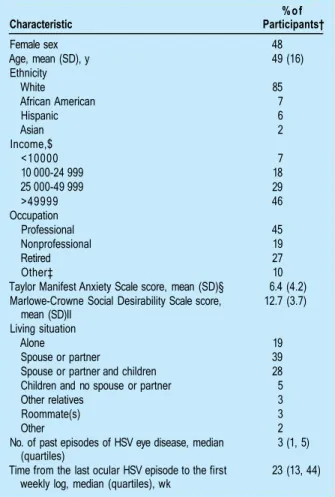
Fifty-eight of the 7 4 clinical sites involved in the treat-ment trial participated in the recurrence factors study. At these sites, among the 565 participants enrolled in the treatment trial who were also eligible for the recurrence factors study, 336 (60%) agreed to participate. Participants were excluded from analysis if they developed active HSY eye disease ei-ther before enrollment into the recurrence factors study (n= 7) or shortly after study enrollment such that either a symptom-onset date could not be determined or a weekly log for the exposure week was not available (n=5). Also excluded were 15 participants who completed baseline information only and dropped out before submitting any subse quent logs and 1 par-ticipant who was subsequently deemed to be ineligible for the treatment trial. These exclusions left a sample of 308 for analysis. Among the 308 patients, 155 were in the acyclovir group and 153 were in the placebo group.
BASELINE DATA COLLECTION
In addition to the data available from the treatment trial, data were obtained on occupation, income, living situation, and the psychological constructs of negative affectivity and social de-sirability. Negative affectivity, defined as the disposition to ex-perience aversive emotional states, 23 was assessed by use of a 20-item version of the Taylor Manifest Anxiety Scale. This in-strument has been shown to correlate highly with the full Tay-lor Manifest Anxiety Scale (Pearson r=0.91) and to exhibit ad-equate reliability ( Cronbach
a=.
7 6). 24 Social desirability wasassessed with a 20-item version of the Marlowe-Crowne So-cial Desirability Scale, which taps defensiveness and the ten-dency to show a positively biased self-image. 25.26 The short form has shown adequate reliability (Pearson r=0. 73-0.87).27
the treatment trial who were eligible for but did not
en-roll in the recurrence factors study, the 308 participants
were more likely to be white (85% vs 71 %; P<.001), but
were similar in sex, age, and number of past episodes of
WEEKLY DATA COLLECTION
Participants completed a log at home once a week (for most participants, each Sunday) on which they reported expe-riences during the prior 7 days. This included rating their psychological stress and reporting on illnesses, sun expo-sure, contact lens wear, eye injury, and the onset of a men-strual period. The "weekly logs" were mailed directly to the Data Coordinating Center.
Logs were considered valid only if they were com-pleted no more than 2 days before and no more than 6 days after the end of the log week. In addition, for logs com-pleted for the exposure week of participants with a recur-rence (as defined later), the log was considered invalid if the completion date was on or after the date of onset of symp-toms of a confirmed recurrence. Only data from logs deemed to be valid were included in the primary analysis.
Psychological Stress
The weekly log included 3 measures of stress: a global stress rating scale, an open-ended question about chronic stress (asking participants to describe situations that had been stressful for ≥2 weeks), and the Life Arenas Stress Mea-sure. Our primary stress measure was the global stress rat-ing scale, which consisted of a srat-ingle question: "Overall, how stressed have you felt this past week?," with a 1 to 7 Likert-type rating scale for responses. For the primary analy-sis, we collapsed these 7 levels into 3 levels according to the response labels "not at all," which appeared above 1 to 2; "moderately," which appeared above 3 to 5; and "ex-tremely," which appeared above 6 to 7. An average stress level across the study was calculated from the global stress rating across all logs for participants submitting at least 5 valid logs (excluding the exposure week for participants with a recurrence). The presence of chronic stress was as-sessed in analyses as a weekly indicator variable.
The Life Arenas Stress Measure consisted of a similar 7-point scale on which participants rated stressfulness in 11 areas of daily life: health; financial; home situation; personal goals; relationships outside the home; and if applicable, re-lationships inside the home; problems with friends and fam-ily; school-related stress; work-related stress; unemployment-related stress; and retirement-unemployment-related stress. The Life Arenas Stress Measure was assessed previously for construct valid-ity, via a correlation with a global measure of stress (r=0.56), and convergent validity, as indicated by hy pothesized posi-tive correlations between specific life arena stress scores and corresponding stress arena scores derived from log-based stressor descriptions and ratings (F. C., unpublished data, No-vember 1996). Two variables derived from the Life Arenas Stress Measure were used in secondary analyses: the sum of the first 5 life arenas previously listed plus the work-related arena (life arenas sum) and the maximum rating among all 11 life arenas (maximum stress). These 2 measures derived from the Life Arenas Stress Measure were highly correlated with the global stress rating scale (Spearman rank correla-tion coefficient [r,]=0.84 and 0.89, respectively), and were also highly correlated with each other (r,=0.85).
Other Variables
Self-reported symptoms suggestive of an infectious sy ndrome were assessed by a checklist and an "other illness" write-in response ( to be referred to as "systemic illness"). Illness was considered to have been present when one of the following was checked as being present-cold or respiratory tract in-fection; stomach flu, vomiting, or diarrhea; or fever--or when participants wrote in names of illnesses suggestive of a sys-temic bacterial or viral infection ( eg, hepatitis or pneumonia). Unprotected sunlight exposure was assessed by the par-ticipant's response to the question, "In the past week, ap-proximately how many total hours did you spend out-doors unprotected by a brimmed hat or other protective clothing?" Respondents selected from one of the follow-ing categories: 0 to 7, 8 to 14, 15 to 21, 22 to 28, or 29 or more hours. For analysis, the 5 categories were collapsed into 2: 0 to 21 and 22 or more hours.
Participants also were queried on each weekly log via yes/no questions as to: (1) the occurrence of an eye injury; (2) the use of contact lenses; and (3) for premenopausal women, whether the menstrual period began in the last 7 days. The menstrual cycle analysis included only the 64 women younger than 50 years reporting at least 1 men-strual cycle during follow-up.
OUTCOME
The study outcome was defined as the first recurrence of active HSV eye disease in any form (blepharitis, conjunc-tivitis, epithelial keratitis, stromal keratitis, and/or irido-cyclitis) confirmed on examination by a certified study oph-thalmologist using slitlamp biomicroscopy. Clinical examinations were performed after treatment trial months 1, 3, 6, 9, 12, 13, and 15 and at additional times when a participant reported new ocular symptoms. Recurrences were dated at the onset of participant symptoms, as de-scribed later. For the primary analysis, only recurrences as-sociated with a valid exposure week log were included.
EXPOSURE PERIOD
The symptom-onset date was determined from the earli-est symptom onset reported on a valid weekly log from the 4 weeks before the examination documenting the recur-rence, from the study examination form, or from medical records completed on the date of the examination. When different symptom-onset dates were recorded on a valid weekly log and the examination form, the date recorded on the weekly log was used. For participants without symp-tom-onset data from any of these sources, symptom onset was imputed to be 7 days before the documented recur-rence. This imputation was based on the data available for the 59 participants with a documented recurrence who had a recorded symptom-onset date (45 [76%] had the onset of symptoms in the prior week).
The exposure period for assessment of each time-dependent variable was considered to be the week before symptom onset. Because exposure data were gathered weekly, the exposure period consisted of a 7-day period that
The baseline global stress scores were positively
cor-related with the measure of negative affectivity (r
5=0. 40,
P<.001) and inversely correlated with the measure of
so-cial desirability (r
5=- 0.19, P
=.002). The baseline scores
varied in relationship to the date of symptom onset accord-ing to the day of the week on which symptoms first devel-oped. The exposure period thus ranged from the period 1 to 7 days before symptom onset (eg, weekly log com-pleted on Sunday and symptom onset occurred the next day on Monday) to the period 7 to 13 days before tom onset ( eg, weekly log completed on Sunday and symp-tom onset occurred on the following Sunday).
STATISTICAL ANALYSIS
Comparisons between eligible nonenrolled participants and enrolled participants and between participants who com-pleted follow-up and those who did not were made using t tests, Wilcoxon rank sum tests, or
x
2 tests as appropri-ate. Correlations between the different psychological stress measures were made using rs, treating follow-up weeks as independent observations.A discrete-time proportional hazards model28 fit by pooled logistic regression29 was used to assess the relationship between the exposure variables and an ocular HSV recurrence. The weekly measure of global psychological stress was specified as a time-dependent covariate. A change in psychological stress was modeled by evaluating the weekly global stress while con-trolling for the participant's average stress across the study, thereby making a within-person assessment. Data for partici-pants with incomplete follow-up were censored after the last weekly log received, and data for participants with invalid re-currences (because of an invalid exposure week log, see pre-vious information) were censored at the beginning of the ex-posure week (the week that preceded the recurrence).
The global stress variable was first assessed in a uni-variate model and then in models adjusting for treatment group, self-reported illness, demographics, and other rel-evant baseline variables. The univariate and full models are reported; 95% confidence intervals were computed for all measures. Models including subsets of the covariates pro-duced similar results. Effect modification (interaction terms with an associated P< .10 retained for further screening) and confounding (a change in the effect estimate b y > 10%30) were assessed. There was no evidence of interaction between the global stress variable and treatment group. Linear and cur-vilinear effects were assessed by use of continuous vari-ables and poly nomial effects, respectively.
Available-case and complete-case methods of analysis with missing data were used for the univariate and multi-variable analyses, respectively.31•3 2 No appreciable
differ-ences were observed when analysis was restricted to partici-pants with 80% or more weekly log completion.
The chronic stress indicator variable, other exposure variables (systemic infection, sunlight exposure, contact lens use, and the onset of menses), and fixed trait characteris-tics (negative affectivity and social desirability) were as-sessed in similar discrete-time proportional hazards mod-els as previously described.
A case-crossover analysis3 3 also was performed. In the
case-crossover analysis, in which data were limited to the 33 participants with a valid recurrence, each participant
Continued on next page
becomes a separate stratum in a discrete-time
propor-tional hazards model, and the participant's mean stress
level in the
control period (the period before theex-posure period) is compared with the participant's stress
in the
exposure period(the week before symptom onset).
Thus, the method assesses a within-person change in
stress, while removing any possibility of
between-person confounding.
Analyses were replicated using only
recur-rences with invalid exposure week logs (completed
late after symptom onset). For this analysis, data from
participants with valid recurrences were censored at
the beginning of the exposure week log.
Analyses were performed using statistical
soft-ware.34 All P values are 2-sided. Data are given as
mean± SD unless otherwise indicated.
The sample size for the recurrence factors study
was a function of the treatment trial sample size. We
estimated that there was 80% power (assuming a
2-sided type I error rate of .05) to detect a rate ratio
of recurrence of 2 or greater for moderate or high stress
exposure (levels 3-7) compared with low stress
(lev-els 1-2) and 99% power to detect a rate ratio of 2.5
or greater. This was based on an estimated
recur-rence rate of 14% related to low stress exposure.
P<.001). The reporting on a weekly log of a chronic (
≥
2
weeks) stressful situation was associated with a higher
global stress score (4.0± 1.5 vs 2.4± 1.4; P<.001).
COMPLETENESS OF FOLLOW-UP
The study was
completed
(defined as the development of
documented active HSV eye disease or completion of the
15-month follow-up period) by 223 (72%) of the 308
par-ticipants (Figure). For 16 of the 85 "noncompleters," early
termination was related to termination from the
treat-ment trial, and for the other 69, termination was related
to the participant's decision to stop completing the weekly
logs. The median length of study completion for the
non-completers was 22 weeks (25th percentile, 8 weeks; and
75th percentile, 47 weeks). The 223 "completers" were older
(52± 15 vs 44± 16 years; P<.001) and more likely to be
re-tired (30% vs 14%; P=.009) than the 85 noncompleters.
The log completion rate was 93% (10459 of 11213
possible logs) for the 223 completers and 78% (1777 of
2276 possible logs before termination) for the 85
non-completers. Of the submitted logs, 10% were
consid-ered invalid (ie, completed > 2 days before or > 6 days
after the end of the log week) for the completers and 16%
for the noncompleters.
RECURRENCES OF OCULAR HSV DISEASE
A documented recurrence of ocular HSV disease
devel-oped in 67 (22%) of the 308 participants. Two of the 67
participants did not submit a log for the
exposure week
(the
week before symptom onset). Among the other 65
partici-pants with a recurrence, the exposure week log was
csidered invalid for 30 (completed late, after symptom
on-Table 1. Characteristics of the 308 Participants*
Characteristic Female sex Age, mean (SD), y Ethnicity
White
African American Hispanic Asian Income,$
<10000 10 000-24 999 25 000-49 999 >49999 Occupation
Professional Nonprofessional Retired Other‡
Taylor Manifest Anxiety Scale score, mean (SD)§ Marlowe-Crowne Social Desirability Scale score,
mean (SD)II Living situation
Alone
Spouse or partner
Spouse or partner and children Children and no spouse or partner Other relatives
Roommate(s) Other
No. of past episodes of HSV eye disease, median (quartiles)
Time from the last ocular HSV episode to the first weekly log, median (quartiles), wk
%of Participants†
48 49 (16)
85 7 6 2
7 18 29 46
45 19 27 10 6.4 (4.2) 12.7 (3.7)
19 39 28 5 3 3 2 3 (1, 5)
23 (13, 44)
*
There were missing data for income (n = 59), occupation (n = 37), the Taylor Manifest Anxiety Scale (n = 6), the Marlowe-Crowne Social Desirability Scale (n = 6), and living situation (n = 42). HSV indicates herpes simplex virus.†
Unless otherwise indicated. Percentages may not total 100 because of rounding.‡lncluding student, homemaker, and unemployed. §A higher score represents higher anxiety (norm, 5.9).35
IIA higher score represents higher social desirability (norm, 9.1;
SD, 3.9).36
set, in 26 cases and completed > 2 days early in 4). For the
remaining 35 participants with a recurrence whose
expo-sure week log was valid, the symptom-onset date was
de-termined from the weekly logs for 10, from the ocular
ex-amination form for 18, and by imputation (see the
"Exposure Period" subsection of the "Participants and
Meth-ods" section) for 7. Two participants with valid exposure
week logs were missing the global stress score, which
re-duced the effective number of valid recurrences to 33 in
the analyses of the global stress variable.
ASSOCIATION OF PSYCHOLOGICAL STRESS
AND OCULAR HSV RECURRENCE
re-Table 2. Baseline and Follow-up Global Stress Ratings*
Global Stress Score
1 2 3 4 5 6 7 Mean± SD
No. (%) of Participants
Baseline Rating (n = 285)
50 (18) 54 (19) 50 (18) 54 (19) 40 (14) 21 (7) 16 (6) 3.4 ± 1.8
Follow-up Ratings (n = 9939)
2337 (24) 1964 (20) 2110(21) 1684 (17) 1007 (10) 548 (6) 289 (3) 3.0 ± 1.6
Exposure Week Ratings
(n = 33) 8 (24) 10 (30) 8 (24) 3 (9) 4 (12) 0 (0) 0 (0) 2.5 ± 1.3
*
Includes valid logs only (see "Weekly Data Collection" subsection of the "Participants and Methods" section for definition). Percentages may not total 100 because of rounding.sults were obtained when the global stress scores were
ana-lyzed as a 1 to 7 continuous variable and for the Life
Are-nas Stress Measure sum and maximum (data not shown).
The mean of the average global stress scores
(com-puted across all weeks for participants with at least 5 valid
logs) was 2.6 ± 1.1 in the 29 participants with a valid
re-currence (and a nonmissing exposure week stress score)
and 3.1 ± 1.3 in the 221 who did not experience a
recur-rence (P=.06). Among these 29 participants with a valid
recurrence, the exposure week stress score was similar
to their average stress in all other weeks (2.5 ± 1.2 vs
2.6±1.1; P=.20, paired
t
test), and the correlation
be-tween their exposure week stress scores and their
aver-age of the prior weeks was 0 .84. In accord with the weekly
global stress measure, a high average stress score was not
associated with increased risk of recurrence
(unad-justed rate ratio for a 1-SD increase in average stress, 0.74;
95% confidence interval, 0 .50-1.10;
P
= .14).
Also in accord with the other measures of stress, there
was no indication of an association between an
in-creased risk of a recurrence and either a change in global
stress (assessed in a model including the weekly global
stress scores and average stress) (Table 3) or presence
of a chronic (2:2 weeks) stressful situation (unadjusted
rate ratio, 0.46; 95% confidence interval, 0.20-1.05;
P=.07). There was also no association between
recur-rence and personality measures of negative affectivity (
un-adjusted rate ratio for a 1-SD increase, 0.98; 95%
confi-dence interval, 0.70-1.38; P=.91) or social desirability
( unadjusted rate ratio for a 1-SD increase, 0.92; 95%
con-fidence interval, 0.66-1.28; P=.61).
Analyses of the global stress scores conducted
us-ing the case-crossover method, which limits the data to
those participants who had a valid recurrence (n=33),
produced results similar to those of the discrete-time
pro-portional hazards model (Table 4).
ASSOCIATION OF OTHER POTENTIAL TRIGGERS
AND OCULAR HSV RECURRENCE
During the study, a systemic infection was reported on 13%
of the weekly logs, sun exposure of more than 21 hours in
a week on 7%, and contact lens wear on 10%. None of these
Enrolled (N=336)
Removed Before Analysis
(n=28) Analysis Cohort (n=308)
Ocular HSV Recurrence (n=67)
No Recurrence and Complete Follow-up
(n=156)
No Recurrence and Incomplete Follow-up
(n=85)
Valid Exposure Week Log
(n=35)
Invalid or Missing Exposure Week Log
(n=32)
Patient flowchart. For the 28 patients removed before analysis, a baseline log only was available tor 15, a preenrollment outcome occurred in 7, the exposure week was unattainable due to an early recurrence in 5, and ineligibility occurred in 1. HSV indicates herpes simplex virus.
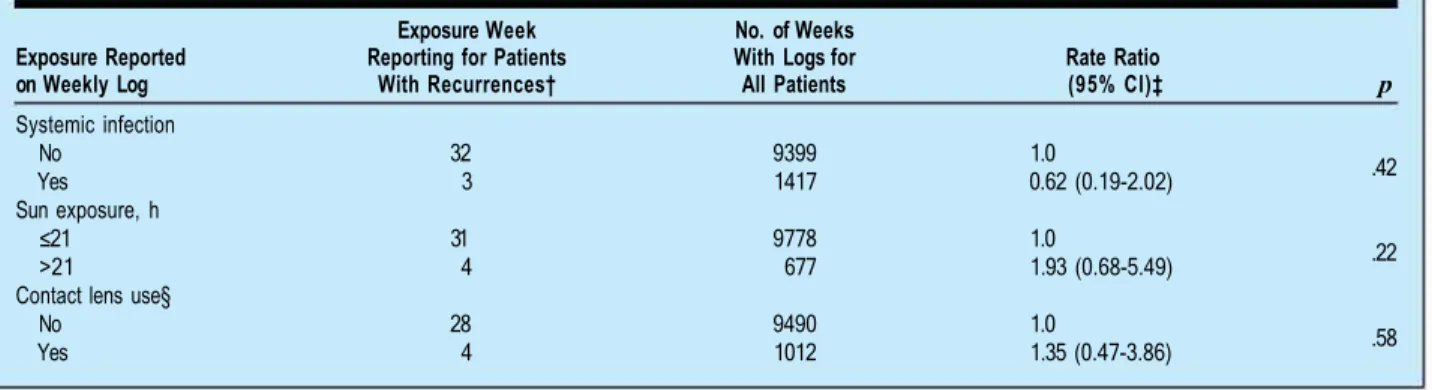
potential triggers were found to be associated with
recur-rences in either the discrete-time proportional hazards
analy-sis (Table S) or the case-crossover analyanaly-sis ( data not shown).
Among the 64 women younger than 50 years who
reported at least 1 menstrual period during the study, there
were only 7 valid recurrences. Although no association
was found between the onset of the menstrual period and
a recurrence, the study's power was too low for any
mean-ingful assessment. Similarly, eye injuries were reported
too infrequently (reported on only 0.8% of the logs) to
assess an association with recurrence.
COMPARISON OF STRESS AND SYSTEMIC
INFECTION REPORTING ON VALID AND
INV AUD EXPOSURE WEEK LOGS
For comparison purposes, we also examined the 26
recur-rences excluded because the exposure week log was
com-pleted after the onset of symptoms of a recurrence. The
base-line characteristics of the 26 participants with an invalid
re-currence were similar to those of the 33 participants with
a valid recurrence. Analyses revealed that both high
glob-al stress and systemic illness were reported more frequently
on exposure week logs completed late after the onset of
symp-toms of the HSY recurrence than on logs completed
prop-erly before the onset of symptoms. High stress was reported
on none of the 33 valid exposure week logs ( with
nonmiss-ing stress scores) and on 4 ( 16%) of the 25 invalid logs with
a stress score (P = .03, Fisher exact test). Systemic illness was
reported on 3 (9%) of the 35 valid logs and on 10 (38%) of
the 26 invalid logs (P= .01, Fisher exact test).
Table 3. Cohort Analysis of the Association of Psychological Stress and Ocular HSV Recurrence in the 308 Participants*
Rate Ratio (95% Cl)
Global Stress Score†
Exposure Week Reporting for
Patients No. of Weeks With Logs for All Patients
Weekly Global Stress Average Global Stress Change From
With Recurrences‡ Unadjusted§ Adjusted§II Unadjusted¶ Adjusted§#
1.0 1.0 1.0 1.0
Low Moderate High Overall**
P**
18 15 0
4405 4945
874 0.74 (0.37-1.48) 0 0.65 (0.31-1 .39) 0 0.83 (0.30-2.27) 0 0.77 (0.27-2.17) 0 0.58 (0.32-1.05)
.07 0.51 (0.26-1.01) .05 0.63 (0.25-1.57) .32 0.59 (0.23-1.54) .28
* HSV indicates herpes simplex virus; Cl, confidence interval; and ellipses, data not applicable.
†
Low indicates a stress rating of 1 to 2; moderate, 3 to 5; and high, 6 to 7.‡Distribution of global stress scores in exposure week for the 33 patients with a "valid" recurrence and a reported stress score (stress score missing for
2 patients).
§From a person-time formulation of a discrete-time proportional hazards model, with the global stress scores modeled as dummy variables. The adjusted model included age, sex, ethnicity (white and Asian vs African American and Hispanic), number of past ocular HSV episodes, negative affectivity (Taylor Manifest Anxiety Scale), social desirability (Marlowe-Crowne Social Desirability Scale), living situation (alone vs with others [missing recoded as with others]), acyclovir treatment group, self-reported illness, and study time.
I
ǁ One hundred sixty-six logs (including 2 recurrences) were not included in the analysis because of missing covariate data.
¶Eighty-four logs (including 4 recurrences) were not included in the analysis because of missing data on average global stress during follow-up.
# Two hundred fifty logs (including 6 recurrences) were not included in the analysis because of missing covariate data.
* * From a model with global stress score as a 3-level continuous variable.
Table 4. Case-Crossover Analysis of the Association of Psychological Stress and Ocular HSV Recurrence in 33 Participants*
Global Stress Score†
Low Moderate High Overall§
P§
Exposure Week Reporting for Patients
With Recurrences‡ 18 15 0
Risk Ratio (95%CI)
1.0 0.88 (0.32-2.46)
0 0.66 (0.27-1.62)
.36
* HSV indicates herpes simplex virus; Cl, confidence interval; and ellipses,
data not applicable.
†
Low indicates a stress rating of 1 to 2; moderate, 3 to 5; and high, 6 to 7.‡Distribution of global stress scores in exposure week for the 33 patients
with a recurrence and a reported stress score on a valid exposure week log (stress score missing for 2 patients).
§From a model including exposure week stress as a 3-level continuous variable.
for systemic infection, 5.08; 95% confidence interval,
1.94-13.30; P<.001; and rate ratio for high stress, 3.52; 95%
confidence interval, 0.69-17.92; P=.13).
When the 26 invalid recurrences were included in
an analysis with the 33 valid recurrences, the
unad-justed rate ratio for the 3-level global stress variable was
0.77 (95% confidence interval, 0.50-1.17; P=.22); for
sys-temic infection, it was 1.80 (95% confidence interval,
0.97-3.33; P=.06).
1n this prospective cohort study, we found no
associa-tion between high psychological stress or a change in
psy-chological stress and a recurrence of HSV infections in
the eye. We also found no clear association of a
recur-rence with systemic infection or with sunlight
expo-sure. However, we did find that considerable bias would
have been present in the estimate of the
exposure-disease association for systemic infection had we not
lim-ited our primary analysis to those recurrences in which
the time-order relationship between exposure reporting
and symptom onset was preserved.
We can state with reasonable certainty that high
stress is unlikely to be associated with the activation of
HSV eye disease. Even if an association exists but was
not identified in our study, the relationship is almost
cer-tainly weak. The upper limit of the 95% confidence
in-terval extends to 1.05, indicating that if our study is
un-biased, a true association is unlikely to have a rate ratio
of a clinically meaningful magnitude that is appreciably
greater than 1.0.
Among the participants who developed an ocular
HSV recurrence, none reported high stress on a valid
exposure week log, and recurrences occurred more
of-ten in those reporting low stress during the exposure
week (observed rate ratio, 0.58). Although this
sugges-tion of an associasugges-tion between low stress and an
in-creased incidence of recurrences is probably due to
chance, another possible explanation could be that
those reporting low stress levels were individuals who
deny feeling stressed in stressful circumstances, even
though physiologically they are having a strong stress
response.
37However, after categorizing the subjects
into repressors (low anxiety and high social
desirabil-ity), sensitizers (high anxiety), and those thought to be
"truly low anxious" (low anxiety and low social
desir-ability) using a method based on one previously
de-scribed,
38-40we found that the participants reporting
ex-Table 5. Cohort Analysis of the Association of Other Variables and Ocular HSV Recurrence in the 308 Participants*
Exposure Reported on Weekly Log
Exposure Week Reporting for Patients
With Recurrences†
Systemic infection
No 32
Yes 3
Sun exposure, h
≤21 31
>21 4
Contact lens use§
No 28
Yes 4
No. of Weeks With Logs for All Patients
9399 1417
9778 677
9490 1012
Rate Ratio (95% Cl)‡
1.0
0.62 (0.19-2.02)
1.0
1.93 (0.68-5.49)
1.0
1.35 (0.47-3.86)
p
.42
.22
.58
*
HSV indicates herpes simplex virus; Cl, confidence interval.†
Distribution of variables in exposure week for patients with a recurrence and a valid exposure week log.‡Unadjusted rate ratio from univariate discrete-time proportional hazards models. §Exposure week data missing for 3 participants.
posure measurement (which reduces exposure
misclas-sification among time-varying exposures), and physician
confirmation of recurrence (which reduces outcome
misclassification). However, even with the extensive
ef-forts we undertook to try to assure compliance with the
protocol, many logs were completed late. For most weeks,
completing the log a few days late did not pose a
prob-lem. However, for recurrences, even a few days delay in
completing the log from the week covering the exposure
period could mean that the exposure data were not
re-corded until after symptoms of the recurrence had
be-gun. Our results strongly indicate that both high stress and
systemic infection, particularly the latter, were
overported when logs were completed after symptoms of a
re-currence appeared. We found no evidence to indicate that
having a systemic illness or high stress level might have
been the reason a log was completed late; logs reporting
one of these occurrences during nonexposure weeks were
no more likely to be late than other logs (data not shown).
If we had not excluded recurrences in which this time
or-der was violated, we could have erroneously concluded
that systemic infection was associated with a recurrence.
Exclusion of these recurrences, which was necessary to
minimize bias, had the unwanted but unavoidable effect
of reducing the power of the study.
Our finding that psychological stress did not
in-crease the risk of a recurrence was consistent in all
mod-els that were assessed with both the discrete-time
propor-tional hazards model and case-crossover methods and when
alternate measures of stress were evaluated, including the
maximum stress reported on the Life Arenas Stress
Mea-sure on a weekly log, reporting of chronic stress on a weekly
log, and a participant's average global stress across all logs.
There was no evidence of confounding being present.
De-spite this consistency, consideration must be given to
whether the measure of stress we used was reliable and
valid for our purposes and to whether the exposure
pe-riod we assessed was appropriate.
Although the global stress score we used has not been
formally validated, other similar scales have been
vali-dated. Using similar single-item global measures of
psy-chological stress, Watson
41provided estimates of
reli-ability (Pearson
r
= 0. 71) and construct validity by
correlation with a measure of negative emotion
(Pear-son r=0.44), and Cohen and William(Pear-son
42reported a
cor-relation of 0.39 with the Perceived Stress Scale among
disease-free adult subjects.
Even with the intensive weekly data collection that
resulted in the submission of 12236 logs by the 308
par-ticipants, the data collection may have been too
infre-quent for optimal assessment of the stress-disease
rela-tionship. Little is known about the timing of this
relationship. We a priori selected the exposure week for
the stress assessment such that it fully preceded the onset
of symptoms of a recurrence of HSY eye disease.
Depend-ing on the day of the week that the symptoms started, the
7 -day period for exposure could have been as long as 7 to
13 days before symptom onset or as short as 1 to 7 days
before symptom onset. Thus, the measured exposure
pe-riod may not have included the
critical exposure period
(the
period before the induction period during which stress
could have a causal effect on recurrence). It is also
pos-sible that the critical exposure period is less than 7 days
and, thus, the measured exposure period included
back-ground information irrelevant to the stress-disease
rela-tionship. We evaluated exposure periods 2 and 3 weeks
before symptom onset and again found no association
be-tween high stress and a recurrence (data not shown).
An additional potential source of error is lack of
pre-cision in determining the symptom-onset date. We used
the weekly logs and the examination records to increase
the accuracy of this determination. However, in some
cases, the symptom-onset date was not available and
needed to be imputed based on the date of examination
documentation of the recurrence. In these cases and
po-tentially others, it is possible that inaccuracies in the
symp-tom-onset date could result in selection of the wrong
ex-posure week log for analysis. This would tend to bias away
from detecting true exposure-disease associations.
To our knowledge, there is no prior study of the
as-sociation of stress and ocular HSY recurrences for
com-parison with our results. Several studies have assessed the
association between stress and nonocular HSY
recur-rences. No consistent finding has been reported.
Prospec-tive studies by Kemeny et al,
43Hoon et al,
18and Rand et
He,petic Eye Disease Stutfy Group
The members of the investigator group who signed authorship responsibility, financial disclosure, and copyright transfer statements for the group are as follows: Frances Cohen, PhD; Stephen R. Cole, PhD; Roy W. Beck, MD, PhD; R. Clifford Blair, PhD; Pamela S. Moke, MSPH; Kevin E. Kip, PhD; Kirk R. Wilhelmus, MD, MPH; Chandler R. Dawson, MD; Bruce A Barron, MD; Dan B.Jones, MD; Herbert E. Kaufman, MD; R. Doyle Stulting, MD, PhD;Joel Sugar, MD; Elisabeth]. Cohen, MD; Robert A. Hyndiuk, MD; Penny A. Asbell, MD; Natalie Kurinij, PhD.
The following individuals participated in the conduct of the trial.
Regional Centers and Clinical Sites
LSU Eye Center, Louisiana State University Medical Center, New Orleans: B. A. Barron (regional principal investigator); K. Edwards; S.J. Massare; M. S. McGovern; D. Williams (regional coordinators); D. M. Dragon; E. E. Graul,Jr; M. S. Insler; H. E. Kaufman; A. D. Lacoste; C. S. McCaa; N. J. Wagner; J. A. Yokubaitis (site investigators). Cullen Eye Institute, Baylor Col-lege of Medicine, Houston, Tex: K. R. Wilhelmus (regional principal investigator); L.A. Todaro; S. J. Woodside (regional co-ordinators); C. B. Bowman;]. Chodosh;J. D. Goosey; D. B. Jones; C. Kirkland,Jr; R. P. Lehmann; A. Y. Matoba; S. L. Smith; T. C. Wolf; R. W. Yee (site investigators). Francis I. Proctor Foundation, University of California, San Francisco: F. Cohen (protocol chair); C.R. Dawson (regional principal investigator); S. Banuvar; S. Y. Osaki (regional coordinators); G. P. Barth; R. Biswell; E. Cunningham; D.R. DeMartini; D. Gritz; W. Hodge; D.S. Holsclaw; D. G. Hwang; C. M. Knox; T. Lietman; T. P. Margolis; I. R. Schwab; L. Schwartz; M. Sherman; B. Silverstein; D. W. Vastine; M. Volpicelli;]. P. Whitcher; S. Wilson; I. Wong (site investigators). Emory Eye Center, Emory University, Atlanta, Ga: R. D. Stulting (regional principal investigator); L. G. DuBois (regional coordinator); R. Baldassare; H. Chopra; S. D. Croll; R. C. Dilorio;J. R. Gussler; S. M. Hamilton; G. R. John;]. W. McCann;J. C. Meyer; P. G. Mitchell; D. A. Palay; R.J. Ramirez; R. E. Reed; R. N. Serros; L. R. Taub; K. P. Thomp-son; K. A. Walter (site investigators). VIC Eye Center, University of Illinois at Chicago: J. Sugar (regional principal investiga-tor); R. Rodick (regional coordinainvestiga-tor); R. Dennis; R. S. Feder; M.J. Hennessey; D. M. Lubeck; S. D. McLeod; D. Meisler; D. D. Morimoto; P. K. Morimoto;]. B. Rubenstein; H. H. Tessler (site investigators). The Eye Institute, Medical College of Wis-consin, Milwaukee: R. A. Hyndiuk (regional principal investigator); C. Samson (regional coordinator); N. P. Barney; F. S. Brightbill;]. D. Decarlo; E. S. Fogel; S. P. Gainey; S. B. Koenig; D. J. Kontra; D. B. Krebs; D.R. Lewellen; S. M. Patalano; P. R. Rice; M. C. Sanderson; K. P. Wienkers; M. M. Yeomans (site investigators). Wills Eye Hospital, Philadelphia, Pa: E. J. Co-hen (regional principal investigator); S. C. Marshall; I. M. Rodriguez; P. Phipps (regional coordinators); R. J. Bailey; K. L. Fung; S. B. Hannush; H. I. Ingraham;].]. Kesselring; V. 0 . Kowal; P.R. Laibson; N. F. Martin; S. 0 . Orlin; C.R. Rapuano; R. S. Rubinfeld; M. Sulewski (site investigators). The Mount Sinai Medical Center, New York, NY: P.A. Asbell (regional principal investigator); N.Justin; M. Arroyo; S. Epstein (regional coordinators); B. A. Barker; E. R. Brocks; G. D'Aversa; M.J. Dunn; B. D. Gorman; M. R. Leopold; W. J. Schwartz; I. J. Udell (site investigators).
Central Units
Jaeb Center for Health Research, Inc, Tampa, Fla (National Coordinating Center 1994-1998): R. W. Beck (director); P. S. Moke; R. C. Blair; S. R. Cole; K. Kip; H. A. Gillespie; L. A. Lester; M. L. Mhamdi; R. L. Gal; E. S. Tan. University of California, San Francisco (National Coordinating Center 1992-1994): W.W. Hauck (director); L. Gee. National Eye Institute, National Insti-tutes of Health, Bethesda, Md: N. Kurinij.
Data and Safety Monitoring Committee
Voting Members: S. I. Bangdiwala (chairman); W. E. Barlow;]. W. Chandler (1992-1994); M.A. Lemp (1994-1996); A. B. Nesburn (1992-1995); D. L. Patrick (1994-1998);]. E. Sutphin,Jr (1995-1998); S. B. Watson (1992-1993). (Ifno dates are listed, then the individual was a member of the committee for the entire study.)
and recurrence of genital herpes via monthly, weekly, and
daily exposure assessment, respectively. Cohen et al,
19us-ing weekly stress assessment in a prospective study, found
that persistent but not acute stress was associated with
in-creased genital herpes recurrence. Goldmeier et al
12ex-amined the time to first recurrence in patients in whom
genital herpes was newly dia
g nosed and found that the
Gen-eral Health Questionnaire (a measure of psychiatric
symp-toms) was associated with an increased recurrence rate (rate
ratio [10-U increase in the General Health Questionnaire
score], 1.27; P<.02), but found no evidence of an
asso-ciation with a measure of stressful life events. Schmidt et
al
16found an increase in stressful life events and hassles
during the week before an oral herpes recurrence
com-pared with a dormant week; however, stress was assessed
after symptoms began (ie, within 3 days of the onset of
the vesicular eruption). Padgett and colleagues,
45in a study
of recurrence ofHSV-1-associated keratitis in mice, found
that only 1 type of stress paradigm (social stress, not
re-straint stress) led to recrudescence in these animals.
How-ever, the biological mechanisms underlying reactivation
and recrudescence could not be determined and are thought
to be complex.
43Our assessments of eye injury, contact lens wear, and
the onset of a menstrual cycle were of insufficient power
for any meaningful conclusions. For systemic infection and
sunlight exposure, interpretation of the study results is
lim-ited by imprecise measurement of the exposure.
Early experimental results of induced fever suggest
a 24-hour induction period before the onset of orofacial
herpes symptoms.
5In view of the potential that this
criti-cal exposure period was obscured or missed in our
mea-sured exposure period, we may have missed a true
asso-ciation between a systemic infection and the development
of an ocular HSV recurrence.
herpes has shown an average induction period of 4 days.
Although our data suggest the possibility of an
associa-tion of extensive sunlight exposure and HSV eye disease,
in retrospect, our measure of sunlight exposure was
in-adequate. Assuming a 4-day or shorter induction period
for our participants whose symptoms began on Friday and
continued through Sunday (assuming log completion on
the previous Sunday), the critical exposure period would
not have been included in the weekly log designated as
the measured exposure period. Furthermore, our study
as-sessed weekly sun exposure rather than intense episodes
of sunlight exposure and, therefore, our measure was
in-sensitive to single intense exposures of short duration that
could be sufficient to trigger a recurrence.
High psychological stress does not appear to be a trigger
of recurrences of HSV eye disease. Although our results
suggest either that low stress may be associated with an
increased risk of a recurrence or that high stress may be
associated with a decreased risk, this finding is not
sup-ported by previous studies of oral and genital herpes
re-currences. Without a credible mechanism for this and
rep-lication in other studies, this association should not be
accepted as plausible. Our finding of a strong potential
bias toward overreporting of systemic infection and high
stress when there was violation of the time-order
require-ments (for exposure reporting before symptom onset)
makes suspect the results of HSV risk factor studies in
which this time-order is not clearly established. If not
ac-counted for, recall bias can substantially overestimate the
importance of factors that do not have a causal
associa-tion with HSV infecassocia-tion.
Accepted for publication February 12, 2000.
This study was supported by cooperative agreements
EY09686, EY09687, EY09691, EY09692, EY09693, EY09694,
EY09695, EY09696, and EY09697 with the National Eye
In-stitute, National Institutes of Health, Bethesda, Md.
We thank Glaxo Wellcome Inc, Research Triangle Park,
NC,
for supplying the study medications.
Reprints: Roy
W.
Beck,
MD,
PhD, Jaeb Center for
Health Research, Inc, 3010
E
138th Ave, Suite
9,
Tampa,
FL
33613 (e-mail: [email protected]).
1. Liesgang TJ, Melton LJ 111, Daly PJ, llstrup DM. Epidemiology of ocular herpes simplex: incidence in Rochester, Minn, 1950 through 1982. Arch Ophthalmol.
1989;107:1155-1159.
2. Liesgang TJ. Epidemiology of ocular herpes simplex: natural history in Roches-ter, Minn, 1950 through 1982. Arch Ophthalmol. 1989;107:1160-1165. 3. Bell DM, Holman RC, Pavan-Langston D. Herpes simplex keratitis:
epidemio-logic aspects. Ann Ophthalmol. 1982;14:421-424.
4. Friedman E, Katcher AH, Brightman VJ. Incidence of recurrent herpes labialis and upper respiratory infection: a prospective study of the influence of biologic, social, and psychologic predictors. Oral Surg Oral Med Oral Pathol. 1977;43:873-878. 5. Warren SL, Carpenter CM, Boak RA. Symptomatic herpes: a sequela of
artifi-cially induced fever. J Exp Med. 1940;71 :155-167.
6. Keddie F, Rees RJ, Epstein N. Herpes simplex following artificial fever therapy.
JAMA. 1941;117:1327-1330.
7. Spruance SL, Kriesel JD, Evans TG, McKeough MB. Susceptibility to herpes la-bialis following multiple experimental exposures to ultraviolet radiation. Antivi-ral Res. 1995;28:57-67.
8. Perna J, Mannix M, Rooney J, Notkins A, Straus S. Reactivation of latent herpes
simplex virus infection by ultraviolet light: a human model. JAcad Dermatol. 1987; 17:473-478.
9. WishartM, Darouger S, Viswalingam ND. Recurrent herpes simplex virus ocular in-fection: epidemiological and clinical features. Br J Ophthalmol. 1987;71 :669-672. 10. Uchio E, Hatano H, Ohno S. Altering clinical features of recurrent herpes
sim-plex virus-induced keratitis. Ann Ophthalmol. 1993;25:271-276.
11. Gamus D, Romano A, Sucher E, Ashkenazi IE. Herpetic eye attacks variability of circannual rhythms. Br J Ophthalmol. 1995;79:50-53.
12. Goldmeier D, Johnson A, Jeffries D, et al. Psychological aspects of recurrences of genital herpes. J Psychosom Res. 1986;30:601-608.
13. Stout CW, Bloom LJ. Genital herpes and personality. J Hum Stress. 1986;12: 119-124.
14. Longo DJ, Clum GA. Psychosocial factors affecting genital herpes recurrences: linear vs mediating models. J Psychosom Res. 1989;33:161-166.
15. Dalkvist J, Wahlin TR, Bartch E, Forsbeck M. Herpes simplex and mood: a pro-spective study. Psychosom Med. 1995;57:127-137.
16. Schmidt DD, Zyzanski S, Ellner J, Kumar ML, Arno J. Stress as a precipitating factor in subjects with recurrent herpes labialis. J Fam Pract. 1985;20:359-366. 17. Longo D, Koehn K. Psychosocial factors and recurrent genital herpes: a review of prediction and psychiatric treatment studies. Int J Psychiatry Med. 1993;23:99-117. 18. Hoon EF, Hoon PW, Rand KH, Johnson J, Hall NR, Edwards NB. A
psycho-behavioral model of genital herpes recurrence. J Psychosom Res. 1991 ;35:25-36. 19. Cohen F, Kemeny ME, Kearney KA, Zegans LS, Neuhaus JM, Conant MA. Per-sistent stress as a predictor of genital herpes recurrence. Arch Intern Med. 1999; 159:2430-2436.
20. Gundersen T. Herpes corneae. Arch Ophtha/mol. 1936;15:225-249. 21. Guinan ME, MacCalman J, Kern ER, Overall JC Jr, Spruance SL. The course of
untreated recurrent genital herpes simplex infection in 27 women. N Engl J Med.
1981 ;304:759-763.
22. Herpetic Eye Disease Study Group. Acyclovir for the prevention of recurrent her-pes simplex virus eye disease. N Engl J Med. 1998;339:300-306.
23. Watson D, Clark LA. Negative affectivity: the disposition to experience aversive emotional states. Psycho/ Bull. 1984;96:465-490.
24. Bendig AW. The development of a short form of the Manifest Anxiety Scale.
J Consult Psycho/. 1956;20:384.
25. Crowne DP, Marlowe D. A new scale of social desirability independent of psy-chopathology. J Consult Clin Psycho/. 1960;24:349-354.
26. Paulhus D. Self-deception and impression management in test responses. In: Angleitner A, Wiggins JS, eds. Personality Assessment via Questionnaires. Ber-lin, Germany: Springer-Verlag; 1986:143-165.
27. Strahan R, Gerbasi KC. Short, homogeneous versions of the Marlowe-Crowne Social Desirability Scale. J Clin Psycho/. 1972;28:191-193.
28. Cox D, Oakes D. Analysis of Survival Data. London, England: Chapman & Hall; 1984. 29. D'Agostino RB, Lee ML, Belanger AJ, Cupples LA, Anderson K, Kannel WB. Re-lation of pooled logistic regression to time dependent Cox regression analysis: the Framingham Heart Study. Stat Med. 1990;9:1501-1515.
30. Mickey RM, Greenland S. The impact of confounder selection criteria on effect estimation. Am J Epidemiol. 1989;129:125-137.
31. Little RJA, Rubin DB. Statistical Analysis With Missing Data. New York, NY: John Wiley & Sons Inc; 1987.
32. Greenland S, Finkle WD. A critical look at methods for handling missing covariates in epidemiologic regression analyses. Am J Epidemiol. 1995;142:1255-1264. 33. Maclure M. The case-crossover design: a method for studying transient effects
on the risk of acute events. Am J Epidemiol. 1991 ;133:144-153.
34. SAS Institute Inc. SAS/STAT Software: Changes and Enhancements, Through Release 6.11. Cary, NC: SAS Institute Inc; 1996.
35. Taylor JA. A personality scale of manifest anxiety. J Abnorm Soc Psycho/. 1953; 48:285-290.
36. Ballard R. Short forms of the Marlowe-Crowne Social Desirability Scale. Psy-cho/ Rep. 1992;71:1155-1160.
37. Weinberger DA. The construct validity of the repressive coping style. In: Singer JL, ed. Repression and Dissociation: Implications for Personality Theory, Psychopa-thology, and Health. Chicago, Ill: University of Chicago Press; 1990:337-386. 38. Weinberger DA, Schwartz GE, Davison RJ. Low-anxious, high-anxious, and
re-pressive coping styles: psychometric patterns and behavioral and physiological responses to stress. J Abnorm Psycho/. 1979;88:369-380.
39. Shaw RE, Cohen F, Doyle B, et al. The impact of denial and repressive style on information gain and rehabilitation outcomes in myocardial infarction patients.
Psychosom Med. 1985;47:262-273.
40. Shaw RE, Cohen F, Fishman-Rosen J, et al. Psychologic predictors of psycho-social and medical outcomes in patients undergoing coronary angioplasty. Psy-chosom Med. 1986;48:582-597.
41. Watson D. lntraindividual and interindividual analyses of positive and negative affect: their relation to health complaints, perceived stress, and daily activities.
J Pers Soc Psycho/. 1988;54:1020-1030.
42. Cohen S, Williamson GM. Perceived stress in a probability sample of the US. In: Spacapan S, Oskamp S, eds. The Social Psychology of Health. Newbury Park, Calif: Sage Publications; 1988:31-67.
43. Kemeny ME, Cohen F, Zegans LS, Conant MA. Psychological and immunologi-cal predictors of genital herpes recurrence. Psychosom Med. 1989;51 :195-208. 44. Rand KH, Hoon EF, Massey JK, Johnson JH. Daily stress and recurrence of
geni-tal herpes simplex. Arch Intern Med. 1990;150:1889-1893.