Parking Lot Mathematics
Jayson Rigsby
Pike High School
IntroductionEach year, mathematics teachers across the nation plan their lessons for the school year. As teachers progress in their careers, they become more aware of students’ needs and how to address these needs. As a mathematics teacher, I believe that the sharing of teaching ideas is an essential part of the profession. It is imperative to evaluate the impact of what we teach and investigate how to better engage students in doing mathematics. Through the sharing of activities and methodologies, we become more effective teachers — which ultimately affects student learning.
At Pike High School, I am part of a staff that shares teaching materials. Furthermore, my involvement with the Indiana University Mathematics Initiative (IMI) has allowed me to
collaborate with others in the Indiana teaching community. Through regular conferences and workshops, IMI has helped me to grow as a professional and given me the opportunity to
improve my teaching of mathematics. In this article I share one outcome of my involvement with IMI — an activity focusing on real-world mathematics in a parking lot.
IMI and Modeling
Through its regular conference and workshop offerings, IMI promotes collaboration among mathematics teachers in the nine IMI districts. A variety of topics has served as the focus of these professional meetings, including mathematical modeling, the use of technology in the classroom, resources to promote mathematical thinking and connections (e.g., the use of the Numbers television show), alternative algorithms, and issues related to the Indiana Academic Standards. At many of these conferences, experienced teachers present activities that enhance students’ understanding, such as games, puzzles, and review activities. In addition to serving as resources for my classroom, these activities encourage and challenge me to improve my lessons and develop creative ways to better educate my students.
For several summers, IMI conducted workshops on the use of modeling in the mathematics classroom. Real-world applications of the mathematical concepts that we teach allow students to connect the content of the classroom with the world in which they live. These concrete examples allow students to expand their conceptions of mathematics, so that it becomes more than a disconnected collection of concepts and procedures. In these modeling workshops, IMI staff illustrated that mathematics is truly present in the world around us — if only we take the time to look. It is this reasoning that led to my interest in parking lot mathematics.
Specifically, the lines in a parking lot provide an ideal application of parallel lines and transversals.
Parking Lot Activities
The activities in this section help students to understand the significance and detail needed to paint lines in a parking lot. To complete these activities, students need access to a parking lot with a common line intersecting several parking spaces. They will also need a protractor large enough to measure the angles created by the intersecting lines. It is preferable, but not essential, to find a parking lot where the lines do not all meet at right angles.
This activity is geared to students who are in geometry (usually in 10th or 11th grade) and ready to learn about parallel lines, transversals, and the related angles. Some prior
knowledge of basic geometry is required to perform this activity, including (but not limited to) the concepts of intersecting lines, congruent angles, angle measures, naming angles, and the use of protractors. Students should also know the different types of angles that are created by any transversal, including corresponding angles, alternate interior angles, alternate exterior angles, and consecutive interior angles (also called same side interior angles).
This activity focuses on properties surrounding Indiana Mathematics Standard G.1.3: Understand and use the relationships between special pairs of angles formed by parallel lines and transversals. It is a project that I typically use to supplement the chapter discussing transversals. Although I’ve used the activity to illustrate the relationships of the angles
surrounding parallel lines cut by a transversal, it can lead to a variety of other investigations. In the remainder of this section, I describe the activity and its many uses in the classroom.
Step 1. When are we ever going to use this?
As many teachers know, questions about the usefulness of mathematics make frequent
appearances in the classroom. In part, I believe these questions arise because of students’ natural curiosity. Mathematics is typically presented without reference to any context (e.g., solving quadratic equations); students are simply curious about the relevance of mathematics to their lives outside the classroom. For some concepts, it is difficult to identify real-world uses. The parking lot activity, however, illustrates that transversals and angles are encountered every day by millions of drivers.
Step 2. The setting
The lines of a parking lot are a perfect application of all theorems and properties that begin with the phrase “When parallel lines are cut by a transversal.” In part, this is due to the desired
outcome. When construction workers paint lines for a parking lot, they seek to paint lines that are parallel to each other. In fact, one can probably imagine the amount of chaos that would exist if the lines in a parking lot were not parallel! The lines in a parking lot, therefore, provide an ideal illustration of the relationships between angles created by parallel lines and a transversal. Step 3. Uncovering the mathematics
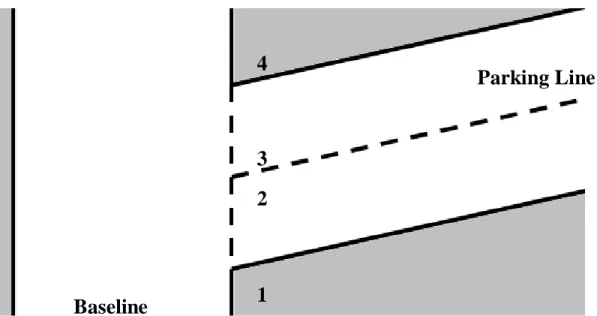
Figure 1. Angles surrounding a single parking line.
Like many real-world activities, even this simple act of measuring the angles surrounding parking lot lines is ripe with mathematics. The dashed line down the middle of the parking line in Figure 1 should represent the general trend of the parking line. The construction of this line, however, is essentially a real-world construction problem. If the dashed line is to be parallel to the outer boundaries of the parking line, what must be true about angles 1 and 3, or 2 and 4? Answers to these questions lead naturally to the classic geometric truth: If lines are cut by a transversal so that corresponding angles are congruent, then the lines are parallel. In Figure 1, students can construct a dashed line that is parallel to the boundaries of the parking line by ensuring that angles 1 and 3 (or 2 and 4) are congruent. This activity also illustrates that the “reference” line for each painted parking line is parallel to the boundaries of the parking line. To measure the angles created by the parking line and baseline, therefore, one only needs to measure the angles created by the boundaries.
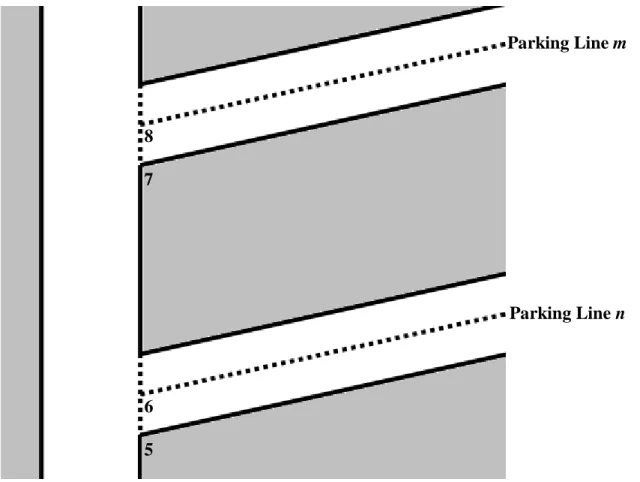
Once students complete the measurement activity suggested by Figure 1, they are prepared to investigate the relationship between many parking lines. In theory, the parking lines are mutually parallel. Are they parallel? Students are now prepared to check the accuracy of the painters’ work. As Figure 2 illustrates, parking lines m and n are parallel if their dashed reference lines are parallel. From their initial investigation, however, students understand that the angles created by the reference lines and the baseline are congruent to the angles created by the boundary lines and the baseline (i.e., angles 5 and 6 are congruent, as are angles 7 and 8). To ensure that lines m and n are parallel, therefore, students simply need to measure angles 5 and 7. If these angles are congruent, then the parking lines are parallel.
1
2
3
4
Baseline
Parking Line
Figure 2. Angles surrounding multiple parking lines.
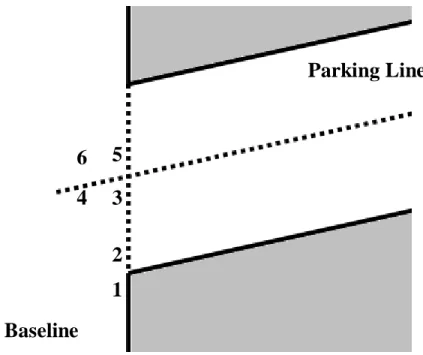
Having focused on corresponding angles, students can now consider other angles and relationships. As Figure 3 illustrates, the parallel nature of the boundary lines and the dashed reference lines guarantees that alternate interior angles are congruent (angles 2 and 4), alternate exterior angles are congruent (angles 1 and 6), and consecutive interior angles are supplementary (angles 2 and 3). In the parking lot, students can either verify the truth of these theorems or discover the theorems through hands-on measurement. Thereafter, students can return to the classroom to establish why these theorems are true.
Parking Line m Parking Line n 5 6 7 8
Figure 3. Explorations of other angles surrounding a transversal.
In addition to these measurement activities, the parking lot offers an ideal context for real-world modeling. For example, students can consider the process of painting the lines on a parking lot. In doing so, they can consider the proper distance between parking lines. What information would establish the proper distance? Remind students that they cannot neglect the mirrors! Another modeling application focuses on the area required for a parking lot — which itself depends on the layout of the lines and the space required to pull into (or back out of) a parking space. These are fascinating activities that illustrate real-world uses of geometry.
Conclusions
Passion, enthusiasm, and excitement are three words that describe the ideal teacher. In the real world of teaching, however, it’s tempting to simply “cover the material.” In other words, teachers often strive for less than the ideal to reach the next content mile marker. Both the
students and I have gotten great joy out of these parking lot activities. If only for a few moments, mathematics in the real-world (as the modeling component of IMI advocates) allows teachers to take our eyes off the mile markers and enjoy the mathematical scenery. More importantly, these activities engage my students and truly encourage them to connect the mathematics of the classroom with life in the real world.
Contact info: Jayson Rigsby Pike High School 5401 W 71st St Indianapolis, IN 46268 (317) 387-2600 [email protected]