Available Online at www.ijecse.org ISSN- 2277-1956
Comparison of most adaptive meta model
With newly created Quality Meta-Model using CART
Algorithm
Jasbir Malik 1, Raj Kumar 2
1 2Departmentof CSE,JIET,Jind(Haryana),India 1
M Tech scholar 2Assistant Professor 1[email protected]
Abstract- To ensure that the software developed is of high quality, it is now widely accepted that various artifacts generated during the development process should be rigorously evaluated using domain-specific quality model. However, a domain-specific quality model should be derived from a generic quality model which is time-proven, well-validated and widely-accepted. This thesis lays down a clear definition of quality meta-model and then identifies various quality meta-models existing in the research and practice-domains. This thesis then compares the various existing quality meta-models to identify which model is the most adaptable to various domains. A set of criteria is used to compare the various quality meta-models. In this we specify the categories, as the CART Algorithms is completely a tree architecture which works on either true or false meta model decision making power .So in the process it has been compared that , if the following items has been found in one category then it falls under true section else under false section .
Keywords –CART, MDSD, MDE. DSl,QMM4M,GQM
1INTRODUCTION
Model-Driven Software Development (MDSD) or Model-Driven Engineering (MDE) is an approach to software
development that emphasizes using models when specifying, developing, analyzing, verifying and managing software systems1. MDE promises to provide better communication between stakeholders, increase portability of solutions to different platforms, provide traceability between artifacts, reduce error-prone and costly manual work and improve software quality. These promises cover several of the quality goals identified in various quality models and researchers have also started work on specific quality issues in MDE such as identifying characteristics of models that are required to achieve software quality.
The work described in this paper also aims at identifying quality attributes and approaches to improve the quality of software artifacts in MDE. These are affected by the quality of modeling languages (including
Domain-Specific Languages or DSLs), models, transformations performed on models, tools, modeling processes, quality
assurance activities, and the knowledge of model developers on the domain, tools and languages they are using. Therefore we define these as targets in our quality model that are subject of improvement. Earlier work on software quality covers several quality models that include various quality attributes and different classifications of them. A detailed comparison of existing quality models is out of the scope of this paper, but we describe those quality models that our work is based on or related to. Furthermore, we apply the practice of meta-modeling to identify and define the elements that are required to develop a quality model for MDE. A meta-model allows us to share a common language when discussing quality and adopt general models to special needs or domains. We also provide an example of applying the approach and of an early implementation of tool support.
IJECSE,Volume1,Number 4
Rahul Malik and Raj Kumar
2493
a generic quality model for any software product (or artifact), it requires some customization for the particular case of meta-models.
The customized model, denominated QM4MM, is presented below. As ISO/IEC 1926, QM4MM defines a set of characteristics and sub-characteristics, together with the relationships between them. They provide the basis for specifying quality attributes and some measures for evaluating them. Attributes are evaluated using measures. A measure relates a defined measurement approach and a measurement scale. A measurement approach is the logical sequence of operations, described generically, used in quantifying an attribute with respect to a specified scale [13]. A measure is expressed in units, and can be defined for more than one attribute. The international standard ISO/IEC 9126 provides a quality model for software products, inheriting from the quality factors of McCall et al.[14] and the model of Boehm et al. [10] and following the well-known Goal-Question-Metric (GQM) paradigm [6].
This quality model proposes decompose the quality of a software product in six characteristics and we can adapt it mapping the product to the meta-model:
1. Functionality, the services offered by the product.
2. Reliability, the confidence in a continuous and precise operation of the product. 3. Usability, if users found the product easy and efficient.
4. Efficiency, evaluation (according to some defined criteria) whether the software performs appropriate use of resources.
5. Maintainability, if it is easy to update and modify the product. 6. Portability, if the product can be used (or not) in others environments.
The QM4MM quality model can classify most proposed attributes without much difficulty and it can be adapted to meta-models from the original software product environment. The main adaptation is to remove some sub characteristics irrelevant to in the field of meta-modeling. Then, we need to assign each attribute to the appropriate sub characteristic. In general, the attributes have been gathered from various authors and we have used the original name and definition used by the authors, when it has been possible. In this process, some problems have emerged, notably the use of different names for the same concept (synonymy) or, contrarily, using the same name to represent different concepts (homonymy).
2.1HIERARCHICAL MODEL
Several quality models have been defined by different people and organizations. In the following, we summarize briefly some of the most standard and well-known quality models.
There are different types of quality models as given below:
2.1.1 McCall's Model (1976)
McCall's model for software quality, see Figure 2.1 combines eleven criteria around product operations, product revisions, and product transitions. The main idea behind McCall's model is to assess the relationships among external quality factors and product quality criteria. McCall's Model is used in the United States for very large projects in the military, space, and public domain. It was developed in 1976-7 by the US Air- force Electronic System Decision (ESD), the Rome Air Development Center(RADC), and General Electric (GE), with the aim of improving the quality of software products" [5].One of the major contributions of the McCall model is the relationship created between quality characteristics and metrics, although there has been criticism that not all metrics are objective. One aspect not considered directly by this model was the functionality of the software product" [7]. The layers of quality model in McCall are defined as [11]:
1 Factor. 2 Criteria.
Figure 2.1: McCall's model [50] 2.1.2 Boehm's Model (1978)
Boehm added some characteristics to McCall's model with emphasis on the maintainability of software product. Also, this model includes considerations involved in the evaluation of a software product with respect to the utility of the program, see Figure 2.2. The Boehm model is similar to the McCall model in that it represents a hierarchical structure of characteristics, each of which contributes to total quality. Boehm's notion includes user’s needs, as McCall's does; however, it also adds the hardware yield characteristics not encountered in the McCall model" [7]. However, Boehm's model contains only a diagram without any suggestion about measuring the quality characteristics.
The layers of quality model in Boehm are defined as [11]: 1. High-level characteristics.
2. Primitive characteristics. 3. Metrics.
IJECSE,Volume1,Number 4
Rahul Malik and Raj Kumar
2495
Figure 2.2: Boehm's Model [9] 2.1.3 FURPS Model (1987)
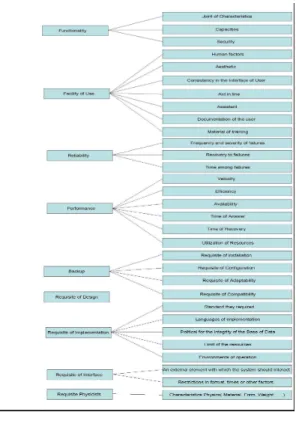
The FURPS model proposed by Robert Grady and Hewlett-Packard Co.de-composes characteristics in two different categories of requirements:
1. Functional requirements (F): Defined by input and expected output.
2. Non-functional requirements (URPS): Usability, reliability, performance, supportability.
Figure 2.3 is an example of the FURPS model. One disadvantage of the FURPS model is that it fails to take account of the software product's portability".
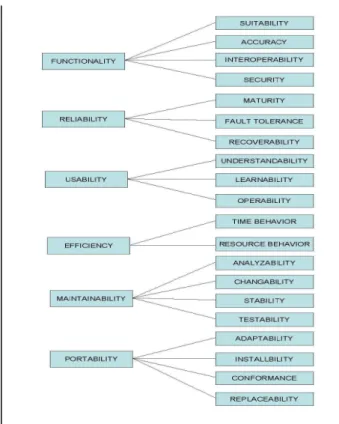
Figure 2.3: FURPS Model 2.1.4 ISO/IEC 9126 (1991)
With the need for the software industry to standardize the evaluation of soft-ware products using quality models, the ISO (International Organization for Standardization) proposed a standard which specifies six areas of importance for software evaluation and, for each area, specifications that attempt to make the six area measurable, see Figure 2.4.
IJECSE,Volume1,Number 4
Rahul Malik and Raj Kumar
2497
Figure 2.4: Software Quality ISO/IEC's Model
One of the advantages of the ISO 9126 model is that it identifies the internal characteristics and external quality characteristics of a software product. However, at the same time it has the disadvantage of not showing very clearly how these aspects can be measured".
The layers of quality model in ISO/IEC are defined as [11]: 1. Characteristics.
2. Sub-characteristics. 3. Metrics.
2.1.5 Dromey's Model (1996)
The main idea to create this new model was to obtain a model broad enough to work for different systems, see Figure 2.5. He [Dromey] recognizes that evaluation differs for each product and you need a more dynamic idea for modeling the process" [2].
Dromey identified five steps to build his model:
1. Choose a set of high-level attributes that you need to use for your evaluation. 2. Make a list of all the components or modules in the system.
Dromey’s model seeks to increase understanding of the relationship between the attributes characteristics) and the sub-attributes (sub-characteristics) of quality. It also attempts to pinpoint the properties of the software product that affect the attributes of quality" [7].
The layers of quality model in Dormey are defined as [11]: 1. High-level attributes.
2. Subordinate attributes.
Figure 2.5: Dromey's Model
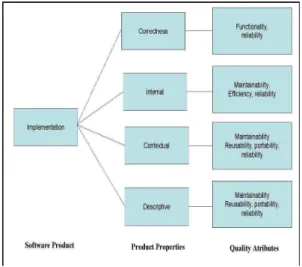
Figure 2.6 is an example of a Dromey's model:
1. Evaluation of two components (variable and expression).
2. Definition of quality-carrying properties for variable and expression. 3. Definition of the product properties.
4. Obtention of the quality attributes for each product properties from Dromey's model.
2.2 NON HIERARCHICAL MODEL 2.2.1 Bayesian Belief Networks
A BBN1 is a graphical network whose nodes are probabilistic variables and whose edges are the causal or influential links among the variables. Associated with each node is a set of conditional probability functions that model the uncertain relationship among a node and its parents.
Using the BBN have some benefits:
1. BBN enable reasoning under uncertainty and combine the advantages of an intuitive visual representation with a sound mathematical basis in Bayesian probability.
2. With BBN, it is possible to articulate expert beliefs about the dependencies between different variables and to propagate consistently the impact of evidence on the probabilities of uncertain outcomes, such as future system reliability.
3. BBN allow an injection of scientific rigour when the probability distributions associated with individual nodes are simply expert opinions".
4. A BBN will derive all the implications of the beliefs that are input to it; some of these will be facts that can be checked against the project observations, or simply against the experience of the decision makers themselves.
IJECSE,Volume1,Number 4
Rahul Malik and Raj Kumar
2499
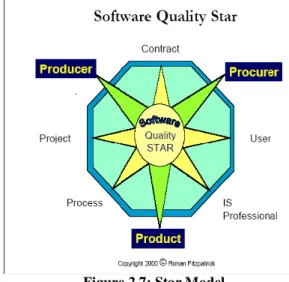
(1995)". There are three significant elements in the Star: The procurer (acquirer), the producer (supplier), and the product, see Figure 2.7. The procurer enters in a contract with the producer to create a software product. This contract clearly specifies the quality characteristics of the product. The procurer's perspective of the producer organization is that they use the best project management techniques available and that they engage interest-rate processes to create a quality product. The procurer's perspective of the product is that it must be acceptable by the user community and that it can be serviced and maintained by their professionals.
The model considers that the acquirer be the lead party in any contractual arrangement because it is the acquirer's users and technical support professionals who dictate the success or failure of the software product. Also, it is the acquirer who dictates the profile and maturity of the supplier organization.
“The model accommodates the producer's perspective of software quality and focuses on the maturity of the producer organization as software developers and the development processes that they used to create quality software products" .
Figure 2.7: Star Model III PRPOPOSED METHODOLOGY
By adopting the meta-model, the resulting methodologies, tools and languages should inherit its desirable characteristics and better support the development of intelligent adaptive systems in open environment. The adaptiveness and open environments create difficult challenges for system development. Traditional quality goals such as correctness cannot be assumed to hold at runtime after deployment. Adaptation and the open nature of the environment may cause system performance; reliability, security and maintainability to be lost or change significantly at runtime .We are study and Analysis the sub-characteristics according to your opinion after evaluating the software with the help of the categorized requirements and the quality model.
IV.CONCLUSION
In this paper, we proposed a thorough study of quality characteristics in software products. We present different quality models, which decompose in hierarchical and non-hierarchical models, such as McCall, Boehm, FURPS, ISO, Dromey, Star model and Bayesian Belief Networks. This paper started by giving an overview over selected quality models for software engineering, which uncovered both weaknesses and strengths of existing approaches.
models for MDE as well. Although we focus on the quality of models and MDE practices, the meta-model is generic and may be used for defining quality models in any area. Users play a role in the measurement of Software Quality.Users have a direct and equal impact on the software quality. Identifies the requirements which needs improvement .Can be used to improve the quality of later versions of the software. Requires a good amount of time for the evaluation.To measure the effectiveness of our metric by using realistic data.
V. REFERENCE
1. Al-Kilidar, H., Cox, K., Kitchenham, B.: The Use and Usefulness of the ISO/IEC 9126 Quality Standard. International Symposium on Empirical Software Engineering, 7 p. (2005) .
2. Boehm, B. W., Brown, J. R., Kaspar, H., Lipow, M., McLeod, G., Merritt, M.: Characteristics of Software Quality. North Holland (1978) .
3. Bøegh, J.: A New Standard for Quality Requirements. IEEE Software 25(2), 57--63 (2008) . 4. Dromey, R.G.: Concerning the Chimera. IEEE Software 13 (1), pp. 33--43 (1996).
5. ISO, International Organization for Standardization: ISO 9126-1:2001,Software Engineering – Product Quality, Part 1: Quality model (2001) .
7. Lindland, O.I., Sindre, G., Solvberg, A.: Understanding Quality in Conceptual Modeling. IEEE Software 11(2), pp. 42--49 (1994) .
8. McCall, J. A., Richards, P. K., Walters, G. F.: Factors in Software Quality. Nat'l Tech. Information Service, Vol. 1, 2 and 3 (1977).
9. Mohagheghi, P., Aagedal, J.Ø.: Evaluating Quality in Model-Driven Engineering. In: Workshop on Modeling in Software Engineering (MISE’07), In: Proc. of ICSE’07, 6. p (2007) .
10. Wagner, S., Deissenboeck, F.: An Integrated Approach to Quality Modeling. Fifth International Workshop on Software Quality, In: Proc. of ICSE’07, 6 p. (2007).
11. Joc Sanders and Eugene Curran.Software Quality, a Framework for success in software Development and Support. Addison - Wesley Publishing Company, 1995.
12 Safa, L. The practice of deploying DSM, report from a Japanese appliance maker trenches. In Proceedings of the 6th OOPSLA Workshop on Domain Specific Modeling (DSM’06), 2006, 12p.
13. Nigel Bevan. Quality in use: Meeting user needs for quality. Journal of System and Software,1999. http://www.usability.serco.com/papers/qiuse.pdf.
14. R. Geo® Dromey. A model for software product quality.IEEE Transactions on Software Engineering, 21(2nd):146{162, Feb 1995.
![Figure 2.1: McCall's model [50]](https://thumb-us.123doks.com/thumbv2/123dok_us/8744114.2371085/3.892.297.598.156.627/figure-mccall-s-model.webp)
![Figure 2.2: Boehm's Model [9]](https://thumb-us.123doks.com/thumbv2/123dok_us/8744114.2371085/4.892.268.624.156.562/figure-boehm-s-model.webp)