Journal Algebra Discrete Math.
c
Journal “Algebra and Discrete Mathematics”
On Sushchansky
p
-groups
Ievgen V. Bondarenko, Dmytro M. Savchuk
Dedicated to V.I. Sushchansky on the occasion of his 60th birthday
Abstract. We study Sushchansky p-groups introduced in
[Sus79]. We recall the original definition and translate it into the language of automata groups. The original actions of Sushchan-sky groups on p-ary tree are not level-transitive and we describe their orbit trees. This allows us to simplify the definition and prove that these groups admit faithful level-transitive actions on the same tree. Certain branch structures in their self-similar clo-sures are established. We provide the connection with, so-called, G groups [BGˇS03] that shows that all Sushchansky groups have intermediate growth and allows to obtain an upper bound on their period growth functions.
Introduction
Sushchanskyp-groups were introduced in [Sus79] as one of the pioneering examples of finitely generated infinite torsion groups, providing counter-examples to the General Burnside problem. Initially, this problem was solved by E.S. Golod in [Gol64] using the Golod-Shafarevich theorem. Simpler and easier to handle counter-examples were constructed by S. V. Aleshin in [Ale72] by means of automata. The use of automata groups to resolve Burnside’s problem was earlier suggested by V. M. Glush-kov in [Glu61]. But only after the results of R. I. Grigorchuk from [Gri80, Gri83] automata groups became the subject of deeper investigation. It
Both authors were partially supported by NSF grants 0308985 and DMS-0456185
2000 Mathematics Subject Classification: 20F69, 20F10, 20E08.
Journal Algebra Discrete Math.
happened that this class contains groups with many extraordinary prop-erties, like infinite torsion groups, groups of intermediate growth, groups of finite width, just-infinite groups, etc.V.I. Sushchansky used a different language, namely the language of tableaux, introduced by L. Kaluzhnin to study properties of iterated wreath products [Kal48]. For each prime p >2, V.I. Sushchansky con-structed a finite family of infinite p-groups generated by two tableaux. Each such a tableau naturally defines an automorphism of a rooted tree and, as was already noticed in [GNS00], can be represented by a finite initial automaton. We describe these automata and study Sushchansky groups and their actions on rooted trees by means of this well-developed language.
The structure of the paper is as follows. In Section 1 we recall the original definition of Sushchansky groups. In Section 2 we describe the corresponding automata. The associated action on a rooted tree is not level-transitive and in Section 3 we describe its orbit tree and show that there exists a faithful level-transitive action given by finite initial au-tomata. The self-similar closure is studied in Section 4. The main re-sults are presented in Section 5. It was pointed out in [Gri85a] that all Sushchanskyp-groups have intermediate growth, but only the main idea of the proof was given. Here we provide a complete proof of this fact together with new estimates on the growth function, thus contributing to the Milnor question [Mil68], which was solved in [Gri83] by R.I. Grig-orchuk. Also we give an upper bound on the period growth function. The main idea is to useGgroups of intermediate growth introduced in [BˇS01]
(see also [BGˇS03]). For each Sushchansky p-group we construct a G
group of intermediate growth and prove that their growth functions are equivalent.
The authors wish to thank Zoran ˇSuni´c for fruitful discussions and important comments, which enhanced the paper.
1. Original definition via tableaux
Let X = {0,1, . . . , p−1} be a finite alphabet for some prime p. We identifyX with the finite fieldFp.
The set X∗ of all finite words over X has a natural structure of a
rootedp-ary tree. Every automorphisms g∈AutX∗ of this tree induces an automorphism g|v of the subtree vX∗ by the rule g|v(w) = u if and
only if g(vw) =g(v)u. This automorphism is called the restriction of g
on wordv (in some papers the word section or state is used).
Journal Algebra Discrete Math.
the infinite wreath product of cyclic groups of orderp, i.e. P∞=≀i≥1Cp(i).Using this description one can construct special “tableau” representa-tion of P∞. The “tableau” representation was initially introduced by L. Kaluzhnin for Sylow p-subgroups of symmetric groups of order pm
in [Kal48].
The group P∞ is isomorphic to the group of triangular tableaux of the form:
u= [a1, a2(x1), a3(x1, x2), . . .],
where a1 ∈ Fp, ai+1(x1, . . . , xi) ∈ Fp[x1, . . . , xi]/hxp1 −x1, . . . , xpi −xii.
The multiplication of tableaux is given by the formula:
[a1, a2(x1), a3(x1, x2), . . .]·[b1, b2(x1), b3(x1, x2), . . .] =
= [a1+b1, a2(x1) +b2(x1+a1), a3(x1, x2) +b3(x1+a1, x2+a2(x1)), . . .].
The action of the tableau u on the treeX∗ is given by:
u(x1x2. . . xn) =y1y2. . . yn, (1)
where y1 = x1+a1, y2 = x2+a2(x1), . . . , yn = xn+an(x1, . . . , xn−1),
where all calculations are made by identifyingX with the fieldFp.
For the duration of the rest of the paper we fix a prime p >2. Fix some order λ = {(αi, βi), i = 1, . . . , p2} on the set of pairs
{(α, β)|α, β ∈Fp}. For j > p2 we define (αj, βj) = (αi, βi) wherei ≡j
mod p2. Define two tableaux
A= [1, x1,0,0, . . .], Bλ= [0,0, b3(x1, x2), b4(x1, x2, x3), . . .],
where the coordinates of Bλ are defined by its values in the following
way:
a) b3(2,1) = 1;
b) bi(0,0, . . . ,0,1) = 1if βi 6= 0;
c) bi(1,0, . . . ,0,1) =−αβii if βi 6= 0 andbi(1,0, . . . ,0,1) = 1if βi = 0;
d) all the other values are zeroes.
The group Gλ = hA, Bλi is called the Sushchansky group of type λ.
The following theorem is proven in [Sus79].
Journal Algebra Discrete Math.
2. Automata approach
Another language dealing with groups acting on rooted trees is the lan-guage of automata groups. For a definitions we refer to the survey pa-per [GNS00]. Many groups related to Burnside and Milnor Problems happen to be in the class of groups generated by finite automata. The Sushchansky groups are not an exception and we describe the structure of the corresponding automata in this section.
The action of every automorphism g of the rooted tree X∗ can be encoded by an initial automaton whose states are the restrictions of g
on the finite words over X. In the case when this set is finite we call
g a finite-state automorphism. The action of such an automorphism is encoded by a finite automaton.
It is known that (see [GNS00]) thatAutX∗ ∼= AutX∗≀Sym(X), which gives a convenient way to represent every automorphism in the following form:
g= (g|0, g|1, . . . , g|p−1)πg,
whereg|0, g|1, . . . , g|p−1 are the restrictions of g on the letters ofX and
πg is the permutation ofX induced byg.
The multiplication of automorphisms written in this way is performed as follows. Ifh= (h|0, h|1, . . . , h|p−1)πh then
gh= (g|0h|πg(0), . . . , g|p−1h|πg(p−1))πgπh.
Now we proceed with an explicit construction of automata associated to Sushchansky groups. Letσ = (0,1, . . . , p−1)be a cyclic permutation of X. With a slight abuse of notation, depending on the context, σ will also denote the automorphism ofX∗ of the form(1,1, . . . ,1)σ.
Given the orderλ={(αi, βi)}define wordsu, v∈Xp 2
in the following way:
ui=
0, if βi = 0;
1, if βi 6= 0. vi =
1, if βi = 0;
−αi
βi, if βi 6= 0.
The wordsuand v encode the actions ofBλ on the words00. . .01∗and
10. . .01∗, respectively. Using the words u andv we can construct auto-morphismsq1, . . . , qp2, r1, . . . , rp2 of the treeX∗by the following recurrent
formulas:
qi = (qi+1, σui,1, . . . ,1), ri= (ri+1, σvi,1, . . . ,1), (2)
for i = 1, . . . , p2, where the indices are considered modulo p2, i.e. i =
Journal Algebra Discrete Math.
Formula (1) implies that qi and ri are precisely the restrictions ofBλon the words00(0)i−1+np2 and10(0)i−1+np2, respectively, for anyn≥0. The action of the tableau A is given by:
A= (1, σ, σ2, . . . , σp−1)σ;
while Bλ acts trivially on the second level and the action on the rest is
given by the restrictions:
Bλ|00=q1, Bλ|10=r1, Bλ|21=σ
and all the other restrictions are trivial. In particular, the automorphisms
AandBλare finite-state and Sushchansky groupGλ is generated by two
finite initial automata. Denote the union of these two automata byAu,v.
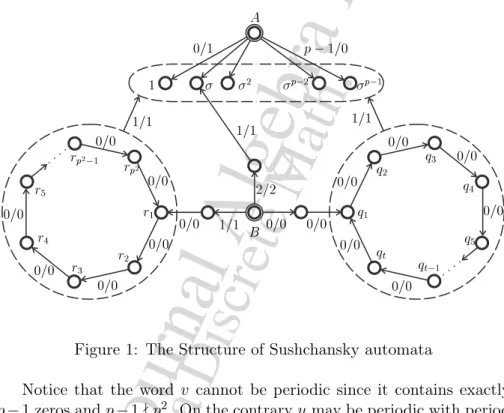
Its structure is shown in Figure 1. The particular automaton for p = 3
and the lexicographic order on{(α, β)|α, β ∈Fp}is given in Figure 2 (all
the arrows not shown in the figures go to the trivial state 1).
Journal Algebra Discrete Math.
PSfragreplaements0=1 p 1=0
1 0=0 0=0 0=0 0=0 0=0 0=0 0=0 0=0 0=0 0=0 0=0 0=0 0=0 0=0 0=0 1=1 1=1 1=1 1=1 2=2 p 2 p 1 2 A B q 1 r 1 r 2 r 3 r 4 r 5 r p 2 1 r p 2 q 2 q 3 q 4 q 5 q t 1 q t
Figure 1: The Structure of Sushchansky automata
Notice that the word v cannot be periodic since it contains exactly
p−1zeros andp−1∤p2. On the contraryumay be periodic with period
p. In this case we have qi =qi+p and the minimization of Au,v contains
p2 + 2p+ 5 states. If u is not periodic then Au,v contains 2p2+p+ 5
states. Lett be the length of the minimal period in u(thus either t=p
Journal Algebra Discrete Math.
Lemma 2. The group hq1, . . . , qt, r1, . . . , rp2i is elementary abelian p-group.
Proof. Allqi, rj have orderp because
qpi = (qpi+1,1,1, . . . ,1), rip= (rip+1,1,1, . . . ,1),
and therefore qip and rip act trivially on the tree. All qi, rj commute with each other, because
qiqj = (qi+1qj+1, σui+uj,1, . . . ,1), qjqi = (qj+1qi+1, σui+uj,1, . . . ,1);
rirj = (ri+1rj+1, σvi+vj,1, . . . ,1), rjri = (rj+1ri+1, σvi+vj,1, . . . ,1);
qirj = (qi+1rj+1, σui+vj,1, . . . ,1), rjqi = (rj+1qi+1, σui+vj,1, . . . ,1),
so the corresponding pairs act equally on the tree.
The last lemma implies that the order ofBλ is p. Since
Ap= (σp(p2−1), σ
p(p−1)
2 , . . . , σ
p(p−1)
2 )
andp is odd, the order ofA is alsop.
Journal Algebra Discrete Math.
PSfragreplaements 0=0 0=0 0=0 0=0 0=0 0=0 0=0 0=0 0=0 0=0 0=0 0=0 0=0 0=0 0=0 1=1 1=1 1=1 1=1 1=1 1=1 1=1 1=1 1=1 1=1 1=1 2=2 1=2 2=0 2 A B q 2 q 3 q 1 r 1 r 2 r 3 r 4 r 5 r 6 r 7 r 8 r 9
Journal Algebra Discrete Math.
3. Actions on rooted trees
Here we describe the structure of the action ofGλon ap-ary tree by means
of the orbit tree. This notion is defined in [Ser03] and used in [GNS01] to establish a criterion determining when two automorphisms of a rooted tree are conjugate. Here we use it to simplify the definition of Sushchan-sky groups and show that they admit a faithful level-transitive action on a regular rooted tree.
Definition 1. LetG be a group acting on a regularp-ary tree X∗. The
orbit tree ofGis a graph whose vertices are the orbits ofGon the levels ofX∗and two orbits are adjacent if and only if they contain vertices that
are adjacent inX∗.
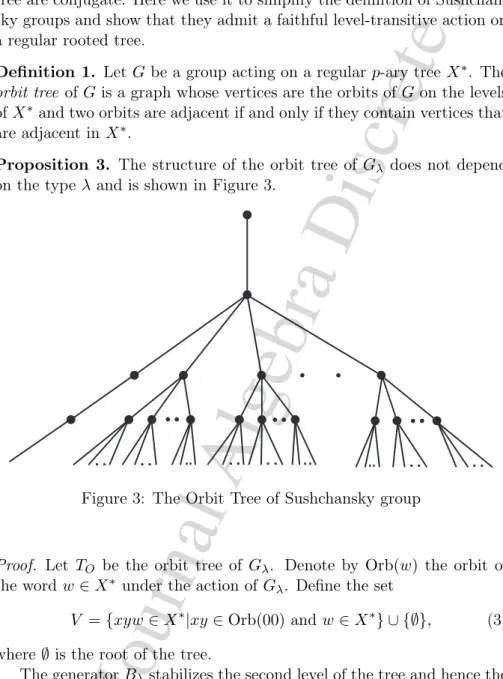
Proposition 3. The structure of the orbit tree of Gλ does not depend
on the typeλand is shown in Figure 3.
Figure 3: The Orbit Tree of Sushchansky group
Proof. Let TO be the orbit tree of Gλ. Denote by Orb(w) the orbit of
the wordw∈X∗ under the action ofGλ. Define the set
V ={xyw∈X∗|xy ∈Orb(00) and w∈X∗} ∪ {∅}, (3) where∅ is the root of the tree.
The generatorBλ stabilizes the second level of the tree and hence the
orbitOrb(00)coincides with the orbit of00under the action of the group generated byA. The setV and its complimentW =X∗\V are invariant
Journal Algebra Discrete Math.
Notice that{00,10,21} ⊂Orb(00)and the generatorBλ acts triviallyon all words that lie in the setW. Since the restrictions ofAon all words of length≥2are trivial, every element g∈Gλ that acts trivially on the
second level of the tree must stabilize all the vertices of the setW. Hence, the orbits of Gλ on W coincide with the ones of A. Automorphism A
acts transitively on the first level and has order p. Therefore the orbit of any wordw∈W consists of pvertices, namely the images of w under the action of the cyclic group of order p generated by A. Therefore the first two levels ofTO are exactly as shown in Figure 3 andp−1 vertices
on the second level of TO are the roots of regularp-ary trees.
Let us prove that Gλ acts transitively on the levels of the set V, i.e.
for every n≥1 the groupGλ acts transitively on the set
Vn={xyw∈Xn+1|xy∈Orb(00)and w∈Xn−1}.
We use induction on n. For n = 1 there is nothing to prove. Assume
Gλ acts transitively on Vn and consider the (n+ 1)-th level. Since by
construction eitherun−1 = 1or vn−1= 1, the restriction ofBλ on either
00. . .01 or 10. . .01 is equal to σ. Denote this word as s(here s∈ Vn)
and note thatB stabilizess. To prove the induction step it suffices for an arbitrarys′z′ ∈Vn+1, where s′ ∈Vnand z′ ∈X, to construct an element
g∈ Gλ such that g(s0) =s′z′. By the inductive assumption there is an
element h ∈ Gλ such that h(s) = s′. Suppose h−1(s′z′) = sz for some
letterz∈X. Then forg= (Bλ)zh (here we consider zas an integer) we
have
g(s0) = h((Bλ)z(s0)) =h(s(Bλ)z|s(0)) =h(s(Bλ|s)z(0)) =
= h(sσz(0)) =h(sz) =s′z′
as required.
The setV has a natural structure of a rootedp-ary treeT, where the root∅ is connected by an edge with every vertex inOrb(00) and there is an edge betweenwandwxfor allw∈V andx∈X. In other words, there is a natural 1-to-1 correspondence betweenV and vertices ofT given by
xyw 7→ xw for xy ∈Orb(00) and w ∈X∗. Since the set V is invariant
under the action ofGλ, the groupGλ acts by automorphisms on the tree
T. This action has simpler structure and the following proposition holds.
Proposition 4. The action of Sushchansky group Gλ on the tree T is
faithful, level transitive and has the following form
A = σ,
Bλ = (q1, r1, σ,1, . . . ,1),
qi = (qi+1, σui,1, . . . ,1),
ri = (ri+1, σvi,1, . . . ,1).
Journal Algebra Discrete Math.
Proof. The expressions (4) follow directly from the definition of Sushchan-sky groups.
Let us prove that this action is faithful. Take an arbitrary nontrivial elementg∈Gλ. Ifgacts non-trivially on the second level ofX∗, then the
exponent ofA ing is not divisible byp. But then gacts non-trivially on the first level of T as well because it is fixed under Bλ and A acts there
asσ. Ifg acts trivially on the second level ofX∗ then it acts trivially on the complement of V inX∗ according to Proposition 3. Therefore to be nontrivial it must act nontrivially on T.
We proved in Proposition 3 that Gλ acts transitively on every setVn,
which is precisely the nth level of the treeT.
4. Self-similar closure
The Sushchansky groupGλ is not generated by all the states ofAu,v and
is not self-similar (see definition below). However, we can embed it into a larger self-similar group where we can use some known techniques to derive some important results about Gλ itself. In particular that Gλ is
amenable (Corollary 8) and that the word problem is solvable in poly-nomial time (Corollary 9). For the definitions not given here and more information on self-similar groups we refer to [Nek05] and [BGˇS03].
Definition 2. A group G <AutX∗ is called self-similar if g|u ∈G for
any g ∈ G and word u ∈ X∗. The self-similar closure of G < AutX∗
is the group generated by all the restrictions of all the elements of Gon words in X∗.
Let G˜λ be the self-similar closure of Gλ, i.e. G˜λ is generated by all
the states of the automatonAu,v. Consider also the self-similar subgroup
K =hq1, . . . , qt, r1, . . . , rp2, σi ofG˜λ.
Lemma 5. The group K is not periodic.
Proof. First, consider the caset=p. Then allui’s are equal to1 except
one equal to 0. In particular, Pp
i=1ui = p−1. Then the element g =
q1q2· · ·qtσp−1 has representation
g= (q1q2· · ·qt, σp−1,1, . . . ,1)σp−1.
Therefore
gp = (q1q2· · ·qtσp−1,∗, . . . ,∗) = (g,∗, . . . ,∗).
Journal Algebra Discrete Math.
In case t = p2, exactly p of ui’s are zeros. We mark the vertices ofthe cycle ofqi’s in the automaton by the corresponding ui’s. There are
at most p2
different distances between the zeros in the cycle. But the length of the cycle is p2 so there are
p2−1
2 >
p2−p
2 =
p
2
possible distances in the cycle, so letdbe a distance that is not attained as a distance between two zeros.
Now consider the element g=q1qd+1σup2+ud. It can be written as
g= (q2qd+2, σu1+ud+1,1, . . . ,1)σup2+ud.
Since the distance between states qp2 and qd in the cycle is exactly dat
least one ofup2 andudis nonzero soσup2+ud is a cycle of lengthp. Hence
gp= (q2qd+2σu1+ud+1,∗, . . . ,∗).
Therefore if the order |g| of g is finite, then it is not smaller than
p· |q2qd+2σu1+ud+1|.
Now we repeat this procedure p2 times and on the i-th iteration we get
qiqd+iσui−1+ud+i−1 = (q
i+1qd+i+1, σui+ud+i,1, . . . ,1)σui−1+ud+i−1.
Again, the distance betweenqi−1andqd+i−1is exactlydsoσui−1+ud+i−1
is a cycle of lengthp and
(qiqd+iσui−1+ud+i−1)p = (qi+1q
d+i+1σui+ud+i,∗, . . . ,∗).
Therefore
|qiqd+iσui−1+ud+i−1| ≥p· |q
i+1qd+i+1σui+ud+i|.
But afterp2 steps we will meetgagain. So its order cannot be finite. Definition 3. A group G acting on the tree X∗ is called weakly regular
branch over its subgroupP, if
1. Gacts transitively on each levelXn,n≥0;
2. P ≻ P ×P × · · · × P as geometric embedding induced by the restriction on some levelXk.
In case if P is a subgroup of finite index in G, the groupG is said to be
Journal Algebra Discrete Math.
Proposition 6. G˜λ is a weakly regular branch group overKp.Proof. First of all note that Lemma 5 guarantees that Kp is nontrivial.
At least one (in fact more) of the ui’s is non zero, say u1. Then the
relations (2) and
σq1σp−1= (σu1,1, . . . ,1, q2)
show that the set of restrictions of the elements of K, that stabilize the first level X of the tree, on letter 0 includes the generators of K and hence the whole groupK (therefore conjugating by σ∈K yields thatK
is self-replicating, i.e. for any x ∈X the projection of Stx(K) onto the
vertex x coincides with K). Thus for anyv ∈ K there is w ∈ K of the form
w= (v, σi,1, . . . ,1, q2j)
for some iandj. But then by Lemma 2
wp = (vp, σip,1, . . . ,1, q2jp) = (vp,1, . . . ,1).
ThereforeKp≻Kp×1×· · ·×1. Sinceσacts transitively on the first level
and belongs to the normalizer of Kp inK (because σ−1vpσ = (σ−1vσ)p) by conjugation we get
Kp ≻Kp×Kp× · · · ×Kp,
as geometric embedding.
The transitivity ofG˜λon levels follows from the fact that its subgroup
K acts nontrivially on the first level and is self-replicating, and hence, level transitive. Another explanation comes from the known fact that a self-similar subgroup of ≀i≥1Cp(i) acts level-transitively if and only it is
infinite (see [BGK+06]). The proof of the last fact is similar to the proof
of transitivity in Proposition 3.
We summarize some general properties of G˜λ in the following
propo-sition:
Proposition 7. The self-similar closure of Gλ is neither torsion, nor
torsion free, level-transitive group of tree automorphisms. Moreover, it is generated by a bounded automaton, hence it is contracting and amenable.
Proof. The first three assertions are already proved above. The automa-ton Au,v is bounded by Corollary 14 in [Sid00] (see the definition there
as well). As a corollaryG˜λ is contracting (see [BN03]) and amenable (see
[BKNV06]).
Journal Algebra Discrete Math.
Note also that the last corollary follows from Theorem 16.Corollary 9. The word problem in Gλ is solvable in polynomial time.
Proof. See Proposition 2.13.10 in [Nek05].
5. Intermediate growth
Let Gbe a group finitely generated by a set S. The growth function of
Gis defined by
γG(n) =
{g∈G|g=s1s2. . . sk for some si ∈S∪S−1, k≤n} .
Two functions γ1 and γ2 are called equivalent if there exists a constant
C >0such thatγ1(C1n)≤γ2(n)≤γ1(Cn)for alln. The growth function
γG depends both on G and on S, but the equivalence class of γG does
not depend onS.
In 1968 John Milnor asked about the existence of finitely generated groups with growth that is intermediate between polynomial and expo-nential. The first examples of such groups were provided by R.I. Grig-orchuk in [Gri83], where he constructed uncountable family of such groups. In particular, it was shown, that there are groups of intermediate growth generated by automata with5states, namely,Gω forω = (012)∞(not to
be confused with Sushchansky groupsGλ). These examples were
general-ized to the notion ofGgroups [BGˇS03]. Under some finiteness restriction
allG groups have intermediate growth.
Recently it was proved [BP06] that there is a4-state automaton over a 2-letter alphabet generating a group of intermediate growth. This group itself is isomorphic to the iterated monodromy group of the map
f(z) =z2+i. But it is still an open question whether there is a group
of intermediate growth generated by a3-state automaton over a 2-letter alphabet.
In view of the examples above it is not very surprising that the two of the pioneering examples of infinite finitely generated periodic groups introduced by S.V. Aleshin in [Ale72] and V.I. Sushchansky in [Sus79] also have intermediate growth. For Aleshin group it follows from the intermediate growth of Grigorchuk group and the result of Y.I. Mer-zlyakov [Mer83], who proved that Aleshin group contains a subgroup of finite index isomorphic to the subdirect product of four copies of Grig-orchuk group. Also the relation between these two groups was studied in [Gri85b].
Journal Algebra Discrete Math.
proof was given. In this paper we give a complete proof of this fact based on the results from [BˇS01].At the present moment the main method of obtaining the upper bounds for growth functions of groups was originated by R.I. Grigorchuk in [Gri84]. Different modifications of this method in [Bar98, MP01, BˇS01] allowed to improve existing estimates and to prove the estimates for new groups.
As for the lower bounds for growth functions, there are several tech-niques. In [Gri84] R.I. Grigorchuk uses self-similarity to obtain the lower bound of the form e√n for most of his groups. Moreover, he shows that any group G that is abstractly commensurable with its own power Gk
for some k ≥ 2 has a growth function not smaller that enα
for some
0< α≤1.
In [Gri89] R.I. Grigorchuk used bounds on the coefficients of Hilbert-Poincar´e series of graded algebras associated with groups to bound their growth functions. Namely, it was obtained that any residually p-group whose growth function is not bounded above by polynomial, must grow at least ase√n.
Y.G. Leonov [Leo01], L. Bartholdi and Z. ˇSuni´c [Bar98, BˇS01] used more advanced techniques (common in spirit to the ones used in [Gri84]) also based on certain self-similarity of the groups acting on trees. In obtaining the lower bounds for the growth functions of these groups the important role was played by the property, which is in some sense opposite to contraction. The main idea is that the restrictions of elements can not be much shorter than the elements themselves.
A. Erschler used random walks and Poisson boundary to approach to this question. In particular, in [Ers04] it was shown that the growth function of Grigorchuk groupGωforω = (01)∞, which is generated by
5-state automaton, grows faster thanenα for anyα <1. The upper estimate of the same sort was obtained for this group in spirit of [Gri84], which shows that groups Gω for ω = (012)∞ and ω = (01)∞ have essentially
different growth functions.
Recall the definition of a Ggroup.
Definition 4. LetR be a subgroup ofSym(X),Dbe any group with a sequence of homomorphisms wi :D→ Sym(X),i≥1. Then R acts on
the first level of X∗ and Dacts onX∗ in the following way. Each d∈D
defines the automorphism dˆthat acts trivially on the first level and is given by its restrictions
ˆ
d
0i1=wi(d), i≥1
Journal Algebra Discrete Math.
The group G=hR,Dˆi is called aG group if the following conditionsare satisfied:
(i) The groups R andwi(D), i≥1, act transitively onX.
(ii) For eachd∈Dthe permutationwi(d)is trivial for infinitely many
indices.
(iii) For each nontrivial d ∈ D the permutation wi(d) is nontrivial for
infinitely many indices.
The groups R and D are called the root part and the directed part of G
correspondingly.
Note that in [BGˇS03] the definition of a G group is given in slightly
more general settings. The results in [BˇS01] and [BGˇS03] imply the following theorem.
Theorem 10. All G groups with finite directed part have intermediate
growth.
There is a lower bound for the growth of such groups given in [BGˇS03]:
γG(n)en
α
, (5)
whereα= log(log(|X|)+log(2)|X|) .
The sequence of homomorphisms wi in the definition of a G group
is calledr-homogeneous, if for every finite subsequence of r consecutive homomorphisms wi+1, wi+2, . . . , wi+r every element of D is sent to the
identity by at least one of the homomorphisms from this finite subse-quence. In particular, if the sequence of homomorphisms {wi, i ≥ 1}
defining aGgroup is periodic with period r, it is alsor-homogeneous.
It is proved in [BˇS01] that in case ofr-homogeneous sequence of defin-ing homomorphisms there is an estimate of the upper bound on the growth function. Moreover, in this case if the directed part has finite exponent there is an upper bound on the torsion growth function π(n)
(the maximal order of an element of length at mostn).
Theorem 11(η-estimate). LetGbe aGgroup defined by anr
-homoge-neous sequence of homomorphisms. Then the growth function of the groupGsatisfies
γG(n)en
β
, (6)
whereβ = log(|log(X|)−|Xlog(|) η
r) <1andηris the positive root of the polynomial
Journal Algebra Discrete Math.
If the directed partDofGhas finite exponentq, then the groupGis torsion and there exists a constant C > 0, such that the torsion growth function satisfiesπ(n)≤Cnlog1/ηr(q). (7)
Sushchansky groupsGλ are notGgroups, because the automorphism
Bλ cannot be expressed asdˆfor some homomorphismswi. On the other
hand, the automorphisms qi and ri can, and the following proposition
shows that the self-similar closure of Gλ contains a subgroup which is a G group. Since the simplified definition of Gλ from Proposition 4 does
not simplify considerably the proofs in this section, we use the original definition in order to make this section independent.
Proposition 12. The group H = hq1, r1, σi is a G group with finite
directed part defined by a periodic sequence of homomorphisms with period p2.
Proof. We prove that the subgroupshq1, r1iandhσi are the directed and
the root parts ofH.
First observe that hq1, r1i ≃ Zp ⊕Zp. Indeed, the group hq1, r1i is
elementary abelianp-group by Lemma 2. Suppose thatr1 ∈ hq1i,r1=qk1.
Comparing restrictions on words0. . .01we get vi=kui. Contradiction,
since ui = 0 andvi = 1 for iwithβi = 0.
Consider the periodic sequence of homomorphisms wi : hq1, r1i →
Sym(X) with period p2 given by wi(q1) = σui and wi(r1) = σvi. Then
for any d ∈ hq1, r1i the associated dˆfrom the definition of a G group
coincides with the automorphism d. To complete the proof we need to check the conditions (i)–(iii) from the definition of a Ggroup.
(i) The root part generated byσacts transitively onX. Furthermore, for any i≥1
wi(q1) =σ, if βi6= 0;
wi(r1) =σ, if βi = 0.
In any case wi(hq1, r1i)contains σ and thus acts transitively onX.
(ii),(iii) Let d=q1kr1l,k, l∈Zp, be an arbitrary nontrivial element of
hq1, r1i. Since the sequencewi is periodic it suffices to show at least one
occurrence of trivial and one occurrence of nontrivial wi(d).
Find isuch that
(αi, βi) = (1,0), if l= 0;
Journal Algebra Discrete Math.
Thenwi(d) =
wi(qk1) =σkui = 1, if l= 0;
wi(qk1rl1) =σkui+lvi =σk+l(−k/l)= 1, if l6= 0.
For a nontrivial occurrence find isuch that
(αi, βi) = (0,1), if l= 0;
(αi, βi) = (1,0), if l6= 0.
Then
wi(d) =
wi(qk1) =σkui =σk, if l= 0;
wi(qk1r1l) =σkui+lvi =σl, if l6= 0.
The last proposition shows that the growth function of H satisfies inequalities (5) and (6), forr=p2. Also note that it is proved in [BGˇS03] that a G group is torsion if and only if its directed part D is torsion.
Therefore, the groupH is torsion. The next proposition exhibits another branch structure inside G˜λ.
Proposition 13. The group H = hq1, r1, σi is regular branch over its
commutator subgroupH′.
Proof. LetHk =hqk, rk, σi,k= 1, . . . , p2 be the subgroups of G˜λ. First
we show that
Hk′ Hk′+1×Hk′+1× · · · ×Hk′+1 (8) for all k. Indeed, at least one of uk and vk is nonzero. Suppose uk 6= 0.
Then relations qk = (qk+1, σuk,1, . . . ,1) and rk = (rk+1, σvk,1, . . . ,1)
imply
[qk, rk] = ([qk+1, rk+1],1, . . . ,1),
[qk,(qσ
−1
k )1/uk] = ([qk+1, σ],1, . . . ,1),
[rk,(qσ
−1
k )1/uk] = ([rk+1, σ],1, . . . ,1).
Since the projection of the stabilizer of the first level inHkon the leftmost
vertex coincides withHk+1 we getHk′ Hk′+1×1× · · · ×1. Conjugation
by σ ∈ Hk implies inclusion (8). Since H1 = Hp2+1 = H, we obtain
H′H′×H′×· · ·×H′as geometric embedding induced by the restriction onXp2.
The transitivity of H on the levels is proved by the method used in Proposition 3.
Now H is a torsion p-group, hence, so is H/H′, which is abelian. But each torsion finitely generated abelian group is finite. Thus,H′ is a
Journal Algebra Discrete Math.
When we deal with a groupGof automorphisms ofX∗, it is sometimes difficult to say something about the whole group, but we know something about the groupP generated by all the restrictions of the elements inGon some level kof the tree. In case G is self-similar,P is a subgroup of
Gand if G is self-replicating,P coincides withG. Some properties of P
are inherited byGitself. In particular, if P is finite or torsion then so is
G (the converse is not true). But what we are interested in here is that the growth ofG can be estimated in terms of the growth ofP.
LetS be a finite generating set of G. ThenP is generated by the set
˜
S of the restrictions of all elements of S on all vertices of k-th level Xk
of the tree. The following lemma holds.
Lemma 14. The growth functionγG(n)of the group Gwith respect to
S is bounded from above by
γG(n) γP(n)|X|
k
, (9)
where γP(n) is the growth function of the group P with respect to S˜.
In particular, the growth type of G (finite, polynomial, intermediate or exponential) cannot exceed the one ofP.
Proof. Letg∈Gbe an element of lengthnwith respect to the generating set S. This element induces a permutation πk of the k-th level of the
tree and |X|k restrictions g|
v, v ∈ Xk, on words of length k. Moreover,
different automorphisms correspond to different tuples(πk,{g|v, v∈Xk})
of restrictions and permutations. Each such a restriction is a word of length not greater than n with respect to the generating setS˜ of P. So for each vertexv∈Xkthe number of possible restrictions onvis bounded
from above byγP(n).
The following corollary shows an easy way to construct new examples of groups with intermediate (finite, polynomial, exponential) growth.
Corollary 15. Let F be a finite set of automorphisms from AutX∗, whose restrictions on some levelkbelong toG(in particular,F could be a set of finitary automorphisms). Then
γG(n)-γhG,Fi(n)- γG(n)|X|
k
.
whereγhG,Fi(n) is the growth function of the group hG, Fi with respect to S∪F.
Journal Algebra Discrete Math.
An interesting question is whether it is true that if G grows faster than polynomially thenγG(n)∼γhG,Fi(n).We are ready to prove the main results.
Theorem 16. All Sushchanskyp-groups have intermediate growth. The growth function of each Sushchanskyp-group Gλ satisfies
enα γGλ(n)e
nβ
,
where α = log(log(p)+log(2)p) , β = log(plog()−log(p) η
r) and ηr is the positive root of
the polynomialxr+xr−1+xr−2−2, wherer=p2.
Proof. The group generated by all the restrictions of elements of Gλ on
the second level is H = hq1, r1, σi, which is a G group of intermediate
growth by Proposition 12 and Theorems 10 and 11, whose growth function satisfies inequalities (5) and (6). Therefore by Lemma 14 the Sushchansky groupGλ has subexponential growth function, which satisfies inequality
γG(n)-(γH(n))p 2
-γH(n). (10)
The last part of this inequality follows from Proposition 13, where it is proved thatH is regular branch overH′.
Now consider the subgroup L = hBλ, ABλAp−1, A2BλAp−2i of Gλ.
This subgroup stabilizes the second level of the tree and the restrictions of the generators on the second level look like:
Bλ = (q1,∗, . . . ,∗),
ABλAp−1 = (r1,∗, . . . ,∗),
A2B
λAp−2 = (σ,∗, . . . ,∗).
Each word of length n in L will be projected on the corresponding word of length ninH. Therefore γL(n)≥γH(n) for alln≥1. But Lis
a finitely generated subgroup ofGλ. Thus
γH(n)-γL(n)-γG(n). (11)
Inequalities (10) and (11) imply
γG(n)∼γH(n). (12)
Finally, it was mentioned above that the group H is torsion as a G
group with torsion directed part. But periodicity of H implies that Gλ
Journal Algebra Discrete Math.
Theorem 17. There is a constant C >0, such that the torsion growth function of each Sushchanskyp-groupGλ satisfies inequalityπGλ(n)≤Cn
log1/ηr(p),
whereηr is the same as in the previous theorem.
Proof. By Proposition 12 the group H is a G group defined by a p2
-homogenous sequence of homomorphisms, whose directed parthq1, r1i is
an elementary abelianp-group (see Lemma 2). Therefore by Theorem 11 the torsion growth function πH(n) satisfies inequality
πH(n)≤C1nlog1/ηr(p)
for some constantC1.
For any element gof length ninGλ,gp stabilizes the second level of
the tree and the restrictions of gp at the vertices of the second level are the elements of H, whose length is not bigger thanpn. Hence, the order of gp cannot be bigger than the least common multiple of the orders of
g|v, v ∈ X2. Since the orders of these restrictions are the powers of p,
the least common multiple coincides with the maximal order among the restrictions. This implies
Order(g) =p·Order(gp)≤pπH(pn)≤pC1(pn)log1/ηr(p)≤Cnlog1/ηr(p)
for C=C1plog1/ηr(p)+1.
References
[Ale72] S. V. Aleˇsin. Finite automata and the Burnside problem for periodic groups. Mat. Zametki, 11:319–328, 1972.
[Bar98] Laurent Bartholdi. The growth of Grigorchuk’s torsion group. Internat. Math. Res. Notices, (20):1049–1054, 1998.
[BGK+06] Ievgen Bondarenko, Rostislav Grigorchuk, Rostyslav Kravchenko, Yevgen Muntyan, Volodymyr Nekrashevych, Dmytro Savchuk, and Zoran ˇSuni´c. Groups generated by3-state automata over2-letter alphabet, I. (available
athttp://arxiv.org/abs/math.GR/0612178), 2006.
[BGˇS03] Laurent Bartholdi, Rostislav I. Grigorchuk, and Zoran ˇSuni´k. Branch groups. InHandbook of algebra, Vol. 3, pages 989–1112. North-Holland, Amsterdam, 2003.
[BKNV06] Laurent Bartholdi, Vadim Kaimanovich, Volodymyr Nekrashevych, and Balint Virag. Amenability of automata groups. (preprint), 2006.
Journal Algebra Discrete Math.
[BP06] Kai-Uwe Bux and Rodrigo P´erez. On the growth of iterated monodromy groups. InTopological and asymptotic aspects of group theory, volume 394 ofContemp. Math., pages 61–76. Amer. Math. Soc., Providence, RI, 2006. (available athttp://www.arxiv.org/abs/math.GR/0405456).
[BˇS01] Laurent Bartholdi and Zoran ˇSuni´k. On the word and period growth of some groups of tree automorphisms. Comm. Algebra, 29(11):4923–4964, 2001.
[Ers04] Anna Erschler. Boundary behavior for groups of subexponential growth. Ann. of Math. (2), 160(3):1183–1210, 2004.
[Glu61] V. M. Gluˇskov. Abstract theory of automata. Uspehi Mat. Nauk, 16(5 (101)):3–62, 1961.
[GNS00] R. I. Grigorchuk, V. V. Nekrashevich, and V. I. Sushchanski˘ı. Automata, dynamical systems, and groups. Tr. Mat. Inst. Steklova, 231(Din. Sist., Avtom. i Beskon. Gruppy):134–214, 2000.
[GNS01] Piotr W. Gawron, Volodymyr V. Nekrashevych, and Vitaly I. Sushchansky. Conjugation in tree automorphism groups. Internat. J. Algebra Comput., 11(5):529–547, 2001.
[Gol64] E. S. Golod. On nil-algebras and finitely approximablep-groups.Izv. Akad. Nauk SSSR Ser. Mat., 28:273–276, 1964.
[Gri80] R. I. Grigorˇcuk. On Burnside’s problem on periodic groups. Funktsional. Anal. i Prilozhen., 14(1):53–54, 1980.
[Gri83] R. I. Grigorchuk. On the Milnor problem of group growth. Dokl. Akad. Nauk SSSR, 271(1):30–33, 1983.
[Gri84] R. I. Grigorchuk. Degrees of growth of finitely generated groups and the theory of invariant means.Izv. Akad. Nauk SSSR Ser. Mat., 48(5):939–985, 1984.
[Gri85a] R. I. Grigorchuk. Degrees of growth ofp-groups and torsion-free groups. Mat. Sb. (N.S.), 126(168)(2):194–214, 286, 1985.
[Gri85b] R.I. Grigorchuk. Groups with intermediate growth function and their ap-plications. Habilitation, Steklov Institute of Mathematics, 1985.
[Gri89] R. I. Grigorchuk. On the Hilbert-Poincar´e series of graded algebras that are associated with groups. Mat. Sb., 180(2):207–225, 304, 1989.
[Kal48] L´eo Kaloujnine. La structure des p-groupes de Sylow des groupes
sym´etriques finis. Ann. Sci. ´Ecole Norm. Sup. (3), 65:239–276, 1948. [Leo01] Yu. G. Leonov. On a lower bound for the growth of a 3-generator 2-group.
Mat. Sb., 192(11):77–92, 2001.
[Mer83] Yu. I. Merzlyakov. Infinite finitely generated periodic groups. Dokl. Akad. Nauk SSSR, 268(4):803–805, 1983.
[Mil68] J. Milnor. Problem5603. Amer. Math. Monthly, 75:685–686, 1968.
[MP01] Roman Muchnik and Igor Pak. On growth of Grigorchuk groups.Internat. J. Algebra Comput., 11(1):1–17, 2001.
[Nek05] Volodymyr Nekrashevych.Self-similar groups, volume 117 ofMathematical Surveys and Monographs. American Mathematical Society, Providence, RI, 2005.
Journal Algebra Discrete Math.
[Sid00] S. Sidki. Automorphisms of one-rooted trees: growth, circuit structure and acyclicity.J. of Mathematical Sciences (New York), 100(1):1925–1943, 2000.
[Sus79] V. I. Sushchansky. Periodic permutation p-groups and the unrestricted
Burnside problem. DAN SSSR., 247(3):557–562, 1979. (in Russian).
Contact information
I. Bondarenko Kyiv Taras Shevchenko University, Ukraine and Texas A&M University, USA
E-Mail: [email protected]
D. Savchuk Texas A&M University, USA
E-Mail: [email protected]