Submission of a manuscript will be held to imply that it contains original unpublished work and is not being submiĴed for publication elsewhere at the same time.
The language of the journal is Romanian (when the use of diacriticals is required) or an interna-tional language (English, French, German, Ital-ian, Spanish, etc.). All submissions must have a title, be 1,5 lines spaced, have a margin of 2 cm all round, be between 7 and 25 pages long, be wriĴen in Times New Roman Style, have 12 points characters, and must start with an align-ment.
• The title page must list the full title, short title of up to 70 characters, names and aĜliations of all authors, their qualięcations, their post and their current appointment if diěerent. Give the full address, including email, tele-phone and fax, of the author who is to check the proofs.
• Supply a long structured abstract wriĴen in English, of up to 200 words for all articles (ex-cept book reviews). This is to enable readers, to get a comprehensive picture of the main is-sues of the study and its impli-cations without reference to the text. The authors are request-ed to summarize very clearly the contents and implications of their study, following prop-erly the structure of the diěerent subsections: Background, Aims of the Study, methods, Results, Discussion (with limitations of the study), Implications for Policies, Implica-tions for Further Research) on the basis of the particular features of their article, in or-der to enable the reaor-ders of diěerent cultural backgrounds and countries to easily follow the main issues of the study. It should contain no citation to other published work.
TEXT
Abbreviations
All abbreviations should be wriĴen in full the ęrst time they appear. Mathematical symbols may be either handwriĴen or typewriĴen. Greek leĴers and unusual symbols should be identi-ęed separately in the margin. Distinction should be made between capital and lower case leĴers; between the leĴer O and zero; between the let-ter l and the number one and prime; between K and Kappa.
REFERENCE STYLE
References should be provided either in Harvard or Chicago manual style.
All references must be complete and accurate. Online citations should include date of access. If necessary, cite unpublished or personal work in the text but do not include it in the reference list. FURTHER INFORMATION
Proofs will be sent to the author for checking. This stage is to be used only to correct errors that may have been introduced during the pro-duction process. Prompt return of the corrected proofs, preferably within two days of receipt, will minimise the risk of the paper being held over to a later issue.
LETTERS TO EDITORS
This section is aimed at encouraging a lively interaction between readers, authors, editorial board and publisher. LeĴers should refer to articles published in the journal. They should not exceed 500 words and there should be no more than ęve references. LeĴers will be edited for clarity and conformity with Transylvanian
Review of Administrative Sciences style, and may
be shortened. Proofs will not be sent to authors. BOOK REVIEWS
1
Transylvanian Review
Transylvanian Review
of Administrative Sciences
of Administrative Sciences
No. 58 E
No. 58 E / / October /
October / 20
2019
19
Senior Editor: Călin Emilian Hinţea Director: Ciprian Tripon
Editor: Cristina Mora
Administrative director: Ovidiu Boldor
Editorial Board: Balogh Marton, Daniel Buda, Marius Dodu, Dacian Dragoş, Călin Ghiolţan, Veronica Junjan, Dan Lazăr, Elena Minea, Natalia Negrea, Liviu Radu, Sorin Dan Şandor, Bogdana Neamţu, Bianca Radu, Raluca Gârboan, Adrian Hudrea, Cornelia Macarie, Dan Balica, Tudor Ţiclău, Cristina Haruţa, Horia Raboca, Raluca Suciu, Ana Elena Ranta, Octavian Moldovan, Alexandru Pavel
Babeş-Bolyai University
Faculty of Political, Administrative and Communication Sciences Department of Public Administration and Management
INTERNATIONAL ADVISORY BOARD
Carole NEVES, Smithsonian Institute, Washington, DC Allan ROSENBAUM, Florida International University Arno LOESSNER, University of Delaware
Roger HAMLIN, Michigan State University Laszlo VARADI, Corvinus University of Budapest
Eric STRAUSS, Michigan State University Gyorgy JENEI, Corvinus University of Budapest Adriano GIOVANNELLI, Genoa University Bernadine Van GRAMBERG, Victoria University
Julian TEICHER, Monash University
Geert BOUCKAERT, Catholic University of Leuven Veronica JUNJAN, University of Twente
György HAJNAL, Corvinus University of Budapest
Taco BRANDSEN, Radboud University Nijmegen, Secretary-General
of the European Association for Public Administration Accreditation (EAPAA) Juraj NEMEC, Masaryk University, president of The Network of Institutes and Schools
of Public Administration in Central and Eastern Europe (Nispacee) Maria ARISTIGUETA, University of Delaware
Yüksel DEMIRKAYA, Marmara University Marian PREDA, University of Bucharest
Marius PROFIROIU, Bucharest Academy of Economic Studies Alexander HENDERSON, Long Island University
2
Transylvanian Review of Administrative Sciences has been selected for coverage in Thomson Reuters products and custom information services. Beginning with no. 22E/2008, this publication is indexed and abstracted in the following:
1. Social Sciences Citation index® 2. Social Scisearch®
3. Journal Citation Report/Social Sciences Edition
5
24
38
52
65
85
100
116
CONTENTS
Mojca BIŠČAK Jože BENČINA
The Impact of HRM Practices on the Performance of Municipalities. The Case of Slovenia
Oana Maria BLAGA
Răzvan Mircea CHERECHEȘ Cătălin Ovidiu BABA
A Community-Based Intervention for Increasing Access to Health Information in Rural Settings
Emil BOC
The Development of Participatory Budgeting Processes in Cluj-Napoca
Andrei CHIRCĂ Dan Tudor LAZĂR
Students’s Visitors – Among the Unexplored Types of Local Tourism?
Min-Hyu KIM
Factors Infl uencing the Propensity to Contract Out Health and Human Services in Response to Government Cutbacks: Evidence from US Counties
Mateusz LEWANDOWSKI
Organizational Drivers of Performance Information Use: The Perspective of Polish Local Governments
Romea MANOJLOVIĆ TOMAN Goranka LALIĆ NOVAK
The (Lack Of) Demand for Performance Information by the Croatian Parliament
Oleksiy POLUNIN
5 Abstract
On the basis of existing research, the paper presents a model for analyzing the impact of the use of human resource management practices on organizational performance. The model al-lows the assessment of these impacts after an-alyzing the use of human resource management practices and the achieved performance. The model includes a survey questionnaire on hu-man resource hu-management practices, a principal component analysis of the results of the question-naire, a DEA model to determine the performance and a linear regression model of the impact of human resource management practices on the performance of Slovenian municipalities.
The results of the research confi rm a nega-tive (focus on quality and job security) and pos-itive (supervisory practices) impact of the use of certain human resource management practices in Slovenian municipalities on their organizational performance. The fi ndings indicate the need for balancing between focus on quality, employee security, and supervisory practices for better in-dividual and organizational performance in Slove-nian local administration.
Keywords: human resource management, performance, effi ciency, impact, municipalities, DEA, Slovenia.
THE IMPACT
OF HRM PRACTICES
ON THE PERFORMANCE
OF MUNICIPALITIES.
THE CASE OF SLOVENIA
Mojca BIŠČAK
Jože BENČINA
Mojca BIŠČAK
Collaborator, Department of Economics and Public Sector Management, Faculty of Administration, University of Ljubljana, Ljubljana, Slovenia
Jože BENČINA (corresponding author)
Associate professor, Department of Economics and Public Sector Management, Faculty of Administration, University of Ljubljana, Ljubljana, Slovenia
Tel.: 00386-1-580.55.49 E-mail: [email protected]
Transylvanian Review of Administrative Sciences,
No. 58 E/2019 pp. 5-23 DOI:10.24193/tras.58E.1
6 1. Introduction
Eff ectiveness and performance of organizations rests with their staff : their capaci-ties and skills, as well as the ability of the leadership to motivate staff to do their best in achieving organizational objectives. In this respect, an increasing importance is giv-en to human resource managemgiv-ent, since it manages the capacities, skills and knowl-edge of employees and aff ects their individual performance (Alagaraja, 2013; Druck-er, 2003). By transferring the knowledge, motivation and performance of employees to the functioning of the organization, human resource management also aff ects the performance of the organization as a whole (Rousseau and Barends, 2011; Vanhala and Stavrou, 2013). HRM practices are positively linked with the operational mea-sures of performance, such as productivity, product quality and operating costs (Al-agaraja, 2013; Akhtar, Ding and Ge, 2008; Baptiste, 2008; Giauque, Anderfuhren-Biget and Varone, 2013; Den Hartog et al., 2012; Jiang et al., 2012; Ko and Smith-Walter, 2013; Kooij et al., 2013; Subramony, 2009; Tzabbar, Tzafrir and Baruch, 2017).
Due to fi scal constraints and high expectations of citizens, the public sector also aims at maximizing performance while delivering high-quality and accessible public services (Andrews and Van de Walle, 2013). Some studies have already confi rmed a positive association between the use of HRM practices and organizational perfor-mance in the public sector (Giauque, Anderfuhren-Biget and Varone, 2013; Walker and Andrews, 2013). Therefore, to add further clarity through either new research methods, new samples, or within new sett ings, authors call for further research of the situation concerning the use of HRM practices and their impact on the function-ing of public sector organizations (Giauque, Anderfuhren-Biget and Varone, 2013; Gould-Williams, 2003; Ko and Smith-Walter, 2013; Walker and Andrews, 2013).
The main aim of the research is to create a model for analyzing the impact of the use of HRM practices on achieving organizational performance of municipalities, and to use this model for Slovenian municipalities. The hypotheses considering the impact of human resource management practices for individual performance on the performance of Slovenian municipalities are formulated in section 2.3.
Three methodological approaches were used within the model. Survey research based on a relevant questionnaire was used to determine the presence of HRM prac-tices in Slovenian municipalities. The results of the survey research were processed by using the principal components analysis. The DEA methodology was used to de-termine the performance of business decision-making units (municipalities), and a relevant linear regression model was used to analyze the impacts.
7
2. HRM practices and organizational performance
Firstly, this section presents a six-dimensional construct of HRM practices. This is followed by the discussion on performance, focusing on the problem of measuring the performance of public sector units with emphasis on local communities. The sec-tion is concluded with a review of research addressing the impact of HRM practices on organizational performance.
2.1. Multi-dimensional structure of the construct of HRM practices
The appropriate use and combination of various HRM practices aff ects the indi-vidual performance of employees, since it deals with the capacities, abilities, skills and knowledge of employees (Giauque, Anderfuhren-Biget and Varone, 2013; Ke-hoe and Wright, 2013; Wallace Ingraham, Coleman Selden and Moynihan, 2000), and thereby also aff ects the organizational performance (Boxall, 2013; Crouse, Doyle and Young, 2011; Ko and Smith-Walter, 2013).
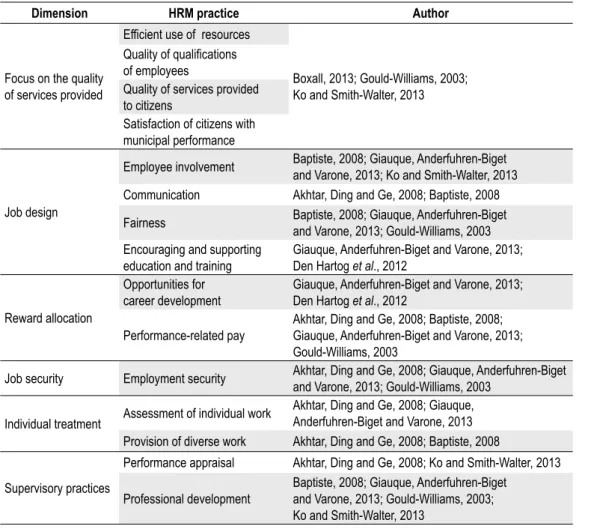
Several authors classifi ed HRM practices boosting operational outcomes into three categories: empowerment-enhancing bundles, motivation enhancing bundles and skill enhancing bundles (Subramony, 2009). Jiang et al. (2012) categorized 14 HRM practices into three dimensions: skill enhancing, motivation enhancing and the op-portunity enhancing dimension. In their research, Aycan et al. (2000) discuss three dimensions of HRM practices, i.e. job design, supervisory practice and reward alloca-tion; other authors defi ned from fi ve to eight dimensions, as shown in Table 1. To put more stress on performance-related rewards, following Tzabbar, Tzafrir and Baruch (2017) and Aycan et. al. (2000), we pointed out a fi ve-dimensional general construct which covers all other defi nitions with: training, job design, supervisory practices, reward allocation and job security.
Based on the above mentioned fi ve-dimensional general construct of HRM prac-tices, and considering the construct defi ned for the public sector by Giauque, An-derfuhren-Biget and Varone (2013), we defi ned a six-dimensional construct of HRM practices to achieve higher individual and organizational performance (as shown in Table 2); as the model is focused on operational managerial practices, it does not in-clude the skill enhancing dimension. For the same reason, it inin-cludes the empower-ment practices as a single dimension of job design according to Aycan et al. (2000). Otherwise, the defi nition is consistent with most other defi nitions of the construct for the public sector presented in Table 1 (Baptiste, 2008; Gould-Williams, 2003; Ko and Smith-Walter, 2013).
8
Table 1
: Dimensionality of the construct of HRM practices
for achieving individual performance across several authors
Subramony , 2009; Jiang et al ., 2012 Aycan et al ., 2000 Gould-Williams, 2003 Akhtar , Ding
and Ge, 2008
Baptiste, 2008
Giauque,
Anderfuhren-Biget and V
arone, 2013
Ko and Smith- Walter
, 2013
Tzabbar
, Tzafrir
and Baruch, 2017
Skill enhancing
Training and development
Training
Extensive training, learning and development Training and development
Training
Selective hiring
Selection practices and internal promotion
Selection Empowerment, opportunity enhancing Job design Teamwork Participation
Greater involvement in decision-making and work teams
Participation
Participation in decision-making
Voice Egalitarianism Job descriptions Employee voice Fairness Empowerment Job descriptions Information sharing
Employee involvement, information sharing
Job enrichment
Motivation enhancing
Supervisory practices Internal career opportunities Professional development
Communication
Results-oriented
appraisal
Career development
Internal career opportunities
Individual appraisal
Performance appraisal Performance appraisal
Reward allocation Performance- related pay
Stocks/profi
t sharing
Compensation contingent on performance
Performance-related
pay
Performance- related rewards
Profi t sharing for performance Employment security Employment security Job security
Employment security
Source
: Authors’
9
mentioned above, we have defi ned an additional dimension of focus on the quality of services provided which covers HRM practices aimed at ensuring that employees provide high-quality services, providing user satisfaction with the functioning and effi cient use of resources, and improving the qualifi cations of employees.
Table 2: Dimensionality of the construct of HRM practices for quality of services and organizational performance
Dimension HRM practice Author
Focus on the quality of services provided
Effi cient use of resources
Boxall, 2013; Gould-Williams, 2003; Ko and Smith-Walter, 2013 Quality of qualifi cations
of employees
Quality of services provided to citizens
Satisfaction of citizens with municipal performance
Job design
Employee involvement Baptiste, 2008; Giauque, Anderfuhren-Bigetand Varone, 2013; Ko and Smith-Walter, 2013
Communication Akhtar, Ding and Ge, 2008; Baptiste, 2008
Fairness Baptiste, 2008; Giauque, Anderfuhren-Bigetand Varone, 2013; Gould-Williams, 2003
Encouraging and supporting education and training
Giauque, Anderfuhren-Biget and Varone, 2013; Den Hartog et al., 2012
Reward allocation
Opportunities for career development
Giauque, Anderfuhren-Biget and Varone, 2013; Den Hartog et al., 2012
Performance-related pay
Akhtar, Ding and Ge, 2008; Baptiste, 2008; Giauque, Anderfuhren-Biget and Varone, 2013; Gould-Williams, 2003
Job security Employment security Akhtar, Ding and Ge, 2008; Giauque, Anderfuhren-Biget and Varone, 2013; Gould-Williams, 2003
Individual treatment Assessment of individual work
Akhtar, Ding and Ge, 2008; Giauque, Anderfuhren-Biget and Varone, 2013 Provision of diverse work Akhtar, Ding and Ge, 2008; Baptiste, 2008
Supervisory practices
Performance appraisal Akhtar, Ding and Ge, 2008; Ko and Smith-Walter, 2013
Professional development
Baptiste, 2008; Giauque, Anderfuhren-Biget and Varone, 2013; Gould-Williams, 2003; Ko and Smith-Walter, 2013
Source: Authors’ own contribution
2.2. The performance of public sector organizations
10
measure is effi ciency, while the studies based on resource theories mostly employ eff ectiveness as the measure of performance. More diverse performance measures are used in studies based on contingency theory; besides effi ciency and eff ectiveness also quality, quantity and user satisfaction are employed (Andrews and Van de Walle, 2013, pp. 10-12).
The studies of performance as effi ciency use diff erent approaches to the mea-surement of effi ciency. Nonparametric and semiparametric approaches include Data Envelopment Analysis (DEA), Free Disposal Hull (FHD), Order-m and Conditional effi ciency, while parametric approaches include Stochastic Frontier Analysis (SFA) and diff erent regression analysis (COLS, OLS, fi xed eff ects regressions). The most fre-quently used methods are DEA and SFA (Narbón-Perpiñá and De Witt e, 2018).
A signifi cant number of studies use DEA as the central measure of local govern-ment performance studying effi ciency from the economic viewpoint with the aim to determine what might contribute to higher performance (Afonso, Schuknecht and Tanzi, 2010; Afonso and Scaglioni, 2006; Balaguer-Coll, Prior-Jiménez and Vela-Bar-gues, 2002; Boett i, Piacenza and Turati, 2010; Geys, Heinemann and Kalb, 2012; Loik-kanen and Susiluoto, 2005; Pevcin, 2014a, 2014b). Many other authors search for fac-tors of effi ciency measured by DEA. They analyze impacts of competition in the po-litical arena (Ashworth et al., 2014; Sørensen, 2014), incomes, expenditures and taxes (Balaguer-Coll, Prior and Tortosa-Ausina, 2007), natural, citizen-related, institutional and legacy determinants (da Cruz and Marques, 2014), voter involvement and fi scal autonomy (Geys, Heinemann and Kalb, 2010), fi nancial and political determinants (Kalb, 2014), and IT development (Seol et al., 2008).
The study of impact of HRM practices is a segment of resource based studies of the determinants of organizational performance, where eff ectiveness, equity and quality are the mostly used measures of performance (Walker and Andrews, 2013). How-ever, some authors fi nd effi ciency as the measure of performance in resource based studies very useful. In his study on the impact of managerial skills on performance of municipal organizations, Carmeli (2006) demonstrates that the structural context plays an important role, especially for performance measures that are potentially less changeable in the short term. With a similar exposure, Andrews and Entwistle (2015) study the impact of management capacity on public service effi ciency, and Borge, Falch and Tovmo (2008) study the institutional factors of public sector effi ciency.
The use of HRM practices for individual and organizational performance is, in principle, the way in which the management in an organization behaves. As HRM practices represent the structural context, the effi ciency as the measure of perfor-mance could contribute to the understanding of the phenomena.
2.3. The impact of HRM practices on organizational performance
11
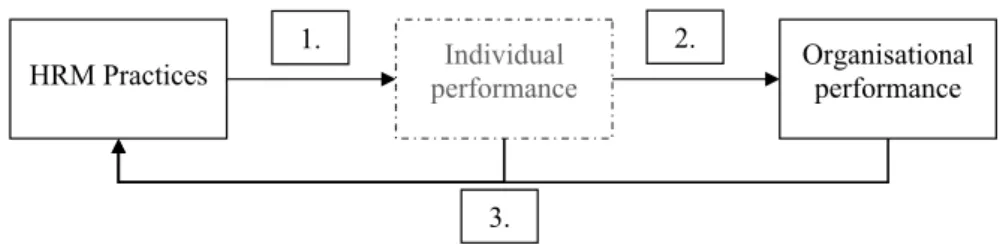
Smith-Walter, 2013). HRM practices have an impact on individual performance of employees (1) in order to achieve organizational performance (2), while feedback on the achievement of individual performance of employees and their impact on organi-zational performance (3) is the basis for identifying the eff ects of HRM practices and further planning of the use of HRM practices (Figure 1).
,QGLYLGXDO SHUIRUPDQFH
+503UDFWLFHV 2UJDQLVDWLRQDOSHUIRUPDQFH
Figure 1: The impact of HRM practices on organizational performance Source: Authors’ own contribution
1. Appropriate use of HRM practices, such as fairness, job enrichment, empower-ment and professional developempower-ment of employees, is positively linked with individ-ual performance and motivation of public employees (Giauque, Anderfuhren-Biget and Varone, 2013). Alagaraja (2013) stresses the importance of empowerment and ed-ucation and training to achieve individual performance. Den Hartog et al., 2012, inter alia, conclude that in organizations where a broad variety of HRM practices is off ered, higher satisfaction, eff ectiveness and performance are detected.
2. Individual performance, consequently, also leads to organizational performance, since HRM practices (their combination) are aimed at developing organizational pro-ductivity and performance by implementing such working conditions which increase the possibility for employees to align their goals with organizational objectives and values and, consequently, also ensure organizational performance (Crook et al., 2011; Curristine, Lonti and Joumard, 2007). The results of certain research (Boxall, 2013; Crouse, Doyle and Young, 2011; Den Hartog et al., 2012; Ko and Smith-Walter, 2013) confi rm that an appropriate use of HRM practices pays dividends to the organization as a whole, since it leads to increased organizational performance.
3. Monitoring the use of HRM practices and their eff ects on individual and orga-nizational performance provides an insight into the advantages and opportunities to improve individual performance on the basis of the use of HRM practices (Giauque, Anderfuhren-Biget and Varone, 2013; Gould-Williams, 2003).
Despite demonstrating importance, there is still a lack of research on the use of HRM practices and their eff ects on individual and organizational performance in the public sector. Therefore, multiple authors (Giauque, Anderfuhren-Biget and Varone, 2013; Gould-Williams, 2003; Ko and Smith-Walter, 2013; Walker and Andrews, 2013) call for further research of the situation concerning the use of HRM practices and their impact on the functioning of public sector organizations.
12
have an impact on the performance of Slovenian municipalities. Considering the six dimensions of the construct of HRM practices, defi ned in section 2.1., we defi ne six specifi c hypotheses as follows:
H1: Focus on the quality of services provided – has an impact on the performance of Slovenian municipalities;
H2: Job design – has an impact on the performance of Slovenian municipalities; H3: Job security – has an impact on the performance of Slovenian municipalities; H4: Individual treatment – has an impact on the performance of Slovenian
munic-ipalities;
H5: Supervisory practices – has an impact on the performance of Slovenian mu-nicipalities; and
H6: Reward allocation – has an impact on the performance of Slovenian munici-palities.
3. Methodology
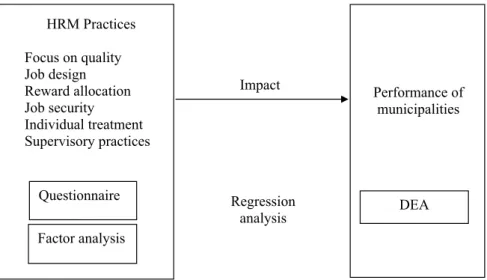
This section presents the model developed based on the assumption of the impact of the use of HRM practices for improved individual performance on the achieve-ment of organizational performance (Giauque, Anderfuhren-Biget and Varone, 2013; Gould-Williams, 2003; Ko and Smith-Walter, 2013). The model comprises two mea-surement models to identify the use of HRM practices and measure the performance of organizations, and a linear regression model to assess the impact of the former on the latt er construct (see Figure 2).
+503UDFWLFHV
)RFXVRQTXDOLW\ -REGHVLJQ 5HZDUGDOORFDWLRQ -REVHFXULW\ ,QGLYLGXDOWUHDWPHQW 6XSHUYLVRU\SUDFWLFHV
4XHVWLRQQDLUH
)DFWRUDQDO\VLV
3HUIRUPDQFHRI PXQLFLSDOLWLHV
'($ ,PSDFW
5HJUHVVLRQ DQDO\VLV
Figure 2: Model of the impact of the use of HRM practices on the performance of municipalities
13
3.1. The measurement model for the assessment of the use of HRM practices
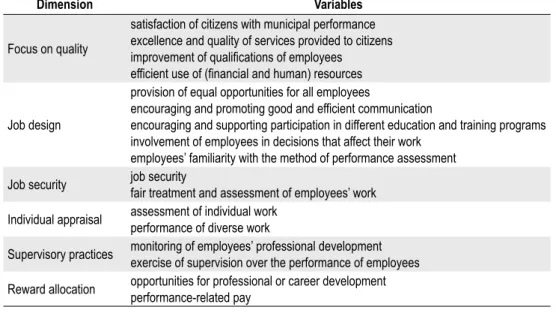
The measurement model for the assessment of the use of HRM practices in mu-nicipalities is based on a six-dimensional model of the construct of HRM practices presented in section 2.1. The questionnaire for measuring the situation takes account of the aforementioned structure of the concept considered (see Table 3).
Table 3: The structure of the questionnaire
Dimension Variables
Focus on quality
satisfaction of citizens with municipal performance excellence and quality of services provided to citizens improvement of qualifi cations of employees
effi cient use of (fi nancial and human) resources
Job design
provision of equal opportunities for all employees
encouraging and promoting good and effi cient communication
encouraging and supporting participation in diff erent education and training programs involvement of employees in decisions that aff ect their work
employees’ familiarity with the method of performance assessment
Job security job security
fair treatment and assessment of employees’ work
Individual appraisal assessment of individual workperformance of diverse work
Supervisory practices monitoring of employees’ professional developmentexercise of supervision over the performance of employees
Reward allocation opportunities for professional or career developmentperformance-related pay
Source: Authors’ own contribution
Along with the structured questionnaire, the dimensionality of the construct needs to be examined by means of a principal component analysis which tests the dimensionality of the construct and identifi es the elements that belong together as part of the same construct (Fabrigar et al., 1999). In this context, manifest variables are questions of the survey questionnaire on the presence and use of HRM practices in municipalities, while the expected factors are the dimensions of HRM practices to ensure performance (see Table 3).
In order to ensure the best possible adaptation of hypothetical data, the results were rotated with the Varimax orthogonal rotation. The examination of quality of the factor included the analysis of validity, reliability and consistency of measurement on the basis of Cronbach’s coeffi cient of reliability (> 0.6), Keiser-Meyer-Olkin statistics (> 0.6) and Bartlett ’s sphericity test (< 0.05). The results of the factor analysis served as the basis for confi rming the existence of latent variables which represented six dimen-sions of the construct of HRM practices.
3.2. Performance of municipalities
14
used measure in local government performance studies. It is measured using diff er-ent approaches, where the DEA is one of most frequer-ently employed methods. The studies take account of a number of diff erent determinants (political, economic, nat-ural, social, legacy and institutional). Our model combines the institutional factor of HRM practices and the effi ciency of local governments.
As local governments produce a number of diff erent services and are at least part-ly responsible for many diff erent (economic, social, environmental) outcomes, it is hard to defi ne any a priori performance measure. For this reason, a non-paramet-ric DEA method is an useful approach to analyze the performance of municipalities (Balaguer-Coll, Prior and Tortosa-Ausina, 2007; Geys, Heinemann and Kalb, 2012; Geys and Moesen, 2009; Loikkanen and Susiluoto, 2005; Storto, 2013). It enables em-ploying existing data and forming models by taking account of diff erent views of performance covering the whole diversity of the circumstances in local communities.
The DEA methodology is based on the linear programming method (Afonso and Fernandes, 2008; Cook, Tone and Zhu, 2014; Cook and Seiford, 2009). A DEA model is set up by determining the inputs and outputs, which represent the coeffi cients of a linear program. The expression is fitt ed with weights, which are the variables of the linear program. The weights (variables) are optimized for each unit under consider-ation, with the restriction of the maximum result of 1 for all other units under consid-eration. Optimization of weights allows each unit to achieve the best possible result, subject to the limits set by the inequations for all other units.
The calculation places the unit in a space limited by an envelope, i.e. hyper-space, which is defi ned by effi cient units. The proportion of achievement of effi ciency and the necessary improvements towards full effi ciency are defi ned for ineffi cient units in the form of values that need to be reached for this purpose. The model can be directed at inputs or outputs. In principle, the results are the same, except that the recommen-dations for improvement relate to the selected side of the model (inputs or outputs). By using a dual linear program, this method defi nes groups of units with a similar mode of performance (similar values of weights) around one or more effi cient units (Cook and Seiford, 2009; Cooper, Seiford and Tone, 2007).
The input side of our model includes (Afonso and Fernandes, 2008; Afonso and Scaglioni, 2006; Loikkanen and Susiluoto, 2005): current expenditure, current trans-fers, and registered unemployed persons.
The output side includes (Boett i, Piacenza and Turati, 2010; Geys, Heinemann and Kalb, 2012; Pevcin, 2014a): the number of persons employed in the municipality; the number of inhabitants under the age of 15; municipality’s investment expenditure; the number of social assistance recipients; the index of labor market self-suffi ciency, and the index of municipality’s fi nancial independence.
15
as effi cient, whereby the model allows achieving effi ciency in diff erent ways. There-fore, according to the model, municipalities with greater social burden, municipali-ties with a lower unemployment rate or a high-quality labor market and fi nancially strong municipalities can be assessed as more effi cient.
The results of the DEA model are very dependent on the choice of input and out-put variables. As the values of the variables for all units under observation form the restrictions of the model, the choice of the set of units has a signifi cant impact on the end results as well. Similarly, the possibility of taking account of diff erent modes of operation as effi cient (the units are treated as effi cient on the ground of the results in diff erent directions, for diff erent variables) could incite certain misleading interpre-tations. However, if the DEA model is built with caution and tightly connected to the similar cases, it provides sound conclusions even for complex and less defi ned service production environments.
3.3. Linear regression model
In order to assess the impact of managerial HRM practices on the performance of municipalities, linear regression analysis (Akhtar, Ding and Ge, 2008; Gould-Wil-liams, 2003; Ko and Smith-Walter, 2013) was selected, where the dimensions of man-agerial practices are independent (predictor) variables and the value of technical effi -ciency of municipalities is a response variable.
Technical effi ciency, as measured with the DEA approach in our study, depends on a number of diff erent factors. Some of them are given and the municipalities have no direct control over them (area, population, natural features), while others are un-der the infl uence of long-term policies and measures (economic development and social status of inhabitants). The factors to be changed in short or medium term are tightly connected to public and private investment in a municipality. Following the contingency and resource based theories, the local governments could develop their effi ciency (performance) functioning strategically based on the quality of employees (Walker and Andrews, 2013).
Hence, we would like to answer the following question: Do the HRM practices supporting bett er performance have an impact on the effi ciency of municipalities and which dimensions manifest the highest impact? The approach allows us to point out the HRM practices which are common for effi cient municipalities and to provide guidelines for ineffi cient municipalities on how to change the att itude towards HRM practices to provide bett er effi ciency.
The examination of the model comprises the assessments of impact size (adjusted R-square), statistical signifi cance of the model as a whole by means of F-statistics and statistical signifi cance of standardized coeffi cients by means of t-statistics.
4. Research fi ndings
16
and organizational performance of municipalities; (2) an analysis of the performance of Slovenian municipalities; (3) a regression analysis of the impact of the use of HRM practices on the performance of municipalities. The data from the survey research and the linear regression analysis were treated with SPSS, while the data from the analysis of performance were treated with Frontier Analyst.
4.1. Survey research on the use of HRM practices in Slovenian municipalities
The questionnaire survey included 17 questions on HRM practices (see Table 4) and the questions about the name and size of the municipality and municipal admin-istration. The HRM practices were measured with a fi ve point Likert scale. The sur-vey research was conceived as a census-based research across all Slovenian munici-palities (N = 212). The questionnaires were addressed to the directors of municipal administrations with the suggestion that they should be answered by them or their human resource manager. The response rate was just over 20% (n = 42). Given the structure by the number of inhabitants, the sample is appropriate, except in the group of larger municipalities (with more than 20,000 inhabitants) which has a share of 4.8% in the sample, compared to the share of 8.1% in the total population.
The examination of the factor structure showed that the factor model exhibits appropriate characteristics (Cronbach’s alpha coeffi cient of reliability = 0.828, Kai-ser-Meyer-Olkin statistics = 0.664, Bartlett ’s test of sphericity = 0.000). The communal-ities reach the values between 0.598 and 0.823.
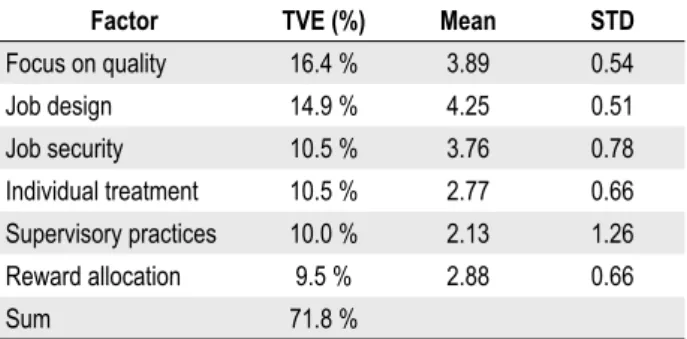
Table 4: Proportions of total variance by dimensions of the construct of the use of HRM practices for performance
Factor TVE (%) Mean STD
Focus on quality 16.4 % 3.89 0.54
Job design 14.9 % 4.25 0.51
Job security 10.5 % 3.76 0.78
Individual treatment 10.5 % 2.77 0.66 Supervisory practices 10.0 % 2.13 1.26 Reward allocation 9.5 % 2.88 0.66
Sum 71.8 %
Legend: TVE = Total Variance Explained; STD = Standard Deviation
Source: Authors’ own contribution
As indicated in Table 4, the factor model explains 71.8% of total variance explained (TVE), whereby each of the factors contributes a substantial share to total variance explained. The examination of the model showed that the data collected suffi ciently fi ts the theoretical model and thus refl ects the expected structure of the construct un-der consiun-deration, since factor weights of all the variables of the model exceed 0.528, whereby the majority exceeds 0.600.
17
on the entire sample. The dimension of supervisory practices – monitoring received the lowest rating and exhibited considerable variability (STD = 1.26). The three high-est rated dimensions include job design, focus on quality and job security, while the group of lower rated dimensions includes supervisory practices aimed at the perfor-mance of employees. This result is not surprising, given that municipalities demon-strate concern for quality and employees but their focus on the development of per-formance is rather limited.
4.2. Analysis of performance of Slovenian municipalities
The analysis of performance was carried out with the DEA model, presented in section 3, with three input variables and six output variables. The source of budget-ary data was the Ministry of Finance (2016), while the other data are available on the Slovenian Statistical Offi ce websites (Statistical Offi ce, 2016). In order to ensure a real-istic picture of the situation, the calculation was made for all Slovenian municipalities for which relevant data were available. The comparative results for the set of munici-palities and the sample considered in the study (n = 42) are shown in Table 5. The dif-ference between the descriptive statistics of both sets for the variable of performance are small; therefore, it can be assumed that the sample provides a good summary of the variability of the entire set. This is also confi rmed by the t-test for independent samples, which confi rms both the equality of variances (F = 0.03, Sig. = 0.909) and the equality of arithmetic means (t = 0.119, df = 199, Sig. = 0.905).
Table 5: Comparison of results of the analysis of effi ciency for all municipalities and for the sample
Mean STD Min Max IQR Q1 Median Q3 Skew Kurt Population 79.45 13.99 43.85 100 24.02 68.96 76.68 92.97 0.120 -1.016 Sample 79.22 14.29 53.86 100 24.57 69.26 76.72 93.83 0.195 -1.005 Legend: STD = Standard Deviation; IQR = Interquartile Range; Q1 = First Quartile; Q3 = Third Quartile; Skew = Skewness; Kurt = Kurtosis
Source: Authors’ own contribution
There are 15.9% effi cient municipalities in the total population of Slovenian mu-nicipalities; these include two larger groups of municipalities, which represent two extreme modes of functioning of municipalities: (a) socially oriented municipalities, with a large number of social assistance recipients, and (b) economically developed municipalities, with low unemployment rate or high level of fi nancial independence and self-suffi ciency of the labor market.
18
4.3. Regression analysis of the impact of the use of HRM practices on the performance of municipalities
The assessment of the impact of the level of use of HRM practices on performance was examined by using the regression model presented in section 3.3. As outlined above, the predictor variables are regression values of dimensions of HRM practic-es, obtained by factor analysis, while the response variable is the measure of perfor-mance of municipalities. As the Kolmogorov-Smirnov (Sig. = 0,200) and Shapiro-Wilk (Sig. = 0,951) tests of normality for regression residuals are statistically insignifi cant, the assumption of normally distributed error terms is fulfi lled. The characteristics of the model are presented in Table 6.
Table 6: Characteristics of the regression model
Summary ANOVA
R R Square Adjusted R Square df F Sig.
0.626 0.392 0.285 6 3.656 0.007
Source: Authors’ own contribution
The model is statistically signifi cant (Sig. = 0.007). The correlation coeffi cient indi-cates an appropriate correlation between predictor and response variables, whereby the impact represents 28.5% of total variance explained; the model as a whole is sta-tistically signifi cant with Sig. = 0.007.
The impact presented above is based on three dimensions – focus on quality (Sig. = 0.019), job security (Sig. = 0.022) and supervisory practices (Sig. = 0.016) (see Table 7).
Table 7: Linear regression model coeffi cients
Model B Std. Error β t Sig.
(Constant) 79.221 1.888 41.966 0.000
H1 Focus on quality -4.703 1.911 -0.329 -2.461 0.019 H2 Job design -3.124 1.911 -0.219 -1.635 0.111 H3 Job security -4.594 1.911 -0.321 -2.404 0.022 H4 Individual treatment 0.590 1.911 0.041 0.309 0.759 H5 Supervisory practices 4.846 1.911 0.339 2.536 0.016 H6 Reward allocation -1.819 1.911 -0.127 -0.952 0.348
Source: Authors’ own contribution
The facts described above support the following conclusions on the hypotheses regarding the impact of dimensions of human resource management practices to en-sure individual performance:
H1: Focus on the quality of services provided – confi rmed negative; H2: Job design – rejected;
H3: Job security – confi rmed negative; H4: Individual treatment – rejected;
19
The model demonstrates a positive impact of supervisory practices and a negative impact of focus on quality and job security. Municipalities focusing on monitoring the effi ciency of individual work are also more effi cient. On the other hand, munici-palities which are more concerned about the quality of functioning and which ensure fair treatment of employees and job security are less effi cient. At fi rst sight, the result is somewhat unexpected. How can the focus on quality, staff development, job secu-rity and fair treatment have a negative impact on the performance of an organization? Apparently, this is a situation in which the practices for staff development are very present; however, they have no positive impact on performance, since they do not in-clude supervision over the performance of employees and monitoring of professional development of employees.
5. Conclusion
The paper confi rms three out of six specifi c hypotheses on the impact of dimen-sions of human resource management practices to ensure individual performance on the performance of Slovenian municipalities. In order to achieve high performance by using HRM practices, it is necessary that the use of HRM practices and their eff ects is monitored continuously (Walker and Andrews, 2013), and that HRM practices are aimed at achieving results (Akhtar, Ding and Ge, 2008). On the other hand, the nega-tive impact of the dimensions’ focus on quality and job security is – somewhat unex-pectedly – negative. Focus on the quality of services helps increase user satisfaction; however, it could occupy additional resources. As mentioned above, job security is a positive driver of performance only if it is supported by appropriate supervisory practices. Without a special focus on the achievement of performance, HRM practices cannot contribute to bett er performance.
The fi ndings of the research carried out, inter alia, point out the att itude of man-agers in Slovenian municipalities. They devote much att ention to empowerment-en-hancing HRM practices (job design, mean = 4.25; quality, mean = 3.89; and job secu-rity, mean = 3.76), whereas they fail to reach an acceptable level of motivation-en-hancing HRM practices (reward allocation, mean = 2.88; individual treatment, mean = 2.77; and supervisory practices = 2.13). Consequently, the Slovenian munici-palities need to improve the use of motivation-enhancing HRM practices, paying spe-cial att ention to supervisory practices.
The research carried out presents a parsimonious model for analyzing the impact of HRM practices on organizational performance. Its’ practical value is the possibility of analyzing the phenomena within groups of public organizations and the opportu-nity of benchmarking of a specifi c organization to all others.
20
levels of economic development to be treated as effi cient. Finally, the results of the model of the impact of HRM practices on performance manifest the importance of balance in using of HRM practices.
The study demonstrates some important characteristics of the phenomena ob-served; however, the generalization of the results is rather limited. The analysis of HRM practices and the regression analysis call for additional research with a big-ger sample, which would allow more accurate construct dimensionality analysis and richer regression analysis. Furthermore, additional effi ciency measures and compari-son between them would help defi ne a sound combined effi ciency measure.
References:
1. Afonso, A. and Fernandes, S., ‘Assessing and Explaining the Relative Effi ciency of Lo-cal Government’, 2008, The Journal of Socio-Economics, vol. 37, no. 5, pp. 1946-1979. 2. Afonso, A. and Scaglioni, C., ‘Public Services Effi ciency Provision in Italian Regions:
A Non-Parametric Analysis’, in Liu, G.V. (ed.), Perspectives on International, State and Local Economics, New York: Nova Science Publishers, 2006, pp. 141-158.
3. Afonso, A., Schuknecht, L. and Tanzi, V., ‘Public Sector Effi ciency: Evidence for New EU Member States and Emerging Markets’, 2010, Applied Economics, vol. 42, no. 17, pp. 2147-2164.
4. Akhtar, S., Ding, D.Z. and Ge, G.L., ‘Strategic HRM Practices and Their Impact on Company Performance in Chinese Enterprises’, 2008, Human Resource Management, vol. 47, no. 1, pp. 15-32.
5. Alagaraja, M., ‘HRD and HRM Perspectives on Organizational Performance: A Review of Literature’, 2013, Human Resource Development Review, vol. 12, no. 2, pp. 117-143. 6. Andrews, R. and Entwistle, T., ‘Public–Private Partnerships, Management Capacity
and Public Service Effi ciency’, 2015, Policy & Politics, vol. 43, no. 2, pp. 273-290.
7. Andrews, R. and Van de Walle, S., ‘New Public Management and Citizens Perceptions of Local Service Effi ciency, Responsiveness, Equity and Eff ectiveness’, 2013, Public Management Review, vol. 15, no. 5, pp. 762-783.
8. Ashworth, J., Geys, B., Heyndels, B. and Wille, F., ‘Competition in the Political Are-na and Local Government Performance, 2014, Applied Economics, vol. 46, no. 19, pp. 2264-2276.
9. Aycan, Z., Kanungo, R., Mendonca, M., Yu, K., Deller, J., Stahl, G. and Kurshid, A., ‘Impact of Culture on Human Resource Management Practices: A 10-Country Com-parison’, 2000, Applied Psychology, vol. 49, no. 1, pp. 192-221.
10. Balaguer-Coll, M.T., Prior-Jiménez, D. and Vela-Bargues, J.M., ‘Effi ciency and Quality in Local Government Management’, 2002, [Online] available at htt p://ddd.uab.cat/re-cord/44565, accessed on June 28, 2016.
11. Balaguer-Coll, M.T., Prior, D. and Tortosa-Ausina, E., ‘On the Determinants of Local Government Performance: A Two-Stage Nonparametric Approach’, 2007, European Economic Review, vol. 51, no. 2, pp. 425-451.
21
13. Boett i, L., Piacenza, M. and Turati, G., ‘Decentralization and Local Governments’ Per-formance: How Does Fiscal Autonomy Aff ect Spending Effi ciency?’, 2010, Working paper No. 11, Former Department of Economics and Public Finance G. Prato, Univer-sity of Torino, [Online] available at htt p://econpapers.repec.org/paper/turwpaper/11. htm, accessed June 15, 2016.
14. Borge, L.-E., Falch, T. and Tovmo, P., ‘Public Sector Effi ciency: The Roles of Political and Budgetary Institutions, Fiscal Capacity, and Democratic Participation’, 2008, Pub-lic Choice, vol. 136, no. 3-4, pp. 475-495.
15. Boxall, P., ‘Mutuality in the Management of Human Resources: Assessing the Quality of Alignment in Employment Relationships’, 2013, Human Resource Management Jour-nal, vol. 23, no. 1, pp. 3-17.
16. Carmeli, A., ‘The Managerial Skills of the Top Management Team and the Performance of Municipal Organisations’, 2006, Local Government Studies, vol. 32, no. 2, 153-176. 17. Cook, W.D. and Seiford, L.M., ‘Data Envelopment Analysis (DEA) – Thirty Years On’,
2009, European Journal of Operational Research, vol. 192, no. 1, pp. 1-17.
18. Cook, W.D., Tone, K. and Zhu, J., ‘Data Envelopment Analysis: Prior to Choosing a Model’, 2014, Omega, vol. 44, pp. 1-4.
19. Cooper, W.W., Seiford, L.M. and Tone, K., Data Envelopment Analysis: A Comprehensive Text with Models, Applications, References and DEA-Solver Software, Springer Science & Business Media, 2007.
20. Crook, T.R., Todd, S.Y., Combs, J.G., Woehr, D.J. and Ketchen, D.J., ‘Does Human Cap-ital Matt er? A Meta-Analysis of the Relationship between Human Capital and Firm Performance’, 2011, Journal of Applied Psychology, vol. 96, no. 3, pp. 443-456.
21. Crouse, P., Doyle, W. and Young, J.D., ‘Workplace Learning Strategies, Barriers, Fa-cilitators and Outcomes: A Qualitative Study among Human Resource Management Practitioners’, 2011, Human Resource Development International, vol. 14, no. 1, pp. 39-55. 22. da Cruz, N.F. and Marques, R.C., ‘Revisiting the Determinants of Local Government
Performance’, 2014, Omega, vol. 44, pp. 91-103.
23. Curristine, T., Lonti, Z. and Joumard, I., ‘Improving Public Sector Effi ciency: Challeng-es and OpportunitiChalleng-es’, 2007, OECD Journal on Budgeting, vol. 7, no. 1, pp. 1-41.
24. Drucker, P.F., Peter Drucker on the Profession of Management, Boston: Harvard Business Review Press, 2003.
25. Fabrigar, L.R., Wegener, D.T., MacCallum, R.C. and Strahan, E.J., ‘Evaluating the Use of Exploratory Factor Analysis in Psychological Research’, 1999, Psychological Methods, vol. 4, no. 3, pp. 272-299.
26. Geys, B., Heinemann, F. and Kalb, A., ‘Voter Involvement, Fiscal Autonomy and Pub-lic Sector Effi ciency: Evidence from German Municipalities’, 2010, European Journal of Political Economy, vol. 26, no. 2, pp. 265-278.
27. Geys, B., Heinemann, F. and Kalb, A., ‘Local Government Effi ciency in German Mu-nicipalities’, 2012, Raumforschung und Raumordnung, vol. 71, no. 4, pp. 283-293.
22
29. Giauque, D., Anderfuhren-Biget, S. and Varone, F., ‘HRM Practices, Intrinsic Motiva-tors, and Organizational Performance in the Public Sector’, 2013, Public Personnel Man-agement, vol. 42, no. 2, pp. 123-150.
30. Gould-Williams, J., ‘The Importance of HR Practices and Workplace Trust in Achiev-ing Superior Performance: A Study of Public-Sector Organizations’, 2003, The Interna-tional Journal of Human Resource Management, vol. 14, no. 1, pp. 28-54.
31. Den Hartog, D.N., Boon, C., Verburg, R.M. and Croon, M.A., ‘HRM, Communication, Satisfaction, and Perceived Performance: A Cross-Level Test’, 2012, Journal of Manage-ment, vol. 39, no. 6, pp. 1637-1665.
32. Jiang, K., Lepak, D.P., Hu, J. and Baer, J.C., ‘How Does Human Resource Manage-ment Infl uence Organizational Outcomes? A Meta-Analytic Investigation of Mediat-ing Mechanisms’, 2012, Academy of Management Journal, vol. 55, no. 6, pp. 1264-1294. 33. Kalb, A., ‘What Determines Local Governments’ Cost-Effi ciency? The Case of Road
Maintenance’, 2014, Regional Studies, vol. 48, no. 9, pp. 1483-1498.
34. Kehoe, R.R. and Wright, P.M., ‘The Impact of High Performance Human Resource Practices on Employees’ Att itudes and Behaviors’, 2013, Journal of Management, vol. 39, no. 2, pp. 366-391.
35. Ko, J. and Smith-Walter, A., ‘The Relationship between HRM Practices and Organi-zational Performance in the Public Sector: Focusing on Mediating Roles of Work At-titudes’, 2013, International Review of Public Administration, vol. 18, no. 3, pp. 209-231. 36. Kooij, D.T.A.M., Guest, D.E., Clinton, M., Knight, T., Jansen, P.G.W. and Dikkers,
J.S.E., ‘How the Impact of HR Practices on Employee Well-Being and Performance Changes with Age’, 2013, Human Resource Management Journal, vol. 23, no. 1, pp. 18-35. 37. Loikkanen, H.A. and Susiluoto, I., ‘Cost Effi ciency of Finnish Municipalities in Basic
Service Provision 1994-2002’, 2005, Urban Public Economics Review, vol. 4, pp. 39-64. 38. Ministry of Finance, ‘Local Community Statistics’, [Online] available at htt p://www.
mf.gov.si/si/delovna_podrocja/lokalne_skupnosti/statistika/, accessed on June 15, 2016. 39. Pevcin, P., ‘Effi ciency Levels of Sub-National Governments: A Comparison of SFA and
DEA Estimations’, 2014a, The TQM Journal, vol. 26, no. 3, pp. 275-283.
40. Pevcin, P., ‘Local Government Cost Function: Case Study Analysis for Slovenian Mu-nicipalities’, 2014b, Zagreb International Review of Economics and Business, vol. 17, no. 1, pp. 79-86.
41. Republic of Slovenia Statistical Offi ce, Data by Municipalities, [Online] available at htt p://pxweb.stat.si/pxweb/Database/Municipalities/Municipalities.asp, accessed on June 15, 2016.
42. Rousseau, D.M. and Barends, E.G.R., ‘Becoming an Evidence-Based HR Practitioner’, 2011, Human Resource Management Journal, vol. 21, no. 3, pp. 221-235.
43. Seol, H., Lee, H., Kim, S. and Park, Y., ‘The Impact of Information Technology on Or-ganizational Effi ciency in Public Services: A DEA-based DT Approach’, 2008, Journal of the Operational Research Society, vol. 59, no. 2, pp. 231-238.
44. Sørensen, R.J., ‘Political Competition, Party Polarization, and Government Perfor-mance, 2014, Public Choice, vol. 161, no. 3-4, pp. 427-450.
23
46. Subramony, M., ‘A Meta-Analytic Investigation of the Relationship between HRM Bundles and Firm Performance’, 2009, Human Resource Management, vol. 48, no. 5, pp. 745-768.
47. Tzabbar, D., Tzafrir, S. and Baruch, Y., ‘A Bridge over Troubled Water: Replication, Integration and Extension of the Relationship between HRM Practices and Organiza-tional Performance Using Moderating Meta-Analysis’, 2017, Human Resource Manage-ment Review, vol. 27, no. 1, pp. 134-148.
48. Vanhala, S. and Stavrou, E., ‘Human Resource Management Practices and the HRM-Performance Link in Public and Private Sector Organizations in Three Western Societal Clusters’, 2013, Baltic Journal of Management, vol. 8, no. 4, pp. 416-437.
49. Walker, R.M. and Andrews, R., ‘Local Government Management and Performance: A Review of Evidence’, 2013, Journal of Public Administration Research and Theory, vol. 25, no. 1, pp. 101-133.
0RMFD%,âý$. -RåH%(1ý,1$
7KH,PSDFWRI+503UDFWLFHVRQWKH3HUIRUPDQFHRI0XQLFLSDOLWLHV 7KH&DVHRI6ORYHQLD
2DQD0DULD%/$*$
5ă]YDQ0LUFHD&+(5(&+(܇ &ăWăOLQ2YLGLX%$%$
$&RPPXQLW\%DVHG,QWHUYHQWLRQIRU,QFUHDVLQJ$FFHVV WR+HDOWK,QIRUPDWLRQLQ5XUDO6HWWLQJV
(PLO%2&
7KH'HYHORSPHQWRI3DUWLFLSDWRU\%XGJHWLQJ3URFHVVHVLQ&OXM1DSRFD
$QGUHL&+,5&Ă 'DQ7XGRU/$=Ă5
6WXGHQWV¶9LVLWRUV±$PRQJWKH8QH[SORUHG7\SHVRI/RFDO7RXULVP"
0LQ+\X.,0
)DFWRUV,QÀXHQFLQJWKH3URSHQVLW\WR&RQWUDFW2XW+HDOWKDQG+XPDQ6HUYLFHVLQ 5HVSRQVHWR*RYHUQPHQW&XWEDFNV(YLGHQFHIURP86&RXQWLHV
0DWHXV]/(:$1'2:6.,
2UJDQL]DWLRQDO'ULYHUVRI3HUIRUPDQFH,QIRUPDWLRQ8VH 7KH3HUVSHFWLYHRI3ROLVK/RFDO*RYHUQPHQWV
5RPHD0$12-/29,û720$1 *RUDQND/$/,û129$.
7KH/DFN2I'HPDQGIRU3HUIRUPDQFH,QIRUPDWLRQE\WKH&URDWLDQ3DUOLDPHQW
2OHNVL\32/81,1