Freedom from Bifocals
Why glasses with age?With age comes presbyopia, the greatly diminished ability to change focus from far to near, and the need for glasses where none were needed before. Probably, presbyopia results from the progressive growth of the lens within the fixed confines of the eye and the progressively shrinking space within which the ciliary muscles must work to appropriately deform the internal lens of the eye for best viewing of objects.
As mentioned previously, some people have to use more muscle power than others to see close-up. For people with hyperopia, when the ciliary muscles of the eye are relaxed, the natural focal point for light from a distant object is actually somewhere behind the retina. People are born with hyperopia; it is caused by the shape and size of the eye and its parts: The cornea is too flat or the eye length is too short.
People with hyperopia experience difficulty reading at an earlier age than others. In hyperopia, ciliary muscle power is needed to accommodate just to see distance. With the declining ability to accommodate, all the available ciliary muscle power is taken up just with deforming the internal lens to give distance vision and there is none left for up-close vision. People with slight hyperopia continue to be able to see long-distance but experience the unwelcome need for reading glasses.
Monovision Surgery
What is monovision surgery?
Monovision surgery is a technique of refractive surgery in which one eye is set to see maximally clearly at long distance and the other eye is set to see maximally clearly for reading. In monovision, the reading eye is myopic. In the early stages of presbyopia, the reading eye does not have to be very myopic in order to accomplish good reading vision. Small differences in eye refraction, such as 1.25 diopters or less between right eye and left eye, are typically well tolerated. Blended vision is the term for monovision with such relatively small differences between the two eyes.
Over-the-counter reading glasses typically come in powers starting at +1.25 diopters and going up to +3.50 diopters. These lens powers account for the needs of people in different stages of presbyopia and also for presbyopia with small degrees of hyperopia.
The problem with blended vision is that with progressively worsening presbyopia, blended vision no longer allows for good reading vision.
LASIK for monovision
LASIK can be used to correct one eye for best distance vision and the other eye for up-close reading vision. The reading eye is laser corrected to be myopic. For people who are only a little presbyopic, blended vision LASIK is a generally superior alternative to LASIK in both eyes for purely distance vision. It is important for the patient to remember that in middle age, once good distance vision has been attained in an eye with LASIK, the up-close vision of that eye will be diminished appropriate to the norms for age.
It is relatively easy for people to adapt to relatively small differences in the eye optics between the two eyes. Typically, differences of less than 1.25 diopters are well tolerated. Blended
vision allows for significant, permanent ability to see up-close, even though good reading vision will ultimately require glasses.
People with normal distance vision in both eyes will most commonly need a reading prescription of +1.75 diopters by age 50 and a prescription of +2.25 diopters or more by age 52. Blended vision affords only the equivalent of a reading glass power of +1.25 diopters and then only in one eye. Thus, by about age 50, blended vision seldom allows people to be fully free of glasses.
One solution is to surgically set the reading eye to be more myopic, such as with a refraction of -2.25 to -2.50 diopters of myopia, so as to give long-term effective unaided reading vision in the non-dominant eye. There are two problems with this approach, although it can certainly work. The first problem is that the distance vision in the non-dominant eye is poor, and that may cause problems for some people. Furthermore, neither eye may have adequately sharp vision at middle distances, such as three to six feet. The near eye is too nearsighted and the longsighted eye cannot change focus to see up-close because of presbyopia.
Conductive Keratoplasty (CK)
As mentioned earlier, conductive keratoplasty (CK) utilizes a special probe that introduces energy into the peripheral cornea by means of radio-frequency electrical current. Typically, eight spots are placed in a ring pattern around the corneal center. A total of one, two, or three rings of spots may be applied. These spots produce some localized heating and localized tissue contraction and a tightening of the corneal fibers. The procedure is rather painless. The tightening of the corneal fibers in a ring or rings around the central cornea causes the central cornea to steepen. It is effective for small amounts of hyperopia.
Conductive keratoplasty is the fifth major attempt in the past 20 years to produce central steepening of the cornea through spot applications of energy into a ring pattern around the corneal center. The four previous generations of devices all led to only temporary results. Although the CK device seems to be yielding more permanent results, the patient should be well aware that the results of CK may be only temporary. In addition, astigmatism
production from CK is common due to an effect on the cornea that does not happen to be perfectly symmetric with respect to its optical center.
CK can produce a myopic shift in the operated eye of 1.25 diopters, enough to accomplish blended vision. Whether CK produces a permanent, useful change in the cornea will need to be proven. Even if the corneal shape changes are permanent, CK is limited. CK shares the shortcomings of other monovision surgeries, and the optical changes in the operated eye are generally not of high magnitude. On the other hand, CK appears to have a good safety record.
Multifocal LASIK and Multifocal PRK
Multifocal LASIK produces two curvatures on the cornea to produce multifocal vision for the operated eye. The purpose of the technique is to change the optics of the operated eye so as to produce vision both at distance and at the usual book-reading distance. Multifocal is a type of LASIK and therefore shares the risk profile of ordinary LASIK.
Multifocal LASIK was originated by Dr. Luis Antonio Ruiz in 1992. At our center, we use the technique of Dr. Guillermo Avalos U, and that procedure has a track record dating to 1998.
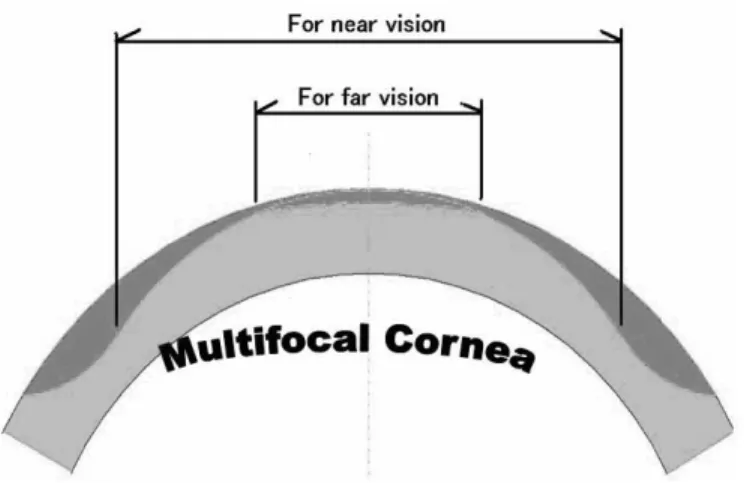
As compared to monovision LASIK where only one eye is set for distance and one for near, in multifocal LASIK, each eye can have the operation for the purpose of providing each with both distance vision and reading vision. To achieve a multifocal effect, the central portion of the treated cornea bends light rays to the back of the eye for far vision. The rays of light for reading vision travel through a ring-shaped section of the cornea around the central area that is curved to bring close-up images into focus.
With multifocal LASIK, the operated eye is set to have natural focal points both at distance and up-close. Worldwide, most people who undergo multifocal LASIK have the procedure done on both eyes.
At our center, we use LASIK to produce a bifocal correction on one eye (typically the non-dominant eye). The dominant eye is set purely to see in the distance to achieve the very best night driving vision. We set the non-dominant eye to see best both at middle range distances and also to read at usual book-reading distance. Typically the multifocal LASIK patient attains 20/20 or close to 20/20 distance vision by virtue of the distance correction on the dominant the. The non-dominant eye, set for short distance vision, does not see distance as well as the distance-corrected eye. But there is only a relatively slight difference in the distance optics between the dominant and non-dominant eye, this system is well tolerated.
Figure 14-1. BIFOCAL LASER CORRECTION Above is a diagram of the design of the side view of the cornea with a bifocal laser correction. The bifocal correction is centered over the cornea. The more central portion of the cornea becomes slightly flatter for more intermediate vision within a room, the car dashboard, and the computer. The peripheral portion of the cornea is made slightly more curved for closer reading vision. In multifocal LASIK we produce pure distance vision for the dominant eye and bifocal correction for the non-dominant eye. This produces three natural focal points for the eye even when the internal focusing system of the eye no longer functions.
The system of multifocal LASIK is an improvement over monovision in that the bifocal eye also sees well at intermediate distance as well as for close reading. For people over about 47 years old multifocal LASIK produces better intermediate range vision than is obtained with standard monovision. By producing the extra focal point for the non-dominant eye, there is a smooth transition when the patient looks at various distances.
Generally the dominant eye is monofocal and directed at distance and the non-dominant eye is bifocal and mildly myopic. Occasionally we will offer bifocal LASIK in both eyes. First the regular multifocal LASIK is performed. Then we wait three months for the eyes to heal from the procedure and we perform special tests in the office to determine whether or not the dominant eye should be bifocal. Actually, only a small percentage of patients feel the need to have the dominant eye set bifocally.
There may be the need for more than one procedure, such as some fine-tuning of the eye optics, to attain best results. Theoretically, there could be some reduction in the ability to see contrast, but we have not seen this problem in our patients. There could be halos around lights under conditions that are similar to being outside at night, but again, we have actually found this to be essentially no problem in the multifocal LASIK patients, probably because the multifocal eye is already slightly out of focus for distance anyway.
As with LASIK in general, we cannot guarantee to what extent the desired result will be achieved. On the other hand, we are finding the typical patient is able to see 20/20 at distance – the small type for reading – and 20/20 or 20/25 test letters at 27 inches. In everyday terms, this translates into the ability to see distance satisfactorily, to read the paper and menus satisfactorily and to work in an office satisfactorily without needing glasses. Since the patients having multifocal LASIK are often twice the age of the younger LASIK patients, healing takes longer.
We typically have stability of the eye optics by eight weeks. People need to learn to use their eyes with the new optics, and this takes some degree of adaptation. Some people may still prefer to wear reading glasses when, say, reading a novel for hours
at a time. One advantage of multifocal LASIK is that it can be modified or even reversed with a relatively minor procedure.
For patients who are not candidates for LASIK but who are candidates for surface laser treatment such as PRK, LASEK, or Epi-LASIK, the multifocal correction can also be performed with successful results that are essentially the same as with multifocal LASIK.
Presbyopic lens exchange
Presbyopic lens exchange is the adaptation of the well-developed technology of cataract/implant surgery and the use of an FDA-approved lens implant to help presbyopic people see better. Presbyopic lens exchange is the same as the refractive lens exchange discussed in a previous chapter, except that the lens implant is for the purpose of eliminating the need for bifocals.
The first FDA approved intraocular lens implant to treat presbyopia was the AMO Array lens, approved in 1997. This is a multifocal implant that offers reading, intermediate-distance vision, and far vision in a single operation on one eye. The lens is constructed to produce concentric rings of lenses, some dominant for distance vision, some for close-up vision, and some for intermediate distance.
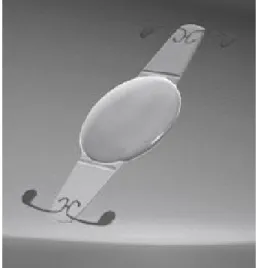
More recently, the Eyeonics CrystaLens TM was FDA approved. The CrystaLensTM is a single-focus lens that actually moves forward and backward under the action of the ciliary muscles to accomplish accommodation.
One eye operation is done at a time, with a time interval between the procedures of between three days and four weeks.
Presbyopic lens exchange is an essentially painless, outpatient procedure performed during a 15-minute period while the patient is partially or totally asleep. The lens implant used has the capability of freeing a person of glasses not only for long-distance vision but also for middle long-distances and close-up vision.
Benefits
People who have the presbyopic lens exchange procedure are generally liberated from glasses. In the U.S. FDA clinical study of the AMO Array lens in 1997, 41% were completely liberated from all types of eyeglasses for all occasions and 92% used glasses at most “occasionally.” We further increase the percentage of people completely liberated these days with the use of LASIK after presbyopic lens exchange to correct minor optical imbalances.
Risks
The downside of presbyopic lens exchange includes a slight risk of damage inside the eye, because that is where the operation takes place.
The consent form goes into more detail, but the main risks of presbyopic lens exchange surgery are summarized below/
• Retinal detachment • Dislocation of the implant • Inflammation
• Bleeding • Infection
• Elevated eye pressure
• Unacceptable degree of halo effect (A more) ( R less) • Late loss of sharpest vision (lens capsular clouding) • Late, minor implant decentration (A)
• Late decrease of accommodation effect (C)
CODE: C=CrystaLensTM A=ArrayR lens R= ReSTOR® lens *Some degree of halo effect is a side effect of the multiple lens system and halos occur in a l l patients who have the Array intraocular lens, but it is almost always tolerable.
Because the multifocal implant consists of concentric rings to achieve the multifocal effect, patients notice a halo around lights at night. In the FDA’s clinical testing, patients with implanted Arraylenses reported a moderate amount of glare from oncoming headlights and from taillights of cars. This glare did not limit patients’ ability to read signs at night. In my surgical experience with the Arraylens since early 1998, only one patient has asked for the implant to be removed and exchanged for a single-focus implant, and this was to eliminate the halo effect.
According to the results of the U.S. FDA Clinical Investigation of the Array lens implant to treat presbyopia, 89 percent of patients were free of any severe problems with glare, 89% could read small print without glasses, and 85% were free of any severe difficulty with halos.
The experience at our center with the Array multifocal intraocular lens implant treatment for presbyopia has been favorable. Nevertheless, in less than 0.5% of patients, the multifocal lens has been removed due to excessive difficulties with the halos. In addition, patients who have suffered accidental head trauma have experienced dislocation of the lens implant as a result. These patients have needed a separate procedure to fixate the implant with sutures.
In addition, we have seen slight decentrations of the lens implant that have occurred years after the initial procedure. These decentrations have led to slight reductions in visual clarity or contrast sensitivity. As of mid-year 2004, we have not removed any implants due to subtle off-center lens migration in all the multifocal lens implants performed since 1997. Such minor lens migrations during healing are actually quite common with monofocal lens implants also, but with these, any change in visual clarity is extremely rare.
A common consequence of implant surgery, especially in people who are younger than the usual elderly cataract patient, is the formation of a clouding of the capsule of the natural lens casing of the eye. The natural lens capsule is the structure that holds the implant into place. Should this clouding occur, a simple, painless and permanent office laser procedure clears the problem. Recovery period
Office workers can usually go back to work within a day or two of surgery even though they have not yet fully recovered vision in the operated eye. People doing heavy work need more time off work after surgery than office workers do.
Recovery of full vision generally takes two weeks with each implant procedure. There is a wide range in the speed of normal healing from the surgery. Surgeons perform the procedures one eye at a time, with the second surgery taking place anywhere from three days to one month after the first. Between the operations on the first eye and the second, the patient can wear glasses with plain glass covering the operated side.
How long will surgery take? Will I feel anything?
The presbyopic lens exchange procedure is typically performed in an outpatient surgical facility. You will arrive at the surgery center about an hour before the procedure. A number of topical drops will be placed in your eye and oral medications may
be administered to help you relax. The eye drops anesthetize your eye and dilate your pupil.
Once in the surgery suite, you will lie down on a comfortable bed, a microscope will be positioned over your eye and you will be asked to look up into the light of the microscope.
The actual surgery usually takes less than 20 minutes. The surgeon will stabilize your eye with a device to keep your eyelids open. You will feel no pain, only slight pressure on your eye. All you have to do is to relax and hold still.
Once the surgery is complete, additional drops will be placed in your eye to prevent infection, decrease inflammation, and keep your pupil dilated. A patch may be placed over your eye and someone will need to drive you home. Once at home, you should rest for the remainder of the day. You should avoid any strenuous activities. Your doctor will see you the day after surgery to remove the eye patch and examine your eye. Do not rub your eye.
After surgery, you are given additional medications to put in your eye for the next week or two. These drugs help the eye to heal with no residual effects.
The Array lens implant
Some lens implants are made to reduce a person’s dependence on bifocals. One such lens is called a multifocal lens implant. In general use since 1997, the Array lens by the A.M.O. Corp consists of multiple lenses arranged in concentric rings. This FDA approved lens has been proven generally safe and effective. Originally developed to improve freedom from glasses after cataract surgery, the success of the Array lens led to the common practice of lens removal surgery purely for reduction of the need for bifocals. But the implant is not perfect.
The lens may well not produce one hundred percent independence from eyeglasses. Some people may need glasses for distance or reading, or both. For people who still need an eyeglass prescription, a supplementary procedure such as LASIK would likely help in further reducing dependence on glasses.
Almost all people who have the A.M.O. Array multifocal lens implant notice a halo around lights in the distance at night when the pupil is dilated. In the long-term, these halos are not generally bothersome to most people. But some people require an eye drop at night to constrict the pupil to remove the halos. Rarely, the halo symptoms are sufficiently bothersome that the lens implant must be replaced. Because best vision requires good implant centration, it is important that there be no eye trauma during the healing process.
Even without trauma, a slight shift in the position of the lens implant that could blur vision is possible years after surgery. Very slight shifts in position are common as a result of contraction of the capsule of the natural lens around the implant, but visual blurring is unusual. Should late shifting occur with significant visual blurring, a surgical process might be elected to either re-center the lens or to remove and replace it?
It is common for there to be slight shifts in the position of the lens implants with time. With a standard or monofocal lens, this shift is highly unlikely to lead to a visual problem. On the other hand, because the Array lens is a sequence of smaller concentric lenses, a small shift is more likely to cause a slight reduction in visual acuity. Because of this late, slight shift, the Array lens implant is not our top choice.
Rather than the Array lens implant, we use a combination of standard monofocal lens implantation with subsequent LASIK. The optical center of multifocal LASIK does not decenter with time because it is engraved onto the cornea. Furthermore, the effect of multifocal LASIK is reversible by a procedure performed on the outside of the eye rather than an intraocular procedure.
Another alternative to the Array lens implant is the Eyeonics CrystaLensTM which achieves multifocality not by having multiple lenses but by physically moving back and forth within the eye as directed by the muscles of accommodation.
FDA-approved in 2003, the CrystaLensTM is also for the purpose of minimizing dependence on bifocals. Again, the CrystaLensTM is implanted into the sac of the natural lens after the process of lens removal. During focusing, the ciliary muscle of the eye pushes the implant slightly forward to see up-close and the lens goes slightly backward to see objects at a greater distance. Results have been generally excellent. The occurrence of halos has been rare with the CrystaLensTM. As with other implants, lens dislocation is possible especially during the early days after surgery, and it is important to avoid trauma to the eye in the early postoperative days. Often the surgeon will keep the pupil dilated and the focusing muscles at rest with eye drops to allow the lens implant to settle into exactly the right position within the lens capsule.
Figure 14-2: CrystaLensTM accommodating lens implant has specially hinged haptics that allow for forward and backward lens movement under the action of the ciliary muscles.
The surgeon may elect not to implant the CrystaLens TM even though that was the preoperative plan. That could occur when, in the surgeon’s judgment, the operative conditions were not best for that lens. In such a case, alternative procedures include using the Array multifocal lens or a monofocal lens implant (and depending on a different procedure such as multifocal LASIK or CK to reduce dependency on bifocals).
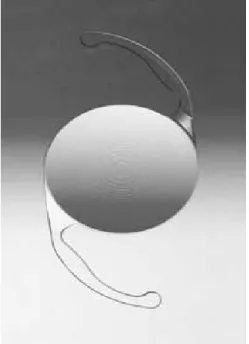
The Alcon Acrysof® ReSTOR® diffractive apodized intraocular lens. The AcrySof ReSTOR IOL has been shown to be, so far the lens that frees the highest percentage of patients from glasses of all the lens implants approved. Unlike the accommodative CrystaLensTM, it doesn't depend on contraction
of the ciliary muscle to move the lens to create a range of vision. Instead, it creates good near and distance vision by combining apodized diffractive and refractive optics.
Figure 14-3: The Alcon Acrysof® ReSTOR® diffractive intraocular lens.
A central 3.6-mm diffractive region facilitates both near and distance vision; this gradually blends into the outer (refractive) portion of the optic through a controlled step height reduction called "apodization." When the pupil is constricted, incoming light is equally divided between near and distance vision; when the pupil is enlarged, as in low lighting conditions, the light distribution becomes distance-dominant. Clinical results are showing a reduction in the incidence of glare and halos, which the company attributes to the apodization process.
Possible complications of presbyopic lens exchange
The procedure of presbyopic lens exchange is the same proven cataract surgery performed annually on over 7 million eyes globally. Over 40 million procedures have been done in the last 25 years. But because it is surgery, it is not completely risk-free.
Complications of cataract surgery range from minor – usually temporary – side effects to sight-threatening compli-cations. Fortunately, significant sight-threatening complications are extremely rare. Some of the possible complications of lens removal surgery include, but are not limited to: making vision worse than before the operation, bleeding, loss of corneal clarity, infection, retinal detachment, glaucoma (high pressure), and double vision. Though quite rare, even blindness could result. Also, many people with cataracts also have other eye diseases such as macular degeneration or diabetic retinopathy that cataract surgery cannot help.
The intraocular lens implant itself could present complications including, but not limited to: clouding of the cornea, infection, inflammation inside the eye, glaucoma, bleeding inside the eye, inability to dilate or to constrict the pupil, dislocation of the implant, retinal detachment and prolonged edema (swelling) of the macula. If the implant needed to be removed and repositioned, it would entail an additional surgery with additional risk.
The role of lens surgery in surgical vision correction Because lens surgery is performed on the inside of the eye, surgeons do not customarily perform it on both eyes at the same time. It is much preferable to wait a few days until the vision of the first eye has attained an acceptable level before going ahead with a procedure on the second eye. There are exceptions, however.
For people who have a high degree of hyperopia, the lens implant techniques can yield better optics than those of LASIK or
PRK. These surface treatments are commonly used after healing from lens implantation to maximize visual results.
Bioptics
Bioptics means a combination procedure involving an intraocular lens implant (typically along with removal of the natural lens) followed by LASIK. It may be recommended for the most extreme levels of myopia and hyperopia when neither technique alone will correct the entire refractive error. This combined technique can be used to correct over 30.00 diopters of myopia — nearly three times the maximum amount that can be safely corrected with LASIK. Using LASIK subsequent to a presbyopic lens exchange is also a form of bioptics surgery.
For patients and surgeons concerned about subtle late implant migration of a multifocal lens in the presbyopic lens exchange, one option is multifocal LASIK, where there is no possibility of migration of the optics. Described elsewhere in this text, multifocal LASIK produces more than one curvature on the cornea. In this way, a person who had previous implant correction with an ordinary monofocal lens implant can gain multifocal vision and independence from glasses.
If the patient’s original eyeglass prescription was beyond the range of LASIK, during lens removal surgery, the lens capsule is left mostly intact for the purpose of holding the implant. Lens capsule opacification, though not considered an actual complication, can cause visual blurring weeks to years after lens removal surgery. Once the problem is detected, a YAG laser capsulotomy done in the office is highly successful in restoring vision.
Even though cataract surgery is usually performed with local numbing of the eye and intravenous sedation, there is a possibility of a drug reaction. Any time anesthesia is used, it is possible that a person could have a complication involving another part of the body, including brain damage or even death. Fortunately, eye surgery has a much lower rate of general body reactions than other surgeries. People with existing medical conditions such as diabetes, high blood pressure, chronic
inflammatory conditions and chronic infections are at a higher risk of developing complications.
Current technology has led to a low complication rate after lens removal for the treatment of visual loss from cataracts with a very high probability of improved vision. With the increased safety and efficacy of lens removal surgery, the technology is now commonly applied to those who want to gain freedom from dependence on eyeglasses but who do not have cataracts. Lens removal/lens implantation is applied mostly for those who have hyperopia beyond the range of good results from LASIK, especially for those over age 45. If the patient has a mild cataract and has hyperopia and dependence on glasses, then there is even more reason for lens removal surgery. Lens removal/lens implantation to reduce the need for glasses is called refractive lens exchange.
Refractive lens exchange using a standard lens implant does not lead to total independence from glasses because reading glasses would still be needed. On the other hand, if refractive lens exchange is performed using multifocal lens implant or the CrystaLensTM implant, there will likely be a major reduction in the need for glasses not only for driving, but also for many up-close tasks. Some up-close tasks such as working on the computer or reading low-contrast material in semi-darkness are easier than others, such as threading a needle or reading low-contrast material in semi-darkness, and people may achieve eyeglass independence for some tasks but not others. For situations best handled with refractive lens exchange for presbyopia, we favor either the CrystaLensTM or a standard monofocal lens implant followed by multifocal LASIK.
Which procedure or combination of procedures to have is a decision to be made by the surgeon and the patient and depends on the merits of the technology for the individual patient’s problem.
Reversing presbyopia by making room for the focusing muscles to work
Presbyopia is the stiffening of the focusing system of our natural lens that decreases near vision as we age. Several devices and surgeries have been tried, all of which are designed to increase the diameter or enlarge the circumference of the front of the eye and tighten the fibers that control the focus of the lens.
One of the principle theories of presbyopia suggests that, as we age and the lens grows, the fibers around the lens become loose and the focusing muscles surrounding the lens become less effective. By enlarging the circumference (and hence the diameter) of the eye, the fibers should once again become tight and thus, muscle focusing should resume.
SRP – Surgical reversal of presbyopia with Scleral Expansion Bands (SEBs) – Schachar method
Surgical reversal of presbyopia (SRP) consists of the use of a number of thin silicone bands implanted within the sclera to stretch or expand the equator of the eye in order to restore
accommodation and the ability to read without corrective lenses. Dr. Ronald Schachar of the Presby Corporation was the primary developer of SRP. I was the first American surgeon to purchase equipment and supplies for the surgery and the fourth American to perform the procedure. My first procedures were in 1997.
Schachar has done much research and published in peer-reviewed journals on the theory of how the human eye focuses for reading. The essence of the theory is that expansion of the diameter of the eye over the ciliary focusing muscles will allow increased room for the eye’s natural crystalline lens to move normally, enabling the eye to see near objects again. These procedures are still being investigated in FDA-monitored clinical trials.
Scleral expansion bands actually do not expand the sclera. The name SEB comes from the fact that earlier models of the system did cinch up the sclera and stretch it. The much tinier SEBs of today merely lift four sections of the sclera to increase the diameter in two perpendicular axes.
To date, there is some controversy about both the theory of accommodation and how Dr. Schachar’s SEBs actually work. But in general, the SEBs do work to improve accommodation. The early results of surgical reversal of presbyopia with SEBs were promising. The main problem is the high variability in the effect of the bands. The bands worked well for some patients and had no effect on accommodation for others. There was some reduction in the effect over time, even in patients where SEB implants did indeed increase accommodation. As equipment for surgical implantation improves and as there is further development of diagnostic devices to more precisely define the optimum place to implant the SEBs in the individual patient, we are likely to see a higher probability of success for the SEB surgery. Our book entitled I CAN SEE! The Baby Boomer’s Guide to Corrective Eye Surgery gives a more comprehensive treatment of SEB surgery.
Anterior Ciliary Sclerotomy (ACS)
Anterior ciliary sclerotomy is a surgical procedure for relieving presbyopia. It involves the creation of several small incisions into the white sclera directly over the ciliary muscle that controls the eye’s natural lens. The purpose of this procedure is to expand the circumference around the equator of the eye. Although there are some proponents of the procedure, there are no data published in any peer-reviewed journal that indicate that anterior ciliary sclerotomy is capable of reliably ridding people of their need for reading glasses.
Laser Assisted Presbyopia Reversal (LAPR)
Patterned after anterior ciliary sclerotomy, laser assisted presbyopia reversal (LAPR), developed by J.T. Lin, Ph.D., involves the creation of eight linear laser tissue excisions 0.6mm wide and 3mm long in the sclera. The excisions go somewhat more than sixty percent of the way through the sclera, are radially oriented, and extend from a point 1mm and a point 4mm back from the limbal border between the sclera and the cornea.
With the laser removal of linear tracks of tissue sixty percent of the way through the sclera, there is a stretching of the
remaining sclera, an enlargement of the circumference of the eye and therefore an increase in the diameter of the eye over the area of the ciliary muscles. With the increased space for muscle action, there is increased accommodation and lessened dependence on reading glasses. As of the year 2004, one experienced investigator reports that an average of one diopter of accommodation is gained through LAPR. The typical reading glasses purchased at the drugstore have a power of +1.25 diopters to +3.50 diopters. Therefore, we would not expect an increase in accommodation of one diopter to remove the need for reading glasses for most people who need them.
Which procedure is best?
As usual, which procedure is best depends on the individual’s situation. People who have cataracts and want to be free of bifocals should consider presbyopic lens exchange. People who are beyond the range of good results from LASIK should consider presbyopic lens exchange.
Most people are probably best served with multifocal LASIK because it combines the good safety record of LASIK with adjustability, the correction of astigmatism, and a high success rate. The inner eye is not touched, so there are no complications of the inner eye. The procedure involves only the outside of the eye, thus eliminating any likelihood of complications for the internal eye. From the data in the chapter that follows, multifocal LASIK appears to be superior in effectiveness and permanency to conductive keratoplasty (CK).
On the other hand, a presbyopic person who has hyperopia and whose eyeglass prescription is beyond the range of good results from LASIK should consider presbyopic lens exchange. Also, if cataracts have already reduced vision, it makes sense to try to solve the problem of cataracts along with presbyopia. The financial costs and potential risks of presbyopic lens change exceed those of multifocal LASIK but in some cases, vision is better with the implants. There are situations where presbyopic lens exchange and multifocal LASIK make equal sense.
Procedures on the sclera, such as the implantation of scleral expansion bands or laser-assisted presbyopia reversal,
could have a significant place in the future, but the technology needs further development. Candidates for these procedures would include those who have no need for glasses for distance, have significant presbyopia, and do not have cataracts.
Candidates for presbyopic lens exchange
On the other hand, some people are best served by
presbyopic lens exchange. Some people who have to wear bifocals may also be developing an early form of opacity in the lens called a cataract. If LASIK were performed for a person with an early cataract, the results of these procedures might not be as long-lasting. If the cataract worsened, changes in the optics of the eye would eventually blur the vision. A person with an early form of cataracts might have better long-term results with a presbyopic lens exchange.
People who do not have a lens opacity, or cataract, but who what to be free of glasses and have an eyeglass prescription that is beyond the range of LASIK, especially too hyperopic for LASIK, may be candidates for presbyopic lens exchange. People who have a high degree of hyperopia, in which a magnifying lens is needed to see distance, may not obtain as good an optical result with LASIK as those with nearsightedness. If the degree of hyperopia is large enough and the patient wants to be free of glasses, a better option may be to have presbyopic lens exchange.
LASIK for hyperopia has improved recently with the addition of wavefront guided LASIK for hyperopia and thus had increased the range of good visual correction by LASIK.
Questions and Answers
Which procedure is right for me, if any?our medical consultation will help you decide this.
LASIK is the procedure of choice for reducing or eliminating the need for glasses and contact lenses for
most people. Most typically, PRK is applicable to people who would be LASIK candidates except for very dry eyes or thin corneas.
If you are past about 47 years old, want to be relatively or fully free of the need for glasses and contact lenses, and do not have any medical issues that prohibit good results from surgery, one of the procedures especially in Chapter 14 of this book could be helpful for you.
Multifocal LASIK is probably the most helpful to
eliminate bifocals. It has the highest rate of getting people free of glasses, is relatively low-risk, is relatively reversible and modifiable and its effect does not fade in any significant way with time. Multifocal LASIK is the procedure of choice for people wanting to get rid of the need for glasses who are past about 47 years old. People who would be LASIK candidates except for a moderately thin cornea may be well- served with multifocal PRK.
Conductive keratoplasty may be the surgical procedure for some patients who are not LASIK or PRK candidates, have no need for any eyeglass correction for distance vision, have little or no astigmatism, are tolerant to monovision, and who do not mind having a quick and relatively painless but temporary visual correction. It is important to remember that CK results fade.
For people with cataracts or for people with clear lenses but whose eye optics are out of the range of LASIK, one of the lens implant procedures should be seriously considered. People who are too myopic or nearsighted for LASIK may be good candidates for the phakic intraocular lens implant such the Staar Visian ICL posterior chamber lens or the Verisyse Artisan anterior chamber lens.
People who have cataracts should definitely consider having lens implants that reduce the need for bifocals and reading glasses as well as glasses for distance. People who have clear lenses without cataract and who are out of the range of multifocal LASIK or who must have both eyes seeing exactly the same way may be candidates for lens removal with implantation of either the Array multifocal lens or the CrystaLensTM or the ReSTOR® lens (when available). The CrystaLensTM is give good quality vision
much more free of night halos than the Array. The ReSTOR® would be the implant most likely to produce complete spectacle independence, even more than the CrystaLensTM, but 5% of ReSTOR® patients reported serious night halos, whereas CrystaLensTM patienst had about the same amount of glare as patients with ordinary monofocal lens implants. Based on the operative conditions in your eye at the time of surgery one type of lens or another may be better for you. This is certainly a surgeon’s judgment call.