Year 7 Science
Ark Globe Academy
Remote Learning
Spring Term Pack 1
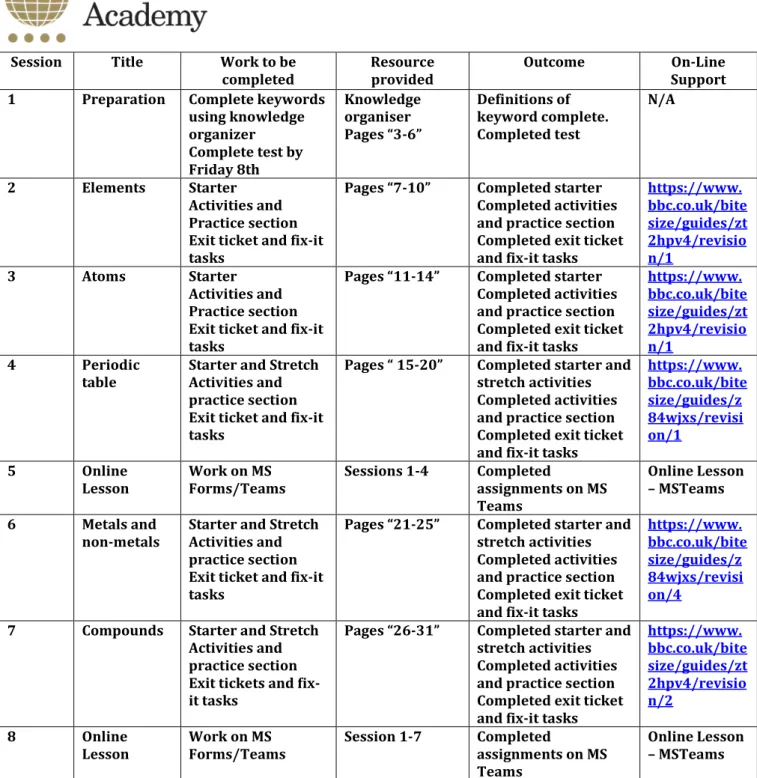
Session Title Work to be
completed Resource provided Outcome Support On-Line 1 Preparation Complete keywords
using knowledge organizer Complete test by Friday 8th Knowledge organiser Pages “3-6” Definitions of keyword complete. Completed test N/A 2 Elements Starter Activities and Practice section Exit ticket and fix-it tasks
Pages “7-10” Completed starter Completed activities and practice section Completed exit ticket and fix-it tasks
https://www. bbc.co.uk/bite size/guides/zt 2hpv4/revisio n/1 3 Atoms Starter Activities and Practice section Exit ticket and fix-it tasks
Pages “11-14” Completed starter Completed activities and practice section Completed exit ticket and fix-it tasks
https://www. bbc.co.uk/bite size/guides/zt 2hpv4/revisio n/1 4 Periodic
table Starter and Stretch Activities and practice section Exit ticket and fix-it tasks
Pages “ 15-20” Completed starter and stretch activities Completed activities and practice section Completed exit ticket and fix-it tasks
https://www. bbc.co.uk/bite size/guides/z 84wjxs/revisi on/1 5 Online
Lesson Work on MS Forms/Teams Sessions 1-4 Completed assignments on MS Teams
Online Lesson – MSTeams 6 Metals and
non-metals Starter and Stretch Activities and practice section Exit ticket and fix-it tasks
Pages “21-25” Completed starter and stretch activities Completed activities and practice section Completed exit ticket and fix-it tasks
https://www. bbc.co.uk/bite size/guides/z 84wjxs/revisi on/4
7 Compounds Starter and Stretch Activities and practice section Exit tickets and fix-it tasks
Pages “26-31” Completed starter and stretch activities Completed activities and practice section Completed exit ticket and fix-it tasks
https://www. bbc.co.uk/bite size/guides/zt 2hpv4/revisio n/2 8 Online
Lesson Work on MS Forms/Teams Session 1-7 Completed assignments on MS Teams
Online Lesson – MSTeams
Elements
1. All substances are composed of atoms
2. Elements are made from only one type of atom.
e.g. this diagram shows an element because it is made from only one type of atom.
3. There are about 100 different elements
4. An atom is the smallest part of an element that can exist
5. Elements have specific physical and chemical properties
6. Physical properties = state,
appearance, smell, magnetic, etc. 7. Chemical properties = what it reacts
with and how reactive it is
Periodic Table
8. Elements are organised in the Periodic Table
9. The Periodic Table is organised into periods and groups
10.Groups are vertical columns 11.Periods are horizontal rows 12.Elements in a group have similar
chemical properties
13.Metals are on the left hand side of the ‘staircase’ and non-metals are on the right hand side of the ‘staircase’.
Compounds
14.Compounds are formed from elements by chemical reactions
15.Chemical reactions always involve the production of one or more new
substances
e.g. in the diagram below there are two elements that when they react together, make a new compound
liquid element gas element solid compound
16.When two elements react to form a compound, the masses of the reacting elements is equal to the mass of the compound produced. This is the law of
conservation of mass.
e.g. magnesium + oxygen magnesium oxide 30 g 10 g 40 g
17.A compound contains two or more elements chemically joined together in fixed proportions
18.A compound has different properties from the elements it’s composed
19.Compounds can only be separated into elements by chemical reactions
20.A molecule is two or more non-metal atoms chemically joined together – this can be an element (e.g. H2) or a
Hazard symbols Naming compounds
21.There are rules to follow when naming compounds:
a. Usually the metal goes first and the non-metal goes second
b. If a metal and a non-metal react, the name of the non-metal ends in –ide
c. For some compounds, if there are a different number of atoms we add in ‘mono’ for 1, ‘di’
for 2 and ‘tri’ for 3
If the compound names ends in –ate then it usually contains three elements, including a non-metal and oxygen.
Chemical formulae
22.Each element is represented by a chemical symbol.
e.g. Iron = Fe, oxygen = O, magnesium = Mg, gold = Au
23.The chemical formula of a molecule or compound tells you which elements and how many atoms of each are in one molecule
24.The small subscript number after an element symbol is the number of atoms of that
element are in one molecule
e.g. In HNO3 there is 1 atom of hydrogen, 1
atom of nitrogen and 3 atoms of oxygen per molecule.
Keyword
Definition
Element Atom Chemical Symbol Periodic Table Properties Particle Metal Non-metal Group Period Brittle Malleable Ductile Sonorous Chemical reaction Compound Conservation of mass Hazard Flammable Harmful Corrosive Molecule Formulae SubscriptStarter
Use the examples in the following pictures to suggest why different products are made with different materials:
All substances are made of very tiny particles called atoms. Atoms are the
smallest unit of matter. There are just over one hundred substances that are
made up of just one type of atom. These are the elements. Elements are the
simplest substances in the universe. For example, Copper is just made up of Copper atoms, Carbon is just made up of Carbon atoms and Helium is just made up of Helium atoms.
Element: a substance made up of one type of atom (all of the atoms in an
element are the same).
From the 5th century AD people thought that there were only four elements: fire, earth, water and wind. These are now considered to be the ‘classical elements’, although none of these are actually elements by today’s definition. Over the years, scientists have discovered lots of new elements and needed a way to order them so the Periodic Table was created. The periodic table shows all of the
elements ever discovered. The first element in the Periodic Table was discovered in 1649 and new elements are still being discovered today; four new elements were recently added in 2016 (although you may not see these in every version of the Periodic Table.
Note: if a substance does not appear in the Periodic Table it is not an element. Water is an example of this. Water’s chemical name is dihydrogen monoxide because it is a compound made from hydrogen and oxygen, which are separate elements and can be found in the Periodic Table themselves.
Elements in different parts of the Periodic Table have different properties and
some will be more familiar to you than others. A lot of the elements in the Periodic Table are solids at room temperature, some are gases but only two are liquids (Bromine and Mercury).
1. Use the following pictures of elements to help you complete the table (or you can research their properties online). The first one has been done for you:
Element Symbol Colour State Appearance
Lead Pb Silver Solid Dull, hard
Copper Mercury
1. What is the best definition for an element?
A. A substance made up of many types of atom (all the atoms in an element are the same)
B. A substance made up of one type of atom (all the atoms in an element are the same)
C. A substance made up of one type of atom (all the atoms in an element are different)
2. How are atoms and elements different?
A. Elements are made from atoms
B. Atoms are made from elements
C. Elements are used to make substances but atoms are not
3. Which correctly shows elements only?
A. Iron, air, water
B. Carbon, hydrogen, water
C. Copper, gold, oxygen
If you answered A
Elements are made up of one type of atom, which means that all the atoms in an element are the same (there is only one type of atom present in an element). If there were different types of atom present, the substance could not be an element.
Explain the difference between Carbon and Copper in terms of atoms. If you answered B
Elements are made up of one type of atom, which means that all the atoms in an element are the same. For example Carbon is made up of only Carbon atoms.
Explain why air is not found in the Periodic Table. If you answered C
Elements are made up of one type of atom, which means that all the atoms in an element are the same. For example Gold contains only Gold atoms (all the atoms in an element are the same).
Starter
1. What is the definition of an element?
2. Which of the following are all elements?
A. Carbon, mercury, lead
B. Carbon, lead steel
C. Steel, lead, mercury
3. Explain how an atom differs from an element.
Foundation: Draw two particle diagrams to represent two different elements.
Stretch: Suggest why scientists left gaps in the early versions of the periodic table.
An atom is the smallest part of an element. The atoms in an element are all the same, but the atoms of different elements are different. They are all very, very small - an element the size of a full stop would contain over 5 million atoms! Different elements have different properties because of the type of atom they are made of. There are about 100 different elements, all with unique atoms!
The image below represents atoms of different elements.
1. Which symbol represents:
a. The smallest atom? ________
b. The largest atom? _________
2. Use your periodic table to identify
the name of the following elements:
a. Li: ______________
b. Xe: _____________
c. Sr: ______________
c.A student looks at this image and says that ‘hydrogen (H) and helium (He) must
be the same element because they have the same atoms’. How can you explain to this student that this isn’t true?
_______________________________________________________ _______________________________________________________ _______________________________________________________
3. The diagrams below represent atoms of different elements.
a. Which diagram represents atoms of two different elements? Explain why.
_______________________________________________________ _______________________________________________________
b. Which diagram represents atoms in a solid state? Explain why.
_______________________________________________________ _______________________________________________________
1. What is the best definition for an atom?
A. The smallest particle of an element that can exist
B. A type of element
C. A group of the same elements
2. Why do different elements have different properties?
A. They are made of different atoms
B. The atoms are all different sizes and colours
C. Some atoms are solid and some atoms are gas
3. Which of these would contain only one type of atom?
A. Water
B. Air
C. Oxygen
If you answered A
Elements consist of one type of atom but can contain a huge number of this same type of atom. Atoms are the smallest particle of an element that exists and the smallest unit of matter. Explain the difference between an atom and an element.
If you answered B
Elements consist of one type of atom but can contain a huge number of this same type of atom. Atoms are the smallest particle of an element that exists and the smallest unit of matter. Atoms are not a type of element, but rather each element is made up of one type of atom.
State the definition of an atom and the definition of an element. If you answered C
Elements consist of one type of atom but can contain a huge number of this same type of atom. Atoms are the smallest particle of an element that exists and the smallest unit of matter. A group of the same element would still be an element, as the term element refers to anything that is made up of one type of atom.
Starter
Describe what each of the different diagrams below represent. A has been done for you.
Foundation: Describe the difference in movement of particles in A and C.
Stretch: Explain why the particles in A and C move differently.
The Periodic Table lists all the elements scientists have discovered. Elements are represented with a chemical symbol (we will use these a lot in chemistry!) Most chemical symbols are easy to remember because they are the first letter, or first two letters of the elements name.
Note: If the symbol is two letters long, the first is always capital, and the second lower case. This is a common mistake as writing CO would represent Carbon and Oxygen and Co would represent Cobalt.
Some have different symbols. E.g. Lead has the symbol Pb. This comes from the Latin word ‘plumbum’,
meaning ‘waterworks’. This dates back to when lead was used in pipes, which we today call plumbing.
The Periodic Table
A shows atoms of
the same element in a gaseous state.
Elements with similar properties are grouped together. Metals are found of the left of the Periodic Table (left of the zigzag line, sometimes referred to as the ‘staircase’) and non-metals are found on the right.
Columns in the Periodic Table are called Groups. Elements in the same group
have similar properties.
METALS
NON-METALS
METALS
This is group 1. All elements in group 1 have similar chemical properties. For example, they all react with water.
This is group 7. All elements in group 7 have similar chemical properties. For example, they all react with metals to make salts.
This is group 0. All elements in group 0 have similar chemical properties. For example, they do not react with anything!
Rows on the Periodic Table are called Periods. Period 1 Period 2 Period 3 Period 4 Period 5 Period 6 All these elements are in Period 4.
Using your periodic table:
1. Identify the correct symbol for:
a. Aluminium: A Al AL aL
b. Sodium: S So Na NA
c. Fluorine: Fl F FL fL
2. Name the element positioned at:
a. Group 2, Period 4: _____________ b. Group 7, Period 3: _____________
c. Group 0, Period 1: _____________
d. Group 4, Period 6: _____________
3. Give the position of the following elements:
a. Magnesium: Group _____, Period _____
b. Polonium: __________________________
c. Lithium: __________________________
d. Carbon: __________________________
4. Only substances that are elements are found on the periodic table. Identify the
three elements in the list below. Label the elements as ‘metal’ or ‘non-metal’:
5. A student says that Sodium is in Group 6, Period 3. How has the student got confused? How would you help them understand why this is wrong?
__________________________________________________________ __________________________________________________________ __________________________________________________________
6. Another student says that Magnesium is in Group 3, Period 2. How has the
student got confused? How would you help them understand why this is wrong? __________________________________________________________ __________________________________________________________ __________________________________________________________
1. Methane is not found on the Periodic Table. What does this tell you about methane?
A. It is an element
B. It is not an element
C. We cannot tell if it is an element or not 2. Which is the correct symbol for Lithium?
A. LI
B. li
C. Li
3. How are elements with similar chemical properties grouped?
A. Within the same group
B. Within the same period
C. Within the same row
If you answered A
The Periodic Table is a list of all the elements. If a substance does not appear in the periodic table it means it cannot be an element and must be made up of a combination of different elements. Explain why Hydrogen and Oxygen are found in the Periodic Table but water is not.
If you answered B
The Periodic Table is a list of all the elements. If a substance does not appear in the periodic table it means it cannot be an element and must be made up of a combination of different elements. Methane is an example of a hydrocarbon. Suggest what elements it is made up of.
If you answered C
The Periodic Table is a list of all the elements. If a substance does not appear in the periodic table it means it cannot be an element and must be made up of a combination of different elements. Determine if the following substances are elements or not:
Starter
1. Which side of the Periodic Table are metals found on?
2. Why are elements placed in the same group in the Periodic Table?
3. Why did scientists leave gaps in the early Periodic Table?
Foundation: Describe how elements are arranged in the Periodic Table.
Stretch: Explain why elements are given a chemical symbol.
The properties of metals
Metals tend to be hard, strong, shiny and sonorous. Sonorous means they ring like a bell when struck. Metals have high density, which means they sink when placed in water.
Metals have high melting points, meaning they can withstand high temperatures and pressure.
Metals are ductile, which means they can be pulled into thin wires.
Metals are good conductors of heat and electricity.
Some metals have magnetic properties (iron, nickel and cobalt).
These different properties make metals suitable for a number of functions
Metals and non-metals
The properties of non-metals
Non-metals tend to be soft, brittle, dull and non-sonorous. Brittle means that something is hard but is likely to shatter.
Non-metals usually have low densities, meaning they tend to float in water.
Non-metals have low melting/boiling points and are poor conductors of heat and electricity.
1. Match the property of the metal to its use:
2. Complete the table to show the uses and properties of different metals.
Metal Use Property
copper electrical wire
high strength
tungsten bulb filament
gold
magnetic
aluminium aeroplanes
aluminium cooking foil ductile
iron bell
saucepan
1. Buildings/drills
2. Pots and pans
3. Wires 4. Jewellery 5. Bells
A. Strong B. Sonorous C. Shiny D. Ductile
3. Scientists have recently discovered a new element called jovium in a crater caused by a meteor that landed on Earth.
A. Describe how scientists could tell if jovium is a metal or a non-metal.
B. Explain how scientists could use jovium’s chemical properties to place it in
the Periodic Table.
__________________________________________________________________________ __________________________________________________________________________ __________________________________________________________________________ __________________________________________________________________________ __________________________________________________________________________ __________________________________________________________________________ __________________________________________________________________________ __________________________________________________________________________ __________________________________________________________________________ __________________________________________________________________________ __________________________________________________________________________ __________________________________________________________________________ __________________________________________________________________________ __________________________________________________________________________ __________________________________________________________________________ __________________________________________________________________________ __________________________________________________________________________ __________________________________________________________________________ __________________________________________________________________________ __________________________________________________________________________ __________________________________________________________________________ __________________________________________________________________________ __________________________________________________________________________
1. Which property of metals makes them useful as bells?
A. They conduct electricity
B. They are ductile C. They are sonorous
2. Most metals are soft and shiny, what can these properties be useful for?
A. Buildings B. Jewellery C. Boats
3. Which word describes non-metals’ tendency to shatter easily?
A. Low density B. Soft
C. Brittle
If you answered A
Different metals have many properties which make them suitable for different functions.
Buildings need to be extremely strong so that they are stable and safe, so it would not be useful to have a soft, shiny metal for this function.
Explain which property of copper makes it suitable to be used for electrical wiring in homes. If you answered B
Different metals have many properties which make them suitable for different functions. Jewellery comes in different shapes and sizes, often with very intricate detail, so it is useful for metals to be soft so they can be made into different shapes. Jewellery is also most valuable if it is gold or silver, which are very shiny metals.
Suggest why aluminium is used to make aeroplanes rather than lead. If you answered C
Different metals have many properties which make them suitable for different functions. Boats need to be built to have a lower density than water (or to have enough air within their structure to give them a lower average density than water). Most metals are more dense than water so would not be suitable to use to build boats by themselves.
Starter
Use your Periodic Table to find the symbol for each element and then use the symbols to find the word being spelled:
e.g. Chlorine, Arsenic, Sulfur : Cl, As, S = ‘ClAsS’
1. Boron, Oxygen, Oxygen, Potassium:
2. Tungsten, Iodine, Nitrogen:
3. Iron, Lithium, Neon:
Foundation: Create your own word using chemical symbols.
Stretch: Metals in Group 1 of the Periodic Table all react with air and water. Suggest how they should be stored in schools to prevent them reacting with air or water.
Sometimes, elements react to make compounds. A compound is a substance that
contains two or more elements chemically bonded together. The properties of the compound will be different to the properties of the two original elements.
We can tell if a chemical reaction has taken place if we observe one of the following:
• A change in colour
• The production of a gas
• A change in temperature
• A change in mass (more on this later)
For example:
Magnesium burns in air (this means it is reacting with oxygen in the air) to produce magnesium oxide. Magnesium oxide is a compound because it contains magnesium and oxygen chemically bonded together. We can see that a chemical reaction has taken place because the new compound and the original element (magnesium) are different colours.
Naming Compounds
There are rules to learn about how to name compounds.
Rule 1 – usually, the metal goes first and the non-metal goes second
e.g. iron and oxygen produce iron oxide
e.g. magnesium + oxygen � magnesium oxide
Rule 2 – if a metal and a non-metal react, the name of the non-metal ends in –ide.
Reacting with the non-metal … oxygen produces oxide sulfur produces sulfide chlorine produces chloride e.g. calcium and oxygen produce calcium oxide
e.g. hydrogen + sulfur hydrogen sulphide
e.g. sodium + fluorine sodium fluoride
Rule 3 – for some compounds, if there are a different number of atoms we add in ‘mono’ for 1, ‘di’ for 2 and ‘tri’ for 3
e.g. Carbon monoxide has 1 oxygen atom
e.g. Carbon dioxide has 2 oxygen atoms
e.g. Carbon trioxide has 3 oxygen atoms
Rule 4 – if the compound names ends in –ate then it usually contains three elements, including a non-metal and oxygen
Reacting with … nitrogen and oxygen produces nitrate sulfur and oxygen produces sufate
chlorine and oxygen produces chlorate e.g. calcium , sulfur and oxygen produces calcium sulfate
e.g. silver + nitrogen + oxygen silver nitrate
e.g. sodium + chlorine + oxygen sodium chlorate
Conservation of Mass
When two elements react to form a compound, the mass of the two elements
combines. The number and type of atoms at the start are the same as at the end. So
the mass of the reactants is the same as the mass of the products. This idea is called conservation of mass because the mass is conserved during the reaction.
E.g. Magnesium + Oxygen Magnesium Oxide
5g + 1g 6g
Note: often if one of the reactant or products in a reaction is a gas people assume that mass has been gained or lost in the reaction. This is not the case – we know that conservation of mass means the total mass of the reactants must be the same as the total mass of the products. However we cannot measure the mass of a gas that reacts or a gas that is produced as it often dissipates into the air. We can use the difference between the mass of the reactants and products to calculate the mass of gas that reacted, or the mass of gas that was produced.
1. Name the compounds formed when there is chemical reaction between these elements:
A. zinc + oxygen
B. 1 carbon atom + 2 oxygen atoms
C. magnesium + oxygen
D. lithium + nitrogen + oxygen
E. potassium + chlorine
F. 1 carbon atom + 3 oxygen atoms
G. calcium + fluorine
H. nitrogen + silver
I. potassium + chlorine + oxygen
J. copper + oxygen + sulfur
2. Magnesium was burnt in air to form magnesium oxygen. The equation for this
reaction is:
Magnesium + Oxygen � Magnesium Oxide
a. Describe the appearance of magnesium before it was burnt in air. You can use
the pictures from the start of this section or use a YouTube video of the reaction between magnesium and oxygen.
__________________________________________________________ __________________________________________________________
b. Describe the appearance of magnesium oxide.
__________________________________________________________ __________________________________________________________
c. Explain how you know a chemical reaction took place.
__________________________________________________________ __________________________________________________________
3. In a chemical reaction, the mass is always conserved.
E.g. Magnesium + Oxygen � Magnesium Oxide
5g + 1g � 6g
a. 7g of Magnesium reacted with 8g of Oxygen. Calculate the mass of magnesium
oxide formed. Show your working.
b. 4g of Magnesium reacted with 1.1g of Oxygen. Calculate the mass of magnesium
oxide formed. Show your working.
c. When 5g of Magnesium reacted with Oxygen, 6.5g of Magnesium Oxide was
formed. Calculate the mass of Oxygen that reacted with the Magnesium. Show your working.
d. When 5g of Magnesium Oxide was broken down (decomposed), 0.8g of Oxygen
was released. Calculate the mass of Magnesium that had been in the compound. Show your working.
1. Which statement best describes this diagram?
A. It shows an element because it is made from only one type of atom
B. It shows a compound because it is made from two different types of
atom bonded together
C. It shows a compound because it is made from two atoms
2.What happens when a chemical reaction takes place?
A. Atoms are made or destroyed
B. A substance melts
C. One or more new substances are produced
3. If 5 g of magnesium reacts with 2 g of oxygen, how many grams of magnesium oxide will be
produced?
A. 3 g B. 7 g
C. 10 g
If you answered A
Elements are made up of only one type of atom. When drawing diagrams to represent elements and compounds different colours or sizes of circle may be used. This does not mean the actual atoms are different colours – this is just so that we can tell the different atoms apart! In this case there are two types of atom present, and they are shown to be joined together. A substance that consists of two or more elements chemically bonded together is a compound.
State the definition of an element and a compound and give an example of each. If you answered B
Compounds are substances which have two or more elements bonded together. When drawing diagrams to represent elements and compounds different colours or sizes of circle may be used. This does not mean the actual atoms are different colours – this is just so that we can tell the different atoms apart! In this case there are two types of atom chemically bonded together, making this substance a compound.
Determine the elements that the following compounds are made up of: Carbon dioxide, sodium chloride, potassium phosphate.
If you answered C
This diagram shows two different types of atom joined (chemically bonded) together. When drawing diagrams to represent elements and compounds different colours or sizes of circle may be used. This does not mean the actual atoms are different colours – this is just so that we can tell the different atoms apart! In this case there are two different types of atom bonded together, which is a compound. If there were two atoms present it could be an element or a compound, depending on if the atoms are different or the same. A compound must be two (or more) different types of atom, which is what is shown in this diagram. An element would only show one type of atom (the circles would all be the same colour or size).