Strategic Performance Allocation in
Institutional Asset Management Firms:
Behold the Power of Stars and Dominant
Clients
*
RANADEB CHAUDHURI
Oakland University
ZORAN IVKOVIĆ
Michigan State University
CHARLES TRZCINKA
Indiana University
ABSTRACT
We identify strong and robust evidence of strategic performance allocation in the institutional money management industry, directed toward strong recent performers. The extent of strategic performance allocation varies with the product’s client power. Strategic performance allocation is particularly pronounced for young products. Studying variation in opportunities for strategic performance allocation (illiquidity of the products’ investment styles and cross-trading status of the firm) enables us to show that (at least part of) strategic performance allocation rests upon cross-subsidization. We also quantify, and assess the implications of, strategic performance allocation away from the products that likely cross-subsidize this performance.
* We thank Vikas Agarwal, Stephen Dimmock, Mark Grinblatt, Umit Gurun, Jung Hoon Lee, Joshua Pollet, Jeffrey
Pontiff, Veronika Pool, Mark Seasholes, Merih Sevilir, Clemens Sialm, Andrei Simonov, and Scott Yonker for comments and suggestions. Our gratitude goes to the 2012 Finance from Down Under conference participants, especially Neal Galpin (the discussant). We also thank seminar participants at Hong Kong University, Indiana University, Massey University Albany Campus, Massey University Palmerston North Campus, Nanyang Technological University, National University of Singapore, and Victoria University for their suggestions.
Institutional asset management firms are a major player in the arena of financial intermediation. The volume of assets under management, comparable to that of the mutual fund industry, is in the range of several trillion dollars.1 Unlike the mutual fund
industry, however, the institutional asset management industry remains fairly obscure, likely because institutional asset management firms are required to disclose relatively little. Databases comparable to the CRSP Open-End Mutual Fund Database, containing a host of information about performance, fees, and fund holdings, are not available for
the institutional asset management industry.2
There is a superficial similarity between the ways investment options are structured in the institutional asset management and mutual fund industries. The prevalent organizational form in both is that of a firm (alternatively called complex or family) offering multiple funds or products that cover a range of investment objectives. However, the two industries are quite different. In addition to the vast disparities in the extent of transparency and institutional framework,3 a key difference is the investor
structure. Mutual funds, investment vehicles inaugurated historically in pursuit of the goal of providing small investors access to diversified investment, have a broad
investor base of relatively small investors.4 In the institutional money management
industry, on the other hand, each product typically has relatively few, but large investors.5
Lack of transparency and the nature of this industry create a fertile soil for the emergence of agency issues, often resulting in manipulations of portfolio choices (Lakonishok, Shleifer, and Vishny (1992a)). One such practice is window dressing,
1 According to Standard & Poor’s (2007), at the end of 2006, more than 51,000 plan sponsors allocated more than
seven trillion dollars in assets to about 1,200 institutional money managers.
2 Institutional investment managers that use the United States mail (or other means or instrumentality of interstate
commerce) in the course of their business and that exercise investment discretion over $100 million or more in Section 13(f) securities must file Form 13F. However, they file their overall holdings, aggregated across all the investments they manage (this may also include mutual funds and hedge funds). Thus, the study of product-level holdings on the basis of Form 13F filings in the present context is not plausible.
3 For excellent reviews of the institutional framework prevailing in the institutional money management industry
and many related issues see Lakonishok, Shleifer, and Vishny (1992a) and Goyal and Wahal (2008) in the academic literature, and Fabozzi (1997), Logue and Rader (1998), and Travers (2004) in the practitioner-oriented literature.
4 A mutual fund typically is held by tens of thousands of investors or more, each of whom holds a miniscule fraction
of fund shares. According to the 2003 Investment Company Institute Fact Book (Investment Company Institute (2003)), individuals dominate the mutual fund arena, accounting for 75% of all mutual fund assets in 1992 and 2002, the two data points covered by our sample period (the 2011 Investment Company Institute Fact Book reports continued predominance of individual investors in mutual funds; Investment Company Institute (2011)). A back-of-the envelope calculation based on back-of-the ICI data suggests that average mutual fund holdings by a household investing in mutual funds was around $48,000 in 1992, and around $88,000 in 2002.
5 The largest client invested in a product holds at least half of the assets managed by the product in nearly
one-half (46 percent) of all investment products in our sample; also, 25% of all product-year observations in our sample feature a single client, and another 25% feature two to five clients. Moreover, the average median account size, taken across all observations in our sample, is around 29 million dollars.
removing poor performers from the portfolio and replacing them with similar, but better-performing holdings at the end of the evaluation period such as the end of the calendar year (e.g., Haugen and Lakonishok (1987), Lakonishok, Shleifer, Thaler, and Vishny (1991), Lakonishok, Shleifer, and Vishny (1992b), Moskowitz (2000), Musto (1999), Poterba and Weisbenner (2001), Sias and Starks (1997), Wermers (2000)). Another practice is marking up (or “leaning for the tape”), wherein managers inflate quarter-end or year-end performance of their portfolios (e.g., Carhart, Kaniel, Musto, and Reed (2002), Agarwal, Daniel, and Naik (2011)). Yet another kind of manipulation of portfolio choices is risk shifting, that is, adjusting risk levels in view of interim performance (either locking in the early gains or increasing risk in case of inferior interim performance) or career concerns (e.g., Brown, Harlow, and Starks (1996), Busse (2001), Chevalier and Ellison (1997), Chevalier and Ellison (1999)). Common to all these manipulations is that they involve alterations pursued by a money manager to impress current or future investors in a specific fund (product) without the need to coordinate across different funds (products) offered by the fund family (money management firm).
This paper studies a more complex manipulation of portfolio choices, involving multiple products offered by the same institutional money management firm in a concerted effort to allocate performance strategically across investment products within the firm. In the mutual fund arena, recent literature presents compelling evidence of strategic allocation practices by means of cross-subsidization.6 Our study reveals the
extent and nature of strategic allocation practices in the institutional money management industry, presents compelling evidence regarding the channels through which strategic allocation operates, and analyzes the effects strategic performance allocation has on various products in the firm and their investors.
The primary data come from 59 quarterly releases of self-reported data over the period from June 1993 to December 2007, obtained from leading institutional money management data vendors: the Mobius Group and, from September 2006 onward, Informa Investment Solutions (IIS) PSN Data Select. Both data sources have been used by most large pension fund sponsors and endowment funds to identify money
6 Gaspar, Massa, and Matos (2006) present evidence consistent with cross-subsidization of the mutual funds in the
family that have “higher value” to the family (by virtue, most notably, of their track record) by the funds in the family that have “lower value.” Similarly, Guedj and Papastaikoudi (2008) find that persistent excess performance is related to the number of mutual funds in the family, a measure of the latitude in allocating resources unevenly among family funds. Bhattacharya, Lee, and Pool (2012) analyze the investment behavior of affiliated funds of mutual funds (mutual funds that can only invest in other funds in the family) and discover that they provide an insurance pool against temporary liquidity shocks to other funds in the family, thus providing benefits to the remainder to the family at the fund investors’ expense.
managers, study their track records, and consider other variables relevant for the investment decision-making process, as well as by academic research concerning institutional investment management (e.g., Busse, Goyal, and Wahal (2010)).
We find strong and robust evidence of strategic performance allocation across products managed by the same firm. We begin by developing a proxy for the availability of strategic performance allocation resources. For each product, we consider all products in the same firm with substantially larger assets under management than the assets of the product itself and calculate the product’s BTRatio, the ratio between the sum of the assets of all the substantially larger products and the assets of the entire
firm.7 The cornerstone of this approach is the asymmetry of taking away relatively
minor extent of performance from a substantially larger product and applying it toward the performance of a smaller product, thereby enhancing the performance of the latter quite substantially.8 In our empirical specifications, “substantially larger” translates into
at least twice as large.9
We define for each product an indicator variable BTHigh, capturing the presence of resources for strategic performance allocation. It is set to one if the product’s BTRatio
is in the top third of the distribution of BTRatio values, and to zero otherwise.10 We
acknowledge readily that allocating performance away from larger products toward smaller products need not be the only channel for strategic performance allocation. In that sense, BTHigh is a noisy proxy that likely constitutes a lower bound on the overall extent of strategic performance allocation.
We further define an indicator variable Top that characterizes the products with high value for the firm because of their historical performance record (ranked in the top quintile among products pursuing the same investment objective over the course of the past year). Our canonical specification relates a product’s annual performance in excess of its investment benchmark to the indicator variables BTHigh and Top, and their
7 Including the product’s assets from the denominator of BTRatio is inessential. The alternative that excludes the
product assets results in a measure of BTRatio that is extremely highly correlated with the one we use throughout (the correlation is 0.9963) and the results are indistinguishable from those we report in the paper.
8 To pick an illustrative example, a one-million dollar position in an asset that experiences a 100% return would
contribute ten basis points to the performance of a one-billion dollar portfolio. At the same time, it could increase the performance of a one-hundred million dollar portfolio much more substantially, by a whole percent.
9 Our robustness checks show that the results are not sensitive to the threshold. For example, focusing on products at
least four times as large as the product under consideration does not affect the results reported in the paper.
10 The value of BTHigh at the 66.66th percentile of distribution is 0.9024, indicating that products for which more than
90.24% of the assets managed by the firm are available for cross-subsidization are regarded as those with high level opportunity for cross-subsidization. The use of alternative cutoffs, for example, at the 50th percentile of BTRatio
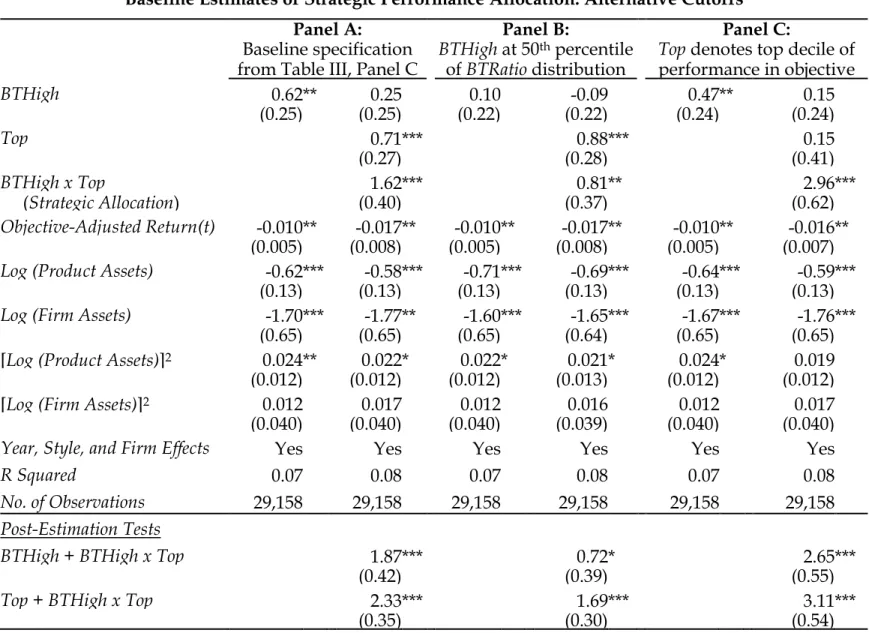
(0.7392), though predictably decreasing the magnitude of the effect, preserves its strong statistical significance and still has a large economic magnitude. These robustness checks are reported in Section VI.
interaction BTHigh x Top. The covariates in the specification also include lagged
product’s annual performance in excess of the investment benchmarks,12 controls for
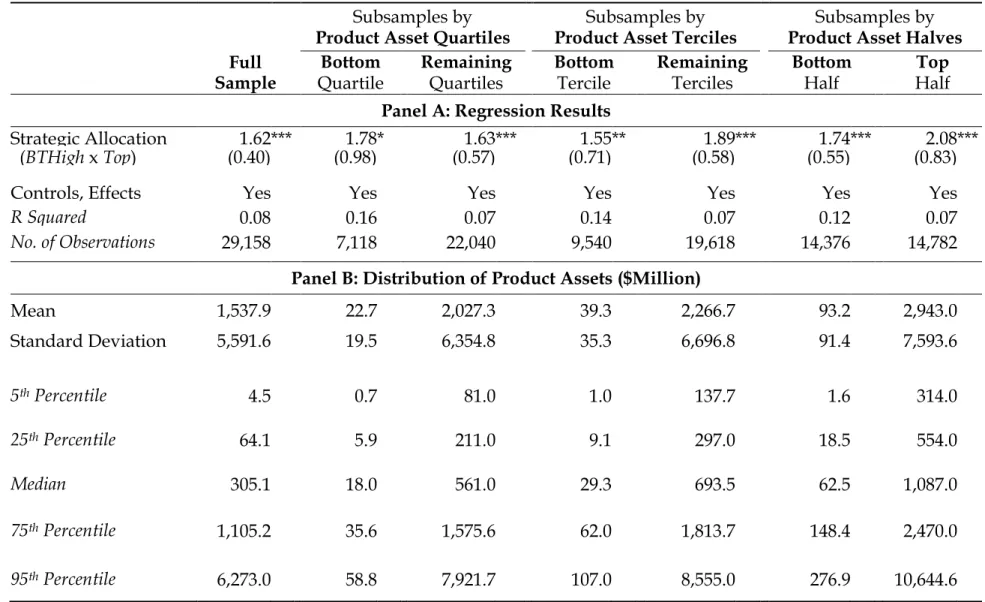
the product’s and the firm’s assets under management (both linear and quadratic terms, to capture potential nonlinearities), as well as firm, investment objective, and year effects. Our panel estimations incorporate adjustment of standard errors by clustering that accounts for heteroskedasticity and dependence of observations across the same firm. We find very robust evidence of strategic performance allocation toward high-value products in the firm, to the extent of around 1.62 percent per year. These results are not driven by strategic performance allocation to very small products; performing the analyses separately for products in the bottom quartile (tercile, half) and for the products in the remaining quartiles (terciles, half) generates very similar regression coefficients associated with strategic performance allocation (ranging from 1.55 to 2.08).
The key challenge, completely absent in the mutual fund industry, is discerning whether the results in this industry arise, at least in part, because of its distinguishing feature—the power of its clients. Specifically, institutional money management firms could be engaging in strategic performance allocation only for the reasons mutual fund families do. Alternatively, powerful clients could demand that the money management firm devotes resources to their product, explicitly or implicitly (the money management firm may wish to please favored clients through strategic performance allocation even if the clients do not explicitly ask for it), and money management firms could be responding to such demand. To tease out whether powerful client demand plays a role, we develop a proxy for the presence of a powerful client in the product by defining an indicator variable Dominant, set to one if the ratio of the assets held in the largest portfolio in the product and the product’s total assets under management is in the top third of the distribution of this ratio in the sample, and to zero otherwise.13 We find that
the extent of strategic performance allocation is substantially larger—around 2.6 percent per year—if the recipient is a high-value product with a concentrated client base (with Dominant = 1). The effect is much smaller and statistically indistinguishable from zero
11 We have calculated adjustments relative to the median performance among all products pursuing the same
objective, same objective and size quartiles, as well as the returns to a broadly diversified style index provided by Russell or Standard and Poor’s. The results are consistent across all of these methods of benchmark adjustments.
12 Exclusion of lagged returns from the specification does not alter the results. All the directions and statistical
significances of key coefficients are preserved, and their magnitudes are generally larger by one-third.
13 The value of Dominant at the 66.66th percentile of distribution is 0.8286, indicating that products for which more
than 82.86% of the assets managed by the product are held by its largest client (approximately five sixths) are regarded as those with a dominant client. Once again, the use of alternative cutoffs, for example, requiring that the largest portfolio in a product accounts for one-half or more of the product’s overall assets under management (a feature shared by 46% observations in the sample), does not alter the results reported in the paper.
for high-value products with a diffuse client base. Thus, our results show that the extent of strategic performance allocation varies with “demand” (interpreted as the dominance of the largest client in the portfolio).14
We present further evidence of the “demand” aspect of strategic performance allocation by considering separately products that have been started within the past three years (“young” products) and products that have been started more than three years ago (“old” products). The point estimate of strategic performance allocation is larger for young products than it is for old products, but the two are not statistically significantly different. However, further refining the product classification into those with and those without dominant clients reveals, perhaps not surprisingly, that strategic performance allocation is by far the most intense for young products with a dominant client (3.99 percent per year).
The clear evidence of strategic performance allocation immediately raises the question of how money management firms achieve it. On the one hand, firms might engage in cross-subsidization of performance across products (Gaspar, Massa, and Matos (2006), Guedj and Papastaikoudi (2008), and Bhattacharya, Lee, and Pool (2012) suggest that this is what mutual fund families do). On the other hand, powerful clients may demand that their portfolio be managed by an outstanding manager, and that they receive the bulk of the manager’s attention (that is, that the product not be eager to admit other clients, nor to have the manager devote time and energy to other products). Moreover, in the spirit of Berk and Green (2004), Chen, Hong, Huang, and Kubik (2004), and Pollet and Wilson (2008), the outstanding manager will generate superior returns because he can hardly use up even the best ideas, and is far from the point of diminishing returns. Thus, the pressure from powerful clients works to keep the product small (increasing the likelihood that BTHigh is equal to one), the manager’s excellence, and the luxury of being far from the point of diminishing returns (increasing the likelihood that the product will perform well, and persistently so) might combine to generate the result in the baseline specification even in the absence of cross-subsidization. Though not necessarily very likely, this scenario provides an alternative
14 The data do not feature information regarding client identity. Clients could invest in multiple products within the
same firm, creating the possibility that Dominant might misclassify the presence of a powerful client in the product: a product without a dominant client could have a client with a very large position in other product(s) within the same firm, making that client very important to the firm, but still registering Dominant = 0 in the product; conversely, especially among smaller products, a client could be dominant in a (small) product, thus Dominant = 1, but the client’s overall investment across other product(s) within the firm could be relatively small, making the client relatively unimportant to the firm. All these considerations suggest noise, but no obvious bias in characterizing the presence of a powerful client in the product. If anything, that Dominant is a noisy proxy makes it more difficult to establish the effects because the noise may attenuate the regression coefficients and diminish the power of our tests.
explanation for the baseline result that does not require cross-subsidization among products.
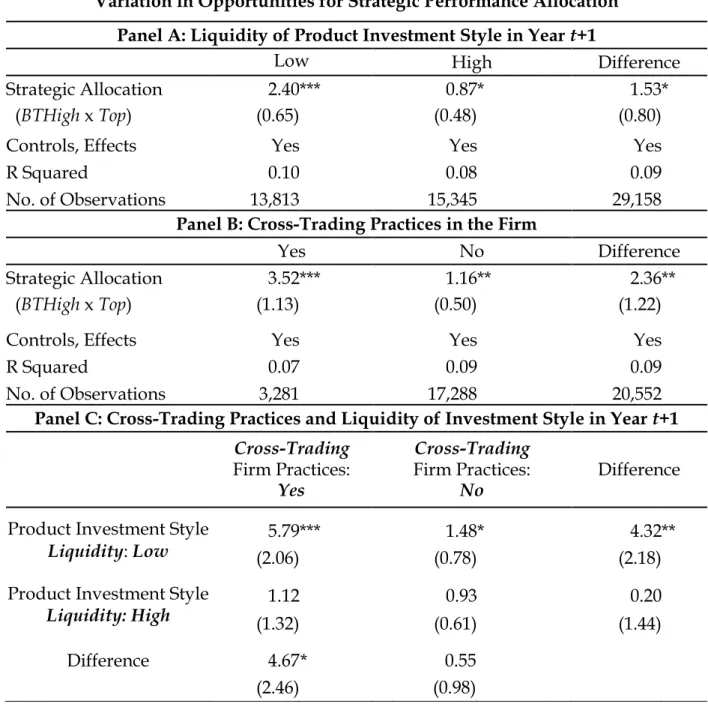
We proceed to show that the strategic performance allocation involves cross-subsidization. We focus on the variation in the extent of opportunities for strategic performance allocation through illiquidity of the products’ investment styles and cross-trading practices prevailing in the firm. Strategic performance allocation is larger toward products pursuing illiquid investment styles than toward products pursuing liquid investment styles (2.40 percent versus 0.87 percent; both are statistically significant, as is their difference of 1.53 percent). Similarly, strategic performance allocation is larger toward products in firms pursuing cross-trading practices than toward products in firms not pursuing cross-trading practices (3.52 percent versus 1.16 percent; both are statistically significant, as is their difference of 2.36 percent). These results make it very difficult to believe that the only source of strategic performance allocation is the allocation of talented managers toward products with powerful clients.
The next point of inquiry is where strategic performance allocation comes from. If products with many significantly larger products in the same firm are receiving it, it appears reasonable that, conversely, products with many significantly smaller products in the same firm should be the ones providing it. Indeed, further analyses show that large products in a position to transfer performance toward smaller products in the firm give away about 63-82 basis points per year to keep on supporting the (smaller) top performers in the firm. Thus, there is a transfer from investors in these large products surrounded by many smaller products, clearly supporting the cross-subsidization hypothesis. A back-of-the-envelope calculation suggests that the total wealth transfer from investors in such larger products to those invested in smaller products is 128.5 to
167.2 billion dollars over the fifteen-year sample period,15 for an annual average
ranging from 865 million to 1.115 billion.
Although this practice hurts investors in the products from which performance is taken away, it works very well for the money management firm and the investors in the products that receive strategic performance allocation. As pointed out in the mutual fund literature, a strong fund performance leads both to larger inflows of investment to the fund (e.g., Ippolito (1992), Chevalier and Ellison (1997), Sirri and Tufano (1998), Ivković and Weisbenner (2009), among others) and to the flow spillover effect, the
15 The average product assets of such large products (with a broad set of smaller products in the same firm that
“demand” cross-subsidization) are 3.85 billion, there are 6,024 such data points, and each generates a loss of around 63-82 basis points.
called “star phenomenon” (e.g., Nanda, Wang, and Zheng (2004)), that benefits other products managed by the same mutual fund family. We show that these phenomena prevail in the institutional money management industry too. High performance affects flows into products, both directly (a results consistent with Del Guercio and Tkac (2002) and Heisler, Knittel, Neumann, and Stewart (2007)) and indirectly, through flow spillover, a novel finding in the institutional money management literature.
Our estimation of the flow-performance relation suggests that strategic performance allocation practices do not diminish the profits to the firm generated by the “exploited,” larger products. Although a decrease in performance that results from providing strategic asset allocation has adverse effects, both direct ones (through a decline in assets under management) and indirect ones (through the flow-performance relation of the fund), these effects are more than offset by the star phenomenon inflows, created by the presence of top performers in the rest of the firm (which the product keeps on supporting). Specifically, although the products that provide strategic asset allocation experience a performance loss of 63-82 basis points in year t, a back-of-the-envelope calculation (detailed in Section V) suggests that the overall effect in year t+1 is a net gain in flows of 2.25-3.65 percent (obtained by subtracting 63-82 basis points from the 3.07-4.47 percent “star effect”). The effect in year t+2 is a 71-96 basis-point decline prompted by the response of the flow to a 63-82 basis-point decrease during year t+1.
The remainder of the paper is organized into seven sections. Section I reviews data sources and the sample. In Section II, we establish the baseline evidence of strategic performance allocation. In Section III, we establish a strong positive relation between the extent of strategic performance allocation and client power. In Section IV we show that the extent of strategic performance allocation varies with both illiquidity of the products’ investment styles and cross-trading practices in the firm. These results not only identify some of the channels through which strategic performance allocation is achieved, but also provide evidence of cross-subsidization. Section V looks into the losses to the larger products that provide strategic performance allocation through cross-subsidization, and provides a back-of-the envelope calculation of the effects of that cross-subsidization (in light of the flow-performance relation). In Section VI, we report robustness checks. Section VII concludes.
I.
Data Sources and Sample Overview
We compile data from several sources. The key data are 59 quarterly releases of self-reported institutional money management data for the period from June 1993 to December 2007, obtained from leading data vendors: first from the Mobius Group and, from September 2006 onward, from Informa Investment Solutions (IIS) PSN Data Select.16 Both data sources have been, and IIS PSN continues to be,17 used by most large
pension fund sponsors and endowment funds to identify money managers, study their track records, and consider a range of other variables relevant for the investment decision-making process. Also, IIS data have been used in extant academic research concerning institutional investment management (e.g., Busse, Goyal, and Wahal, 2010).
Aside from quarterly product returns, the data contain a range of firm and product characteristics, including products’ firm affiliation, assets under managements, total number of portfolios, and the assets of the largest portfolio in the product. Because most of the variables are available with annual frequency, our analyses extend over annual performance horizons (we compound quarterly product returns into annual
product returns).For some of our analyses, we use investment style benchmarks from
Russell (see Table AI in the Appendix). Our sample consists of all product-year observations that have the requisite variables for our analyses. We exclude mutual funds by screening out all product-year observations from our sample that have 100 or more clients. 18 Table I presents the summary statistics.
Finally, for some of the analyses we collect information from ADV forms. Registered investment advisors who manage $100 million of client money or more must file the form with the SEC annually. The ADV forms have undergone some changes over the years, expanding steadily their coverage of issues of interest. Recent format includes an item directly relevant for some of our tests. Item 8 is devoted to conflict of interest, and the question most directly relevant for our study is 8B1 (listed under “Sales
Interest in Client Transactions”).19 The most recent release, revised in 2010, is the only
16 Upon subsuming the Mobius Group and the subsequent expiration of one-year agreements with Mobius clients,
Informa Investment Solutions began applying its own pricing model (data extractions charged by variable), making continued subscription to the data more challenging and prohibitively costly. Ultimately, December 2007 was the last installment IIS was willing to provide under the earlier pricing scheme.
17Recent extant literature on institutional money managers uses either the same data source (Informa Investment
Solutions; Bussee, Goyal, and Wahal (2010)) or a comparable data source from another vendor (Mercer’s Manager Performance Analytics; Goyal and Wahal (2008)).
18Results are unaffected if we retain mutual funds in the sample.
19Question 8B1 is worded as follows: “Do you or any related person ... as a broker-dealer or registered representative
of a broker-dealer, execute securities trades for brokerage customers in which advisory client securities are sold to or bought from the brokerage customer (agency cross transactions)?”
one accessible from the SEC. Although ADV forms pertain to 2010, after the period covered in our study (1992-2007), cross-trading practices are highly persistent and their measurement in 2010 may introduce some noise, but no evident bias. An additional consequence of the timing of the ADV forms available for these analyses is that we do not have observations associated with firms that have been around during the sample period, but have seized to exist since.
TABLE I ABOUT HERE
II.
Baseline Results
Our baseline specification relates products’ objective-adjusted annual returns (in percent) to indicator variables BTHigh, Top, and their interaction, as well as a number of controls and effects:
OARi,t+1 = β0 BTHighi,t + β1 Topi,t + β2 BTHighi,t x Topi,t + controls + effects + εi,t+1. (1)
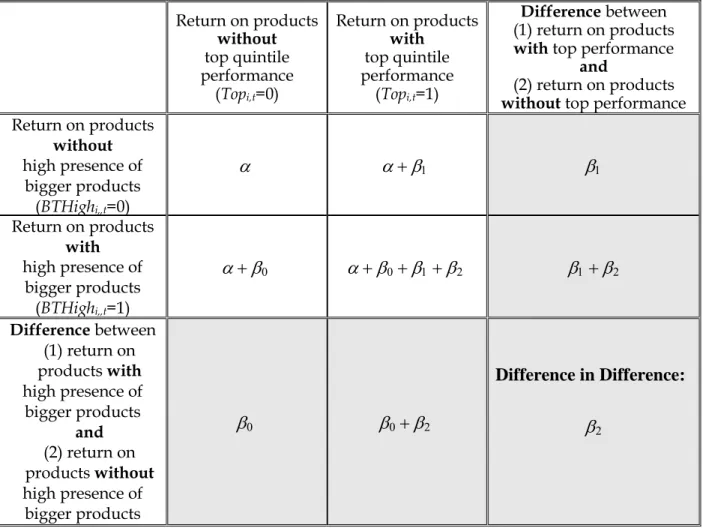
Regression coefficient β0 reflects the performance differential between past
non-top performers with high presence of bigger products (with more opportunities for strategic performance allocation) and past non-top performers with low presence of bigger products (with fewer opportunities for strategic performance allocation). The sum of regression coefficients β0 and β2, β0 + β2, reflects the extent to which the performance of past top performers will be higher in the settings with more resources for strategic performance allocation (with high presence of bigger products) than in the setting with fewer resources for strategic performance allocation (with low presence of bigger products). The differential, the difference-in-difference estimator β2, is pivotal. It
reflects the extent to which performance differential between products with more resources for strategic performance allocation and fewer resources for strategic performance allocation is higher for past top performers than it is for past non-top performers. A positive and statistically significant coefficient β2, therefore, is evidence
of strategic performance allocation.
Regression coefficient β1 reflects the performance differential between the
products with fewer opportunities to receive strategic performance allocation that had
been top performers and such products that had not been top performers. β1 + β2
reflects the extent to which the performance of products with more opportunities for strategic performance allocation will be higher if they had been top performers than if
they had not been top performers. Finally, once again, the differential β2 reflects the
extent to which performance differential between products with more resources for strategic performance allocation and fewer resources for strategic performance
allocation is higher for past top performers than it is for past non-top performers.20
Controls are lagged objective-adjusted annual product returns, product assets and firm assets (both in logarithmic form), as well as their squares. Effects include year effects, investment objective effects, and firm effects, thus ensuring that any variable that varies only by time, objective, or firm is absorbed and cannot explain our findings. We calculate standard errors by clustering in a way that allows for heteroskedasticity as well as correlation across observations associated with the same firm.
Annual product returns are objective-adjusted in three different ways. First, by subtracting from product annual returns the contemporaneous return to the style
benchmark defined by the appropriate Russell index.21 Second, by subtracting from
product annual returns the contemporaneous median return among all the products pursuing the same investment objective. The third adjustment method addresses the potential concern that the controls for product size (that is, its asset under management) may not suffice to control for size effects. Accordingly, the adjustment is done more stringently, by grouping all products in each objective and in each year into quartiles according to their assets under management, and subtracting from product annual returns the contemporaneous median return among all products pursuing the same investment objective and belonging to the same size quartile.
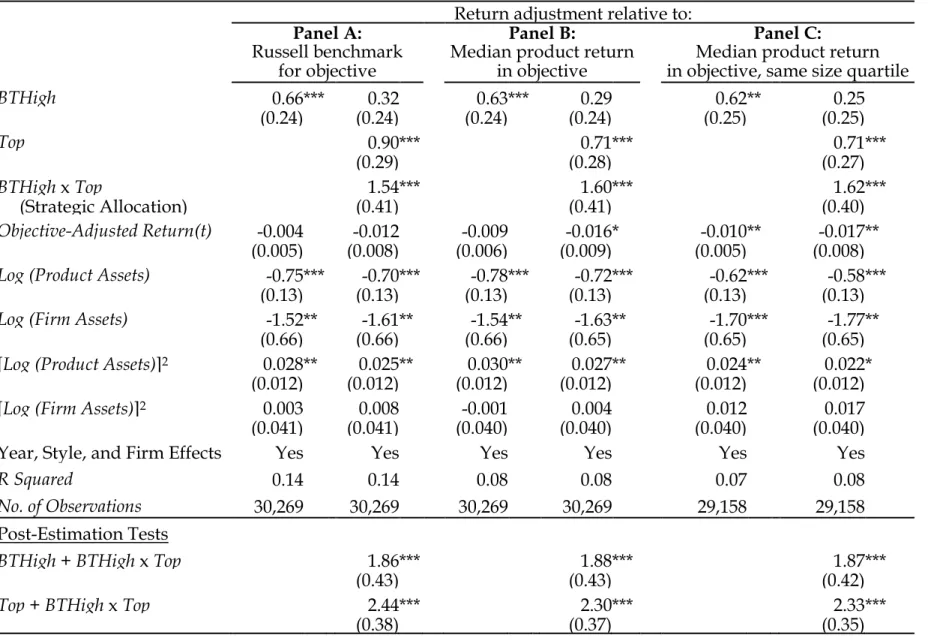
The results of estimating all these regressions are displayed in Table II. It features three panels, in accordance with the approaches to return benchmark adjustment. In each panel, the first column presents the results of fitting a simpler specification, featuring BTHigh only (as well as all the other controls). Regardless of the specification, that is, across all three panels, the products with a high fraction of bigger products outperform those without it by 62 to 66 basis points per year. Of course, it is difficult to ascertain the extent to which this result stems from strategic performance allocation. Among other alternative explanations, it could also be that a high percentage of much bigger products in the same firm is indicative of managerial skill present in the firm.
The second column in each panel presents the results of fitting the specification from Equation (1). Moreover, the two bottom rows of Table II in the second column of
20 See Table A.II in the Appendix for interpretation of regression coefficients from Equation (1) in tabular form. 21 See table AI in the Appendix for the indexes used for style adjustment. Using corresponding Standard and Poor’s
each panel feature estimates of β0 + β2 (labeled in the table as BTHigh + BTHigh x Top) and β1 + β2 (labeled in the table as Top + BTHigh x Top).
Coefficient estimates of β1 (labeled in the table as Top) show that, among
products with fewer opportunities to receive strategic performance allocation, the performance differential between the products that had been top performers and had not been top performers is between 71 basis point per year (Panels B and C) and 90 basis points (Panel A), with statistical significance across all three. Estimates of β1 + β2 (the bottom row of Table II, labeled as Top + BTHigh x Top) show substantially larger performance differentials between products that had and had not been top performers among products with more opportunities to receive strategic performance allocation (that is, with high values of BTRatio, as characterized by the value of BTHigh equal to 1); across the three panels, these estimates are very similar and are all highly statistically significant; they range from 2.30 percent to 2.44 percent across the three panels. These differentials may partly reflect momentum in portfolio returns, but there also is a very large component consistent with strategic performance allocation within the firm. That
component is captured directly by the difference-in-difference coefficient estimate of β2
(labeled in the table as BTHigh x Top). Indeed, β2 reflects the extent to which the
difference between returns on products that had been and had not been top quintile performers last year is higher for products with more opportunities for strategic performance allocation than for the products with fewer such opportunities. Once again, the estimates are very similar across the three panels, and are all highly statistically significant; they range from 1.54 percent to 1.62 percent across the three panels.22
The results from Table II are very consistent across all three panels; they are not sensitive to the method of benchmark-adjusting annual product returns. This holds for all subsequent analyses too. Thus, to avoid repetition, we henceforth report only the results based upon the most stringent of the three methods, featuring grouping all the products within each objective and within each year into quartiles according to their assets under management and subtracting from product annual returns the contemporaneous median return among all the products pursuing the same investment objective and belonging to the same size quartile (Panel C in Table II).
22This magnitude, about 1.6 percent per year, amounts to about one-half of the strategic cross-subsidization effect in
the domain of mutual funds (Gaspar, Massa, and Matos (2006)). Gaspar, Massa, and Matos (2006) report their baseline result indicating cross-subsidization of up to 3.3 percent per year, prevailing for the specifications in which high (low) fund value is captured by recent high (low) fund performance. That the effect is smaller in the institutional money management
TABLE II ABOUT HERE
One potential concern with these results is that strategic performance allocation might be contained to fairly small products, thus limiting the economic importance of our findings. Indeed, although we have introduced ample controls for product size into our specifications, both through the measurement of annual performance relative to the median product in the same asset size quartile, and through the inclusion of controls capturing product size (and its square, to capture potential nonlinearities), it is possible that all these controls still are not picking up the possibility that strategic performance allocation might be pursued predominantly, and more vigorously, in the domain of small products (for which it is easier to achieve). These concerns are alleviated by the results presented in Table III. The table features, in addition to restating the baseline result in the first column, results of estimating the specification from Equation (1) on subsamples determined by product asset size. The next two columns of Table III feature a sample split into observations with product assets belonging to the bottom quartile of the asset size distribution, and the other three quartiles, respectively. The coefficient associated with strategic performance allocation, displayed in the first row of the table, remains virtually unaltered for both subsamples. Continuing along the subsequent columns, the next two feature the split along terciles of product asset size, and the last two feature the split along the median of product asset size. In all these cases, as displayed in Panel A of Table III, the regression coefficient associated with strategic performance allocation remains very closely aligned with the baseline estimate of 1.62 percent (estimated over the full sample). Panel B documents distributions of product asset size for the respective subsamples, showing from yet another perspective that, although product sizes vary substantially across various subsamples, the extent of strategic performance allocation, as documented in Panel A of Table III, does not.
TABLE III ABOUT HERE
III.
“Demand” for Strategic Performance Allocation
The key result in the preceding section is evidence of strategic resource allocation of around 1.6 percent per year (Table II). This section builds upon that result by relating the extent of strategic resource allocation to a measure of demand for it. As discussed in the introductory section, although the structure of investment options in the institutional money management industry may resemble that offered by the mutual
fund industry, the two industries are quite different. Aside from the differences in transparency and in institutional framework, a pivotal difference is the structure of their respective investors. Mutual funds, investment vehicles inaugurated historically in pursuit of the goal of providing small investors access to diversified investment, have a broad investor base. A mutual fund shares is held by thousands, sometimes even tens of thousands of investors or more, each of whom typically holds a miniscule fraction of fund shares. In the institutional money management industry, on the other hand, each product typically has relatively few investors.23
This extent of concentration makes many investors in the institutional arena very powerful by comparison. For example, though not desirable by the fund’s manager, a mutual fund investor’s decision to leave the fund will have a fairly limited effect on the assets under management, the primary determinant of mutual fund managers’ compensation. It would take a strongly correlated action of many mutual fund investors to create an observable effect. By contrast, an investor’s (plan sponsor’s) decision in the institutional asset management industry to fire the manager and take their portfolio elsewhere often shrinks the product’s assets under management by a large percentage, perhaps even up to one-half of total assets or more. Whereas not all client departures can be prevented (especially those not undertaken for reasons related to product performance), this threat of asset base depletion could wield considerable power. Because the departure of a dominant client significantly alters total assets under management, whether a product has a dominant client may be an important consideration in the process of strategically allocating performance across a firm’s products. In that sense, on the margin, the firm may wish to cater to the “demand” for returns from products with dominant clients to a higher extent than to the comparable demand from products without dominant clients.
This tendency may also be related to the firms’ propensity to build relationships with powerful clients by managing their portfolios through arrangements in which there are fewer other clients (perhaps none!) in the same product, thus providing (nearly) exclusive attention to such clients. Ceteris paribus, highly concentrated ownership of the assets in a product indicates that the firm may be keenly interested in cultivating the relationship with the (few) client(s) invested in the product, and thus particularly inclined to allocate performance strategically toward such a product.
23 Indeed, the largest client invested in a product holds at least one-half of the assets managed by the product in
nearly one-half (46 percent) of all investment products. Also, 25% of all product-year observations in our sample feature a single client, and another 25% feature two to five clients.
All these considerations create a need to better understand what drives strategic performance allocation. In the mutual fund arena, matters are relatively simple. Mutual fund families manage their products’ performance through cross-subsidization (Gaspar, Massa, and Matos (2006), Bhattacharya, Lee, and Pool (2012)) in ways that promote high value products and thus maximize profits for the family (e.g., building a strong performance track record of a fund increases future flows into the fund, as well as into other funds in the firm through the flow spillover effect). Their clientele consists of many shareholders, each of whom holds a miniscule fraction of fund shares. It is unlikely that strategic performance allocation in the mutual fund industry happens because of the pressure exerted by powerful clients.
In the institutional money management arena, however, powerful clients could be demanding that a lot of attention and care be given to the performance of their portfolio, and money management firms might be responding accordingly by providing the requisite resources. These considerations produce a testable implication that, as a result of this “demand” generated by powerful clients, the extent of strategic performance allocation should be larger when directed toward products dominated by powerful clients. To capture the notion of a powerful client, we define an indicator
variable Dominanti,t to characterize products that have a very concentrated client base
(our proxy for a powerful client). Dominanti,t is set to one if the ratio of the assets held in
the largest portfolio in the product and the product’s total assets under management24
is in the top third of the distribution of this ratio in the sample,25 and to zero
otherwise.26 Next, we estimate the regression from Equation (1) separately for products
that feature dominant clients and for those that do not.
24 In many contexts, the Herfindahl index is an alternative (and sometimes preferred) measure of concentration.
These data, however, contain only the information about the portfolio sizes of the largest and, if applicable, the smallest client invested in the product. Thus, for products with more than three clients, the breakdown of the total product assets by client cannot be computed precisely, rendering the use of the Herfindahl index impractical.
25 The value of Dominant at the 66.66th percentile of distribution is 0.8286, indicating that products for which more
than 82.86% (approximately five sixths) of its assets are held by its largest client are regarded as those with a dominant client. Once again, the use of alternative cutoffs, for example, requiring that the largest portfolio in a product accounts for one-half or more of the product’s overall assets under management (a feature shared by 46% observations in the sample), does not alter the results reported in the paper.
26 As discussed in the introductory section, the data do not feature information regarding client identity. Clients
could invest in multiple products within the same firm, creating the possibility that Dominant might misclassify the presence of a powerful client in the product: a product without a dominant client could have a client with a very large position in other product(s) within the same firm, making that client very important to the firm, but still registering Dominant = 0 in the product; conversely, especially among smaller products, a client could be dominant in a (small) product, thus Dominant = 1, but the client’s overall investment across other product(s) within the firm could be relatively small, making the client relatively unimportant to the firm. All these considerations suggest noise, but no obvious bias in characterizing the presence of a powerful client in the product. If anything, that Dominant is a noisy proxy makes it more difficult to establish the effects because the noise may attenuate the regression coefficients and diminish the power of our tests.
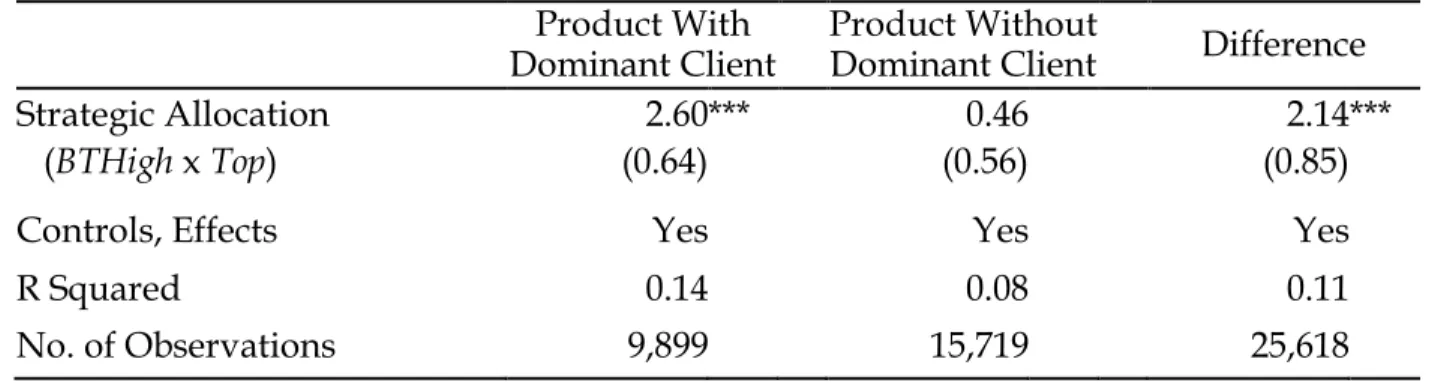
Table IV features the difference-in-difference estimates of strategic performance allocation (regression coefficients associated with BTHigh x Top) for the subsample of products with a dominant client (the first column) and the subsample of products without a dominant client (the second column). The effect is substantially stronger among products with dominant clients—it is as large as 2.60 percent per year, that is, 62% stronger than the baseline effect estimated over the full sample. The point estimate of the extent of strategic performance allocation among products without a dominant client is 46 basis points per year, but its standard error is 56 basis points. To evaluate the statistical significance of the difference between the two, we estimate the following specification over the full sample:
OARi,t+1 = β0 BTHighi,t + β1 Topi,t + β2 BTHighi,t x Topi,t + controls + effects + (2)
(β0’ BTHighi,t + β1’ Topi,t + β2’BTHighi,t x Topi,t +
controls + effects) x Dominanti,t + εi,t+1.
That is, every covariate from the baseline regression specification (Equation (1)) is also multiplied by the indicator variable Dominanti,t. The coefficient β2’,associated
with the triple interaction BTHigh x Topx Dominant, captures the desired
difference-in-difference-in-difference.27 Its point estimate, by construction, is equal to the difference
between the two difference-in-difference estimates reported for each subsample). Its magnitude is 2.14 percent, and it is statistically significant at the one-percent level.
TABLE IV ABOUT HERE
We conclude this section with further evidence of the “demand” aspect of strategic performance allocation. The manifestations of “demand” (explicit or implicit) should be manifested more strongly early on, at the beginning of the relationship between the client and the product. This is the most fragile period during which the firm may be particularly eager to please its clients, especially the favored ones. To test this hypothesis, we separately consider products that have been started within the past three years (“young” products) and products that have been started more than three years ago (“old” products). The results provide support for the hypothesis. Whereas
27 The number of observations in this regression is 25,618, a 12% decrease relative to the number of observations
reported in Panel C of Table III. This decline in the number of observations is a reflection of the fact that the assets of the largest portfolio are reported for 88% of the observations.
strategic performance allocation is present among both, it appears more prevalent among young products (2.08 percent per year per year for “young” products versus 1.27 percent per year for “old” products; both of these coefficients are highly statistically significant, but their difference of 0.81 percent per year is not). Further refining product classification into those with and those without dominant clients reveals, perhaps not surprisingly, that strategic performance allocation is by far the most intense for young products with a dominant client (3.99 percent per year).
TABLE V ABOUT HERE
IV.
Variation in Opportunities for Strategic Performance Allocation
The results reported in the preceding two sections provide compelling evidence that strategic performance allocation takes place in the institutional money management industry, and that there is a positive relation between the extent of strategic performance allocation and the power of the clients toward whom it is directed. What still needs clarification is how money management firms accomplish strategic performance allocation. One possibility is cross-subsidization. Gaspar, Massa, and Matos (2006), Guedj and Papastaikoudi (2008), and Bhattacharya, Lee, and Pool (2012) find this is what mutual fund families do. Another is that powerful clients could demand that their portfolio be managed by an outstanding manager, and that they receive the manager’s (virtually) exclusive attention (that is, that the product not be eager to admit other clients). Moreover, in the spirit of Berk and Green (2004), Chen, Hong, Huang, and Kubik (2004), and Pollet and Wilson (2008), the outstanding manager will generate superior returns because he can hardly use up even the best ideas, and is far from the point of diminishing returns. Thus, the pressure from powerful clients works to keep the product small (increasing the likelihood that BTHigh is equal to one), the manager’s excellence, and the luxury of being far from the point of diminishing returns (increasing the likelihood that the product will perform well, and persistently so) might combine to generate the result in the baseline specification even in the absence of cross-subsidization. Though not necessarily very likely, this scenario provides an alternative explanation for the performance gap that does not require cross-subsidization among products (rather, it requires allocation of outstanding managers to powerful clients).
We proceed to show that the strategic performance allocation involves cross-subsidization. We focus on the variation in the extent of opportunities for strategic performance allocation through illiquidity of the products’ investment styles and cross-trading practices prevailing in the firm. Guided by the features of the particular channel, we define for each observation regarding product i in year t+1 the appropriate indicator variable Classificationi,t+1 that classifies its circumstances as associated with
either higher (Classificationi,t+1 = 1) or lower (Classificationi,t+1 = 0) extent of availability of
resources for cross-subsidization toward product i in year t+1.
A key step in the analyses of each channel will be producing the difference-in-difference estimates based on the estimation of regression from Equation (1) (as in the earlier section, regression coefficients associated with BTHigh x Top) of strategic performance allocation for the subsamples generated along the two channels. One regression will focus on the subsample of products with higher extent of availability of resources for cross-subsidization of product i in year t+1 (Classificationi,t+1 = 1), and the
other on products with lower availability of resources for cross-subsidization of product i in year t+1 (Classificationi,t+1 = 0). Finally, to evaluate the statistical significance of the
difference between the two, we estimate the following specification over the full sample, and focus on the triple interaction BTHigh x Topx Classification:
OARi,t+1 = β0 BTHighi,t + β1 Topi,t + β2 BTHighi,t x Topi,t + controls + effects + (3)
(β0’ BTHighi,t + β1’ Topi,t + β2’BTHighi,t x Topi,t +
controls + effects) x Classificationi,t+1 + εi,t+1.
B. The First Channel: (Il)liquidity of the Products’ Investment Styles
The first channel for strategic performance allocation is related to the varying extent of (il)liquidity of the stocks pursued by various investment styles. Although we do not have the products’ transaction-level information, nor their quarterly product
holdings,28 we can form a hypothesis that relates asset (il)liquidity and the extent of
strategic performance allocation. Simply put, under the circumstances of low liquidity, bid-ask spreads are high, price impact is likely, and there is a heterogeneity of prices available in a possibly fragmented market, enabling the practice of giving the best execution prices to the favored clients to make a substantial difference. Moreover,
28 Gaspar, Massa, and Matos (2006) study quarterly mutual fund holdings and find that allocations of underpriced
providing preferential treatment to favored clients through other trading-related mechanisms such as executing opposite trades and cross-trades will be more pronounced in the domain of illiquid styles.
The prediction, then, is that evidence of strategic performance allocation will be stronger (weaker) for the observations characterized by low (high) liquidity. To test this prediction, we define the classification criterion for this channel, an indicator variable Illiquid_Stylei,t+1 for each product i in year t+1, and set it to zero if, according to a simple
turnover-based measure (e.g., Brennan, Chordia, and Subrahmanyam (1998), Chordia, Subrahmanyam, and Anshuman (2001)), the average liquidity of the CRSP stocks classified under product i’s investment style in year t+1 is high, and to one otherwise. C. The Second Channel: Cross-Trading at the Firm Level
The second channel for strategic performance allocation is related to the firms’ cross-trading practices, that is, coordinated trade strategies wherein a buy order of a particular security made by one product (mutual fund) is matched with a sale order from another product (mutual fund) belonging to the same firm (mutual fund family), resulting in a transfer of the security from the product (mutual fund) looking to sell it to the product (mutual fund) looking to buy it. Cross-trades, though potentially beneficial for both parties, also feature potential for conflicts of interest. They are regulated by Rule 17a-7 of the U.S. Investment Company Act, which permits such transactions, subject to several conditions, including that: transactions are effected at the independent current market price; transactions are consistent with the policy of each registered investment company participating in the transaction; no brokerage commission, fee (except for customary transfer fees), or other remuneration is paid in connection with the transaction, and adequate documentation is maintained and preserved.
Although academic interest in the effects of cross-transactions is relatively recent (e.g., Gaspar, Massa, and Matos (2006), Casavecchia and Tiwari (2011), Goncalves-Pinto and Sotes-Paladino (2011), Bhattacharya, Lee, and Pool (2012)), it has not escaped the notice of the SEC over the past few decades. Also, other important entities have been contemplating cross-trading practices and their effects. In 1998, U.S. Department of Labor—its Pension and Welfare Benefits Administration—has expressed serious concerns regarding potential misuse of cross-trading in the domain of the portfolios covered by ERISA (Employee Retirement Income Security Act of 1974, with subsequent
amendments). Its notice concerning cross-trades of securities by investment managers (U.S. Department of Labor (1998, p. 13697)) summarizes the key issues by stating that:
“…the Department’s concerns are illustrated by, among other things, the potential for an investment manager to:
(i) Place relatively illiquid securities into ERISA accounts in order to, among
other reasons, shift anticipated losses away from, or provide artificial liquidity and price stability for, favored accounts;
(ii) Use ERISA accounts as buyers or sellers of securities at particular times in
order to promote the interests of more favored client accounts;
(iii) Allocate favorable cross-trade opportunities, and the transaction cost savings
associated with such trades, to favored client accounts, such as those that have a performance-based fee arrangement with the manager in order to either increase the manager’s fees or demonstrate superior investment performance;
(iv) Allow cross-trade opportunities to affect the underlying investment
management decision as to which securities to buy or sell for particular ERISA accounts; and
(v) Use cross-trades to avoid the potential market impact of large trades on
certain accounts where such trades may not be in the best interests of all accounts involved or may not result in the best execution for the acquisition or sale of such securities.”
In accordance with these considerations, we form a hypothesis that relates cross-trading practices and the extent of strategic performance allocation. In the presence of cross-trading practices, the maneuvering space for allocation of prices within the bid-ask spread is higher than in the absence of cross-trading practices. Consequently, strategic performance allocation should be pronounced more among the products that
belong to firms engaging in cross-trading practices.29
D. Results
Table VI displays the results. The first column features regression results for the
subsample of observations with Classificationi,t+1 = 1 (more conducive to strategic
performance allocation), and the second column features regression results for the
subsample of observations with Classificationi,t+1 = 0 (less conducive to strategic
performance allocation). The third column presents the difference between the two estimates, obtained by estimating the regression from Equation (3). This estimation is
29 As described in more detail in Section I, we use question 8B1 (listed under “Sales Interest in Client Transactions”)
from the most recent release of ADV forms available from the SEC, revised in 2010, to identify firms that pursue cross-trading practices.
carried out on the full sample and β2’, the coefficient associated with the triple
interaction BTHigh x Topx Classification, provides the estimate of the desired
difference-in-difference-in-difference.
Panel A features a classification by the (il)liquidity of the product’s investment style. It shows that strategic performance allocation is larger toward products pursuing illiquid investment styles than toward products pursuing liquid investment styles (2.40 percent versus 0.87 percent; both are statistically significant, as is their difference of 1.53 percent). Panel B features a classification by the cross-trading practices prevailing in the product’s firm. Similarly, it shows that strategic performance allocation is larger toward products in firms pursuing cross-trading practices than toward products in firms not pursuing cross-trading practices (3.52 percent versus 1.16 percent; both are statistically significant, as is their difference of 2.36 percent).
Finally, Panel C of Table VI contrasts strategic performance allocation by both products’ investment style liquidity and their firms’ cross-trading practices. Strategic performance allocation toward products that pursue illiquid investment styles and are managed by firms pursuing cross-trading practices is very large, 5.79 percent per year. It is larger than the strategic performance allocation prevailing in the other three circumstances (high liquidity, cross-trading practices; low liquidity, no cross-trading practices; high liquidity, no cross-trading practices) by a substantial margin, at least four percent per year.
Overall, as noted in the introductory section, these results make it very difficult to believe that the only source of strategic performance allocation is the allocation of talented managers toward products with powerful clients, unless we are prepared to believe that exploitation of liquidity risk and favorable trade execution are exclusively traits of managerial talent, to the complete exclusion of cross-subsidization practices.
V.
Strategic Performance Allocation Away from Products
The analyses from the previous section uncover firms’ strong and robust tendency to allocate performance strategically, notably in the circumstances in which the products that have more opportunities to receive it (as captured by BTHigh = 1) and are regarded as high-value products by virtue of their strong recent performance (as captured by Top = 1). It is plausible that this performance boost, estimated at approximately 1.62 percent per year, comes from cross-subsidization provided by some other product(s) in the firm.
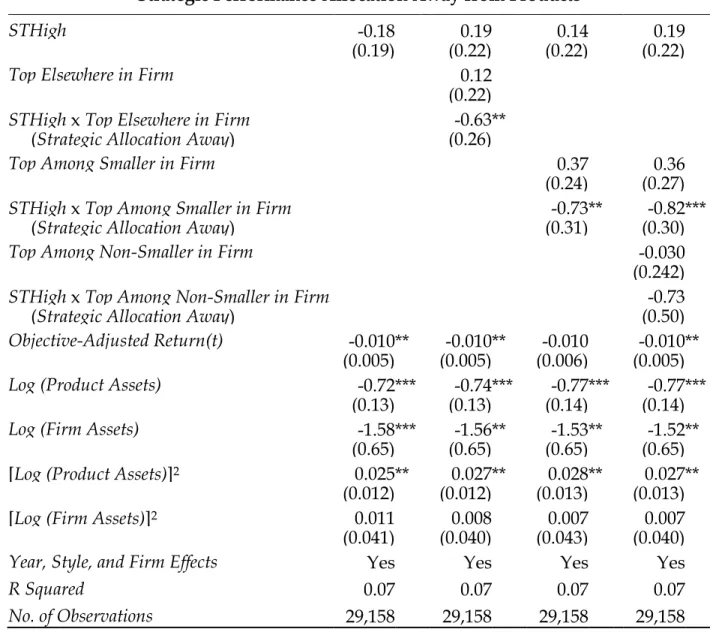
The products that provide this support presumably are larger products, with strategic performance allocation taken away from them, and directed toward the smaller products with strong historical performance. We capture opportunities for strategic performance allocation away from products by computing for each product STRatio, the ratio between the sum of all the assets of the products managed by the same firm that are each as small as one-half of the assets of the product or smaller, and the assets of the entire firm (less the assets under management of the product under consideration itself). We then define the indicator variable STHigh for each product to characterize whether the product can cross-subsidize smaller products in the firm. We set STHigh to one for the values of STRatio in the top third of the STRatio distribution,
and to zero otherwise. Finally, we define the indicator variable Top Elsewhere in Firmi,t
and set it to one if the one-year objective-adjusted performance in year t of at least one of the other products in the same firm has been in the top quintile. Top Elsewhere in Firmi,t is set to zero otherwise. In a manner analogous to testing for strategic
performance allocation toward a product in the previous section, here we employ STHigh, Top Elsewhere in Firm, and their interaction, to assess strategic performance allocation away from product i in year t+1:
OARi,t+1 = β0 STHighi,t + β1 Top Elsewhere in Firmi,t + (4)
β2 STHighi,t x Top Elsewhere in Firmi,t +
controls + effects + εi,t+1.
The controls and effects are the same as in the preceding analyses. Similar to the analyses reported in the previous section, the key estimator is the differential, the
difference-in-difference estimator β2. As shown in Table VII, the estimate of strategic
performance allocation away from larger products managed in firms with many smaller products in the firm ranges between 63 and 82 basis points per year, depending on the way of capturing top performers elsewhere in the firm. The last two columns introduce variations in the way the star phenomenon is measured, either as the presence of a top performer only among products one-half the size or smaller than the product or as two indicator variables capturing the presence of a top performer among products one-half the size or smaller than the product and the presence of a top performer among products that are not one-half the size or smaller than the product, respectively.
Finally, results from Table VII provide us with a way to perform a simple back-of-the envelope calculation that calculates the amount of wealth transfer between
investors invested in large products that cross-subsidize smaller products. Specifically, throughout the sample, there are 6,024 observations with STHigh equal to one, and their average assets under management are 3.385 billion. The coefficient associated with strategic performance allocation varies between 63 and 82 basis points, suggesting the overall transfer over the entire sample period of 128.5 to 167.2 billion, for an annual average ranging from 8.65 billion to 11.15 billion.
TABLE VII ABOUT HERE
A. Direct and Indirect Effects of Strategic Performance Allocation Away from Products: The Role of the Flow-Performance Relation
The products that are well-suited for giving away strategic performance allocation away from them (products with STHigh = 1) may experience both direct and indirect effects of such performance reallocation. According to the estimates from Table VII, once there is a top-quintile performer among the other products in the firm at the end of year t, if product i has STHigh = 1, it will keep on supporting such top performers, incurring the direct effect of a 63-82 basis-point reduction in the assets it manages in year t+1. This reduction follows mechanically, from a 63-82 basis-point reduction in product i’s own performance in year t+1.
Indirect effects stem from the flow-performance relation. To quantify these indirect effects, we estimate the following flow-performance relation in the institutional money management industry:
Flowi,t+1 = β0 Past Performancei,t + (5)
β1Top Elsewhere in Firmi,t + controls + effects + εi,t+1.
We measure product i’s flow during year t+1, Flowi,t+1, as the change in assets
from year t to t+1 divided by assets at the end of year t, (Assetsi,t+1 – (1+Ri,t+1) x
Assetsi,t)/Assetsi,t, adjusted in a manner similar to that applied to returns—by
subtracting the median flow to a product pursuing the same objective in the same year, in the same size quartile. We model past performance of a product in two ways. The
first approach is linear, expressed as annual product returns OARi,t (as usual, it is
objective-adjusted by grouping all products within each objective and within each year into quartiles according to their assets under management and subtracting from product annual returns the contemporaneous median return among all the products
pursuing the same investment objective and belonging to the same size quartile). We use it as a starting point primarily because it gives as a gauge of the relation between flows and past performance we will find useful for back-of-the-envelope calculations of the indirect effects of strategic performance allocation away from a product. The second
approach allows for potential nonlinearity of the flow-performance relation,30 captured
through four indicator variables, Quintile_5i,t, Quintile_4i,t, Quintile_2i,t, and Quintile_1i,t,
where Quintile_ki,t is set to one if the product’s one year performance is in quintile k (5th
quintile denotes the top 20% performers) of all product returns during the year in the same objective and the same size quartile (as defined by portfolio assets), and to zero otherwise. The middle quintile is omitted.
Common to both models is the presence of an indicator variable Top Elsewhere in Firmi,t, set to one if the one-year performance of at least one of the other products in the
same firm has been in the top quintile in its investment objective in year t, and to zero otherwise. The existence of a top performer elsewhere in the firm at the end of year t may lend itself to a star phenomenon similar to that documented in the mutual fund literature (Nanda, Wang, and Zheng, 2004), whereby there will be a flow spillover to product i in year t+1, prompted by a strong performance of stars (top quintile performers) among the other products in the firm. The remaining covariates are lagged flows, as well as size controls: product assets and firm assets (both in logarithmic form), as well as their squares (to control for potential nonlinearity of size effects).
The results are presented in Table VIII. Panels A and B present the results of fitting a linear and non-linear flow-performance specification, respectively. In each panel, the first column presents coefficients from a specification that omits the star-phenomenon variable Top Elsewhere in Firm, and the second column presents coefficients based on the complete specification from Equation (5). This exercise shows that, although the star phenomenon has its own strong effect (ranging from 3.07 to 4.47 percent per year), its presence in the specification leaves the other regression coefficients virtually unchanged.
Panel A suggests a strong relation between flows and performance—a one percent increase in objective adjusted returns in year t is associated with a 1.13 to 1.17 percent increase in flows to the product in year t+1. Panel B allows for nonlinearity in the flow-performance relation. Regression coefficients associated with top quintile
30 The nonlinearity in the flow-performance relation, though prevalent in the mutual fund industry (e.g., Chevalier
and Ellison (1997), Ippolito (1992), Sirri and Tufano (1998)), has not been found to be as pronounced in the institutional money management industry (e.g., DelGuercio and Tkac (2002)).