Will You Be There for Me When Things Go Right? Supportive Responses
to Positive Event Disclosures
Shelly L. Gable
University of California, Los Angeles
Gian C. Gonzaga
University of California, Los Angeles, and Eharmony.com
Amy Strachman
University of California, Los AngelesClose relationship partners often share successes and triumphs with one another, but this experience is rarely the focus of empirical study. In this study, 79 dating couples completed measures of relationship well-being and then participated in videotaped interactions in which they took turns discussing recent positive and negative events. Disclosers rated how understood, validated, and cared for they felt in each discussion, and outside observers coded responders’ behavior. Both self-report data and observational codes showed that 2 months later, responses to positive event discussions were more closely related to relationship well-being and break-up than were responses to negative event discussions. The results are discussed in terms of the recurrent, but often overlooked, role that positive emotional exchanges play in building relationship resources.
Keywords:social support, close relationships, positive emotions, intimacy, marital satisfaction
Good things happen, and when they do, people often share the positive event with someone else—a process that has been called capitalization (Langston, 1994). Capitalizing on positive events has been linked to increases in positive affect and well-being independent of the positive events themselves; however these effects rest, in large part, on the reactions of persons with whom the events are shared (Gable, Reis, Impett, & Asher, 2004). More-over, the targets of capitalization are almost always close relation-ship partners, such as spouses, parents, best friends, or roommates. Research has shown that when close relationship partners, specif-ically romantic partners, regularly respond to positive event dis-closures in a supportive manner, disclosers report feeling closer, more intimate, and generally more satisfied with their relationships than those whose partners typically respond in a nonsupportive manner (Gable et al., 2004). These effects have also been shown to be independent of the well-established association between partners’ responses to each other’s negative behavior and the health of the relationship (Rusbult, Verdette, Whitney, Slovic, and Lipkus, 1991). Whereas previous research has focused primarily on couples’ management of negative emotional experiences (e.g., jealousy,
conflict, criticisms; Gottman, 1994; Karney & Bradbury, 1997; Notarius & Markman, 1989), studies such as those of capitaliza-tion processes offer emerging evidence that important dyadic relationship processes take place in the context of positive emo-tional experiences and deserve continued empirical investigation.1
In the present article, we examined the role that positive emotional exchanges play in relationship functioning through an observa-tional study of couples’ interactions when sharing positive events. In addition, couples’ responses to positive event disclosures were compared with their responses to negative event disclosures— what is traditionally known as social support—to determine whether the association between positive event responses and relationship well-being are independent of the associations be-tween social support and relationship well-being. That is, previous research has shown convincingly that a characteristic of satisfying relationships is believing that the partner will be there when things go wrong (e.g., Collins & Feeney, 2000; Pasch, Bradbury, & Davila, 1997), but it has not yet been shown that having a partner who will be there when things go right has independent effects on relationship functioning.
Capitalization Responses and Traditional Social Support
When people experience a negative or stressful event, they often turn to others for aid and comfort. The provision of emotional,
1We do not intend to suggest that all work on close relationships has focused on negative processes. There are certainly numerous examples of work on positive emotional processes in close relationships (e.g., A. Aron, Norman, E. N. Aron, McKenna, & Heyman, 2000; Drigotas, Rusbult, Wieselquist, & Whitton, 1999; Hatfield & Rapson, 1993; Sternberg, 1986). However, it remains the case that most research on close relationships targets the management of negative emotions (for a review and discussion, see Gable & Reis, 2001 and Reis & Gable, 2003).
Shelly L. Gable and Amy Strachman, Department of Psychology, Uni-versity of California, Los Angeles; Gian C. Gonzaga, Department of Psychology, University of California, Los Angeles, and Eharmony.com, Pasadena, California.
This research was supported by a Young Scholars Grant from the Templeton Foundation and Positive Psychology Network awarded to Shelly L. Gable. We are grateful to Natalya Maisel and Harry Reis for comments on earlier versions of this article.
Correspondence concerning this article should be addressed to Shelly L. Gable, Department of Psychology, University of California, Los Angeles, 4560 Franz Hall, Box 951563, Los Angeles, CA 90095-1563. E-mail: [email protected]
tangible, and informational assistance from the social network has come to be known as social support. An abundance of research shows that the perception that one has supportive others to turn to in times of stress (i.e., perceived support) buffers against the harmful effects of stress (e.g., Cohen, 1992; Collins & Feeney, 2000; Sarason, Sarason, & Gurung, 1997). Of the different types of support, emotional support may play a particularly important role in the stress–adjustment link (Uchino, Cacioppo, & Kiecolt-Glaser, 1996). Moreover, in terms of the quality of close relation-ships, perceptions that a partner provides good support in times of distress are correlated with better functioning relationships (e.g., Barbee & Cunningham, 1995; Collins & Feeney, 2000, 2004; Cutrona, 1986; Pasch et al., 1997; Reis & Franks, 1994).
However, although it is apparent that believing others will be available in bad times is beneficial for the person and the relation-ship, the associations among enacted support, perceived support, and well-being are mixed (e.g., Lakey, McCabe, Fisicaro, & Drew, 1996). In fact, many studies show that actual support transactions are not associated with better adjustment, or worse, they are negatively correlated with well-being (e.g., Barbee, Rowlett, & Cunningham, 1998; Bolger, Zuckerman, & Kessler, 2000; Coyne, Wortman, & Lehman, 1988). One possible reason that receiving social support may have neutral or detrimental effects is that it may be a signal to the recipient that he or she is unable to cope with the stressor, which can be a blow to self-worth and self-esteem (e.g., Fisher, Nadeler, & Whitcher-Alagna, 1982). Moreover, because a romantic partner is often a primary support provider, the percep-tion of a diminished sense of self-worth in the eyes of the partner (real or imagined) may be especially problematic. For example, Murray and colleagues (e.g., Murray, Holmes, & Griffin, 2000; Murray et al., 2005) have shown that feeling inferior to one’s partner is associated with less commitment, less relationship sat-isfaction, and less love for the partner. These costs may offset the tangible or emotional benefits of a partner’s assistance.
Bolger, Zuckerman, and Kessler (2000) reasoned that one way around the catch-22 inherent in support receipt may be to provide help to a distressed partner without his or her awareness. Bolger and colleagues have labeled thisinvisible supportand have offered evidence that the most effective support is that which goes unno-ticed by the distressed recipient. However, it may be difficult to provide support to a distressed individual without his or her knowledge. For example, in a daily experience study, when part-ners reported providing support to distressed New York Bar ex-aminees, the distressed examinees reported receiving that support 65% of the time, and they even reported receiving support on 44% of the days that their partners denied providing it (Bolger et al., 2000, Table 1).
We propose that another way around this apparent catch-22 is for the provision of support to occur in a situation free of threats to self-worth. That is, individuals who receive supportive re-sponses from their partners in response to positive event disclo-sures can reap the relational benefits associated with perceived support without the blow to self-esteem. In contrast to negative event disclosure discussions, supportive responses to positive events actually highlight and play up the capitalizer’s strengths. Note that there are still risks involved in sharing a positive event; the partner could respond in an unsupportive manner or not re-spond at all. However, these risks are equivalent to the risks of a partner responding in an unsupportive manner when a negative
event is shared. Thus, there are unique threats to the self associated with seeking social support in times of stress that are not inherent in capitalization situations. Finally, because supportive responses to positive events can and should be out in the open (see below), enacted support may be more strongly linked to perceptions of support; which is in contrast to findings in traditional social support research that show that the link between enacted and perceived support is neither consistent nor clear (e.g., Kaul & Lakey, 2003).
Reactions to Capitalization Attempts and Perceived
Responsiveness
What constitutes a supportive response to capitalization at-tempts? In previous work, we used a modified framework that was originally used to describe responses to another person’s negative behavior (e.g., Hirschman, 1970; Rusbult, Zembrodt, & Gunn, 1982) to categorize responses along two dimensions: constructive– destructive and active–passive. Therefore, responses to capitaliza-tion attempts can be differentiated into four types: active– constructive (e.g., enthusiastic support), passive– constructive (e.g., quiet, understated support), active– destructive (e.g., demean-ing the event), and passive– destructive responses (e.g., ignordemean-ing the event). These four different responses are illustrated in the following example. Maria comes home from her job as an asso-ciate in a law firm and excitedly tells her husband, Robert, that the senior partners called her into a meeting today and assigned her to be the lead lawyer for an important case filed on behalf of their most prestigious client. An active– constructive response from Robert might be, “Wow, this is great news! Your skills and hard work are definitely paying off; I am certain that your goal to make partner will happen in no time. What is the case about?” A passive– constructive response could be a warm smile followed by a simple, “That’s nice, dear.” An active– destructive response might be, “Wow, I bet the case will be complicated; are you sure you can handle it? It sounds like it might be a lot of work; maybe no one else wanted the case. You will probably have to work even longer hours this month.” A passive– destructive response might be, “You won’t believe what happened tometoday,” or “What do you want to do for dinner?”
Previous studies have found that only responses that were per-ceived to be active and constructive were associated with personal well-being and higher relationship quality, whereas the other three types of responses were negatively associated with these outcomes (Gable et al., 2004). In this study, we examined possible explana-tions for why responses perceived as active and constructive were beneficial to close relationships, whereas passive or destructive ones were detrimental. We reasoned that active and constructive responses convey two types of information to the discloser. First, active– constructive responses communicate positive information about the event itself through confirmation of the event’s impor-tance and elaboration on potential implications of the event. Sec-ond, active-constructive responses convey positive information about the responder’s relationship with the capitalizer through displayed knowledge of the personal significance of the event to the capitalizer and a demonstration of the responder’s own feelings toward the capitalizer. On the other hand, passive or destructive responses fail to convey this information or, worse, convey the reverse. A passive or destructive response may signify (explicitly or implicitly) that (a) the event itself is not significant, either in the
present or in its future value; (b) the responder does not have intimate knowledge of what is important to the capitalizer; or (c) the capitalizer’s emotions, thoughts, and life are not of concern to the responder.
In short, sharing personal positive events provides prime oppor-tunities to obtain understanding, validation, and caring—a con-struct termedperceived partner responsiveness to the selfin Reis and Shaver’s (1988) transactional model of intimacy. Perceived responsiveness to the self (responsiveness, for short) includes three overlapping elements: beliefs about others’ understanding of one-self, including one’s qualities, opinions, goals, emotions, and needs; thoughts about the degree to which others value, respect, and validate the self; and the perception that others care about and support the self. As Reis, Clark, and Holmes (2004) pointed out in a comprehensive literature review, the perception that close others appreciate and care for us lies at the heart of many processes in close relationships, including expectancies in social interaction, self-verification theory, individual differences in attachment secu-rity, and communal relationships (Holmes, 2002; Swann, 1990; Collins & Read, 1990; and Clark & Mills, 1979, respectively).
Given that responsiveness seems to be central to relationship functioning, we hypothesized that capitalization exchanges play a significant role in the development and maintenance of healthy relationships. Therefore, in the present study, we investigated whether perceptions of partner responsiveness during discussions of personal positive events and negative events predicted relation-ship health. We also hypothesized that when partners reacted in an active– constructive manner to disclosers’ positive events, as coded by outside observers, the disclosers would report more perceived responsiveness than when their partners reacted in a passive or destructive manner.
The Context of Positive Events and Positive Emotions
When positive events occur, individuals are likely to experience positive emotions. For example, previous research has shown that when rewarding events occur, people experience an increase in positive affect, but negative affect remains unchanged (e.g., Gable, Reis, & Elliot, 2000). Fredrickson’s (1998, 2001) broaden-and-build functional model of positive emotions posits that positive emotions broaden an individual’s scope of cognition, attention, and action and build the individual’s physical, intellectual, and social resources. Isen and colleagues’ (Isen & Daubman, 1984; Isen, Daubman, & Nowicki, 1987) research provided early evi-dence for the broadening aspects of positive emotions such that induced positive emotions led to more flexible and creative pro-cessing. More recently, Fredrickson and Joiner (2002) found that broader and more flexible coping was associated with increased positive emotional experiences.
Although most empirical investigations have focused on broad-ening functions, a recent study of post–September 11th resilience found that experiencing some positive emotions (such as interest, hope, contentment) following the terrorist attacks led to increases in psychological resources (such as optimism, life satisfaction; Fredrickson, Tugade, Waugh, & Larkin, 2003). We suggest that capitalization presents opportunities to build social resources. That is, when an individual discloses a positive event to his or her partner, and the partner responds in an active– constructive man-ner, both partners experience positive emotions, and the
relation-ship itself becomes stronger. These relationrelation-ship resources, such as commitment, satisfaction, intimacy, and love, can be drawn on in the future. Thus, the context of positive events seems central to relationship health.
The Current Investigation
We tested our hypotheses with an observational study. Specif-ically, dating couples participated in four videotaped interactions. They each took turns sharing a recent positive event and a recent negative event. After each interaction, the discloser rated how understood, validated, and cared for (i.e., perceived responsive-ness) he or she had felt during the interaction. Before their inter-actions, we assessed the well-being of the participants’ relationship using standard measures and the participants’ perceptions of how their partners typically respond to the participants’ capitalization attempts. We had three primary hypotheses:
Hypothesis 1.The measure of how a partner typically reacts to positive event disclosures would predict perceived partner responsiveness during the positive event discussion but not during the negative event discussion (i.e., discriminant validity). Hypothesis 2.Ratings of responsiveness in the positive event discussion would be a better predictor of relationship well-being than ratings of responsiveness in the negative event disclosure. Hypothesis 3.Our new behavioral coding system designed to assess active versus passive and constructive versus destructive behavior of the partner would predict the discloser’s reports of perceived responsiveness in the positive event discussion.
Method
Participants
Seventy-nine couples were recruited via advertisements in the campus newspaper and flyers posted throughout the campus of a large public university. The recruitment materials specified that participation required couples to have been dating exclusively for a minimum of 6 months. Although advertisements did not specify sexual orientation, only hetero-sexual couples responded to the ads and participated in the study. On average, participants had been dating 25.1 months (SD⫽22.3 months, Mdn⫽18, range⫽6 –98). The mean age of the women was 21.3 years (SD⫽2.69 years) and the mean age of the men was 22.2 years (SD⫽2.80 years). Participants were of diverse ethnicity (41.1% White, 36.1% Asian/ Pacific Islander, 6.3% Hispanic, 5.1% African American, and 10.1% other or declined to answer) that reflected, roughly, the ethnic composition of the university community. Approximately one third of participants (38.0%) described themselves as time students, 13.9% were employed full-time, 3.2% were unemployed, and the remaining participants split their time between school and employment. Forty-three percent of the couples were cohabitating; 3 couples were engaged. Couples received $50 for participation in the study.
General Laboratory Session Procedure
Couples attended a single laboratory session that lasted approximately 1.5 hr. After a brief introduction to the study and completion of consent procedures, couples were led into separate rooms to complete the packet of demographic, individual difference, and relationship measures. After com-pleting the measures, couples were reunited and seated in two chairs angled
to face each other. Two small cameras were mounted on the wall approx-imately 4 feet above the ground, with one camera pointed at each partic-ipant at an angle to allow for full frontal recording. The cameras were visible to the couple and captured an image of the participants from the top of their heads to their feet. The cameras were controlled by experimenters in an adjacent control room who could see and hear the activities in the experiment room, adjust the cameras to follow participants if they shifted positions in their chairs, and communicate with couples via an intercom. Couples then participated in seven separate interactions, each lasting a maximum of 5 min. After each interaction, they completed brief question-naires independently; we used appropriate measures to ensure particpants’ confidentiality.
Measures in Initial Packet
Perceived Responses to Capitalization Attempts Scale (PRCA; Gable et al., 2004). Participants completed the PRCA scale, a recently developed and validated 12-item scale measuring perceptions of a partner’s typical response to the sharing of positive events. Participants rated each item using the stem, “When I tell my partner about something good that has happened to me . . . ,” and a 7-point scale on which 1 is labeled asnot at all trueand 7 is labeled asvery true. The scale includes three active– constructive responses (e.g., “I sometimes get the sense that my partner is even more happy and excited than I am”), three passive– constructive responses, (e.g. “My partner tries not to make a big deal out of it but is happy for me”), three active– destructive responses (e.g., “My partner reminds me that most good things have their bad aspects as well”), and three passive– destructive responses (e.g., “My partner often seems disin-terested”). Previous research has shown that active and constructive re-sponses are positively correlated with relationship well-being, whereas the remaining three types are negatively correlated with relationship well-being (Gable et al., 2004). Thus, a single composite capitalization score was created by subtracting the mean of the passive– constructive, active– destructive, and passive– destructive scales from the active– constructive scales. Higher numbers indicated more active– constructive and less passive– destructive responses. The composite scores ranged from⫺2.22 to 6.00 for men and from⫺3.22 to 5.67 for women, and the scale showed good reliability for both men (␣ ⫽.84) and women (␣ ⫽.81).
Relationship quality measures. Participants completed three measures of the quality of their relationship with their partners. They completed the seven-item (e.g., “How good is your relationship compared with most?”) Relationship Satisfaction Scale (Hendrick, 1988). Statements were rated on a 7-point scale ranging from 1 (low satisfaction/never/not at all/none) to 7 (very high satisfaction/very often/a great deal/very many), and reliabilities were good for both men (␣⫽.90) and women (␣⫽.92). Participants also completed a seven-item commitment measure (e.g., “I want our relation-ship to last for a very long time.”) from the Investment Model Scale (Rusbult, Martz, & Agnew, 1998) on a scale ranging from 1 (not at all true/never true) to 7 (very true/true all of the time), and reliabilities were good for both men (␣⫽.91) and women (␣⫽.92). Passionate love was also measured using seven items (e.g., “I have an endless appetite for affection from my partner” from the Passionate Love Scale (Hatfield & Sprecher, 1986) on a scale ranging from 1 (not al all true of our relationship/never true) to 7 (very true/true all of the time), and reliabilities were good for both men (␣⫽.85) and women (␣⫽.83).
Principal component analyses were computed separately for men and women, and all three measures loaded on a single factor for both sexes (loadings⫽.93, .89, and .86 for men and .94, .91, and .86 for women, respectively). The single factor accounted for 79.8% of the variance in male responses and 81.3% of the variance in female responses. Thus, a single composite score was calculated by averaging the three measures into one score, Time 1 relationship well-being (RWB).
Individual difference measures. For discriminant validity purposes, we included two sets of individual difference measures variables that would theoretically be predicted to influence partners’ active– constructive
behav-ior after the disclosure of a positive event: attachment dimensions and the Big Five personality variables.
Attachment. Participants completed the Experiences in Close Relation-ships Scale (Brennan, Clark, & Shaver, 1998). This standard 36-item attachment measure assesses the two primary dimensions of attachment: avoidance (␣ ⫽.86 for men and␣ ⫽.91 for women) and anxiety (␣⫽.89 for men and␣ ⫽.91 for women). Participants responded to each statement on a scale ranging from 1 (strongly disagree) to 7 (strongly agree).
Personality. Personality was measured with the Big Five Inventory (BFI; John, Donahue, & Kentle, 1991). This 44-item measure assesses five major dimensions of personality. Participants are asked to rate the degree to which they agree or disagree with each of the statements on a scale ranging from 1 (disagree strongly)to 5 (agree strongly). These dimensions are extraversion (8 items measuring qualities such as sociability), agree-ableness (9 items measuring qualities such as helpfulness and unselfish-ness), conscientiousness (9 items measuring qualities related to reliability), neuroticism (8 items measuring predisposition to anxiety), and openness to experience (10 items measuring qualities such as curiosity about new things). The scales showed good reliability for both men and women in the present sample: alphas for men were .82, .80, .79, .81, and .79 and alphas for women were .87, .78, .80, .81, and .79, respectively. The BFI scales have shown convergent validity with other measures of personality and predict meaningful life outcomes (John & Srivastava, 1999).
Measures and Procedure for Videotaped Interactions
Participants completed seven videotaped interactions. In the first inter-action, couples were asked to describe their first date in an unstructured discussion for up to 5 min. This interaction was designed to allow couples to become acquainted with the cameras and videotape task and is not discussed further. In the last two of the seven interactions, each member of the couple took a turn describing their favorite characteristic of the partner. This interaction was designed so that all couples ended the laboratory session on a positive note and is not discussed further.The four interactions in the middle of the laboratory session are the focus of the current study. In Interactions 2–5, each member of the couple took turns discussing a recent personal negative event and a recent personal positive event. The order of these discussions was randomly assigned and counterbalanced such that in 21 couples, the woman discussed her positive event first; in 21 couples, the man discussed his positive event first; in 20 couples, the woman discussed her negative event first; and in 17 couples, the man discussed his negative event first. The next discussion was the other partner discussing his or her event in the same category. Then, the participants took turns discussing the other event, with the same individual who went first in the first round going first in the second round. We examined mean differences of all the interaction variables (see below) and found no significant mean differences that were based on order (allps⬎.05).
Pre-event instruction and measures. Before completing the personal positive event discussion, participants were given the following instructions: In these next set of interactions, we are interested in how couples discuss positive things that happen to them. We are not interested in how couples discuss positive things that happen to the both of you, such as going on vacation, or something that the other has done for you. Rather, we are interested in how couples talk about the positive events that one member has in his or her life. We would like you to choose some recent positive event from your life. Your positive event may be something that happened to you recently or in the past that continues to make you happy, something going on now, or something you anticipate will happen in the future. Examples of positive events would be receiving a good grade in a class, a work promotion, or a financial windfall; being offered a job, internship, or scholarship; being accepted into graduate school; or even being given a compli-ment from someone other than your partner. Please pick something
that has been on your mind recently, no matter how big or small you may think it is.
Each participant was then given a form to complete on which he or she was asked to briefly describe the positive event and to rate how important the event was on a 7-point scale ranging from 1 (not very important) to 7 (extremely important). The average positive event importance rating was 5.54 (SD⫽1.34) for women and 5.75 (SD⫽1.49) for men. Personal positive events were content-coded by trained raters, whose rate of agree-ment was 100%. The positive events discussed were academic accomplish-ments (37.1%), work or financial success (29.8%), family and friends (8.6%), personal travel (4.0%), receiving compliments (3.3%), athletic accomplishments (3.3%), and other accomplishments and miscellaneous positive events (e.g., health, housing, receiving gifts; 13.9%). We also asked participants the degree to which they had previously discussed this event with their partner on a 7-point scale ranging from 1 (never) to 4 (a fair amount) to 7 (a great deal). All but 4 participants (1 man, 3 women) had previously discussed their positive event with their partner, and 85% of participants reported discussing it a fair amount or more. The average rating on the previous discussion item was 5.09 (SD⫽1.67) for women and 5.75 (SD⫽1.49) for men. Each participant then took a turn discussing his or her positive event (see description below).
Before completing the personal negative event discussion, participants were given the following instructions:
In these next set of interactions, we are interested in how couples discuss their personal concerns. We are not interested in the concerns you may have about your relationship or your partner, but rather we are interested in concerns that affect one of you. We would like you to choose some current problem, concern, or stressor you are facing in your life. This may be something that happened before but continues to bother you, something going on now, or something you anticipate will happen in the future. Some examples could be a recent argument with a friend or family member, a grade in class, work or financial problems, or personal illness. Please pick something that has been on your mind recently, no matter how big or small you may think it is. Each participant was then given a form on which he or she was asked to briefly describe the negative event and to rate how important the event was on a 7-point scale ranging from 1 (not very important) to 7 (extremely important). The average negative event importance rating was 5.86 (SD⫽ 1.44) for women and 5.82 (SD⫽1.29) for men. Negative events focused on work or financial issues (41.4%), academic difficulties (27.6%), family or friends (21.7%), personal illness (3.3%), or other or general concerns (5.9%). We also asked participants the degree to which they had previously discussed this event with their partner on a 7-point scale ranging from 1 (never) to 4 (a fair amount) to 7 (a great deal). All but 4 participants (2 men, 2 women) had previously discussed their concern with their partner, and 84% of participants reported discussing it a fair amount or more. The average rating on the previous discussion item was 5.38 (SD⫽1.60) for women and 5.09 (SD⫽1.67) for men. Each participant then took a turn discussing his or her negative event (see the description below).
Event discussions. As noted, the order of discussion of positive and negative events was counterbalanced. For example, in the negative event– man first discussion, participants were given the following instructions after completing the pre–negative event discussion form:
In the first interaction, the discussion will be about (man’s name)’s concern. When you have finished with that discussion, you will complete another short form, and then you will repeat the process, except the discussion will center on the (woman’s name)’s concern. Again, while you are interacting, please feel free to talk about any-thing related to the personal concern. Some suggestions for the person who has the concern would be to discuss the circumstances surround-ing the concern, how you feel and what you think about the concern, and any other details or issues that you think are important. When the
discussion is about your partner’s concern, you can respond to, add to, or talk about as much or as little as you would under normal circumstances. The couple then discussed the man’s negative event for up to 5 min. Both members of the couple completed a postinteraction form (see below). Then, the couple discussed the woman’s negative event for up to 5 min, and both members of the couple completed a postinteraction form (see below). The procedure was then repeated for the positive events, with identical instructions given.
Postevent discussion responsiveness measure. After each discussion, the disclosing participants independently completed a measure of how responsive their partner had been during the interaction.2Specifically, they rated 10 items from Reis’s (2003) 18-item Responsiveness Scale on a scale ranging from 1 (not at all) to 5 (very much). The measure was designed to assess how understood, validated, and cared for individuals feel when interacting with their intimate partners, and it is theoretically modeled on Reis and Shaver’s (1988) Intimacy Model. The postevent form was com-pleted independently by each partner. To ensure confidentiality, we in-structed the couples to turn and angle away from each other and use clipboards. Experimenters observed the couples during this time via the video–audio equipment to verify that forms were completed independently. Each time a form was completed, participants placed it inside a covered box next to their chairs to ensure continued confidentiality. The items were as follows: “My partner . . . saw the ‘real’ me; ‘got the facts right’ about me; focused on the ‘best side’ of me; was aware of what I was thinking and feeling; understood me; really listened to me; expressed liking and encour-agement for me; valued my abilities and opinions; respected me; was responsive to my needs.” The mean responsiveness score following the negative event was 4.33 (SD⫽0.58) for men (␣ ⫽.94) and 4.33 (SD⫽ 0.73) for women (␣⫽.89). The mean responsiveness score following the positive event was 4.20 (SD⫽0.82) for men (␣ ⫽.94) and 4.37 (SD⫽ 0.67) for women (␣⫽.95).3
Coding of the responding partner’s behavior in positive event interac-tions. The personal positive event discussions were coded for how active and constructive the responding partner was during the interaction in which the disclosing partner discussed his or her positive event (i.e., the partner listening to the positive event). Judges were given the following instruc-tions on coding how passive or active the respondent was on a scale ranging from 1 (extremely passive) to 7 (extremely active):
Rate the activity, both verbal and nonverbal, on the scale provided. This rating should be devoid of content, made irrespective of posi-tivity or negaposi-tivity of the interactions. Look for head nodding/shaking, emotional displays, animation, hand gestures, laughing or scoffing, questions, or statements.
Judges were given the following instructions when coding how destruc-tive or construcdestruc-tive the respondents were on a scale ranging from 1 (extremely destructive) to 7 (extremely constructive):
Rate the valence of the verbal and nonverbal displays using the scale provided. Destructive units include negative suggestions and ques-tions, turning the discussion away from the target, and displays of negative emotion. Constructive units include elaboration of positives, linking to other positive events, smiling, laughing.
The eight judges completed a set of 10 cases and then discussed their ratings in a group (which also included authors Shelly L. Gable and Gian C. Gonzaga) and came to a consensus on the rating to be given to each
2The nondisclosing participants also completed a form at this time, the contents of which are not the focus of this article.
3Six couples mistakenly received the incorrect version of the post– positive event discussion form. Therefore, the sample size for the post– positive event discussion responsiveness ratings was 73 men and 73 women.
case. To increase the independence of ratings and decrease direct compar-isons between men and women, raters coded either the male responders or the female responders, and they either coded the passive–active dimension or the destructive– constructive dimension. Thus, two raters coded the passive–active dimension of the men responding to the women; two raters coded the destructive– constructive dimension for men responding to the women; two raters coded the passive–active dimension of the women responding to the men, and two raters coded the destructive– constructive dimension for women responding to the men. Interrater reliability was good. On the passive–active dimension, the intraclass correlations were .83 for ratings of the female responder and .87 for ratings of the male re-sponder; on the destructive– constructive dimension, the intraclass corre-lations were .68 for ratings of the female responder and .70 for ratings of the male responder. The scores of two independent judges of each target were averaged to create one passive–active dimension and one destructive– constructive score. These two dimensions were uncorrelated for both men and women,r(78)⫽.06 andr(77)⫽.02, respectively;ps⬎.60.
As stated earlier, only responses that were active and constructive have been positively correlated to relationship quality in previous research, whereas passive and destructive responses have been negatively correlated with relationship quality. Therefore, a single “observed partner reactions” score was created by adding the two codes (new range⫽2–14), higher scores indicated more active or constructive and less passive or destructive responding. The average observed partner reaction score was 9.57 (SD⫽ 1.67) for women’s behavior during men’s positive event disclosure and was 9.41 (SD⫽1.98) for men’s behavior during women’s positive event disclosure.4It should be noted that we did not code partners’ behavior during the negative event disclosure. We had no reason to predict that active and constructive responses to negative event disclosures would be positively related to relationship outcomes. In fact, an enthusiastic response to a discussion of recent problems is likely to have negative consequences for the person and the relationship. There are existing systems for coding social support provisions (e.g., Barbee & Cunningham, 1995). Understand-ing capitalization behaviors was the focus of the current research, and comparisons of an existing social support behavioral coding schemes to our own would have been difficult, thus reactions to negative event disclosures were not examined. We refer the reader instead to existing literature (e.g., Collins & Feeney, 2000; Simpson, Rholes, & Nelligan, 1992) that does examine social support provision with observational methods.
Follow-Up Assessment
Eight weeks after their participation in the study, both members of the couple were independently sent follow-up relationship questionnaires. Of the 158 people who participated in the laboratory portion of the study, 88 individuals (38 men and 50 women) completed the follow-up measures. In exchange for returning their follow-up assessment, participants were mailed a $5 gift certificate to the campus store. At least 1 member of 4 additional couples (8 individuals) indicated that they had broken up by the time of the follow-up and therefore could not complete the follow-up measures (they were still mailed their compensation), and the remaining 62 participants (37 men and 25 women) did not respond at all to the follow-up survey. To determine whether participants who responded to the follow-up survey differed from those who did not (excluding the 8 individuals who had broken up), we conducted a series ofttests for independent groups on the Time 1 measures. As seen in Table 1, the two groups did not differ significantly on the Time 1 relationship quality variables, the postinterac-tion ratings, observer ratings of partners’ behavior, attachment, or length of time dating.
The follow-up questionnaires included the commitment, satisfaction, and passionate love measures described above. A second set of principal component analyses was computed, and all three measures again loaded on one factor (loadings⫽.94, .83, and .85 for men and .94, .93, and .93 for women, respectively). The single factor accounted for 76.6% of the
vari-ance in male responses and 87.2% of the varivari-ance in the female responses. Thus, a single composite score was calculated by averaging the three measures into one score: Time 2 RWB.
Results
Data Analysis Strategy
Our data violated assumptions of independence because both members of the romantic couple participated in all interactions. More important, men’s postinteraction reports were taken from two separate videotaped interaction sessions: the man sharing his positive event and the man sharing his negative event. Women’s postinteraction reports were taken from two additional videotaped interaction sessions: the woman sharing her positive event and the woman sharing her negative event. Because the data originated from different interactions in which participants were playing different roles (i.e., discloser or responder) and discussing different events, the most appropriate data analytic strategy was to analyze the man-as-discloser interactions and the woman-as-discloser in-teractions separately. This strategy had the advantage of being the most conservative in terms of avoiding problems associated with nonindependent data and allowing the examination of male and female patterns of associations separately.
PRCA and Relationship Quality Measures
Before testing our major hypotheses, we thought it was impor-tant to replicate the findings of Gable et al. (2004) by testing whether PRCA ratings predicted relationship RWB at Time 1 and Time 2. As we described above, before participants engaged in the videotaped interactions, they completed the 12-item PRCA mea-sure of how their partner typically responded to news of the participants’ positive events as well as measures of relationship well-being. Indeed, the PRCA scores were positively correlated with the composite relationship well-being measure at Time 1, r(79)⫽.41 for men andr(79)⫽.41 for women,ps⬍.001, such that the more active and constructive (and less passive or destruc-tive) participants rated their partners’ typical response to positive event sharing, the more commitment, satisfaction, and passionate love they also reported feeling. A similar finding emerged when we predicted Time 2 RWB,r(37) ⫽.53 for men,p ⬍.01, and r(50) ⫽ .27 for women, p⬍ .06. Finally, we used a multiple regression analysis to predict change in Time 2 RWB, relative to Time 1 RWB, by entering Time 1 RWB in the first step and PRCA in the second step. For men, the addition of PRCA was significant, ⌬R2⫽.06,F(1, 34)⫽4.84,p⬍.05, PRCA ⫽.27,p⬍.05. For
women, the addition of the PRCA in Step 2 was not significant ⌬R2⫽.01,F(1, 47)⫽1.92,p⫽ns, PRCA ⫽ ⫺.13,p⫽ns.
Examination of change scores shows that on average Time 2 RWB
4One couple, although fluent in English, reported that they typically spoke to each other in Korean when at home. They requested that their videotaped interactions also be in Korean. Therefore, these two interactions were not coded by our raters, who were not fluent in Korean. We experi-enced a technical difficulty (loss of sound) during one woman’s positive event disclosure and thus could not code the male partner’s behavior in this interaction. Therefore, the final sample size was 78 ratings of women’s behavior during men’s disclosures and 77 ratings of men’s behavior during women’s disclosures.
decreased 0.23 points for men and 0.22 points for women. Thus, the appropriate interpretation of the significant effect of PRCA on men’s Time 2 RWB scores, controlling for Time 1, is that men with higher PRCA scores decreased in RWB less than those with lower PRCA scores.
PRCA and Postdiscussion Perceived Partner
Responsiveness
To test Hypothesis 1, we examined the discriminant validity of the PRCA measure. Specifically, participants who reported that their partners typically responded actively and constructively (and not passively or destructively) should have felt more understood, validated, and cared for following the interaction in which they discussed their own positive event but not necessarily following the discussion of their own negative event. Indeed, participants’ feelings of responsiveness following discussion of their positive event were positively correlated with their ratings of their partners’ typical reactions using the PRCA,r(73)⫽.41 for men andr(73)⫽ .31, for women, ps ⬍.01. Responsiveness ratings following the positive event discussion and responsiveness ratings following the negative event discussion were positively correlated,r(73)⫽.68 for men andr(73)⫽.72, for women,ps⬍.001. That is, the more understood, validated, and cared for participants felt after disclos-ing their positive event, the more understood, validated, and cared for they felt after disclosing their negative event.5Not surprisingly
(given the high correlation between the two postdiscussion respon-siveness measures), responrespon-siveness ratings after the negative event were positively correlated with PRCA ratings of their partners’ typical reactions to positive event disclosure,r(79)⫽.37 for men, p⬍.01, andr(79)⫽.22, for women,p⬍.06.
However, the critical test of discriminant validity for the PRCA measure, and thus of Hypothesis 1, was the independent variability that is accounted for when both ratings of responsiveness were entered simultaneously into a multiple regression equation. As seen in Table 2, responsiveness ratings after the negative event discussion were no longer significant predictors of the PRCA for either men or women, ⫽.11 for men,p⫽.47, and ⫽ ⫺.02 for women,p⫽.92. However, the association between post–positive event discussion responsiveness ratings and the PRCA remained significant for men, ⫽.34,p⬍.05, and marginal for women,  ⫽.32, p⫽ .057. Thus, when controlling for the relationship between the two postevent discussion responsiveness ratings, only the positive event responsiveness ratings predicted the PRCA measures, showing that the PRCA is assessing variance uniquely associated with a partner’s ability to effectively respond to capi-talization attempts.
A question related to Hypothesis 1 was whether the PRCA was associated with the actual behavior of partners during disclosures of positive events. To test this, we correlated outsider observer codes of the partner’s behavior during participants’ disclosure of positive events (higher numbers indicate more active and construc-tive behavior) with the PRCA measures. Additional analyses were also done in which we controlled for the participants’ rating of the
5An additional regression was performed in which postevent respon-siveness and the rating of how much they had discussed the event before the laboratory session were entered as predictors of the PRCA score. Prior discussion of an event was not a significant predictor of the PRCA score for men or women,ps⬎.20, and postevent responsiveness remained a significant predictor of PRCA for men and women,ps⬍.05.
Table 1
Comparison of Means, Standard Deviations, and t Tests of Scores for Couples Who Completed the Follow-Up Measures Versus Couples Who Did Not
Time 1 measure
Completed Not Completed
t(73) p
M SD M SD
Men
RWB 5.79 0.82 5.73 1.08 ⫺0.27 .79
PRCA 1.98 1.94 2.28 2.21 0.61 .54
Positive event responsiveness 4.30 0.84 4.21 0.78 ⫺0.47 .64 Negative event responsiveness 4.36 0.52 4.31 0.62 ⫺0.33 .75
Attachment-anxiety 3.38 1.05 3.50 1.08 0.51 .61
Attachment-avoidance 2.40 0.80 2.40 0.72 0.01 .97
Months dating 28.9 24.8 22.1 19.6 ⫺1.31 .19
Women
RWB 5.98 0.88 5.74 0.95 ⫺1.07 .29
PRCA 2.45 1.20 2.40 2.14 ⫺0.12 .91
Positive event responsiveness 4.37 0.73 4.37 0.57 ⫺0.01 .99 Negative event responsiveness 4.44 0.72 4.14 0.75 ⫺1.63 .11
Attachment-anxiety 3.82 0.97 3.85 1.40 0.08 .94
Attachment-avoidance 2.39 1.00 2.63 0.79 1.05 .30
Months dating 25.5 22.5 25.3 24.3 ⫺0.02 .98
Note. Among the men, 38 completed and 37 did not complete the follow-up measures; among the women, 50 completed and 25 did not complete the follow-up measures. Comparison excludes 4 couples (8 participants) who indicated they had broken up at Time 2. Degrees of freedom for positive event responsiveness⫽67. RWB⫽ relationship well-being score; PRCA⫽Perceived Responses to Capitalization Attempts Scale.
importance of the event because we reasoned that the partner’s response may have been related to the importance of the event. Men’s ratings of their female partner on the PRCA were signifi-cantly correlated with observer codes of her behavior during the discussion of the man’s event,r(78)⫽ .29, p⬍.05, and when controlling for male ratings of the importance of the event dis-cussed, the partial correlation remained significant,pr(75)⫽.29, p⬍.05. Women’s ratings of their male partner on the PRCA were also positively correlated with observer ratings of his behavior during the discussion of the woman’s event,r(77)⫽.18; however, this was not significant (p ⫽ .12). Although when women’s ratings of the importance of the event were controlled for, the partial correlation was marginally significant,pr(75)⫽.20,p⬍ .09 (interactions with event importance are explored more fully below). Thus, there is evidence for both men and women (mar-ginally) that the more active and constructive (and less passive or destructive) participants described their partners’ typical reaction to their good fortune on the 12-item PRCA, the more active and constructive their partners actually behaved in the laboratory interaction.
Postinteraction Responsiveness and RWB
The next set of analyses was designed to test Hypothesis 2 via the relationships among postinteraction responsiveness ratings and the RWB composite measure. First, post–positive event respon-siveness ratings and post–negative event responrespon-siveness ratings were entered simultaneously as predictors of the Time 1 RWB measure in a multiple regression equation. The results are pre-sented in Table 3. For men, only the positive event responsiveness ratings were a significant predictor of Time 1 RWB, but for women, both positive event and negative event responsiveness ratings were significant predictors of Time 1 RWB.
This analysis was repeated using Time 2 RWB as the outcome measure (see Table 3). For men, neither postinteraction respon-siveness rating was a unique significant predictor of Time 2 RWB; however, both predictors jointly accounted for a significant portion of the variability in the overall model. For women, only postposi-tive event responsiveness ratings were significant predictors of Time 2 RWB.6
We then examined whether responsiveness ratings predicted change in Time 2 RWB, controlling for Time 1. However, when Time 1 RWB was entered into the equation, postinteraction re-sponsiveness ratings (positive or negative) were no longer
signif-icant predictors of Time 2 RWB for either men or women. These results indicate that feeling understood, validated, and cared for following a positive event disclosure is more strongly and consis-tently associated with RWB than ratings of responsiveness follow-ing a negative event disclosure.
Observer Ratings of Partner’s Active–Constructive
Behavior in Response to Participants’ Disclosure of
Positive Event
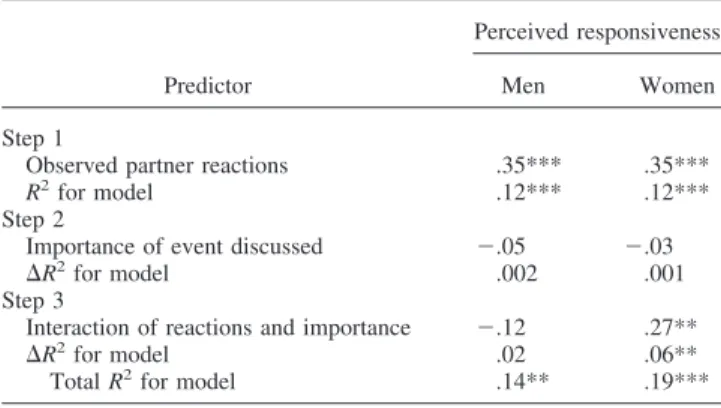
Hypothesis 3 predicted that the behavior of participants’ part-ners during the disclosure of the positive event, as coded by the outside observers, would be associated with participants’ feelings of responsiveness directly following the interaction. To examine this question, we conducted hierarchical multiple regression equa-tions separately for men and women in which the observed ratings of partners’ reactions predicted responsiveness ratings of the par-ticipant. As seen in the first two rows of Table 4, in couples in which the woman’s behavior was rated as more active and con-structive by outside observers, her male partner’s feelings of responsiveness were significantly higher, ⫽.35,R2⫽.12,p⬍
.01. In couples in which the man’s behavior was rated as more active and constructive by outside observers, his female partner’s feelings of responsiveness were significantly higher,  ⫽ .35, R2⫽.12,p⬍.01.7
6All the analyses reported in Table 3 were rerun, entering ratings of how much participants had discussed their events before the laboratory sessions into the regression. Neither prior positive event nor personal concern discussion ratings predicted Time 1 RWB for men or women; prior personal concern discussion did not predict Time 2 RWB for men or women; and prior positive event discussion ratings was a significant predictor of women’s (but not of men’s) Time 2 RWB ( ⫽.29,p⬍.05). Most important, all significant effects in Table 3 remained significant when controlling for prior event discussion.
7Prior positive event discussion was not a significant predictor of men’s or women’s behavior, as coded by observers,ps⬎.45. Moreover, observer codes of behavior remained significant predictors of responsiveness ratings when we controlled for prior event discussion.
Table 2
Postinteraction Responsiveness Ratings Predicting Perceived Responses to Capitalization Attempts Scale (PRCA)
Predictor
PRCA score
Men Women
Positive event responsiveness .34** .32* Negative event responsiveness .11 ⫺.02
TotalR2for model .18** .09**
Note. n ⫽ 73 for each group. Numbers are standardized regression weights (s). Predictor variables were entered simultaneously.
*p⬍.06. **p⬍.05.
Table 3
Positive and Negative Event Disclosure Postinteraction Responsiveness Ratings Predicting Relationship Well-Being at Time 1 and Time 2
Predictor
Relationship well-being
Men Women
Time 1 Time 2 Time 1 Time 2 Positive event responsiveness .54*** .19 .35** .62*** Negative event responsiveness .08 .34 .34** .05
R2for responsiveness predictors .36*** .25** .40*** .43***
Note. Relationship well-being score⫽a composite of scores on scales of commitment, satisfaction, and passionate love. Time 1n⫽73 for each group, and Time 2n⫽34 men and 45 women. Numbers are standardized regression weights (s). Predictor variables were entered simultaneously. **p⬍.05 ***p⬍.01.
To further explore Hypothesis 3, we examined the relationship between the importance of the event disclosed because this may have been an important factor moderating both how the responder behaved and how the responder’s behavior was interpreted. Thus, in Step 2 of the regression equation, we entered the importance rating that the disclosing participants gave their own event before discussing it in the interaction, but it was not a significant predictor of responsiveness ratings for either men or women (see Table 4). For each person, an interaction term was created by multiplying thezscores of event importance and observer codes, and this score was entered in Step 3 of the equation. Also as seen in Table 4, the interaction term was not significant for men, nor didR2 change
significantly. However, for women, the interaction term was sig-nificant,  ⫽.27, p⬍ .05, and this was a significant change, ⌬R2 ⫽.06, p⬍ .05. To interpret the interaction, we calculated
predicted scores for men and women 1 standard deviation above and below the mean on importance ratings of events and on the observed active– constructive behavior of their partners using the weights from the final step of the regression equation. These scores are shown in Figure 1. For men, there was no significant interac-tion; only the active– constructive behavior of their partner pre-dicted feelings of responsiveness. However, for women, there was a significant interaction, reflecting that women felt most responded to when their partners were active and constructive in discussing their important events and least responded to when their partners were not active and constructive in discussing their important events. Thus, the man’s behavior was particularly influential when the woman’s event was important, as per her own ratings of the event. Finally, to further investigate discriminant validity, we exam-ined the association between our observer ratings of partners’ behavior during the positive event disclosure and self-ratings of responsiveness after the negative event disclosure. Neither men’s nor women’s ratings of responsiveness after their negative event discussions were significantly correlated with their partners’ be-havior during the positive event discussions,r(78)⫽.08,p⬎.50, andr(76)⫽.118,p⬎.35, respectively. This result indicates that active– constructive responses to positive event disclosures are
uniquely related to feeling understood, validated, and cared for in the capitalization context, not in the social support context and that partners who respond actively and constructively to capitalization attempts are not necessarily the same partners who provide effec-tive social support.
Additional Analyses
Predictors of partners’ behavior during participants’ disclo-sures of positive events. We examined two sets of individual difference variables that were theoretically predicted to influence active– constructive behavior following the disclosure of a positive event: attachment dimensions and the Big Five personality vari-ables. For the first set of analyses, observer codes of participants’ behavior during their partners’ positive event disclosure were correlated with their own attachment anxiety and attachment avoidance scores. For men, anxiety was not a significant predictor of behavior,r(76)⫽ ⫺.05,p⫽.65, and avoidance was marginally associated with behavior, ⫽ ⫺.22,p⬍.06, such that men who scored high on avoidance were rated as less active and constructive by our observers. For women, neither the avoidance nor the anxiety dimensions significantly correlated with their behavior,rs (78)⫽ ⫺.06 and .01, respectively,ps⬎.60. Thus, it appears that the attachment dimensions are not consistent or strong predictors of behavior during the positive event discussion.
Table 4
Observer Ratings of Partners’ Active and Constructive Reactions and Importance of Event Predicting Participants’ Perceived Responsiveness
Predictor
Perceived responsiveness
Men Women
Step 1
Observed partner reactions .35*** .35***
R2for model .12*** .12***
Step 2
Importance of event discussed ⫺.05 ⫺.03
⌬R2for model .002 .001
Step 3
Interaction of reactions and importance ⫺.12 .27**
⌬R2for model .02 .06**
TotalR2for model .14** .19***
Note. n⫽72 men and 71 women for each group. Numbers are standard-ized regression weights (s).
**p⬍.05. ***p⬍.01.
Men
-0.8 -0.6 -0.4 -0.2 -0 0.2 0.4 0.6 0.8
Resp
o
n
si
ven
ess
High Event Importance Low Event Importance
High Low
Partner’s Active/Constructive Behavior
Women
-0.8 -0.6 -0.4 -0.2 -0 0.2 0.4 0.6 0.8
Resp
o
n
si
ven
ess
High Event Importance Low Event Importance
High Low
Partner’s Active/Constructive Behavior
Figure 1. Predicted ratings of partners’ responsiveness during positive event discussion by observer ratings of active– constructive behavior and importance of event.
Correlations among the Big Five and participants’ behavior during their partners’ positive event disclosure were also calcu-lated. For men, agreeableness was correlated with their behavior, r(78)⫽.23,p⬍.05, such that more agreeable men were rated as more active and constructive responders by our coders. The re-maining four personality dimensions were not correlated with behavior, allps⬎.25. For women, none of the correlations with personality factors and behavior reached traditional significance levels. However, agreeableness,r(76)⫽.19,p⬍.10, and neurot-icism,r(76) ⫽ ⫺.20, p⬍ .08, were marginally associated with behavior. Overall, personality was not strongly correlated with behavior during partners’ positive event disclosures.
Break-ups at Time 2. Four couples broke up (as reported by at least 1 member of the couple); both members of 34 couples completed measures and 1 member of an additional 20 couples completed the follow-up (4 men, 16 women), for a total of 88 individuals who completed the follow-up. Neither member of the remaining 21 couples returned the follow-up survey. Therefore, we had at least one follow-up measure completed by 54 of the 75 couples that were not verifiably broken up at Time 2. We usedt tests to compare the Time 1 RWB score, the PRCA score, and the positive and negative event postinteraction responsiveness ratings of the 54 couples who we were certain remained together at the follow-up with those of the 4 couples who broke up. Because of the large difference in samples sizes, unequal variances were assumed, and separate analyses were performed for men and women. We note here that the results reported should be considered preliminary, given the small portion of the sample that broke up. The women from the dissolved couples did not differ from those in the intact couples on Time 1 RWB (Ms ⫽ 5.61 and 6.01, respectively),t(56)⫽1.25,p⬎.25; post–positive event respon-siveness ratings (Ms⫽4.28 and 4.38, respectively),t(52)⫽0.35, p⬎.75; or post–negative event responsiveness (Ms ⫽4.25 and 4.45, respectively), t(52) ⫽ 0.69, p ⬎ .50. However, the two groups were marginally different on the PRCA ratings (Ms⫽1.56 vs. 2.55), t(56) ⫽ 2.23,p ⫽ .068, such that women in couples whose relationships dissolved before the follow-up rated their partners’ typical response to their sharing of positive events as less active and constructive and more passive and destructive than the women in couples who remained intact at the follow-up.
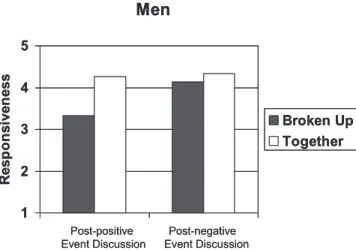
The men from the dissolved couples did not differ from those in intact couples on Time 1 RWB (Ms⫽4.70 and 5.79, respectively), t(56) ⫽ 1.73, p⫽ .176, or post–negative event responsiveness (Ms ⫽ 4.13 and 4.34, respectively), t(56) ⫽ 0.51, p ⫽ .65. However, like the women, the two groups of men scored signifi-cantly differently on the PRCA scale (Ms ⫽ ⫺0.25 vs. 2.09), t(56)⫽2.97,p⬍.05. Also interesting was the finding that the two groups significantly differed on the postpositive event discussion responsiveness ratings of their partners (Ms ⫽ 3.32 vs. 4.26), t(52)⫽3.04,p⬍.05. That is, as shown in Figure 2, men in the couples who broke up before the follow-up felt less understood, validated, and cared for following their positive event discussion (but not following the negative event discussion) than those men in the couples who remained intact at Time 2. Moreover, women in the dissolved couples actually behaved less actively and constructively as rated by the outside observers during the male partner’s positive event discussion than those in the couples that remained intact at Time 2 (Ms⫽8.75 and 9.62, respectively),t(56)⫽2.44,p⫽.05.8
The analyses of relationship stability over time should be inter-preted with caution because the vast majority of couples remained together, and the couples who dissolved their relationships were a small group (4 couples). Nonetheless, the results suggest that if the two groups differed on any of the variables, they differed on the variables concerning how partners respond to the disclosure of positive events. These results, although preliminary, are supportive of our hypotheses concerning the context of positive events in relationship processes.
Discussion
Data from the present study replicate and extend findings from previous research on capitalization. First, we found that a measure of partners’ typical responses to capitalization attempts (the PRCA) was correlated with both concurrent and future relationship commitment, satisfaction, and love and, for men, with change in these outcomes over time. These findings are consistent with previous research showing that when individuals rate their partners as active and constructive responders (and not as passive or de-structive), they feel more intimacy and trust, are more satisfied with their relationships on a daily basis, report fewer daily con-flicts, and engage in more fun and relaxing activities on a daily basis (Gable et al., 2004).
Perhaps more important, we found both discriminant and con-vergent validity for the PRCA. First, the PRCA predicted the
8Because there was a small number of couples who broke up, we were concerned our significant effects may have been driven by an outlier in the group. Thus, we carefully inspected the data from the four broken-up couples on the variables on which they differed from the intact couples: women’s and men’s PRCA scores, men’s post–positive event responsive-ness ratings, and observer’s codes of women’s behavior during men’s positive event disclosure. For each variable, scores from all four broken-up couples were below the mean and median scores for the intact couples. Thus, it is unlikely that significant differences were driven by an outlier; all broken up participants scored similarly low on these variables.
Men
1 2 3 4 5
Resp
o
n
si
ven
ess
Broken Up Together
Post-positive Post-negative Event Discussion Event Discussion
Men
1 2 3 4 5
Resp
o
n
si
ven
ess
Broken Up Together
Post-positive Post-negative Event Discussion Event Discussion
Figure 2. Difference between ratings of responsiveness during postevent discussions for men who were in couples who had broken up (n⫽4) and who had remained together (n⫽54) at Time 2.