Hybrid Type Checking
Cormac Flanagan
Department of Computer Science University of California, Santa Cruz
Abstract
Traditional static type systems are very effective for verifying ba-sic interface specifications, but are somewhat limited in the kinds specifications they support. Dynamically-checked contracts can en-force more precise specifications, but these are not checked until run time, resulting in incomplete detection of defects.
Hybrid type checkingis a synthesis of these two approaches that enforces precise interface specifications, via static analysis where possible, but also via dynamic checks where necessary. This paper explores the key ideas and implications of hybrid type checking, in the context of the simply-typedλ-calculus with arbitrary refine-ments of base types.
Categories and Subject Descriptors D.3.1 [Programming Lan-guages: Formal Definitions and Theory]: specification and verifi-cation
General Terms Languages, Theory, Verification
Keywords Type systems, contracts, static checking, dynamic checking
1.
Motivation
The construction of reliable software is extremely difficult. For large systems, it requires a modular development strategy that, ideally, is based on precise and trusted interface specifications. In practice, however, programmers typically work in the context of a large collection of APIs whose behavior is only informally and imprecisely specified and understood. Practical mechanisms for specifying and verifying precise, behavioral aspects of interfaces are clearly needed.
Static type systems have proven to be extremely effective and practical tools for specifying and verifying basic interface spec-ifications, and are widely adopted by most software engineering projects. However, traditional type systems are somewhat limited in the kinds of specifications they support. Ongoing research on more powerful type systems (e.g., [45, 44, 17, 29, 11]) attempts to over-come some of these restrictions, via advanced features such as de-pendent and refinement types. Yet these systems are designed to be statically type safe, and so the specification language is intention-ally restricted to ensure that specifications can always be checked statically.
Permission to make digital or hard copies of all or part of this work for personal or classroom use is granted without fee provided that copies are not made or distributed for profit or commercial advantage and that copies bear this notice and the full citation on thefirst page. To copy otherwise, to republish, to post on servers or to redistribute to lists, requires prior specific permission and/or a fee.
POPL’06 January 11–13, 2006, Charleston, South Carolina, USA. Copyright c2006 ACM 1-59593-027-2/06/0001. . . $5.00.
In contrast,dynamic contract checking[30, 14, 26, 19, 24, 27, 36, 25] provides a simple method for checking more expressive specifications. Dynamic checking can easily support precise speci-fications, such as:
- Subrange types,e.g., the functionprintDigitrequires an in-teger in the range [0,9].
- Aliasing restrictions,e.g.,swaprequires that its arguments are distinct reference cells.
- Ordering restrictions,e.g.,binarySearchrequires that its ar-gument is a sorted array.
- Size specifications,e.g., the functionserializeMatrixtakes as input a matrix of sizenbym, and returns a one-dimensional array of sizen×m.
- Arbitrary predicates: an interpreter (or code generator) for a typed language (or intermediate representation [39]) might nat-urally require that its input be well-typed,i.e., that it satisfies the predicatewellTyped:Expr→Bool.
However, dynamic checking suffers from two limitations. First, it consumes cycles that could otherwise perform useful computa-tion. More seriously, dynamic checking provides only limited cov-erage – specifications are only checked on data values and code paths of actual executions. Thus, dynamic checking often results in incomplete and late (possibly post-deployment) detection of de-fects.
Thus, the twin goals ofcomplete checkingandexpressive spec-ificationsappear to be incompatible in practice.1Static type check-ing focuses on complete checkcheck-ing of restricted specifications. Dy-namic checking focuses on incomplete checking of expressive specifications. Neither approach in isolation provides an entirely satisfactory solution for checking precise interface specifications.
In this paper, we describe an approach for validating precise in-terface specifications using a synthesis of static and dynamic tech-niques. By checking correctness properties and detecting defects statically (whenever possible) and dynamically (only when neces-sary), this approach ofhybrid type checkingprovides a potential solution to the limitations of purely-static and purely-dynamic ap-proaches.
We illustrate the key idea of hybrid type checking by consider-ing the type rule for function application:
Et1 : T →T Et2 : S ES <:T
E(t1t2) : T
1Complete checking of expressive specifications could be achieved by requiring that each program be accompanied by a proof (perhaps expressed as type annotations) that the program satisfies its specification, but this approach is too heavyweight for widespread use.
Ill-typed programs Well-typed programs Clearly ill-typed Subtle programs Clearly well-typed
Rejected Accepted Accepted with casts without casts Casts Casts
may never fail fail
Figure 1. Hybrid type checking on various programs. This rule uses the antecedentE S <:T to check compatibility of the actual and formal parameter types. If the type checker can prove this subtyping relation, then this application is well-typed. Conversely, if the type checker can prove that this subtyping rela-tion does not hold, then the program is rejected. In a convenrela-tional, decidable type system, one of these two cases always holds.
However, once we consider expressive type languages that are not statically decidable, the type checker may encounter situations where its algorithms can neither prove, nor refute, the subtype judg-mentES <:T(particularly within the time bounds imposed by interactive compilation). A fundamental question in the develop-ment of expressive type systems is how to deal with such situations where the compiler cannot statically classify the program as either ill-typed or well-typed:
- Statically rejectingsuch programs would cause the compiler to reject some programs that, on deeper analysis, could be shown to be well-typed. This approach seems too brittle for use in practice, since it would be difficult to predict which programs the compiler would accept.
- Statically acceptingsuch programs (based on the optimistic assumption that the unproven subtype relations actually hold) may result in specifications being violated at run time, which is undesirable.
Hence, we argue that the most satisfactory approach is for the com-piler to accept such programs on a provisional basis, but to insert sufficient dynamic checks to ensure that specification violations never occur at run time. Of course, checking thatE S <:T at run time is still a difficult problem and would violate the principle ofphase distinction[9]. Instead, our hybrid type checking approach transforms the above application into the code
t1(STt2)
where the additionaltype castorcoercionSTt2dynamically
checks that the value produced byt2is in the domain typeT. Note
that hybrid type checking supports very precise types, andT could in fact specify a detailed precondition of the function, for example, that it only accepts prime numbers. In this case, the run-time cast would involve performing a primality check.
The behavior of hybrid type checking on various kinds of pro-grams is illustrated in Figure 1. Although every program can be classified as either ill-typed or well-typed, for expressive type sys-tems it is not always possible to make this classification statically. However, the compiler can still identify some (hopefully many) clearly ill-typed programs, which are rejected, and similarly can identify some clearly well-typed programs, which are accepted un-changed.
For the remainingsubtleprograms, dynamic type casts are in-serted to check any unverified correctness properties at run time. If the original program is actually well-typed, these casts are re-dundant and will never fail. Conversely, if the original program is ill-typed in a subtle manner that cannot easily be detected at com-pile time, the inserted casts may fail. As static analysis technology
Expressi
veness
Coverage Dynamic
Checking
Type Checking
Full Program Verification Hybrid
Type Checking
100%
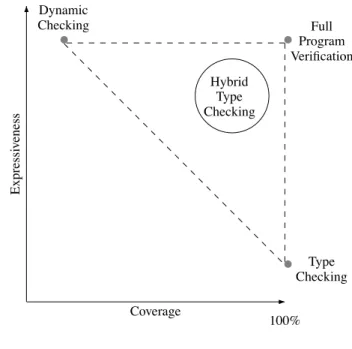
Figure 2. Rough sketch of the relationship between hybrid type checking, dynamic checking, type checking, and full program ver-ification.
improves, we expect that the category of subtle programs in Fig-ure 1 will shrink, as more ill-typed programs are rejected and more well-typed programs are fully verified at compile time.
Hybrid type checking provides several desirable characteristics: 1. It supports precise interface specifications, which are essential
for modular development of reliable software.
2. As many defects as is possible and practical are detected at compile time (and we expect this set will increase as static analysis technology evolves).
3. All well-typed programs are accepted by the checker.
4. Due to decidability limitations, the hybrid type checker may statically accept somesubtly ill-typedprograms, but it will in-sert sufficient dynamic casts to guarantee that specification vi-olations never occur; they are always detected, either statically or dynamically.
5. The output of the hybrid type checker is always a well-typed program (and so, for example, type-directed optimizations are applicable).
6. If the source program is well-typed, then the inserted casts are guaranteed to succeed, and so the source and compiled programs are behaviorally equivalent (orbisimilar).
Figure 2 contains a rough sketch of the relationship between hybrid type checking and prior approaches for program checking, in terms of expressiveness (y-axis) and coverage (x-axis). Dynamic checking is expressive but obtains limited coverage. Type checking obtains full coverage but has somewhat limited expressiveness. In theory, full program verification could provide full coverage for expressive specifications, but it is intractable for all but small programs. Motivated by the need for more expressive specification languages, the continuum between type checking and full program verification is being explored by a range of research projects (see, for example, [37, 5, 23, 45]). The goal of this paper is to investigate the interior of the triangle defined by these three extremes.
Our proposed specifications extend traditional static types, and so we view hybrid type checking as an extension of traditional static type checking. In particular, hybrid type checking supports precise specifications while preserving a key benefit of static type systems; namely, the ability to detect simple, syntactic errors at compile time. Moreover, as we shall see, for any decidable static type checkerS, it is possible to develop a hybrid type checkerH that performs somewhat better thanSin the following sense:
1.Hdynamically detects errors that would be missed byS, since H supports more precise specifications thanS and can detect violations of these specifications dynamically.
2.Hstatically detects all errors that would be detected byS, since Hcan statically perform the same reasoning asS.
3.H actually detects more errors statically thanS, sinceH sup-ports more precise specifications, and could reasonably detect some violations of these precise specifications statically. The last property is perhaps the most surprising; Section 6 contains a proof that clarifies this argument.
Hybrid type checking may facilitiate the evolution and adoption of advanced static analyses, by allowing software engineers to experiment with sophisticated specification strategies that cannot (yet) be verified statically. Such experiments can then motivate and direct static analysis research. In particular, if a hybrid compiler fails to decide (i.e., verify or refute) a subtyping query, it could send that query back to the compiler writer. Similarly, if a hybrid-typed program fails a compiler-inserted castSTv, the valuev is a witness that refutes an undecided subtyping query, and such witnesses could also be sent back to the compiler writer. This information would provide concrete and quantifiable motivation for subsequent improvements in the compiler’s analysis.
Indeed, just like different compilers for the same language may yield object code of different quality, we might imagine a variety of hybrid type checkers with different trade-offs between static and dynamic checks (and between static and dynamic error messages). Fast interactive hybrid compilers might perform only limited static analysis to detect obvious type errors, while production compilers could perform deeper analyses to detect more defects statically and to generate improved code with fewer dynamic checks.
Hybrid type checking is inspired by prior work on soft typ-ing [28, 42, 3, 15], but it extends soft typtyp-ing by rejecttyp-ing many ill-typed programs, in the spirit of static type checkers. The interaction between static typing and dynamic checks has also been studied in the context of type systems with the typeDynamic[1, 38], and in systems that combine dynamic checks with dependant types [35]. Hybrid type checking extends these ideas to support more precise specifications.
The general approach of hybrid type checking appears to be applicable to a variety of programming languages and to various specification languages. In this paper, we illustrate the key ideas of hybrid type checking for a fairly expressive dependent type system that is statically undecidable. Specifically, we work with an extension of the simply-typedλ-calculus that supports arbitrary refinements of base types.
This language and type system is described in the following sec-tion. Section 3 then presents a hybrid type checking algorithm for this language. Section 4 illustrates this algorithm on an example program. Section 5 verifies key correctness properties of our lan-guage and compilation algorithm. Section 6 performs a detailed comparison of the static and hybrid approaches to type checking. Section 7 discusses related work, and Section 8 describes opportu-nities for future research.
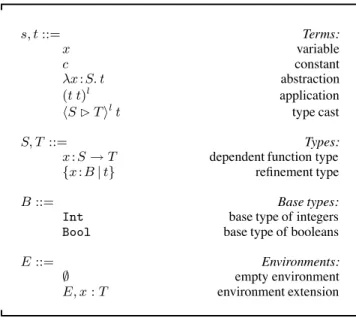
Figure 3: Syntax
s, t::= Terms:
x variable
c constant
λx:S. t abstraction
(t t)l application
STlt
type cast
S, T ::= Types:
x:S→T dependent function type
{x:B|t} refinement type
B::= Base types:
Int base type of integers
Bool base type of booleans
E::= Environments:
∅ empty environment
E, x:T environment extension
2.
The Language
λ
HThis section introduces a variant of the simply-typedλ-calculus extended with casts and with precise (and hence undecidable) re-finement types. We refer to this language asλH.
2.1 Syntax ofλH
The syntax ofλHis summarized in Figure 3. Terms include vari-ables, constants, functions, applications, and casts . The cast S Tt dynamically checks that the result oftis of typeT (in a man-ner similar to coercions [38], contracts [13, 14], and to type casts in languages such as Java [20]). For technical reasons, the cast also includes that static typeS of the termt. Type casts are annotated with associated labelsl ∈Label, which are used to map run-time errors back to locations in the source program. Applications are also annotated with labels, for similar reasons. For clarity, we omit these labels when they are irrelevant.
TheλHtype language includes dependent function types [10], for which we use the syntaxx : S → T of Cayenne [4] (in preference to the equivalent syntaxΠx: S. T). Here, S is the domain type of the function and the formal parameterxmay occur in the range typeT. We omitx if it does not occur free inT, yielding the standard function type syntaxS→T.
We useBto range over base types, which includes at leastBool
andInt. As in many languages, these base types are fairly coarse and cannot, for example, denote integer subranges. To overcome this limitation, we introducebase refinement typesof the form
{x:B|t}
Here, the variablex(of typeB) can occur within the boolean term orpredicatet. This refinement type denotes the set of constantscof typeBthat satisfy this predicate,i.e., for which the termt[x:=c] evaluates to true. Thus,{x:B|t}denotes a subtype ofB, and we use a base typeBas an abbreviation for the trivial refinement type
{x:B|true}.
Our refinement types are inspired by prior work on decidable re-finement type systems [29, 17, 11, 45, 44, 35]. However, our refine-ment types support arbitrary predicates, and this expressive power causes type checking to become undecidable. For example, sub-typing between two refinement types{x:B|t1}and{x:B|t2}
reduces to checking implication between the corresponding predi-cates, which is clearly undecidable. These decidability difficulties are circumvented by our hybrid type checking algorithm, which we describe in Section 3.
The type of each constant is defined by the following function ty:Constant→Type, and the setConstantis implicitly defined as the domain of this mapping.
true : {b:Bool|b} false : {b:Bool|notb}
⇔ : b1:Bool→b2:Bool→ {b:Bool|b⇔(b1⇔b2)}
not : b:Bool→ {b:Bool|b⇔notb}
n : {m:Int|m=n}
+ : n:Int→m:Int→ {z:Int|z=n+m}
+n : m:Int→ {z:Int|z=n+m}
= : n:Int→m:Int→ {b:Bool|b⇔(n=m)} ifT : Bool→T →T →T
fixT : (T →T)→T
Abasic constantis a constant whose type is a base refinement type. Each basic constant is assigned a singleton type that denotes exactly that constant. For example, the type of an integerndenotes the singleton set{n}.
Aprimitive functionis a constant of function type. For clarity, we use infix syntax for applications of some primitive functions (e.g.,+,=,⇔). The types for primitive functions are quite precise. For example, the type for the primitive function+:
n:Int→m:Int→ {z:Int|z=n+m}
exactly specifies that this function performs addition. That is, the termn+mhas the type {z:Int|z = n+m} denoting the singleton set{n+m}. Note that even though the type of “+” is defined in terms of “+” itself, this does not cause any problems in our technical development, since the semantics of refinement predicates is defined in terms of the operational semantics.
The constantfixT is thefixpoint constructor of typeT, and enables the definition of recursive functions. For example, the fac-torial function can be defined as:
fixInt→Int
λf:(Int→Int). λn:Int.
ifInt(n= 0) 1 (n∗(f(n−1)))
Refinement types can express many precise specifications, such as:
- printDigit: {x:Int|0≤x∧x≤9} →Unit. - swap : x:RefInt→ {y:RefInt|x=y} →Bool. - binarySearch: {a:Array|sorteda} →Int→Bool. Here, we assume that Unit, Array, andRefIntare additional base types, and the primitive functionsorted :Array→ Bool
identifies sorted arrays.
2.2 Operational Semantics ofλH
We next describe the run-time behavior of λH terms, since the semantics of the type language depends on the semantics of terms. The relations −→ tperforms a single evaluation step, and the relation−→∗is the reflexive-transitive closure of−→.
As shown in Figure 4, the rule [E-β] performs standard β -reduction of function applications. The rule [E-PRIM] evaluates
applications of primitive functions. This rule is defined in terms of the partial function:
[[·]]·:Constant×Term→pTerm
Figure 4: Evaluation Rules
Evaluation s−→t
(λx:S. t)s −→ t[x:=s] [E-β] c t −→ [[c]](t) [E-PRIM] (x:S1→S2)(x:T1→T2)lt [E-CAST-F]
−→
λx:T1.S2T2l(t(T1S1lx))
{x:B|s}{x:B|t}c −→ c [E-CAST-C]
ift[x:=c]−→∗true
C[s] −→ C[t] ifs−→t [E-COMPAT]
Contexts C
C ::= • | • t|t • | ST •
which defines the semantics of primitive functions. For example: [[not]](true) = false
[[+]](3) = +3
[[+3]](4) = 7
[[not]](3) = undefined [[ifT]](true) = λx:T. λy:T. x
[[ifT]](false) = λx:T. λy:T. y
[[fixT]](t) = t (fixT t)
The operational semantics of casts is a little more complicated. As described by the rule [E-CAST-F], casting a term t of type x:S1→S2to a function typex:T1→T2yields a new function
λx:T1.S2T2l(t(T1S1lx))
This function is of the desired typex:T1 → T2 ; it takes an
argumentxof typeT1, casts it to a value of typeS1, which is
passed to the original functiont, and the result of that application is then cast to the desired result typeT2. Thus, higher-order casts are
performed a lazy fashion – the new castsS2T2landT1S1l
are performed at every application of the resulting function, in a manner reminiscent of higher-order contracts [14]. If either of the two new casts fail, their labellthen assigns the blame back to the original cast(x:S1→S2)(x:T1→T2)l.
The rule[E-CAST2]deals with casting a basic constantcto a
base refinement type{x:B|t}. This rule checks that the predicate tholds onc,i.e., thatt[x:=c]evaluates totrue.
Note that these casts involve only tag checks, predicate checks, and creating checking wrappers for functions. Thus, our approach adheres to the principle of phase separation [9], in that there is no type checking of actual program syntax at run time.
2.3 TheλHType System
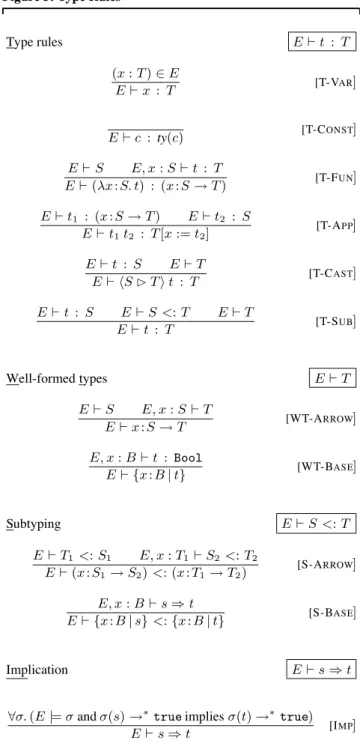
We next describe the (undecidable)λHtype system via the collec-tion of type judgments and rules shown in Figure 5. The judgment Et : Tchecks that the termthas typeTin environmentE; the judgmentE T checks thatT is a well-formed type in environ-mentE; and the judgmentES <:T checks thatSis a subtype ofTin environmentE.
Figure 5: Type Rules
Type rules Et : T
(x:T)∈E
Ex : T [T-VAR] Ec : ty(c) [T-CONST] ES E, x:St : T
E(λx:S. t) : (x:S→T) [T-FUN] Et1 : (x:S→T) Et2 : S
Et1t2 : T[x:=t2]
[T-APP]
Et : S ET
E STt : T [T-CAST] Et : S ES <:T ET
Et : T [T-SUB]
Well-formed types ET
ES E, x:ST
Ex:S→T [WT-ARROW]
E, x:B t : Bool
E {x:B|t} [WT-BASE]
Subtyping ES <:T
ET1 <:S1 E, x:T1 S2 <:T2
E(x:S1→S2)<: (x:T1→T2)
[S-ARROW]
E, x:Bs⇒t
E {x:B|s}<:{x:B|t} [S-BASE]
Implication Es⇒t
∀σ.(E|=σandσ(s)→∗trueimpliesσ(t)→∗true) Es⇒t [IMP]
Consistent Substitutions E|=σ
∅ |=∅ [CS-EMPTY]
∅ t : T (x:=t)E|=σ
x:T, E|= (x:=t, σ) [CS-EXT]
The rules defining these judgments are mostly straightforward. The rule[T-APP] for applications differs somewhat from the rule
presented in the introduction because it supports dependent func-tion types, and because the subtyping relafunc-tion is factored out into the separate subsumption rule[T-SUB]. We assume that variables
are bound at most once in an environment. As customary, we apply implicitα-renaming of bound variables to maintain this assumption and to ensure substitutions are capture-avoiding.
The novel aspects of this system arise from its support of refine-ment types. Recall that a type{x:B|t}denotes the set of con-stantscof typeBfor whicht[x:=c]evaluates totrue. We use two auxiliary judgments to express the correct subtyping relation between refinement types. The implication judgmentEt1⇒t2
holds if whenever the termt1evaluates totruethent2also
evalu-ates totrue. This relation is defined in terms of substitutions that areconsistentwithE. Specifically, a substitutionσ(from variables to terms) isconsistentwith the environmentEifσ(x)is of type E(x)for eachx ∈dom(E). Finally, the rule[S-BASE]states that
the subtyping judgmentE {x:B|t1}<:{x:B|t2}holds if E, x:Bt1⇒t2
meaning that every constant of type{x : B|t1} also has type
{x:B|t2}.
As an example, the subtyping relation:
∅ {x:Int|x >0}<:{x:Int|x≥0}
follows from the validity of the implication: x:Int(x >0)⇒(x≥0)
Of course, checking implication between arbitrary predicates is undecidable, which motivates the development of the hybrid type checking algorithm in the following section.
3.
Hybrid Type Checking for
λ
HWe now describe how to perform hybrid type checking for the languageλH. We believe this general approach extends to other languages with similarly expressive type systems.
Hybrid type checking relies on an algorithm for conservatively approximating implication between predicates. We assume that for any conjectured implicationEs⇒t, this algorithm returns one of three possible results, which we denote as follows:
• The judgmentE√algs⇒tmeans the algorithmfinds a proof thatEs⇒t.
• The judgmentE×
algs⇒tmeans the algorithmfinds a proof thatEs⇒t.
• The judgmentE ?
alg s ⇒tmeans the algorithm terminates due to a timeout without either discovering a proof of either Es⇒torEs⇒t.
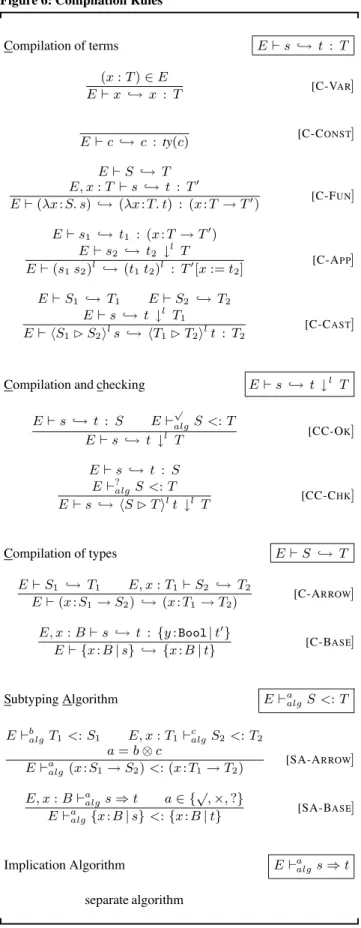
We lift this 3-valued algorithmic implication judgmentEaalg s⇒t(wherea∈ {√,×,?}) to a 3-valued algorithmic subtyping judgment:
Ea
algS <:T
as shown in Figure 6. The subtyping judgment between base re-finement types reduces to a corresponding implication judgment, via the rule[SA-BASE]. Subtyping between function types reduces
to subtyping between corresponding contravariant domain and co-variant range types, via the rule [SA-ARROW]. This rule uses the
following conjunction operation⊗between three-valued results:
⊗ √ ? ×
√ √ ? ×
? ? ? ×
Figure 6: Compilation Rules
Compilation of terms Es → t : T (x:T)∈E
Ex → x : T [C-VAR] Ec → c : ty(c) [C-CONST]
ES → T E, x:T s → t :T
E(λx:S. s) → (λx:T. t) : (x:T →T) [C-FUN]
Es1 → t1 : (x:T→T)
E s2 → t2 ↓l T
E(s1s2)l → (t1t2)l : T[x:=t2]
[C-APP]
ES1 → T1 ES2 →T2
Es → t ↓l T
1
E S1S2ls → T1T2lt : T2
[C-CAST]
Compilation and checking Es → t ↓l T Es → t : S E√algS <:T
Es → t ↓l T [CC-OK]
Es → t : S E?
algS <:T
Es → STlt ↓l T [CC-CHK]
Compilation of types ES →T
ES1 → T1 E, x:T1S2 → T2
E(x:S1→S2) →(x:T1 →T2)
[C-ARROW]
E, x:Bs →t : {y:Bool|t}
E {x:B|s} → {x:B|t} [C-BASE]
Subtyping Algorithm EaalgS <:T Eb
algT1 <:S1 E, x:T1calgS2<:T2
a=b⊗c Ea
alg (x:S1→S2)<: (x:T1→T2)
[SA-ARROW]
E, x:Ba
algs⇒t a∈ {√,×,?}
Ea
alg{x:B|s}<:{x:B|t} [SA-BASE]
Implication Algorithm Eaalgs⇒t separate algorithm
If the appropriate subtyping relation holds for certain between the domain and range components (i.e., b = c = √), then the subtyping relation holds between the function types (i.e.,a= √). If the appropriate subtyping relation does not hold between either the corresponding domain or range components (i.e., b = ×or c = ×), then the subtyping relation does not hold between the function types (i.e., a = ×). Otherwise, in the uncertain case, subtypingmayhold between the function types (i.e.,a= ?). Thus, like the implication algorithm, the subtyping algorithm may not return a definite answer in all cases.
Hybrid type checking uses this subtyping algorithm to type check the source program, and to simultaneously insert dynamic casts to compensate for any indefinite answers returned by the subtyping algorithm. We characterize this process of simultaneous type checking and cast insertion via thecompilation judgment:
Es → t : T
Here, the environmentEprovides bindings for free variables,sis the original source program,tis a modified version of the original program with additional casts, andTis the inferred type fort. Since types contain terms, we extend this compilation process to types via the judgmentES →T. Some of the compilation rules rely on the auxiliarycompilation and checkingjudgment
Es →t ↓l T
This judgment takes as input an environmentE, a source terms, and a desired result typeT, and checks thatscompiles to a term of this result type. The labellis used to appropriately annotate casts inserted by this compilation and checking process.
The rules defining these judgments are shown in Figure 6. Most of the rules are straightforward. The rules[C-VAR] and[C-CONST]
say that variable references and constants do not require additional casts. The rule[C-FUN] compiles an abstractionλx:S. tby com-piling the typeS toS and compilingttotof typeT, and then yielding the compiled abstractionλx:S. tof typex:S → T. The rule[C-APP] for an applications1s2compiless1to a termt1
of function typex:T →T, and uses the compilation and check-ing judgment to ensure that the argument terms2 compiles into a
term of the appropriate argument typeT. The rule[C-CAST] for a
castS1S2scompiles the two typesS1andS2intoT1andT2,
respectively, and then uses the compilation and checking judgment to ensure thatscompiles to a termtof type expected typeT1.
The two rules defining the compilation and checking judgment E s → u ↓l T demonstrate the key idea of hybrid type checking. Both rules start by compilingsto a termtof some type S. The crucial question is then whether this typeSis a subtype of the expect typeT:
• If the subtyping algorithm succeeds in proving thatSis a sub-type ofT(i.e.,E√algS <:T), thentis clearly of the desired typeT, and so the rule[CC-OK] returnstas the compiled form
ofs.
• If the subtyping algorithm can show thatSis not a subtype of T (i.e.,E×
algS <:T), then the program is rejected since no compilation rule is applicable.
• Otherwise, in the uncertain case whereE ?
alg S <:T, the
rule[CC-CHK] inserts the type castSTl to dynamically
ensure that values returned bytare actually of the desired type T.
These rules for compilation and checking illustrate the key benefit of hybrid type checking – specific static analysis problem instances (such asES <:T) that are undecidable or computationally in-tractable can be avoided in a convenient manner simply by
insert-ing appropriate dynamic checks. Of course, we should not abuse this facility, and so ideally the subtyping algorithm should yield a precise answer in most cases. However, the critical contribution of hybrid type checking is that it avoids the very strict requirement of demanding a precise answer forall(arbitrarily complicated) sub-typing questions.
Compilation of types is straightforward. The rule[C-ARROW] compiles a dependent function typex:S → T by recursively compiling the typesSandT (in appropriate environments) toS andT respectively, and then yielding the compiled function type x:S → T. The rule[C-BASE] compiles a base refinement type
{x:B|t}by compiling the termttot(whose type should be a subtype ofBool), and then yielding the compiled base refinement type{x:B|t}.
Note that checking that a type is well-formed is actually a com-pilation process that returns a well-formed type (possibly with added casts). Thus, we only perform compilation of types where necessary, atλ-abstractions and casts, when we encounter (possi-bly ill-formed) types in the source program. In particular, the com-pilation rules do not explicitly check that the environment is well-formed, since that would involve repeatedly compiling all types in that environment. Instead, the compilation rules assume that the environment is well-formed; this assumption is explicit in the cor-rectness theorems later in the paper.
4.
An Example
To illustrate the behavior of the hybrid compilation algorithm, consider a functionserializeMatrixthat serializes annbym matrix into an array of sizen×m. We extend the languageλH with two additional base types:
•Array, the type of one dimensional arrays containing integers.
•Matrix, the type of two dimensional matrices, again containing integers.
The following primitive functions return the size of an array; create a new array of the given size; and return the width and height of a matrix, respectively:
asize : a:Array→Int
newArray : n:Int→ {a:Array|asizea=n} matrixWidth : a:Matrix→Int
matrixHeight : a:Matrix→Int
We introduce the following type abbreviations to denote arrays of sizenand matrices of sizenbym:
Arrayn def= {a:Array|(asizea=n)} Matrixn,m def= {a:Matrix|
matrixWidth a=n
∧matrixHeighta=m
}
The shorthandtaslTensures that the termthas typeTby passing tas an argument to the identity function of typeT →T:
taslT def= ((λx:T. x)t)l
We now define the functionserializeMatrixas:
λn:Int. λm:Int. λa:Matrixn,m.
letr = newArrayein . . . ;r
aslT
The elided term. . .initializes the new arrayrwith the contents of the matrixa, and we will consider several possibilities for the size expressione. The typeTis the specification ofserializeMatrix:
T def= (n:
Int→ m:Int→ Matrixn,m→ Arrayn×m)
For this declaration to type check, the inferred typeArrayeof the function’s body must be a subtype of the declared return type:
n:Int, m:Int Arraye <:Arrayn×m
Checking this subtype relation reduces to checking the implication: n:Int, m:Int, a:Array (asizea=e)
⇒ (asizea= (n×m))
which in turn reduces to checking the equality:
∀n, m∈Int. e=n×m
The implication checking algorithm might use an automatic theo-rem prover (e.g., [12, 6]) to verify or refute such conjectured equal-ities.
We now consider three possibilities for the expressione. 1. Ifeis the expressionn×m, the equality is trivially true, and
the program compiles without any additional casts.
2. Ifeism×n(i.e., the order of the multiplicands is reversed), and the underlying theorem prover can verify
∀n, m∈Int. m×n=n×m
then again no casts are necessary. Note that a theorem prover that is not complete for arbitrary multiplications might still have a specific axiom about the commutativity of multiplication. If the theorem prover is too limited to verify this equality, the hybrid type checker will still accept this program. However, to compensate for the limitations of the theorem prover, the hybrid type checker will insert a redundant cast, yielding the compiled function (where due to space constraints we have elided the source type of the cast):
· · ·Tlλn:Int. λm:Int. λa:Matrixn,m.
letr = newArrayein . . . ; r
aslT
This term can be optimized, via[E-β] and[E-CAST-F] steps and via removal of clearly redundantIntInt casts, to:
λn:Int. λm:Int. λa:Matrixn,m. letr = newArray(m×n)in
. . . ;
Arraym×nArrayn×mlr
The remaining cast checks that the result valuer is of the declared return typeArrayn×m, which reduces to dynamically checking that the predicate:
asizer = n×m
evaluates totrue, which it does.
3. Finally, ifeis erroneouslym×m, the function is ill-typed. By performing random or directed [18] testing of several values fornandmuntil itfinds a counterexample, the theorem prover might reasonably refute the conjectured equality:
∀n, m∈Int. m×m=n×m
In this case, the hybrid type checker reports a static type error. Conversely, if the theorem prover is too limited to refute the conjectured equality, then the hybrid type checker will produce (after optimization) the compiled program:
λn:Int. λm:Int. λa:Matrixn,m. letr = newArray(m×m)in
. . . ;
Arraym×mArrayn×mlr
If this function is ever called with arguments for whichm×
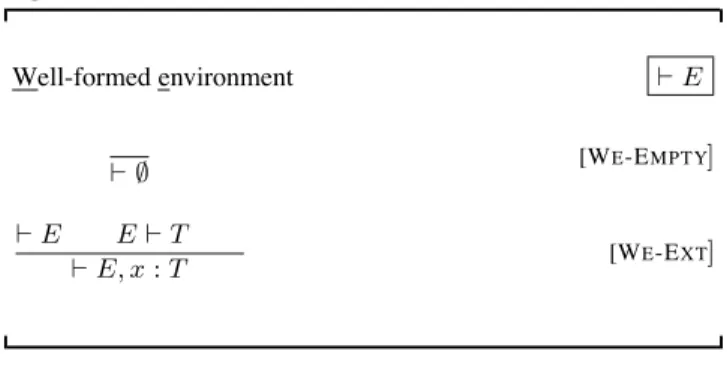
Figure 7: Well-formed Environments
Well-formed environment E
∅ [WE-EMPTY]
E ET
E, x:T [WE-EXT]
the cast label lwill identify theaslconstruct in the original program as the location of this type error, thus indicating that the original definition ofserializeMatrixdid not satisfy its specification.
Note that prior work on practical dependent types [45] could not handle any of these cases, since the typeT uses non-linear arithmetic expressions. In contrast, case 2 of this example demon-strates that even fairly partial techniques for reasoning about com-plex specifications (e.g., commutativity of multiplication, random testing of equalities) can facilitate static detection of defects. Fur-thermore, even though catching errors at compile time is ideal, catching errors at run time (as in case 3) is still clearly an improve-ment over not detecting these errors at all, and getting subsequent crashes or incorrect results.
5.
Correctness
We now study what correctness properties are guaranteed by hybrid type checking, starting with the type system, which provides the specification for our hybrid compilation algorithm.
5.1 Correctness of the Type System
As usual, a term is considered to be innormal form if it does not reduce to any subsequent term, and avaluev is either a λ-abstraction or a constant. We assume that the functiontymaps each constant to an appropriate type, in the following sense:
ASSUMPTION1 (Types of Constants). For eachc∈Constant:
•chas a well-formed type,i.e.∅ ty(c).
•If c is a primitive function then it cannot get stuck and its operational behavior is compatible with its type,i.e.
ifEc v : Tthen[[c]](v)is defined
ifEc t : Tand[[c]](t)is defined thenE[[c]](t) : T.
•Ifcis a basic constant then it is a member of its type, which is a singleton type,i.e.
if ty(c) ={x:B|t}thent[x:=c]−→∗true
if ty(c) ={x:B|t}then∀c∈Constant. t[x:=c]−→∗trueimpliesc=c
The type system satisfies the following type preservation or sub-ject reduction property [43]. This theorem includes a requirement that the environmentEis well-formed ( E), a notion that is de-fined in Figure 7. Note that the type rules do not refer to this judg-ment directly in order to yield a closer correspondence with the compilation rules.
THEOREM2 (Preservation).
IfEandEs : T ands−→tthenEt : T.
PROOF: By induction on the typing derivationE s : T, based on the usual substitution lemma.
The type system also satisfies the progress property, with the caveat that type casts may fail. A failed cast is one that either (1) casts a basic constant to a function type, (2) casts a function to a base refinement type, or (3) casts a constant to an incompatible refinement type (i.e., one with a different base type or an incompat-ible predicate)
DEFINITION3 (Failed Casts).Afailed castis one of: 1.{x:B|s}(x:T1→T2)lv.
2.(x:T1 →T2){x:B|s}lv.
3.{x:B1|t1}{x:B2|t2}lcunlessB1=B2and
t2[x:=c]−→∗true
THEOREM4 (Progress).
Every well-typed, closed normal form is either a value or contains a failed cast.
PROOF: By induction of the derivation showing that the normal form is well-typed.
5.2 Type Correctness of Compilation
Since hybrid type checking relies on necessarily incomplete algo-rithms for subtyping and implication, we next investigate what cor-rectness properties are guaranteed by this compilation process.
We assume the 3-valued algorithm for checking implication between boolean terms is sound in the following sense:
ASSUMPTION5 (Soundness ofEaalgs⇒t). SupposeE. 1. IfE√algs⇒tthenEs⇒t.
2. IfE×algs⇒tthenEs⇒t.
Note that this algorithm does not need to be complete (indeed, an extremely naive algorithm could simply returnE?
alg s <:tin all cases). A consequence of the soundness of the implication algo-rithm is that the algoalgo-rithmic subtyping judgmentE alg S <:T is also sound.
LEMMA6 (Soundness ofEaalgS <:T). SupposeE. 1. IfE√algS <:T thenES <:T.
2. IfE×algS <:T thenES <:T.
PROOF: By induction on derivations using Assumption 5. Becasue algorithmic subtyping is sound, the hybrid compilation algorithm generates only well-typed programs:
LEMMA7 (Compilation Soundness).SupposeE. 1. IfEt → t : T thenEt :T.
2. IfEt → t ↓ TandETthenEt : T. 3. IfET → TthenET.
PROOF: By induction on compilation derivations.
Since the generated code is well-typed, standard type-directed compilation and optimization techniques [39, 31] are applicable. Furthermore, the generated code includes all the type specifications present in the original program, and so by the Preservation Theo-rem these specifications will never be violated at run time. Any attempt to violate a specification is detected via a combination of static checking (where possible) and dynamic checking (only when necessary).
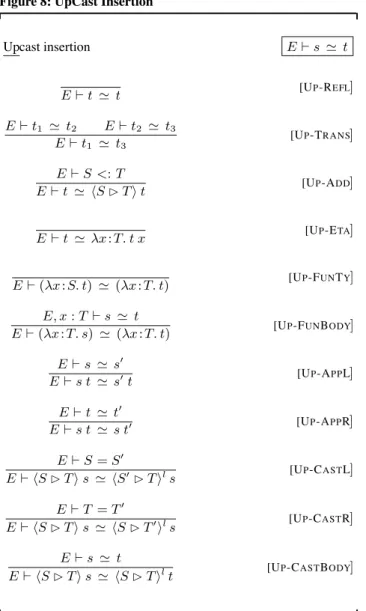
Figure 8: UpCast Insertion
Upcast insertion Es t
Et t [UP-REFL] Et1 t2 Et2 t3
Et1 t3
[UP-TRANS]
ES <:T
Et STt [UP-ADD] Et λx:T. t x [UP-ETA] E(λx:S. t) (λx:T. t) [UP-FUNTY]
E, x:Ts t
E(λx:T. s) (λx:T. t) [UP-FUNBODY] Es s
Es t st [UP-APPL] Et t
Es t s t [UP-APPR]
ES=S
E STs STls [UP-CASTL]
ET =T
E STs STls [UP-CASTR]
Es t
E STs STlt [UP-CASTBODY]
5.3 Bisimulation
In this section we prove that compilation does not change the meaning of well-typed programs, so that the original and compiled programs are behaviorally equivalent, orbisimilar.
As afirst step towards defining this bisimulation relation, the cast insertion relation shown in Figure 8 characterizes some aspects of the relationship between source and compiled terms. The rule [UP-ADDCAST] states that, if E S <:T, then the
castS T is redundant, and any termt is considered to be
-equivalent toS Tt. Note that this rule requires that we track the current environment. The remaining rules implement the reflexive-transitive-compatible closure of this rule, updating the current environment as appropriate. The rule[UP-ETA] also allows
for η-expansion, which is in part performed by the evaluation rule[E-CAST-FN] for function casts.
As a technical requirement, we assume that application of prim-itive functions preserves-equivalence:
ASSUMPTION8 (Constant Bisimulation). For all primitive func-tionsc, ifs tthen[[c]](s) [[c]](t).
The desired bisimulation relationRis then obtained by strength-ening the cast insertion relation with the additional requirement that both the original program and compiled programs are well-typed:
R={(s, t)|s tand∃S.∅ s : Sand∃T.∅ t : T} This relationRis a bisimulation relation,i.e., ifR(s, t)holds then sandtexhibit equivalent behavior.
LEMMA9 (Bisimulation).SupposeR(s, t).
1. Ifs−→sthen∃tsuch thatt−→∗tandR(s, t). 2. Ift−→tthen∃ssuch thats−→∗sandR(s, t). PROOF: By induction on the cast insertion derivation.
Finally, we prove that the compilationE s → t : T of a well-typed programsyields a bisimilar programt. Proving this property requires an inductive hypothesis that also characterizes the compilation relationsEs → t ↓ TandES →T. LEMMA10 (Compilation is Upcasting).SupposeE.
1. IfE s : S andE s → t : T thenE T <:S and Es t.
2. IfE s : S andE s → t ↓ T andE S <:T then Es t.
3. IfESandES → TthenES=T. PROOF: By induction on compilation derivations.
It follows that compilation does not change the behavior of well-typed programs.
LEMMA11 (Correctness of Compilation).Suppose∅ s : S and∅ s → t : T.
1. Ifs−→∗sthen∃tsuch thatt−→∗tands t. 2. Ift−→∗tthen∃ssuch thats−→∗sands t. PROOF: By Lemma 10,s t. Also,tis well-typed by Lemma 7, andsis also well-typed, soR(s, t). Thefirst case then follows by induction on the length of the reduction sequences −→∗s. The base case clearly holds. For the inductive case, ifs−→sthen by Lemma 9∃tsuch thatt−→∗tands t. Furthermore, by the Preservation Theorem,sandtare well-typed, and soR(s, t). The second case is similar.
From part 3 of Lemma 10, compilation of a well-formed type yields an equivalent type. It follows via a straightforward induction that the compilation algorithm is guaranteed to accept all well-typed programs.
LEMMA12 (Compilation Completeness).SupposeE. 1. IfEs : Sthen∃t, Tsuch thatEs →t : T.
2. IfE s : SandE S <:T then∃tsuch thatE s → t ↓ T.
3. IfESthen∃T such thatES →T. PROOF: By induction on typing derivations.
6.
Static Checking vs. Hybrid Checking
Given the proven benefits of traditional, purely-static type systems, an important question that arises is how hybrid type checkers relate to conventional static type checkers.
To study this question, we assume the static type checker tar-gets a restricted subset ofλHfor which type checking is statically decidable. Specifically, we assume there exists a subsetDofTerm such that for allt1, t2∈ Dand for all environmentsE(containing
onlyD-terms), the judgmentEt1⇒t2is decidable. We
intro-duce the languageλSthat is obtained fromλHby only permitting
D-terms in refinement types.
As an extreme, we could takeD={true}, in which case the λStype language is essentially:
T ::=B|T →T
However, to yield a more general argument, we assume only that
Dis a subset ofTermfor which implication is decidable. It then follows that subtyping and type checking forλSare also decidable, and we denote this type checking judgment asESt : T.
Clearly, the hybrid implication algorithm can give precise an-swers on (decidable) D-terms, and so we assume that for all t1, t2∈ Dand for all environmentsE, the judgmentEaalgt1⇒
t2holds for somea∈ {√,×}. Under this assumption, hybrid type
checking behaves identically to static type checking on (well-typed or ill-typed)λSprograms.
THEOREM13.For all λS termst, λS environmentsE, and λS typesT, the following three statements are equivalent:
1.ESt : T 2.Et : T 3.Et → t : T
PROOF: The hybrid implication algorithm is complete onD-terms, and hence the hybrid subtyping algorithm is complete forλStypes. The proof then follows by induction on typing derivations. Thus, to aλSprogrammer, a hybrid type checker behaves exactly like a traditional static type checker.
We now compare static and hybrid type checking from the perspective of aλH programmer. To enable this comparison, we need to map expressiveλHtypes into the more restrictiveλStypes, and in particular to map arbitrary boolean terms intoD-terms. We assume the computable function
γ:Term→ D
performs this mapping. The functionerasethen mapsλH refine-ment types toλSrefinement types by usingγto abstract boolean terms:
erase{x:B|t} = {x:B|γ(t)}
We extenderasein a compatible manner to mapλH types, terms, and environments to correspondingλS types, terms, and environ-ments. Thus, for anyλHprogramP, this function yields the corre-spondingλSprogramerase(P).
As might be expected, theerasefunction must lose information, with the consequence that for any computable mappingγthere ex-ists some programPsuch that hybrid type checking ofPperforms better than static type checking oferase(P). In other words, be-cause the hybrid type checker supports more precise specifications, it performs better than a traditional static type checker, which nec-essarily must work with less precise but decidable specifications. THEOREM14.For any computable mappingγeither:
1. the static type checker rejects the erased version of some well-typedλHprogram, or
2. the static type checker accepts the erased version of some ill-typed λH program for which the hybrid type checker would statically detect the error.
PROOF: LetEbe the environmentx:Int.
By reduction from the halting problem, the judgmentEt⇒
falsefor arbitrary boolean termstis undecidable. However, the
implication judgmentE γ(t)⇒γ(false)is decidable. Hence these two judgments are not equivalent,i.e.:
{t|(Et⇒false)} = {t|(Eγ(t)⇒γ(false))}
It follows that there must exists somewitnesswthat is in one of these sets but not the other, and so one of the following two cases must hold.
1. Suppose:
Ew⇒false
Eγ(w)⇒γ(false)
We construct as a counter-example the programP1:
P1 = λx:{x:Int|w}.(xas{x:Int|false})
From the assumptionEw⇒falsethe subtyping judgment
∅ {x:Int|w}<:{x:Int|false}
holds. Hence,P1is well-typed, and by Lemma 12 accepted by
the hybrid type checker.
∅ P1 : {x:Int|w} → {x:Int|false}
However, from the assumptionE γ(w) ⇒ γ(false)the erased version of the subtyping judgment does not hold:
∅ erase({x:Int|w})<:erase({x:Int|false})
Henceerase(P1) is ill-typed and rejected by the static type
checker.
∀T. ∅ Serase(P
1) : T
2. Conversely, suppose:
Ew⇒false
Eγ(w)⇒γ(false)
From thefirst supposition and by the definition of the implica-tion judgment, there exists integersnandmsuch that
w[x:=n]−→m
true
We now construct as a counter-example the programP2:
P2 = λx:{x:Int|w}.(xas{x:Int|false∧(n=m)})
In the programP2, the termn=mhas no semantic meaning
since it is conjoined withfalse. The purpose of this term is to serve only as a “hint” to the following rule for refuting implica-tions (which we assume is included in the reasoning performed by the implication algorithm). In this rule, the integersaandb serve as hints, and take the place of randomly generated values for testing iftever evaluates totrue.
t[x:=a]−→b
true
E×
algt⇒(false∧a=b)
This rule enables the implication algorithm to conclude that: E×
algw⇒false∧(n=m) Hence, the subtyping algorithm can conclude:
×
alg{x:Int|w}<:{x:Int|false∧(n=m)} Therefore, the hybrid type checker rejectsP2, which by Lemma 12
is therefore ill-typed.
∀P, T. P2 → P : T
We next consider how the static type checker behaves on the program erase(P2). We consider two cases, depending on
whether the following implication judgement holds: Eγ(false)⇒γ(false∧(n=m))
(a) If this judgment holds then by the transitivity of implication and the assumptionEγ(w)⇒γ(false)we have that:
Eγ(w)⇒γ(false∧(n=m))
Hence the subtyping judgement
∅ {x:Int|γ(w)}<:{x:Int|γ(false∧(n=m))}
holds and the programerase(P2)is accepted by the static
type checker:
∅ erase(P2) : {x:Int|γ(w)} →
{x:Int|γ(false∧(n=m))}
(b) If the above judgment does not hold then consider as a counter-example the programP3:
P3=λx:{x:Int|false}.
(xas{x:Int|false∧(n=m)})
This program is well-typed, from the subtype judgment:
∅ {x:Int|false}<:{x:Int|false∧(n=m)}
However, the erased version of this subtype judgment does not hold:
∅ erase({x:Int|false})
<:erase({x:Int|false∧(n=m)})
Hence,erase(P3)is rejected by the static type checker: ∀T. ∅ Serase(P
3) : T
7.
Related Work
Much prior work has focused on dynamic checking of expressive specifications, orcontracts[30, 14, 26, 19, 24, 27, 36, 25]. An en-tire design philosophy,Contract Oriented Design, has been based on dynamically-checked specifications. Hybrid type checking em-braces precise specifications, but extends prior purely-dynamic techniques to verify (or detect violations of) expressive specifi-cations statically, wherever possible.
The programming language Eiffel [30] supports a notion of hybrid specifications by providing both statically-checked types as well as dynamically-checked contracts. Having separate (static and dynamic) specification languages is somewhat awkward, since it requires the programmer to factor each specification into its static and dynamic components. Furthermore, the factoring is too rigid, since the specification needs to be manually refactored to exploit improvements in static checking technology.
Other authors have considered pragmatic combinations of both static and dynamic checking. Abadi, Cardelli, Pierce and Plotkin [1] extended a static type system with a typeDynamicthat could be explicitly cast to and from any other type (with appropri-ate run-time checks). Henglein characterized thecompletion pro-cessof inserting the necessary coercions, and presented a rewriting system for generating minimal completions [22]. Thatte developed a similar system in which the necessary casts are implicit [38]. These systems are intended to support looser type specifications. In contrast, our work uses similar, automatically-inserted casts to support more precise type specifications. An interesting avenue for further exploration is the combination of both approaches to sup-port a large range of specifications, fromDynamicat one end to precise hybrid-checked specifications at the other.
Research on advanced type systems has influenced our choice of how to express program invariants. In particular, Freeman and Pfenning [17] extended ML with another form of refinement types. They do not support arbitrary refinement predicates, since their sys-tem provides both decidable type checking and type inference. Xi and Pfenning have explored the practical application of dependent
types in an extension of ML called Dependent ML [45, 44]. De-cidability of type checking is preserved by appropriately restricting which terms can appear in types. Despite these restrictions, a num-ber of interesting examples can be expressed in Dependent ML.
In recent work, Ou, Tan, Mandelbaum, and Walker developed a type system similar to ours that combines dynamic checks with re-finement and dependent types [35]. They leverage dynamic checks to reduce the need for precise type annotations in explicitly labeled regions of programs. Unlike our approach, their type system is de-cidable, since they do not support arbitrary refinement predicates. Their system can also handle mutable data.
The static checking tool ESC/Java [16] checks expressive JML specifications [8, 26] using the Simplify automatic theorem prover [12]. However, Simplify does not distinguish between fail-ing to prove a theorem andfinding a counter-example that refutes the theorem, and so ESC/Java’s error messages may be caused ei-ther by incorrect programs or by limitations in its theorem prover. The limitations of purely-static and purely-dynamic approaches have also motivated other work on hybrid analyses. For example, CCured [33] is a sophisticated hybrid analysis for preventing the ubiqutous array bounds violations in the C programming language. Unlike our proposed approach, it does not detect errors statically -instead, the static analysis is used to optimize the run-time analysis. Specialized hybrid analyses have been proposed for other problems as well, such as data race condition checking [41, 34, 2].
Prior work (e.g.[7]) introduced and studied implicit coercions in type systems. Note that there are no implicit coercions in theλH type system itself, but only in the compilation algorithm, and so we do not need a coherence theorem forλH, but instead reason about the connection between the type system and compilation algorithm.
8.
Conclusions and Future Work
Precise specifications are essential for modular software develop-ment. Hybrid type checking appears to be a promising approach for providing high coverage checking of precise specifications. This paper explores hybrid type checking in the idealized context of the λ-calculus, and highlights some of the key principles and implica-tions of hybrid type checking.
Many areas remain to be explored, such as how hybrid type checking interacts with the many features of realistic program-ming languages, such as records, variants, recursive types, poly-morphism, type operators, side-effects, exceptions, objects, con-currency, etc. Our initial investigations suggests that hybrid type checking can be extended to support these additional features, though with some restrictions. In an imperative context, we might require that refinement predicates bepure[45].
Another important area of investigation is type inference for hybrid type systems. A promising approach is to develop type inference algorithms that infer most type annotations, and to use occasional dynamic checks to compensate for limitations in the type inference algorithm.
In terms of software deployment, an important topic is recovery methods for post-deployment cast failures; transactional roll-back mechanisms [21, 40] may be useful in this regard. Hybrid type checking may also allow precise types to be preserved during the compilation and distribution process, via techniques such as proof-carrying code [32] and typed assembly language [31].
AcknowledgementsThanks to Matthias Felleisen, Stephen Fre-und, Robby Findler, Mart´ın Abadi, Shriram Krishnamurthi, David Walker, Aaron Tomb, Kenneth Knowles, and Jessica Gronski for valuable feedback on this paper. This work was supported by the National Science Foundation under Grants CCR-0341179, and by faculty research funds granted by the University of California at Santa Cruz.