Headquarters
Department of the Army Washington, DC
1 May 2008
Incorporating Change, February 2013
Information Management
Staff Action Process and Correspondence Policies
NOTE: This publication implements the revised Headquarters, Department of the Army
(HQDA) Form 5 (para 12 and fig 21) and revises paragraph 16. All other policy changes
will be included in a subsesquent revision.
Applicability. This memorandum applies to HQDA, its field operating agencies, and Direct Reporting Units (DRUs) when corresponding with the Executive Office of Headquarters (EOH). This also applies to Army Commands (ACOMs) and Army Service Component Commands (ASCCs) which send products to the Executive Office of Headquarters (EOH) for signature and in response to HQDA official taskings.
Proponent and exception authority. The proponent of this memorandum is the Administrative Assistant to the Secretary of the Army (AASA). The proponent has the authority to approve exceptions or waivers to this memorandum that are consistent with controlling law and regulations. The proponent may delegate this approval authority, in writing, to a division chief within the proponent agency or its direct reporting unit or field operating agency, in the grade of colonel or the civilian equivalent. Activities may request a waiver to this memorandum by providing justification that includes a full analysis of the expected benefits and must include formal review by the activity’s senior legal officer. All waiver requests will be endorsed by the commander or senior leader of the requesting activity and forwarded through higher headquarters to the policy proponent. Refer to Army Regulation 25–30 for specific guidance.
Paragraph Page
Purpose ... 1 2 References ... 2 2 Explanation of abbreviations and terms ... 3 2 Responsibilities ... 4 2 Policy ... 5 4 Suspense dates ... 6 7 Tracking actions ... 7 7 Correspondence guidelines ... 8 8 Letters and memorandums ... 9 11 Letterhead and stationery ... 10 23 Information and discussion papers ... 11 23 HQDA Form 5 ... 12 24 Assembly of staff actions and correspondence ... 13 41 Briefings ... 14 41
Appendix A ... 48 Glossary ... 50
1. Purpose
This document supplements Army Regulation (AR) 25–50 and provides HQDA staff action officers guidance for preparation, coordination, and submission of actions and correspondence to members of the Department of the Army and other offices and agencies within HQDA. The EOH is headed by the Secretary of the Army (SA) and includes the Chief of Staff of the Army (CSA), the Under Secretary of the Army (USA), and the Vice Chief of Staff of the Army (VCSA).
2. References
Required and related publications and prescribed and referenced forms are listed in appendix A. 3. Explanation of abbreviations and terms
Abbreviations and special terms used in this memorandum are explained in the glossary. 4. Responsibilities
a. The AASA, in accordance with Department of the Army General Order (DAGO) 2002–03 and as the
proponent agency for this policy memorandum, will—
(1) Serve as principal civilian advisor to the SA with respect to administrative matters. (2) Have oversight of the administration functions within the Department of the Army.
b. The Director of the Army Staff (DAS) will have authority to disapprove recommendations of the Army
Staff (ARSTAF) agency principals in the name of the CSA. This authority is reserved for the CSA, VCSA, or DAS acting in the name of the CSA. In accordance with DAGO 2002–03, the DAS will—
(1) Synchronize and integrate the HQDA staff.
(2) Oversee the staff ensuring the effective integration and coordination of Army policy, positions, and procedures across the functional domains of Army responsibility.
c. Officials listed below are subject to the direction and control of the SA and, as authorized by DAGOs
and as further directed by the SA, act for the SA in their respective fields of responsibility. This also applies to the ARSTAF as reflected in DAGO 2002–03. These officials include—
(1) USA.
(2) Assistant Secretaries of the Army. (3) General Counsel of the Army. (4) AASA.
(5) Chief Information Officer/G–6. (6) The Inspector General.
(7) The Auditor General.
(8) Deputy Under Secretaries of the Army. (9) Chief of Legislative Liaison.
(10) Chief of Public Affairs.
(11) Director, Office of Small and Disadvantaged Business Utilization.
d. The Director, Executive Communications and Control (ECC), is the executive agent for EOH members
in processing documents requiring their review and decision. The Director, ECC, ensures staff actions are responsive to the requests and directions of EOH members. The Director, ECC, will—
(1) Maintain close liaison with the EOH members.
the executive officers (XOs) of HQDA principals and Staff Action Control Offices (SACOs). Provide mission analysis for EOH taskers.
(3) Expedite inquiries, executive summaries (EXSUMs), information papers, and briefings and relay instructions and information to the HQDA staff agencies, ACOMs, ASCCs, and DRUs (through their respective HQDA staff agencies) on behalf of the EOH members.
(4) Ensure that responses to the taskers are complete (that is, properly formatted, assembled, and appropriately coordinated). Evidence of proper coordination will include the names, positions, and offices with which coordination was made. Responses that do not meet these criteria will be returned for correction.
(5) Provide a functional officer to coordinate meetings and/or briefings, as directed by EOH members. The functional officer will collect the taskings from the meetings and dispatch them upon the approval of the DAS or the Director, ECC. The ECC functional officer will officially task the appropriate lead HQDA staff agency, ACOM, ASCC or DRU (through their respective HQDA staff agencies) to provide a calendar request in order for the ECC to coordinate the scheduling of this meeting within the EOH, unless the EOH office dictates a specific date/time. Once the date/time is finalized by the specific EOH member’s front office, the ECC functional officer will send out an electronic meeting announcement.
e. The staff agency XO or SACO will ensure that staff agency action officers respond to ECC taskings in
a timely, accurate, complete, and properly coordinated manner in accordance with DAGO 2002–03. Staff agencies will—
(1) Comply with the instructions in responding to time-sensitive correspondence from the EOH members, Department of Defense (DOD), Members of Congress, and the White House. Make requests for extension to the ECC point of contact (POC) no later than 48 hours from the agency’s receipt of the tasking. Extension requests must include an interim response to the tasker in the form of HQDA Form 5 (Army Staffing Form)/EXSUM. Clearly identify the reasons for extension and the way ahead for completion.
(2) Reclama any tasker within 24 hours of assignment from ECC. After 24 hours has lapsed, the tasking agency is responsible for identifying and coordinating with another staff agency for acceptance. If verification of acceptance by another staff is not confirmed by the ECC, the original lead agency retains responsibility for tasker execution.
(3) Review the correspondence prior to its delivery to ECC to ensure accuracy of response; ensure the response answers the inquiry or questions from the EOH members. The response will be concise and to the point. If detailed analyses and explanations are required, the use of an information paper is encouraged.
(4) Ensure the correspondence is packaged completely. Proper packaging will include an HQDA Form 5 signed by the appropriate principal, or his or her designated general officer (GO) or Senior Executive Service (SES) representative.
(5) Coordinate action with appropriate agencies as indicated in the tasking. Results of the coordination (for example, concurrence or nonconcurrence) will be noted on HQDA Form 5.
(6) Notify the ECC of any actions received directly from agencies outside of the Army (for example, DOD, Answer Secretary Note, Office of the Secretary of Defense (OSD), Deputy Secretary of Defense (DEPSECDEF), Assistant Secretary of Defense, Congress, or the White House) addressed to an EOH member.
(7) If tasked as lead agency for an EOH meeting/briefing by ECC:
(a) Provide a completed/coordinated request. (You are responsible for coordinating with all other
meeting participants from other HQDA Staff Agencies, ACOMs, ASCCs, and DRUs, excluding EOH member participation).
(b) Provide a read ahead (cover sheet plus materials) at a minimum 48 hours prior to the scheduled
meeting to ECC.
5. Policy
a. General. All HQDA staff actions forwarded to the EOH members (SA, CSA, USA, and VCSA) will
be processed through the ECC. The only exceptions are—
(1) Those prepared by the Chief of Staff’s Coordination Group and the EOH Staff Group. (2) Actions that an EOH member has instructed to be submitted directly to his/her office.
(3) Report actions pertaining to general officers, originating in the General Officer Management Office and such sensitive actions as selection board documents and certain Inspector General or legal
correspondence, to the appropriate authority.
(4) Joint actions that will be controlled and tracked through the Joint Actions Control Office.
b. Staff action guidelines. HQDA correspondence will follow the specific guidance contained in this
memorandum and AR 25–50. DOD correspondence will follow the guidance contained in this memorandum and DOD 5110.4–M for preparation, coordination, and submission of staff actions and correspondence.
c. Completed staff actions. Complete and fully coordinate actions before the end of the suspense date
established in the tasking order. Responses and justifications will be concise and to the point. Coordinate requests for extensions through the ECC.
d. Resources. Each HQDA staff agency is responsible for addressing its respective manpower, finance,
and/or other resource implications for each action. Resource coordination among HQDA agencies will be conducted directly among agencies.
e. Priority White House and Office of the Secretary of Defense (OSD) actions.
(1) White House correspondence. All written, electronic, and telephone contacts with the White House
will be coordinated with the ECC White House Liaison Office (WHLO).
(2) Office of the Secretary of Defense correspondence. Correspondence to the Secretary of Defense
(SECDEF) or Deputy Secretary of Defense (DEPSECDEF) from Senior White House Staff, Cabinet Members, Members of Congress, State Governors, and other correspondents will receive personal replies from the SECDEF or DEPSECDEF unless otherwise directed by OSD correspondence or directives. Such correspondence is held to a strict and short suspense. Contact the ECC immediately if an action has been misdirected and recommend, if known, what the appropriate agency should be.
(3) Congressional correspondence. Coordinate all correspondence to Members of Congress through the
Office of the Chief of Legislative Liaison (OCLL).
f. Priority Office of the Secretary of the Army actions.
(1) Normally, the ECC will assign a Secretariat or ARSTAF agency as lead for a formal action that involves major policy, or that may result in substantially increased activity for an agency. However, Office of the Secretary of the Army (OSA) may task an action that requires an immediate response directly to an agency.
(2) In such a case, the agency will provide an information copy of the tasking to the ECC. An action officer tasked directly by OSA or OSD will notify ECC when—
(a) An action has major policy implications or requires substantial increase in workload. (b) An action appears to conflict with earlier guidance.
(3) Actions involving major policy, budget, or reorganization proposals that have significant State and local impact will follow procedures as prescribed in DA Memo 11-2 and coordinate all actions with the Office of the Deputy Under Secretary of the Army.
g. Coordination. Complete all required coordination before an action is forwarded to the ECC. Verbal
consultation or discussion between action officers does not imply concurrence if action requires approval by an EOH member.
(1) Electronic staffing and coordination via e-mail or collaborative Web sites such as the Army Knowledge Online are encouraged.
(2) Informal coordination will not presume or imply an SA, CSA, USA, or VCSA decision or position. (3) It is the responsibility of the lead agency to coordinate assigned staff actions with all applicable HQDA agencies, ACOMs, and appropriate Office of the Chief of Staff, Army (OCSA), OSA, and OSD
preclude last-minute nonconcurrences, rewrites, and delays. Offices with which a paper is coordinated will be informed of any major changes made by the decision maker.
(4) Coordination will be initiated informally by face-to-face contact, telephone, e-mail, and working draft. Early contact with all parties including OSD and ACOMs is encouraged. Coordination by conference, including teleconference when the parties are physically separated, may be used when complex issues are being addressed. The final action must reflect the name, position, and office with which coordination was made. This information will be annotated on HQDA Form 5.
(5) Coordination and comments will show official positions only, not personal opinions. Actions requiring a decision by an EOH member will have the endorsement of the agency’s principal, or his/her designated GO or SES representative.
(6) Concurrences will not be assumed. If no response is received within 10 days following verification of receipt, the nonresponse will be noted and the action forwarded for approval. If time permits, the action officer may contact the agency electronically or by telephone to verify its position (whether the agency concurs or does not concur). A line-thru is not an indication of concurrence or nonconcurrence unless the correspondence specifically requests a line-thru and initial to indicate concurrence or approval.
(7) The term "noted" is an annotation used to indicate review of an action that requires no substantive comment or coordination. When used by action officers, it reflects only that the action has been viewed and connotes neither concurrence nor nonconcurrence. Only the Office of the Inspector General or other special staff agencies that have reason to note actions may use terms such as "noted" or "no staff interest" as an official staffing response. These terms will be used only if an agency has no role in the completion of an action.
(8) A nonconcurrence is a separate act and requires a formal statement. If an agency continues to nonconcur with an action not requiring staffing through the ECC to the EOH members, the lead agency’s principal may override the nonconcurrence if it is wholly within that agency’s functional area and there is no direct impact on other agencies. It is the responsibility of the action officer to present to the agency principal the reasons for and consideration of the nonconcurrence. When a nonconcurrence involves functional responsibility not wholly within the purview of the action agency, or when the nonconcurrence involves two or more functional areas, reasons for the nonconcurrence, consideration of the nonconcurrence rationale, and recommendations will be forwarded through the ECC to the EOH member for decision, as appropriate.
(9) Personal review by an agency principal will not be implied, unless that official actually conducts the review. The term "Office of the G–4" indicates office coordination, whereas "the G–4" connotes the personal review of the agency principal. Action officers will furnish their name, rank, office symbol, phone number, and the HQDA Tracking System (which will be replaced by the Army Automated Tracking System (A2TS)) control number when coordinating an action.
(10) Secretariat and ARSTAF principals will ensure that actions to be lined-thru or signed personally by an EOH member are coordinated with the appropriate Assistant Secretary of the Army (ASA), GO, SES representative, General Counsel, or The Judge Advocate General.
(11) Lateral direct coordination among staff agencies is authorized and highly encouraged. The agency establishing suspense dates during coordination will ensure that reasonable time is given to accomplish the action. Agencies will respond by the established suspense date or negotiate an extension with the tasking agency.
h. Delegation of authority.
(1) Authentication authority. Care must be taken to ensure that actions of special interest are forwarded
through the ECC to the SA, CSA, USA, or VCSA, as appropriate. (2)
that are not certain if such delegated authority exists will process the actions through the ECC to the appropriate EOH member for approval.
(c) Officials in OCSA, OSA, and OSD may be quoted in written communications only if the official
quoted or officials to whom this authority has been delegated personally review both the content and specific use in the text.
(d) Line-thru authority is approval authority and is used to limit the number of administrative levels.
Line-thru authority will be exercised on routine actions and on those actions that principal officials determine need not be forwarded to the SA, CSA, USA, or VCSA for review.
(3) Addressing officials in OSD. All correspondence from or to OSD will be routed through the ECC
for tracking and processing.
(a) In responses on behalf of the SECDEF or DEPSECDEF, the standard opening is: "This is in
reply to your (date) letter to Secretary___________ (or Deputy Secretary_________) regarding_________."
(b) The statement, "The Secretary of Defense (or Deputy Secretary of Defense) has asked that I
respond to your letter," will not be used without specific instructions, nor will a closing authority line be used without such instructions.
(c) When quoting the source of authority for policies or actions of the SECDEF and the assistants,
reference will be made to the office or position from which the authority derives, not the official.
(4) Officials in the immediate office of the OSA. All correspondence from or to the immediate office of
the SA will be routed through the ECC for official tracking and processing. If you are tasked to respond on behalf of the SA, use the following in your correspondence:
(a) When responding on behalf of the SA, the standard opening is, "This responds to your (date)
letter to the SA concerning...."
(b) If the date on the incoming letter is over 30 days old, consider using "recent" instead of the
actual date.
(c) Use the statement, "The Secretary of the Army (or Secretary __________) has asked me to
respond to your letter (or memo)," only when specifically instructed to do so by the SA.
(5) Officials in OCSA. All correspondence from or to OCSA will be routed through ECC for official tracking and processing.
(a) DAGO 2002–03 describes the delegation of authority to act for the CSA. Agency principals and
designated individuals are delegated authority to take final action for the CSA on all subjects within their functional areas, except for those areas in which the CSA or VCSA has expressed personal interest. If you are tasked to respond on behalf of the CSA use the following in your correspondence.
(b) When responding on behalf of the CSA, the standard opening is, "The Chief of Staff has asked
that I respond to your letter of (date) _________ because the subject you addressed is within my area of responsibility."
(c) Correspondence originated for the SA by an ARSTAF agency or ARSTAF field operating agency
requires a "Thru Chief of Staff, Army" line in the address. Other THRU addressees, such as the VCSA, are not required. The ECC will route the action through the DAS and VCSA as appropriate.
(d) Agency principals will delegate their signature and coordination authority to the lowest level
possible, consistent with the following:
1. Correspondence that will be seen personally by the SA will be routed through the ECC. The
proponent prepares HQDA Form 5. The ECC determines the routing at the EOH level.
2. The agency principal or principal assistant must sign, line-thru, or initial correspondence to the
SA, CSA, USA, or VCSA and forward action to the ECC for tracking and processing.
3. The DAS may line-thru for the CSA on correspondence addressed to ASAs and principals of
HDQA agencies, but not on correspondence addressed to the SA. A copy of all line-thru actions will be forwarded through the ECC to the DAS.
4. Correspondence that transmits an "Army position" and is sensitive in nature that responds to
in determining appropriate involvement of the principal directors or ASAs. In general, correspondence will be signed at a level that is commensurate with the correspondent or with the nature of the action, as appropriate. If uncertain, the DAS or the Director, ECC will be consulted for the signature authority.
5. Line-thru actions will clearly show the organization and position (by stamp or printed
annotation) so that the addressee will know the routing process.
6. Care must be taken to ensure that actions are seen by an agency principal and do not become
purely executive officer actions. 6. Suspense dates
a. Office of the Secretary of Defense suspense timetable. The OSD Correspondence Control Division
receives, analyzes, and assigns actions for correspondence addressed to the SECDEF, DEPSECDEF; congressional correspondence addressed to the Assistant Secretary of Defense for Legislative Affairs; and all White House correspondence referred to DOD. The Correspondence Control Division assigns suspense dates in accordance with established rules. These rules and general guidance for OSD correspondence management are posted in DOD 5110.4–M, chapter 2.
b. Headquarters suspense timetable. Upon receipt of correspondence addressed to an EOH member, the
ECC establishes a suspense date, in coordination with that EOH member. The "clock" for the suspense begins the first working day after the date ECC officially tasks the action to an agency. The final product is due to ECC no later than 1200 (noon) of the suspense date.
c. Extensions. When additional time is needed to complete an adequate response, these procedures will be
followed to request an extension – with the exception of congressional inquiries in which case OCLL will send an interim response.
(1) Requests for extensions. These are made to the ECC. Only the agency’s XO or SACO tasked by
the ECC will request extensions. The ECC will coordinate with the originator and confirm all extensions. Requests for extensions should be made well in advance of the actual suspense date to ECC.
(2) External HQDA suspense. If it is not possible to provide a complete response prior to the suspense
date, an interim response will be provided. An explanation of why the suspense cannot be met must accompany the request for extension. An extension will be requested to allow adequate time to prepare a more comprehensive response.
(3) Actions controlled by ECC. A copy of the interim response must accompany the request for
extension. The ECC will notify HQDA agencies of short-suspense actions as soon as possible after receipt. Short-suspense actions will be hand-carried or sent electronically.
(a) Actions received from OSD for signature of the SECDEF or DEPSECDEF. Extension of these types
of suspense actions is rarely permitted. If compelling reasons dictate, submit a request for extension on SD Form 391 (Correspondence Action Report) Secretary of Defense, and coordinate the request with the ECC. The ECC must sign all SD Form 391s to OSD.
(b) Actions received from the Under Secretaries of Defense, Assistant Secretaries of Defense, and other OSD offices. Direct contact with the appropriate OSD office is authorized if an extension is required.
Appropriate control points (ECC and/or SACO) will be notified of any extension granted by OSD.
(c) Actions received for the signature of SA. If suspense cannot be met, HQDA agencies will notify the
ECC immediately and furnish an interim response for SA signature. 7. Tracking actions
a. General. The ECC currently uses the HQDA Tracking System (to be replaced by the Army Automated
Tracking System (A2TS) in FY 08 after validation) to track the status of assigned actions to HQDA agencies. The HQDA Tracking System Training Guide provides specific instructions on using the HQDA
documents and attach them to the record under that action’s control number. The action is tasked electronically through the HQDA Tracking System.
(2) The remarks section on the Tasking Control Sheet will be annotated to provide a general description of the action required based on the initial assessment of the action received.
b. Tracking System Control Sheet. The control sheet is automatically generated by the HQDA Tracking
System when the action is assigned and identifies information specific to the action. Click on the "Preview Task" hyperlink on the Tasking Information page to open the control sheet.
c. Determining tasking roles. The assignment of tasking roles will be determined using the following basic
criteria:
(1) Information only. Used for nonsuspense items where no action is required. The Staff Action Control
Sheet will reflect "I" in the Role Field. No action is necessary. Assigned agency shares information as appropriate.
(2) Routine actions. The Staff Action Control Sheet will be annotated with an "X" to indicate that the
tasking requires action. The appropriate fields will be completed as assigned.
(3) Appropriate actions. Used for nonsuspense items that require the agency’s review and tasking.
(4) WHLO tasking. The WHLO acts as a liaison between the White House, DOD and other agencies.
Upon receipt of a White House action, the WHLO determines the action agency and assigns the appropriate suspense date.
(5) Congressional tasking. For direct reply, a copy of the response will be provided to OCLL; for draft
reply, a draft will be provided to OCLL.
d. Closing out actions in the HQDA Tracking System.
(1) Actions may be closed only by the tasking office that made the assignment.
(2) Routine actions not requiring signature of an HQDA principal official may be closed by contacting the ECC through the appropriate SACO, providing an e-mail or hard copy of the response with the following information:
(a) Staff action control number.
(b) Action officer and telephone number. (c) How the action was closed and with whom. (d) The date the action was completed.
(3) For key actions signed by an EOH member, a principal official, and other actions of interest to the ECC, OSD, WHLO, personal staff of an EOH member, or OCLL, a copy of the final signed action will be provided along with a copy of the initial Staff Action Control Sheet to the ECC. The information identified in paragraph 7d(2) will also be included.
(4) Each agency’s SACO will annotate in the HQDA Tracking System the action taken, date, responsible action officer, and appropriate remarks for future reference.
(5) Upon completion of a staff action requiring a direct reply, action officers will ensure a copy is attached or scanned into the HQDA Tracking System.
(6) It is the responsibility of the action officer/SACO to attach all documents associated with the agency’s response to the tasking to the record in the HQDA Tracking System.
e. Appealing a suspense assignment. Organizations disagreeing with the assignment of an action will mark
the action as "reconsidered" in their HQDA Tracking System inbox. The action officer will explain why the action will be reassigned.
8. Correspondence guidelines
a. Designated style references.
(1) The United States Government Printing Office (GPO) Style Manual is the designated reference for all users of this memorandum. It provides guidance on rules on capitalization, spelling, punctuation, and abbreviations.
b. Rules for preparing HQDA correspondence.
(1) Correspondence for the signature of a principal official will be submitted to the official’s office (or SACO, when appropriate) in final form on the correct stationery.
(2) Correspondence to be signed will not be stapled.
(3) 12-point Arial font will be used for all correspondence signed by HQDA principal officials. (4) 13-point Times New Roman font will be used for all correspondence addressed to or prepared for the signature of the SECDEF and DEPSECDEF (see DOD 5110.4–M, chap 4).
(5) An envelope will be prepared and enclosed in accordance with AR 25-50 when the correspondence is to be mailed.
c. Writing guidance.
(1) Give specifics, not generalizations. (2) State ideas logically.
(3) State the purpose in the first paragraph. (4) Keep sentences and paragraphs short. (5) Convey an expedient and concerned reply.
(6) Use correct grammar and punctuation. The GPO Style Manual and the Chicago Manual of Style are the designated references for HQDA.
(7) Write in present tense and use first person, as if the signer was actually writing the document. For example, say, "I am pleased to inform you that you have been selected for promotion."
(8) Use commonly understood words and phrases. Write to communicate, not to impress. (9) Convey that all alternatives have been explored.
(10) Identify and emphasize any controversial material.
(11) Avoid the appearance of a form letter or a fill-in-the-blank reply when responding to correspondence.
(12) Address each issue raised in the incoming correspondence. (13) Keep correspondence to a single page whenever possible.
(14) Write in the active voice–for example, "Our office thoroughly researched this problem," rather than the passive voice: "This problem was thoroughly researched by our office."
(15) Avoid repeating words or ideas.
(16) Avoid wordy expressions such as "in order to" or "in accordance with" (see DOD 5110.4–M, table C4.T1).
(17) Avoid splitting infinitives–for example, say, "to understand fully" instead of "to fully understand." (18) Avoid military and informal jargon.
d. Style. The following is a selection of style and usage preferences for HQDA correspondence. Additional
guidance is available in the GPO Style Manual and DOD 5110.4–M, chapter 4.
(1) Capitalize the word "Soldier" when it refers to a U.S. Army service person for internal Army correspondence.
(2) Capitalize the word “Family” when it refers to U.S. Army family members for internal Army correspondence.
(3) Place two spaces between sentences.
(4) Avoid abbreviations except for those generally accepted, for example, a.m., p.m., or Inc. The meanings of acronyms and brevity codes will always be spelled out the first time that they appear, followed by the acronym or brevity code in parentheses (for example, memorandum of understanding (MOU)). Acronyms and brevity codes will be spelled out if used only once.
(5) Do not carry abbreviations–for example, Jr., Inc.–to the next line. Adjust spacing to accommodate or move entire words to the next line.
(7) Keep month, day, and year on same line of the text. If necessary, split the month and year, but keep the month and day on the same line.
(8) Proper nouns–for example, place or people names–and single syllable words will not be divided. Although word division at the end of a line is acceptable, a word must not be divided if only one letter appears on a line.
e. Visual appearance.
(1) Margins will be 1 inch on all sides.
(2) Full- or right-justified margins will not be used.
(3) Guidance for formatting letters and memorandums for the signatures of OSD officials is provided in DOD 5110.4–M.
(4) Pen and ink changes are allowed on all internal Army correspondence, including that addressed to the SA or CSA. Pen and ink changes are not acceptable on correspondence addressed outside the
Department of the Army.
(5) A spreadsheet or table will be used to present complex and essential matters in matrix form. (6) Office symbols on correspondence for the signature of the SA, CSA, USA, VCSA, AASA, or OSD officials will not be used. Office symbols may be used on correspondence for the DAS signature. The office symbol of the originating office is used unless instructions dictate otherwise.
f. Dating correspondence.
(1) Correspondence prepared for signature of HQDA principal officials is not dated. It will be dated after it is signed. This rule also applies to correspondence for the signature of OSD officials.
(2) Memorandums and letters are dated in different places. Dates on memorandums are placed in the upper right corner. Dates on letters are centered below the letterhead.
(3) Dates on memorandums will be in either of these formats: 1 January 2007 or 1 Jan 07. Dates registered by date stamps with different configurations are acceptable; for example, a date stamp of "FEB 16 2007" is acceptable. Date style will be consistent throughout the body of the correspondence, even though the date stamp on the correspondence may differ.
(4) The civilian date style (January 1, 2007) is used in the following cases:
(a) On all correspondence addressed to, or for the signature of OSD officials, regardless of the
intended reader.
(b) On all correspondence to individuals outside of DOD.
(5) Dates on letters and dates within letters will be referred to only in the civilian format: January 1, 2007.
(6) AR 25-50, paragraph 1-26, provides guidance on dating memorandums and letters.
g. Signature/authority lines. Closing authority lines will not be used on letters and memorandums signed
by the SA, CSA, USA, VCSA, AASA, or DAS unless directed.
h. Style rules for correspondence for the signature of the SA.
(1) "That" will not be used with recommendations by OSD principal officials–for example, "Recommendation: That the Principal Deputy_________." Instead, say "Recommendation: The Principal Deputy Under Secretary of Defense for Personnel and Readiness approves the board’s report and the Secretary of Defense appoints the 502 officers to the next higher grade" or "Recommendation: The Secretary of Defense appoints the 502 officers to the next higher grade."
(2) The pronoun "you" will not be used when referring to OSD principal officials when recommending a course of action. Instead, the person is referred to by the duty position, such as "Secretary of Defense" or "Deputy Secretary of Defense." Examples are "Recommendation: The Deputy Secretary of Defense approves the board’s report and the Secretary of Defense forwards the names of the 502 officers to the President for nomination for promotion" or "Recommendation: The Secretary of Defense appoints the 502 officers to the next higher grade."
(3) OSD correspondence intended for the SA signature is not dated. As with all correspondence for principal officials, it will be dated after it is signed.
9. Letters and memorandums
a. Letters.
(1) General. Letters are used for correspondence addressed to the most senior government officials
outside of the Department of the Army and to the public (people who do not work for the U.S.
Government). Letters may also be used for correspondence to individuals outside the department or agency when a personal tone is appropriate. Letters prepared for the signature of HQDA principal officials or their staffs will follow AR 25–50, chapter 3, and the following supplemental guidance:
(2) Format. Letters differ from memorandums in that they consist of an addressee block followed by a
salutation such as "Dear Mr. Smith." Paragraphs are indented and not numbered. Appropriate closing is "Sincerely." Refer to AR 25–50, paragraph 3–7 and figure 3–1, for a guide to correct formatting of letters. See figure 1 for an example of a letter prepared for the signature of an HQDA principal official.
(a) Letters with just a few lines of text need not be vertically centered on the page, but will be
dropped down from the letterhead so that the appearance is balanced and professional. Beginning the addressee line approximately one-fourth down the page is a good rule of thumb.
(b) The date is centered at the top of the page on the second line below the letterhead. Note: A date
is not put on letters for the signature of principal officials before it is signed.
(c) Multiple-page letters will be numbered. The number will be centered at the top of the page about
1 inch from the top. Type a hyphen on each side of the number (no spaces). The first page is not numbered.
(d) When a multiple-page letter or letter with subparagraphs is unavoidable, it is formatted as shown
in figure 2.
(e) See AR 25–50, figures 3–1 through 3–4 and appendix D for additional examples of letter formats
and address, salutation, and complementary close.
(3) Forms of address for letters to Members of Congress.
(a) When referring to Congress, the phrase "The United States House of Representatives" or "The United States Senate" is used instead of "House of Representatives" or "Senate." "Dear Senator (Last name)" is used when addressing Senators, and "Dear Representative (Last name)" is used when addressing U.S. Representatives.
(b) Letters to chairpersons of congressional committees or subcommittees will use the greeting, "Dear
Mr. Chairman" or "Dear Madam Chairman." Other titled senior congressional members will be addressed by their titles, such as "Dear Mr. Speaker" or "Dear Madam Speaker."
(c) Letters addressed to persons whose title includes "The Honorable" will be addressed "The
Honorable (First name Last name)" followed by the person’s title–for example The Honorable Jane Smith, Senate Majority Leader, United States Senate.
Figure 2. Sample format for multiple-page letter with subparagraphs (8 1/2 x 11) – continued
(d) Letters addressed to persons whose title is "Secretary" will begin with "Dear Mr. Secretary" or
"Dear Madam Secretary."
(e) DOD 5110.4–M, appendix 6, will be used as a reference for a complete matrix of appropriate
forms of address, salutations, and complimentary closings for letters to senior government and other officials.
b. Memorandums.
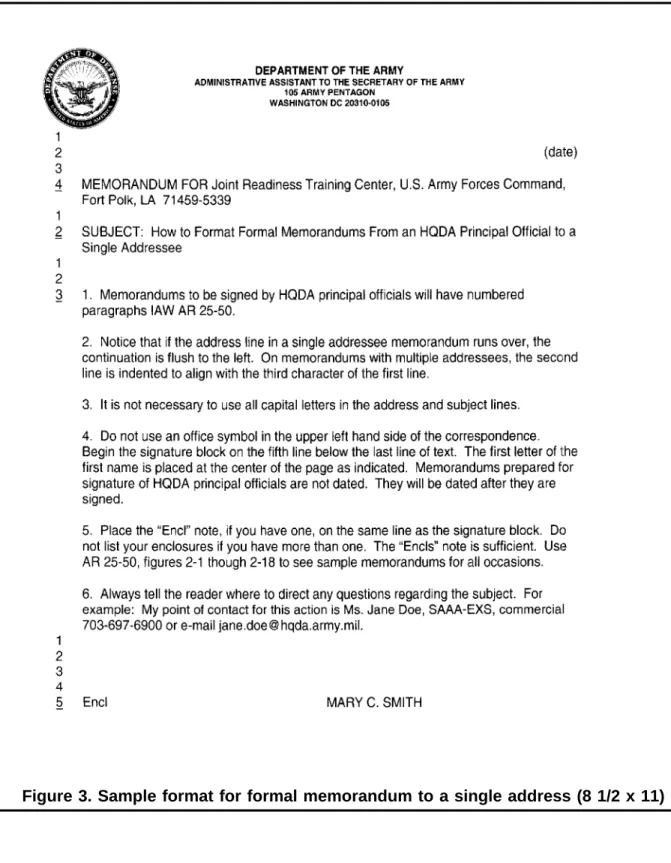
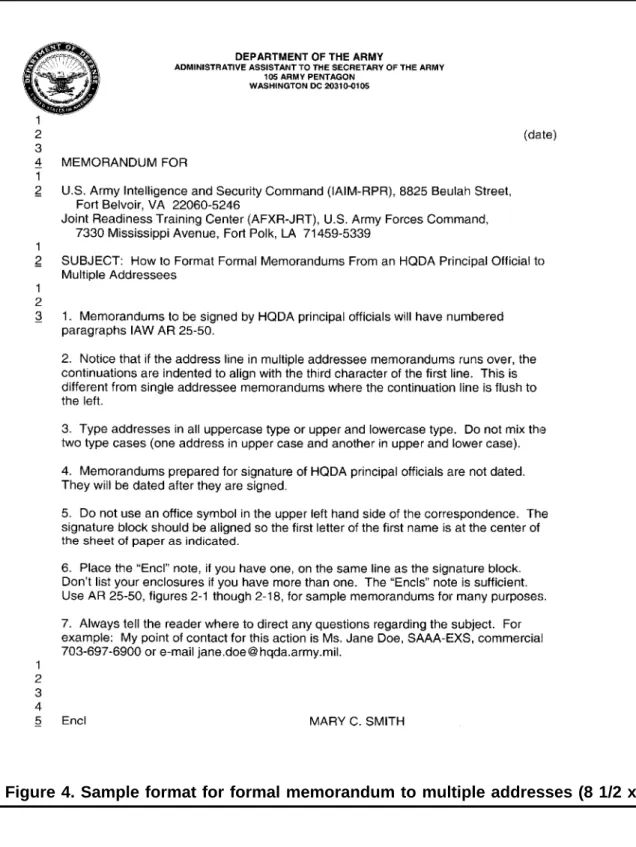
(1) The formal memorandum is the primary internal correspondence medium used by HQDA. It is also the standard memorandum used throughout the Army. Formal memorandums are described in detail in AR 25–50, chapter 2, and illustrated in this memorandum for added clarity in figures 3 through 5.
(2) Action and information memorandums have been eliminated as separate formats. Use HQDA Form 5 (to be attached to the cover of the staff action) to request action by senior Army leaders and to make recommendations. The formal memorandum format will be used in all circumstances where a memorandum is appropriate, whether providing information, tasking, or other types of communication.
(3) In a few instances, formatting for HQDA correspondence differs from the formatting for Army correspondence described in AR 25–50, as noted in figures 3 through 5. In addition to the guidance in AR 25–50, the following rules apply to HQDA memorandums:
(a) An office symbol is not added to memorandums signed by EOH members using their individual
letterhead.
correspondence for the signature of OSD leaders. Once signed, the date will be placed/stamped in the upper right corner.
(c) "Attachment" or "tab" is not used in correspondence to refer to an enclosure–use "enclosure(s)."
Enclosures are documents that come with the basic correspondence and are required to complete the action or to keep the body as brief and concise as possible. Enclosures will be dated as of the date of preparation.
(d) OSD uses the word attachment(s) for their correspondence.
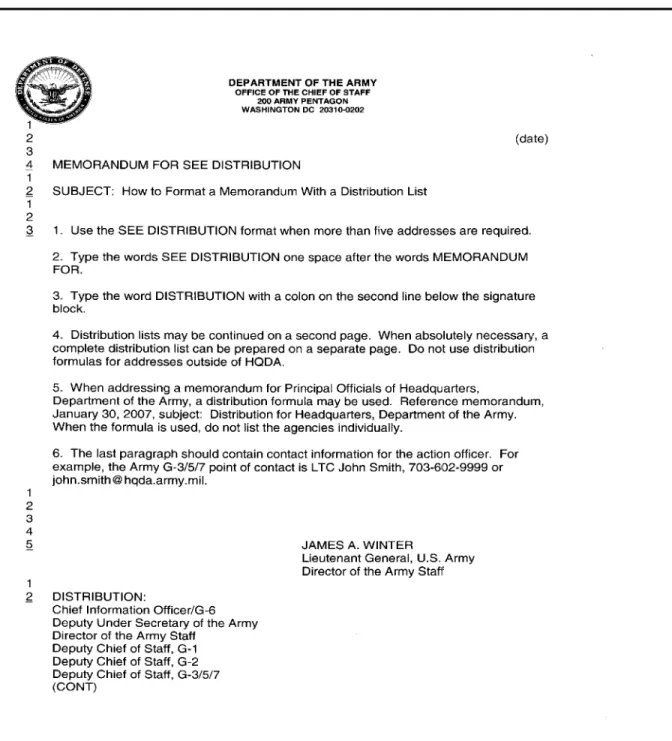
(4) When more than five addressees are needed, the "SEE DISTRIBUTION" format as shown in figure 6 is used.
(5) Memorandums from ARSTAF agencies to the SA or the USA do not need to be addressed through an Assistant Secretary. However, the actions will be formally coordinated with the Assistant Secretaries or their principal deputies, and so noted on HQDA Form 5.
(6) Appropriate HQDA officials in the Secretariat and on the ARSTAF may sign memorandums to all HQDA principal officials.
(7) Correspondence prepared for the SECDEF or DEPSECDEF must be accompanied by an information or action memorandum using OSD style and formatting. Memorandums addressed to the SECDEF or DEPSECDEF will be formatted in the OSD style. DOD 5110.4–M, chapter 5, will be used for guidance.
(a) In the "Recommendation" paragraph of an action memorandum to OSD leaders, the phrase, "I
recommend the (Secretary of Defense, Deputy Secretary of Defense)...," is used, depending to whom the memorandum is addressed. "I recommend YOU...," will not be used.
(b) Correspondence for the signature of OSD will not be dated before it is signed.
(8) The following information applies to multiple-signature memorandums:
(a) When preparing a memorandum for the signature of two officials, the signature block of the
higher ranking (that is, historically older) office is placed on the right (see fig 7).
(b) When preparing a memorandum for the signature of three officials, the signature of the highest
ranking office is centered at the bottom. The signature block of the next highest ranking office is placed above and on the right. The signature block of the junior office is on the left (see fig 7).
(c) Correspondence with multiple signature blocks of the Service secretaries will be placed on DOD
letterhead (see fig 7).
(9) AR 25–50, figures 2–1 through 2–18, are examples of additional memorandum formats.
(10) Memorandums that are for or addressed to the SA, CSA, USA, or VCSA will be routed through the DAS via the ECC. The DAS will annotate by initialing the HQDA Form 5. This rule does not apply to actions for which the AASA has been delegated as approval authority or signature authority.
Figure 5. Sample of a multiple-page formal memorandum for the signature of principal official (8 1/2 x 11)
Figure 6. Sample of a memorandum with a SEE DISTRIBUTION address list – continued (8 1/2 x 11)
10. Letterhead and stationery
a. The letterhead displaying the Korean War commemorative seal in the upper right corner will not be
used; it is out of date.
b. The letterhead for the SA sent to external addresses will be printed in blue ink; letterhead sent to
internal addresses will be printed in black.
c. The SA is the only Secretariat principal who uses Secretary of the Army standard (8.5 x 11 inches)
letterhead (see fig 8) and Secretary of the Army small (7 x 8.5 inches) stationery. The standard letterhead consists of the DOD seal placed in the upper left corner and "SECRETARY OF THE ARMY" and "WASHINGTON" centered on two lines at the top of the page. The small letterhead consists of the DOD seal placed in the upper left corner and "SECRETARY OF THE ARMY" and "WASHINGTON" centered on two lines at the top of the page.
d. Informal or personal letters for the signature of the SA, CSA, USA, or VCSA will be written on that
individual’s flag stationery. See figure 9 for CSA flag stationery. For official CSA letterhead, see figure 10.
e. Correspondence prepared for the USA’s signature will use Under Secretary of the Army letterhead (see
fig 11).
f. Correspondence prepared for VCSA signature will use Office of the Vice Chief of Staff letterhead (see
fig 12).
g. The following describes the correct use of Department of the Army letterhead.
(1) Except for the SA and CSA, all HQDA principal officials and their offices will use Department of the Army letterhead, displaying their organization title, complete street address, city, state, and ZIP+4.
(2) Department of the Army letterhead consists of the DOD seal placed in the upper left corner, and "DEPARTMENT OF THE ARMY, organization title, complete street address, WASHINGTON DC 20310 (ZIP+4)" centered (on four lines) at the top of the page (see fig 13).
(3) Use Department of the Army letterhead that shows "DEPARTMENT OF THE ARMY" and "WASHINGTON DC 20310" centered on two lines when—
(a) The correspondence is for the signature of an Acting Secretary of the Army. (b) The correspondence is for the signature of the Acting Under Secretary of the Army.
(c) The correspondence is for the dual signatures of the Secretary of the Army and Chief of Staff of
the Army (see fig 14).
(d) The correspondence is for the signature of the Secretary of the Army, Chief of Staff of the
Army, and Sergeant Major of the Army (see fig 14).
(e) The correspondence is for the dual signatures of the Administrative Assistant to the Secretary of
the Army and the Director of the Army Staff (see fig 15).
(f) The signature is uncertain.
(h) Informal correspondence for the Administrative Assistant will use 7 x 8.5-inch stationery (see fig
16). For official AASA letterhead, (see fig 17).
(i) Correspondence prepared for DAS signature will use Office of the Chief of Staff letterhead (see
fig 18).
(j) For letters prepared for signature of OSD officials, DOD 5110.4–M, chapter 6, will be the guide. (k) The Department of the Army letterhead template is available on the Army Publication Web site,
www.apd.army.mil. EOH stationery is available from the ECC Web site, https://securewebako.hqda.pentagon. mil/AKO/ecc.
11. Information and discussion papers
Information and discussion papers are used to present information in general or information specifically for a discussion.
b. Discussion papers. Figure 20 shows the format for a discussion paper. Use plain bond paper for
discussion papers. 12. HQDA Form 5
a. Use the HQDA Form 5 to control and coordinate staff documents. It provides pertinent information about the action that is being staffed for coordination and/or submitted for approval and signature. Additional guidance and templates are provided on the ECC Web site, https://securewebako.hqda.pentagon.mil/AKO/ecc and the HQDA Tracking System site.
b. The information provided on HQDA Form 5 will be a brief, accurate, clear summary of the action required and the documents included in the staff package. If possible, prepare the form as a stand-alone document.
c. A one page information memorandum should be used and included as TAB A if it is not possible to provide adequate information in the space provided in block 12 of the HQDA Form 5.
d. A completed HQDA Form 5 will be included in the staffing package and attached to the front of the folder as described in paragraph 13c of this document.
e. The HQDA Form 5 is available as a template in the HQDA Tracking System. Click on the
"Templates" tab next to the Document List on any Master Control page. The HQDA Form 5 is listed under the heading "General Templates." It is also available on the ECC Web site, https://securewebako.hqda. pentagon.mil/AKO/ecc.
f. Instructions for completing the HQDA Form 5 are included on the form and are shown in Figure 21. Arial font 11 must be used to complete the form.
g. Do not highlight, initial, or handwrite notes on the front side of the HQDA Form 5. This is for comments/initials by the senior leaders listed in block 6. Do not write or mark in block 6 or 16 of the HQDA Form 5.
h. You must select whether this action is routed through ECC or Office of the Joint and Defense Affairs (OJDA). This selection will affect block 16 as well.
i. The classified version of this form is HQDA Form 5–S (Army Staffing Form). It is essentially the same form; however, when using a classified SIPRNet system you will be able to select FOUO, CONFIDENTIAL, or SECRET as the classification.
Figure 14. Sample format of Department of the Army letterhead for correspondence jointly signed by the Secretary of the Army, Chief of Staff of the Army, and Sergeant
Figure 15. Sample format of Department of the Army letterhead for correspondence jointly signed by the Administrative Assistant to the Secretary of the Army and Director
Figure 16. Sample of the Administrative Assistant to the Secretary of the Army stationery (7 x 8 1/2)
Figure 17. Sample of the Administrative Assistant to the Secretary of the Army letterhead (8 1/2 x 11)
Figure 18. Sample format of Office of the Chief of Staff letterhead used for the Director of the Army Staff’s signature (8 1/2 x 11)
13. Assembly of staff actions and correspondence
The following instructions will be followed when packaging staff actions and correspondence for HQDA principal officials. The requirements in AR 25–50, chapter 4, will also provide guidance, with exceptions and additions as noted.
a. HQDA formal memorandums will not list enclosures following the "Encl" notation. This HQDA
practice differs from guidance in AR 25–50.
b. Correspondence will be placed in a blue folder with facing pockets.
c. A completed HQDA Form 5 will be attached to the front of the folder. Use only the current version
of the form as shown in figure 21. Use a FOUO coversheet at a minimum. Classified products will have the appropriate cover sheets.
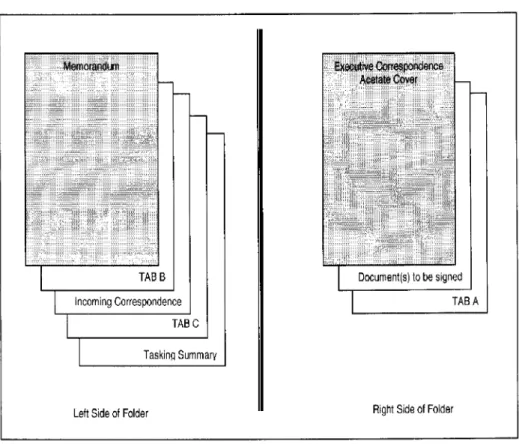
d. Paperwork will be attached with clam or butterfly clips. Assembly instructions follow. (Note: These
instructions are different from guidance in AR 25–50, chap 4; see fig 22).
(1) Left side of folder. The incoming correspondence (correspondence the action is responding to) will
be placed on the inside left of the folder. The tasking summary/control sheet will be placed in the inside left of the folder under the incoming correspondence. Alphabetic tabs will be used to identify specific items of the backup documentation.
(2) Right side of folder. The Executive Correspondence Cover will be placed on the inside right of the
folder. The proposed correspondence requiring decision or signature will be placed on the inside right of the folder under the Executive Correspondence Cover. Alphabetic tabs will be placed behind the correspondence to be signed.
e. Correspondence intended for signature will not be stapled.
f. An adhesive signature tab will be used to indicate where the principal official will sign or initial. g. An acetate Executive Correspondence Cover for protection is preferable, but not required.
h. Correspondence for a principal official’s signature or papers that will be forwarded to higher authority
will not be marked in any way. Do not highlight or underline any portion of any correspondence. Celluloid markers such as Post-it notes and adhesive tabs may be used to point out specific lines or paragraphs at tabs; these will be removed before the document is sent to the addressee.
14. Briefings
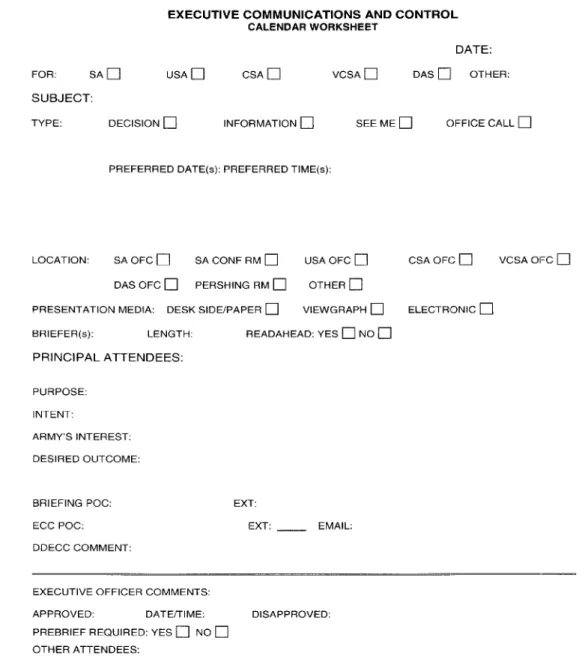
a. An approved calendar request will be submitted (see fig 23) to the appropriate ECC representative to
schedule a briefing (see the ECC Web site at https://securewebako.hqda.pentagon.mil/AKO/ecc for the template). The request will be submitted electronically to the ECC.
b. Briefings to HQDA principal officials will be prepared in accordance with DA Memorandum 1–1.
Action officers will coordinate with the appropriate ECC representative to schedule a briefing and to determine the recipients, length, and attendees.
c. The OSD does not provide written guidance for briefing OSD principal officials. Informal guidance
includes instructions to avoid the use of color for color’s sake in briefing slides. Keep briefings to black and white unless color serves a purpose.
15. Read aheads
a. For Army principal officials.
(1) A read ahead (see fig 24) will be provided to a principal official when the subject area deals with complex or high-visibility issues and/or subjects. The intent of the read ahead is to give principal officials an opportunity to become familiar with the issue prior to receiving a briefing. This allows them the opportunity to prepare to make decisions when receiving the briefing.
Department of Defense, Office of the Executive Secretary, Military Handbook, which addresses preferred content, style, and format.
16. Executive summary
a. An executive summary (EXSUM) provides timely information in a brief, succinct manner (see fig 25). b. The EXSUMs will be one paragraph, marked with the appropriate classification. A separate
classification marking for the title is also required.
c. The EXSUMs will not exceed 15 lines.
d. Executive summaries, whether for decision or information and which respond to an OSA, OCSA,
OUSA or OVCSA tasking, will reflect the HQDA Tracking System control identification number (for example, 60115700) in the upper right corner.
e. The date the EXSUM was prepared will be typed under the control identification number (if
applicable).
f. The action officer’s name/office symbol/telephone number will be typed two lines under the last line
(right justified). The action officer’s e-mail address will be typed directly under the name/office symbol/ telephone number (right justified).
g. APPROVED BY will be typed on the second line below the e-mail address. h. An EXSUM may be used in paragraph 2 (Discussion section) of HQDA Form 5.
i. In addition to the format and content requirements of the EXSUM, the following items must be
addressed:
(1) What question is being answered (that is, "In response to SA/CSA/USA/VCSA question in the meeting today")?
(2) Why does the SA/CSA/USA/VCSA need this information? (3) What action by SA/CSA/USA/VCSA is required/desired?
j. All unclassified and classified EXSUMs will be submitted to the ECC in hard copy enclosed in a blue folder at TAB A.
k. The principal official of the submitting activity will approve the EXSUM prior to submission to the
ECC. The ECC will forward the EXSUM to the appropriate EOH offices.
l. The EXSUM can be submitted using HQDA Form 5 with the EXSUM paragraph going in the
Figure 22. Sample format of how to assemble the inside of a folder for a HQDA staff action
17. HQDA staff action guidance
Table 1 provides the basic framework for working an HQDA staff action. Table 1
Basic guide for working a staff action
Steps Guidelines Action source –Internal –OCSA –OSA –OSD
Initial guidance normally included.
Obtain guidance Know what the requirement is.
Direct contact with action source is encouraged.
Differentiate between personal opinion and official position. If required, seek guidance any time during staff action process. Check for suspense If action initiated by OCSA, OSA, or OSD and suspense cannot
be met, contact Director, ECC or appropriate Deputy Director. Collect and analyze data Check background file.
Discuss with experienced action officers. Prepare draft for coordination Maximize use of working draft for coordination. Execute intra-agency coordination Prepare papers in memorandum or letter format.
Determine who will sign action.
Coordinate with OSA or OCSA (via ECC) early. Make necessary coordination.
Maximize use of e-mail, telephone, and handwritten notes. Revise draft as necessary and complete Resolve nonoccurrence if possible.
Take final action/forward for approval Agency principal or designated individual takes final action.
Forward for resolution of nonconcurrence Agency principal—
–Overrides nonconcurrence.
–States reasons for nonconcurrence and rationale for considera-tion and recommendaconsidera-tions. Forward to SA or USA, or to CSA or VCSA for decision.
–Forwards to ECC for transmittal to SA or USA, or to CSA or VCSA for decision.
–If necessary for paper to be approved above agency level, it will forwarded to OCSA or line-thru for CSA and forward to OSA.
Appendix A
References
Section I
Required Publications
AR 25–50
Preparing and Managing Correspondence. (Cited in paras 1, 5b, 8b(5), 8f(6), 9a(1), (2), (3), 9b(1)(3)(9), and 13.).
DAGO 2002–03
Assignment of Functions and Responsibilities within Headquarters, Department of the Army, 9 July 2002. (Cited in paras 4a, b, c, e, and 4h(5)(a).)
Section II
Related Publications
A related publication is a source of additional information. The user does not have to read it to understand these implementation procedures.
AR 1–20
Legislative Liaison AR 25–11
Record Communications and the Privacy Communications System AR 25–30
The Army Publishing Program AR 25–55
The Department of the Army Freedom of Information Act Program AR 380–5
Department of the Army Information Security Program DA Memo 1–1
Briefing the Secretary of the Army, Under Secretary of the Army, Chief of Staff, Vice Chief of Staff, and Director of the Army Staff
DA Memo 10–7
Relationships Between the Office, Secretary of the Army and the Army Staff DA Memo 11–2
Consultation with State and Local Officials DA Pam 25–40
Army Publishing: Action Officers Guide
Office of the Administrative Assistant to the Secretary of the Army
HQDA Tracking System Training Guide. (Available at http://eoaa.hqda.pentagon.mil/orientation/TSTraining. asp.)
DOD Office of the Executive Secretary
Military Assistant/Executive Officer Handbook. (Available at www.defenselink.mil/execsec/handbook_index. html.)
DOD 5110.4–M
Manual for Written Material. (Available at http://www.dtic.mil/whs/directives.) GPO Style Manual
United States Government Printing Office Style Manual. (Available at www.gpoaccess.gov/stylemanual/index. html.)
The Chicago Manual of Style
The University of Chicago Press, 15th edition. (Available with subscription at http://www. chicagomanualofstyle.org/home.html.)
Section III
Prescribed Forms
HQDA Form 5
Army Staffing Form (Prescribed in paras 4e, 5g(4), 5h(5), 9b 12, 13c, and 16.) (Available at www.apd.army. mil and https://securewebako.hqda.pentagon.mil/AKO/ecc.)
HQDA Form 5–S
Army Staffing Form (Prescribed in para 12i) (Available on the SIPERnet.)
Section IV
Referenced Forms
SD Form 391
Secretary of Defense Correspondence Action Report. (Available at www.dtic.mil/whs/directives/infomgt/forms/ formsprogram.htm.)
Glossary
Section I Abbreviations
AASA
Administrative Assistant to the Secretary of the Army ACOM
Army Command AR
Army Regulation ARSTAF Army Staff AKO
Army Knowledge Online ASA
Assistant Secretary of the Army CSA
Chief of Staff, Army DAGO
Department of the Army General Order DAS
Director of the Army Staff DEPSECDEF
Deputy Secretary of Defense ECC
Executive Communication and Control EOH
Executive Office Headquarters EXSUM
Executive Summary GO
General Officer HQDA
Headquarters, Department of the Army OCLL
OCSA
Office of Chief of Staff, Army OJDA
Office of the Joint and Defense Affairs OSA
Office of the Secretary of the Army OSD
Office of the Secretary of Defense POC
point of contact SA
Secretary of the Army SACO
Staff Action Control Office SECDEF
Secretary of Defense SES
Senior Executive Service SIPRNet
Secure Internet Protocol Router Network USA
Under Secretary of the Army VCSA
Vice Chief of Staff, Army WHLO
White House Liaison Office XO
Executive Officer
Section II Terms
Section III
Special Abbreviations and Terms
This section contains no entries.
Distribution:
This publication is available in electronic media only and is intended for Headquarters, Department of the Army and its field operating agencies.