SLVS312A – JULY 2000 – REVISED DECEMBER 2002
D
Overvoltage Protection and Lockout for12 V, 5 V, 3.3 V
D
Undervoltage Protection and Lockout for5 V and 3.3 V
D
Fault Protection Output With Open-DrainOutput Stage
D
Open-Drain Power Good Output Signal forPower Good Input, 3.3 V and 5 V
D
Power Good Delay; 300-ms TPS3510,150-ms TPS3511
D
75-ms Delay for 5-V and 3.3-V PowerSupply Short-Circuit Turnon Protection
D
2.3-ms PSON Control to FPO Turnoff DelayD
38-ms PSON Control DebounceD
73-µs Width Noise DeglitchesD
Wide Supply Voltage Range From 4 Vto 15 V
description
The TPS3510/1 is designed to minimize external components of personal-computer switching power supply systems. It provides protection circuits, power good indicator, fault protection output (FPO) and PSON control. Overvoltage protection (OVP) monitors 3.3 V, 5 V, and 12 V (12-V signal detects via VDD pin). Undervoltage protection (UVP) monitors 3.3 V and 5 V. When an OV or UV condition is detected, the power good output (PGO) is set to low and FPO is latched high. PSON from low to high resets the protection latch. UVP function is enabled 75 ms after PSON is set low and debounced. Furthermore, there is a 2.3-ms delay (and an additional 38-ms debounce) at turnoff. There is no delay during turnon.
Power good feature monitors PGI, 3.3 V and 5 V and issues a power good signal when the output is ready. The TPS3510/1 is characterized for operation from –40°C to 85°C.
typical application 1 2 3 4 8 7 6 5 PGI GND FPO PSON PGO VDD VS5 VS33 PSON (From Motherboard) 5 VSB PGO 0.5 V Drop PGI 12 V VSB 5 V 3.3 V 1 2 3 4 8 7 6 5 PGI GND FPO PSON PGO VDD VS5 VS33 D OR P PACKAGE (TOP VIEW)
SLVS312A – JULY 2000 – REVISED DECEMBER 2002
FUNCTION TABLE PGI PSON UV CONDITION
(3.3 V OR 5 V) OV CONDITION (3.3 V, 5 V, OR 12 V) FPO PGO <0.95 V L no no L L <0.95 V L no yes H L <0.95 V L yes no L L 0.95 V<PGI<1.15 V L no no L L 0.95 V<PGI<1.15 V L no yes H L 0.95 V<PGI<1.15 V L yes no H L PGI > 1.15 V L no no L H PGI > 1.15 V L no yes H L PGI > 1.15 V L yes no H L x H x x H L x = don’t care
FPO = L means: fault IS NOT latched FPO = H means: fault IS latched PGO = L means: fault
SLVS312A – JULY 2000 – REVISED DECEMBER 2002 functional block diagram
_ + _ + _ + _ + _ + _ + Band-Gap Reference 1.15 V _ + Band-Gap Reference 0.95 V 73-µs Debounce 73-µs Debounce 150-µs Debounce and 4.8-ms Delay POR 2.3-ms Delay 150-µs Debounce R S 75-ms Delay 38-ms Debounce Delay† VDD VDD VDD VS5 VS33 PGI FPO PSON PGO 12 V OV 5 V OV 3.3 V OV Q 3.3 V UV PGI2 PGI1 5 V UV
SLVS312A – JULY 2000 – REVISED DECEMBER 2002 timing diagram td1 tb td1 td2 td1 PG OFF Delay Protect Occur PSON Off PSON On AC Off VDD PSON FPO PGI 3.3 V, 5 V 12 V PGO PSON On Terminal Functions TERMINAL I/O DESCRIPTION
NAME NO. I/O DESCRIPTION
FPO 3 O Inverted fault protection output, open drain output stage
GND 2 Ground
PGI 1 I Power good input
PGO 8 O Power good output, open drain output stage
PSON 4 I ON/OFF control
VDD 7 I Supply voltage/12 V overvoltage protection input pin VS33 5 I 3.3 V over/undervoltage protection
SLVS312A – JULY 2000 – REVISED DECEMBER 2002 detailed description
power good and power good delay
A PC power supply is commonly designed to provide a power-good signal, which is defined by the computer manufacturers. PGO is a power-good signal and should be asserted high by the PC power supply to indicate that the 5-V and 3.3-V outputs are above the under-voltage threshold limit. At this time the converter should be able to provide enough power to ensure continuous operation within the specification. Conversely, when either the 5-V or the 3.3-V output voltages fall below the under-voltage threshold, or when ac power has been removed for a time sufficiently long so that power supply operation is no longer ensured, PGO should be de-asserted to a low state.
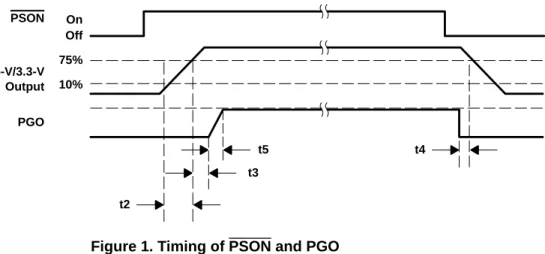
Figure 1 represents the timing characteristics of the power good (PGO), dc enable (PSON), and the 5 V/3.3 V supply rails. t2 t3 t5 t4 5-V/3.3-V Output PSON PGO On Off 75% 10%
Figure 1. Timing of PSON and PGO
Although there is no requirement to meet specific timing parameters, the following signal timings are recommended:
2 ms ≤ t2 ≤ 20 ms, 100 ms < t3 < 2000 ms, t4 > 1 ms, t5 ≤ 10 ms
Furthermore motherboards should be designed to comply with the previously recommended timing. If timings other than these are implemented or required, this information should be clearly specified.
The TPS3510/1 family of power-supply supervisors provides a power-good output (PGO) for the 3.3-V and 5-V supply voltage rails and a separate power-good input (PGI). An internal timer is used to generate a power-good delay. If the voltage signals at PGI, VS33, and VS5 rise above the under-voltage threshold, the open-drain power-good output (PGO) goes high after a delay of 150 ms or 300 ms. When the PGI voltage or either the 3.3-V and 5-V power rails drops below the under-voltage threshold, PGO is disabled immediately (after 150-µs debounce).
power supply remote on/off (PSON) and fault protect output (FPO)
Since the latest personal computer generation focuses on easy turnon and power saving functions, the PC power supply requires two characteristics. One is a dc power supply remote on/off function, the other is standby voltage to achieve very low power consumption of the PC system. Thus the main power needs to be shut down. The power supply remote on/off (PSON) is an active low signal that turns on all of the main power rails including 3.3 V, 5 V, –5 V, 12 V, and –12 V power rails. When this signal is held high by the PC motherboard or left open circuited, the signal of the fault protect output (FPO) also goes high. Thus, the main power rails should not deliver current and should be held at 0 V.
SLVS312A – JULY 2000 – REVISED DECEMBER 2002
power supply remote on/off (PSON) and fault protect output (FPO)(continued)
When the FPO signal is held high due to an occurring fault condition, the fault status is latched and the outputs of the main power rails should not deliver current but are held at 0 V. Toggling the power supply remote on/off (PSON) from low to high resets the fault-protection latch. During this fault condition only the standby power is not affected.
When PSON goes from high to low or low to high, the 38-ms debounce block is active to avoid a glitch on the input that disables/enables the FPO output. During this period the under-voltage function is disabled for 75 ms to prevent turnon failure. At turnoff, there is an additional delay of 2.3 ms from PSON to FPO.
Power should be delivered to the rails only if the PSON signal is held at ground potential, thus FPO is active-low. The FPO pin can be connected to 5 V (or up to 15 V) through a pullup resistor.
undervoltage protection
The TPS3510/1 provides under-voltage protection (UVP) for the 3.3-V and 5-V rails. When an undervoltage condition appears at either one of the 3.3-V (VS33) or 5-V (VS5) input pins for more than 146 µs, the FPO output goes high and PGO goes low. Also, this fault condition is latched until PSON is toggled from low to high or VDD is removed.
The need for undervoltage protection is often overlooked in off-line switching power supply system design. But it is very important in battery-powered or hand-held equipment since the TTL or CMOS logic often results in malfunction.
In flyback or forward-type off-line switching power supplies, usually designed for low power, the overload protection design is very simple. Most of these types of power supplies are only sensing the input current for an overload condition. The trigger point needs to be set much higher than the maximum load in order to prevent false turnon.
However, this causes one critical problem. If the connected load is larger than the maximum allowable load but smaller than the trigger point, the system always becomes overheated with failure and damage occurring.
overvoltage protection
The overvoltage protection (OVP) of TPS3510/1 monitors 3.3 V, 5 V, and 12 V (12 V is sensed via the VDD pin). When an overvoltage condition appears at one of the 3.3-V, 5-V, or 12-V input pins for more than 73 µs, the FPO output goes high and PGO goes low. Also, this fault condition is latched until PSON is toggled from low to high or VDD is removed. During fault conditions, most power supplies have the potential to deliver higher output voltages than those normally specified or required. In unprotected equipment, it is possible for output voltages to be high enough to cause internal or external damage of the system. To protect the system under these abnormal conditions, it is common practice to provide overvoltage protection within the power supply. Because TTL and CMOS circuits are very vulnerable to overvoltages, it is becoming industry standard to provide overvoltage protection on all 3.3-V and 5-V outputs. However, not only the 3.3-V and 5-V rails for the logic circuits on the motherboard need to be protected, but also the 12-V peripheral devices such as the hard disk, floppy disk, and CD-ROM players etc., need to be protected.
short-circuit power supply turnon
During safety testing the power supply might have tied the output voltage direct to ground. If this happens during the normal operating, this is called a short-circuit or over-current condition. When it happens before the power supply turns on, this is called a short-circuit power supply turnon. It can happen during the design period, in the production line, at quality control inspection or at the end user. The TPS3510/1 provides an undervoltage protection function with a 75-ms delay after PSON is set low.
SLVS312A – JULY 2000 – REVISED DECEMBER 2002 absolute maximum ratings over operating free-air temperature (unless otherwise noted)†
Supply voltage, VDD (see Note1) . . . 16 V
Output voltage VO: FPO . . . 16 V
PGO . . . 8 V All other pins (see Note 1) . . . –0.3 V to 16 V Continuous total power dissipation. . . See Dissipation Rating Table Operating free-air temperature range, TA . . . –40°C to 85°C Storage temperature range, Tstg. . . –65°C to 150°C Soldering temperature . . . 260°C
† Stresses beyond those listed under “absolute maximum ratings” may cause permanent damage to the device. These are stress ratings only, and functional operation of the device at these or any other conditions beyond those indicated under “recommended operating conditions” is not implied. Exposure to absolute–maximum–rated conditions for extended periods may affect device reliability.
NOTE 1: All voltage values are with respect to GND.
DISSIPATION RATING TABLE PACKAGE TA ≤ 25°C POWER RATING DERATING FACTOR ABOVE TA = 25°C TA = 70°C POWER RATING TA = 85°C POWER RATING P 1092 mW 8.74 mW/°C 699 mW 568 mW D 730 mW 5.84 mW/°C 467 mW 379 mW
recommended operating conditions at specified temperature range
MIN NOM MAX UNIT
Supply voltage, VDD 4 15 V
PSON, VS5, VS33 7
Input voltage, VI PGI VDD + 0.3 V
(max = 7 V) V
Output voltage V
FPO 15
V
Output voltage, VO PGO 7 V
O tp t sink c rrent I
FPO 20
mA
Output sink current, IO,sink PGO 10 mA
Supply voltage rising time, tr See Note 2 1 ms
Operating free-air temperature range, TA –40 85 °C
SLVS312A – JULY 2000 – REVISED DECEMBER 2002
electrical characteristics over recommended operating conditions (unless otherwise noted)
overvoltage protection
PARAMETER TEST CONDITIONS MIN TYP MAX UNIT
VS33 3.7 3.9 4.1
Overvoltage threshold VS5 5.7 6.1 6.5 V
Overvoltage threshold
VDD 13.2 13.8 14.4
V
ILKG Leakage current (FPO) V(FPO) = 5 V 5 µA
VOL Low-level output voltage (FPO) VDD = 5 V, Isink = 20 mA 0.7 V
Noise deglitch time OVP VDD = 5 V 35 73 110 µs
PGI and PGO
PARAMETER TEST CONDITIONS MIN TYP MAX UNIT
V Inp t threshold oltage (PGI) PGI1 1.1 1.15 1.2 V
VPGI Input threshold voltage (PGI)
PGI2 0.9 0.95 1 V
V Under oltage threshold VS33 2 2.2 2.4 V
VIT Undervoltage threshold
VS5 3.3 3.5 3.7 V
ILKG Leakage current (PGO) PGO = 5 V 5 µA
VOL Low-level output voltage (PGO) VDD = 4 V, Isink = 10 mA 0.4 V
Short-circuit protection delay 3.3 V, 5 V 49 75 114 ms
TP3510
PGI to PGO
200 300 450
td1 Delay time TP3511 PGI to PGO VDD = 5 V 100 150 225 ms
td1 Delay time PGI to FPO VDD 5 V 3.2 4.8 7.2 ms PGI to PGO 88 150 225
Noise deglitch time PGI to FPO VDD = 5 V 180 296 445 µs
Noise deglitch time
UVP to FPO
VDD 5 V
82 146 220
µs
PSON control
PARAMETER TEST CONDITIONS MIN TYP MAX UNIT
II Input pullup current PSON = 0 V 120 µA
VIH High-level input voltage 2.4 V
VIL Low-level input voltage 1.2 V
tb Debounce time (PSON) VDD = 5 V 24 38 57 ms
td2 Delay time (PSON to FPO) VDD = 5 V tb+1.1 tb+2.3 tb+4 ms
total device
PARAMETER TEST CONDITIONS MIN TYP MAX UNIT
SLVS312A – JULY 2000 – REVISED DECEMBER 2002 TYPICAL CHARACTERISTICS Figure 2 400 200 –100 –300 0 2.5 5 7.5 15 – Supply Current – SUPPLY CURRENT vs SUPPLY VOLTAGE 300 100 0 –200 10 12.5 I DD A µ VDD – Supply Voltage – V PGI = 1.4 V PSON = 5 V TA = –40°C TA = 85°C TA = 25°C TA = 0°C Figure 3 –60 –100 0 1 2 3 6 7 –20
INPUT CURRENT (PSON) vs
INPUT VOLTAGE (PSON) 20 0 –40 –80 –120 –140 4 5 VI – Input Voltage – V II – Input Current – A µ TA = –40°C TA = 0°C TA = 25°C TA = 85°C VDD = 4 V Figure 4 VDD = 4 V PSON = GND 2 1 0 0 20 40 60 80 120 – Low-Level Output V o ltage – V 3 4
LOW-LEVEL OUTPUT VOLTAGE (FPO) vs
LOW-LEVEL OUTPUT CURRENT (FPO)
100 IOL – Low-Level Output Current – mA VOL TA = –40°C TA = 85°C TA = 25°C TA = 0°C Figure 5 400 200 0 0 5 10 15 20 – Low-Level Output V oltage – mV 600 800
LOW-LEVEL OUTPUT VOLTAGE (FPO) vs
LOW-LEVEL OUTPUT CURRENT (FPO)
25 IOL – Low-Level Output Current – mA VOL TA = –40°C TA = 85°C TA = 25°C VDD = 4 V PSON = GND Exploded View TA = 0°C 300 100 500 700
SLVS312A – JULY 2000 – REVISED DECEMBER 2002
TYPICAL CHARACTERISTICS Figure 6 VDD = 4 V PSON = GND 2 1 0 0 25 50 75 100 150 – Low-Level Output V oltage – V 3 4
LOW-LEVEL OUTPUT VOLTAGE (PGO) vs
LOW-LEVEL OUTPUT CURRENT (PGO)
125 IOL – Low-Level Output Current – mA VOL TA = –40°C TA = 0°C TA = 85°C TA = 25°C Figure 7 400 200 0 0 5 10 15 20 – Low-Level Output V oltage – mV 600
LOW-LEVEL OUTPUT VOLTAGE (PGO) vs
LOW-LEVEL OUTPUT CURRENT (PGO)
IOL – Low-Level Output Current – mA VOL TA = –40°C TA = 85°C TA = 25°C VDD = 4 V PSON = GND Exploded View TA = 0°C 300 100 500 0.994–40 –15 10 35 0.996 0.997
NORMALIZED SENSE THRESHOLD VOLTAGE vs FREE-AIR TEMPERATURE AT VDD 0.999 60 85 0.998 0.995 C ° TA – Free-Air Temperature – °C 1.001 1 VDD = 4 V PSON = GND
Normalized Input Threshold V
o ltage – VIT(T A)/VIT(25 ) Figure 8
PACKAGE OPTION ADDENDUM
www.ti.com 24-Aug-2014
PACKAGING INFORMATION Orderable Device Status
(1)
Package Type Package Drawing Pins Package Qty Eco Plan (2) Lead/Ball Finish (6) MSL Peak Temp (3)
Op Temp (°C) Device Marking (4/5)
Samples
TPS3510D ACTIVE SOIC D 8 75 Green (RoHS
& no Sb/Br)
CU NIPDAU Level-1-260C-UNLIM -40 to 85 PS3510
TPS3510DG4 ACTIVE SOIC D 8 75 Green (RoHS
& no Sb/Br)
CU NIPDAU Level-1-260C-UNLIM -40 to 85 PS3510
TPS3510DR ACTIVE SOIC D 8 2500 Green (RoHS
& no Sb/Br)
CU NIPDAU Level-1-260C-UNLIM -40 to 85 PS3510
TPS3510DRG4 ACTIVE SOIC D 8 2500 Green (RoHS
& no Sb/Br)
CU NIPDAU Level-1-260C-UNLIM -40 to 85 PS3510
TPS3510P ACTIVE PDIP P 8 50 Pb-Free
(RoHS)
CU NIPDAU N / A for Pkg Type -40 to 85 TPS3510P
TPS3510PE4 ACTIVE PDIP P 8 50 Pb-Free
(RoHS)
CU NIPDAU N / A for Pkg Type -40 to 85 TPS3510P
TPS3511D ACTIVE SOIC D 8 75 Green (RoHS
& no Sb/Br)
CU NIPDAU Level-1-260C-UNLIM -40 to 125 PS3511
TPS3511DR ACTIVE SOIC D 8 2500 Green (RoHS
& no Sb/Br)
CU NIPDAU Level-1-260C-UNLIM -40 to 125 PS3511
TPS3511DRG4 ACTIVE SOIC D 8 2500 Green (RoHS
& no Sb/Br)
CU NIPDAU Level-1-260C-UNLIM -40 to 125 PS3511
(1)
The marketing status values are defined as follows: ACTIVE: Product device recommended for new designs.
LIFEBUY: TI has announced that the device will be discontinued, and a lifetime-buy period is in effect.
NRND: Not recommended for new designs. Device is in production to support existing customers, but TI does not recommend using this part in a new design. PREVIEW: Device has been announced but is not in production. Samples may or may not be available.
OBSOLETE: TI has discontinued the production of the device.
(2)
Eco Plan - The planned eco-friendly classification: Pb-Free (RoHS), Pb-Free (RoHS Exempt), or Green (RoHS & no Sb/Br) - please check http://www.ti.com/productcontent for the latest availability information and additional product content details.
TBD: The Pb-Free/Green conversion plan has not been defined.
Pb-Free (RoHS): TI's terms "Lead-Free" or "Pb-Free" mean semiconductor products that are compatible with the current RoHS requirements for all 6 substances, including the requirement that lead not exceed 0.1% by weight in homogeneous materials. Where designed to be soldered at high temperatures, TI Pb-Free products are suitable for use in specified lead-free processes.
PACKAGE OPTION ADDENDUM
www.ti.com 24-Aug-2014
(3)
MSL, Peak Temp. - The Moisture Sensitivity Level rating according to the JEDEC industry standard classifications, and peak solder temperature.
(4)
There may be additional marking, which relates to the logo, the lot trace code information, or the environmental category on the device.
(5)
Multiple Device Markings will be inside parentheses. Only one Device Marking contained in parentheses and separated by a "~" will appear on a device. If a line is indented then it is a continuation of the previous line and the two combined represent the entire Device Marking for that device.
(6)
Lead/Ball Finish - Orderable Devices may have multiple material finish options. Finish options are separated by a vertical ruled line. Lead/Ball Finish values may wrap to two lines if the finish value exceeds the maximum column width.
Important Information and Disclaimer:The information provided on this page represents TI's knowledge and belief as of the date that it is provided. TI bases its knowledge and belief on information provided by third parties, and makes no representation or warranty as to the accuracy of such information. Efforts are underway to better integrate information from third parties. TI has taken and continues to take reasonable steps to provide representative and accurate information but may not have conducted destructive testing or chemical analysis on incoming materials and chemicals. TI and TI suppliers consider certain information to be proprietary, and thus CAS numbers and other limited information may not be available for release.
TAPE AND REEL INFORMATION
*All dimensions are nominal
Device Package Type Package Drawing Pins SPQ Reel Diameter (mm) Reel Width W1 (mm) A0 (mm) B0 (mm) K0 (mm) P1 (mm) W (mm) Pin1 Quadrant TPS3510DR SOIC D 8 2500 330.0 12.4 6.4 5.2 2.1 8.0 12.0 Q1 TPS3511DR SOIC D 8 2500 330.0 12.4 6.4 5.2 2.1 8.0 12.0 Q1
PACKAGE MATERIALS INFORMATION
*All dimensions are nominal
Device Package Type Package Drawing Pins SPQ Length (mm) Width (mm) Height (mm)
TPS3510DR SOIC D 8 2500 340.5 338.1 20.6
TPS3511DR SOIC D 8 2500 340.5 338.1 20.6
PACKAGE MATERIALS INFORMATION
IMPORTANT NOTICE
Texas Instruments Incorporated and its subsidiaries (TI) reserve the right to make corrections, enhancements, improvements and other changes to its semiconductor products and services per JESD46, latest issue, and to discontinue any product or service per JESD48, latest issue. Buyers should obtain the latest relevant information before placing orders and should verify that such information is current and complete. All semiconductor products (also referred to herein as “components”) are sold subject to TI’s terms and conditions of sale supplied at the time of order acknowledgment.
TI warrants performance of its components to the specifications applicable at the time of sale, in accordance with the warranty in TI’s terms and conditions of sale of semiconductor products. Testing and other quality control techniques are used to the extent TI deems necessary to support this warranty. Except where mandated by applicable law, testing of all parameters of each component is not necessarily performed.
TI assumes no liability for applications assistance or the design of Buyers’ products. Buyers are responsible for their products and applications using TI components. To minimize the risks associated with Buyers’ products and applications, Buyers should provide adequate design and operating safeguards.
TI does not warrant or represent that any license, either express or implied, is granted under any patent right, copyright, mask work right, or other intellectual property right relating to any combination, machine, or process in which TI components or services are used. Information published by TI regarding third-party products or services does not constitute a license to use such products or services or a warranty or endorsement thereof. Use of such information may require a license from a third party under the patents or other intellectual property of the third party, or a license from TI under the patents or other intellectual property of TI.
Reproduction of significant portions of TI information in TI data books or data sheets is permissible only if reproduction is without alteration and is accompanied by all associated warranties, conditions, limitations, and notices. TI is not responsible or liable for such altered documentation. Information of third parties may be subject to additional restrictions.
Resale of TI components or services with statements different from or beyond the parameters stated by TI for that component or service voids all express and any implied warranties for the associated TI component or service and is an unfair and deceptive business practice. TI is not responsible or liable for any such statements.
Buyer acknowledges and agrees that it is solely responsible for compliance with all legal, regulatory and safety-related requirements concerning its products, and any use of TI components in its applications, notwithstanding any applications-related information or support that may be provided by TI. Buyer represents and agrees that it has all the necessary expertise to create and implement safeguards which anticipate dangerous consequences of failures, monitor failures and their consequences, lessen the likelihood of failures that might cause harm and take appropriate remedial actions. Buyer will fully indemnify TI and its representatives against any damages arising out of the use of any TI components in safety-critical applications.
In some cases, TI components may be promoted specifically to facilitate safety-related applications. With such components, TI’s goal is to help enable customers to design and create their own end-product solutions that meet applicable functional safety standards and requirements. Nonetheless, such components are subject to these terms.
No TI components are authorized for use in FDA Class III (or similar life-critical medical equipment) unless authorized officers of the parties have executed a special agreement specifically governing such use.
Only those TI components which TI has specifically designated as military grade or “enhanced plastic” are designed and intended for use in military/aerospace applications or environments. Buyer acknowledges and agrees that any military or aerospace use of TI components which havenotbeen so designated is solely at the Buyer's risk, and that Buyer is solely responsible for compliance with all legal and regulatory requirements in connection with such use.
TI has specifically designated certain components as meeting ISO/TS16949 requirements, mainly for automotive use. In any case of use of non-designated products, TI will not be responsible for any failure to meet ISO/TS16949.
Products Applications
Audio www.ti.com/audio Automotive and Transportation www.ti.com/automotive
Amplifiers amplifier.ti.com Communications and Telecom www.ti.com/communications
Data Converters dataconverter.ti.com Computers and Peripherals www.ti.com/computers
DLP® Products www.dlp.com Consumer Electronics www.ti.com/consumer-apps
DSP dsp.ti.com Energy and Lighting www.ti.com/energy
Clocks and Timers www.ti.com/clocks Industrial www.ti.com/industrial
Interface interface.ti.com Medical www.ti.com/medical
Logic logic.ti.com Security www.ti.com/security
Power Mgmt power.ti.com Space, Avionics and Defense www.ti.com/space-avionics-defense
Microcontrollers microcontroller.ti.com Video and Imaging www.ti.com/video
RFID www.ti-rfid.com
OMAP Applications Processors www.ti.com/omap TI E2E Community e2e.ti.com
Wireless Connectivity www.ti.com/wirelessconnectivity
Mailing Address: Texas Instruments, Post Office Box 655303, Dallas, Texas 75265 Copyright © 2014, Texas Instruments Incorporated