Volume 5, Issue 6, Ver. I (Nov -Dec. 2015), PP 58-62 e-ISSN: 2319 – 4200, p-ISSN No. : 2319 – 4197 www.iosrjournals.org
Review and Classification of Cloud Computing Research
Naushad Ahmad Usmani
1, Mohammed Waseem Ashfaque
2,
Kayte
Jaypalsing
3,Roy Mathew
4, Sangramsing Kayte
51
(Department of IT, Buraimi University College, Buraimi, Oman)
2
(Department of IT, Buraimi University College, Buraimi, Oman)
3
(Dr.Babasaheb Ambedkar Marathwada University Aurangabad (MH) India)
4
(Department of IT, Buraimi University College, Buraimi, Oman)
5
(Dr.Babasaheb Ambedkar Marathwada University Aurangabad (MH) India)
Abstract : Cloud computing is latest trend in IT world. The relative novelty and rapidly increasing growth of cloud computing makes it an exciting area for research. The present paper aims to assess the state of cloud computing research. We portray a current landscape of this research stream, where it is today, and most importantly, given the current relevance of the topic, some suggestions as to where more effort should be focused in the future in order to produce more ’consumable research’. The remainder of this article is organized as follows: First a brief overview of cloud computing is given. Next the research methodology and our classification schema are presented. This is followed by the results of our literature review and classification.
Keywords: cloud computing, literature review, classifications
I. INTRODUCTION
Cloud computing has recently reached popularity and developed into a major trend in IT. While industry has been pushing the Cloud research agenda at high pace, academia has only recently joined, as can be seen through the sharp rise in workshops and conferences focusing on Cloud Computing. Lately, these have brought out many peer-reviewed papers on aspects of cloud computing, and made a systematic review necessary, which analyses the research done and explains the resulting research agenda. We performed such a systematic review of all peer-reviewed academic research on cloud computing, and explain the technical challenges facing in this paper. Cloud computing offers an alternative. „Cloud computing‟, as a term for Internet-based computing service, was launched by industry giants (e.g. Google, Amazon.com, etc.) in late 2006. It promises to provide on-demand computing power with quick implementation, low maintenance, fewer IT staff, and consequently lower cost. Such appealing promises have made cloud computing a dominant IT press topic over the past three years. As projected by market-research firm IDC, IT cloud-service spending will grow from about USD16 billion in 2008 to about USD42 billion by 2012 [Leavitt, 2009]. Cloud computing regularly appears in the „top 10‟ current issues for CIOs identified by industry commentators such as the VP and editor in chief of Information Week [Preston, 2011].
In this paper we discuss the advances and research questions in technical aspects of Cloud Computing, such as protocols, interoperability and techniques for building clouds, while we discuss the research challenges facing enterprise users, such as cost evaluations, legal issues, trust, privacy, security, and the effects of cloud computing on the work of IT departments, elsewhere [1].
II. LITERATURE REVIEW
The literature identifies three different broad service models for cloud computing: a) Software as a Service (SaaS), where applications are hosted and delivered online via a web browser offering traditional desktop functionality for example Google Docs, Gmail and MySAP. b)Platform as a Service (PaaS), where the cloud provides the software platform for systems (as opposed to just software), the best current example being the Google App Engine. c) Infrastructure as a Service (IaaS), where a set of virtualized computing resources, such as storage and computing capacity, are hosted in the cloud; customers deploy and run their own software stacks to obtain services. Current examples are Amazon Elastic Compute Cloud (EC2), Simple Storage Service (S3) and Simple DB. The literature also differentiates cloud computing offerings by scope. In private clouds; services are provided exclusively to trusted users via a single-tenant operating environment. Essentially, an organization‟s data centre delivers cloud computing services to clients who may or may not be in the premises [2]. Public clouds are the opposite: services are offered to individuals and organizations who want to retain elasticity and accountability without absorbing the full costs of in-house infrastructures [2]. Public cloud users
are by default treated as untrustworthy. There are also hybrid clouds combining both private and public cloud service offerings [3].
This section includes survey conducted by international data corporation (IDC). It shows the strength of cloud computing to be implemented in IT industry and gives the potential inspiration to CSP. The section contains the survey related to the growth of cloud, security aspect, cloud is the first priority to the vendors, revenue report, future and current usage, state of cloud to the IT users and popularity survey of cloud computing.
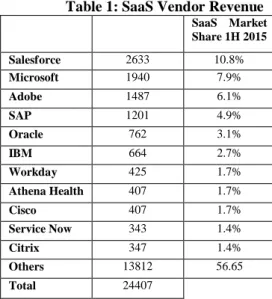
a) SaaS Vendor Revenue: The Table 1 shows the cloud growth 2015 [4].
Table 1: SaaS Vendor Revenue SaaS Market Share 1H 2015 Salesforce 2633 10.8% Microsoft 1940 7.9% Adobe 1487 6.1% SAP 1201 4.9% Oracle 762 3.1% IBM 664 2.7% Workday 425 1.7% Athena Health 407 1.7% Cisco 407 1.7% Service Now 343 1.4% Citrix 347 1.4% Others 13812 56.65 Total 24407
b) Definition of Cloud Computing
A large pool of easily usable and accessible virtualized resources (such as hardware, development platforms and/or services). These resources can be dynamically reconfigured to adjust to a variable load (scale), allowing also for an optimum resource utilization. This pool of resources is typically exploited by a pay-per-use model in which guarantees are offered by the infrastructure provider by means of customized SLAs. [Vaquero, Rodero–Merino, Caceres, and Lindner, 2009]
The NIST definition is one of the clearest and most comprehensive definitions of cloud computing and is widely referenced in US government documents and projects. This definition describes cloud computing as having five essential characteristics, three service models, and four deployment models. The essential characteristics are:
On-demand self-service: computing resources can be acquired and used at anytime without the need for human interaction with cloud service providers. Computing resources include processing power, storage, virtual machines etc.
Broad network access: the previously mentioned resources can be accessed over a network using heterogeneous devices such as laptops or mobiles phones.
Resource pooling: cloud service providers pool their resources that are then shared by multiple users. This is referred to as multi-tenancy where for example a physical server may host several virtual machines belonging to different users.
Rapid elasticity: a user can quickly acquire more resources from the cloud by scaling out. They can scale back in by releasing those resources once they are no longer required.
Measured service: resource usage is metered using appropriate metrics such monitoring storage usage, CPU hours, bandwidth usage etc.
The above characteristics apply to all clouds but each cloud provides users with services at a different level of abstraction, which is referred to as a service model in the NIST definition. The three most common service models are:
Software as a Service (SaaS): this is where users simply make use of a web-browser to access software that others have developed and offer as a service over the web. At the SaaS level, users do not have control or access to the underlying infrastructure being used to host the software. Salesforce‟s Customer Relationship Management software3 and Google Docs4 are popular examples that use the SaaS model of cloud computing.
Platform as a Service (PaaS): this is where applications are developed using a set of programming languages and tools that are supported by the PaaS provider. PaaS provides users with a high level of abstraction that allows them to focus on developing their applications and not worry about the underlying infrastructure. Just like the SaaS model, users do not have control or access to the underlying infrastructure being used to host their applications at the PaaS level. Google App Engine5 and Microsoft Azure6 are popular PaaS examples.
Infrastructure as a Service (IaaS): this is where users acquire computing resources such as processing power, memory and storage from an IaaS provider and use the resources to deploy and run their applications. In contrast to the PaaS model, the IaaS model is a low level of abstraction that allows users to access the underlying infrastructure through the use of virtual machines. IaaS gives users more flexibility than PaaS as it allows the user to deploy any software stack on top of the operating system. However, flexibility comes with a cost and users are responsible for updating and patching the operating system at the IaaS level. Amazon Web Services‟ EC2 and S37 are popular IaaS examples.
Private cloud: a cloud that is used exclusively by one organisation. The cloud may be operated by the organisation itself or a third party. The St Andrews Cloud Computing Co-laboratory8 and Concur Technologies are example organisations that have private clouds.
Public cloud: a cloud that can be used (for a fee) by the general public. Public clouds require significant investment and are usually owned by large corporations such as Microsoft, Google or Amazon.
Community cloud: a cloud that is shared by several organisations and is usually setup for their specific requirements. The Open Cirrus cloud testbed could be regarded as a community cloud that aims to support research in cloud computing.
Hybrid cloud: a cloud that is setup using a mixture of the above three deployment models. Each cloud in a hybrid cloud could be independently managed but applications and data would be allowed to move across the hybrid cloud. Hybrid clouds allow cloud bursting to take place, which is where a private cloud can burst-out to a public cloud when it requires more resources.
III. RESEARCH METHODOLOGY
The reviews the research that describes technological aspects of research in cloud computing. This starts with a look at lessons to be learnt from related fields of research. In the following, standards and interfaces in cloud computing as well as interoperability between different cloud systems are explained. Then, techniques for designing and building clouds are summarised, which include advances in management software, hardware provisioning, and simulators that have been developed to evaluate design decisions and cloud management choices. This is rounded up by presenting new use-cases that have become possible through cloud computing. Voas and Zhang identified cloud computing as the next computing paradigm that follows on from mainframes, PCs, networked computing, the internet and grid computing. These developments are likely to have similarly profound effects as the move from mainframes to PCs had on the ways in which software was developed and deployed. One of the reasons that prevented grid computing from being widely used was the lack of virtualization that resulted in jobs being dependant on the underlying infrastructure. This often resulted in unnecessary complexity that had an effect on wider adoption. Ian Foster – who was one of the pioneers of grid computing – compared cloud computing with grid computing and concluded that although the details and technologies of the two are different, their vision is essentially the same. This vision is to provide computing as a utility in the same way that other public utilities such as gas and electricity are provided. In fact the dream of utility computing has been around since the 1960s and advocated by the likes of John McCarthy and Douglas Parkhill. For example, the influential mainframe operating system Multics had a number of design goals that are remarkably similar to the aims of current cloud computing providers. These design goals included remote terminal access, continuous operational provision (inspired by electricity and telephone services), scalability, reliable file systems that users trust to store their only copy of files, information sharing controls, and an ability to support different programming environments. Therefore it is unsurprising that many people compare cloud computing to mainframe computing. However, it should be noted that although many of the ideas are the same, the user experience of cloud computing is almost completely the opposite of mainframe computing. Mainframe computing limited people's freedom by restricting them to a very rigid environment; cloud computing expands their freedom by giving them access to a variety of resources and services in a self-service manner.
a) Technological Issues
This category focuses on technology details of cloud computing. Articles in this category are produced by researchers who see cloud computing as a white-box and are interested in its components and mechanisms. Six categories are related to technological issues.
Cloud Performance: This subcategory covers articles focusing on the evaluation and optimisation of the performance of the clouds.
Data Management: This subcategory includes specific issues associated with the large scale, distributed data processing in the clouds
Data Centre Management: This subcategory looks into the foundational enabler of cloud computing, the data centres. Articles in this category concentrate on energy efficiency, power conservation, and environmental considerations in the design of data centers.
Software Development: This subcategory represents a stream of software developer-oriented research. Articles in this subcategory range from generic discussions on developing distributed and parallel software in cloud computing environments.
Service Management: As an emerging research theme focusing on the administration of cloud computing services, this subcategory includes articles exclusively targeting aspects such as service lifecycle in the cloud.
Security: Cloud security has been a common concern for the public.
b) Business Issues
In this category contains articles that provide a general view of cloud computing practice and research, with an aim to provide a general understanding of this area rather than to focus on any specific facet of it. These articles can be further classified into two subcategories.
Foundational/Introductions: ontains articles that introduce foundational concepts and components of cloud computing. Such introductory articles provide definitions and outline key features of cloud computing.
Predictions: This subcategory contains articles focusing on forecasting the future of cloud computing and suggesting potential implications. Some project the technical and managerial effects of cloud computing on network and software vendors.
c) Domains and Applications
In that category consists of articles which discuss the impact of cloud computing on particular domains or applications.
E-Science: targets the implications of cloud computing for the e-Science community, which has long been yearning for infinite computing power. E-Science refers to the scientific disciplines (i.e. earth science, bio-informatics, particle physics, etc.).
E-Government: This subcategory discusses the potential of cloud computing for governments. Governments are more hesitant than businesses to adopt cloud computing services
Education: This subcategory focuses on the impact of cloud computing on educational institutes, especially those in the higher education sector. Operating and maintaining IT infrastructure has cost universities enormous amounts of money; hence, some argue that by adopting cloud-based solutions, such money could be saved and used in places more meaningful to the students and teachers
Mobile Computing: In that subcategory contemplates the potential of combining cloud computing and mobile technologies
Open Source: This subcategory looks into merging the two paradigms―cloud computing and open source―to build open clouds. The key theme is the proposal that to ensure that the Internet becomes an interoperable „network of networks‟, cloud platforms should be built on open standards, open interface, and open source software
Other Domains: This subcategory contains articles which each represent a stand-alone topic relevant to the application of cloud computing. Topics include using cloud computing for improving analysing and reasoning capabilities of semantic search engines.
IV. CLOUD COMPUTING TECHNOLOGIES a) Microsoft Cloud Technologies
Microsoft is a foremost provider of cloud technologies and applications with results that matches with all type of business needs. It provides all type of services whether it is PaaS, IaaS or SaaS.
b) Oracle Cloud Technologies
Oracle also provides the complete enterprise read public cloud solution including IaaS, PaaS and SaaS. With this you only need to concentrate on your business without worrying about IT management .oracle offers the following services
Database, it is available Database-as-a-Service along with accessing the Database in the Cloud directly through standard network connections, or as a Platform as a Service, with a complete development and deployment environment.
c) Google Cloud Technologies
Google cloud also provides the services such as Software-as-a-Service, Platform-as-a Service and Infrastructure-as-a-Service. Google cloud enables developers to build, test and deploy applications on Google‟s highly scalable and secure infrastructure. As we know that Google has already provided infrastructure that allows Google to return billions of search results in milliseconds, provide storage for about 425 million Gmail users and serve 6 billion hours of YouTube video per month. Google has the ability to build, organize and operate a huge network of servers and fiber-optic cables .All this in aggregate makes Google the King of all cloud.
V. LIMITATIONS
Cloud computing is industry-driven in nature, many quality professional articles may also embrace this phenomenon. This may hinder the ability of the present article to present a complete picture of the current developments in this domain. Second, the articles included are all refereed journal articles. Therefore, the classification scheme might not reflect the topic distribution of conference papers related to cloud computing. Third, our search criteria might be incomplete, as some papers discussing cloud computing that do not have the term „cloud computing‟ in the abstract or keyword list may not have been included.
VI. CONCLUSION
Cloud computing is the cost, time and performance effective technology. Of course the usage of cloud computing will surely will increase more in next few years. In this paper we have discussed and surveyed basic of cloud computing and security issues in the cloud computing. Some security issues are the key concern in the cloud computing. Especially privacy and integrity of data are the key concern security issues. In the cloud as data is stored publically and we really don‟t know where the data is being stored, we don‟t know the exact location of the data, due to this data stored in the cloud has a higher risk of being accessed by un- theorized person during storage as well as transmission.
REFERENCES
[1] KHAJEH-HOSSEINI, A., SOMMERVILLE, I. and SRIRAM, I. "Research Challenges for Enterprise Cloud Computing," (unpublished).( Submitted to 1st ACM Symposium on Cloud Computing, Indianapolis, Indiana, USA, June 2010, under paper id 54)
[2] Adamov, A ; Erguvan, M.; (2009),“The Truth about Cloud Computing as new Paradigm in IT”,IEEE International Conference on Application of Information and communication Technologies, AICT 2009.
[3] Dikaiakos, M.D; Katsaros, D.; Mehra, P.; Pallis, G.; Vakali, A.; (2010), “Cloud Computing Distributed Internet Computing for IT and Scientific Research”.Vol.13 ,pp 10, Sept.-Oct. 2009.
[4] Ralph Finos; Public Cloud Market Shares 2014 and 2015
[5] VOAS, J. and ZHANG, J. 2009. Cloud Computing: New Wine or Just a New Bottle? IT Professional 11, 2, 15-17.
[6] VOUK, M. A. 2008. Cloud computing — Issues, research and implementations. In Information Technology Interfaces, 2008. ITI 2008. 30th International Conference on, 31-40.
[7] FOSTER, I., ZHAO, Y., RAICU, I. and LU, S. 2008. Cloud Computing and Grid Computing 360-Degree Compared. In Grid Computing Environments Workshop (GCE '08), Austin, Texas, USA, November 2008, 1-10.
[8] Corbató, F. J., Saltzer, J. H., and Clingen, C. T. 1972. Multics: the first seven years. In Proceedings of the May 16-18, 1972, Spring Joint Computer Conference, Atlantic City, New Jersey, May 1972, 571-583.