Hertfordshire Business School
Title of Programme: MSc Accounting and Financial Management
Programme Code: BSAFM
Programme Specification
This programme specification is relevant to students entering:
01 September 2015
Associate Dean of School (Academic Quality Assurance):
Denise Ball
Programme Specification
MSc Accounting and Financial
Management
This programme specification (PS) is designed for prospective students, enrolled students,
academic staff and potential employers. It provides a concise summary of the main features of
the programme and the intended learning outcomes that a typical student might reasonably be
expected to achieve and demonstrate if he/she takes full advantage of the learning
opportunities that are provided. More detailed information on the teaching, learning and
assessment methods, learning outcomes and content for each module can be found in
Definitive Module Documents (DMDs) and Module Guides.
Section 1
Awarding Institution/Body University of Hertfordshire
Teaching Institution University of Hertfordshire
University/partner campuses de Havilland
Programme accredited by Not applicable
Final Award PG Dip and MSc for full time students
PG Cert, PG Dip and MSc for part-time students
All Final Award titles Accounting and Financial Management
FHEQ level of award
Language of Delivery type all languages that have been approved 7
English
A. Programme Rationale
The emphasis of the programme is to prepare students for a career in business where knowledge of accounting and financial management and the skills related to this form a key component. Students are not expected to have any prior knowledge of accounting and/or finance and this programme is not designed to deliver the technical depth that a professional accountant would require.
The objective is to enable students to deal with real world accounting and finance issues in an
intellectually challenging manner and will provide students with critical evaluation skills and the ability to apply decision making to complex situations. It helps to develop analytical and problem-solving skills required for future work.
The curriculum explores core disciplines of accounting and financial management, set in a managerial context, and also provide students with an awareness of the conceptual issues within accounting and financial management. The programme culminates with the applied project. This offers each
participant the chance to work independently on a topic of direct relevance to their own career/research while developing the analytic skills to locate, critically evaluate, present and analyse relevant theories and data to support conclusions and recommendations.
The programme forms a professional, managerial alternative to formal accountancy training, it providess a solid foundation in accounting and financial management while extending their preparedness for a range of different careers in areas such as general management, financial management etc.
All modules in the programme are compulsory as this gives the most rounded foundation in accounting and finance for financial managers.
B. Educational Aims of the Programme
The programme has been devised in accordance with the University's graduate attributes of programmes of study as set out in UPR TL03.
Additionally this programme aims to:
• provide students with an intellectually challenging programme of study of the issues, themes and applications within the field of accounting and financial management, and develop the academic skills appropriate to the study of accounting and financial management at masters level;
• develop students’ awareness of current issues within accounting and financial management to enable critical evaluation of the literature and current practice;
• provide a learning environment which encourages the development of systematic and independent thought and learning
C. Intended Learning Outcomes
The programme provides opportunities for students to develop and demonstrate knowledge and understanding, skills and other attributes in the following areas. The programme outcomes are referenced to the Framework for Higher Education Qualifications in England, Wales and Northern Ireland (2008), and relate to the typical student. Additionally, the SEEC Credit Level Descriptors for Further and Higher Education 2010 have been used as a guiding framework for curriculum design.
Knowledge and Understanding of:
Teaching/learning methods & strategies
Assessment
A1- contemporary
accounting and financial theories, models and research to develop independent analysis of these issues
A2- a variety of models , techniques and methods to solve practical
problems arising in accounting and financial management
A3- accounting and financial databases, finance specific software and bibliographic resources related to accounting and financial management
Acquisition of knowledge and understanding from A1 – A3 is through study on all of the modules with the view to the knowledge gained being used to complete the ‘Applied Project for MSc AFM’.
Acquisition of A1 will occur particularly in the ‘Emerging Issues in Accounting and Finance’ module, which instills a critical awareness of external and internal issues impacting upon organizational practice and strategy.
Acquisition of A2 will be particularly focused on in the ‘Accounting for Business Decisions’ and ‘Finance for Business Decisions’ modules, where students explore practical models, techniques and methods relevant to accounting and finance practice.
Acquisition of A3 occurs in all modules and blended learning as
Knowledge and
understanding are assessed through coursework
assignments including time-constrained assessments, in class tests, presentations (individual and group), group work, case studies and written reports or essays. The ‘Applied Project for MSc AFM’ provides the
opportunity for students to demonstrate their ability to research, critically analyse theories and complex problems, collate and analyse data, and extrapolate from existing research to consider the relevance of theory to the workplace.
above, but will also incorporate training courses delivered by external partners such as BvM /Thompson Reuters. Specific sessions relating to this learning outcome will be held in the ‘Professional Skills’ and
‘Research Methods’ modules (a combined double module for full time mode, and two linked 15-credit modules in part-time mode). These incorporate sessions by Information Hertfordshire and the Business Schools Academic Skills Unit
Throughout, the learner is encouraged to undertake independent study both to supplement and consolidate what is being taught/learnt and to broaden their individual
knowledge and understanding of the subject.
Intellectual skills - able to: Teaching/learning methods & strategies
Assessment
B1-analyse and discuss financial information in a range of business contexts using critical methodological skills in accounting and finance which can be adapted to solve further problems arising either in practice or in research
B2-evaluate accounting and finance research and a variety of types of information and synthesise information from a number of sources B3-recognise ethical
dilemmas and corporate social responsibility issues as applicable to accounting and finance
Analysis and critical
methodological skills (B1) are strongly encouraged in most modules in particular the
‘professional skills’ and ‘research skills’ module(s).
Students critically review substantial amounts of empirical research (B2) in ‘Emerging Issues in Accounting and Finance’ and business-focused information in their other modules, which include the use of business case studies. The ‘Applied Project for AFM’ presents the opportunity for students to undertake detailed research of their chosen subject, and evaluate theory within the workplace context.
In developing B3, students will explore ethical issues related to their field in the module ‘Effective Governance and Accountability’, and recognize issues of corporate responsibility as applicable to their future practice within organisations. Students may also explore issues related to the
Intellectual skills are assessed through formative activities in tutorials, and summative coursework throughout. In-class tests are also used to assess intellectual skills. These are clearly identified within the appropriate DMDs.
The ‘Applied Project for MSc AFM’ particularly assesses the students’ abilities to research and critically evaluate theory at an advanced level.
financial crisis and social and environmental reporting in ‘Emerging Issues in Accounting and Finance’.
Throughout, the learner is encouraged to develop intellectual skills further by independent study
Practical skills - able to: Teaching/learning methods & strategies
Assessment
C1 - plan and manage independent study C2 - demonstrate self-direction and some originality in tackling and solving problems
C3 - make appropriate use of learning resources, including sophisticated data sets.
Practical skills are developed through all taught modules. Students will be expected throughout the programme to manage their own time (C1) and will be supported in this by sessions in their ‘Professional Skills’ module and through pastoral support throughout their programme.
The ‘Applied Project’ requires students to demonstrate C2 and again this will be supported by the ‘Professional Skills’ modules C3 is a vital skill for the ‘Applied Project’ and will be supported by the research methods module(s)
Practical skills are assessed through formative work in tutorials and summative coursework. This includes debates, oral presentations and written work (both individual and group) and is a vital aspect of the applied project.
.
Transferable skills - able to: Teaching/learning methods & strategies
Assessment
D1-communicate arguments, ideas and information effectively in writing and orally to specialist and none specialist audiences. D2- critically analyse
problems arising in both academic and practical contexts
D3 – engage in critical self- reflection
Transferable skills are developed through all modules by teaching and learning methods.
The ‘Professional Skills’ module gives students the chance to acquire these skills to apply in their other modules.
The ‘Applied Project’ in particular will demand that students can clearly present their research in a high quality professional report (D1)
Critical analysis (D2) is encouraged throughout the program but specifically in an academic context in ‘Emerging Issues in Accounting and
Finance’ and in a practical context
Transferable skills are assessed through coursework, oral presentations/debates, seminars, group based work and the applied project. In-class tests are also used to assess intellectual skills. These are clearly identified within the appropriate DMDs. Examples of these include written work, for example business reports in ‘Accounting for Business Decisions’ and ‘Finance for Business Decisions’, essays in ‘Emerging Issues in Accounting and Finance’ and oral work such as debates in ‘Emerging issues in
D. Programme Structures, Features, Levels, Modules, and Credits
The programme is offered in full-time (1 year) mode and part-time (2 or 3 year) mode, and leads to the award of MSc Accounting and Financial Management. The PgDip is available over 9 months full-time or 2 years part-time. The PgCert is available over 9 months part-time only. Entry is normally at Masters (7) level with an honours degree (at least 2:2 or above) in a business-related discipline with evidence of numeracy or relevant professional qualification but is also possible for the part time route for entry to be based on work experience in a related business role over a number of years. Intake for the full time route is normally semester A (September). The part time route will also have entry in semester A (September) but would be delivered prior to the normal intake and will use a block method of teaching.
Exemptions
The programme is designed to develop accounting and financial expertise in those seeking a career in general business management, with a specialist insight into these technical areas. As such, the programme does not seek professional exemptions.
Research Methods Support
This programme includes a credit-bearing, taught Research Methods module for students as preparation for independent research. This is especially tailored for students on this programme of study, and engagement in it is essential and compulsory.
As an additional resource, students may also wish to draw on the School’s general, online Postgraduate Online Research Methods course, non-assessed, available to further support their understanding.
Postgraduate Online Research Methods 7BSP1268 Non credit-bearing, additional optional resource
through the ‘Applied Project’. Reflection (D3) is required as part of the ‘Professional Skills’
module(s) and allows students to develop this form of reflective learning. They will also need to demonstrate this later in their ‘Applied Project’.
Throughout, the learner is encouraged to develop
transferable skills by maintaining a record of evidence and
completing a personal development plan. This encourages them to take responsibility for continuing to develop their own knowledge and skills.
Accounting’ and group presentations in ‘Effective Governance and
Accountability’. These skills encourage the learner to operate effectively in a variety of team roles. The ‘Applied Project’ is a substantial, summative piece of independent work, and as such encouraged students to be self-directed and able to act autonomously in planning and implementing their own work.
Programme Structure
The programme structure and progression information below (Table 1a and 1b) is provided for the award. Any interim awards are identified in Table 1b. The Programme Learning Outcomes detailed above are developed and assessed through the constituent modules. Table 2 (in section 2) identifies where each learning outcome is assessed.
Table 1a Outline Programme Structure Mode of study Full Time, MSc
Entry point Semester A
Compulsory Modules
Module Title Mo
du le Cod e Cr ed it P o ints La ng ua g e o f Del iv ery % Ex am in ati on % C ou rs ework % Prac ti c a l S em es ter s
Accounting for Business Decisions 7BSP1223 30 English 0 100 0 AB
Finance for Business Decisions 7BSP1224 30 English 0 100 0 AB
Emerging Issues in Accounting & Finance
7BSP1226 15 English 0 100 0 B
Effective Governance & Accountability 7BSP1225 15 English 0 100 0 A
Professional & Research Skills for Financial Managers**
7BSP1227 30 English 0 100 0 AB
Applied Project for MSc AFM 7BSP1228 60 English 0 100 0 BC
** Any student choosing to take this degree on a module-by-module basis must complete the Professional Skills for Finance Managers as their first module taken
The award of an MSc Accounting and Financial Management requires 180 credit points passed at level 7, including the Applied Project
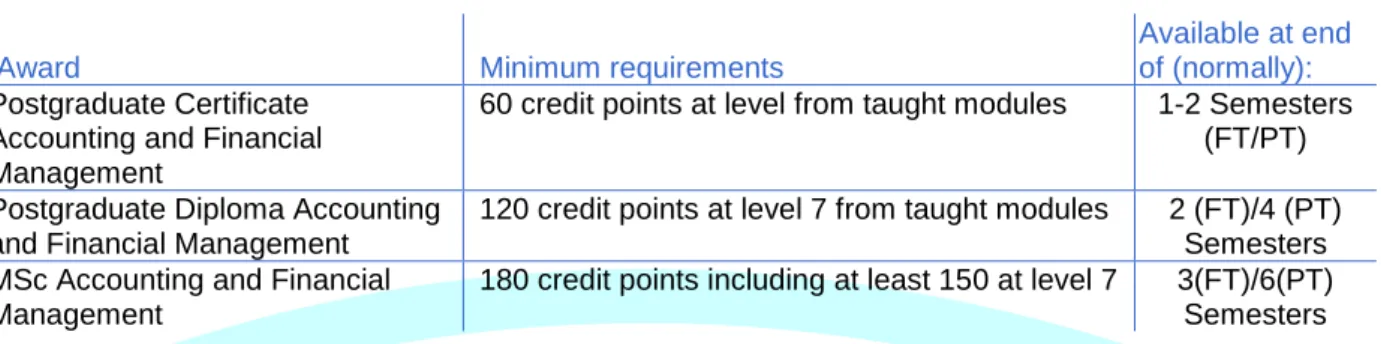
Table 1b Final and interim awards available
The programme provides the following final and interim awards:
Award Minimum requirements
Available at end of (normally):
Postgraduate Certificate Accounting and Financial Management
60 credit points at level from taught modules 1-2 Semesters (FT/PT) Postgraduate Diploma Accounting
and Financial Management
120 credit points at level 7 from taught modules 2 (FT)/4 (PT) Semesters MSc Accounting and Financial
Management
180 credit points including at least 150 at level 7 3(FT)/6(PT) Semesters Masters and Diploma awards can be made "with Distinction" or "with Commendation" where criteria as described in UPR AS14, Section D and the students' handbook are met.
E. Support for students and their learning
Students are supported by; A Programme Tutor
Academic Skills Unit ( ASU)
Student Representative on programme committees
A designated programme administrator
An Induction week at the beginning of the academic session
Overseas Orientation
StudyNet, a versatile on-line inter-active intranet and learning environment
Access to extensive digital and print collections of information resources
Attractive modern study environments in Learning Resources Centres
A substantial Student centre that provides advice on issues such as finance, University regulations, legal matters, accommodation, international student support etc.
Office of Dean of Students, incorporating Chaplaincy, Counselling and nursery
Medical centre
English support classes
A Mathematics Drop-in Centre
A faculty based Disabled Student Co-ordinator
An Equal Opportunities Officer
The Students’ Union
Guided student centred learning through the use of StudyNet
A Careers Service for all current students and graduates
F. Entry requirements
This programme is designed for those wishing to extend their knowledge of accounting and financial management. It is designed for graduates who have done undergraduate studies, or for those who have three years practical business knowledge in a management role. Candidates will need to be able to demonstrate numerate ability either through previous studies or through interview with the post graduate admissions tutor.
For graduates who have done undergraduate studies, the normal entry requirements for the programme are:
• an honours degree of at least 2:2 classification, in a business-related discipline from a UK Universityor; • the equivalent of the above from a recognized University overseas or;
• a degree equivalent professional qualification approved by the Programme Tutor or;
• a postgraduate qualification in a business related discipline from a UK University or its equivalent from a recognized University overseas or;
• A recognized Graduate Certificate in Business or equivalent.
Those who have three years practical business knowledge in a management role, the level of readiness will be assessed through the form of an interview with the post graduate admissions tutor allocated to this programme.
.
All students for whom English is not their first language must produce evidence of their English Language proficiency. The standard required is:
(a) a score of 6.5 or better on the British Council's IELTS test, or an equivalent score on a test recognised by the University of Hertfordshire; or
(b) a score of 6.0 or better on the British Council's IELTS test, or an equivalent score on a test recognised by the University of Hertfordshire, plus an appropriate pre-sessional English language course at the University of Hertfordshire; or
(c) a score of 5.5 or better on the British Council's IELTS test, or an equivalent score on a test recognised by the University of Hertfordshire, plus successful completion of a relevant pre-masters qualification.
The programme is subject to the University's Principles, Policies, Regulations and Procedures for the Admission of Students to Undergraduate and Taught Postgraduate Programmes and will take account of University policy and guidelines for assessing accredited prior certificated learning (APCL) and accredited prior experiential learning (APEL). APEL applications are processed within the Business School by the Programme Tutor with the support of the APEL manager. APEL requires formal
registration and the production of a substantial formal written submission, and reports are subject to the University’s usual rigorous moderation processes.
Section 2
Programme management
Relevant QAA subject benchmarking statements Specialist Masters Award in Business and Management (2007)
Date of validation/last periodic review January 14
Date of production/ last revision of PS January 2014
Relevant intakes Level 7 entering September 2015
Administrative School Hertfordshire Business School
Course details
Course code Course description JACS
BSAFM MSc Accounting and Financial Management N400/N300
Course Instances
Instances code
Intake Stream Instances
Year
Location: Mode of study
AFMF1F-1 A Accounting & Financial Management 1 Hatfield Full-time
AFMF1F-2 A Accounting & Financial Management 1 Hatfield Full-time
AFMPGD1F A Accounting & Financial Management 1 Hatfield Full-time
AFMPGD1P A Accounting & Financial Management 1 Hatfield Full-time
The programme is managed by;
Dean of School
The Head of Department
Head of Post Graduate Development
A Programme Tutor who is responsible for the day- to-day management of the programme
An Admissions Tutor, with specific responsibility for open days and selection
An International Admissions Tutor, with specific responsibility for selection of overseas students
A designated Administrator to deal with day-to-day administration associated with the programme
Module Leaders who are responsible for individual modules
A programme committee, the membership of which includes student representatives from each level of study and key members of the Business School staff.
Programme-specific assessment regulations
The programme is compliant with the University's generic assessment regulations (Structure and Assessment Regulations for Academic Programmes, UPR AS14, section D) with the exception of those listed below, which have been specifically approved by the University:
Students joining the programme on a module by module basis should first take the Professional Skills module
Further points of clarification and interpretation relevant to this specific programme are given below:
none
Other sources of information
Definitive Module Documents
Module Guides
Student Handbook
University of Hertfordshire Course website:
http://www.herts.ac.uk/courses/
QAA Benchmark Statement website:
http://www.qaa.ac.uk/academicinfrastructure/benchmark/default.asp
The Framework for Higher Education Qualifications in England, Wales and Northern Ireland, 2008:
http://www.qaa.ac.uk/academicinfrastructure/FHEQ/EWNI08/default.asp
SEEC Credit Level Descriptors for Further and Higher Education 2010:
http://www.seec.org.uk/academic-credit/seec-credit-level-descriptors-2010
External Quality Review report website:
http://www.qaa.ac.uk/reviews/reports/instReports.asp?ukprn=10007147
UNISTATS website:
http://www.unistats.com/
University of Hertfordshire Academic Quality Office website:
(StudyNet Staff Department Lists Academic Quality Office)
Structure & Assessment Regulations - Undergraduate & Taught Postgraduate Programmes, UPR AS14:
http://sitem.herts.ac.uk/secreg/upr/AS14.htm
Learning and Teaching Policy and Graduate Attributes, UPR TL03:
http://sitem.herts.ac.uk/secreg/upr/TL03.htm
Admissions - Undergraduate & Taught Postgraduate Students, UPR SA03:
http://sitem.herts.ac.uk/secreg/upr/SA03.htm
Academic Quality, UPR AS17:
http://sitem.herts.ac.uk/secreg/upr/AS17.htm
Index of UPRs for students:
http://sitem.herts.ac.uk/secreg/upr_azlist_info.htm
Information on Programme and Module External Examiners
http://www.studynet1.herts.ac.uk/ptl/common/studentcentre.nsf/Teaching+Documents/184A221E5E ECA6B780257A5C00250BA9?OpenDocument
Other information relevant to the programme
NoneUniversity policies relevant to the Programme
The University undertakes to use all reasonable endeavors to deliver, assess and administer this programme in accordance with this Programme Specification. At the same time it is recognised that it is in the nature of academic developments that changes, for example to the structure, curriculum, and assessment of a programme may be necessary in order to ensure that the programme remains up to date, in response to issues raised as a result of on-going monitoring and evaluation, and/or in order to conform to new regulatory requirements imposed by this institution, by professional or statutory bodies, or by national or governmental bodies.
The programme operates within the guidelines and policies relating to equal opportunities and environmental issues which may be agreed from time to time by the Board of Governors and/or the Academic Board of the University.
Where the programme is offered in collaboration with another institution these policies and guidelines will normally be those of the partner institution.
The programme operates in accordance with the University's Regulations Governing Studies Involving the Use of Human Subjects (UPR RE01) agreed from time to time by the Academic Board of the University. However, where the programme is offered in collaboration with another institution (for example through a franchise arrangement for all or part of the programme) then specific approval must be obtained from the University for the operation of the programme within ethical guidelines prepared by the partner institution. The partner institution will be responsible for all insurance liability in connection with the observance of ethical guidelines.
Signed Date 05/03/2015 Denise Ball
Associate Dean of School (Academic Quality Assurance)
If you would like this information in an alternative format please contact:
Edna Stan-Maduka (Programme Tutor)
Msc Accounting and Financial Management
Table 2: Development of Programme Learning Outcomes in the Constituent Modules
This map identifies where the programme learning outcomes are assessed in the constituent modules. It provides (i) an aid to academic staff in understanding how individual modules contribute to the programme aims (ii) a checklist for quality control purposes and (iii) a means to help students monitor their own learning, personal and professional development as the programme progresses.
Module Title Module Code A1 A2 A3 B1 B2 B3 C1 C2 C3 D1 D2 D3
FULL TIME
Accounting for Business Decisions 7BSP1223 x x x x x x x x x
Finance for Business Decisions 7BSP1224 x x x x x x x x x
Emerging Issues in Accounting & Finance 7BSP1226 x x x x x x x x x x
Effective Governance & Accountability 7BSP1225 x x x x x x x x
Professional & Research Skills for MSc AFM 7BSP1227 x x x x x x x x x x x
Applied Project for MSc AFM 7BSP1228 x x x x x x x x x x x x
PART TIME YEAR ONE
Accounting for Business Decisions 7BSP1223 x x x x x x x x x
Finance for Business Decisions I 7BSP1229 x x x x x x x x x
Professional skills for MSc AFM 7BSP1230 x x x x x x x x x x
YEAR TWO
Emerging Issues in Accounting & Finance 7BSP1226 x x x x x x x x x x x
Finance for Business Decisions II 7BSP1231 x x x x x x x x x
Effective Governance & Accountability 7BSP1225 x x x x x x x x
Research Methods for MSc AFM 7BSP1232 x x x x x x x x x x x
YEAR THREE
Applied Project for MSc AFM 7BSP1228 x x x x x x x x x x x x
Programme Learning Outcomes (as identified in section 1 and the following page)
Transferable Skills Practical Skills
Intellectual Skills
Knowledge & Understanding
Key to Programme Learning Outcomes
Knowledge and Understanding Practical Skills
A1. contemporary accounting and financial theories, models and research to develop independent analysis of these issues
C1. plan and manage independent study
A2. a variety of models , techniques and methods to solve practical problems arising in accounting and financial management
C2. demonstrate self-direction and some originality in tackling and solving problems
A3.accounting and financial databases, finance specific software and bibliographic resources related to accounting and financial management
C3. make appropriate use of learning resources, including sophisticated data sets.
Intellectual Skills Transferable Skills
B1. analyse and discuss financial information in a business context using critical methodological skills in accounting and finance which can be adapted to solve further problems arising either in practice or in research
D1. communicate arguments, ideas and information effectively in writing and orally to specialist and none specialist audiences.
B2. evaluate accounting and finance research and a variety of types of information and synthesise information from a number of sources
D2. critically analyse problems arising in both academic and practical contexts
B3. recognise ethical dilemmas and corporate social responsibility issues as applicable to accounting and finance