Design Applications ProSIARS as Media Support for Optimize the Simulation Based
Learning
Slamet Sudaryanto N1, Maryani S2, Sudaryanto1
1Computer Science Faculty, Dian Nuswantoro University Central Java, Indonesia
2Health Faculty, Dian Nuswantoro University Central Java, Indonesia
{[email protected], 2[email protected],[email protected]}
ABSTRACT: Currently there are a lot of electronic learning media are developed to support the learning environment and improving the quality of learning outcomes. Learning is the process of how we perceive and understand the real world around us. Thus in the process of learning requires learning media that can support quality learning outcomes. With the development of information technology we can develop learning media application framework that can be used to build a learning atmosphere simulation-based medical records. The purpose of this research is to design a prototype for simulation of the administration of the hospital medical record (ProSIARS). ProSIARS will be used as a media laboratory practice simulation clinic medical records I (PKRM I). Simulation is a technique for practice and learning that can be applied to various disciplines. Simulation can strengthen in depth experience with real-world substance imitate aspects fully interactive. With ProSIARS can wake simulation-based learning environment that is dynamic and visualizations that represent the atmosphere of the time and the behaviour of real work. ProSIARS can be combined with teaching materials, guidance materials and tools supporting software, can even be combined with inter-related disciplines such as education of nurses and doctors. Traditionally the procedural PKRM I education and knowledge gained through theoretical concepts and models of apprenticeship. Software architecture contributes independently developed to represent the educational content of medical records (e.g. simulation models, guidance materials) and software engineering (e.g. interface). We provide a template interface and set of application modules to be arranged into administration education simulation framework needs medical records. Prototype design is done with the stages of the SDLC (system development life cycle), then followed up with the study to determine the level of benefit ProSIARS against behavioural (cognitive, affective and psychomotor) students. The approach uses quasi-experimental research with methods of non-equivalent control group design.
Keywords: Simulation, ProSIARS, Media study, Medical records, Software engineering
Received: 18 September 2015, Revised 25 October 2015, Accepted 4 November 2015
© 2016 DLINE. All Rights Reserved
1. Introduction
“learner-centered education” does not depend on the application of technology, because of the application of technology in the electronic learning environment only serves as a powerful trigger (catalyst) in a positive change. The electronic learning environment has several advantages such as:
1. Colaboratories, which can facilitate communication between groups [3].
2. Construction toolsets, who can teach skills design and modeling study [4].
3. Simulation, which can support the “learning by doing” [2].
4. System “Scaffolding”, which allows learners to start learning from the simple to the complex [11].
In educational administration of medical records should be no exposure to cases, document medical records of patients alive even necessary. With media that supports problem-based learning then ProSIARS can be used for simulation in solving tasks and cases. ProSIARS built as an application framework that can be used as an environment “live” simulation (live simulation-based learning environments). Domain of the framework emphasizes the concept of educational content taught to the nature of excellence custom front end. For the purposes of ProSIARS simulation can be set as the actual work environment such as in hospitals. There is a reception outpatient, inpatient emergency and medical support installation. With the complexity of the handling of medical records of patients it not only requires employee medical record admisnitasi master knowledge, skills and procedural course. But also the ability to communicate effectively to patients, relatives and other health service providers to coordinate the various activities of care and patient medical records. In this simulation takes several players or actors (employee medical records, patient and other disciplines such as nurses) to design scenarios started from simple to complex. All players or actors can perform role-play in systematic appropriate competencies expected. Simulation environment using ProSIARS is a learning tool that can be used to encourage exploration that allows students to be players in a professional working group.
2. Research Methodology
An easy way to comply with the conference paper formatting requirements is to use this document as a template and simply type your text into it.
2.1 Design ProSIARS
ProSIARS media design and development based on the model of software development life cycle (Software Development Life Cycle - SDLC) which consists of five stages: analysis, design, development, implementation, evaluation. ProSIARS learning model combines the cognitive approach, constructive and contextual. ProSIARS effectiveness testing results con-ducted based on case studies with quasi-experimental methods of non equivalent control group design in study program medi-cal records and health information. This method is suitable for evaluating the effectiveness of ProSIARS, because it is used to compare the learning process between the conventional classroom with a class that uses the media lab ProSIARS on the topic and the same learning materials. Selection of topics related to the clinical practice of medical records I (PKRM I). Initial analysis is the analysis of documents and learning materials PKRM I. Some activities are also conducted interviews both to teachers and students of medical records. Evaluation was conducted with a sample case study on a group of students. This evaluation takes four weeks to do activities and the entire evaluation procedure. The sample in this study are two classes of students who took the 2013/2014 semester courses Medical Record Clinical Practice I (PKRM I) in the course of medical records and health information UDINUS. Number of subjects from the experimental class and control class each 15 people, one of the class acts as experimental group (E) and other class air role as the control group (K). Experimental group (E) were given teaching materials with the media lab PKRM I ProSIARS, while group control (K) with conventional teaching methods on the same topic. Table 1 below shows the distribution of students who study sample with 15 students as the control group (K) and the other 15 as an experimental group (E). Conducted pre and post test were used to determine the effectiveness of the media lab ProSIARS. The results were compared between students who use the media lab ProSIARS with students who do not use the media lab ProSIARS. Test in the design into three domains question as data collection instrument, domain knowledge 15 items, 15 items of attitude domains and domains of practice 15 items. Measurement results of the test are considered to have an increase of the pre and post test.
2.2 ProSIARS Instructional Design Model
tive-psychomotor approach. ProSIARS instructional design function model is built based on the theories and principles of matter PKRM I need application functions as a dynamic media and integrated practice in the management of electronic medical records. Material and function modules can be setup dynamically (customize) based on the parameters of application needs. ProSIARS instructional design models into account the objectives, content and competencies, so that will effectively transfer knowledge to assist the media-based instructional transition.
Figure 1. Concept of Instructional Design Model In ProSIARS
2.3 User Interface ProSIARS Based Instructional Design
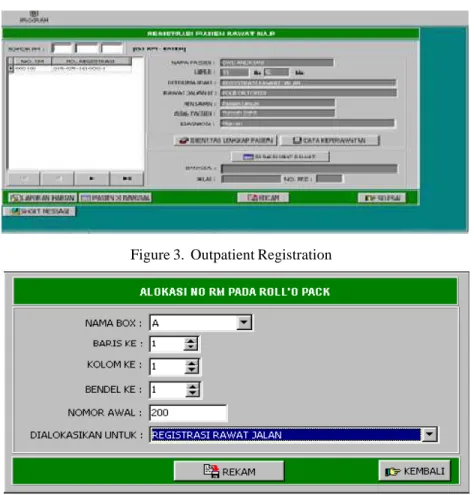
ProSIARS as media simulation lab consists of five main modules, modules acceptance outpatient (clinic), inpatient admission, the index of medical records, medical records and mutation assembling medical record. Each of these modules contain materials theory medical record needs to be set up as conditions and needs in the real world (the hospital). All of these modules with data input and reporting requirements as required in groups and integrated simulation. ProSIARS can be simulated and the media role plays in solving certain cases (problem-base learning PBL). PBL contextual learning theory and applied simultaneously go to fast, this method will help students to associate theory lessons with realistic aspects of the application of information systems in the hospital medical record. Pictures below are some examples of interfaces.
Figure 3. Outpatient Registration
Figure 4. Allocation No.Medical Record In Roll’O Pack
Table 1. Student distribution
Whereas in the control group (K) concentration pre and post test results at most in domain knowledge is sufficient category 13 respondents (86.7%) post-test 10 respondents (66.6%), affective category of pretty 13 respondents (86.7%) post test 13 respondents (86.7%), psychomotor domain results in the pre-test at most enough nine categories of respondents (60.0%) post the results of the test categories quite 7 respondents (46.6%).
These findings illustrate that the student group (E) after treated with ProSIAR as the media make use of simulation has increased on average higher than category enough to good for all domains in comparison group (K), which amounted to 73.36%, whereas in the group (K) experienced an increase in concentrations of less to enough category for all domains in the amount of 11:13%. At these calculations also found the percentage of students graduating in the group (E) is 100%, while for the group (K) was 86.70%. Furthermore, the frequency distribution of the pre-test and post-test as follows:
3. Results and Discussion
Based on experiments with the same treatment (not using ProSIARS) against a group of students, it was found that the average value of at most for group (E) in the matter of the cognitive domain is sufficient category 10 respondents (66.6%), affective category of pretty 14 respondents (93, 3%), and psychomotor category quite 14 respondents (93.3%). Results at most after using the media practice of domain knowledge ProSIARS in both category 14 respondents (93.3%), affective category of good 11 respondents (73.3%), and psychomotor good category 12 respondents (80.0%).
Group Treatment Total
Control (K) without treatment 15
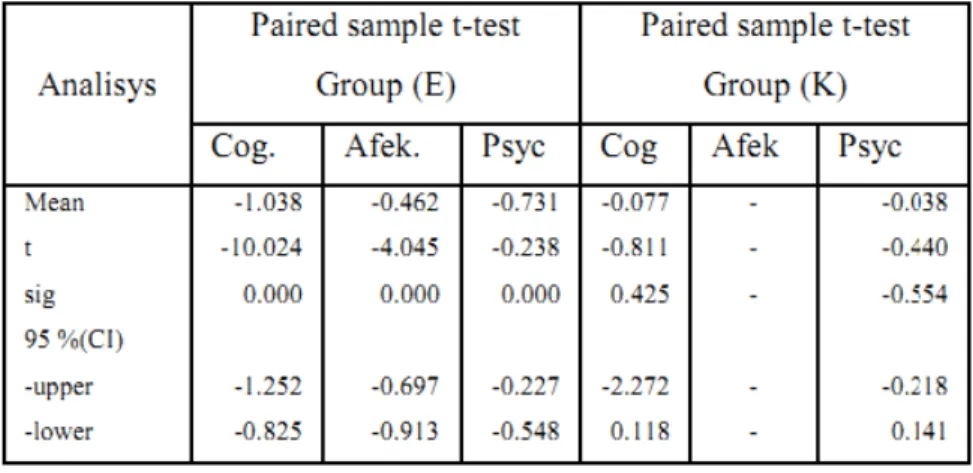
The test results paired-sample test group (E) on the domain behavior (knowledge, attitude and practice) showed sig. (2-tailed) 0.0014 < α = 0.005. Results t count> t table = 1.699 thus giving ProSIARS use as a media lab simulations shown to improve behaviour (knowledge, attitudes and practices) with regard to material PKRM I. Thus ProSIARS as media simulation can support improved learning outcomes as outcome learning.
Table 2. Distribution of the Frequency of Behavioural Learning Outcomes
Table 3. Paired Sample T-Test
Results paired sample t-test showed the control group p > α = 0.005. These results prove there is no difference in behaviour between the pre-test and post-test group that did not use the media ProSIARS.
Results of analysis of independent samples t-test behavioural domain knowledge, attitude and practice show the value of p < α = 0.005. Results t count> t table = 2.0598. In conclusion there is significant influence ProSIARS use as a media lab simula-tion of the learning process PKRM I. Behaviours (knowledge, attitude and practice) on the evaluasimula-tion of learning outcomes as a result of the intervention group (E) is better than the control group (K).
4. Conclusion
The study concluded that the use of ProSIARS as a media laboratory simulation can improve higher level of knowledge, attitudes and practices of group (E) compared with the group (K) which is not used as a medium ProSIARS simulation. It can be implied that the model can effectively support ProSIARS for simulation PKRM I. It is suggested that the simulation can involve learning PKRM I (integrated) with other health disciplines such as nurses or doctors. So it will be able to complete the frame and function ProSIARS, ProSIARS eventually will be used as supporting media simulation in an integrated manner with other disciplines.
Acknowledgment
This research was provided by the Research and Technology Ministry of Higher Education, sponsored under a grant budget of private colleges compete coordinator IV Central Java.
References
[1] Anderson, W. L., Krathwohl, R. D. (2001). A Taxonomy for Learning Teaching and Assessing A Revision of Bloom’s Taxonomy of Educational Objectives. Washington: Addison Wesley Longman.
[2] Cole, R., Tooker, S. (1996). Physics to Go: Web based tutorials for CoLoS physics simulations, In: Proceedings of Frontiers in Education’ 96, IEEE, 681-683.
[3] Edelson, D., Pea, R., Gomez, L. (1996). Constructivism in the Collaboratory. In B. G. Wilson (Ed.), Constructivist learning environments: Case studies in instructional design, Educational Technology Publications, Englewood Cliffs, NJ, 151-164.
[4] Eden, H., Eisenberg, M., Fischer, G., Repenning, A. (1996). Making Learning a Part of Life. Communications of the ACM 39, 4, 40-42.
[5] Hudson, S. and Smith, I. (1997). Supporting Dynamic Downloadable Appearances in an Extensible User Interface Toolkit, In: Proceedings of UIST 97, ACM, New York, 159-168.
[6] Knowles, M. S. (2009). The Modern Practice of Adult Education: From Pedagogy to Andragogy. N.Y.:Cambridge, The Adult Education Company.
[7] Liliasari. (2005). Membangun Keterampilan Berpikir Manusia Indonesia melalui Pendidikan Sains. Pidato Pengukuhan Guru Besar Tetap dalam Ilmu Pendidikan IPA Universitas Pendidikan Indonesia, Bandung, 23 November.
[8] Manisha, B. (2013). Development Concepts in Physics through Virtual Lab Experiment: An Effectiveness Study. Techno LEARN: An International Journal of Educational Technology, 3 (1), 43-50.
[9] McGregor, D. (2007). Developing Thinking; Developing Learning A Guide to Thinking Skill in Education. England: McGraw Hill.
[10] Norman, D., Spohrer, J. (1996). Learner-Centered Education, Communications of the ACM 39, 4, 24-27.