TOOLS FOR
MANAGEMENT
CONSULTING
Tools, Models and
Approaches for
Clients and Consultants
Simon A. Burtonshaw-Gunn
Registered office
John Wiley & Sons Ltd, The Atrium, Southern Gate, Chichester, West Sussex, PO19 8SQ, United Kingdom
For details of our global editorial offices, for customer services and for information about how to apply for permission to reuse the copyright material in this book please see our website at www.wiley.com.
The right of the author to be identified as the author of this work has been asserted in accordance with the Copyright, Designs and Patents Act 1988.
All rights reserved. No part of this publication may be reproduced, stored in a retrieval system, or transmitted, in any form or by any means, electronic, mechanical, photocopying, recording or otherwise, except as permitted by the UK Copyright, Designs and Patents Act 1988, without the prior permission of the publisher.
Wiley also publishes its books in a variety of electronic formats. Some content that appears in print may not be available in electronic books.
Designations used by companies to distinguish their products are often claimed as trademarks. All brand names and product names used in this book are trade names, service marks, trademarks or registered trademarks of their respective owners. The publisher is not associated with any product or vendor mentioned in this book. This publication is designed to provide accurate and authoritative information in regard to the subject matter covered. It is sold on the understanding that the publisher is not engaged in rendering professional services. If professional advice or other expert assistance is required, the services of a competent professional should be sought.
A catalogue record for this book is available from the British Library.
ISBN 978-0-470-74593-9
ACKNOWLEDGEMENTS vii
FOREWORD BY DR MALIK SALAMEH ix
ABOUT THE AUTHOR xiii
INTRODUCTION xvii
1. THE PROFESSION OF
MANAGEMENT CONSULTANCY 1
2. DEVELOPING MANAGEMENT
CONSULTANCY 35
3. THE MANAGEMENT OF
CONSULTANCY PROJECTS 63
5. TOP-TEN CONSULTANCY TOOLS 107
REFERENCES 135
WEBSITES 139
ADDRESSES 141
From the feedback since the publication of my book The Essential Management Toolbox I have been asked to expand on the models and tools in a practical way; for me the value of the Toolbox book is to have a collection of tools which may be used for a variety of management assign-ments. Again in compiling this book I have to say that this would not have been possible without the fi ne efforts from all those management authors, research publications and course notes, etc. that I have collected over the years. As such I am greatly indebted to all whose work appears in the book, and also to my own teachers and mentors who have aided my own journey through many manage-ment topics.
omissions and would be pleased to correct these in any future edition.
by D r M alik S alameh
Once again Professor Simon Burtonshaw -Gunn has iden-tified a significant area where his extensive consultancy expertise can provide an essential road map – all in one publication. In this book he addresses the most important aspects which any prospective management consultant or consultancy expert would need to consider in providing consultancy intervention and in turn satisfy both profes-sional standards and corporate management expectations.
investment necessary to ensure any consultancy commis-sion is executed on a mutually benefi cial basis.
Furthermore, it highlights the sheer variety of oppor-tunities which currently exist within the business consult-ing profession and become available when consultancy output is fully aligned with client expectations and can be seen to embed true organizational value. This book continues to adopt a highly successful formula developed previously by the author of providing the user with comprehensive domain knowledge and then selecting a range of management tools and techniques which he believes are the most effective in consultancy delivery and in anticipating the real -world issues threatening an organ-ization’s performance.
Having professionally collaborated with the author in delivering international management consultancy in both public and private sectors, I believe this publication satisfies a hitherto untapped opportunity; that being to provide a unique publication which is easily accessible and strikes the careful balance of identifying consultancy as a career development opportunity, as a catalyst to improve business performance, and as a client organiza-tional reference to aid delivery of optimal value when selecting consultants and engaging consultancy practices on either an internal or external basis, respectively.
and currently is a principal management consultant for an international management consultancy company in the UK working in both the public and private sectors. To complement this experience he holds two Master ’s degrees and a PhD in various strategic management topics together with fellowship of four professional bodies including the Chartered Management Institute (FCMI) and the Institute of Business Consulting (FIBC).
He was a post -doctoral research fellow for four years at the Manchester Metropolitan University before relin-quishing this at the beginning of 2005 to take up the role of a visiting professor at the University of Salford in Greater Manchester. Here he served for three years in the six -star research rated School of the Built Environment before being appointed as the first visiting professor to the Salford Business School in 2007. In addition, he held a two -year appointment as a member of the Court at the University of Leeds – itself a member of the Russell Group association of the top 20 UK research -intensive universities – until 2009.
This book has been developed from an interest in the use of management tools and models published in January 2008 in The Essential Management Toolbox: Tools, Models and Notes for Managers and Consultants. This supplemen-tary book describes a number of examples and shares the author’s practical experience in the use of appropriate management tools and models taken from the Toolbox with a focus on identifying and describing the essential tools for those involved in undertaking management con-sultancy activities.
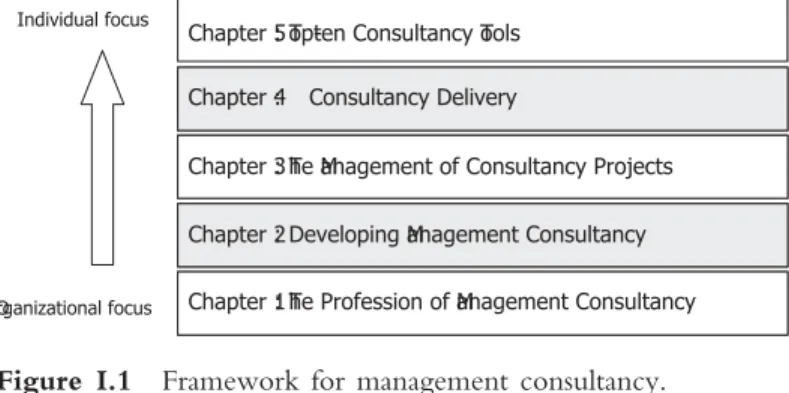
project management approach, the importance of under-standing the assignment requirements and expectations, and adoption of risk management for consultancy pro-jects. Chapter 4 describes the main consulting delivery approaches including problem solving, facilitation and communication. The final chapter covers the author ’s selected “Top-ten” consultancy tools and describes from practical experience how and where these tools are best suited to be used. Each of the topics of these fi ve chapters has been chosen to provide a framework for both organi-zations and individuals to draw upon in the delivery of their consultancy services, as shown in Figure I.1.
The intent of writing this title has been to provide once again a suitable reference for aspiring, recently appointed or seasoned management consultants wishing to understand and undertake practical performance improvements relevant to their professional development
Individual focus
O
rganizational focus
Chapter 5: Top-ten Consultancy Tools
Consultancy Delivery Chapter 4:
Chapter 3: The Management of Consultancy Projects
Chapter 2: Developing Management Consultancy
Chapter 1: The Profession of Management Consultancy
whether at the individual or organizational level and with an equal relevance to those employed as internal or exter-nal consultants within both the public and private sectors. The book describes a range of methodologies aimed to provide an underpinning knowledge of the practical tools that are open to consultants to employ on their assign-ments. In addition the opening chapter looks towards the profession itself in sharing some thoughts around added value and the issues of governance and ethical practice.
Whilst the intent has been to provide an opportunity to discuss some new models, the majority of the fi gures and models are taken from The Essential Management Toolbox: Tools, Models and Notes for Managers and Consultants published by John Wiley and Sons in 2008. Where the original source is not the author ’s, then the source is shown with each model discussed.
The book is designed as one of a series of sibling publications intended to group enabling management tools, techniques and models into related clusters giving consultancy practitioners a highly effective means of development at both an individual and practice level providing consultancy services. Other titles are Essential Tools for Organizational Performance and Essential Tools for Operations Management.
THE PROFESSION OF
MANAGEMENT
CONSULTANCY
I N T R O D U C T I O N
D E V E L O P M E N T S I N
M A N A G E M E N T C O N S U L T I N G
Management consultancy derives its revenues from clients in all areas of both public and private sectors. Whilst regarded as a large and diverse profession in terms of practising consultants and business turnover revenue, it is a volatile profession where individuals are mobile and practices are able to form and change rapidly. Unlike other professions, consultancy has little, if any, barriers to entry, and with an absence of any statutory regulation anyone is free to enter the workplace as a consultant irrespective of their level of experience, education or level of competence required for this profession. Indeed, this view is further complicated with free use of the title; from personal trainers to recruiters calling themselves consultants. Perhaps because of this there are two oppos-ing opinions on management consultants; one often quoted view is that:
Consultants are people who borrow your watch to tell you what time it is … and then walk off with the watch.
From Up the Organisation by Robert Townsend
The other view, happily, is about a symbiotic rela-tionships and mutual reliance between “consultant” and “client”.
creating effective business cultures, in addition to sharing “best practice ” and assisting in increased organizational performance. Indeed, if carefully selected, briefed and respected by their clients, management consultants can provide a valuable resource for organizations of all sizes, whether in the private, public or “not for profi t ” sectors. Whilst there are a number of views on the role, scope and attributes of a management consultant ranging from “adviser to business ” to “a specialist to bring about efficient management practices ” the following list also captures for many individuals and businesses what man-agement consultancy is about:
• The provision of information that may not be other-wise available to the client with the opportunity to gain an insight into current thinking in a particular industry or sector which can be benchmarked accordingly. • The provision of specialist resources with skill sets to
address a key problem or issue thoroughly which are either in short supply or non -existent within the client’s organization. These may only be needed in the short -term and as such full -time recruitment to undertake this role would not be cost effective. In addition this may also offer opportunities to the client for the transfer of such skills to its own staff if com-mercially viable.
• The provision of expert opinions to enable line man-agement to make decisions on what to do.
• Undertaking of diagnostic analysis with sophisticated tools not available to a client or their subordinates. • Developing practical action plans based on
“best-practice” and wider pan -industry experience.
• Improvement of systems and methods again with the ability to draw upon a wider knowledge base than resides within the client ’s organization.
• Training and development of management and staff to help them make more effective decisions relative to the business objective and long -term strategic direction.
• The provision of personal counselling, coaching, mentoring and training to support the development and retention of key knowledge workers.
• Implementation of difficult or unpopular decisions with responsibility for them; this may also include providing support to others through diffi cult situations.
• The ability to act as a messenger and carry informa-tion that is not moving up the organizainforma-tion by the normal communication route. This often includes easier access to senior managers and opportunities to provide independent or impartial advice.
• The ability to undertake work which requires objec-tivity and complete independence, for example, to gain acceptance to introducing a change that is un -palatable or difficult to achieve.
• The ability to take the pressure off the client by taking on the role of “scapegoat” for the introduction of new methods, systems and processes, etc.
For a more succinct view, the UK ’s professional body for consultancy (the Institute of Business Consulting) proposes the following definitions of the consultancy profession:
Management consulting involves individuals, whether self-employed or employed, using their knowledge and experience, and their analytical and problem -solving skills, to add value into a wide variety of organisations within a framework of appropriate and relevant professional standards, disciplines and ethics.
In addition, the Institute of Business Consulting also offers the following definition of a management consultant:
A management consultant is a person who is professionally engaged in advising on and providing a detached, external view of a company ’s management techniques and prac-tices. A consultant can operate as a specialist or a general-ist. The client ’s requirements dictate which skills and expertise are most appropriate and the situations in which to use a consultant.
From the opening comment about the profession being unregulated the Institute of Business Consulting itself is pursuing policies to set, maintain and raise the standards of both professionalism and competence for the profession. Leading on from the above definitions it is widely accepted that management consulting typically involves the identification and cross -fertilization of best practices, analytical techniques, change management, technology implementations, strategy development and coaching skills. However, such identification is merely a list of tools or competencies which the consultant may wish to draw upon in order to provide sound advice to business about efficient management practices. On this basis therefore one of the attributes of management con-sultancy can be considered to be the practice of assisting companies to improve their operational and hence fi nan-cial performance through analysis of existing business problems together with the introduction of key perform-ance metrics by which the organization can then be actively managed. The publication of the Geneva -based International Labour Organization (ILO) proposes that:
Management consulting is an independent professional advisory service assisting managers and organizations in achieving organizational purposes and objectives by solving management and business problems, identifying and seizing new opportunities, enhancing learning and implementing changes.
reasons; the first being that consultants can often provide an informed analysis by drawing upon their wider exper-tise and independent specialist skills than is available within the host organization. Second, it is often easier for an outsider to provide an objective appraisal by seeing the broader picture whilst realistically recognizing the organization’s long -term requirements. This in itself may lead on to various outcomes such as change management, outsourcing, crisis management or detailed process con-sultation. The third reason arises where the use of a management consultant may be needed for the provision of additional temporary assistance to address an unex-pected increase in the management workload, this can often arise in conjunction with the implementation of a major change programme or from a new development in management responsibility.
Having proposed these three reasons for the use of consultants it is clear that these can feature in the fi ve broad generic consultancy purposes proposed by clients for their use of consultants irrespective of differences in the techni-cal area of the intervention and in the specifi c intervention method used. According to the ILO these purposes are: • Achieving organizational purposes and objectives. • Solving management and business purposes. • Identifying and seizing new opportunities. • Enhancing learning.
• Implementing changes.
course there are many examples of where both skill sets are utilized on a single consultancy project. The technical dimension concerns the nature of management or busi-ness problems faced by the client organization and the way that this problem is analysed, recommendations offered and then resolved by the proposed implementa-tion. Such technical management consulting usually draws upon knowledge of organizational structures, systems, processes, resource allocation and models of utilization to achieve efficient and effective business performance. The “human dimension ” encompasses the interpersonal relationship in the client ’s organization, people’s feelings about the problem, business environ-ment, its current market position and the relationship between the consultant and the client as people. In this area the consultant ’s role is in providing advice to moti-vate, energize and empower people typically around organizational development, change management and human resource development. (Note: the topics of process management, change management and people -focused performance are discussed in detail together with supporting tools and models in Essential Tools for Organizational Performance.)
T Y P E S O F C O N S U L T A N T S
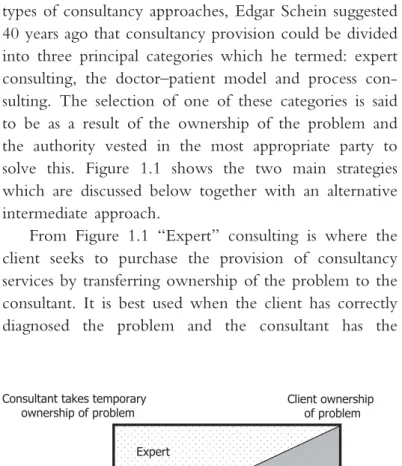
types of consultancy approaches, Edgar Schein suggested 40 years ago that consultancy provision could be divided into three principal categories which he termed: expert consulting, the doctor –patient model and process con-sulting. The selection of one of these categories is said to be as a result of the ownership of the problem and the authority vested in the most appropriate party to solve this. Figure 1.1 shows the two main strategies which are discussed below together with an alternative intermediate approach.
From Figure 1.1 “Expert” consulting is where the client seeks to purchase the provision of consultancy services by transferring ownership of the problem to the consultant. It is best used when the client has correctly diagnosed the problem and the consultant has the
Consultant takes temporary Client ownership ownership of problem of problem
Expert
Process
Use of consultant or Use of client expertise or expertise knowledge knowledge
Figure 1.1 Consultancy approaches.
capability to provide the relevant competent expertise. This choice also requires the client to accept some risk in the advice and solution given as the problem may have been incorrectly thought through at the outset and the consultant may therefore have been asked to solve the “wrong” issue with the potential consequence of obtain-ing the wrong information or recommendobtain-ing an in -appropriate solution.
At the other extreme is “Process” consulting which is often founded on the premise that the client owns the problem and continues to do so throughout the consulta-tion process. In this approach the client accepts that the organization has problems but does not know what to do about them; as such the consultant is required to undertake a diagnosis as part of the intervention. Process consulting can be used to offer the client an understand-ing of the problem and identify the range of actions open for consideration. In the longer term the client will be capable of learning to embed these tools and techniques to help diagnose and solve their own organizational prob-lems. It is then likely to understand the best approach to the implementation of the solution by linking this to its own business processes.
helpful to the client and information on the problem area will be provided in full and without exaggeration. The doctor–patient model can be used when the client will understand and correctly interpret the diagnosis provided by the consultant and will implement the prescribed solu-tion resulting in long -term performance improvements after delivery of the intervention. Here the client will be responsible for the implication following the diagnosis and the continued momentum of the initiative.
Having looked at the three different types of consult-ant models there is also a distinction between internal and external consultancy interventions. An internal con-sultant already works inside part of the organization and is tasked with helping other parts of the same business; in the main, the use of internal consultants is becoming increasingly common in large organizations where they have both the financial resources to afford such full -time assistance and where they have sufficient work, or indeed problems, to keep them gainfully employed. In many cases internal consultancy develops from the use of busi-ness improvement teams often formed to solve an imme-diate problem which go on to address short - and longer-term business needs, introduction of new legisla-tion, sudden changes in market dynamics and/or fi scal pressures. These share a number of features with exter-nally consultants, such as their abilities to:
• fix or install something;
• solve a problem;
• undertake research of the feasibility of a certain change;
• re-engineer or reorganize a process; or lastly
• create a new function based on a clear vision with the motivation and support to make it happen. Internal consultants may also be used to commission external consultants; to brief them about the culture and context of the assignment; to ensure that they are com-pliant with the governance requirements of the business; and to assess if they provide value for money.
The different types of consultant are shown in Figure 1.2 where the consulting activity can take either an advi-sory or an executive role, and is undertaken by external or by an organization’s own in-house consultants.
Advisor
Role A. External consultant advising client Role B. External project manager advising clients Role C. Internal specialist staff advising colleagues Role D. Internal manager advising subordinates or colleagues External consultant Executive In n tlconsultant e ra
Figure 1.2 Types of consultant.
Examples of internal consultancy areas of work may include IT, finance and increasingly HRM where they may be involved in performance improvement or imple-menting change programmes. Whilst some may operate at a strategic level, this is a real exception as at this level the senior management prefers paying for the external perspective, a service not so readily provided by internal consultants. This also offers the board a level of privacy and comfort as an external mentor or advisor can be seen as a “critical friend ”. It is noted that at this level credi-bility, status, internal politics, legacy issues and reputation are the main challenges facing internal consultants and it is clear that internal and external consultants wield dif-ferent amounts of power and senior level infl uence. Role A is the conventional notion of an external
consult-ant who provides specialist advice on contract for a time to clients.
Role B has its origin in the construction and IT industries particularly where a project manager from an outside organization has responsibility for deliver-ing an assignment but acts as a consultant to the clients and as a line manager in their own organization.
Role C has a full -time executive to act as a consultant to colleagues in a coaching and supporting way. Role D employs internal consultants for their specialist
Naturally, there are advantages and disadvantages in using internal consultants, and whilst the most obvious benefit is that they inevitably cost much less that external consultants this perception cannot be treated in isolation as further consideration will recognize that internal con-sultants also have other costs not immediately considered when making such a statement, for example the cost of holidays, sickness leave, training, pension and health care provisions and the cost of any unproductive time. Whilst in the same debate external consultants may cost more initially for the work, there is no obligation from the client with respect to the same additional costs of holi-days, training, etc. This is not to say that external con-sultants should be used in preference to internal resources or indeed vice versa as both will have attributes which they are able to bring to the assignment undertaking. As shown in Figure 1.3 there are a number of reasons for
Reasons for using internal consultants on market research
They are flexible and can undertake the consultancy work in conjunction with other activities.
They offer value for money in that they can be used as and when required. They are often very knowledgeable about the company and its culture and can understand the difficulties that it faces to a greater extent than external resources. They need to be fully briefed to allow them to use their own experience to interpret the objectives of the task and use this knowledge to modify the questions if necessary in order to obtain the required information.
Reasons for not using internal consultants on market research
Can be under-resourced as they may be perceived as a cost.
May be overused – and given too much work because they are seen to be “free” and therefore always available for use. May have incomplete range of skills required in order to undertake specific needs.
They need to be fully briefed and know the broader reasons for collecting the data. Without such information they are likely to ask the wrong questions in the survey and the results will not meet the objectives of the task.
and against the use of internal consultants when consider-ing, as an example, undertaking market research.
Having mentioned above the different costs of inter-nal and exterinter-nal consultants it is common practice for departments to have an allocated number of internal consultancy days which they may call upon when required. Whilst the current economic climate may see an increase in the use of internal consultants there is often a view of “not valuing what you don ’t pay for ” – a common problem with respect to the credibility of inter-nal consultants. A good use of both is to have exterinter-nal consultants review an internal consultant team ’s work or, at least, provide their views on the same problem and hence they can be seen to validate the internal approach and act as a barometer for aligning both outputs. Although external consultants are able to draw upon their depth and breadth of experience it is often at a premium cost and there is always the pressure to end the arrangement as soon as practicable. On the other hand, internal con-sultants are employees who will see the project through to completion and have a vested interest in its success.
Having looked at individual consultants it is also clear that consultancy firms can themselves be categorized into a number of specialist areas such as:
• Strategy consultants offering strategic advice to companies on a project -by-project basis.
• Human resource consultants offering specialist HR advice.
• Information technology consultancy fi rms, which offer specialist IT advice such as defi ning information needs, systems analysis and design, and making hardware evaluations.
• Financial consultants offering specialist advice including the installation of budgetary control systems, profit planning and capital and revenue budgeting. • Niche fi rms, these are a result of consultants leaving
the larger firms and setting up their own consultancy firms in a particular sector or offering unique special-ist advice.
Having identified some of the purposes around the use of consultancy and the different practitioner types and attributes, the focus of this chapter now looks at explor-ing the mutual benefits of the use of management con-sultants by discussing the concept of added value where the term “added value ” refers to that which exists beyond the payment of fees to the consultant, or the receipt of advice and assistance to the client.
C O N S U L T A N C Y A D D E D V A L U E
overall performance and support industry -wide bench-marking; it does not, however, seem easily applicable for companies wishing to identify their added value when delivering technical or management consultancy services. Indeed in looking at the world of consultancy it is sug-gested that as the contractual relationship between the supplier (consultant) and the buyer (client) is satisfi ed by the exchange of knowledge, assistance, advice and so on, in return for agreed fees, that this arrangement does not at first sight support the concept of added value. Having said this, it is proposed that the relationship does indeed offer a number of opportunities where both parties are able to benefit over and above the contracted value of the services provided and hence the use of the term added value can then be wholly justifiable. The often quoted adage that:
Give a man a fish and you feed him for a day. Teach him how to fish and you feed him for a lifetime.
(attributed to Tao philosopher, Lao Tzu 570 –490 BC)
is a perfect example of consultancy added value. In today’s consultancy business, added value can be seen in a number of ways including knowledge transfer and training – both contemporary adoptions of Lao Tzu ’s philosophy.
Consultancy delivery PLUS opportunities for added value for client organization
Consultant (Supplier)
Client (Buyer) Contractual
Relationship Consultant
(Supplier)
Client (Buyer)
Provides payment of agreed fees PLUS opportunities for added value for the consultant organization
Figure 1.4 Consultant/client relationship and expectations. From Extending the Concept of “Added-Value” to Consultancy. Professional Consulting, Institute of Management Consultants, UK. S.A. Burtonshaw-Gunn, 2005.
List 1: Examples of added value to consultants
• Business development (new work): Opportunities to use the consultancy tasks as a natural way for follow-on work as part of a “one-stop-shop” approach where knowledge of the project and client organiza-tion will already be known to the consultancy provider.
• Business development (extension of work): Developing further work by utilizing advanced knowledge of client needs, experience of client’s culture and hence the ability to offer a vastly reduced “learning curve”.
• Project management: Using a consultant ’s own network and established supply chain to undertake work or gain support from other specialist consultants.
• Consultancy track record: Establishing a track record with a client in an industry or work type which can then be used to market services to other potential clients in adjacent industries or markets. Such experience can be marketed with a multiplier affect on the consultancy ’s impact on the client ’s overall business performance.
• Client knowledge: Developing knowledge of clients and other businesses as part of ongoing con-sultancy practice enhancement.
List 2: Examples of added value to clients
• Speed and cost: Provision of rapid response and flexible resourcing from the supplier (consultant) with immediate use of required skills and experience to undertake the client ’s task. This also means savings on recruitment, training and termination costs if this is not to be a whole time resource.
• Specialist advice: Acquisition of advice on proc-esses, etc. into the client ’s business as “best practice ” examples drawn from wider consultancy assignments and other industry experience.
delays in further tendering, assessment and selection by client.
• Project risk reduction: The benefit of using a specialist consultant is in gaining expert advice and the opportunity for the client to reduce any risk contingency allocation based on such knowledge and experience.
• Value more than cost: Clients can value consul-tancy delivery with a multiplier affect with respect to the impact on the business, for example decisions made and processes introduced have impact on the success of its larger -scale business operations, for example a one -off £5000 fee for consultancy work may save the business £50 000 per annum.
• Knowledge transfer and training: The client ’s staff can learn from consultants either informally, as part of a collaborative team or by shadowing – a modern-day version of the earlier Lao Tzu quotation.
Essential Tools for Organizational Performance published by John Wiley and Sons.
B I G - P I C T U R E “ A D D E D V A L U E ” F O R C O N S U L T A N T S
Within a consultancy organization it is proposed that the concept of added value be examined at either one of three main time -related opportunities. The fi rst opportu-nity is at the pre -contract stage where a subjective assess-ment can be made regarding the added value to the practice for undertaking a certain piece of consultancy work in relation to its future strategic aspirations. Such considerations at this stage will include the fit with the overall company in terms of market development, par-ticularly if this represents a venture into a new target country or region. Although subjective this can be rep-resented by the following equation:
Value added =The anticipated consultancy fee multiplied
by thhe value of strategic fit (a value
between 0 to 1) less thee cost to bid and win the consultancy work
weighting of the work for the consultancy practice is added to demonstrate how it undertakes work in line with its own business objectives and long -term develop-ment ambitions – rather than just taking on work as a source of income.
The second opportunity to examine the value added of consultancy work arises at the project execution stage where a much more quantitative analysis can be under-taken. This can cover the cost of the consultancy in relation to the value of the project and the effectiveness of the services provided in supporting the project ’s time, cost and quality requirement; the impact of the advice provided to minimize business risk or provide improve-ments from the introduction of any new processes and practices.
Value added =Value of the overall project multiplied by
the sstrategic value to business less the value of the consultanncy contract
Identifying this level of added value can be used by the consultancy practice in its promotion and market-ing activities, especially where supported by client testimonials.
assess-ment at the project completion stage focuses on capital-izing the experience of the consultancy work completed by either a subsequent award for work with the same client or alternately securing work with a new client based upon this initial experience. Again this is expressed in the proposed formula shown below, which also reflects the erosion of value added as a function of time.
Value added =Consultancy fee multiplied by the value of
new wwork for same client (or multiplied by the value of new w rrk in the same
geographic area or similar work with a new
c )
client ; this value is then divided by time in years
The subtlety of this formula is its ability to recognize that the learning and benefits from completed projects have a natural “half-life” such that the value of recent projects is much more relevant to winning new work than those completed say five or so years ago.
T H E R O L E O F G O V E R N A N C E I N C O N S U L T A N C Y
Whilst there are practice guidelines and standards appli-cable for the delivery of professional services including the Institute of Business Consulting ’s own “Code of Professional Conduct ”, this area is now examined to see how both consultancy organizations and individual con-sultants recognize that they each have responsibilities during the execution of management consultancy assign-ments. Both the company ’s and individual ’s consultancy delivery activities should be undertaken within an organi-zational governance framework and the conduct of the consultant must reflect professional ethical responsibility. This is by no means a new concept, indeed one of the first Codes of Professional Practice was the oath believed to be written by Hippocrates in the 4th century BC and although taken by physicians to cover ethical practice by the requirement to “abstain from whatever is deleterious and mischievous ” it is suggested that this philosophy is applicable to today ’s business undertakings as it has been to the medical profession for almost two and a half thou-sand years.
Another common definition is that governance is the capability to set and evaluate performance against objec-tives; authorize a strategy to achieve objectives while addressing risks; and stay within legally mandated and voluntary boundaries. The term “governance” itself has the same roots as the word “government” and is derived from the Greek term cybernetics (kybern e¯te¯s) where its defi nition is:
the study of feedback and derived concepts such as com-munication and control in living organisms, machines and organizations.
Source: Oxford English Dictionary
Whilst there is widespread general acceptance that it is fundamental to long -term business performance that work is conducted in a professional way, it is proposed that there is a natural link between the guiding processes of governance and that of ethics; a topic also covered in this chapter and eloquently summed up by Achal Raghavan’s (2006) article commenting on ethics and governance in India:
Good ethics and governance are not just “moral” or “compliance” issues. In the long term, they are essential behavioural traits for the organization that strengthen brand equity and help ensure stable growth.
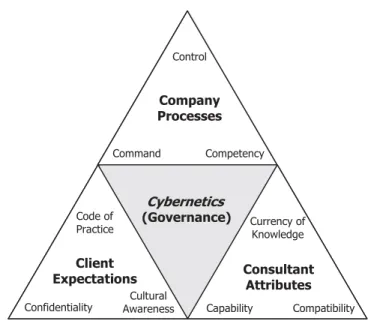
Code of Practice Command Capability Cultural Awareness Currency of Knowledge Competency Compatibility Control Cybernetics (Governance) Confidentiality Consultant Attributes Client Expectations Company Processes Code of Practice Command Capability Cultural Awareness Currency of Knowledge Competency Compatibility Control Cybernetics (Governance) Confidentiality Consultant Attributes Client Expectations Company Processes
Figure 1.5 The trilateral “C” model of consultancy governance.
the action of developing and managing consistent, cohe-sive policies, processes and the provision of decision rights for a given area of responsibility. In a practical sense for consulting businesses this can be achieved through address-ing the followaddress-ing trilateral issues shown in the author’s model of Figure 1.5 and discussed below. This model can be used to provide a robust framework to address the topic of governance for a consultancy practice.
In looking at organizational governance are the Company processes, the model shows three inter -related management functions, these being:
• Command: This should address how the consul-tancy activities are effectively managed through a systematic and clear delegated authority process and adherence to company consultancy processes. This element will have to consider and include delegation of the authority to develop, review and amend such processes.
• Control: This should describe how the consultancy business and projects are audited to ensure adherence to relevant processes.
• Compatibility: This will need to describe how the match between individual consultants to the client is assessed in terms of their technical/business skills and relevant experience to undertake the client ’s works. Next to be considered are the Consultant ’s attributes which are comprised of a further three inter -related factors which may contribute to the organization ’s governance from a peer group or self -assessed input: • Capability: This should describe how the company
supports the consultancy skills and experience and how they are maintained and further developed. • Competency: This describes the maturity of an
environ-ment, legislation requirements, business practices and so on.
• Currency of knowledge: This should explain the onus on the consultancy practice to ensure that their consultant ’s knowledge is kept up to date and linked to cutting -edge developments in their domain fi eld.
The final set of three factors represents the Client’s expectations which may also be considered to contrib-ute to the formal governance of the consultancy organi-zation; these are shown in the model as being:
• Cultural awareness: This should cover how the individual consultant is matched to the client in terms of understanding and empathy of political, religious, historical and social infl uences.
• Code of practice: This covers how the individual consultants required behaviour traits are articulated and embraced and are evident to the client.
• Confi dentiality: This should describe how the con-sultancy practice and individual consultant deals with client confidentiality, data protection and intellectual property rights (IPR).
con-sultants would operate in line with a code of conduct. Indeed, such a code of practice is often regarded as the basis of ethical behaviour and responsibility and naturally leads to the discussion on ethics in consultancy.
E T H I C S A N D C O N S U L T A N C Y
In recent years the perceived lack of individual ethical behaviour has received increasing publicity and scrutiny in the media. The public response has been an increased level of expectations of higher standards from public serv-ants, elected representatives and professional advisors. Whilst the philosophical subject of “ethics” as a whole covers a range of subtopics one of these is business ethics which examines rules and principles within a commercial context, the various moral or ethical problems that can arise in a business setting, and any special duties or obli-gations that apply to persons who are engaged in commerce.
believe that they are professional enough not to be given the company ’s rules on how to behave especially where there is a lack of respect for the senior leadership team.
In focusing on the consultancy profession, many con-sultants will undertake their work through adherence to their consultancy practice ’s quality and professional proc-esses in terms of a providing a traceable audit route with verification of their methodology used, conclusions drawn and recommendations or actions proposed to the client; however, the ethical aspect is often less overtly regulated, relying almost exclusively on an individual ’s personal modus operandi. Perhaps because consultants often have access to information and knowledge from a range of client organizations the way that they treat such privileged information needs to be managed from a confi dential and ethical standpoint as breaking such trust will naturally result in detrimental and potential legal consequences for both the individual client and the wider consultancy practice. This relationship with the client suggests the need to conduct consultancy business against key criteria such as accountability, honesty, integrity, openness and respect. Putting these professional requirements into prac-tice is widely undertaken and is “second nature ” to many of those who have gained a level of consultancy experi-ence; for newcomers to the profession these attributes often need to be checked by peer review and mentoring as part of their professional development plans.
mem-bership and on examination they largely share a similar theme of encouraging the consultant to act professionally, in good faith and to the highest standards for the work objectives. In addition, there are two further topics within this subject, namely transparency and vulnerability; trans-parency covers the degree to which there is openness in the situation, such as how much knowledge or informa-tion has been made available to the client. If there is not a full and complete level of openness, the reason for such lack of transparency will need to be carefully examined by the consultant. The second term of “vulnerability” refers to the level to which each of the client ’s interests may be at risk as a result of the proposed consultancy action (or indeed inaction). Clearly, both of these need to be properly managed and for this reason consultants should carry an appropriate level of professional indem-nity insurance.
practice advice to their members covering the above in addition to advisory notes on client education, compe-tence, confidentiality and intellectual property rights (IPR) including programme and software considerations. In looking wider at consultancy assignments in a business context, the Institute of Business Ethics proposed that any resulting business decision should follow a simple three stage test:
• First, in questioning the perception of transparency and openness, does the client organization mind others knowing what it has decided?
• Second, what is the effect of the decision and who does the decision affect or hurt?
• Third, is the topic of fairness by questioning if the decision will be considered fair by those affected? Finally, whilst every consultancy organization is free to develop its own corporate code of professional practice those with overseas business contracts may benefi t from the lessons cited by the International Business Ethics Institute (IBEI) on mistakes that organizations make in developing a single global ethics programme. The IBEI suggests that these mistakes include:
• Not integrating international personnel into the development process.
• Discounting the importance of promoting the program as a competitive advantage.
• Appointing headquarters staff or expatriates to fi ll ethics positions.
• Offering training materials only in their home language.
• Using the word “ethics” extensively in program materials.
• Focusing on the few cultural differences rather than acknowledging the many cultural similarities.
Source: International Business Ethics Institute
DEVELOPING
MANAGEMENT
CONSULTANCY
I N T R O D U C T I O N
relationship and the process leading to the award of a contract.
I N D I V I D U A L D E V E L O P M E N T
• Competencies – How they go about their work. • Attitude – How they prepare for work.
• Skills – What they can do. • Knowledge – What they know.
• Differentiation – What unique benefits they bring. Over the last decade there has been a proliferation of smaller consulting organizations and it is these smaller organizations – down to self -employed, one -man consul-tancy businesses and internal consulconsul-tancy groups – who are often unable to commit time and funds to such devel-opment and usually rely more on their experience than any formal learning and development. However, the pro-ficiency of the above four areas will contribute to the professionalism of management consulting and are appli-cable to a number of activities required for consultancy delivery such as communications, teamworking, innova-tion, facilitation and problem solving to name but a few. In looking wider at the requirement for professionalism within consulting it is proposed that the following eight features are necessary:
• Competency, attitude, skills and knowledge (as shown above).
• A commitment to be cognisant of advances in the profession and their domain knowledge area in order to provide a currency of information and best prac-tice knowledge.
• Professional approach with adherence to ethics and standards.
• Self-discipline and self -control. • Trust and confi dentiality. • Impartiality and objectivity.
• Flexibility, quality and “value for money ”.
It is suggested then that the development of compe-tencies, attitudes, skills and knowledge is linked into the individual’s performance as shown in Figure 2.1, itself part of a performance management system, described in more detail in the sister publication Essential Tools for Organizational Performance.
Career Planning
Performance
Training Recruitment
Promotion
Succession Planning
Development – Individual and Team
Retirement
Competencies
Redeployment Reward and Performance
Resignation Recognition Management
Figure 2.1 The cycle of recruitment, training and career man-agement as part of a performance manman-agement system.
Whilst this figure suggests a close working relation-ship between HR and functional managers as part of a cyclical business process, investment in the training and development aspects of the model should be undertaken as part of a wider programme of management consul-tancy competency with objectives around the four areas of competencies, skills, attitude and knowledge.
Achieving Sustainable Results Applying Expertise and Knowledge Building and Sustaining Relationships
Client Focus
Building Understanding and External Awareness Technical Discipline Examples Sector Specialism Examples Finance IT Strategy Production HR Marketing Public Financial Internal Not for Profit
Telecomms Life Sciences Market Capability and Knowledge Consulting Competence
Professionalism and Ethics Complexity and Responsibility Personal Growth Analytical & Proactive Thinking Interpersonal interaction Delivery Effectiveness Professional Behaviours
Figure 2.2 Management Consultancy Competence Framework. Reproduced with kind permission of the Institute of Business Consulting.
Management Consultancy. The model shown in Figure 2.2 is taken from the 2002 document on the Competence Framework and although is the same in format, logic and requirements, this model is not illustrated in the latest version of the Framework document.
be recognized that both the smaller consultancy and indeed internal consultancy groups are not as wedded to a set tool or methodology and as such may offer a broader range of solutions than just those in large practice vogue or which are more convenient for the consultancy provider.
If consultancy is a new activity for an organization then training and other development activities should be regarded as being very important. Even with the most qualified, experienced and professional consultants, organizations still need to attract new clients and retain their existing ones; as such marketing of the consultancy ’s up-to-date knowledge should be regarded as part of their marketing message and a key facet of their intellectual capital asset and talent management strategy.
M A R K E T I N G C O N S U L T A N C Y
An ideal starting point is to understand the consultant team’s offering and how this may be matched to market needs. As such, agreeing a consultancy practice vision and mission statement is a useful exercise as this can focus the team into developing a mutually agreed marketing plan. However, it has to be said that this is not absolutely necessary as it is possible just to make it up as you go along, although such an unplanned approach makes mon-itoring progress difficult in the absence of a “route map ” for comparison.
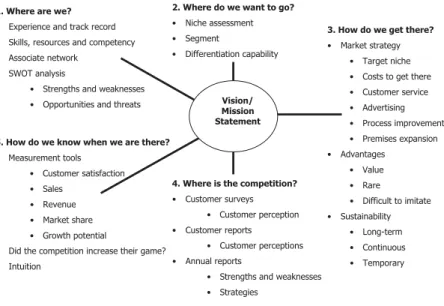
In planning to market a consultancy offering, the skills, knowledge and experience, i.e. the competencies of the staff, need to be articulated to show what type of work the consultancy will do and perhaps what it might do in the future. Figure 2.3 shows how having a shared vision may be used to expand the development of the consultancy services by prompting consideration of markets, resources, competencies, competitors and so on. It can then be used to set short -term and medium -term objectives for converting the goals into reality by assign-ing actions. These should be detailed in its marketassign-ing plan.
1. Where are we? 2. Where do we want to go?
• Experience and track record • Niche assessment 3. How do we get there?
• Skills, resources and competency • Segment • Market strategy
• Associate network
Vision/ Mission Statement • Differentiation capability
• Target niche
• SWOT analysis • Costs to get there
• Strengths and weaknesses • Customer service
• Opportunities and threats • Advertising
• Process improvement • Premises expansion 5. How do we know when we are there?
• Advantages • Measurement tools
• Value • Customer satisfaction
4. Where is the competition? • Rare • Sales
• Customer surveys • Difficult to imitate
• Revenue
• Market share • Customer perception • Sustainability
• Growth potential • Customer reports • Long-term
• Continuous • Did the competition increase their game? • Customer perceptions
• Intuition • Annual reports • Temporary
• Strengths and weaknesses • Strategies
Figure 2.3 Consultancy marketing considerations.
direct mail, brochure, poster campaigns and so on. The prime objective is to connect with the potential client in a way that a meeting to discuss the client ’s issue and the consultancy’s offering becomes a natural and easily arranged event. Connor and Davidson (1997) propose that there are six client -centred marketing activities that when incorporated into a marketing plan will provide a competitive advantage, these are:
• Selecting a targeted industry -market niche for special attention.
• Building a favourable awareness and earning an insid-er’s reputation with targeted members of the niche. • Preparing, positioning, promoting and providing
added value solution to their needs.
• Building strong, value -based relationships with all who are or can be influential to your marketing goals.
• Leveraging your knowledge, skills, experience and resources.
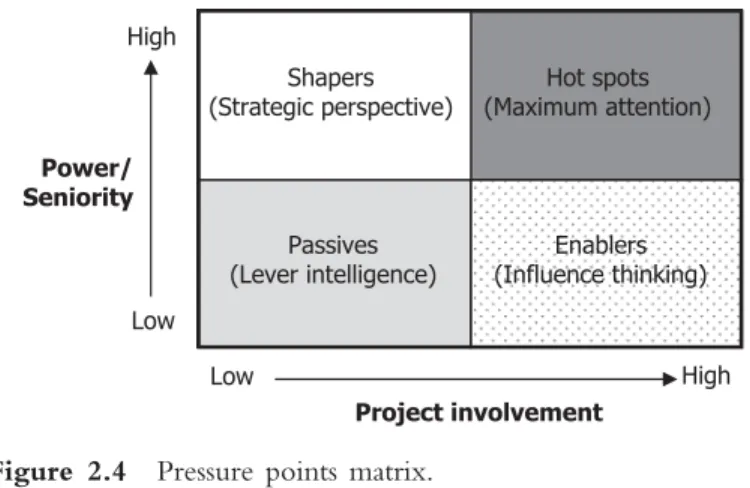
In support of the above methodology to target poten-tial selected clients, rather than adopting an untargeted mailing approach, Leach and Moon in their book Pitch Perfect offer the following matrix model (shown as Figure 2.4) which may be used to plan how best to approach the identifi ed clients.
High
Shapers (Strategic perspective)
Hot spots (Maximum attention)
Passives (Lever intelligence)
Enablers (Influence thinking)
Power/ Seniority
Low
Low High
Project involvement
Figure 2.4 Pressure points matrix.
From the model in Figure 2.4 the position of the individuals in the target client organizations may be mapped on the matrix to determine how they may be approached. This is detailed below:
• Hot spots are individuals that hold budget respon-sibility and should be of prime importance to business developers as they often carry the maximum weight in the decision -making process. Personal credibility is at stake with these “hot spots ” and as such the consultant will only have one chance to impress them. • Shapers are often the most senior individuals within an organization concerned with strategy and direc-tion. These would typically be individuals whose day-to-day role would not involve them in a project as they tend to take a more strategic perspective on purchasing decisions and would ensure that the deci-sion is in the interests of the overall strategy, policy and direction of the business.
• Enablers are project individuals who have a day -to-day high degree of involvement with projects and are often part of the decision -making team.
The importance of the matrix is its use for plotting current contacts in both existing and potential clients, these can be colour coded (red, amber and green, for example) to show the strength of the relationship which can indicate strengths and weaknesses and where to direct attention in developing the consultancy relationship further.
Tool 5 in Chapter 5 covers the elements of market-ing in the match between the seller ’s approach to price, place, product and promotion and the market ’s reaction in terms of matching customer, cost convenience and communication. Whilst this tool may be useful to con-sultants in undertaking work for a client it can of course also be used when considering the marketing of the con-sultant’s professional services. Additional marketing models are provided in the sister book Essential Tools for Operations Management.
D E V E L O P I N G C O N S U L T A N C Y T H R O U G H N E T W O R K I N G
which people make or are helped to make professional contacts with each other and how to make the most of such relationships.
Considering how much time is actually available to individuals to “network”, to meet new people and explore common interests, etc. when faced with other demands upon available time, then the selection of where, when and how often to network should be regarded as a serious decision. On the basis of available time it is then possible to select which networking groups or events to target and attend; these can cover any one of the three types of professional networking groups which offer dif-ferent benefi ts:
• Some groups provide opportunities to interact with prospective employers and clients, e.g. “business link ” breakfast meetings where smaller businesses are encouraged to share experiences and ideas to improve in-house knowledge.
• Some groups enable their members to keep abreast of the latest developments, such as technical products or managerial processes. These are typical of many professional institutes ’ local branch meetings and special interest groups such as the Chartered Management Institute ’s Women in Management, Police and Care Management groups.
a successful transition, an example of this is alumni associations.
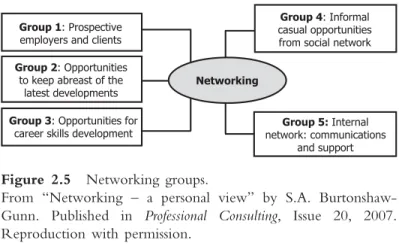
In addition to these professional networking groups is the use of a more informal casual network such as family and friends, local school PTAs and friends of arts or charity groups as shown as Group 4 in Figure 2.5.
Having identified outward facing external network-ing it should be noted that there are also internal networks typically formed through proximity and organi-zational structure rather than by invitation. The purpose of the Group 5 internal networks of Figure 2.5 should be to allow an individual to develop their potential and for them in turn to contribute to the development of others through knowledge sharing. This internal network can also be used to share information about each other ’s
Group 1: Prospective employers and clients
Group 2: Opportunities to keep abreast of the
latest developments
Group 3: Opportunities for career skills development
Group 4: Informal casual opportunities from social network
Group 5: Internal network: communications
and support
Networking
Figure 2.5 Networking groups.
skills and experience rather than just using the knowledge for which an individual was engaged.
in support of the six degrees of separation concept – an example of quality rather than quantity perhaps. However, the strength of networking is only fully realized where an individual is known and trusted by the group and, also importantly, where members feel comfortable to make the next connection with another known network with which they have a trusted relationship. Without the attribute of developed trust and acceptance the relation-ship with another network is likely to fail as the linkage will be immature and possibly regarded as superfi cial by its network members. On this basis there is a clear message for consultancy marketing: whether from mem-bership of a professional body or in sharing a common leisure interest, occasional ad -hoc attendance should not be considered as “networking” as it is little more that a preliminary meeting with pleasant, yet reserved, conversation.
a way to initiate an introduction of themselves to others. The well -known cultural/national distinctions are very obvious in this setting with Kate Fox (2004) observing in her fieldwork research the traditional British reserve which inhibits introductions and a preference for small talk around the weather and local traffi c congestion rather than any discussion on business or professional practice topics. This is not to suggest that this is wrong and that networkers should spend the occasion jumping from one conversation to another with a haphazard distribution of their business cards to everyone and asking to let them know of any work offers. For even the most confi dent of people, this approach is usually inappropriate and should be avoided to save gaining a reputation as being too pushy – or even desperate! Instead, good networkers use the meeting as an opportunity to develop a relation-ship and then suggest a business meeting for a later date.
For networking to provide a real value it needs to be carefully managed and continually rationalized other-wise individuals run the risk of hoarding a myriad of contacts which are never interactive and can even breed complacency over the need to attend networking events. Furthermore, without such self -imposed management it is possible to develop a false sense of security about per-sonal worth in the marketplace which may also prove to be detrimental to other organizations ’ and individuals ’ perceptions of you.
latter stages is not adding value then it should be tactfully brought to a close. From a professional work perspective, networking should be considered to be valuable and an essential exercise in both organizational and personal branding; where such brand management and visibility may help to raise your industry profile, credibility and consequently “brand value ” – all of which are important characteristics in the management consulting profession.
For some consultants, a professional network is one of their most valuable assets with networking meetings regarded as one of the best ways to continually keep up to date on industrial, commercial and professional devel-opments and to revitalize and grow future business con-tacts. Whilst many advocate a highly structured approach to networking through contact mapping and customer relationship management frameworks, it is easy to forget to seize those unscripted opportunities which sometimes present themselves as they may prove serendipitous from a future development perspective. Returning to an earlier point, it is the “quality, not quantity ” of the networking that in the vast majority of cases produces the best results.
forgetting all about it until the next time the two parties meet is unlikely to progress the relationship or any busi-ness opportunity. This leads to the initial exploratory stage and the development of the consultant –client rela-tionship discussed below.
C O N S U L T A N C Y S E L E C T I O N P R O C E S S
When a client wishes to engage the services of a consult-ant there are a number of indicators even at this early stage which may be used in the selection process; based not on price but on the perceived value and relationship with the consultant that the work will involve. The importance of understanding the client ’s requirements at this early stage is crucial in order to eliminate the risk of failure which may arise from:
• An ill -defined client requirement,
• Poor communication of the problem to be addressed, • An inappropriate level of expectation, or
What
How Who
When Where Why
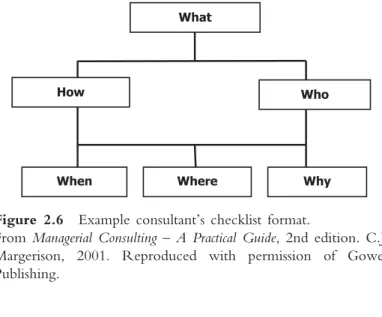
Figure 2.6 Example consultant ’s checklist format.
From Managerial Consulting – A Practical Guide, 2nd edition. C.J. Margerison, 2001. Reproduced with permission of Gower Publishing.
What
• What is the background to the request for a project? • What is the client ’s system?
• What are the objectives of the project?
• What does the client want from the consultant? • What information is sought?
• What criteria will be used to measure results? • What resources (staff, financial, materials) will the
client commit to the project?
• What support does the consultant need to carry out the project?
• What checks will be made on progress?
How
• How long will the project take?
• How will the consultant and the project team work? • How much time will the client commit to the
project?
• How will information be communicated? • How will confidentiality be maintained?
Who
• Who is the client?
When
• When will the project start and fi nish? • When will the checks on progress occur? Where
• Where will meetings be held? • Where will the consultant work? Why
• Why has the consultant been asked to assist?
Step 1: Prepare a long list of consultancy providers Step 2: Prepare a short list of consultancy providers
Step 3: Issue invitation to tender
Step 4: Undertake tender assessment and invite final short list to interview/presentation
Step 5: Attend presentation/”beauty Step 6: Award of contract and
commencement of work Step 7: Debrief unsuccessful companies
parade” and make final assessment
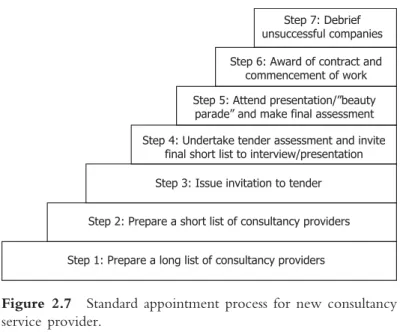
Figure 2.7 Standard appointment process for new consultancy service provider.
may be awarded without the same degree of formal tendering as reflected in the fast -track approach shown in Figure 2.8. Although this offers cost and time benefi ts for both parties it also demonstrates the importance of main-taining a good relationship between the client and con-sultant. Indeed, the established level of mutual trust can allow the assignment work to commence in the knowl-edge that the commercial formal contract will follow later, saving significant service acquisition and delivery.