Address for correspondence Dr. Asia Hafeez
Department of Dermatology Unit II, King Edward Medical University/ Mayo Hospital, Lahore.
Original Article
Comparison of the efficacy and safety of 40%
glycolic acid & 60% lactic acid chemical peel in
treatment of epidermal melasma
Introduction
Melasma is a disorder characterized by the development of light & dark brown macules, symmetrically distributed on sun exposed parts of the body.1 It most commonly involves upper lips, cheeks and forehead; predominantly females of Fitzpatrick skin IV & V those exposed to extremely high ultraviolet radiation.2
On the basis of Wood’s lamp examination melasma is classified into epidermal, dermal and mixed. Its etiology is multifactorial including oral contraceptives, pregnancy, racial, thyroid disease, sunlight exposure and genetic.1,3 There are three clinical patterns of melasma which are centrofacial, malar & mandibular.4
The melasma area and severity index (MASI) is the scoring system used to quantify the severity of melasma. Maximum score for MASI is 48 and minimum is 0.3
Topical treatment modalities for melasma Asia Hafeez, Shehla Shaukat, Madiha Sanai, Tahir Jamil Ahmad, Shahbaz Aman
Department of Dermatology Unit II, King Edward Medical University, Mayo Hospital, Lahore.
Abstract
Objective To compare the efficacy and safety of chemical peel with 40% glycolic acid and 60%lactic acid in the treatment of epidermal melasma.
Methods In this comparative interventional study, 112 patients of 18 to 40 years, suffering from epidermal melasma, not taking any treatment for melasma for last 4 weeks were included. Pre-treatment melasma area severity index (MASI) was calculated. 56 patients were treated with lactic acid peel and 56 with glycolic acid peel. Total of 6 sessions of each peel with 4 weeks interval were done and then monthly post treatment follow up for 2 months. During each visit MASI score was calculated. Photographs were taken at baseline and at follow-up visit. Percentage reduction of MASI was calculated at the end of therapy.
Results In Group A, treated with 40% glycolic acid chemical peeling, efficacy of treatment was seen in 38 (67.5%), while in Group B, treated with 60% lactic acid chemical peeling efficacy was seen in 45 (80.4%). This proved that efficacy was higher in Group B but was not significantly different (P value=0.13) so final MASI reduced significantly in both study groups. Side effects e.g burning, erythema, scarring, crusting, post peel hypo/hyper pigmentation were 52 (64.20%) in Group A and 29 (35.80%) in Group B.
Conclusion Both 40% Glycolic acid & 60% lactic acid chemical peeling agents are effective in treatment of epidermal melasma. 60% Lactic acid chemical peel is safer than 40% Glycolic acid chemical peel.
Key words
include sunscreens in combination with lightening agents e.g. hydroquinone. Other lightening agents include retinoic acid, azelaic acid, kojic acid and flavonoid extract and steroids.5
Glycolic acid is an alpha hydroxy acid that acts via epidermolysis as well as through the dispersal of basal layer melanin. It is available in 20%-70% concentration range. Glycolic acid peels are effective and safe to use in the treatment of melasma especially for skin type IV, V & VI.6 Glycolic acid is used as superficial as well as medium depth peel & not used in dermal melasma.7
Lactic acid is alpha hydroxyl acid. It is safe, effective, & a new therapeutic agent used for chemical peeling in melasma.8 Few studies find out the efficacy and safety of lactic acid in melasma and patients showed a significant response with no side effects.9
In our setup glycolic acid peeling for melasma is being done but sufficient evidence of lactic acid peeling is not available10. Aim of present study is to compare the efficacy and safety of these both treatments.
Methods
It was comparative interventional study. Total 112 patients all were females except two, having epidermal type of melasma, age more than 18 years, MASI score ranging from 6-15 and Fitzpatrick’s Skin type IV & V, presenting in outpatient department of Dermatology Unit II, Mayo Hospital Lahore from1st June 2014 to 30th November 2014 were enrolled for this study. Patients who were pregnant, lactating, had keloid tendency, having active dermatosis, taking retinoids or other drugs cause hypermelanosis were excluded from the study.
After approval from hospital ethic committee, written informed consent was taken, the patient’s biodata, detailed history and relevant examination findings were recorded on a specially designed proforma.Patients were assigned with clinical variant of melasma as centrofacial, mandibular or malar. Epidermal type of melasma was determined using Wood’s light.
Patients were randomly divided using lottery system into equal groups. Group A was treated with 40% glycolic acid chemical peel monthly for 6 months, while group B was treated with 60% lactic acid monthly for 6 months. Patient’s face was washed with soap and water, then thoroughly dried and degreased with acetone. Test peel with concerned agent was applied on a small area retro auricular for 5 minutes after which it was diluted with saline. Chemical agent was applied on hyperpigmented area and left for 5 minutes. If the patient felt irritation, burning or pain it was removed earlier. After 5 minutes the acid was diluted with normal saline.
Patients were advised to avoid sun exposure for at least two days after peeling and later use topical sunscreen. Patients were instructed not to
use any other topical therapy for melasma. Six sessions were carried out in each patient for
both groups. Time period between two visits was 1 month. Photographs of patients were taken before and after treatment and MASI score was calculated on each visit. Patients were inquired about side effects of treatment such as burning, erythema, scaring and crusting experienced during treatment and on follow up visits. Monthly Follow-up was done for 2 months after last session.
Results
compiled. All patients were female. Mean age of patients in Lactic acid group was 29.89 ± 6.01 years and in Glycolic acid group 29.32 ± 5.61 years.
In Lactic acid groups 67.86% patients were house wives, 10.71% were students and 21.43 were office workers while in Glycolic acid group there were 69.64% house wives, 12.50% were students and 17.86% were office workers.
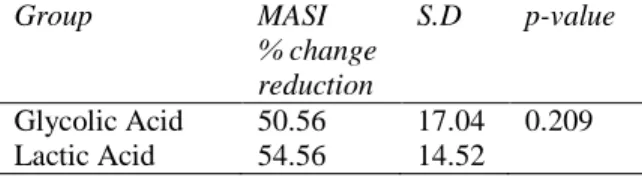
Fitzpatrick skin type IV was seen most frequent (40 in Lactic acid group and 40 in Glycolic acid group) type V skin was seen in 16 patients each group. In lactic acid group 42 patients had centrofacial and 14 had malar type of melasma, while in Glycolic acid group 37 patients had centrofacial and 19 patients had malar type of melasma. The mean value of the MASI score pre-treatment was more in Glycolic acid group i.e. 10.44±5.70 than in Lactic Acid group (i.e. 10.15±4.63). The mean MASI percentage reduction from baseline to 8 months in group A was 50.56±6.929 and in group B was 54.46±14.52 years, the mean MASI change% was decreased in both groups whereas it was comparatively more decreased in lactic acid, showed insignificant difference between both the treatment groups and MASI change% as p-value > 0.05.
On applying repeated measurement ANOVA test, MASI score was significantly reduced in both study groups with same percentage reduction, so both treatments were found to be equally effective in treatment of melasma
During 8 months of our study Lactic acid group showed 29 numbers of side effects (35.80%) and Glycolic acid showed 52 numbers of side effects (64.20%). Lactic acid had significantly fewer side effects as compared to Glycolic acid p-value 0.011.
Table 1 Comparison of MASI % age change in both study groups
Group MASI
% change reduction
S.D p-value
Glycolic Acid 50.56 17.04 0.209 Lactic Acid 54.56 14.52
Table 2 Distribution of patients by efficacy of treatment
Efficacy Glycolic Acid Group no(%)
Lactic Acid Group no (%) No response 2 (0.8) 1 (1.79)
Mild 4 (3.57) 3 (2.68)
Moderate 12 (10.71) 13 (11.61) Good 38 (33.93) 39 (34.82)
Figure 1 Total number of side effects Discussion
Chemical Peeling is an established treatment modality for melasma with variable success rates. Glycolic acid has been used successfully for treatment of melasma in our setup.
Lactic is a new chemical peeling agent that was proved effective and safe in treatment of melasma8,9 but no sufficient study is available in Pakistan & on skin type IV & V.
In our study mean age of patients was 29 years, that correlate with the study of Sharique KE et al9 in which mean age of patients is same (29 years). It also correlate with other study by Brar
SK et al11 in which mean age of pateints was 30
29, 36%
52, 64%
years. This is in accordance with the results of other studies; as well melasma is more common in females of reproductive age.3
In present study Fitzpiatrick skin type IV was seen in 80 patients and type V seen in 32 patients, these two skin types are more common in Asian population and melasma is most common in Fitzpatrick skin type III, IV and V, as shown by many other Asian studies.12
Majority of patients in our study presented with centrofacial patteren of melasma (n=79 i.e. 70%) and rest of patients were with malar pattern. Sharique KE et al8 also observed that centrofacial pattern was most common pattern. In a Pakistani study by Amir S et al12 65% patients were with centrofacial pattern of melasma, this figure is close to our study result. Some other studies also showed that centrofacial pattern of melasma is most commonly seen pattern.13
In present study mean percentage reduction in MASI score (from baseline to end of treatment) in Glycolic acid group was 50.56% and in Lactic acid group was 54.46%. Efficacy in terms of mean MASI % reduction was comparatively higher in Lactic acid group but there is insignificant difference between two groups p value >0.05.
Sharique KE et al8 used 92% Lactic acid peel (3 weekly) for treatment of melasma on 20 patients and exhibited marked improvement with 79% mean MASI score reduction. Singh R et al11
reported 64.3% reduction in mean MASI score with 82% lactic acid use.
Amir S et al12 reported 75% reduction in MASI score from baseline to end of treatment with Glycolic acid peels. Javaheri et al14 reported 47% reduction in mean MASI score with 50% glycolic acid. Brar S et al11 observed that
glycolic acid is not effective in treatment of melasma.
The difference in our results with these studies could be due to, use of different concentration of drug, sample size bias, use of concomitant treatment along with peel e.g. topical tretinoin and hydroquinone cream, different study tools and time to reach optimum clearance also different between subjects.
Regarding safety of both peeling agents, In Glycolic acid group, patients experienced following side effects: burning in maximum of 78% (n= 44) of patients, erythema in maximum of 66% (n= 37) of patients it was seen few minutes after peeling and resolve with in few hours. Crusting was seen in 7.14% (n=4) patients, post inflammatory hyperpigmentation was seen in 8.93% (n=5), it was also significantly higher as compared to Lactic acid group p value < 0.05. Only 1 patient experienced scarring that was not significant.
In Lactic acid group only two side effects were seen i.e. burning sensation in maximum of 35% (n=20) patients and erythema in maximum of 23% (n= 13) patients no other side effect was seen in Lactic acid group
Our results are comparable with Sharique KE et al8,9 who observed no side effect with lactic acid chemical peeling and Singh et al15 who reported that burning was only side effect seen with Lactic acid use. This minor disparity in our results may be due to small sample size was used in these studies.
Regarding Glycolic acid study by Amir S et al12
Our results are comparable with another study by Khunger et al16 in that erythema, superficial desquamation, burning and vesiculation were observed with use of Glycolic acid.
Kumari R et al7 also concluded by their study that Glycolic acid was not safe and well tolerated as burning, erythema, post peel crusting and pigmentation were commonly seen side effects in their patients.
According to our study Lactic acid had significantly few no of side effects i.e. 27 (35.80%) as compared to Glycolic acid that showed 52 ( 64.20%) no of side effects, p value 0.011.
We did not see any recurrence in our study in two months follow up period, improvement was maintained with significance but further studies are needed with longer period of follow up and large sample size
Conclusion
It is concluded that Chemical peeling with 60% Lactic acid treatment is as effective, safe and well tolerated and significantly reduces MASI scores offering rapid, gentle, and convenient treatment against epidermal melasma. Both 60 % lactic acid and 40% glycolic acid are equally effective but lactic acid peel was better tolerated than glycolic acid peel. It was also seen that lactic acid had significantly fewer adverse effects compared to glycolic acid
References
1. Sarkar R, Bansal S, Garg VK. Chemical peels for melasma in dark skinned patients. J Cutan and Asthet surg 2012; 5(4): 247-53.
2. Kodali S, Ian LG, Carrigan RC, Daulat S, Blanco G, Boker A et al. A prospective, randomized, split face, controlled trial of salicylic acid peels in treatment of melasma
in latin american women. J Am Acad Dermatol 2009; 63(6): 1030-5.
3. Ethawi AMD, Sidiq LM. Comparison of the effect of salicylic acid chemical peel combined with topical modified kligman formula and topical modified kligman formula alone in the treatment of melasma. The Iraqi Postgrad Med J 2011; 10(2): 191-7.
4. Puri N. Comparative study of 15% TCA peel versus 35% glycolic acid peel for the treatment of melasma. Indian Dermatol Online J 2012; 3(2): 109- 13.
5. Gulzar K, Mujtaba G, Hameed S. Comparison between efficacy of serial glycolic acid peel and triple combination creams vs. triple combination cream alone in treatment of melasma. J Pak Dermatol 2010; 20: 84-8.
6. Rossi A, Perez MI. Cosmetic concern in melasma part 2 treatment options and approaches. Cosmet Dermatol 2011; 24(12): 575-8.
7. Kumari R, Thappa DM. Comparative study of trichloroacetic acid versus glycolic acid chemical peels in the treatment of melasma. Indian J Dermatol Venereol Leprol 2010; 76(4): 447.
8. Mashhadani SA, Shariquie KE, Tikreety MM. Lactic acid Chemical Peels as a new therapeutic modality in melasma in comparison to Jessner’s solution chemical peels. Dermatol Surg 2006; 32(12): 1429-36.
9. Mashhadani SA, Al-Tikreety MM, Sharquie KE. Lactic acid as a new therapeutic peeling agent in melasma. Dermatol Surg 2005; 31(2): 149-54.
10. Shankar K, Godse K, Aurangabadkar S, Lahiri K, Mysore V, Ganjoo A et al. Evidence-based treatment for melasma: expert opinion and a review. Dermatology and therapy 2014; 4(2):165-86.
11. Brar KS, Sunil KG, Sanjeev U, Singh K. Comparative Efficacy of 35% Glycolic Acid and 20% Trichloroacetic Acid peels in the treatment of recalcitrant melasma. The Gulf Journal of Dermatology and Venereology 2015; 22(1): 15-20.
12. Amir.S, Nabi.H, Rashid.T, Haroon.T.S. Superficial chemical peel with glycolic acid in melasma: J Pak Dermatol 2005; 15(2): 130-5.
Textbook of Dermatology, 9th edn. UK: Wiley Blackwell Science Publication; 2016: 1-13.
14. Javaheri SM, Handa S, Kaur I, Kumar B. Safety and efficacy of glycolic acid facial peel in Indian women with melasma. Int J Dermatol 2001; 40(5): 354–7.
15. Singh R, Goyal S, Ahmed QR, Gupta N, Singh S. Effect of 82% Lactic Acid in
Treatment of Melasma. International Scholarly Research Notices 2014: 1-7. 16. Khunger N, Sarkar R, Jain RK. Tretinoin