Address for correspondence Dr. Lubna Khondker
Assistant Professor of Dermatology and Venereology,
Bangabandhu Sheikh Mujib Medical University, Dhaka, Bangladesh.
Email: [email protected]
Original Article
Comparative adverse effects of low-dose oral
prednisolone
and
oral
mini
pulse
dexamethasone in patients of vitiligo
Lubna Khondker*, Md Shirajul Islam Khan**
* Department of Dermatology and Venereology, Bangabandhu Sheikh Mujib Medical University (BSMMU), Dhaka
** Department of Dermatology, Combined Military Hospital (CMH), Dhaka, Bangladesh
Abstract Objective To compare the adverse effects of low-dose oral prednisolone and oral mini pulse dexamethasone in patients of vitiligo.
Methods A clinical trial was carried out from January 2013 to December 2013. Total sixty patients of vitiligo were enrolled and 30 of group A patients were treated with low dose oral prednisolone (0.3 mg/kg body weight) daily and 30 of group B patients were treated with oral dexamethasone pulse therapy (10 mg per week) for 16 weeks.
Results During 12 week follow-up, increased body weight, headache, dyspepsia and fatigue were more frequent in group A as compared to group B.Similarly, in group A other side effects noted were acne (33.3%), mooning of face (26.6%), striae (26.6%), hypertrichosis 13.2%, purpura (6.7%) and among the female patients, menstrual abnormality (71.4%) whereas in group B, no patient developed these problems from baseline to follow-up period (p<0.05).
Conclusion Low dose oral prednisolone was found to be associated with more adverse effects than oral dexamethasone pulse therapy in treating vitiligo.
Key words
Adverse effects of oral corticosteroids, adverse effects of mini pulse dexamethasone, vitiligo.
Introduction
Vitiligo is a common, acquired, discoloration of the skin, characterized by well-circumscribed, ivory or chalky white macules which are flushed to the skin surface.1 The cause is unknown but
may involve genetic factors, autoimmunity, toxic metabolites and/or a higher vulnerability of melanocytes.2-4 Abnormalities in both humoral
and cell-mediated immunity have been
documented in vitiligo patients and they present a basis for using steroids in the treatment of vitiligo.5 There are numerous treatment options
available for vitiligo, but none is universally effective. All approaches have advantage and disadvantages; and none is appropriate for every patient with vitiligo.6
corticosteroid low-dose treatment may be associated with less severe and fewer side effects than usual-dose treatment. Some studies showed that low-dose oral corticosteroids were effective without serious side effects in preventing the progression and inducing repigmentation of actively spreading vitiligo. Several data showed that oral dexamethasone pulse treatment was effective in arresting progression of vitiligo but observed no side effects. Oral corticosteroid, either low-dose or pulse, therapy has provided inconsistent results regarding the adverse effects in the treatment of patients with vitiligo in some studies. To minimize the adverse effects associated with corticosteroids in daily dose, the adverse effects of low-dose oral prednisolone and mini pulse dexamethasone therapy were assessed in vitiligo patients.
Methods
The study was carried out in the outpatient Department of Dermatology and Venereology, Bangabandhu Sheikh Mujib Medical University (BSMMU) and Combined Military Hospital (CMH), Dhaka. The duration of the study was from January 2013 to December 2013 and patients of vitiligo were the study population. Inclusion criteria were patients aged 18-55 years, of both sexes, suffering from vitiligo for more than six months, having focal, segmental and generalized type of vitiligo, either stable or progressive, who had not received any treatment for vitiligo (both systemic and topical) in the previous 2 months prior to inclusion, and who gave informed consent comply with the study procedure. Exclusion criteria were pregnant and lactating mothers, patients suffering from systemic illnesses like diabetes mellitus, hypertension, ischemic heart disease, thyroid disorder or any other systemic autoimmune disorder, known case of prednisolone and dexamethasone sensitivity and vitiligo
universalis and mucosal variety of vitiligo. By consecutive type of purposive sampling, 60 patients of vitiligo were enrolled and divided into group A and group B. Thirty group A patients were treated with oral prednisolone and 30 group B patients were treated with dexamethasone. The group A patients were given daily doses of oral prednisolone, 0.3 mg/kg body weight, initially for 2 months; the dosage was reduced to half of the initial dose for the third month and was halved again for the fourth month. The patients of group B were given 5 mg dexamethasone as a single oral dose after breakfast on 2 consecutive days per week (10 mg/week) for 16 weeks. Adverse effects were assessed during treatment and at each follow-up period.
Prior to the commencement of this study, the aims and objectives of the study along with its procedure, alternative methods, risks and benefits of this study were explained to the patients in easily understandable local language and then informed written consent were taken from each patient. It was assured that all information and records were kept confidential. The patients were explained that they had the right to refuse or accept to participate in the study and they would not receive any financial benefit from this study.
creatinine and electrolytes, plasma glucose fasting and 2 hours after breakfast, liver function tests and serum cortisol levels. All the patients were weighed before starting treatment. Wood’s lamp examination of lesions was done to confirm the clinical diagnosis. In the first and fourth week of therapy, plasma cortisol levels were determined in all patients.
The clinical response was evaluated at 4 weekly intervals for 12 weeks after completion of therapy and type and frequency of side effects were recorded at each visit. At the end of study, complete blood count, serum urea, serum creatinine and electrolytes, blood glucose fasting and 2 hours after breakfast and liver function tests were performed in all patients.
Data analysis was performed by Statistical Package for Social Science (SPSS), version-12. Level of significance was measured by using appropriate procedures like chi square test (χ2) and t-test, where applicable. p value was set at 0.05 and confidence interval at 95%.
Results
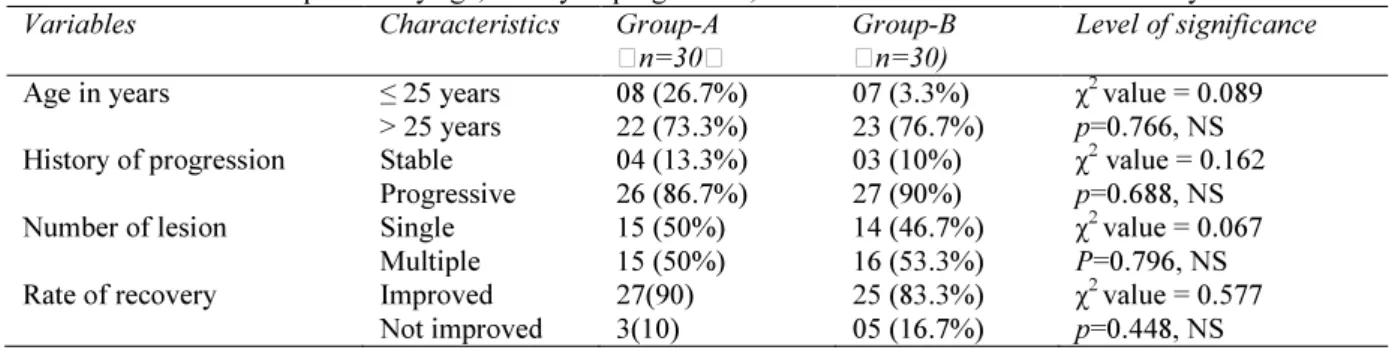
The two groups were well matched in terms of pretreatment clinical characteristics and response to treatment (Table 1). Majority of
patients in both groups were >25 year old i.e. 73.3% and 76.7%, respectively, χ2 value=0.089.
df=1, p=0.766 (p> 0.05). Disease was stable in the vast majority, 86.7% in group A and 90% in group B had stable disease, χ2 value=0.089. df=1, p=0.766 (p> 0.05). About equal number of patients in both groups had single or multiple lesions, χ2 value = 0.067, df =1, p=0.796 (> 0.05). Regarding the recovery rate after treatment, 27 (90%) and 25 (83.3%) patients improved, respectively in group A and B, χ2 value= 0.577, df=1, p=0.448 (>0.05).
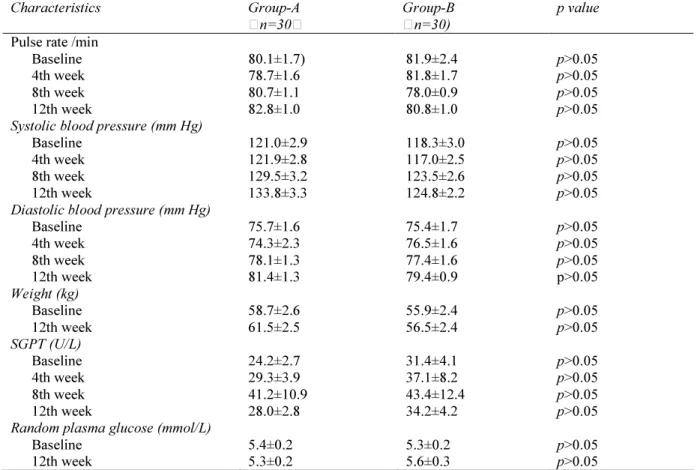
Table 2 compares mean pulse rate, systolic
blood pressure, diastolic blood pressure, weight, SGPT and random plasma glucose levels in the studied patients at baseline and during study period. Unpaired student’s t testrevealed that no statistically significant mean difference was found between group A and group B in terms of pulse rate, systolic blood pressure and diastolic blood pressure. Analysis revealed that body weight was significantly increased from baseline to 12th week follow-up, in group A from 55.9±2.4kg to 56.5±2.4kg and in group B from 58.7±2.6kg to 61.5±2.5kg. An increasing trend of SGPT rise was observed in both groups up to 8th week of treatment and then it decreased, (p>0.05). No statistically significant difference of mean random plasma glucose levels was found in different stages of study (p>0.05).
Table 1 Distribution of patients by age, history of progression, number of lesion and rate of recovery. Variables Characteristics Group-A
n=30
Group-B n=30)
Level of significance
Age in years ≤ 25 years
> 25 years
08 (26.7%) 22 (73.3%)
07 (3.3%) 23 (76.7%)
χ2 value = 0.089 p=0.766, NS History of progression Stable
Progressive
04 (13.3%) 26 (86.7%)
03 (10%) 27 (90%)
χ2 value = 0.162 p=0.688, NS Number of lesion Single
Multiple
15 (50%) 15 (50%)
14 (46.7%) 16 (53.3%)
χ2 value = 0.067 P=0.796, NS Rate of recovery Improved
Not improved
27(90) 3(10)
25 (83.3%) 05 (16.7%)
Table 2 Findings of pulse, blood pressure, weight, SGPT and random plasma glucose from baseline to 12th week.
Characteristics Group-A
n=30
Group-B n=30)
p value
Pulse rate /min Baseline 4th week 8th week 12th week
80.1±1.7) 78.7±1.6 80.7±1.1 82.8±1.0
81.9±2.4 81.8±1.7 78.0±0.9 80.8±1.0
p>0.05 p>0.05 p>0.05 p>0.05 Systolic blood pressure (mm Hg)
Baseline 4th week 8th week 12th week
121.0±2.9 121.9±2.8 129.5±3.2 133.8±3.3
118.3±3.0 117.0±2.5 123.5±2.6 124.8±2.2
p>0.05 p>0.05 p>0.05 p>0.05 Diastolic blood pressure (mm Hg)
Baseline 4th week 8th week 12th week
75.7±1.6 74.3±2.3 78.1±1.3 81.4±1.3
75.4±1.7 76.5±1.6 77.4±1.6 79.4±0.9
p>0.05 p>0.05 p>0.05 p>0.05 Weight (kg)
Baseline 12th week
58.7±2.6 61.5±2.5
55.9±2.4 56.5±2.4
p>0.05 p>0.05 SGPT (U/L)
Baseline 4th week 8th week 12th week
24.2±2.7 29.3±3.9 41.2±10.9 28.0±2.8
31.4±4.1 37.1±8.2 43.4±12.4 34.2±4.2
p>0.05 p>0.05 p>0.05 p>0.05 Random plasma glucose (mmol/L)
Baseline 12th week
5.4±0.2 5.3±0.2
5.3±0.2 5.6±0.3
p>0.05 p>0.05
Group A= Oral prednisolone, group B= Oral dexamethasone pulse therapy, p value reached from unpaired student’s t test.
Table 3 shows that complaints of diarrhea and
nausea appeared to be more or less similar in both groups of patients whereas headache, alopecia, dyspepsia and fatigue, were marginally more frequent in group A as compared to group B and the difference was not statistically significant (p>0.05) in two groups. Table 4
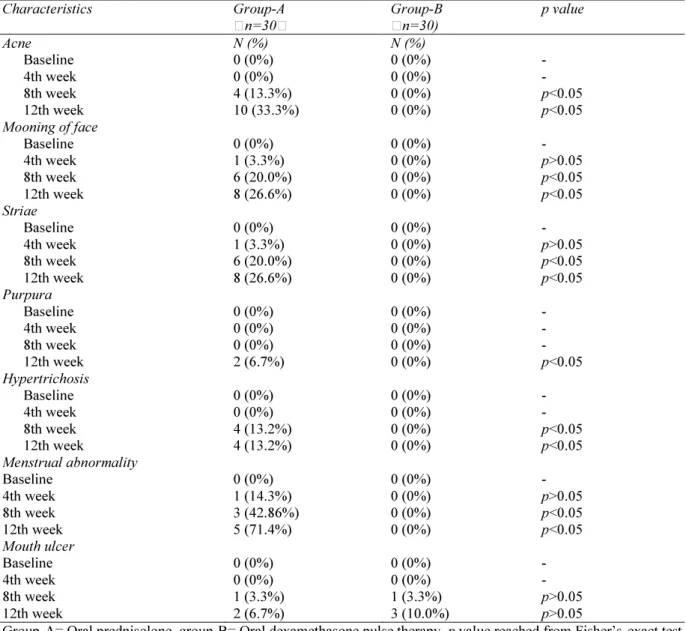
reveals that in group B, no patient developed acne, mooning of face, striae, purpura, hypertrichosis and menstrual abnormalities; but in the group A, acne (33.3%), mooning of face (26.6%), striae (26.6%), purpura (6.7%), hypertrichosis (13.2%) and menstrual abnormalities (71.4%) were observed (p<0.05). On the contrary, mouth ulcers developed in both groups of patients; however, no statistically significant difference was found between two groups of patients (p>0.05).
Discussion
The results of our study were similar to study findings of Habib et al.,8 Kim et al.9 and
Radakovic-Fijan et al10 Habib et al.8 conducted
Table 3 Comparison of diarrhea, nausea, dyspepsia, headache, alopecia and fatigue during follow-up period.
Characteristics Group A
n=30
Group B n=30)
p value
Diarrhea Baseline 4th week 8th week 12th week
0 (0%) 1 (3.3%) 0 (0%) 1 (3.3%)
0 (0%) 1 (3.3%) 1 (3.3%) 1 (3.3%)
- p>0.05 p>0.05 p>0.05 Nausea
Baseline 4th week 8th week 12th week
0 (0%) 7 (23.3%) 7 (23.3%) 7 (23.3%)
0 (0%) 5 (16.7%) 7 (23.3%) 7 (23.3%)
- p>0.05 p>0.05 p>0.05 Dyspepsia
Baseline 4th week 8th week 12th week
0 (0%) 12 (40.0%) 15 (50.0%) 15 (50.0%)
0 (0%) 4 (13.3%) 7 (23.3%) 11 (36.6%)
- p>0.05 p>0.05 p>0.05 Headache
Baseline 4th week 8th week 12th week
2 (6.7%) 5 (16.7%) 6 (20.0%) 7 (23.3%)
0 (0%) 3 (10.0%) 5 (16.7%) 6 (20.0%)
p<0.05 p>0.05 p>0.05 p>0.05 Alopecia
Baseline 4th week 8th week 12th week
0 (0%) 0 (0%) 0 (0%) 1 (3.3%)
1 (3.3%) 1 (3.3%) 3 (10.0%) 4 (13.3%)
p>0.05 p>0.05 p>0.05 p>0.05 Fatigue
Baseline 4th week 8th week 12th week
0 (0%) 7 (23.3%) 11 (36.6%) 11 (36.6%)
0 (0%) 5 (16.7%) 5 (16.7%) 8 (26.6%)
- p>0.05 p>0.05 p>0.05
Group-A= Oral prednisolone, Group-B= Oral Dexamethasone pulse therapy, p value reached from Fisher’s exact test.
an increasing number of dexamethasone pulses. They also showed that side effects were quite common with dexamethasone pulse therapy. Twenty-one (70%) patients reported one or more side effects such as epigastric burning or pain, bloating, weight gain, insomnia, acne and menstrual disorders. Plasma cortisol levels were markedly decreased 48 hours after the second dexamethasone pulse. However, dexamethasone-induced suppression of endogenous cortisol production was only transitory and plasma cortisol values returned to baseline levels before administration of the next corticosteroid pulse. They concluded that oral dexamethasone pulse therapy is an effective
treatment modality to arrest progressive vitiligo but treatment associated reversible side effects are frequent.8 Kim et al.9 evaluated 81 patients
Table 4 Comparison of adverse effects like acne, mooning face, striae, purpura, hypertrichosis, menstrual abnormality and mouth ulcers during treatment.
Characteristics Group-A
n=30 Group-B n=30) p value Acne Baseline 4th week 8th week 12th week N (%) 0 (0%) 0 (0%) 4 (13.3%) 10 (33.3%) N (%) 0 (0%) 0 (0%) 0 (0%) 0 (0%) - - p<0.05 p<0.05 Mooning of face
Baseline 4th week 8th week 12th week 0 (0%) 1 (3.3%) 6 (20.0%) 8 (26.6%) 0 (0%) 0 (0%) 0 (0%) 0 (0%) - p>0.05 p<0.05 p<0.05 Striae Baseline 4th week 8th week 12th week 0 (0%) 1 (3.3%) 6 (20.0%) 8 (26.6%) 0 (0%) 0 (0%) 0 (0%) 0 (0%) - p>0.05 p<0.05 p<0.05 Purpura Baseline 4th week 8th week 12th week 0 (0%) 0 (0%) 0 (0%) 2 (6.7%) 0 (0%) 0 (0%) 0 (0%) 0 (0%) - - - p<0.05 Hypertrichosis Baseline 4th week 8th week 12th week 0 (0%) 0 (0%) 4 (13.2%) 4 (13.2%) 0 (0%) 0 (0%) 0 (0%) 0 (0%) - - p<0.05 p<0.05 Menstrual abnormality Baseline 4th week 8th week 12th week 0 (0%) 1 (14.3%) 3 (42.86%) 5 (71.4%) 0 (0%) 0 (0%) 0 (0%) 0 (0%) - p>0.05 p<0.05 p<0.05 Mouth ulcer Baseline 4th week 8th week 12th week 0 (0%) 0 (0%) 1 (3.3%) 2 (6.7%) 0 (0%) 0 (0%) 1 (3.3%) 3 (10.0%) - - p>0.05 p>0.05
Group-A= Oral prednisolone, group-B= Oral dexamethasone pulse therapy, p value reached from Fisher’sexact test
Radakovic-Fijan et al.10 conducted a study to
evaluate the efficacy, safety, and tolerability of oral dexamethasone pulse therapy in a cohort of Austrian patients with vitiligo. Twenty-nine patients with vitiligo were included in the study and of these, 25 had progressive and 4 had stable disease. They were evaluated clinical response in monthly intervals. The patients were given weekly pulses of 10 mg dexamethasone each on 2 consecutive days followed by 5 days off treatment for a maximum period of 24 weeks. After a mean treatment period of 18.2+/-5.2
weight gain, insomnia, acne, agitation, menstrual disturbance, and hypertrichosis. Plasma cortisol and corticotropin values were markedly decreased 24 hours after the second dexamethasone dose, yet returned to baseline values within the off treatment period before the next dexamethasone pulse. They concluded that mild to moderate side effects are common with this treatment modality.10
Conclusion
We conclude that low-dose oral prednisolone was found to be associated with more adverse effects than oral dexamethasone pulse therapy in treating vitiligo. Further multicenter, randomized, double-blind study should be conducted with large sample size.
References
1. Yalçin B, Sahin S, Bükülmez G et al. Experience with calcipotriol as adjunctive treatment for vitiligo in patients who do not respond to PUVA alone: a preliminary study. J Am Acad Dermatol. 2001;44:634-7. 2. Westerhof W. Vitiligo management update.
Skin Therapy Lett. 2000;5:1-2,5
3. Bleehen SS. Disorders of skin color. In: Champion RH, Burton JL, Burn DA, Breathnach SM eds. Textbook of
Dermatology. London Blackwell Science
1998; 1753-1815.
4. Kovacs SO. Vitiligo. J Am Acad Dermatol. 1998;38:647-66.
5. Handa S, Pandhi R, Kaur I. Vitiligo: a retrospective comparative analysis of treatment modalities in 500 patients. J Dermatol. 2001;28:461-6.
6. Njoo MD, Westerhof W. Vitiligo. Pathogenesis and treatment. Am J Clin Dermatol. 2001;2:167-8S.
7. Imamura S, Tagami H. Treatment of vitiligo with oral corticosteroids. Dermatology. 1976;153:179-85.
8. Habib A, Sheikh ZI, Khan QUD, Rahman SB. Efficacy and safety of oral dexamethasone pulse treatment for vitiligo.
Pak Armed Forces Med J. 2006;2:1-6
9. Kim SM, Lee HS, Hann SK. The efficacy of low-dose oral corticosteroids in the treatment of vitiligo patients. Int J Dermatol. 1999;38:546-50.