A THEORITICAL FRAMEWORK OF PHASE-LOCKED LOOP AND ITS OPERATIONS IN ANALOG
COMMUNION
Madhavi Marripally1, Dr Suchi Jain2
Department of Electronics and Communication Engineering 1,2
OPJS University, Churu (Rajasthan)
ABSTRACT
The phase-locked loop (PLL) is the most critical procedure for era of multiplexing of message signals. It
permits the era of variable output frequency with a similar dependability of a precious stone oscillator
by methods for feedback. In this work mathematical description of the multiplier operation is presented,
and characteristic of the PD for various signal waveforms is presented. The characteristics of a PD
obtained in this work are in line with the well-known characteristics for the sinusoidal and square
waveforms. PLL models in the phase-frequency domain are justified using the averaging method by
Krylov-Bogolyubov. Numerical simulation confirms the adequacy of the derived models.
1. INTRODUCTION
Phase-locked loop (PLL) is a circuit invented by a
French engineer Anri de Bellescize in the 1930s.
One of the first applications of PLL was in the
wireless communication. In radio engineering,
PLL-based circuits (e.g., a PLL system with a
squarer and Costas loop) were and still are
widely used for demodulation, carrier recovery,
and frequency synthesis [1].
can be on a different chip or incorporated into
another chip. The PC as a synchronous
framework suggests that each repeated
(blended) clock has a known phase and
frequency relationship to its reference. This
makes the phase relationship (phase mistake)
an essential parameter in chip-to-chip
communication. Likewise since chips have an
2. THE PLL OVERVIEW
The PLL has been utilized over the previous
decades for extensive variety of uses in the
fields of correspondence, instrumentation,
control framework, mixed media and so forth. It
is thought to be a vigorous means for creating a
low clamor reference flag and recuperating the
clock motion from a loud source. Research work
has been preceded for headway of PLL design
and for its applications in modem
correspondence frameworks. It is watched that
the PLL is as of now settled by its hypothetical
work and handy applications. Be that as it may,
distinctive techniques are being utilized for
examining and further change of different
execution parameters. The investigation of PLL
requires information of many orders of
electronic building, for example,
Communication, Control System, Signals and
Noise, Analog and Radio recurrence (RF) circuit
outline and examination. The reenactment of
PLL is thought to be fundamental in perspective
of quick change in the field of Integrated
Circuit(IC) Technology. The availability of an
ease PLL in a solid IC opened up impressive new
fields of use that had beforehand been
restricted by cost and many-sided quality.
Reenactment helps in understanding both
direct and non-straight conduct of components
that include the PLL framework. The upside of
recreation is that the framework could be
effortlessly changed to fuse flag handling
segments to enhance the exhibitions. The
decision of recreation strategy relies upon the
speed and precision of the outcomes [3]. In like
manner, PLL reenactment might be founded on:
(a) mathematical arrangement,
(b) framework level arrangement and
(c) Circuit level arrangement.
3. THE PLL COMPONENTS
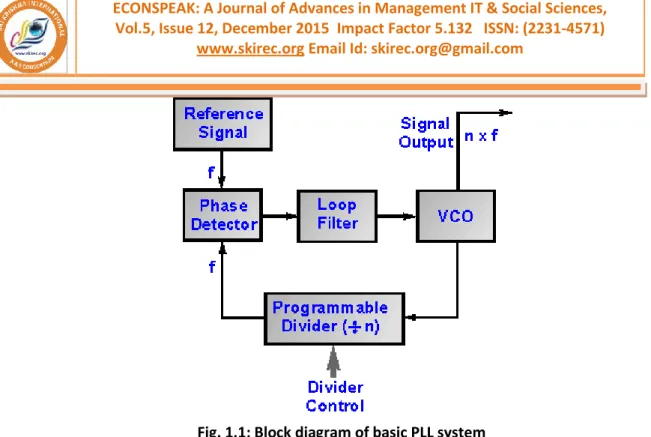
The basic PLL consists of a PD, an LF and a VCO
Fig. 1.1: Block diagram of basic PLL system
THE MULTIPLIER TYPE PD
A sinusoidal PD works as a multiplier. This kind
of PD naturally has stage recognition interim
from - 90° to 90°. On the off chance that the
two contributions to a perfect multiplier are
sinusoidal, at that point the multiplier plays out
a blending operation which is genuine simple
augmentation. The multiplier utilized as PD is an
imperative piece of PLL since it analyzes the
information reference and the VCO flags at the
same time. The augmentation of two
information signals makes a PLL appropriate for
much extraordinary reason application. The
multiplier sort PD can function admirably up to
sufficiency of the information and VCO signals,
as opposed to quantizing them to 1 bit. The
mistake processed by the multiplier is the
distinction between the momentary periods of
two info signals. The twofold recurrence
segment is separated by the activity of the LF,
has no centrality and the PD output shifts
sinusoidally with stage distinction. The circle
with this specific PD locks when there is a
quadrature stage distinction between the two
sources of info and the securing scope of the PD
is 180°. All things considered, this sort of PD is
only utilized as a part of stage bolt collector. In
The quantity of integrator decides the kind of
the framework according to traditional control
framework hypothesis. The VCO input-output
relationship is considered as a combination
procedure according to traditional hypothesis
of control framework. In this way, the PLL sort is
characterized as: Sort of PLL =Number of
integrators +1 [6].
THE APLL
In APLL, the PD is by and large a simple
multiplier and the VCO is an oscillator working
around tranquil recurrence. The LF is a simple
latent or dynamic sort. The LF is a simple
detached or dynamic sort. The APLLs have been
very much displayed by direct control
hypothesis. In APLL, the key swell recurrence of
the PD output is equivalent to the entirety of
reference input recurrence and the VCO output
recurrence. The APLL is considered as a
non-direct framework because of the nearness of
multiplier sort PD. Be that as it may, it can be
precisely demonstrated as a straight framework
when the stage contrast between the PD input
signals is small [7].
Fig.1.2: The VCO gain characteristics
THE DIGITAL PLL
The computerized PLL (DPLL) framework varies
from the APLL in that it produces an advanced
output flag. Both the reference and VCO output
signals are computerized. In the DPLL, the PD is
EX-OR door or stage recurrence identifier (PFD).
The VCO and the LF are of an indistinguishable
sort from utilized as a part of APLL. The DPLL is
in some cases named as APLL actualized with an
recurrence of the PD output is equivalent to the
reference input recurrence or the VCO output
recurrence. The PFD decides the stage contrast
between the two information signals. In the
event that the stage and recurrence of these
info signals are equivalent then the output of
the PFD will be zero, generally the output will
be some portrayal of the stage contrast in
either voltage frame [9].
5. THE OPERATION OF APLL
The PLL is named as a control framework which
utilizes criticism to keep up the period of the
output motion in synchronism with that of the
reference flag. The multiplier plays out a
blending operation between the info reference
and VCO output. This blending is genuine simple
augmentation. The output of the multiplier is a
component of flag amplitudes, frequencies and
period of the data sources. The stage blunder
between VCO output and the info reference is
evaluated by the multiplier utilized as PD. The
output of the PD is handled by the LF and the
outcomes are connected to the contribution of
the VCO. The output of the LF controls the stage
and recurrence of the VCO. At the point when
the reference input recurrence. On the off
chance that the reference and VCO frequencies
are not equivalent, the output of the LF will be
an expanding or diminishing voltage relying
upon which flag has the higher recurrence. This
adjustment in recurrence is followed by an
adjustment in the LF output [10].
Any synchronization framework utilizing the
stage secure guideline works two modes, viz.
(i) The procurement and
(ii) The following mode.
6. THE ACQUISITION PROCESS
The way toward bringing a circle into a bolt
state is known as the securing [7]. The circle
may procure the bolt state independent from
anyone else. Such a procedure is called
self-procurement. On the off chance that the locking
procedure is helped by the assistant circuits, at
that point the procedure is called supported
procurement. On the off chance that the
information reference recurrence is sufficiently
close to VCO output recurrence, at that point
the PLL bolts up with a stage transient and
there is no cycle slips preceding lock. The
stage secure. The securing of recurrence is mind
boggling and slower process. It requires more
consideration in its outline.
PLL SIMULATORS
A portion of the critical focuses in regards to PLL
recreation are
(a) nearness of two input ways,
(b) nearness of high recurrence motion with
bring down time constants, and
(c) Trouble in watching the elements of the
whole circle with small reproduction step.
PLL APPLICATIONS
The innovation and investigation of PLL have
seen touchy development in the course of the
most recent couple of decades and have
discovered across the board use in
correspondence and buyer electronic
frameworks. The wonder of stage bolting first
created significant enthusiasm with the coming
of the space program in the mid 1960s.
Significant advances in IC since this time have
cut down the cost and inconvenience of utilizing
PLL innovation. Notwithstanding its utilization
in military and space applications, PLLs are
broadly utilized as a part of modem flag
preparing and flag union [12]. A halfway
rundown of uses incorporates
(i) recurrence union,
(ii) beneficiaries for satellite and space
correspondence,
(iii) FM demodulators,
(iv) era of neighborhood oscillator frequencies in
Radio,
(v) TV,
(vi) FM tuners,
(vii) remote framework,
(viii) PCs and so on.
OFDM OVERVIEW
OFDM is a procedure which is a subset of
frequency division multiplexing in which a
solitary channel utilizes different sub-carriers on
neighboring frequencies. The sub-carriers of an
OFDM framework cover each other. Typically
the neighboring channels which cover may
impede each other. Since the sub-carriers in an
OFDM framework are precisely orthogonal to
each other, they are equipped for covering
without meddling. Therefore, OFDM systems
are equipped for boosting phantom efficiency
without causing neighboring channel
interference [13].
7. FAST FOURIER TRANSFORM ALGORITHM
The Fast Fourier Transform (FFT) is a basic
calculation in computerized signal processing. It
is utilized in different applications, for example,
radar, wireless communication, restorative
imaging, ghostly analysis and acoustics. Quick
Fourier Transforms have been executed on
various platforms, ranging from universally
chips. Late increases in microchip fabrication
costs have made it harder to deliver specially
crafts for applications. Implementation of
computerized signal processing algorithms, for
example, the FFT, on superior reconfigurable
systems is becoming increasingly alluring [14].
Memory references in Digital Signal Processors
(DSP) are costly because of their long latencies
and high power consumption.
Implementing FFT algorithms on DSP involves
numerous memory references to access
butterfly inputs and twiddle factors.
Conventional FFT implementations require
repetitive memory references to stack
indistinguishable twiddle factors for butterflies
from various stages in the FFT charts. To defeat
these impacts, memory reference reduction
technique is utilized to minimize the memory
references because of twiddle factors in FFT
implementations on DSP. The proposed
strategies initially gather the butterflies with
indistinguishable twiddle factors from various
phases of the FFT graph and figure them before
computing other butterflies with various
twiddle factors. Consequently, each twiddle
quantity of twiddle factor queries so that
considerably more butterflies can be processed
by loading one twiddle factor from memory
[15].
8. CONCLUSION
With the constant demand of high unearthly
efficiency and high transmission speed for
sound, video and internet application,
MIMO-OFDM has turned into the most promising
technology for wireless communication
systems. The power reduction and area
reduction in OFDM and MIMO-OFDM systems is
the most essential area of innovative work in
cellular mobile framework. Such systems have
their limitation on control dissipation and
computational complexity because of
interference and multipath fading.
MIMO communication framework has
increased phantom efficiency in a wireless
channel. It can give both rapid data
transmission and spatial diversity between any
transmit-get match. Alamouti's code is an
uncommon STBC for OFDM framework and
permits to accomplish or approach, channel
and/or the framework capacity by exploiting
spatial domain. As of late space-time coded
OFDM systems have been receiving far reaching
attention. A space-time-frequency coded OFDM
framework which accomplishes greatest
diversity is proposed. Space-time codes have
been intended for use with OFDM over
frequency selective fading channels and can
accomplish spatial diversity technique by using
multiple antennas at the transmitter and
receiver. The technique is promising, since it
doesn't increase the transmit control and the
signal bandwidth. This can be efficiently used
through STBC MIMO-OFDM systems. Be that as
it may, the above schemes require some side
information to be transmitted to the receiver
with high unwavering quality, which lessens the
ghastly efficiency.
REFERENCES
1. Hsieh, G.C. and Hung, J.C., “Phase-Locked
Loop Techniques-A Survey”, IEEE
Transactions on Industrial Electronics’, vol.
43, pp 609-615 No.6, December 1996,
2. Lai, M.F. and Nakano, M., “Special Section
on Phase-Locked Loop Techniques”, IEEE
Transactions on Industrial Electronics,
vol.43/6, December 1996
3. Goldman S., “Phase-locked loop,
engineering handbook for integrated
circuits”, Artech House, 2007
4. Siwiec, K., Borejko, T. and Pleskacz, W.,
“CAD Tool for PLL Design”,
978-1-4244-9756-0/11/$26.00 ©2011 IEEE
5. Li, W., Meiners, j., “Introduction to
phase-lock loop system modeling”.2005, Texas
Instruments
6. Margaris, N. “Theory of nonlinear behaviour
of the analog Phase-Locked Loop”, Springer,
2004
7. Stesnby, J. L., “Phase-Locked Loops: Theory
and Applications”, CRC Press, 1997
8. Gardner, F. M., “Phase lock Techniques”,
John Wiley &Sons, 1979.
9. Abramovitch, Daniel. , “Phase-Locked
Loops: A Control Centric Tutorial”, Agilent
Laboratories
10. Kroupa, V.F., “Phase Lock Loops and
Frequency Synthesis”, John Wiley Sons Ltd.,
2003
11. Smith, J., “Modem Communication
Circuits”, Tata McGraw-Hill Edition, 2003
12. Haque,N., Boruah,P.K. and Bezboruah,T.,
“Simulation of transient behaviour of
second order Phase-Locked Loops using
phase error process in time domain”,
Proceedings of International Conference on
System Dynamics and Control, Manipal
Institute Technology(MIT), Manipal,
13. Sonnaillon, M. O., Urteaga, R. and Bonetto,
F. J., “Software PLL Based on Random
Sampling”, IEEE Transactions on
Instrumentations and Measurement,vol.59,
No. 10, October 2010
14. Chou, Y., Chen, Y and Chang, F., “Loop Filter
Design for Phase-Locked Loops with
Guaranteed Lock-in Range”, Proceedings of
the 17th World Congress, The International
Federation of Automatic Control, Seoul,
Korea, July 6-11,2008
15. He R., Li, j., Rhee, W. and Wang, Z.,
“Transient analysis of nonlinear settling
behaviour in charge-pump phase-locked
loop design”, 978-1-4244-3