© 2017 Universidad Nacional Autónoma de México, Centro de Ciencias de la Atmósfera. This is an open access article under the CC BY-NC License (http://creativecommons.org/licenses/by-nc/4.0/).
Implementation of the Unified Post Processor (UPP) and the Model
Evaluation Tools (MET) for WRF-chem evaluation performance
Agustín GARCÍA-REYNOSO * and Marco A. MORA-RAMÍREZ
Centro de Ciencias de la Atmósfera, Universidad Nacional Autónoma de México, Circuito de la Investigación
Científica s/n, Ciudad Universitaria, 04510 Ciudad de México
*Corresponding author; email: [email protected]
Received: October 14, 2016; accepted: March 16, 2017
RESUMEN
Este trabajo se centra en la descripción detallada de varias modificaciones realizadas a las versiones más
recientes de los paquetes informáticos Unified Post Processor (UPP) y Model Evaluation Tools (MET), las
cuales son necesarias para incorporar especies químicas importantes y parámetros meteorológicos al proceso
de verificación. Los cambios realizados en ambos programas se ejemplifican con un episodio de altas
con-centraciones de ozono, comparando simulaciones del modelo Weather Research and Forecasting-chemistry
(WRF-chem) con datos observacionales de la Red Automática de Monitoreo Atmosférico correspondientes
a un fin de semana en la Zona Metropolitana de la Ciudad de México. El modelo WRF-chem se alimentó
con datos formateados del Inventario Nacional de Emisiones (2006). Se proporcionan ejemplos de resultados
y gráficas que contemplan la adición de nuevas especies químicas al proceso de verificación, con el objeto
de explicar el tipo de mediciones de verificación y gráficas que el MET podría aportar en la actualidad. Por
último, las modificaciones realizadas a diferentes archivos de los paquetes UPP y MET podrían ser de interés
en particular para los usuarios y desarrolladores del modelo WRF-chem preocupados por el pronóstico o la
investigación de episodios con mala calidad del aire urbano.
ABSTRACT
This study focuses on a detailed description of several modifications made in both the Unified Post-Processor
(UPP) and the Model Evaluation Tools (MET) release packages, which are necessary in order to incorporate
relevant chemical species and meteorological parameters into the verification process. The changes made
in UPP and MET are illustrated with a high ozone concentration episode, comparing the Weather Research
and Forecasting-chemistry (WRF-chem) simulations against observational data from the Red Automática
de Monitoreo Atmosférico (Automatic Atmospheric Monitoring Network) during a weekend in the Mexico
City Metropolitan Area. National Emission Inventory (2006) formatted data was supplied to the WRF-chem
model. Examples of statistical results and plots contemplating the new chemical species added to the
verifi-cation process are given, with the aim to illustrate the kind of verifiverifi-cation measurements and plots that MET
could provide now. Finally, The modifications made over different files in UPP and MET packages could be
of particular interest for users and developers of the WRF-chem model concerned about the forecast of the
analysis episodes related with poor urban air quality.
Keywords:
WRF-chem, evaluation, UPP, MET.
1. Introduction
Improving air quality in many large cities requires a
better understanding of the sources and
transforma-tion of pollutants in the atmosphere. The air quality
models constitute a major tool to carry out this task.
However, the process of verifying the model results
can be even more important.
The Weather Research Forecast (WRF) model was
developed at the National Center for Atmospheric
Research (NCAR). Grell et al. (2005) and Fast et al.
(2006) updates incorporated into the WRF the chemical
transformations, complex gas-phase chemistry,
photol-ysis, and aerosols, creating in this way the WRF-chem
model. In order to work with the WRF-chem model
outputs, there are several computing packages: NCL
(NCAR, 2015); GrADS (COLA, 2015); NetCDF
(UNIDATA, 2015); and the Unified Post-Processor
(UPP), developed at NOAA (DTC, 2015). All of them
are very useful to visualize and extract information.
Also, there are statistical tools that serve to evaluate
the performance of model simulations, in some cases
comparing the simulation results against observations.
Recently, the Model Evaluation Tools (MET)
(Gotway et al., 2014), a state-of-the-art suite of
ver-ification tools, was released by the Developmental
Testbed Center (DTC) (http://www.dtcenter.org/met/
users/index.php). It can perform a set of standard
veri-fication scores by comparing gridded model data with
point-base observations and with gridded observations,
among others. This kind of software provides useful
information to the model users in order to improve
the model performance by testing different model
configuration setups, to improve the forecast and the
decision making, and to identify forecast weakness
and strengths. MET reads the output from UPP. In
turn, the UPP code take in WRF output files (wrfout*)
in NetCDF format. The original configuration of
UPP can read several fields (eg, U, V, T, albedo) (see
Baldwin
et al
., 2012, chapter 7, table 2). However, as
far as we have seen, the chemical species oriented to
the study of air quality are not included in these fields.
Therefore, changes were made in the UPP source code
and the MET configuration file to add new fields for
air quality modeling evaluation.
In this document, a detailed description of
mod-ifications made in both UPP and MET is provided.
These changes must be included to incorporate
rele-vant chemical species (NO, NO
2, SO
2, CO, particulate
matter, O
3) and meteorological parameters into the
verification process. These modifications have been
tested in the UPPV3.1 (http://www.dtcenter.org/upp/
users/) and METv5.2 releases, under a Linux 86-64
cluster with the corresponding Fortran, C and C++
Intel compilers. A script is given in Appendix B that
allows controlling the desired flow through MET.
However, the process to perform the evaluation is
similar to the procedure described in the WRF-NMM
users page for UPP and MET.
A specific episode of high weekend ozone
con-centration to illustrate the verification process is
considered, where MET is used to verify agreement
between simulated species concentrations and data
form the Red Automática de Monitoreo
Atmosféri-co (Automatic Atmospheric Monitoring Network,
RAMA) in Mexico City. The episode corresponds to
the “ozone weekend effect” reported in Stephens
et al
.
(2008), which occurs when vehicular traffic emissions
decrease during the weekend; the amount of ozone
measured in the monitoring stations remains
approx-imately the same or higher that during the weekdays.
2. UPP modifications
Modifications are needed in order to incorporate new
chemical species in the post-processing data from
the WRF-chem model. It is essential to modify the
following files:
DEALLOCATE.f, INITPOST.F , MDLFLD.f,
ALLOCATE_ALL.f, RQSTLD.f , VRBLS3D_mod.f
and wrf cntrl.parm. Specific line codes for each file
are presented in Appendix A.
To place data in a standard grib format, run the
UPP tool unipost.exe provided script in UPP
(run_un-ipost). The WRF-Chem considers the ARW core
therefore the utility
copygb
was not used.
3. MET modifications
Example of variables that can be incorporated in
the input file for ascii2nc:
ADPSFC 76201 20130101_000000 19.635 -98.912 2240. 11 776. -9999. 1 284.150 ADPSFC 76201 20130101_000000 19.635 -98.912 2240. 33 776. -9999. 1 -0.618 ADPSFC 76201 20130101_000000 19.635 -98.912 2240. 34 776. -9999. 1 0.329 ADPSFC 76201 20130101_000000 19.635 -98.912 2240. 52 776. -9999. 1 58.000 ADPSFC 76201 20130101_000000 19.635 -98.912 2240. 180 776. -9999. 1 2000.000 ADPSFC 76201 20130101_000000 19.635 -98.912 2240. 148 776. -9999. 1 1500.000 ADPSFC 76201 20130101_000000 19.635 -98.912 2240. 232 776. -9999. 1 6000.000 ADPSFC 76201 20130101_000000 19.635 -98.912 2240. 141 776. -9999. 1 23000.000 ADPSFC 76201 20130101_000000 19.635 -98.912 2240. 142 776. -9999. 1 30000.000 ADPSFC 76201 20130101_000000 19.635 -98.912 2240. 156 776. -9999. 1 127.000 ADPSFC 76201 20130101_000000 19.635 -98.912 2240. 157 776. -9999. 1 -9999.000
The names particle matter (coarse) and particle
matter (fine) are used for PM
10and PM
2.5,
respec-tively. The chemical variables are set up in different
parameter table versions (ON388, 2013) as shown
in Table I. For the chemical variables CO, NO
2, NO
and SO
2the table version 141 has to be explicit. In
order to do the comparison between model and
ob-servations in the configuration file (PointStatConfig)
the following lines has to be modified. For
meteo-rological variables temperature, u wind, v wind and
relative humidity there is no need to set the grib table:
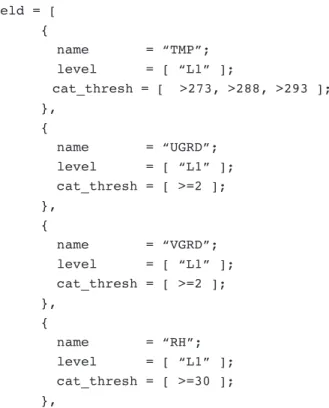
field = [ {
name = “TMP”; level = [ “L1” ];
cat_thresh = [ >273, >288, >293 ]; },
{
name = “UGRD”; level = [ “L1” ]; cat_thresh = [ >=2 ]; },
{
name = “VGRD”; level = [ “L1” ]; cat_thresh = [ >=2 ]; },
{
name = “RH”; level = [ “L1” ]; cat_thresh = [ >=30 ]; },
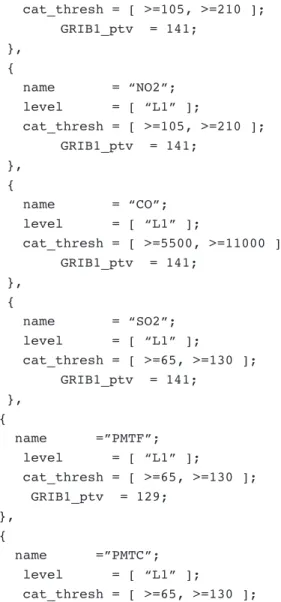
for chemical compounds and particles, O
3, NO, NO
2,
CO, SO
2, PMTC and PMTF :
{name = “OZCON”; level = [ “L1” ];
cat_thresh = [ >=50, >=110 ]; GRIB1_ptv = 129;
}, {
name = “NO”; level = [ “L1” ];
Table I. Chemical species description and grib table version and code
Version
Code Parameter
Units
Abbrev
129
156
Particulate matter (coarse)
mg m
–3PMTC
129
157
Particulate matter (fine)
mg m
–3PMTF
129
180
Ozone concentration
µl m
–3OZCON
141
141
Nitrogen oxide
µl m
–3NO
141
142
Nitrogen dioxide
µl m
–3NO
2
141
148
Carbon monoxide
µl m
–3CO
141
166
Formaldehyde
µl m
–3FORM
141
232
Sulfur dioxide
µl m
–3SO
2
cat_thresh = [ >=105, >=210 ]; GRIB1_ptv = 141;
}, {
name = “NO2”; level = [ “L1” ];
cat_thresh = [ >=105, >=210 ]; GRIB1_ptv = 141;
}, {
name = “CO”; level = [ “L1” ];
cat_thresh = [ >=5500, >=11000 ]; GRIB1_ptv = 141;
}, {
name = “SO2”; level = [ “L1” ];
cat_thresh = [ >=65, >=130 ]; GRIB1_ptv = 141;
}, {
name =”PMTF”; level = [ “L1” ];
cat_thresh = [ >=65, >=130 ]; GRIB1_ptv = 129;
}, {
name =”PMTC”; level = [ “L1” ];
cat_thresh = [ >=65, >=130 ];
GRIB1_ptv = 129; }
];
For a demonstrative purpose, gas pollutants
cate-gorical threshold values were set on the 1-h average
air quality standard (upper value) and half of the
standard (lower value).
4. Results
A high weekend ozone episode was considered to
show a comparison between model and observed data
by using MET and UPP modified codes. The episode
took place in Mexico City from 06:00 LT on April
13, 2007 through 03:00 LT on Apr 15, 2007. During
that period, measurements of criteria pollutants were
made by RAMA. Although it is possible to extract
the model formaldehyde concentrations during this
episode, this compound was not measured.
WRF-chem was configured to use the chemical
mechanism RADM2 as the chemical module
(Stock-well
et al
., 1990). The emissions inventory was
grid-ded based on the National Emission Inventory for the
Mexico City Metropolitan Area (MCMA) for the year
2006 (SMA, 2015). These emissions were updated
to fill in a 3-km spatial resolution and simulations
were carried out for a 40-h time period. Finally, the
observational data, required by MET, is provided by
the MCMA monitoring stations (RAMA). Figures 1
and 2 show examples where simulations are
com-pared against monitoring stations data.
0 1000 2000
12:00 00:00 12:00
0 20 40 60 80 100
O3 RAMA
Apr 13 15:00 h O3 ppbV
Apr 14 15:00 h
12:00 00:00 12:00
3000
O3 concentration in Cerro de la Estrella (CES) monitoring station CO concentrations in San Agustin (SAG) monitoring station
O3 WRF-Chem
CORAMA
Apr1315:00h COppm
Apr1415:00h O3 WRF-Chem
The Point-Stat tool computes several statistics
to evaluate the forecast performance in monitoring
stations. Figure 1 shows the simulated and observed
concentrations of O
3and CO in ground-base stations.
To the left, the ozone concentration in the Cerro
de la Estrella (CES) monitoring station is shown.
The simulations (continuous line with fill squares)
fit well with the observation data (filled circles) in
most of the time domains, except for the high ozone
concentration time interval, where the simulations
underestimate the ozone peak (Apr 14, 15:00 LT).
Conversely, illustrated on the right side of Figure 1,
the simulated CO concentrations at San Agustín
(SAG) monitoring station are well fitted in the high
measured ozone concentrations. The CO simulated
concentrations systematically underestimate the
measurements, but almost follow the same observed
data pattern, which could indicate that the emission
inventory should be modified in that case. Also it
is possible that MET computes the grid average of
fields; the Stat-Analysis tool provides verification
statistics for a matched forecast and observation grid.
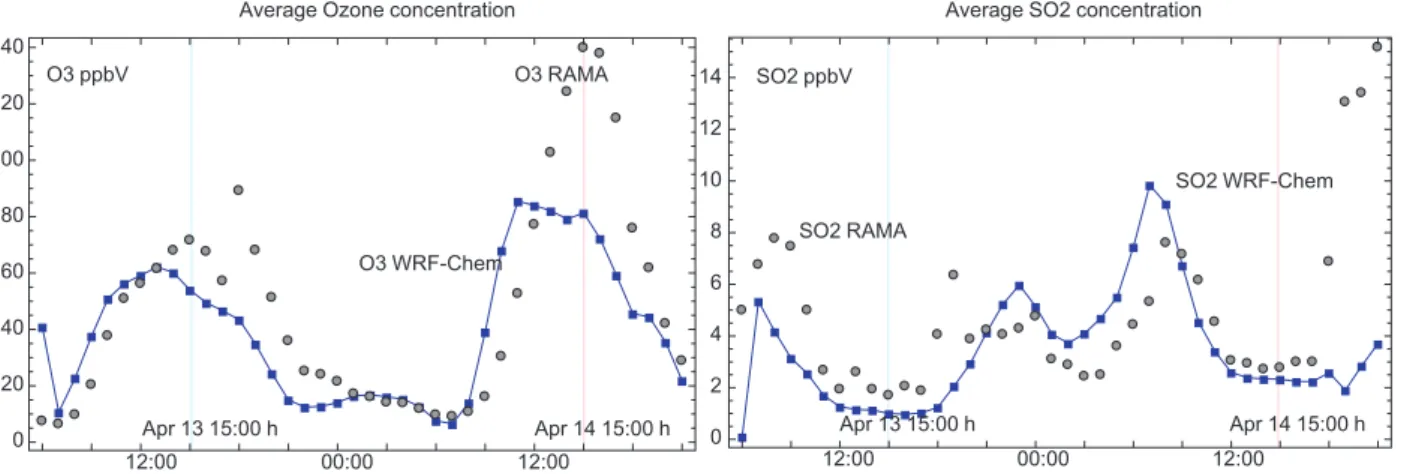
Figure 2 shows the point averages of the
observa-tions and simulaobserva-tions, the simulated variables
(con-tinuous line with fill squares) are compared against
the average of all RAMA stations (filled circle). On
the left in figure 2, the average ozone concentration
against RAMA data is shown. The maximum ozone
concentration occurred at 15:00h Apr 14 (Saturday)
and is pretty close to 140 μL m
-3(ppbv), this value
is bigger than the previous day maximum Apr 13
(Ozone weekend effect). The ozone numerical
simu-lation concentrations underestimate the second ozone
peak; the model concentration value is approximately
42% of the measured value. This pattern is presented
in other monitoring stations indicating that the model
underestimates the ozone concentration. In figure 2
(right panel) the average SO
2concentration for model
and observations is shown. This chemical species is
well reproduced by the model especially in the first
hours of the high concentration episode.
Ambient concentrations depend on the emissions
and weather conditions. In the studied episode,
primary pollutants (CO and SO
2) concentrations
have a better agreement with the measurements than
secondary pollutants (O
3). The O
3concentration
depends on primary pollutants like NO
2and
Vol-atile Organic Compounds (VOC), and the highest
ambient concentration is reached downwind from
its precursor emissions. Because CO and SO
2con-centrations from the model are in agreement with
measurements, and they are primary pollutants that
depend on local emissions, the high O
3concentra-tions on April 14 suggest that this pollutant was
transported from elsewhere.
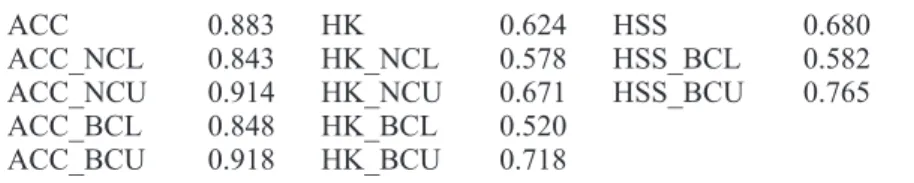
Additionally, Table II shows examples of several
verification measurements for SO
2,including the
normal and bootstrap lower and upper confidence
limits (NCL, BCL, NCU and BCU). In this case the
threshold concentration were 130 ppb in order to
compute the categorical statistics. The first
param-eter shown on this table correspond to the accuracy
Fig. 2. Simulated and observed averaged fields, from April 13, 2007 at 6:00 LT to April 14 at 03:00 LT, in Mexico
City. Continuous line represents the average field calculated with the WRF-chem model, and filled circles represent
the average measured field from RAMA in the MCMA.
Average Ozone concentration Average SO2 concentration
12:00 00:00 12:00
0 20 40 60 80 100 120 140
O3 RAMA
Apr 13 15:00 h O3 ppbV
Apr 14 15:00 h O3 WRF-Chem
0 2 4 6 8 10 12 14
12:00 00:00 12:00
SO2 RAMA
Apr 13 15:00 h SO2 ppbV
Table II. Statistical analysis results for SO
2evaluation. Accuracy (ACC),
Hansen-Kuipers Discriminant (HK) and Heidke Skill Score (HSS) for 662
total observations.
ACC
0.883
HK
0.624
HSS
0.680
ACC_NCL
0.843
HK_NCL
0.578
HSS_BCL
0.582
ACC_NCU
0.914
HK_NCU
0.671
HSS_BCU
0.765
ACC_BCL
0.848
HK_BCL
0.520
ACC_BCU
0.918
HK_BCU
0.718
(ACC) contingency parameter. In our simulation
ACC = 0.883, meaning the fraction of forecast that
was correct, ACC ranges from 0 to 1, perfect forecast
has an ACC value of 1.
The two other parameters are the
Hanssen-Kui-pers Discriminant (HK) and the Heidke Skill. Its
values range from –1 to 1. A perfect forecast has
HK = 1, and a value of 0 indicates no skill. HSS is
a skill score based on accuracy with values ranging
from −∞ to 1. A perfect forecast will have an HSS
= 1. For a more comprehensive description of these
and other verification measurements, see Appendix C,
Verification measures on the MET Users Guide v5.2.
5. Conclusions
The modifications made in the UPP code can provide
files that include pollutant concentration variables
(i.e., O
3, CO, SO
2, PM
10and PM
2.5, among others);
these files can be used by MET in order to evaluate
objectively the model performance with a set of
statistical parameters. A demonstration of the
func-tionality of the code modifications was presented
through its application in the case study, which
showed that CO and SO
2model concentrations
have a better agreement than O
3when compared
to measured values. In the case of O
3, the first day
presents a good agreement, but for the second day
its concentrations could indicate that it comes from
elsewhere.
These code additions can reduce the time for data
analysis and standardize the evaluation procedure
for chemical and meteorological variables by using
a state-of-the-art suite of verification tools.
Acknowledgment
The authors want to tanks Paul Oldenburg and
John Halley Gotway from Meted-UCAR for their
support.
References
Baldwin M., H.-Y. Chuang, L. Bernardet, D. Jovic, R.
Rozumalski, W. Ebisuzaki and L. Nance, 2012. User‘s
cuide for the NMM core of the Weather Research and
Forecast (WRF) modeling system version 3. Chapter
7. Post Processing Utilities. NCAR/MMM, 2012.
COLA, 2015. Grid Analysis and Display System (GrADS).
Available at: http://www.iges.org/grads/.
DTC, 2015. Developmental Testbed Center. Available at:
http://www.dtcenter.org (last accessed on June 10, 2017).
Fast J.D., W.I. Gustafson, R.C. Easter, R.A. Zaveri, J.C.
Barnard, E.G. Chapman, G.A. Grell and S.E. Peckham,
2006. Evolution of ozone, particulates, and aerosol
direct radiative forcing in the vicinity of Houston using
a fully coupled meteorology-chemistry-aerosol model.
J. Geophys. Res.-Atmos. 111.
DOI: 10.1029/2005JD006721
Gotway J. H., R. Bullock, P. Oldenburg, T. Jensen, L.
Holland, B. Brown, T. Fowler, D. Ahijevych and E.
Gilleland, 2014. Model Evaluation Tools Version 3.0.1
(METv3.0.1). Development Testbed Center, Boulder,
Colorado.
Grell G.A., S.E. Peckham, R. Schmitz, S.A. McKeen,
G. Frost, W.C. Skamarock and B Eder, 2005. Fully
coupled “online” chemistry within the WRF model.
Atmos. Environ. 39, 6957-6975.
NCAR, 2015. The NCAR Command Language (NCL).
Available at: http://www.ncl.ucar.edu/overview.shtml.
ON388, 2013. Parameters and UNITS Table 2. Available
at: http://www.nco.ncep.noaa.gov/pmb/docs/on388/
table2.html.
SMA, 2015. Inventario de Emisiones de Contaminantes
de la Zona Metropolitana del Valle de Mexico 2008.
Secretaría de Medio Ambiente, Mexico City. Available
at: http://www.aire.df.gob.mx/.
PM
10, and O
3during 1986-2007. Atmos. Chem. Phys.
Discuss. 8, 8357-8384. doi: 10.5194/acp-8-5313-2008
Stockwell W.R., P. Middleton, J.S. Chang and X. Tang,
1990. The second-generation regional acid deposition
model chemical mechanism for regional air quality
modeling. J. Geophys. Res. 95, 343-16,367.
A1 VRBLS3D_mod.f
After line 27 ! Add GFS fields
,O3(:,:,:),O(:,:,:),O2(:,:,:)& ,NO(:,:,:),NO2(:,:,:),SO2(:,:,:),-CO(:,:,:) &
,HCHO(:,:,:),PMTC(:,:,:) ,PMTF(:,:,:)
A2 ALLOCATEALL.f
After line110 !GFS FIELD
allocate(o3(im,jsta_2l:jend_2u,lm)) ...
allocate(NO(im,jsta_2l:jend_2u,lm)) allocate(NO2(im,jsta_2l:jend_2u,lm)) allocate(SO2(im,jsta_2l:jend_2u,lm)) allocate(CO(im,jsta_2l:jend_2u,lm)) allocate(HCHO(im,jsta_2l:jend_2u,lm)) allocate(PMTC(im,jsta_2l:jend_2u,lm)) allocate(PMTF(im,jsta_2l:jend_2u,lm))
A3 RQSTFLD.f After line 1611
! GFS fields Chemistry Add
DATA IFILV(510),AVBL(510),IQ(510),I S(510),AVBLGRB2(510) &
& /1,’SO2 ON MDL SFCS ‘,232,109,&
& ‘SO2 con-centration ppb’/ !table 141 232 DATA IFILV(511),AVBL(511),IQ(511),I S(511),AVBLGRB2(511) &
& /1,’CO ON MDL SFCS ‘,148,109,&
& ‘CO concen-tration ppb’/ !table 141 148 DATA IFILV(512),AVBL(512),IQ(512),I S(512),AVBLGRB2(512) &
& /1,’HCHO ON MDL SFCS ‘,166,109,&
& ‘Formal-dehyde conc ppb’/ !table 141 166 DATA IFILV(513),AVBL(513),IQ(513),I S(513),AVBLGRB2(513) &
& /1,’O3 ON MDL
Appendix A. Specific modifications for UPP files
SFCS ‘,180,109,&& ‘Ozone conc. ppb ‘/ !table 129 180
DATA IFILV(514),AVBL(514),IQ(514),I S(514),AVBLGRB2(514) &
& /1,’SURFACE O3 CONC ‘,180,100,&
& ‘Ozone surf conc ppb ‘/ !table 129
DATA IFILV(515),AVBL(515),IQ(515),IS (515),AVBLGRB2(515) &
& /1,’PMTC ON MDL SFCS ‘,156,109,&
& ‘PM 10 conc ug/m3 ‘/ !table 129 156
DATA IFILV(516),AVBL(516),IQ(516),IS (516),AVBLGRB2(516) &
& /1,’PMTF ON MDL SFCS ‘,157,109, &
& ‘PM 2.5 conc ug/m3 ‘/ !table 129 157
DATA IFILV(517),AVBL(517),IQ(517),I S(517),AVBLGRB2(517) &
& /1,’NO ON MDL SFCS ‘,141,109,&
& ‘NO concen-tration ppb ‘ / !table 141 141 DATA IFILV(518),AVBL(518),IQ(518),I S(518),AVBLGRB2(518) &
& /1,’NO2 ON MDL SFCS ‘,142,109,&
& ‘NO2 con-centration ppb’ / !table 141 142
A4 DEALLOCATE.f
Include the following lines after line 111: !GFS FIELD
A5 INITPOST.F
After line 48.
use vrbls3d, only: t, u, uh, v, vh, wh, q, pmid, t, omga, pint, alpint,&
qqr, qqs, qqi, qqg, qqni,qqnr, cwm, qqw, qqi, qqr, qqs, extcof55,&
f_ice, f_rain, f_rimef, q2, zint, zmid, cfr, REF_10CM, &
o3,co,no,no2,so2,pmtf,pmtc,hcho After line 341. (Because WRF-chem model has gas concentrations in ppm a conversion to ppb is made multiplying by 1000 only gas chemical variables).
print*,’finish reading mixing ratio’ ! For Particulate Matter (Coarse) PM10 VarName=’PM10’
call getVariable(fileName,DateStr,-DataHandle,VarName,DUM3D, &
IM+1,1,JM+1,LM+1,IM,JS,JE,LM) do l = 1, lm
do j = jsta_2l, jend_2u do i = 1, im
PMTC( i, j, l ) = dum3d ( i, j, l )
end do
end do end do
! For Particulate Matter (Fine) PM2.5 VarName=’PM2_5_DRY’
call getVariable(fileName,DateStr,-DataHandle,VarName,DUM3D, &
IM+1,1,JM+1,LM+1,IM,JS,JE,LM) do l = 1, lm
do j = jsta_2l, jend_2u do i = 1, im
PMTF( i, j, l ) = dum3d ( i, j, l )
end do end do end do
print*,’finish reading PM10 and PM2.5 concentrations’
! For Ozone O3 VarName=’o3’
call getVariable(fileName,DateStr,Da-taHandle,VarName,DUM3D, &
IM+1,1,JM+1,LM+1,IM,JS,JE,LM) do l = 1, lm
do j = jsta_2l, jend_2u do i = 1, im
O3( i, j, l ) = dum3d ( i, j, l )*1000.
end do end do end do
! For Nitrogen Oxides NO VarName=’no’
call getVariable(fileName,DateStr,Da-taHandle,VarName,DUM3D, &
IM+1,1,JM+1,LM+1,IM,JS,JE,LM) do l = 1, lm
do j = jsta_2l, jend_2u do i = 1, im
NO( i, j, l ) = dum3d ( i, j, l )*1000.
end do end do end do
! For Nitrogen Dioxide NO2 VarName=’no2’
call getVariable(fileName,DateStr,Da-taHandle,VarName,DUM3D, &
IM+1,1,JM+1,LM+1,IM,JS,JE,LM) do l = 1, lm
do j = jsta_2l, jend_2u do i = 1, im
NO2( i, j, l ) = dum3d ( i, j, l )*1000.
end do end do end do
! For Sulfur Dioxide SO2 VarName=’so2’
call getVariable(fileName,DateStr,Da-taHandle,VarName,DUM3D, &
IM+1,1,JM+1,LM+1,IM,JS,JE,LM) do l = 1, lm
do j = jsta_2l, jend_2u do i = 1, im
SO2( i, j, l ) = dum3d ( i, j, l )*1000.
end do end do end do
call getVariable(fileName,DateStr,Da-taHandle,VarName,DUM3D, &
IM+1,1,JM+1,LM+1,IM,JS,JE,LM) do l = 1, lm
do j = jsta_2l, jend_2u do i = 1, im
CO( i, j, l ) = dum3d ( i, j, l )*1000.
end do end do end do
! For Formaldehyde HCHO VarName=’hcho’
call getVariable(fileName,DateStr,Da-taHandle,VarName,DUM3D, &
IM+1,1,JM+1,LM+1,IM,JS,JE,LM) do l = 1, lm
do j = jsta_2l, jend_2u do i = 1, im
HCHO( i, j, l ) = dum3d ( i, j, l )*1000.
end do end do end do
print*,’*** Finish reading gas chem-ical concentrations’
A6 MDLFLD.f
After line 82
use vrbls3d, only: zmid, t, pmid, q, cwm, f_ice, f_rain, f_rimef, qqw, qqi,& qqr, qqs, cfr, dbz, dbzr, dbzi, dbzc, qqw, nlice, nrain, qqg, zint, qqni,& qqnr, uh, vh, mcvg, omga, wh, q2, ttnd, rswtt, rlwtt, train, tcucn,& o3, rhomid, dpres, el_pbl, pint, icing_gfip, icing_gfis, REF_10CM,& co,no,no2,so2,pmtf,pmtc,hcho
After line 2049
! Nitrogen Oxide (NO) ON MDL SURFACES. IF (IGET(517).GT.0) THEN
IF (LVLS(L,IGET(517)).GT.0) THEN LL=LM-L+1
ID(1:25) = 0 ID(2)=141
!$omp parallel do private(i,j) DO J=JSTA,JEND
DO I=1,IM
GRID1(I,J)=NO(I,J,LL) ENDDO
ENDDO
if(grib==”grib1”) then CALL GRIBIT(IGET(517),L,GRID1,IM,-JM)
else if(grib==”grib2” )then cfld=cfld+1
fld_info(cfld)%i-fld=IAVBLFLD(IGET(517))
fld_info(cfld)%lvl=LVLSXM-L(L,IGET(517))
!$omp parallel do private(i,j,jj) do j=1,jend-jsta+1 jj = jsta+j-1 do i=1,im
datapd(i,j,cfld) = GRID1(i,jj)
enddo enddo endif ENDIF
ENDIF
! Nitrogen Dioxide (NO2) ON MDL SURFACES. IF (IGET(518).GT.0) THEN
IF (LVLS(L,IGET(518)).GT.0) THEN LL=LM-L+1
ID(1:25) = 0 ID(2)=141
!$omp parallel do private(i,j) DO J=JSTA,JEND DO I=1,IM
GRID1(I,J)=NO2(I,J,LL) ENDDO
ENDDO
if(grib==”grib1”) then CALL GRIBIT(IGET(518),L,GRID1,IM,-JM)
else if(grib==”grib2” )then cfld=cfld+1
fld_info(cfld)%i-fld=IAVBLFLD(IGET(518))
fld_info(cfld)%lvl=LVLSXM-L(L,IGET(518))
do i=1,im
datapd(i,j,cfld) = GRID1(i,jj)
enddo enddo endif ENDIF
ENDIF
! Sulfur Dioxide (SO2) ON MDL SURFACES.
IF (IGET(510).GT.0) THEN
IF (LVLS(L,IGET(510)).GT.0) THEN LL=LM-L+1
ID(1:25) = 0 ID(2)=141
!$omp parallel do private(i,j) DO J=JSTA,JEND DO I=1,IM
GRID1(I,J)=SO2(I,J,LL) ENDDO
ENDDO
if(grib==”grib1”) then CALL GRIBIT(IGET(510),L,GRID1,IM,-JM)
else if(grib==”grib2” )then cfld=cfld+1
fld_info(cfld)%i-fld=IAVBLFLD(IGET(510))
fld_info(cfld)%lvl=LVLSXM-L(L,IGET(510))
!$omp parallel do private(i,j,jj) do j=1,jend-jsta+1 jj = jsta+j-1 do i=1,im
datapd(i,j,cfld) = GRID1(i,jj)
enddo enddo endif ENDIF
ENDIF
! Carbon Monoxide (CO) ON MDL SURFACES.
IF (IGET(511).GT.0) THEN
IF (LVLS(L,IGET(511)).GT.0) THEN LL=LM-L+1
ID(1:25) = 0 ID(2)=141
!$omp parallel do private(i,j) DO J=JSTA,JEND DO I=1,IM
GRID1(I,J)=CO(I,J,LL) ENDDO
ENDDO
if(grib==”grib1”) then CALL GRIBIT(IGET(511),L,GRID1,IM,-JM)
else if(grib==”grib2” )then cfld=cfld+1
fld_info(cfld)%i-fld=IAVBLFLD(IGET(511))
fld_info(cfld)%lvl=LVLSXM-L(L,IGET(511))
!$omp parallel do private(i,j,jj) do j=1,jend-jsta+1 jj = jsta+j-1 do i=1,im
datapd(i,j,cfld) = GRID1(i,jj)
enddo enddo endif ENDIF
ENDIF
! Formaldehyde (HCHO) ON MDL SUR-FACES.
IF (IGET(512).GT.0) THEN
IF (LVLS(L,IGET(512)).GT.0) THEN LL=LM-L+1
ID(1:25) = 0 ID(2)=141
!$omp parallel do private(i,j) DO J=JSTA,JEND DO I=1,IM
GRID1(I,J)=HCHO(I,J,LL) ENDDO
ENDDO
if(grib==”grib1”) then CALL GRIBIT(IGET(512),L,GRID1,IM,-JM)
else if(grib==”grib2” )then cfld=cfld+1
fld_info(cfld)%i-fld=IAVBLFLD(IGET(512))
!$omp parallel do private(i,j,jj) do j=1,jend-jsta+1 jj = jsta+j-1 do i=1,im
datapd(i,j,cfld) = GRID1(i,jj)
enddo enddo endif ENDIF
ENDIF
! OZONE (O3) ON MDL SURFACES. IF (IGET(513).GT.0) THEN
IF (LVLS(L,IGET(513)).GT.0) THEN LL=LM-L+1
ID(1:25) = 0 ID(2)=129
!$omp parallel do private(i,j) DO J=JSTA,JEND DO I=1,IM
GRID1(I,J)=O3(I,J,LL) ENDDO
ENDDO
if(grib==”grib1”) then CALL GRIBIT(IGET(513),L,GRID1,IM,-JM)
else if(grib==”grib2” )then cfld=cfld+1
fld_info(cfld)%i-fld=IAVBLFLD(IGET(513))
fld_info(cfld)%lvl=LVLSXM-L(L,IGET(513))
!$omp parallel do private(i,j,jj) do j=1,jend-jsta+1 jj = jsta+j-1 do i=1,im
datapd(i,j,cfld) = GRID1(i,jj)
enddo enddo endif ENDIF
ENDIF
! PMTC (PM10) ON MDL SURFACES. IF (IGET(515).GT.0) THEN
IF (LVLS(L,IGET(515)).GT.0) THEN LL=LM-L+1
ID(1:25) = 0
ID(2)=129
!$omp parallel do private(i,j) DO J=JSTA,JEND DO I=1,IM
GRID1(I,J)= PMTC(I,J,LL) ENDDO
ENDDO
if(grib==”grib1”) then CALL GRIBIT(IGET(515),L,GRID1,IM,-JM)
else if(grib==”grib2” )then cfld=cfld+1
fld_info(cfld)%i-fld=IAVBLFLD(IGET(515))
fld_info(cfld)%lvl=LVLSXM-L(L,IGET(515))
!$omp parallel do private(i,j,jj) do j=1,jend-jsta+1 jj = jsta+j-1 do i=1,im
datapd(i,j,cfld) = GRID1(i,jj)
enddo enddo endif ENDIF
ENDIF
! PMTF (PM2.5) ON MDL SURFACES. IF (IGET(516).GT.0) THEN
IF (LVLS(L,IGET(516)).GT.0) THEN LL=LM-L+1
ID(1:25) = 0 ID(2)=129
!$omp parallel do private(i,j) DO J=JSTA,JEND DO I=1,IM
GRID1(I,J)= PMTF(I,J,LL) ENDDO
ENDDO
if(grib==”grib1”) then CALL GRIBIT(IGET(516),L,GRID1,IM,-JM)
else if(grib==”grib2” )then cfld=cfld+1
fld_info(cfld)%i-fld=IAVBLFLD(IGET(516))
!$omp parallel do private(i,j,jj) do j=1,jend-jsta+1 jj = jsta+j-1 do i=1,im
datapd(i,j,cfld) = GRID1(i,jj)
enddo enddo endif ENDIF
ENDIF !
! ---- ADD GOCART FIELDS
A7 wrf cntrl.parm
Additional lines to be add.
(O3 ON MDL SFCS ) SCAL=( 4.0)
L=(10000 00000 00000 00000 00000 00000 00000 00000 00000 00000 00000 00000 00000 00000)
(NO ON MDL SFCS ) SCAL=( 4.0)
L=(10000 00000 00000 00000 00000 00000 00000 00000 00000 00000 00000 00000 00000 00000)
(NO2 ON MDL SFCS ) SCAL=( 4.0)
L=(10000 00000 00000 00000 00000 00000 00000 00000 00000 00000 00000 00000 00000 00000)
(SO2 ON MDL SFCS ) SCAL=( 4.0)
L=(10000 00000 00000 00000 00000 00000 00000 00000 00000 00000 00000 00000 00000 00000)
(CO ON MDL SFCS ) SCAL=( 4.0)
L=(10000 00000 00000 00000 00000 00000 00000 00000 00000 00000 00000 00000 00000 00000)
(HCHO ON MDL SFCS ) SCAL=( 4.0)
L=(10000 00000 00000 00000 00000 00000 00000 00000 00000 00000 00000 00000 00000 00000)
(SURFACE O3 CONC ) SCAL=( 4.0)
L=(00000 00000 00000 00000 00000 00000 00000 00000 00000 00000 00000 00000 00000 00000)
(PMTC ON MDL SFCS ) SCAL=( 4.0)
L=(10000 00000 00000 00000 00000 00000 00000 00000 00000 00000 00000 00000 00000 00000) (PMTF ON MDL SFCS ) SCAL=( 4.0)
B1 This is the main script to run MET
#!/bin/bash
echo “WRF-chem statistics analysis” #
# The following directories have to be set # DIRFCT - Forecast/model output from UPP # fobservado - Observational data from ascii2nc
# fconfig - Configuration file to extract met, chem variables
export DIR=/media/Disco2
export DIRFCT=/media/DOMAINS/abr_2007/ postprd
export fobservado=${DIR}/met/out/ascii2nc/ ramaApr2007.nc
export fconfig=${DIR}/met/scripts/config/ PointStatConfig_Apr
#
# Data extraction and comparison #
n=1
for file in ${DIRFCT}/WRFPRS_d01.0? do
echo $file
if [ $n -lt 10 ]; then
bin/point_stat $file $fobservado $fconfig -outdir out/point_stat -v 2 >& fe_0$n.log else
bin/point_stat $file $fobservado $fconfig -outdir out/point_stat -v 2 >& fe_$n.log fi
(( n++ )) done
B2 Script to run the stat module from MET
ecaim_stat.sh #!/bin/sh
echo
echo “*** Running STAT-Analysis for Ecaim ***”
/tmpu/agr_g/agr/met/bin/stat_analysis \ -config ./STATAnalysisConfig_ecaim \ -lookin ./out/point_stat \
Appendix B Scripts to run MET
-out ./out/stat_analysis/stat_analy-sis_ecaim.out \
-v 2
B3 Additions in the point stat
configura-tion file
PointStatConfig_Apr field =[
{
name = “TMP”; level = [ “L1” ]; cat_thresh = [ >298 ]; },
{
name = “OZCON”; level = [ “L1” ];
cat_thresh = [ >=60, >=95, >=110 ]; GRIB1_ptv = 129;
}, {
name = “NO”; level = [ “L1” ];
cat_thresh = [ >=105, >=210 ]; GRIB1_ptv = 141;
}, {
name = “NO2”; level = [ “L1” ];
cat_thresh = [ >=105, >=210 ]; GRIB1_ptv = 141;
}, {
name = “CO”; level = [ “L1” ];
cat_thresh = [ >=550, >=1100 ]; GRIB1_ptv = 141;
}, {
name = “SO2”; level = [ “L1” ];
cat_thresh = [ >=65, >=130 ]; GRIB1_ptv = 141; },
{
level = [ “L1” ];
cat_thresh = [ >=65, >=130 ]; GRIB1_ptv = 129;
}, {
name =”PMTC”; level = [ “L1” ]; cat_thresh = [ >=45, >=90 ]; GRIB1_ptv = 129;
}]
B4 Additions in the stat analysis
configu-ration file
“-job aggregate_stat -fcst_var OZCON -line_type MPR -out_line_type CTC -out_fcst_ thresh >=95.0 -out_obs_thresh >=95.0 -du mp_row ./out/stat_analysis/job3_eca_aggr_ stat_mpr.stat -interp_pnts 4”,
“-job aggregate_stat -fcst_var NO
-line_type MPR -out_line_type CTC -out_fcst_ thresh >=105.0 out_obs_thresh >=105.0 -dump_row ./out/stat_analysis/job4_eca_aggr_ stat_mpr.stat -interp_pnts 4”,
“-job aggregate_stat -fcst_var NO2 -line_type MPR -out_line_type CTC -out_fcst_ thresh >=105.0 out_obs_thresh >=105.0 -dump_row ./out/stat_analysis/job5_eca_aggr_ stat_mpr.stat -interp_pnts 4”,
“-job aggregate_stat -fcst_var CO -line_type MPR -out_line_type CTC -out_fcst_ thresh >=550.0 out_obs_thresh >=550.0 -dump_row ./out/stat_analysis/job6_eca_aggr_ stat_mpr.stat -interp_pnts 4”,