MOBILE ADVERTISING: ROLE OF SELECT VARIABLES IN SHAPING ATTITUDE AND TECHNOLOGY
ACCEPTANCE
Neeraj Gupta
Research Scholar, UBS Chandigarh, Panjab University
ABSTRACT
PURPOSE: The purpose of this paper was to analyze the role of select variables in shaping the
attitude towards and acceptance of mobile advertising.
DESIGN/METHODOLOGY/APPROACH: This research paper covered the variables like perceived
usefulness, entertainment, irritation, informativeness, ubiquity and personalization, as the
antecedents of attitude toward mobile advertising and its effects on mobile advertising acceptance
were analyzed. Then the author tested the mediating role of attitude between these variables and
acceptance and moderating role of gender between attitude and acceptance of mobile advertising
using the Process plug-in in SPSS 21. The data was collected using a self-administered structured
questionnaire having 32 items representing 8 different constructs on a five point likert scale.
FINDINGS: Findings show that attitude played a partially mediating role between variables like
perceived usefulness, entertainment, informativeness, ubiquity, personalization and acceptance of
mobile advertising. There was no mediation effect of attitude between irritation and acceptance to
use mobile advertising. Another finding showed that there was no moderating effect of gender on
the attitude towards and acceptance of mobile advertising.
PRACTICAL IMPLICATIONS: This research provides practical implications for marketing managers
interested in targeting mobile advertising campaigns to consumers that no extra efforts need to be
paid in terms of devising separate strategies for opposite genders. They will need to work on
reducing the irritation levels of mobile advertisements (either by making the content more relevant
or by reducing the number or messages being sent to consumers) as this is the only factor where
attitude did not have a mediating affect.
ORIGINALITY/VALUE: A lot of attention has been paid on these variables effect on attitude and
acceptance of mobile advertising, but little research had focused on the mediating role of attitude
and moderating role of gender between attitude and acceptance of mobile advertising.
KEYWORDS: Mobile advertising, Attitude, Irritation, Entertainment, Perceived usefulness,
Mediation, Moderation
1. INTRODUCTION
Mobile advertising is gaining popularity as an industry with around 600 million Indian consumers
being able to access Internet over mobile devices by 2020 (Patil, 2016). Mobile advertising has been
defined as “the set of actions that enable firms to communicate and relate their audience in a
relevant, interactive way through any mobile device or network” (Mobile Marketing Association,
2010). The frequent use of the SMS ads to reach consumers through their mobile devices has
become a very successful medium (Muk 2007; Tsang, Ho, and Liang 2004).
As per e-Marketer, (2016), by the year 2020 mobile ad spends will be 50.2% of digital advertisement
spending and 10.2% of overall advertisement spending in India. As per e-Marketer, (2015), globally
mobile advertising spending is expected to reach 195.55 bn dollars by 2019, which will be 70.1% of
total digital advertisements and 25% of total media spending. Mobile screens are having a huge
potential in terms of sending focused and customized advertisements to consumers who are always
on the move, with companies redesigning marketing budgets to target this set of customers. (Salo
and Tahtinen, 2005; Liu et al, 2012) The emphasis is being put on how a positive attitude towards
mobile advertisements can be built so as to increase the level of acceptance of mobile
advertisements as a technology. (Parreno et al, 2013; Bauer et al, 2005; Scharl et al 2005; Xu et al.
2009). A lot of research using a combination of theoretical models like Theory of Reasoned action by
Fishbein and Ajzen, (1975) and Technology Acceptance model (TAM) by Davis, (1989) to study
attitude formation and acceptance of technology have been done. It is important to know attitude
as it is a mental and neural state of readiness, organized through experience, exerting a directive or
dynamic influence upon an individual's response to all objects and situations with which it is related;
which can be used to enhance acceptance levels of new technologies using models like TAM.
(Allport, 1935; Davis, 1989) This study extended the study done by Parreno et al (2013) who studied
the factors that affect teenager’s mobile advertising acceptance levels and proposed different
dimensions which have been tested for a mediating effect of attitude between these dimensions and
acceptance to use mobile advertising. This study added factors like informativeness, ubiquity, and
personalization (Bauer et al, 2005; Scharl et al 2005; Xu et al, 2009) to test their influence towards
attitude formation and used a more representative sample i.e. a non-student sample(Parreno et al,
2013). Author tested the moderating effect of gender between attitude and acceptance of mobile
The objectives of the study on the basis of above information are as follows:
1. To study the mediating role of attitude between perceived usefulness and acceptance to use
mobile advertising.
2. To study the mediating role of attitude between entertainment and acceptance to use mobile
advertising.
3. To study the mediating role of attitude between irritation and acceptance to use mobile
advertising.
4. To study the mediating role of attitude between informativeness and acceptance to use mobile
advertising.
5. To study the mediating role of attitude between ubiquity and acceptance to use mobile
advertising.
6. To study the mediating role of attitude between personalization and acceptance to use mobile
advertising.
7. To study the moderating role of gender between attitude towards and acceptance to use mobile
advertising.
The Research Questions addressed by the author
1. How attitude mediates between different variables influencing acceptance of mobile advertising
as a technology?
2. How the gender of consumer moderates their attitude towards mobile advertising and affects the
acceptance of mobile advertisements?
2. REVIEW OF LITERATURE AND HYPOTHESIS
The author in this study used the slightly extended version of TAM(Davis, 1989) which defines and
predicts acceptance of mobile advanced services(Bouwman et al, 2012) and mobile advertising (Yang
and Zao, 2011) (adopted by Parreno et al,2013). This was done by adding the utilitarian factors and
perceived usefulness as factor, which served as an extension of TRA model proposed by Fishbein and
Ajzen, (1975). These factors were tested for their influence on acceptance by including factors like
perceived usefulness, entertainment, etc. which define the attitude (Gao and Zang, 2016; Unal et al,
2011) as used by Parreno et al, (2013). Irritation was also used in this research (Gao and Zang, 2016;
Saadeghvaziri and Seyedjavadain, 2011; Unal et al, 2011; Van Der Waldt et al, 2009; Kolsaker and
Drakatos, 2009; Tsang et al, 2004) to test if it has a direct effect on formation of attitude towards
mobile advertisements. Irritation was to be studied as an affective antecedent having a negative
Informativeness, Ubiquity and personalization were also chosen on the basis of future research
suggestions of Parreno et al (2013). Ubiquity allows for experience of technology everywhere which
shows its importance (Sultan and Andrew (2005; Okazaki et al, 2012), whereas informativeness (Unal
et al, 2011; Tsang et al, 2004) also helps form attitude of a person towards the mobile
advertisement. Personalization was highlighted as an important factor (Unal et al, 2011; Feng et al,
2016; Gao and Zang, 2016; Chen and Hseih, 2012) having an effect on attitude towards mobile
advertisement. All these factors have been used in this study and the author tested the mediating
relationship of attitude with these factors and acceptance to use of mobile advertising.
2.1. PERCEIVED USEFULNESS
Perceived usefulness is a strong predictor of attitude formation which helps in enabling access to
something they might not be able to otherwise (Karjaluoto et al 2008; Kleijnen et al., 2004; Grand
and O’Donohoe, 2007). Perceived usefulness was chosen as a factor because in a study by Xu et al.,
(2013) the mediating role of attitude between perceived usefulness and usage intention was found
in case of e-commerce industry. So the author in this case will test this mediating effect in case of
mobile advertising as a technology. Thus hypotheses is formulated as –
H1: Attitude plays a mediating role between perceived usefulness and acceptance of mobile
advertising.
2.2. ENTERTAINMENT
Entertainment ensures strong attraction to mobile advertisement content and has a positive effect
on attitude formation and purchase intentions of consumers towards mobile advertising. (Gao and
Zhang 2016, Delfaroz and Zanjankhah, 2015; Islam et al, 2013; Faraz and Hosseini, 2011; Unal et al,
2011). Mediating role of attitude between entertainment and acceptance has not been studied and
as per Yong Jin Kim, (2016), attitude towards the technology usage fully mediates behavioral
intention and thus acceptance in case of new technologies and author will test this result in case of
entertainment. Thus hypothesis is formulated as –
H2:Attitude plays a mediating role between entertainment and acceptance of mobile advertising.
2.3. IRRITATION
Irritation is a vital factor and has got a direct effect on consumer attitude towards mobile
advertisements which is mostly negative due to these advertisements being considered irritating.
(Gao and Zhang, 2016; Delfaroz and Zanjankhah, 2015; Saadeghavaziri and Seyedjavadain, 2011;
Islam et al, 2013; Unal et al, 2011; Van Der Waldt et al, 2009; Kolsaker and Drakatos, 2009; Tsang et
al, 2004) Even Grant and O’Donohoe, (2007) concluded that mobile advertisements are considered
test this result in case of irritation as a variable in relation to mobile advertising.Thus hypothesis is
formulated as –
H3:Attitude plays a mediating role between Irritation and acceptance of mobile advertising.
2.4. INFORMATIVENESS
The informativeness quotient of an advertisement can affect the consumer’s attitude towards the
mobile advertisement in a positive manner and it acts as a driver for acceptance of such
advertisements due to their ability to provide up-to-date and timely information. (Gao and Zang,
2016; Unal et al, 2011; Wong and Tang, 2008; Altuna and Konuk, 2009). In this case the mediating
effect of attitude between informativeness and acceptance to use has not been tested and the
author will test the same in this study. Thus hypothesis is formulated as -
H4:Attitude plays a mediating role between Informativeness and acceptance of mobile advertising.
2.5. UBIQUITY
Ubiquity is an important and a determining factor for consumer attitude towards mobile advertising,
and it increases the utility of mobile internet and strengthens the attitude of consumers to wards
mobile advertisements (Okazaki et al, 2012; Xu et al, 2009; Sheng et al, 2008). As per Okazaki, (2009)
it is defined as the usage flexibility of time and location that is a unique feature of mobile phones
and it is passed on to mobile advertising as a profession. The author will test the mediating role of
attitude between ubiquity and acceptance ot use mobile advertising as this has not been done
earlier in case of ubiquity as a variable. Thus hypothesis is formulated as –
H5:Attitude plays a mediating role between Ubiquity and acceptance of mobile advertising.
2.6. PERSONALIZATION
Personalization as a trait for mobile advertisement refers to the degree to which the advertisement
messages can be tailored to reflect consumer’s needs, wants or preferences, or other geographical
or cultural characteristics (Feng et al, 2016; Gao ad Zang, 2016; Chen and Hseih, 2012; Leppaniemi
and Karjaluoto, 2008; Bauer et al, 2005) and due to its utility in formation of consumer relationships
and helps in reduction of unnecessary messages being sent to consumers and this makes consumers
receptive to mobile advertisements due to increased relevance (Unal et al, 2011; Xu, 2007; Delfaroz
and Zanjankhah, 2015, Muk, 2007). The author will test the mediating role of attitude between
personalization and acceptance of mobile advertisements as technology. Thus hypothesis is
formulated as –
2.7. MODERATING ROLE OF GENDER BETWEEN ATTITUDE TOWARDS AND ACCEPTANCE OF USE OF
MOBILE ADVERTISING
Attitude as a concept has drawn a lot of aspects from constructs defined under the TRA and TAM
(Davis et al, 1989, Fishbein and Azjen, 1975) A lot of studies have predicted a relationship between
the attitude of people towards the mobile advertisements and the acceptance level of the
technology (Unal et al, 2011; Koury and Yang, 2010; Xu, 2007; Bauer et al. 2005). But the moderating
role of gender between attitude and acceptance to use mobile advertising has not been extensively
studied which the author proposes to study (Karjaluoto, 2008; Gao and Zang, 2016) . Thus the
following hypothesis will follow –
H7:Gender plays a moderating role between attitude towards and acceptance of Mobile advertising.
3. RESEARCH METHODOLOGY
This study used a descriptive research design in which the author tested the mediating effect of
attitude between different factors leading to acceptance of mobile advertising and acceptance of
mobile advertising as a technology.
3.1. SAMPLE: Punjab was chosen as the state for the study as Punjab is among the top five telecom
circles in country with around 107 percent penetration of mobile services. (Roy, 2016) The rest of
the states in top 5 were not considered due to geographical distance and time limitation. And in
Punjab Chandigarh was chosen as it ranks eighth in India in terms of literacy rate and is way ahead of
other cities of Punjab in terms of literacy levels which made it easier to identify people who are
comfortable using mobile advertisements. (Source - http://www.census2011.co.in) The multi-stage
sampling method was used with systematic random sampling being used to select respondents from
two markets Chandigarh i.e. 22-C and 35-C which were chosen using random number tables from a
sampling frame which divided Chandigarh into 5 commercial belts. A sample of 350 respondents
with 175 each from markets of sector 22-C and sector 35-C, was chosen as in study conducted by
Mathew S. Fritz, 2007 the author had identified that out of the total studies in his study using
mediation around 74.60 percent studies had used a sample size till 350 respondents, which makes
this sample size adequate to conduct and test a mediation relationship.
3.2. DATA COLLECTION
The data was collected from the respondents in Chandigarh using a self-administered questionnaire.
3.3. INSTRUMENT
A self-administered structured questionnaire was created using already established scales with 32
items representing 8 different constructs with all items being measured on a 5 point likert scale after
were made to the questionnaire and the final questionnaire was designed for getting filled from
respondents.
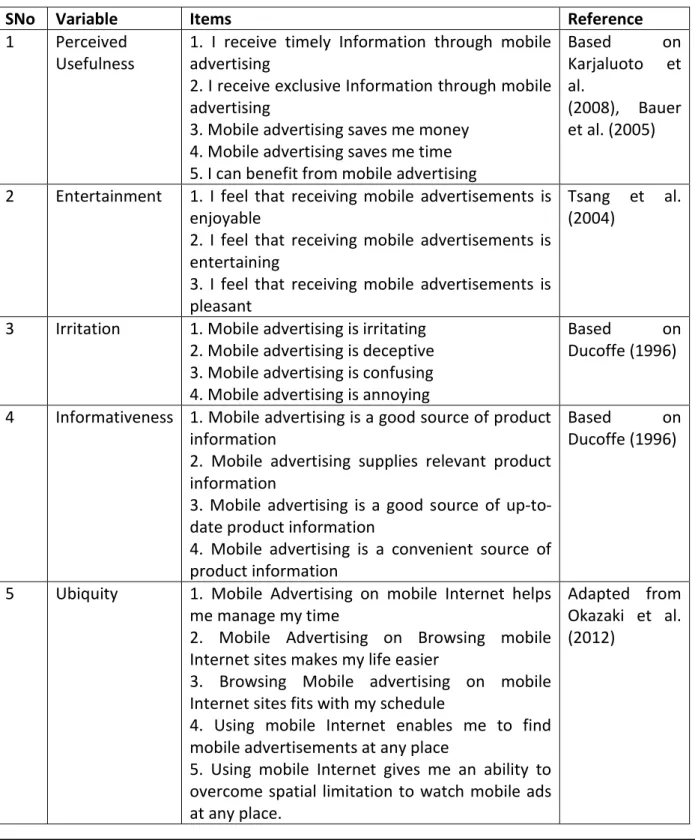
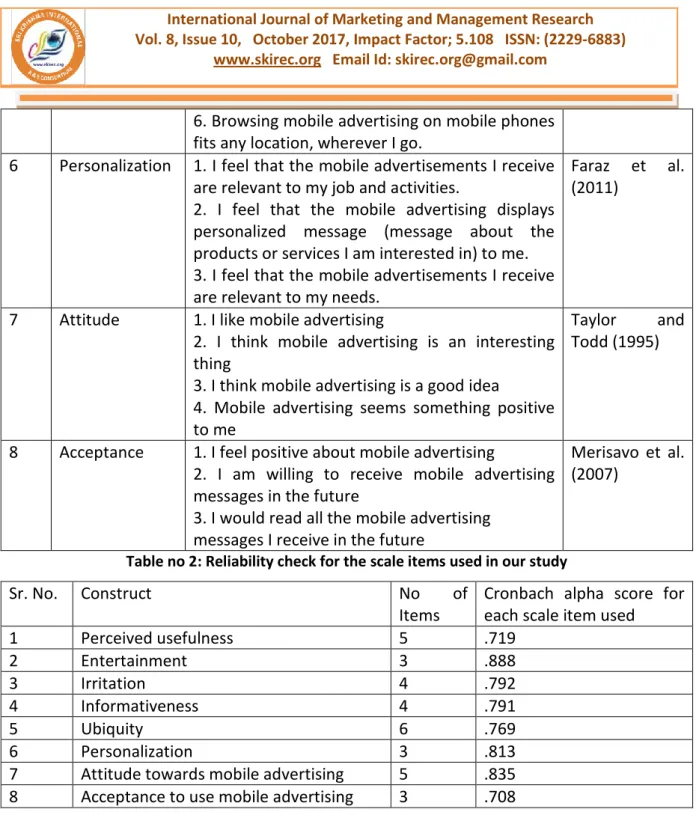
All these scales items used to measure different constructs were then tested for their reliability in
this study by calculating the Cronbach alpha scores for all constructs individually given in table no 2.
The details of from where the scale items were taken are given in Table no 1.
Table no 1: Source of scale items
SNo Variable
Items
Reference
1
Perceived
Usefulness
1. I receive timely Information through mobile
advertising
2. I receive exclusive Information through mobile
advertising
3. Mobile advertising saves me money
4. Mobile advertising saves me time
5. I can benefit from mobile advertising
Based
on
Karjaluoto
et
al.
(2008), Bauer
et al. (2005)
2
Entertainment
1. I feel that receiving mobile advertisements is
enjoyable
2. I feel that receiving mobile advertisements is
entertaining
3. I feel that receiving mobile advertisements is
pleasant
Tsang et al.
(2004)
3
Irritation
1. Mobile advertising is irritating
2. Mobile advertising is deceptive
3. Mobile advertising is confusing
4. Mobile advertising is annoying
Based
on
Ducoffe (1996)
4
Informativeness 1. Mobile advertising is a good source of product
information
2. Mobile advertising supplies relevant product
information
3. Mobile advertising is a good source of
up-to-date product information
4. Mobile advertising is a convenient source of
product information
Based
on
Ducoffe (1996)
5
Ubiquity
1. Mobile Advertising on mobile Internet helps
me manage my time
2. Mobile Advertising on Browsing mobile
Internet sites makes my life easier
3. Browsing Mobile advertising on mobile
Internet sites fits with my schedule
4. Using mobile Internet enables me to find
mobile advertisements at any place
5. Using mobile Internet gives me an ability to
overcome spatial limitation to watch mobile ads
at any place.
6. Browsing mobile advertising on mobile phones
fits any location, wherever I go.
6
Personalization 1. I feel that the mobile advertisements I receive
are relevant to my job and activities.
2. I feel that the mobile advertising displays
personalized message (message about the
products or services I am interested in) to me.
3. I feel that the mobile advertisements I receive
are relevant to my needs.
Faraz et al.
(2011)
7
Attitude
1. I like mobile advertising
2. I think mobile advertising is an interesting
thing
3. I think mobile advertising is a good idea
4. Mobile advertising seems something positive
to me
Taylor
and
Todd (1995)
8
Acceptance
1. I feel positive about mobile advertising
2. I am willing to receive mobile advertising
messages in the future
3. I would read all the mobile advertising
messages I receive in the future
Merisavo et al.
(2007)
Table no 2: Reliability check for the scale items used in our study
Sr. No.
Construct
No
of
Items
Cronbach alpha score for
each scale item used
1
Perceived usefulness
5
.719
2
Entertainment
3
.888
3
Irritation
4
.792
4
Informativeness
4
.791
5
Ubiquity
6
.769
6
Personalization
3
.813
7
Attitude towards mobile advertising
5
.835
8
Acceptance to use mobile advertising
3
.708
As we can see in the above table, that all the values for Cronbach Alpha are above the prescribed
value of .700 so we can use these scale items for our study.
3.4. DATA ENTRY AND EDITING
After data collection there were some checks performed during data collection and data editing. The
methods like field edit, range check, manual check etc. were used to ensure correct entry of data in
SPSS sheet. The data entry was done in the SPSS as per the pre-decided coding for different
3.5. ANALYSIS
The analysis was conducted using the SPSS version 21 and the PROCESS plugin that comes for SPSS
21.
3.6. FINDINGS, DISCUSSION AND CONCLUSION
3.6.1. DESCRIPTION OF PROFILE OF SAMPLE
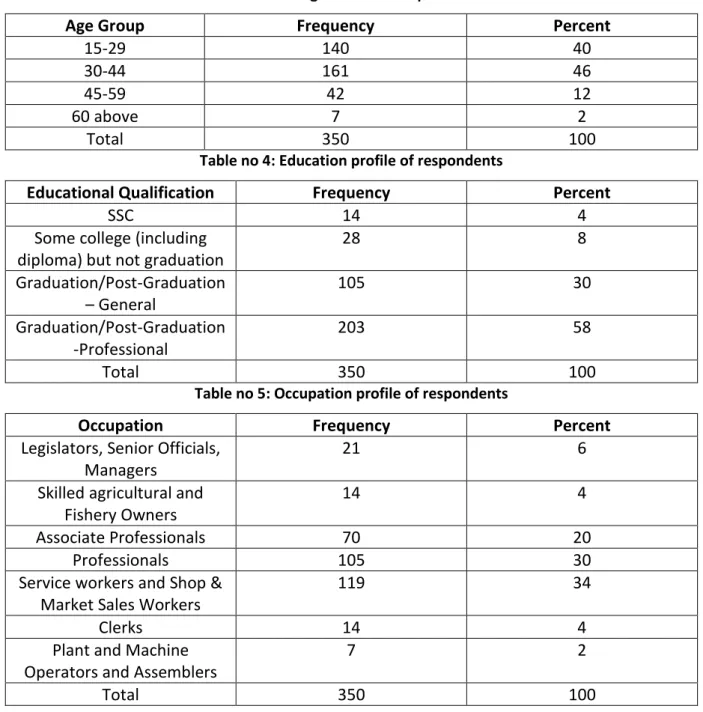
The profile of the sample data collected has been explained using the descriptive statistics from
SPSS. The tables from table number 3 to table number 6 giving details of the descriptive for the
profile of sample are given below –
Table no 3: Age Profile of respondents
Age Group
Frequency
Percent
15-29
140
40
30-44
161
46
45-59
42
12
60 above
7
2
Total
350
100
Table no 4: Education profile of respondents
Educational Qualification
Frequency
Percent
SSC
14
4
Some college (including
diploma) but not graduation
28
8
Graduation/Post-Graduation
– General
105
30
Graduation/Post-Graduation
-Professional
203
58
Total
350
100
Table no 5: Occupation profile of respondents
Occupation
Frequency
Percent
Legislators, Senior Officials,
Managers
21
6
Skilled agricultural and
Fishery Owners
14
4
Associate Professionals
70
20
Professionals
105
30
Service workers and Shop &
Market Sales Workers
119
34
Clerks
14
4
Plant and Machine
Operators and Assemblers
7
2
Table no 6: Gender profile of respondents
Gender
Frequency
Percent
Male
224
64
Female
126
36
Total
350
100
The majority of respondents in sample belonged to the age group of 30-44 with 46 percent followed
by 15-29 with 40 percent respondents. The majority of respondents belonged to
graduation/post-graduation – professional with 58 percent and 30 percent in graduation/post-graduation/post-graduation/post-graduation – general
with 30 percent. In terms of occupation 34 percent were service workers, and shop and market sales
workers, and 30 percent were professionals. The final sample comprised of 64 percent males and 36
percent females. This highlights that sample is very diverse in nature which is a good indicator.
3.6.2. FINDINGS: The entire analysis has been done using the SPSS 21. To analyses the results for
different constructs represented by a combination of items, we calculated and added new variables
by calculating composite scores of all items for each scale item and then using the composite score
as a new variable in SPSS. This led to the computation and addition of 8 new variables in the SPSS
sheet and the final analysis was performed on these items.
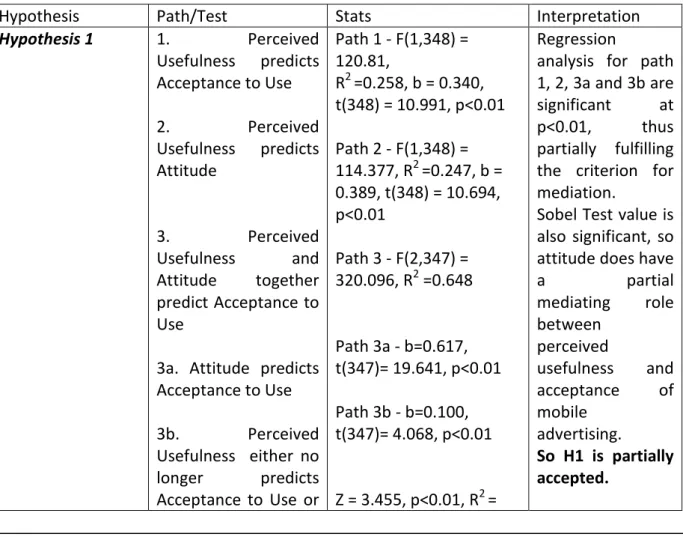
Table no 7: Results for Process Plugin to test Mediation for Hypothesis 1 to Hypothesis 6
Hypothesis
Path/Test
Stats
Interpretation
Hypothesis 1
1.
Perceived
Usefulness
predicts
Acceptance to Use
2.
Perceived
Usefulness
predicts
Attitude
3.
Perceived
Usefulness
and
Attitude
together
predict Acceptance to
Use
3a. Attitude predicts
Acceptance to Use
3b.
Perceived
Usefulness either no
longer
predicts
Acceptance to Use or
Path 1 - F(1,348) =
120.81,
R
2=0.258, b = 0.340,
t(348) = 10.991, p<0.01
Path 2 - F(1,348) =
114.377, R
2=0.247, b =
0.389, t(348) = 10.694,
p<0.01
Path 3 - F(2,347) =
320.096, R
2=0.648
Path 3a - b=0.617,
t(347)= 19.641, p<0.01
Path 3b - b=0.100,
t(347)= 4.068, p<0.01
Z = 3.455, p<0.01, R
2=
Regression
analysis for path
1, 2, 3a and 3b are
significant
at
p<0.01,
thus
partially fulfilling
the criterion for
mediation.
Sobel Test value is
also significant, so
attitude does have
a
partial
mediating
role
between
perceived
usefulness
and
acceptance
of
mobile
advertising.
prediction is lessened
4. Value for Sobel test
0.240
Hypothesis 2
1.
Entertainment
predicts Acceptance
to Use
2.
Entertainment
predicts Attitude
3. Entertainment and
Attitude
together
predict Acceptance to
Use
3a. Attitude predicts
Acceptance to Use
3b.
Entertainment
either
no
longer
predicts Acceptance
to Use or prediction is
lessened
4. Value for Sobel test
Path 1 - F(1,348) =
90.766,
R
2=0.207, b = 0.384,
t(348) = 9.527, p<0.01
Path 2 - F(1,348) =
61.731, R
2=0.150, b =
0.383, t(348) = 7.856,
p<0.01
Path 3 - F(2,347) =
332.239, R
2=0.656
Path 3a - b=0.623,
t(347)= 21.3363 , p<0.01
Path 3b - b=0.146,
t(347)= 5.0493, p<0.01
Z = 7.365, p<0.01, R
2=
0.238
Regression
analysis for path
1, 2, 3a and 3b are
significant
at
p<0.01,
thus
partially fulfilling
the criterion for
mediation
Sobel Test value is
also significant, so
attitude does have
a
partial
mediating
role
between
entertainment
and acceptance of
mobile
advertising.
So H2 is partially
accepted.
Hypothesis 3
1. Irritation predicts
Acceptance to Use
Path 1 - F(1,348) = 3.376,
p=0.067, R
2=0.0096,
b = 0.0674, t(348) =
-1.837, p=0.067
Regression
analysis for path 1
comes out to be
insignificant thus
the
mediation
effect of attitude
between irritation
and acceptance of
mobile advertising
cannot
be
established
as
significance of this
regression path is
a
pre-condition
for mediation to
occur.
So H3 is not
accepted.
predicts Acceptance
to Use
2.
Informativeness
predicts Attitude
3.
Informativeness
and Attitude together
predict Acceptance to
Use
3a. Attitude predicts
Acceptance to Use
3b. Informativeness
either
no
longer
predicts Acceptance
to Use or prediction is
lessened
4. Value for Sobel test
237.377,
R
2=0.406, b = 0.501,
t(348) = 15.407, p<0.01
Path 2 - F(1,348) =
176.110, R
2=0.336, b =
0.533, t(348) = 13.2707,
p<0.01
Path 3 - F(2,347) =
366.022, R
2=0.678
Path 3a - b=0.549,
t(347)= 17.160 , p<0.01
Path 3b - b=0.209,
t(347)= 7.0977, p<0.01
Z = 10.486, R
2= 0.292,
p<0.01
analysis for path
1, 2, 3a and 3b are
significant
at
p<0.01,
thus
partially fulfilling
the criterion for
mediation.
Sobel Test value is
also significant, so
attitude does have
a
partial
mediating
role
between
informativeness
and acceptance of
mobile
advertising.
So H4 is partially
accepted.
Hypothesis 5
1 Ubiquity predicts
Acceptance to Use
2. Ubiquity predicts
Attitude
3.
Ubiquity
and
Attitude together
predict Acceptance to
Use
3a. Attitude predicts
Acceptance to Use
3b. Ubiquity either no
longer
predicts
Acceptance to Use or
prediction is lessened
Path 1 - F(1,348) =
144.629,
R
2=0.294, b = 0.330,
t(348) = 12.0262, p<0.01
Path 2 - F(1,348) =
78.817, R
2=0.185, b =
0.306, t(348) = 8.877,
p<0.01
Path 3 - F(2,347) =
370.270, R
2=0.681
Path 3a - b=0.590,
t(347)= 20.524, p<0.01
Path 3b - b=0.149,
t(347)= 7.314, p<0.01
Regression
analysis for path
1, 2, 3a and 3b are
significant
at
p<0.01,
thus
partially fulfilling
the criterion for
mediation. Sobel
Test value is also
significant,
so
attitude does have
a
partial
mediating
role
between ubiquity
and acceptance of
mobile
advertising.
4. Value for Sobel test
Z = 8.1402, R
2= 0.180,
p<0.01
Hypothesis 6
1
Personalization
predicts Acceptance
to Use
2.
Personalization
predicts Attitude
3. Personalization and
Attitude
together
predict Acceptance to
Use
3a. Attitude predicts
Acceptance to Use
3b.
Personalization
either
no
longer
predicts Acceptance
to Use or prediction is
lessened
4. Value for Sobel test
Path 1 - F(1,348) =
423.054,
R
2=0.549, b = 0.612,
t(348) = 20.568, p<0.01
Path 2 - F(1,348) =
255.138, R
2=0.423, b =
0.628, t(348) = 15.973,
p<0.01
Path 3 - F(2,347) =
442.887, R
2=0.719
Path 3a - b=0.465,
t(347)= 14.470, p<0.01
Path 3b - b=0.321,
t(347)= 10.343, p<0.01
Z = 10.712, R
2= 0.292,
p<0.01
Regression
analysis for path
1, 2, 3a and 3b are
significant
at
p<0.01,
thus
partially fulfilling
the criterion for
mediation. Sobel
Test value is also
significant,
so
attitude does have
a
partial
mediating
role
between
personalisation
and acceptance of
mobile
advertising.
So H6 is partially
accepted.
* All values are tested for significance at p<0.01
The results from table no 7 clearly state that factors like perceived usefulness, entertainment,
informativeness, ubiquity and personalization are partially mediated by attitude with acceptance of
mobile advertising. In case of irritation no mediating affect was found. Thus our hypothesis number
1, 2, 4, 5 and 6 are partially accepted, whereas the hypothesis number 3 shows no mediation affect
at all.
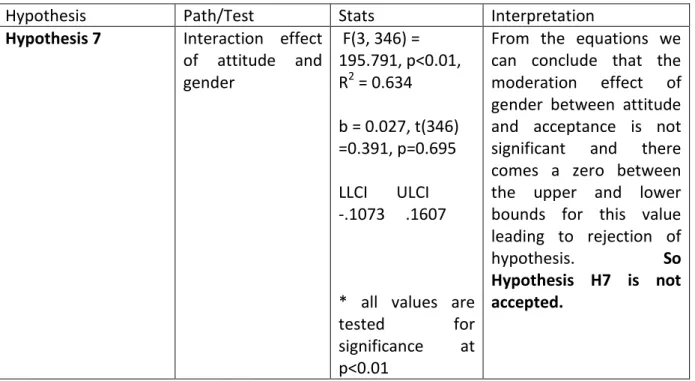
Hypothesis number 7 has been tested using moderation and the findings are presented in the table
Table no 8: Results for Process Plugin to test Moderation affect for Hypothesis 7
Hypothesis
Path/Test
Stats
Interpretation
Hypothesis 7
Interaction effect
of attitude and
gender
F(3, 346) =
195.791, p<0.01,
R
2= 0.634
b = 0.027, t(346)
=0.391, p=0.695
LLCI ULCI
-.1073 .1607
* all values are
tested
for
significance
at
p<0.01
From the equations we
can conclude that the
moderation
effect
of
gender between attitude
and acceptance is not
significant
and
there
comes a zero between
the upper and lower
bounds for this value
leading to rejection of
hypothesis.
So
Hypothesis H7 is not
accepted.
3.6.3. DISCUSSION
Using the results the author has confirmed that perceived usefulness, entertainment,
informativeness, ubiquity and personalization of the content on mobile advertisements have a
significant effect on the acceptance to use of the mobile advertisements and their effect is partially
mediated by attitude as an emerging technology based platform to advertise among its customers.
(Parreno et al, 2013; Bauer et al, 2005; Scharl et al, 2005 and Xu et al, 2009) On the other side the
effect of irritation is not mediated by attitude on the acceptance to use the technology. The studies
conducted earlier had already tested the effect of attitude on acceptance of mobile advertising (Unal
et al, 2011; Koury and Yang, 2010; Xu, 2007; Bauer et al. 2005), but the mediating effect of attitude
on different variables leading to acceptance of mobile advertisement had not been tested earlier
and these results can be used to understand that how attitude mediates between these factors and
acceptance of mobile advertising. These results are in line with Yong Jin Kim, (2016), who also tested
the mediating affect of attitude and found it to be significant for variables like behavioral intention
and thus acceptance in case of new technologies. The results of moderating effect of gender
(Karjaluoto, 2008) came out to be insignificant indicating that there was no moderating effect of
3.6.4. CONCLUSION/IMPLICATIONS
The findings of the study are a guide to researchers and practitioners to take care of this partially
mediating role of attitude to promote acceptance of newer technologies. The firms need to pay
more attention to irritation as a variable as the results indicate that people get irritated by not to
useful content. The academicians can shed light on how to lower the irritation levels to enhance this
technologies acceptance levels. The mediating affects have been studied, but the mediating affects
can be studied in combination or in total including all factors to get a clearer picture.
The practitioners or managers need to work on building positive attitudes towards these
technologies. These results can be helpful in guiding the strategies for increasing acceptance levels
of new technologies by using the variables and the mediator attitude. The practitioners need not put
emphasis on the gender as results for moderation of gender between attitude and acceptance were
insignificant, but this can be further verified by others so as to generalize the overall results.
4. LIMITATIONS AND DIRECTIONS FOR FUTURE RESEARCH
The geographical scope of this study was narrow and so the researchers can further carry out a study
for the audience of a broader geographical area and sample. The mediation affects in this study can
be studied in total i.e. how attitude plays a mediating role between different variables when taken
together.
The researchers can also test further the moderating effects of other variables like education level,
or geographical location(urban, rural and semi-urban) etc. or carry out a cross-cultural study to test
the mediating role of attitude across cultures between variables and acceptance. Further this
combination of variables influencing the acceptance of use of new technology like mobile advertising
have not been tested collectively using SEM and this can be another area where the researchers can
5. REFERENCES
Allport, G. W. (1935). Attitudes. A Handbook of Social Psychology , 798-844.
Altuna, O. K. and Konuk, F. A. (2009). Understanding consumer Attitudes toward mobile advertising
and its impact on consumers behavioral intentions: A Cross-Market comparison of US and Turkish
Consumers. International Journal of Mobile Marketing, 4(2), 43-51
Bauer, H.H., Barnes, S.J., Reichardt, T. and Neumann, M.M. (2005). Driving consumer acceptance of
mobile marketing: a theoretical framework and empirical study. Journal of Electronic Commerce
Research, 6(3), 181-191.
Bouwman, H., Lo´pez-Nicola´s, C., Molina-Castillo, F. and Van H. P. (2012). Consumer lifestyles:
alternative adoption patterns for advanced mobile services. International Journal of Mobile
Communications, 10(2), 169-189.
Chen, P. and Hseih, H. (2012). Personalized mobile advertising: Its key attributes, trends, and social
impact. Technological Forecasting and Social Change, 79, 543-557.
Davis, F.D. (1989). Perceived usefulness, perceived easy of use, and user acceptance of information
technology. MIS Quarterly, 13(3), 319-340.
Davis, F.D., Bagozzi, R.P. and Warshaw, P.R. (1989). User acceptance of computer technology: a
comparison of two theoretical models. Management Science, 35, 982-1003.
eMarketer. (2016, April 7). Digital Ad Spending in India to Surpass $1 Billion Next Year. Retrieved
March 06, 2017, from eMarketer:
https://www.emarketer.com/Article/Digital-Ad-Spending-India-Surpass-1-Billion-Next-Year/1013800
Faraz, S. and Hosseini, H. K. (2011). Mobile advertising: an investigation of factors creating positive
attitude in Iranian customers. African Journal of Business Management, 5, 394–404.
Feng, X., Fu, S., Qin, J. (2016). Determinants of consumers’ attitudes toward mobile advertising: The
mediating roles of intrinsic and extrinsic motivations. Computers in Human Behavior, 63, 334-341
Fishbein, M. and Ajzen, I. (1975). Belief, Attitude, Intention and Behavior: An Introduction to Theory
and Research. Addison-Wesley, New York, NY.
Gao, S. and Zang, Z. (2016). An empirical examination of users adoption of Mobile Advertising in
China. Information Development, 32(2), 203-215.
Grant, I. and O'Donohoe, S. (2007). Why young consumers are not open to mobile marketing
communications. International Journal of Advertising, 26 (2). 223-246.
Hayes, A. (n.d.). The PROCESS macro for SPSS and SAS . Retrieved May 02, 2017, from
Islam, M., Kang, M. and Yang, S. (2013). A Research to Identify the Relationship between Consumers’
Attitude and Mobile Advertising. PACIS 2013 Proceedings, 39.
Karjaluoto, H., Lehto, H., Leppa¨niemi, M. and Jayawardhena, C. (2008). Exploring gender influence
on customer’s intention to engage permission-based mobile marketing. Electronic Markets, 18 (3),
242-259.
Kleijnen, M., Wetzels, M. and de Ruyter, K. (2004). Consumer acceptance of wireless finance. Journal
of Financial Services Marketing, 8(3), 206-217.
Kolsaker, A. and Drakatos, N. (2009). Mobile advertising: The influence of emotional attachment to
mobile devices on consumer receptiveness. Journal of Marketing Communications, 15(4), 267-280.
Koury, S., and Yang, K. (2010). Factors affecting consumers’ responses to mobile advertising from a
social norm theoretical perspective. Telematics and Informatics, 27, 103-113.
Leppaniemi, M., and Karjaluoto, H. (2008). Exploring the effects of gender, age, income and
employment status on consumer response to mobile advertising campaigns. Journal of Systems and
Information Technology, 10(3), 251-265.
Liu, C., Sinkovics, R., Pezderkab, N. and Haghirian, P(2012). Determinants of consumer perceptions
toward mobile advertising – a comparison between Japan and Austria. Journal of Interactive
Marketing, 26, 21-32.
Mathew S. Fritz, D. M. (2007). Required sample size to detect the mediated effect. Psychological
Science , 233-239.
Mobile Marketing Association. (2010). 3er Estudio de Inversion en Marketing y Publicidad Movil en
Espana 2010. Available at: http://recursos.anuncios.com/files/387/64.pdf (accessed 18 March,
2017).
Mobile Ad Spend to Top $100 Billion Worldwide in 2016, 51% of Digital Market. (2015, April 2).
Retrieved March 04, 2017, from eMarketer:
https://www.emarketer.com/Article/Mobile-Ad-Spend-Top-100-Billion-Worldwide-2016-51-of-Digital-Market/1012299
Muk, A. (2007). Consumer’s Intentions to Opt-in to SMS Advertising. International Journal of
Advertising, 26(2), 177–198.
Okazaki, S., Molina, F. J., and Hirose, M. (2012). Mobile advertising avoidance: exploring the role of
Ubiquity. Electron Markets, 22, 169-183.
Okazaki, S. (2009). Social influence model and electronic word of mouth: PC versus mobile internet.
International Journal of Advertising, 28(3), 439–472.
Parreno, J.M., Blas, S.S., Mafe, C.R., Manzano, J.A. (2013). Key factors of teenagers' mobile
Patil, R. (2016, March 31). Money is where mobile is: The future of mobile advertising in India.
Retrieved March 03, 2017, from Economic Times:
http://economictimes.indiatimes.com/small-
biz/security-tech/technology/money-is-where-mobile-is-the-future-of-mobile-advertising-in-india/articleshow/51626677.cms
Roy, V. (2016, October 13). Punjab emerges among top 5 markets for telcos. Retrieved May 08, 2017,
from The Tribune:
http://www.tribuneindia.com/news/business/punjab-emerges-among-top-5-markets-for-telcos/309049.html
Salo, J. and Tahtinen, J. (2005). Retailer use of permission based mobile advertising. Advances in
Electronic Marketing, 139–156.
Scharl, A., Dickinger, A. and Murphy, J. (2005). Diffusion and success factors of mobile marketing.
Electronic Commerce Research and Applications, 4 (2), 159-173.
Sheng, H., Nah, F., & Siau, K. (2008). An experimental study on ubiquitous commerce adoption:
Impact of personalization and privacy concerns. Journal of the Association for Information Systems,
9(6), 344–376.
Sultan, F. and Andrew, R. (2005). The Coming Era of ‘Brand in the Hand' Marketing. MIT Sloan
Management Review, 47(1), 83-90.
Tsang, Melody M., Shu-Chun H., and Ting-Peng, L. (2004). Consumer Attitudes toward Mobile
Advertising: An Empirical Study. International Journal of Electronic Commerce, 8(3), 65–78.
Unal, S., Ercis, A. and Keser, E. (2011). Attitudes towards Mobile Advertising – A Research to
Determine the Differences between the Attitudes of Youth and Adults. Procedia Social and
Behavioral Sciences, 24, 361-377
Wong, M. M. T. and Tang, E. P. Y. (2008). Consumers’ Attitudes Towards Mobile Advertising: The
Role of Permission, Review of Business Research, 8(3), 181-187.
Xu, J.D., Benbasat, I. and Cenfetelli, R.T. (2013). Integrating Service Quality with System and
information Quality: An Empirical Test in the E-Service Context. Management Information Systems
Quarterly, 37, 777-794
Xu, H., Teo, H. H., Tan, B. C. Y., & Agarwal, R. (2009). The role of push–pull technology in privacy
calculus: The case of location based services. Journal of Management Information Systems, 26(3),
135–173.
Xu, H., Oh, L.-B. and Teo, H.-H. (2009). Perceived effectiveness of text vs multimedia location-based
advertising messaging. International Journal of Mobile Communication, 7(2), 154-177.
Xu, D. (2007). The influence of personalization in affecting consumer attitude toward mobile
Yong Jin Kim, J. U. (2016). Investigating the role of attitude in technology acceptance from an
attitude strength perspective. Retrieved May 13, 2017, from OU.edu: