Development and Implementation of Pregnancy
Healthcare Mobile Applications: A Case Study
Mahmoud Jazzar1, Shooq Alhathal2, Maryam Al-Rayes3
1,2,3 College of IT, Royal University for Women
Abstract: Mobile apps are computer application programs that act as one of the current major assists in connecting people to Internet Services accessed via handheld and several microcomputer machines. This study investigate the development and implementation of pregnancy healthcare mobile based application called ‘BabyApp’. The proposed application work as an assistant to pregnant women in order to monitor their baby growth week-by-week, provide feedback information and as time management system. Agile development model was used as incremental model. As such, every software release was carefully implemented and tested in order to maintain and guarantee the minimum software quality. Based on the obtained feedback and results, the application sound as an indispensable asset for pregnant women and can provide additional support for the complete nine months of pregnancy.
Keywords—Mobile apps; Pregnancy mobile apps; Pregnancy Healthcare, Healthcare mobile apps; Baby Apps.
I. INTRODUCTION
Mobile applications are soft tools for connecting users to Internet services that are frequently accessed using PCs and microcomputer machines. Mobile technology has made life easier, it serve the users in different aspects and can be used as an essential gadget to users worldwide. As such, mobile phones have many features, one of these feature is the ability to download application programs. In addition, the modern business needs and the technology advancements have made such applications very popular and highly demanded among several mobile phone users.
According to [1] mobile medical apps are more popular among women as compared to men. This popularity range from elaborating simple and common health patterns to experimenting personalized tests. In addition, as per the results of [2] on how women are using technology today which studied completive number of women using technology showed that women are always in a hunt of technology which help them to follow up with their active lifestyles. This makes women the fastest growing and one of most valuable consumer of internet and ecommerce companies.
From the exact sense, it is obvious that specific life-cycle like pregnancy requires the use of mobile technology to manage and monitor the pregnancy status week-by-week, provide feedback information and provide essential support and time management. On the other hand, mobile apps are customary in the healthcare development, and have achieved dominant progress in the aspect of developing healthcare mobile applications. In view of the above, we have studied the development of specialized pregnancy healthcare mobile application that provide weekly monitoring and feedback information to pregnant women. The proposed healthcare mobile app provide a variety of free helpful information, graphs, charts, and videos.
One of the interesting advantages of the proposed pregnancy mobile application is the due date and kicks calculator feature which helps pregnant women to easily know their expected delivery date. The app will provide a wish list for the pregnant women to organize their thoughts and ideas. In addition, the unique kick calculation feature gives an estimation about the average kicks per day, calculate the expected delivery time such that to help women be prepared for the delivery period. Furthermore, the proposed app has an online mini store which provide convenient use and benefits after delivery. The rest of the paper is organized as follows: Section II provides background and related study. Section III describe the methodology followed during the development phase. Section IV detailed the system design and analysis phase followed by the implementation and testing in section V. Finally, we conclude the paper in section VI.
II. BACKGROUND
apps that help to manage time, and encourage easy communication with relevant health based community. One of the best examples of a recent innovation for mobile medical technologies is the WebMD Health application [5]. This cross platform smartphone application is geared toward physicians providing information on the go. The application, called Medscape Mobile, provides information on medications, tools, medical news, and other educational information. The application relies on WebMD Health Network consisting of WebMD health, and other health resources [9][10]. The application allows doctors to reference vital information whenever they need it, and providing a higher level of treatment [5].
Another advantage of mobile medical technologies can be seen in the ease of deployment and how well they facilitate treatment, especially in developing countries. Rockefeller Foundation focused on universal health coverage with an infrastructure for health systems in Africa and Asia [6]. The goal is to utilize smartphone applications on this new infrastructure to improve the efficiency, increase the overall access, and ultimately increase the quality of care. One of the major advantages to phone based applications is the versatility. Phones are able to be taken into environments not well suited for even laptops. A lot of developing countries have some form of cellular network, therefore allowing much easier deployment for such systems [6]. Basic and essential features of some reviewed pregnancy based mobile applications are shown in Table 1.
TABLEI
SAMPLE OF PREGNANCY BASED MOBILE APPLICATIONS
strongly believe that healthcare time management systems for pregnant women using mobile apps will be a relief for women such that in handling health care data from all aspects. The goal of this project is to combine our knowledge and the technology in order to create an application that can serve pregnant women, by making their life easier and normal without any concerns and difficulties. The details of the proposed application are illustrated in the following sections.
III. METHODOLOGY
Developing successful software involve that the software pass through specified software development model. System Development Life Cycle (SDLC) is a well-known model in which the proposed software go through a sequence of ordered phases during the development process [7]. SDLC is divided into five main phases. After executing each phase deliverables will be produced [7]. These phases are considered as the requirement gathering and analysis, design, implementation or coding, testing and release. In the requirement analysis phase the focus is on collecting and conducting the requirements from the involved parties in the software, and at the end of this phase a requirement specification document should be generated. During the design phase the software and hardware that are required should be specified and a system architecture should be defined. The implementation is considered as the longest and main phase were the actual code is generated. In the testing phase the completed software is being tested in order to insure that it works properly and meets the defined requirements. At the deployment phase the completed software is being released to the customer. Furthermore, some developers take account of a sixth phase which is maintenance, where the real problems are recognized after the customer uses the software and it needs to be solved [11].
Research methodology is a procedure that is used to gather data and information in order to have business decisions. These data and information could be collected by interviews, surveys and questionnaires, and publication researches or many other methods. For creating the BabyApp, extreme programming methodology [7] was followed. As extreme programming handles the unexpected changes during the software development it is considered as type of agile methodology. Most of the developers prefer to follow the agile methodology because of its many advantages over the other methodologies. If we compared the agile with the other methods we can notice that it is more effective, cheaper and it has less risks. It ensures continuous improvements, early delivery and flexibility in handling any required changes. In agile methodology, the product development work is broken down into smaller increments which reduces the amount of planning and design. After finishing each stage, the product is reviewed in order to know if there is any required change at this specific stage which reduce the overall risk and costs. At the end, the customer will receive the complete software with all the requirements [7][11]. Agile benefits includes:
A. Continuous interaction between the developers and the clients.
Application Name Basic Feature Essential Feature
WebMD pregnancy App [7] Easy to navigate Reference items
Pregnancy ++ App [8] Abstract body Interesting design
B. Clients are involved in each step of the software developing process.
C. Early delivery and less cost.
D. Allows to make changes at any stage, even in late stages.
E. Better quality because of breaking the software developing process into smaller increments.
F. Client satisfaction because of rapid and continuous delivery.
G. Less planning and design required.
H. Easy managing and flexible for developers.
The operating system used during developing the project is Microsoft Windows 8 operating system, and Adobe Photoshop for graphics and design, Microsoft Visio for designing diagrams and flowcharts. Microsoft office 2010 for documentation. In addition, PHP and notepad++ was used for coding the software. XAMPP is a free and open source cross platform server was used as local server for testing, the abbreviation “XAMPP” stands for Cross-Platform (X), Apache (A), MySQL (M), PHP (P) and Perl (P). These tools will give us a high quality output that meets all of the required standards and basic requirement.
IV. ANALYSISANDDESIGN
Since the development of the BabyApp following agile method, we followed the following procedures accordingly. The first thing is a feasibility study for the sake of evaluating and analysing the capability of our project’s main ideas and goals. Thus a survey was conducted to a number of pregnant women from different clinics/ hospitals and took their responses. We concluded that pregnant women will find our app as a relief, and a friend who will accompany them through their nine-month journey. As per the survey result and since the participated pregnant women are in favour of building ‘BabyApp’, the collection and definition of the system requirement was used to build the system. The following illustrate the functional and non-functional requirement of the system.
A. Functional Requirements
Functional Requirements analyse the utilities that should be provided in the system, they also analyse the behaviour in specific actions. The functional requirements of the application are:
For the system:
1) The system should enable the admin to login.
2) The system should enable the admin to change and enhance any part in the system like adding new item in any part of the
system, updating or deleting.
3) The system should enable the admin to view, edit, and delete any pregnant woman from the registered women list.
4) The system should enable the admin to view, edit information in the week’s section.
5) For the user
a) The user will be able to register in the App.
b) The user will be able to add personal information.
c) The user will be able to add name/s for the baby.
d) The user will be able to track the development of the baby week by week, and by picture.
e) The user will be able to get weekly updates and tips.
f) The user will be able to get weekly pregnancy guide videos.
g) The user will be able to use the Due date calculator.
h) The user will be able to use a wish list to write down her interests for baby stuff.
i) The user will be able to use the kick tracker: Easily keep track of your baby's movements.
j) The user will be able to shop for products.
k) The user will be able to add products to cart.
B. Non-functional Requirements
functional requirements are relevant to the architecture of the system that should meet all the performance requirements. Non-functional requirements for The Baby App application are as follows:
1) Product requirement: The Baby App shall be available for all customers who are using an Android platform. Also, it should be available 24 hours.
password
3) Consistency: The user interface system should be well designed, convenient, easy to use and user-friendly. In addition, the interface shall have a unified design.
The system must be maintainable, updatable, and flexible. The functionality of the system must be high, strong and secure
Security aspect: To ensure the authorization and authentication of the admin, the system must ask to login in order to apply any changes.
C. Structure Diagram
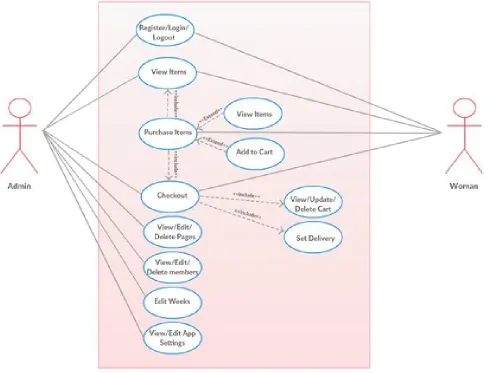
As per figure 2 illustration, the system consists of two main parts: the admin and woman interfaces.
1) Admin interface: a web-page that will only be used by the admin. The admin has the privilege to login, in order to add, edit,
update, and delete any content of the Baby App.
2) Woman interface: an android mobile application that will be used by women only.v The proposed use case diagram contains
four components.
3) The boundary, defines the system of interest in relation to the world around it.
4) The actors, usually individuals involved with the system defined according to their roles.
5) The use cases, which the specific roles are played by the actors within and around the system.
6) The relationships between and among the actors and the use cases.
[image:5.612.55.544.326.699.2]The Figure below displays the use case diagram for the proposed application.
V. IMPLEMENTATIONANDTESTING
Building and developing software projects can be quite challenging. The projects start with the idea of having an application that can manage pregnant women period to setting goals and objectives. Meetings were conducted with stakeholders in order to collect the exact information and requirements. Those requirements was used in implementation and testing phase and can help us to determine whether the software application would lead to success or failure as per the given requirement. At the beginning the implementation and testing, we started creating the system database which will store all of the data that we need.
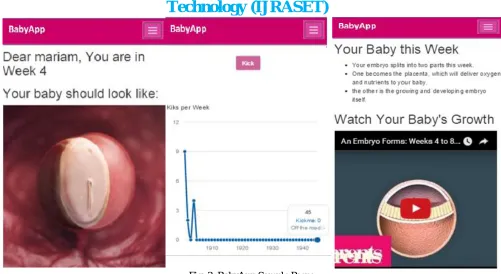
Both the application and the admin are connected to the admin database using connection string in PHP. As such, when the admin updates, edits, or delete information, it will be saved in the database and synchronized into the application. Moreover, the IP address of the environment network were added into our smartphone in order to allow open the webserver in the mobile application. Fig. 2 illustrate the home page of the BabyApp. This page consists of three main parts:
A. Main Screen with the logo.
B. Menu in the Action Bar (before login): contains four sections: home, about us, login, and registration section.
C. Menu in the Action Bar (after login): after logging in it will have more sections such as: my page, week information, baby
[image:6.612.55.562.263.568.2]image, baby names, week tips, kick, interests, products, cart, profile, and logout.
Fig. 2 BabyApp Home Page and Login.
Fig. 3 BabyApp Sample Pages.
Each category in the list has a specified name and an illustrative image/logo. The design of the page is similar to the other pages in application, such as: colour of background and alignment of images. The consistency in design can be considered as an advantage to the entire application. At the top of the page, there is an action bar that contains the logo of the application and the main menu that customer can easily navigate from one page to another. The kicks page allows the member to enter each ‘kick’, and compute the total mounts of ‘kicks’ as displayed in Fig. 3 above.
The cart page consists of the products for clients chose shopping. The Baby App cart page contains cart table, which includes name of products selected, quantities, price of each single product, and total price of each product. The client can easily edit the table by increasing or decreasing the quantity of each product, or can delete a product by setting the quantity to 0, and then press the “update cart” button. In addition, the total price of whole purchase is shown in bottom of the page. After the client is satisfied with all products selected, they can click on “Proceed to Checkout” button to continue the process.
During the implementation period and after each development step, the progress compared with the defined requirements to make sure that we meets all requirements. The application met functional and non-functional requirements. Moreover, we compared the application with the design layout to make sure that they are the same. After downloading the final version of the application, the user will be able to view any further updates or improvements such as new items were added or new products were added to the store, and even if there is any kind of change in the application design. The admin is the only one who can make the update to the application.
VI. CONCLUSIONS
BabyApp is an android mobile-based application for pregnant women. It helps the pregnant woman to manage time and provides all of the information needed during pregnancy period. In addition, the proposed mini-online store provides essential goods for babies. The main audience of the BabyApp are pregnant women and it was found that such mobile-based application will make pregnant women life much easier, and provide additional support for the complete nine months of pregnancy.
REFERENCES
[1] S. Stebbing, “Women Taking The Lead When It Comes To Mobile,” The Guardian. N.p., 2017. [Online]. Available: https://www.theguardian.com/media-network/media-network-blog/2012/aug/06/women-lead-mobile-technology-retail. [Accessed: 6 Apr. 2017].
[2] "Always on women: A Survey of How Women Are Using Technology Today”, [Online]. Available: http://adage.com/images/bin/pdf/1114WP.pdf. [Accesses: 6 Apr. 2017].
[3] E. Derbyshire and D. Dancey, “Smartphone Medical Applications for Women’s Health: What Is the Evidence-Base and Feedback?” International Journal of Telemedicine and Applications, vol. 2013, Article ID 782074, 10 pages, 2013. doi:10.1155/2013/782074.
and Child Health,” International Journal of Telemedicine and Applications, vol. 2012, Article ID 973237, 16 pages, 2012. doi:10.1155/2012/973237. [5] "Webmd Mobile Apps". WebMD. N.p., 2017. [Online]. Available: http://www.webmd.com/mobile. [Accessed: 6 Apr. 2017].
[6] "Transforming Health Systems". The Rockefeller Foundation. N.p., 2017. [Online]. Available: https://www.rockefellerfoundation.org/our-work/initiatives/transforming-health-systems. [Accessed: 6 Apr. 2017].
[7] A. I. Khan and et. al., "A Comprehensive Study of Commonly Practiced Heavy and Light Weight Software Methodologies", IJCSI International Journal of Computer Science Issues, Vol. 8, Issue 4, No 2, July 2011, ISSN (Online): 1694‐0814, www.IJCSI.org.
[8] WebMD, "Webmd Pregnancy". App Store. N.p., 2017. [Online]. Available: https://itunes.apple.com/us/app/webmd-pregnancy/id600535431?mt=8. [Accessed 6 Apr. 2017].
[9] "Pregnancy ++ ". App Store. N.p., 2017. [Online]. Available: https://itunes.apple.com/us/app/pregnancy/id505862554?mt=8. [Accessed 6 Apr. 2017]. [10] MedHelp, "I’M Expecting Pregnancy App and Baby Guide". App Store. N.p., 2017. [Online]. Available:
https://itunes.apple.com/us/app/im-expecting-pregnancy-app-and-baby-guide/id383565674?mt=8. [Accessed 6 Apr. 2017].