5
VIII
August 2017
A Hybrid Approach for Load Balancing in
Cloud Environment
Priti Devi1, Ritesh Rana2
1M. Tech. (CSE), Deenbandhu Chhotu Ram University of Science & Technology (DCRUST), Sonipat 2Asstt. Prof., Dept. of CSE & IT, Deenbandhu Chhotu Ram University of Science & Technology, Sonipat
Abstract: Cloud computing is highly designed setup provides platform as a service, infrastructure as a service and software as service. It helps clients to use required services & pay according to the usage of service. The principle aspect of cloud computing is virtualization that deals with the construction and management of virtual machines efficiently. Cloud computing environment provides multiple resources and services for sharing with their clients. Data storage on cloud computing is increasing day by day which causes scarcity of resources on cloud data centers. Also some data centers are overloaded & some are under loaded. Therefore load balancing on cloud data centers is required. With load balancing concept some tasks of overloaded servers are transferred to under loaded servers. Generally load balancing algorithms work dynamically. There are multiple dynamic load balancing algorithms exists for balancing the work load on cloud data centers. In this paper Hybrid approach for load balancing in cloud environment.
Keywords: Cloud Computing, Load Balancer, Round Robin, Throttle Method
I. INTRODUCTION
Cloud computing provides flexible way to retain data and files which involves virtualization, distributed computing, and web services. The main aim of cloud servers is to share vast amount of resources with their clients with low cost. The clients can use the cloud resources by registering with specific server & send requests for the resources. The server after authentication provides desired services to the requesting clients.
The cloud computing now a day is facing a real time challenge of load balancing [1]. The main reason for this challenge is the increase in the users demand for cloud services. So it is practically impossible to maintain the one or more free service to fulfill the demand. Providing each server with one demand to fulfill will result into traffic on the server and ultimately the crash of the system. It is used by Cloud service provider (CSP) in its own cloud computing platform to provide a high efficient solution for the user. Also, a inter CSP load balancing mechanism is needed to construct a low cost and infinite resource pool for the consumer [2].
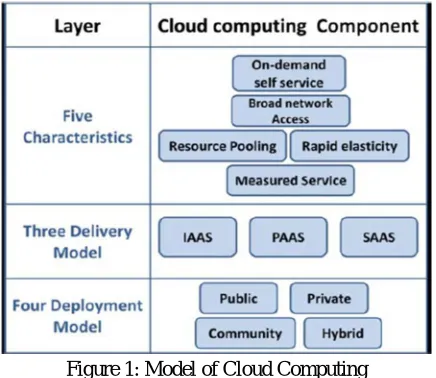
[image:2.612.198.416.504.693.2]A general model of Cloud Computing is shown in figure 1 below.
Figure 1: Model of Cloud Computing
balancing and better resource utilization [3]. Load balancing is the process of finding overloaded nodes and then transferring the extra load to other nodes. In this paper Hybrid approach for load balancing in cloud environment.
II. LOAD BALANCING IN CLOUD COMPUTING
Load balancing is used to distributing a larger processing load to smaller processing nodes for enhancing the overall performance of system. In cloud computing environment load balancing is required distribute the dynamic local is a techniques that helped networks and resources by providing a Maximum throughput with minimum response time. Load balancing is dividing the traffic between all servers, so data can be sent and received without any delay with load balancing Load balancing required to improve the performance of the system by minimize the overall completion time and avoid the situation where some resources are heavily loaded or others remains under loaded in the system [4].
[image:3.612.190.403.419.575.2]The goals of load balancing are:
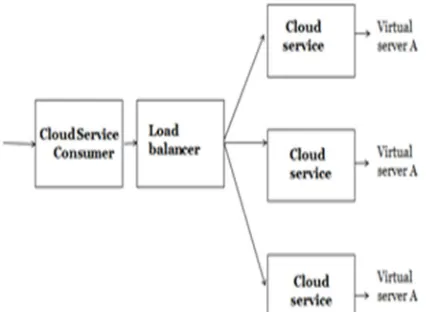
Figure 2 below shows load balancing in cloud environment.
Figure 2: Load Balancer in cloud Environment
III. EXISTING LOAD BALANCING ALGORITHMS
To design an effective load balancing policy and to determine how to increase the cloud resource usage are the two main goals of a cloud service provider. The VM scheduling algorithms for load balancing helps in allotment of VMs efficiently on need. Basically, a VM load balancing algorithm decides which VM is to allocate when request is made by cloud consumer. Numerous VM load balancing algorithms that have been proposed are discussed here [6][10]:
A. Round Robin Load Balancing Algorithm
B. ESCE load Balancing Algorithm
ESCE stands for Equally Spread Current Execution. It is also called Active VM Load Balancing algorithm. This algorithm is based on spread spectrum technique. As the name indicates, it equally distributes the workload on each VM in data center. A job queue keeps all the cloudlet requests that need the VM for their execution. ESCE VM Load Balancer (VMLB) also maintains a list of virtual machines. The VM Load Balancer continuously checks the job queue and VM list. If a VM is found free, then cloudlet request will be allotted over that VM. At the same time, VMLB inspect the overloaded VMs. If any virtual machine is found overloaded, then VMLB move some load to an idle or an under loaded virtual machine, so as to reduce some load of overloaded VM. The main drawback is high computational overhead.
C. Throttled Load Balancing Algorithm
It is a dynamic approach. In this, user submits its request to the Data Center Controller (DCC). Data Center Controller asks the VM Load Balancer to determine the appropriate virtual machine that can handle that much workload easily. Throttled VM Load Balancer keeps a virtual machine list and their status (available/busy). If a suitable VM is found on memory space, cores or availability basis, then throttled VM Load Balancer accept the cloudlet request and allot the cloudlet request over that virtual machine. Otherwise, clients have to wait in the waiting queue until a suitable VM becomes available. Among all, it is best approach for load balancing, since it maintains the present state of all VMs in data center. But the major drawback is that it works properly only if all VMs in a data center have same hardware configuration.
IV. PROPOSED WORK
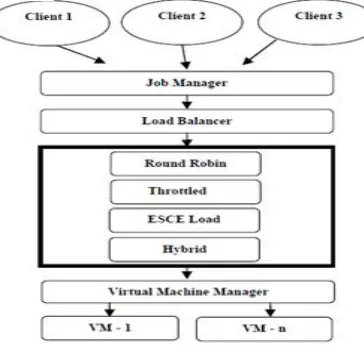
The goal of the proposed work is to design an efficient scheduling algorithm that uniformly distribute workload among the available virtual machines in a data center and at the same time, decrease the overall response time and data center processing time. The proposed approach is a combination of Throttled (TVLB) and ESCE algorithm. TVLB algorithm makes use of states of VMs. A virtual machine state may be either AVAILABLE or BUSY. AVAILABLE state indicates that the virtual machine is idle/free and ready for cloudlet allotment, where BUSY state indicates that the current virtual machine is busy in execution of previous cloudlets and is not available to handle any new cloudlet request. This current load state of a VM helps in taking decision whether to allocate cloudlets to virtual machines or not.
[image:4.612.213.395.547.720.2]Active VM Load Balancing algorithms continuously monitor the job queue for new cloudlets and allot them to the bunch of idle/free VMs. It also maintains the list of cloudlets allocated to each virtual machine. This allocated cloudlet list helps in determining whether a VM is overloaded or under loaded at particular moment of time. On the basis of this information, VM load Balancer moves some load from overloaded VMs to the VM having minimum number of cloudlets, so as to maintain a high degree of balance among virtual machines. These features combined together, make the proposed scheduling algorithm more efficient & effective and help in fair distribution of the load
Figure 3 below shows the proposed load balancing algorithm.
V. IMPLEMENTATION & RESULTS
Implementation is the stage of the project when the theoretical design is turned out into a working system. Thus it can be considered to be the most critical stage in achieving a successful new system and in giving the user, confidence that the new system will work and be effective. The implementation stage involves careful planning, investigation of the existing system and it’s constraints on implementation, designing of methods to achieve changeover and evaluation of changeover methods.
[image:5.612.204.411.165.304.2]Figure 4 shows the main menu of our implementation.
Figure 4: Main menu of implementation
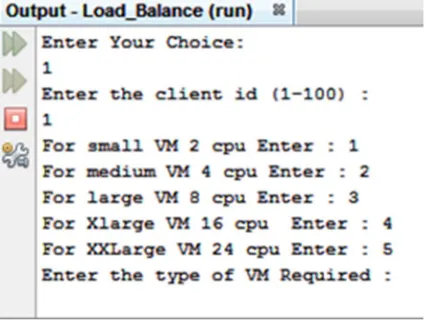
[image:5.612.201.415.345.506.2]When user select option 1 i.e., allocation of resources then it ask for client id and numbers of CPUs required as shown in figure 5.
[image:5.612.199.415.552.680.2]Figure 5: Allocation of resources for client id 1
Figure 6 shows the effect after allocation of resources
Figure 6: Effect after resource allocation
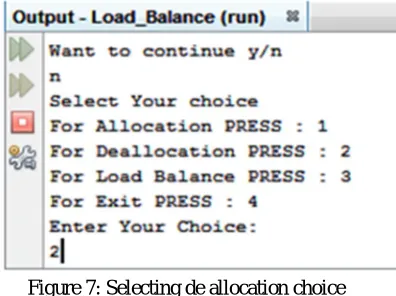
Figure 7: Selecting de allocation choice
In main menu options now select the option 2 for deallocation of resources. It will ask for client id and numbers of CPUs to be deallocated. If client id is not correct or numbers CPUs to be deallocated are more than the allocation then appropriate error message is displayed. If everything is OK then deallocation is performed. The remaining capacity and utilization value are updated for the server on which deallocation are performed as shown in figure 8.
Figure 8: Effect of deallocation
[image:6.612.212.408.433.558.2]Now press the option 3 for performing the load balance as shown in figure 9 below.
Figure 9: Selecting the option 3 for load balancing
Figure 10 below shows the effect of load balancing.
In this work, we propose the hybrid approach of three load balancing algorithms to overcome the drawback of existing methods. We first assign the load on the server using round robin fashion then we use throttle concept to find the suitable machine for current tasks and finally we use equally spread technique to equally distribute the load on various virtual machines to balance the load [11][12].
REFERENCES
[1] Vishwas Bagwaiya, Sandeep k. Raghuwanshi, “Hybrid Approach Using Throttled And ESCE Load Balancing Algorithms In Cloud Computing”.
[2] Mamta Khanchi, Sanjay Tyagi, “AN EFFICIENT ALGORITHM FOR LOAD BALANCING IN CLOUD COMPUTING”,© International Journal of Engineering Sciences & Research Technology.
[3] Bhavisha Patel, Shreyas Patel, “Various Load Balancing Algorithms in cloud Computing”, IJARIIE-ISSN(O)-2395-4396. Vol-1 Issue-2 2015.
[4] Mithun Dsouza, Mohammed Rizwan, Ramnath Gaonkarand, S. Sathyanarayana, “SCHEDULING AND LOAD BALANCING TECHNIQUES IN CLOUD
COMPUTING: A SURVEY”, International Journal of Latest Trends in Engineering and Technology Special Issue SACAIM 2016, pp. 309-316 e-ISSN:2278-621X.
[5] Bhasker Prasad Rimal, Enumi Choi, “A Taxonomy and survey of cloud computing systems”, 2009 Fifth International Joint Conference on INC, IMS and IDC. [6] Rajwinder Kaur and Pawan Luthra, “Load Balancing in Cloud Computing”.
[7] Amandeep Kaur Sidhu, Supriya Kinger, “Analysis of Load Balancing Techniques in Cloud Computing”, International Journal of Computers &Technology Volume 4 No. 2, March-April, 2013, ISSN 2277-3061.
[8] Ratan Mishraand, Anant Jaiswa, “Ant colony Optimization: A Solution of Load balancing in Cloud”, International Journal of Web &Semantic Technology (IJWesT) Vol.3, No.2, April 2012
[9] Fang, Y., Wang, F., and Ge, J., “A Task Scheduling Algorithm Based on Load Balancing in Cloud Computing”, Lecture Notes in Computer Science, Jg. 2010(6318): pp. 271-277, (2010).
[10] Abhinav Hans, Sheetal Kalra, “Comparative Study of Different Cloud Computing Load Balancing Techniques”, 2014 International Conference on Medical Imaging, m-Health and Emerging Communication Systems (MedCom).
[11] V Ravi Teja Kanakala,V. Krishna Reddy and K. Karthik, “Performance Analysis of Load Balancing Techniques in Cloud Computing Environment” 978-1-4799-6085-9/15/$31.00©2015 IEEE.